Finance Insights & Guides
Tax law updates, investment strategies, regulatory changes — authored by the Finin2min editorial team. See our Contributors page for named bylines and disclosed credential status.
From idea to inspection-ready: eight end-to-end business blueprints
Licences, laws, taxes, costs and day-to-day controls, step by step, for the kind of business you actually run. Each blueprint has a checklist, a break-even estimator and a PDF edition.
 Restaurant & Cloud KitchenFSSAI, city approvals, GST on platform orders, hygiene, labour and costs.
 E-commerce & D2C BrandMarketplace and seller GST, BIS/QCO, Legal Metrology, privacy and unit economics.
 Manufacturing UnitSite approvals, pollution consent, labour, certification and capital planning.
 Hospital & Diagnostic CentreState clinical law, AERB, medical staff, waste, tax and finances.
 Fintech StartupRBI and SEBI perimeter, payments and lending roles, KYC, AML and data controls.
 Exporter & ImporterDGFT IEC, HS policy, customs, FEMA, export incentives and documents.
 Property Purchase, Lease & SaleTitle, RERA, stamp duty, registration, TDS, lease taxes and finance.
 Regulatory Notice ResponseGST, income-tax and MCA notices: deadlines, evidence, replies and appeals.
New vs Old Tax Regime: the break-even for FY 2025-26
Which regime actually leaves you better off — and the deduction level where the old regime overtakes the new. A practical, number-by-number comparison.
Latest Articles
The most recently published guides and analyses, newest first.
🔥 Trending this week
- Loading…
⭐ Most read
- Loading…
FinComics

The real cost of an annual fee, the break-even spend and five golden rules for a waiver.

What a reward point is really worth, and why expiry, fees and caps decide it.
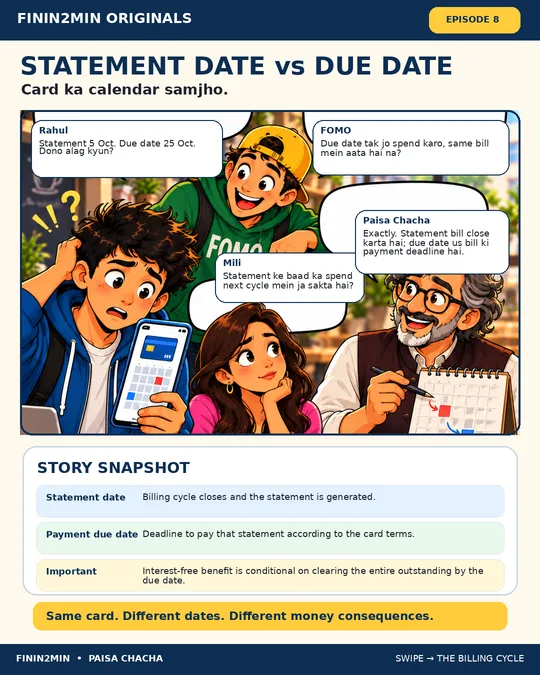
Why the statement date and the due date differ, and how the interest-free period works under RBI rules.
Expert articles by practice area
500 in-depth, expert-reviewed guides — authored by the Finin2min Editorial Desk and reviewed by subject-matter CAs and CSs.
Browse 31 primary categories
A controlled taxonomy replaces hundreds of one-off category labels and groups related articles into durable subject areas.
Professional Finance Insights
Authored by the Finin2min editorial team. Tax law updates, corporate governance, regulatory changes.
Featured Finance Guides
Long-form, research-backed guides from the Finin2min editorial desk — each paired with a working calculator.
Why the official national cpi can diverge sharply from the inflation experienced by a specific family.
Which components of the food basket create the greatest stress for different income groups.
Why rent changes faced by new tenants can differ from the housing inflation recorded in a broad cpi.
Why medical costs can rise differently from the general price index and how insurance cover should respond.
The total cost of raising and educating a child beyond the published school tuition fee.
How a crude-oil shock reaches household spending through several direct and indirect channels.
How companies hide effective price increases by reducing quantity, quality or included features.
Why many service prices remain elevated after food or commodity inflation cools.
How gold prices shape household perceptions of inflation and financial security.
Whether salary increases are improving purchasing power after inflation and tax.
Why rural and urban households experience different inflation even under the same national shock.
Why vegetable prices can spike rapidly and collapse before policy reacts.
Why milk, eggs, pulses and other protein foods matter for both budgets and nutrition.
How electricity tariff changes vary by state, consumption slab and subsidy.
Why insurance renewal premiums can rise faster than general consumer prices.
How multiple cost lines combine to produce menu-price inflation.
Why airline ticket prices move with capacity and demand as well as fuel.
The recurring repair and replacement costs homeowners often omit from affordability calculations.
How higher income can reset recurring spending and erase the financial benefit of a raise.
How to protect purchasing power without turning inflation fear into reckless investing.
Every Guide, Grouped by Topic
The archive above is chronological. To read by subject — income tax, GST, corporate law, banking and more — use the topic index, which covers every guide on the site.
Latest Finance Insights
The first 40 articles of the full Insights archive, in publication order.
Whether the traditional six-month emergency fund remains adequate when essential costs are rising quickly.
The purchasing-power return of a fixed deposit after tax and inflation.
Why inflation-indexed government securities have not become a simple mass retail product in india.
How a small change in long-term inflation creates a large retirement-corpus gap.
How a family can create a transparent cost-of-living index from its own transactions.
Why rapid gdp growth can coexist with too few secure, high-productivity jobs.
Why unemployment can look stable even when people stop looking for work.
The lost output and household resilience when women cannot enter or remain in paid work.
The true economics of gig work after idle time, expenses and income volatility.
What epfo payroll additions reveal—and what they do not reveal—about employment.
Why entry-level pay can remain weak even when the overall economy grows strongly.
Whether rural workers are gaining purchasing power or merely receiving higher nominal wages.
How manufacturing and service jobs differ in wage stability, skills and household security.
Which white-collar tasks are exposed to ai before entire occupations disappear.
Whether apprenticeships convert classroom learning into productive, better-paid employment.
Why the wage value of degrees changes with supply, technology and employer demand.
When a higher quoted ctc produces a weaker risk-adjusted household outcome.
How to compare uncertain employee stock options with guaranteed cash compensation.
How remote work savings are divided between employees, employers and cities.
How commuting time and expense can erase the financial value of a higher salary.
Why moving to a larger city can raise gross wages without improving disposable income or security.
The trade-off between flexible labour costs for firms and operational or household risk.
How households use second jobs, freelancing and small businesses to diversify labour income.
The years of income, experience and savings lost during prolonged exam preparation.
The difference between a statutory wage floor and the income needed for a basic decent life.
When variable incentives align effort with output and when they create gaming or unsafe behaviour.
How households should value severance, notice pay, insurance and the time required to regain income after a layoff.
The long-term salary and retirement effect of time outside paid work.
How workers without employer pensions must convert irregular earnings into retirement security.
A balanced monthly dashboard for jobs, participation, wages, payroll and demand.
Why state budgets determine public schools, hospitals, policing, transport, electricity support and local infrastructure more directly than the union budget.
When state borrowing creates productive assets and when interest costs reduce room for health, education and maintenance.
The fiscal and distributional economics of electricity supplied below cost.
How guarantees for state enterprises and agencies create contingent liabilities that can later become direct debt.
How public liabilities are shifted to special entities, suppliers or utilities outside the core budget.
Which states depend most on gst-linked consumption and how a spending slowdown affects their revenue.
How the constitutional tax-sharing system and grants move union tax revenue to states.
Why the finance commission formula changes the distribution of shared taxes across states.
Why borrowing to pay current bills is fiscally weaker than borrowing for assets.
How state infrastructure spending can raise local demand and future productive capacity.
Are You a Finance Professional?
Share your expertise with the Finin2min audience. Submit articles and build your professional byline.
Contribute to Finin2min →