An education loan can make a good course affordable, but a family's first question should not be only “How much will the bank lend?” It should also ask whether the college qualifies for a government-supported scheme, who will pay interest during study, what the repayment terms require and whether a particular subsidy is available.
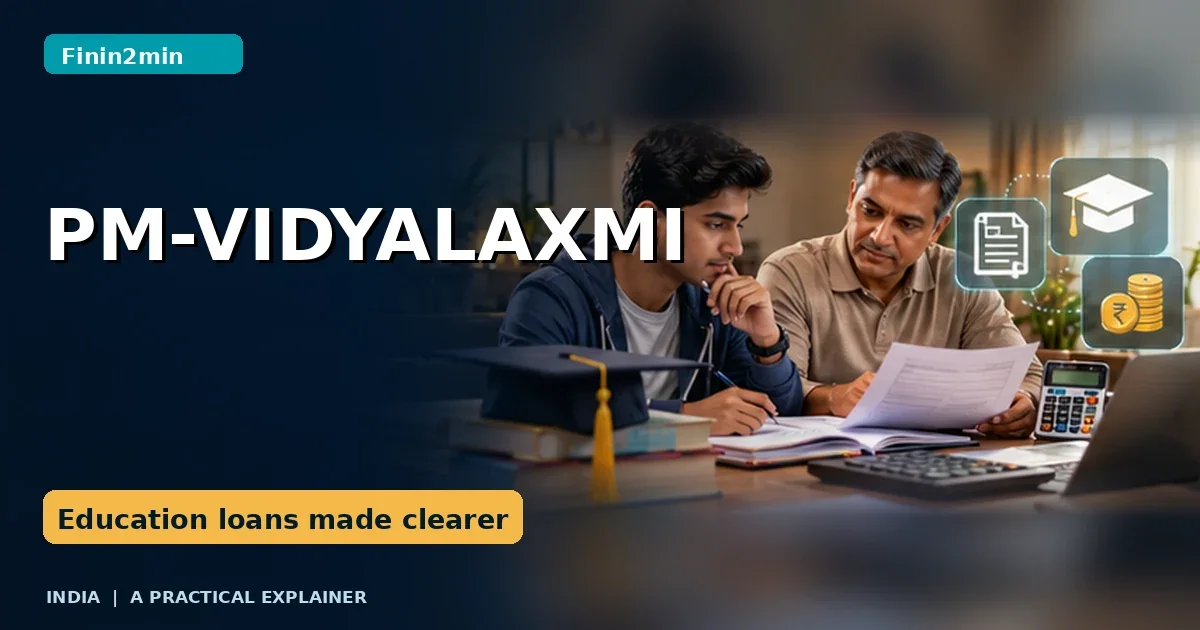
PM-Vidyalaxmi is a Central Sector scheme approved on 6 November 2024 to facilitate education loans for students admitted to qualifying higher educational institutions in India. Its digital portal makes applications and eligible interest-subvention processes easier to track, but the scheme is not a blanket free-college or loan-waiver programme.
Who can use PM-Vidyalaxmi?
The scheme's special education-loan product is linked to admission in identified Quality Higher Educational Institutions (QHEIs). Before paying application fees or accepting a loan advertisement, check whether the exact institute appears in the official eligible-institution list for the relevant year and course.
Admission, recognition, lender due diligence and the bank's credit assessment still matter. A student should confirm the applicable course and fee schedule, admission letter, previous educational records, required co-borrower details if relevant under bank processes and any restrictions shown in the current scheme instructions.
The official portal supports participating scheduled commercial banks, regional rural banks and cooperative banks as described in the scheme materials. It is a route for applying, not a promise that every applicant will be sanctioned the requested amount.
Three benefits that must not be confused
| Feature | Who or what it helps | What it does not mean |
|---|---|---|
| Collateral-free, guarantor-free loan product | Qualifying students at eligible institutions | Every lender must approve every amount without underwriting |
| Government credit guarantee on loans up to ₹7.5 lakh | Lenders: 75% guarantee coverage under scheme terms | The Government pays 75% of the student's loan |
| 3% interest subvention on eligible loan amounts up to ₹10 lakh | Students from families with annual income up to ₹8 lakh, subject to scheme conditions | The entire loan is interest-free or principal is waived |
The scheme also refers to full interest subvention under a separate existing framework for students with family income up to ₹4.5 lakh, subject to the distinct programme's eligibility. Confirm which scheme actually applies to the student's course, institution and loan rather than adding benefits together without checking restrictions.
How to apply through the official portal
- Confirm the institute. Search the current QHEI list on the official PM-Vidyalaxmi portal and match the institute name and identifiers carefully.
- Prepare documents. Gather admission proof, fee structure, identity and address documents, income evidence, academic information and bank-requested co-borrower records.
- Register on the official site. Use the URL shown in the source section, not an advertisement or unofficial agent link.
- Complete the education-loan application. Enter correct course costs, financing need and contact details. Keep a copy of the submitted application.
- Review bank offers and requests. Compare the actual interest rate, moratorium, disbursement, repayment terms and processing expenses in the bank's offer.
- Check interest-support eligibility separately. If eligible, select the appropriate interest-subvention option and follow the current claim or verification journey.
- Track the acknowledgement. Respond promptly to genuine bank queries through verified channels; never send OTPs, banking PINs or documents to an unknown caller.
Use the bank's actual sanction letter, repayment schedule and scheme terms for financial planning. A portal status of “applied” is not the same as an education loan disbursed to the institute.
The October 2026 claim-window point
The official portal currently displays a notice that the interest-subvention claim window for FY 2025–26 under the referenced PM-USP-CSIS and PM-Vidyalaxmi schemes runs 1 September 2026 to 31 December 2026. It directs students and applicants to coordinate with their financing branch and, where relevant, confirm that the appropriate subvention option was selected on the portal.
This dated notice is relevant to affected past-year loans, not a universal application deadline for every future course. A student should verify the live notice immediately before acting because claim windows and portal steps may be revised.
Example: planning the cost of a ₹9 lakh loan
Assume a student needs an education loan of ₹9 lakh and has a family income of ₹7 lakh a year. The broad 3% interest-subvention headline may look relevant, but the student must first establish the institute and course eligibility, bank sanction, scheme requirements and actual permitted loan amount. The subsidy relates to eligible interest under the scheme; it is not ₹27,000 cash every year regardless of principal outstanding or interest period.
For illustration only, 3% of ₹9 lakh equals ₹27,000 on a simple annual full-balance assumption. Real benefits depend on the programme's calculation rules, outstanding principal, relevant period, successful claim and other conditions. Use the bank's loan schedule for the actual amount.
Compare the full loan, not just the interest support
Ask whether the lender changes the rate during the course, when interest starts accumulating, whether unpaid interest is capitalised, how the repayment holiday works, and what happens if a student changes or discontinues a programme. Check expected earnings honestly; a prestigious course is not a guarantee of employment or salary.
Students should also ask about the overall cost: tuition, accommodation, devices, exam charges, travel, insurance if applicable and fees that are not included in the sanctioned loan.
Mistakes to avoid
- Assuming every college is a QHEI under the active scheme list.
- Treating a 75% government credit guarantee as a discount on the student's debt.
- Believing 3% subvention means no interest will ever accrue.
- Applying through a lookalike “loan agent” page and disclosing OTPs.
- Ignoring the separate income proof and scheme selection required for interest support.
- Counting a claimed subsidy as received before the bank/portal confirms it.
FAQs
Does PM-Vidyalaxmi guarantee my loan will be sanctioned?
No. The eligible scheme provides a defined support framework, but lenders still apply the governing processes.
Is an income of ₹8 lakh a cap for the entire loan programme?
Do not confuse the 3% interest-subvention income condition with all other aspects of the loan product. Read the separate eligibility rules.
Can I apply to an institution not in the listed QHEI set?
Other bank education-loan products may exist, but PM-Vidyalaxmi special-product eligibility needs the current official institution list.
Can my bank and I use different portal status screens?
Yes. Loan sanction, disbursement, interest-support selection and claim processing are distinct steps. Reconcile them through the official lender and portal.
Disclaimer: This educational guide does not promise loan sanction, subsidy or debt waiver. Eligibility, credit terms, income documentation and claim windows are governed by the official scheme and bank decision. Borrowing involves repayment and credit-history risk. Confirm terms and suitability with the financing bank before committing to tuition or fees.