Income Tax Planning
Advance Tax 2026–27: Dates, Capital Gains and 1% Interest
By Finin2min Editorial Desk · Reviewed by CA Nikhil Gupta · Published 16 October 2026 · about 5 minute read
📄 Download the PDF edition (free sign-in)
Finin2min 2-minute summary
Finin2min 2-minute answerAdvance tax is not an extra tax. It is the mechanism for paying an estimated annual liability in instalments when tax collected at source will not be sufficient. This matters for freelancers, rental income, interest and stock-market gains, as well as salaried people with significant untaxed income. The Income-tax Act, 2025 governs tax year 2026–27, and the usual instalment framework remains.
Do not confuse FY2025–26 filings with FY2026–27 earnings
Advance tax paid during tax year 2026–27 is governed by the Income-tax Act, 2025. An unpaid balance relating to FY2025–26 is not converted into a new-tax-year liability merely because it is paid after April 2026. The Income Tax Department has clarified that the new Act largely preserves the underlying advance-tax policy while reorganising the operative provisions. A payment challan should identify the correct tax year and tax type. Before paying, reconcile previously deducted salary TDS, interest TDS, capital-gain TDS and self-assessment balances to avoid double counting.
The four cumulative instalment milestones
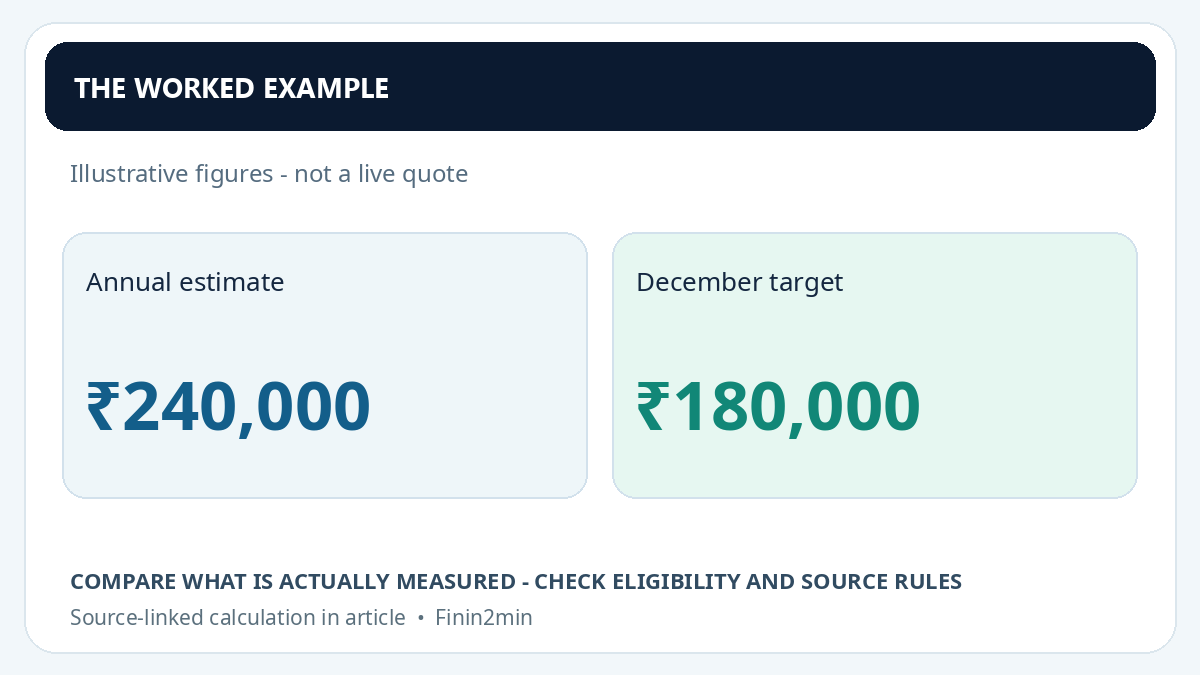
For the standard advance-tax framework, estimate the annual residual advance-tax liability and target 15% by 15 June, 45% by 15 September, 75% by 15 December and 100% by 15 March. These are cumulative payments, not independent 15%, 45%, 75% and 100% extra payments. An individual with a ₹2.40 lakh advance-tax estimate would ordinarily target cumulative payments of ₹36,000, ₹1,08,000, ₹1,80,000 and ₹2,40,000. The actual liability depends on all income, regime and allowable credits.
Freelancers and presumptive taxpayers need a separate check
A consultant receiving monthly bank credits should not assume that net taxable profit equals the invoice total. Identify actual business receipts, turnover classification, permissible expenses and eligibility for any presumptive scheme under the current Act. The Income Tax Department says eligible section 58 presumptive taxpayers can ordinarily pay their entire advance-tax liability by 15 March. That exception is not automatically available to everyone who is self-employed. Compare advance tax on declared profit, other taxable sources and the applicable tax regime; preserve customer invoices, TDS certificates and foreign remittance records.
Capital gains arising late in a year
A shareholder may unexpectedly realise a major gain after a June or September instalment date. The Act's deferment-interest provisions contain rules for certain incomes that could not be estimated earlier, subject to paying the relevant tax in the remaining permitted instalments. Do not pretend a December sale was known to you in June, but also do not ignore the remaining instalment after the gain arises. Document the sale date, contract note, type of gain and recalculated annual total tax. A mid-year salary bonus or revised freelance forecast should similarly trigger an updated estimate.
One-percent interest: identify which provision applies
The department's 2026 FAQ describes interest under sections 424 and 425 of the new Act, which correspond broadly to the earlier advance-tax failure and deferment provisions. Interest can run at 1% per month or part-month for specified shortfalls, with statutory calculation differences. It is unsafe to apply 1% to total salary or every unpaid instalment without working through assessed tax, prescribed cumulative amounts, period and permitted exceptions. A spreadsheet must show principal liability, instalment due date, amount paid, eligible credit and interest separately.
Practical payment workflow
Recalculate income and tax monthly when compensation or markets are volatile. Use the official e-pay tax service; choose the applicable Act and tax-year fields; complete the bank payment; save the challan identification number; and verify that the credit posts in the tax account. Before the next instalment, download AIS or relevant TDS evidence and check whether the payment is correctly attributed. For an overpayment, the eventual return and refund process follows the applicable statutory rules; paying extra is not an investment return.
Salary TDS does not automatically cover other income
A company payroll system calculates withholding from salary and employee declarations. It generally does not automatically know about interest at a different bank, sale of an inherited flat, or freelance receipts paid without TDS. A salary-only employee may therefore still need advance tax. Conversely, someone with large taxable income but adequate withholding may have no residual advance-tax payable. Compute projected annual tax first, subtract legally allowable TDS and other prepaid taxes, then decide the due instalment. A bank statement showing cash inflow is not the same as the taxable-profit computation.
Why forecasting each quarter is worth the effort
A 30-minute quarterly update can avoid a year-end scramble. Prepare a table with salary, bonus probability, freelance revenue, allowable costs, interest, rent, investments and realised gains. Beside each forecast, record confidence and source document. When an assumption changes, preserve the version and date so a later interest calculation can explain why a gain arose after an earlier instalment. A self-employed taxpayer should track receivables separately from cash because tax recognition may not equal collections. A clean quarterly trail also helps reconcile return data to TDS and AIS records.
Worked example: Illustration: ₹2,40,000 residual estimated tax
Assume estimated annual tax after all expected TDS is ₹2,40,000. The ordinary cumulative milestones are ₹36,000 on 15 June, ₹1,08,000 on 15 September, ₹1,80,000 on 15 December and ₹2,40,000 on 15 March. If ₹1,08,000 has already been paid before December, the incremental December amount is ₹72,000, not ₹1,80,000. Later events can require a forecast adjustment and an interest analysis.
Questions readers ask
Is advance tax a penalty?
No. It is timely payment of an estimated annual tax liability.
Is the December instalment 75% extra?
No. It is a cumulative 75% threshold.
Does the 2025 Act change all due dates?
The Department says no substantive change to the existing advance-tax policy.
Can late-year capital gains be treated differently?
There are statutory rules for certain difficult-to-estimate income; test conditions carefully.
Are presumptive taxpayers always exempt?
No. Eligible taxpayers have a different payment schedule, not a universal tax exemption.
More Finin2min guides- Share Capital Gains Tax 2026: STCG, LTCG, STT and ₹1.25 Lakh
- Bank FD Interest TDS 2026: ₹50,000/₹1 Lakh and Form 121
Direct official sources
- Income Tax Department advance tax FAQs, Act transition — Dates, advance tax transition and interest rules.
- Income-tax Act 2025 — Sections 405, 408, 424 and 425.
This educational guide explains general Indian rules as of the date of publication or last update shown above. Individual eligibility and tax treatment depend on the applicable law, contract, evidence and tax year. Verify primary documents before acting; nothing here is personalised legal, tax or investment advice.