Finin2min SummarySection 24Section 25Section 26Section 27Section 28Section 29Section 30Section 31Section 32Section 33Section 34Section 35Section 36Section 37Section 38Section 39Section 40Section 41Section 42Section 43Section 44Section 45Section 46Section 47Section 48Section 49Section 50Section 51Section 52Rules/formsOld lawCase lawState alertsQ&AProvision mapTransaction and cross-law controls
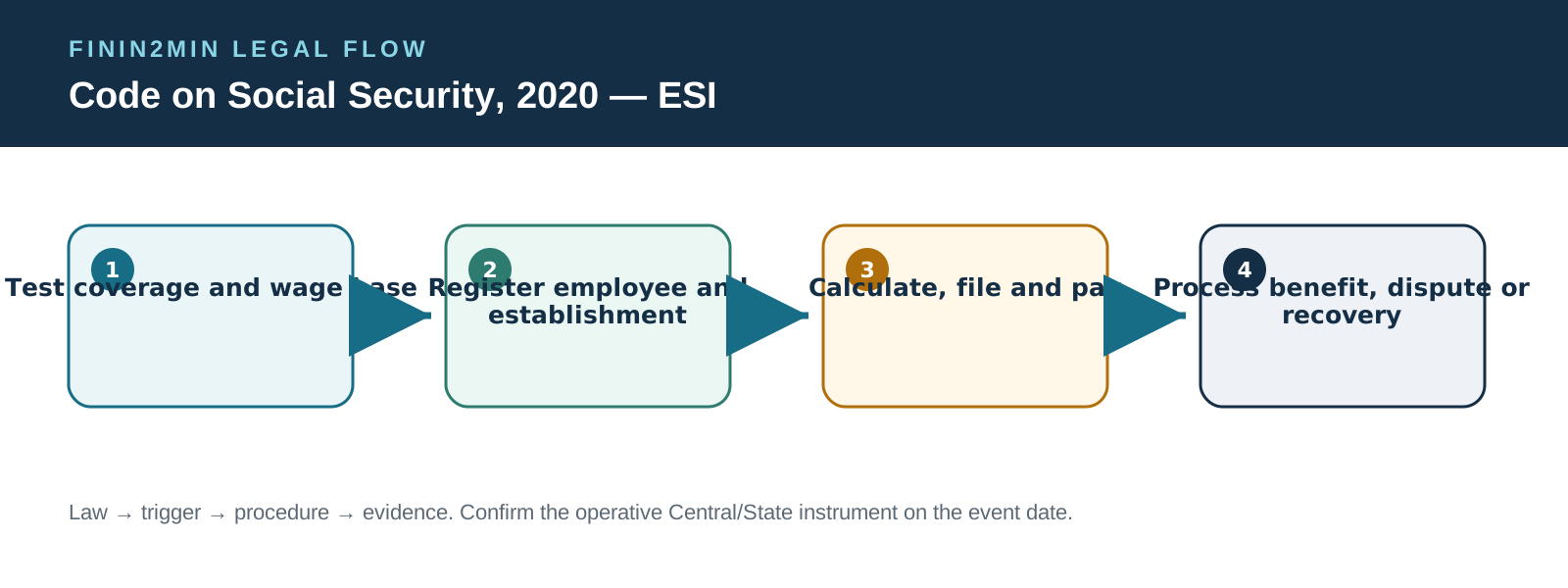
Chapter decision flow
Finin2min Summary - Chapter in 2 Minutes
This chapter turns esi into an operational control file. It covers Principal Officers and other staff, Employees’ State Insurance Fund, Purposes for which Employees’ State Insurance Fund may be expended, Holding of property, etc.; the practical sequence is to classify coverage and event date, apply the provision and mapped Rule, complete the form/register, calculate the entitlement or exposure, and retain evidence for inspection, claim or appeal.
Who is covered
Employers, employees, unorganised workers, gig/platform workers, beneficiaries and social-security authorities must identify the applicable chapter, establishment threshold and scheme.
Main obligations and rights
- Section 24: Principal Officers and other staff
- Section 25: Employees’ State Insurance Fund
- Section 26: Purposes for which Employees’ State Insurance Fund may be expended
- Section 27: Holding of property, etc.
- Section 28: All employees to be insured
- Section 29: Contributions
Key thresholds and timelines
- Use only the threshold, rate and limitation period effective on the event date; verify the Central/State instrument before acting.
Forms, registers and evidence
- Applicable form/register, calculation file, approval and acknowledgement evidence
- Retain classification, calculation, approval, communication, acknowledgement and payment/filing proof.
Employer risk snapshot
Highest practical risks: coverage, contribution, accident reporting, certification or benefit-period errors.
Employee/worker remedy snapshot
Core protection: medical and cash benefits, employment-injury protection and access to ESIC/Employees Insurance Court remedies. Confirm the authority, limitation and appeal route stated in this chapter.
Old law / transition
Map the event date and savings position against: Employees’ Compensation Act, 1923; Employees’ State Insurance Act, 1948; EPF and MP Act, 1952; Employment Exchanges Act, 1959; Maternity Benefit Act, 1961.
Five-point professional checklist
- Freeze the event date, establishment, location and person/worker classification.
- Identify the controlling section/paragraph, mapped Rule, notification and appropriate Government.
- Reperform the calculation or decision test and document every exception or approval.
- Complete the prescribed form/register/portal step and retain acknowledgement, payment and communication evidence.
- Record the remedy, forum, limitation, appeal path and State variation before sign-off.
Finin2min takeaway: for esi, the defensible answer is not a policy label - it is the event-date law, the mapped procedure, the calculation and a complete evidence trail.
Section-by-section provision map
| Provision | Subject | Implementation focus |
|---|---|---|
| Section 24 | Principal Officers and other staff | Trigger, linked Rule/form, evidence, consequence and remedy |
| Section 25 | Employees’ State Insurance Fund | Trigger, linked Rule/form, evidence, consequence and remedy |
| Section 26 | Purposes for which Employees’ State Insurance Fund may be expended | Trigger, linked Rule/form, evidence, consequence and remedy |
| Section 27 | Holding of property, etc. | Trigger, linked Rule/form, evidence, consequence and remedy |
| Section 28 | All employees to be insured | Trigger, linked Rule/form, evidence, consequence and remedy |
| Section 29 | Contributions | Trigger, linked Rule/form, evidence, consequence and remedy |
| Section 30 | Administrative expenses | Trigger, linked Rule/form, evidence, consequence and remedy |
| Section 31 | Provisions as to payment of contributions by employer, etc. | Trigger, linked Rule/form, evidence, consequence and remedy |
| Section 32 | Benefits | Trigger, linked Rule/form, evidence, consequence and remedy |
| Section 33 | Corporation’s power to promote measures for health, etc., of Insured Persons | Trigger, linked Rule/form, evidence, consequence and remedy |
| Section 34 | Presumption as to accident arising in course of employment | Trigger, linked Rule/form, evidence, consequence and remedy |
| Section 35 | Accidents happening while acting in breach of law, etc. | Trigger, linked Rule/form, evidence, consequence and remedy |
| Section 36 | Occupational disease | Trigger, linked Rule/form, evidence, consequence and remedy |
| Section 37 | References to medical board | Trigger, linked Rule/form, evidence, consequence and remedy |
| Section 38 | Dependants’ benefit | Trigger, linked Rule/form, evidence, consequence and remedy |
| Section 39 | Medical benefit | Trigger, linked Rule/form, evidence, consequence and remedy |
| Section 40 | Provision of medical treatment by State Government or by Corporation | Trigger, linked Rule/form, evidence, consequence and remedy |
| Section 41 | General provisions as to benefits | Trigger, linked Rule/form, evidence, consequence and remedy |
| Section 42 | Corporation’s rights when an employer fails to register, etc. | Trigger, linked Rule/form, evidence, consequence and remedy |
| Section 43 | Liability of owner or occupier of factories, etc., for excessive sickness benefit | Trigger, linked Rule/form, evidence, consequence and remedy |
| Section 44 | Scheme for other beneficiaries | Trigger, linked Rule/form, evidence, consequence and remedy |
| Section 45 | Scheme for unorganised workers, gig workers and platform workers | Trigger, linked Rule/form, evidence, consequence and remedy |
| Section 46 | Exemption of factories or other establishments belonging to Government or any local authority | Trigger, linked Rule/form, evidence, consequence and remedy |
| Section 47 | Contributions, etc., due to Corporation to have priority over other debts | Trigger, linked Rule/form, evidence, consequence and remedy |
| Section 48 | Constitution of Employees’ Insurance Court | Trigger, linked Rule/form, evidence, consequence and remedy |
| Section 49 | Matters to be decided by Employees’ Insurance Court | Trigger, linked Rule/form, evidence, consequence and remedy |
| Section 50 | Powers of Employees’ Insurance Court | Trigger, linked Rule/form, evidence, consequence and remedy |
| Section 51 | Proceedings of Employees’ Insurance Courts | Trigger, linked Rule/form, evidence, consequence and remedy |
| Section 52 | Appeal to High Court | Trigger, linked Rule/form, evidence, consequence and remedy |
Section 24: Principal Officers and other staff
Current statutory text
24. Principal Officers and other staff.—(1) The Central Government may appoint a Director General
of the Corporation and a Financial Commissioner, who shall be the Principal Officers of the Corporation.

    (2) The Director General and the Financial Commissioner shall hold office for such period, not
exceeding five years, as may be specified in the order of appointment:

    Provided that outgoing Director General or Financial Commissioner, as the case may be, shall be
eligible for re-appointment if he is otherwise qualified.

    (3) The Director General or the Financial Commissioner shall receive such salary and allowances as
may be prescribed by the Central Government.

    (4) The Director General and the Financial Commissioner shall exercise such powers and discharge
such duties as may be prescribed by the Central Government and shall perform such other functions as may
be specified in the regulations.

    (5) A person shall be disqualified from being appointed as or for being the Director General of the
Corporation or the Financial Commissioner if he is subject to any of the disqualifications specified in
section 8.

    (6) The Central Government may at any time remove the Director General of the Corporation or the
Financial Commissioner from office and shall do so if such removal is recommended by a resolution of the
Corporation passed at a special meeting called for the purpose and supported by the votes of not less than
two-third of the total strength of the Corporation.

    (7) The Corporation may employ such other officers and employees as may be necessary for the
efficient transaction of  its business and for discharge of any other responsibilities assigned to the
Corporation from time to time by the Central Government:

    Provided that the sanction of the Central Government shall be obtained for the creation of any post the
maximum monthly salary of which exceeds such salary as may be prescribed by the Central Government.


    (8) (a) The method of recruitment, salary and allowances, discipline and other conditions of service of
the officers and employees of the Corporation shall be such as may be specified in the regulations in
accordance with the rules and orders applicable to the officers and employees of the Central Government
drawing corresponding scales of pay:

    Provided that the terms and conditions of service including pay and allowances of such posts of medical
specialists and super specialists in the Corporation possessing comparable qualifications and expertise, as
may be notified by the Central Government, with the equivalent posts of the specialists and super specialists
in the All India Institute of Medical Sciences or in the Post Graduate Institutes of Medical Sciences and
Research or other similar institutions established by the Central Government, shall respectively be similar:

    Provided further that where the Corporation is of the opinion that it is necessary to make a departure
from the said rules or orders in respect of any of the matters aforesaid, it shall obtain the prior approval of
the Central Government:

    Provided also that this sub-section shall not apply to appointment of consultants and specialists in
various fields appointed on contract basis.

    (b) In determining the corresponding scales of pay of officers and employees under clause (a), the
Corporation shall have regard to the educational qualifications, method of recruitment, duties and
responsibilities of such officers and employees under the Central Government and in case of any doubt, the
Corporation shall refer the matter to the Central Government whose decision thereon shall be final.

    (9) Every appointment to posts (other than medical, nursing or para-medical posts) corresponding to
Group 'A' and Group 'B' Gazetted posts under the Central Government shall be made in consultation with
the Union Public Service Commission:

    Provided that the provisions of this sub-section shall not apply to an officiating or temporary
appointment for a period not exceeding one year:

    Provided further that any such officiating or temporary appointment shall not confer any claim for
regular appointment and the services rendered in that capacity shall not count towards seniority or minimum
qualifying service specified in the regulations for promotion to next higher grade.

    (10) If any question arises whether a post corresponds to a Group 'A' and Group 'B' posts under the
Central Government, the question shall be referred to that Government whose decision thereon shall be
final.
Finin2min clause-by-clause decode
- Legal test 1
- This section allocates legal responsibility for principal officers and other staff within the Employees’ State Insurance Corporation Chapter.
- Legal test 2
- Identify the statutory trigger, person obligated, authority, timing, exceptions and documentary output before applying the provision.
- Legal test 3
- Read every subsection, proviso, explanation and linked Schedule in the official text; the heading alone is not the legal test.
- Implementation control
- Trigger
- Document the facts that activate section 24: principal officers and other staff.
- Coverage and jurisdiction
Applicable Central Rules immediately below the provision
Central Rule 14: Rule 14 — Salary and allowances of Director General and Financial Commissioner
Rule mapping is retained; read the official 2026 Gazette for the exact sub-rule text and forms.
Practical example
A multi-location employer prepares a legal classification memo, identifies the appropriate Government, maps the operative provision and Rule, records the decision owner and retains the documents needed to prove compliance during inspection or litigation.
Controls and evidence
- Employer: assign owner, configure system and retain approval/payment proof.
- Employee/worker: retain contract, attendance, wage/benefit proof and communication.
- Professional: reconcile the Act, Rule, notification, form, limitation and State overlay.
Consequence, remedy and limitation
Identify the substantive default first, then separately map arrears or benefit, interest/damages, administrative penalty, prosecution, compounding, company/officer liability, forum, appeal and limitation. Do not infer a remedy from the heading alone.
Mapped Rules: Rule 14 | Official source: section 24.
Section 25: Employees’ State Insurance Fund
Current statutory text
25. Employees’ State Insurance Fund.—(1) All contributions and user charges paid under this
Chapter and all other moneys received on behalf of the Corporation shall be paid into a fund (hereinafter
referred to as the Employees' State Insurance Fund) which shall be held and administered by the
Corporation for the purposes of this Code:

    Provided that the user charges collected from the other beneficiaries referred to in section 44 shall be
deemed to be contribution and shall form part of Employees' State Insurance Corporation.

    (2) The Corporation may accept grants, donations, Corporate Social Responsibility Fund and gifts from
the Central or any State Government, local authority, or any individual or body whether incorporated or
not, for all or any of the purposes of this Chapter.

    (3) Subject to the other provisions contained in this Code and to any rules or regulations made in this
behalf, all moneys accruing or payable to the said Fund shall be deposited in such bank or banks as may be
approved by the Central Government to the credit of an account styled the account of the Employees' State
Insurance Fund.

    (4) The Employees State Insurance Fund or any other money which is held by the Corporation shall be
deposited or invested in the manner prescribed by the Central Government and the account referred to in
sub-section (3) shall be operated by such officers as may be authorised by the Committee constituted under
sub-section (3) of section 5 (hereinafter referred to as the Standing Committee) with the approval of the
Corporation.
Finin2min clause-by-clause decode
- Legal test 1
- This section allocates legal responsibility for employees’ state insurance fund within the Employees’ State Insurance Corporation Chapter.
- Legal test 2
- Identify the statutory trigger, person obligated, authority, timing, exceptions and documentary output before applying the provision.
- Legal test 3
- Read every subsection, proviso, explanation and linked Schedule in the official text; the heading alone is not the legal test.
- Implementation control
- Trigger
- Document the facts that activate section 25: employees’ state insurance fund.
- Coverage and jurisdiction
Applicable Central Rules immediately below the provision
Controls and evidence
- Employer: assign owner, configure system and retain approval/payment proof.
- Employee/worker: retain contract, attendance, wage/benefit proof and communication.
- Professional: reconcile the Act, Rule, notification, form, limitation and State overlay.
Mapped Rules: Rule 15 | Official source: section 25.
Section 26: Purposes for which Employees’ State Insurance Fund may be expended
Current statutory text
26. Purposes for which Employees’ State Insurance Fund may be expended.— Subject to the
provisions of this Chapter and the rules and regulations relating thereto, made under this Code, the
Employees' State Insurance Fund shall be expended only for the following purposes, namely:—

        (a) payment of benefits and provision of medical treatment and attendance to Insured Persons
    referred to in section 28 and, where the medical benefit is extended to their families, the provision of
    such medical benefit to their families, in accordance with the provisions of this Chapter and the rules
   and regulations relating thereto and defraying the charges and costs in connection therewith;

        (b) payment of fees and allowances to members of the Corporation, the Standing Committee, the
   Medical Benefit Committee or other Committees thereof;

         (c) payment of  salaries, leave and  joining time allowances,  travelling and compensatory
    allowances, gratuities and compassionate allowances, pensions, contributions to provident or other
    benefit fund of officers and staff of the Corporation and meeting the expenditure in respect of offices
   and other services set up for the purpose of giving effect to the provisions of this Code relating to this
    Chapter;

        (d) establishment and maintenance of hospitals, dispensaries and other  institutions and the
    provision of medical and other ancillary services for the benefit of Insured Persons referred to in section
   28 and, where the medical benefit is extended to their families;

         (e) payment of contributions to any State Government, local authority or any private body or
    individual, towards the cost of medical treatment and attendance provided to Insured Persons referred
    to in section 28 and, where the medical benefit is extended to their families, their families, including
    the cost of any building and equipment, in accordance with any agreement entered into by the
    Corporation;

          (f) defraying the cost (including all expenses) of auditing the accounts of the Corporation and of
    the valuation of its assets and liabilities;

        (g) defraying the cost (including all expenses) of the Employees' Insurance Courts set up under this
    Chapter;

        (h) payment of any sums under any contract entered into for the purposes of this Code by
    Corporation or the Standing Committee or by any officer duly authorised by the Corporation or the
    Standing Committee in that behalf;

          (i) payment of sums under any decree, order or award of any Court or Tribunal against the
    Corporation or any of its officers or staff for any act done in the execution of his duty or under a
   compromise or settlement of any suit or other legal proceeding or claim instituted or made against the
    Corporation;

          (j) defraying the cost and other charges of instituting or defending any civil or criminal proceedings
    arising out of any action taken under this Code relating to this Chapter;

         (k) defraying expenditure, within the limits prescribed by the Central Government after consultation
    with the Corporation, on measures for the improvement of the health and welfare of Insured Persons
   and for the rehabilitation and re-employment of Insured Persons referred to in section 28 who have
   been disabled or injured; and

          (l) such other purposes as may be authorised by the Corporation with the previous approval of the
    Central Government.
Finin2min clause-by-clause decode
- Legal test 1
- This section allocates legal responsibility for purposes for which employees’ state insurance fund may be expended within the Employees’ State Insurance Corporation Chapter.
- Legal test 2
- Identify the statutory trigger, person obligated, authority, timing, exceptions and documentary output before applying the provision.
- Legal test 3
- Read every subsection, proviso, explanation and linked Schedule in the official text; the heading alone is not the legal test.
- Implementation control
- Trigger
- Document the facts that activate section 26: purposes for which employees’ state insurance fund may be expended.
- Coverage and jurisdiction
Applicable Central Rules immediately below the provision
Controls and evidence
- Employer: assign owner, configure system and retain approval/payment proof.
- Employee/worker: retain contract, attendance, wage/benefit proof and communication.
- Professional: reconcile the Act, Rule, notification, form, limitation and State overlay.
Mapped Rules: Rule 16 | Official source: section 26.
Section 27: Holding of property, etc.
Current statutory text
27. Holding of property, etc. .— (1) The Corporation may, subject to such conditions as may be
prescribed by the Central Government, acquire and hold property, both movable and immovable, sell or
otherwise transfer any movable or immovable property which may have become vested in or have been
acquired by it and do all things necessary for the purposes for which the Corporation is established.

    (2) Subject to such conditions as may be prescribed by the Central Government, the Corporation may
from time to time invest any moneys which are not immediately required for expenses properly defrayable
under this Code and may, subject to as aforesaid, from time to time re-invest or realise such investments.


    (3) The Corporation may, with the previous sanction of the Central Government and on such terms as
may be prescribed by it, raise loans and take measures for discharging such loans.

    (4) The Corporation may constitute for the benefit of its officers and staff or any class of them, such
provident or other benefit fund as it may think fit.
Finin2min clause-by-clause decode
- Legal test 1
- This section allocates legal responsibility for holding of property, etc. within the Employees’ State Insurance Corporation Chapter.
- Legal test 2
- Identify the statutory trigger, person obligated, authority, timing, exceptions and documentary output before applying the provision.
- Legal test 3
- Read every subsection, proviso, explanation and linked Schedule in the official text; the heading alone is not the legal test.
- Implementation control
- Trigger
- Document the facts that activate section 27: holding of property, etc..
- Coverage and jurisdiction
Applicable Central Rules immediately below the provision
Controls and evidence
- Employer: assign owner, configure system and retain approval/payment proof.
- Employee/worker: retain contract, attendance, wage/benefit proof and communication.
- Professional: reconcile the Act, Rule, notification, form, limitation and State overlay.
Mapped Rules: Rule 15, Rule 17 | Official source: section 27.
Section 28: All employees to be insured
Current statutory text
28. All employees to be insured.—(1) Subject to the provisions of this Code, every employee in an
establishment to which this Chapter applies shall be insured in such manner whether electronically or
otherwise, as may be prescribed by the Central Government.

    (2) An employee whether insured or insurable under sub-section (1) in respect of whom contributions
are or were payable and who is by reason thereof, entitled to any of the benefits provided under this Chapter,
shall be called “Insured Person”.
Finin2min clause-by-clause decode
- Legal test 1
- Insurance coverage is employee- and establishment-specific; voluntary or notified extension and exclusions must be checked.
- Implementation control
- Trigger
- Document the facts that activate section 28: all employees to be insured.
- Coverage and jurisdiction
- Identify establishment, employee/worker category, appropriate Government, First Schedule threshold and territorial authority.
- Decision owner
- Assign a named owner for ESI insurance, contributions, benefits and adjudication; identify HR, payroll, finance, legal, contractor and authorised-signatory roles.
- Evidence pack
Applicable Central Rules immediately below the provision
Controls and evidence
- Employer: assign owner, configure system and retain approval/payment proof.
- Employee/worker: retain contract, attendance, wage/benefit proof and communication.
- Professional: reconcile the Act, Rule, notification, form, limitation and State overlay.
Mapped Rules: Rule 18 | Official source: section 28.
Section 29: Contributions
Current statutory text
29. Contributions.—(1) The contribution payable under this Chapter in respect of an employee shall
comprise contribution payable by the employer (hereinafter referred to as the employer's contribution) and
contribution payable by the employee (hereinafter referred to as the employee's contribution) and shall be
paid to the Corporation.

    (2) The contributions (employer's contribution and the employee’s contribution both) shall be paid at
such rates as may be prescribed by the Central Government.

    (3) The wage period in relation to an employee shall be the unit as specified in the regulations
(hereinafter referred to as the wage period) in respect of which all contributions shall be payable under this
Chapter.

    (4) The contributions payable in respect of each wage period shall ordinarily fall due on the last day of
the wage period, and where an employee is employed for part of the wage period, or is employed under two
or more employers during the same wage period, the contributions shall fall due on such days as may be
specified in the regulations.
Finin2min clause-by-clause decode
- Legal test 1
- Contribution computation requires the operative wage definition, rate, contribution period and ESIC regulations.
- Implementation control
- Trigger
- Document the facts that activate section 29: contributions.
- Coverage and jurisdiction
- Identify establishment, employee/worker category, appropriate Government, First Schedule threshold and territorial authority.
- Decision owner
- Assign a named owner for ESI insurance, contributions, benefits and adjudication; identify HR, payroll, finance, legal, contractor and authorised-signatory roles.
- Evidence pack
Applicable Central Rules immediately below the provision
Controls and evidence
- Employer: assign owner, configure system and retain approval/payment proof.
- Employee/worker: retain contract, attendance, wage/benefit proof and communication.
- Professional: reconcile the Act, Rule, notification, form, limitation and State overlay.
Mapped Rules: Rule 19 | Official source: section 29.
Section 30: Administrative expenses
Current statutory text
30.  Administrative expenses.—The types of expenses which may be termed as administrative
expenses and the percentage of the income of the Corporation which may be spent for such expenses shall
be such as may be prescribed by the Central Government and the Corporation shall keep its administrative
expenses within the limit so prescribed by the Central Government.
Finin2min clause-by-clause decode
- Legal test 1
- This section allocates legal responsibility for administrative expenses within the Employees’ State Insurance Corporation Chapter.
- Legal test 2
- Identify the statutory trigger, person obligated, authority, timing, exceptions and documentary output before applying the provision.
- Legal test 3
- Read every subsection, proviso, explanation and linked Schedule in the official text; the heading alone is not the legal test.
- Implementation control
- Trigger
- Document the facts that activate section 30: administrative expenses.
- Coverage and jurisdiction
Applicable Central Rules immediately below the provision
Controls and evidence
- Employer: assign owner, configure system and retain approval/payment proof.
- Employee/worker: retain contract, attendance, wage/benefit proof and communication.
- Professional: reconcile the Act, Rule, notification, form, limitation and State overlay.
Mapped Rules: Rule 16, Rule 20 | Official source: section 30.
Section 31: Provisions as to payment of contributions by employer, etc.
Current statutory text
31. Provisions as to payment of contributions by employer etc.— (1) The employer shall pay in
respect of every employee, whether directly employed by him or by or through a contractor, both the
employer's contribution and the employee's contribution.

    (2) Notwithstanding anything contained in any other law for the time being in force, but subject to the
provisions of this Code and the rules and regulations, if any, made thereunder in this behalf, the employer
shall, in the case of an employee directly employed by him (not being an exempted employee), be entitled
to recover from the employee the employee's contribution by reduction from his wages and not otherwise:

    Provided that no such deduction shall be made from any wages other than such as relates to the period
or part of the period in respect of which the contribution is payable or in excess of the sum representing the
employee's contribution for the period.

    (3) Notwithstanding any contract to the contrary, neither the employer nor the contractor shall be
entitled to deduct the employer's contribution from any wages payable to an employee or otherwise to
recover it from him.

    (4) Any sum deducted by the employer from wages under this Chapter shall be deemed to have been
entrusted to him by the employee for the purpose of paying the contribution in respect of which it was
deducted.

    (5) The employer shall bear the expenses of remitting the contributions to the Corporation.

    (6) An employer, who has paid contribution in respect of an employee employed by or through a
contractor, shall be entitled to recover the amount of the contribution so paid (that is to say the employer's
contribution as well as the employee's contribution, if any,) from the contractor, either by deduction from
any amount payable to him by the employer under any contract, or as a debt payable by the contractor.

    (7) The contractor shall maintain a register of employees employed by or through him as provided in
the regulations and submit the same to the employer before the settlement of any amount payable under
sub-section (6).

    (8) In the case referred to in sub-section (6), the contractor shall be entitled to recover the employee's
contribution from the employee employed by or through him by deduction from wages and not otherwise,
subject to such conditions as specified in the proviso to sub-section (2).

    (9) Subject to the provisions of this Code, the Corporation may make regulations for any matter relating
or incidental to the payment and collection of contributions payable under this Chapter.
Finin2min clause-by-clause decode
- Legal test 1
- Employer remains the primary remittance control owner even where the employee share is recoverable from wages.
- Implementation control
- Trigger
- Document the facts that activate section 31: provisions as to payment of contributions by employer, etc..
- Coverage and jurisdiction
- Identify establishment, employee/worker category, appropriate Government, First Schedule threshold and territorial authority.
- Decision owner
- Assign a named owner for ESI insurance, contributions, benefits and adjudication; identify HR, payroll, finance, legal, contractor and authorised-signatory roles.
- Evidence pack
Applicable Central Rules immediately below the provision
No direct Central Rule is mapped. Check general procedural Rules, State Rules and later notifications.
Controls and evidence
- Employer: assign owner, configure system and retain approval/payment proof.
- Employee/worker: retain contract, attendance, wage/benefit proof and communication.
- Professional: reconcile the Act, Rule, notification, form, limitation and State overlay.
Mapped Rules: No direct Central Rule mapped in the repository concordance | Official source: section 31.
Section 32: Benefits
Current statutory text
32. Benefits.— (1) Subject to the provisions of this Code, the Insured Persons, their dependants or the
persons hereinafter mentioned, as the case may be, shall be entitled to the following benefits, namely:—

        (a) periodical payments to any Insured Person in case of his sickness certified by a duly appointed
    medical practitioner or by any other person possessing such qualifications and experience as the
    Corporation may, by the regulations, specify in this behalf (hereinafter referred to as sickness benefit);

        (b) periodical payments to an Insured Person being a woman in case of confinement or miscarriage
    or sickness arising out of pregnancy, confinement, premature birth of child or miscarriage, such woman
    being certified to be eligible for such payments by an authority specified in this behalf by the regulations
    (hereinafter referred to as maternity benefit);

         (c) periodical payments to an Insured Person suffering from disablement as a result of an
   employment injury sustained by him as an employee for the purposes of this Chapter and certified to
   be eligible for such payments by an authority specified in this behalf by the regulations (hereinafter
    referred to as disablement benefit);

        (d) periodical payments to such dependants of an Insured Person who dies as a result of an
   employment injury sustained by him as an employee for the purposes of this Chapter, as are entitled
    under this Chapter (hereinafter referred to as dependents’ benefit);

         (e) medical treatment for and attendance on Insured Persons (hereinafter referred to as medical
    benefit); and

          (f) payment to the eldest surviving member of the family of an Insured Person who has died,
    towards the expenditure on the funeral of the deceased Insured Person, or, where the Insured Person
    did not have a family or was not living with his family at the time of his death, to the person who
    actually incurs the expenditure on the funeral of the deceased Insured Person (to be known as funeral
    expenses):

    Provided that the amount of payment under this clause shall not exceed such amount as may be
prescribed by the Central Government and the claim for such payment shall be made within three months
of the death of the Insured Person or within such extended period as the Corporation or any officer or
authority authorised by it in this behalf may allow.

    (2) The Corporation may, subject to such conditions as may be laid down in the regulations, extend the
medical benefits to the family of an Insured Person.

    (3) The qualification of a person to claim sickness benefit, maternity benefit, disablement benefit and
dependants' benefit and the conditions subject to which such benefit may be given and the rate and period
thereof, shall be such as may be prescribed by the Central Government.

    (4) Subject to the provisions of this Code and the rules made thereunder relating to this Chapter, the
Corporation may make regulations for any matter relating or incidental to the accrual and payment of
benefits payable under this Chapter.
Finin2min clause-by-clause decode
- Legal test 1
- Each benefit has its own qualifying contribution/insurance conditions and evidence pathway; benefit names are not interchangeable.
- Implementation control
- Trigger
- Document the facts that activate section 32: benefits.
- Coverage and jurisdiction
- Identify establishment, employee/worker category, appropriate Government, First Schedule threshold and territorial authority.
- Decision owner
- Assign a named owner for ESI insurance, contributions, benefits and adjudication; identify HR, payroll, finance, legal, contractor and authorised-signatory roles.
- Evidence pack
Applicable Central Rules immediately below the provision
Controls and evidence
- Employer: assign owner, configure system and retain approval/payment proof.
- Employee/worker: retain contract, attendance, wage/benefit proof and communication.
- Professional: reconcile the Act, Rule, notification, form, limitation and State overlay.
Mapped Rules: Rule 21, Rule 22 | Official source: section 32.
Section 33: Corporation’s power to promote measures for health, etc., of Insured Persons
Current statutory text
33. Corporation’s power to promote measures for health,  etc., of Insured Persons.—The
Corporation may, in addition to the benefits specified in  this Chapter, promote measures for the
improvement of the health and welfare of Insured Persons and for the rehabilitation and re-employment of
Insured Persons who have been disabled or injured and may incur in respect of such measures, expenditure


from the Employees' State Insurance Fund within such limits as may be prescribed by the Central
Government.
Finin2min clause-by-clause decode
- Legal test 1
- This section allocates legal responsibility for corporation’s power to promote measures for health, etc., of insured persons within the Employees’ State Insurance Corporation Chapter.
- Legal test 2
- Identify the statutory trigger, person obligated, authority, timing, exceptions and documentary output before applying the provision.
- Legal test 3
- Read every subsection, proviso, explanation and linked Schedule in the official text; the heading alone is not the legal test.
- Implementation control
- Trigger
- Document the facts that activate section 33: corporation’s power to promote measures for health, etc., of insured persons.
- Coverage and jurisdiction
Practical example
Following a workplace event, the incident controller first protects life and the site, then completes statutory reporting, evidence preservation, medical documentation, contractor allocation and root-cause action without waiting for a compensation dispute.
Controls and evidence
- Employer: assign owner, configure system and retain approval/payment proof.
- Employee/worker: retain contract, attendance, wage/benefit proof and communication.
- Professional: reconcile the Act, Rule, notification, form, limitation and State overlay.
Mapped Rules: No direct Central Rule mapped in the repository concordance | Official source: section 33.
Section 34: Presumption as to accident arising in course of employment
Current statutory text
34. Presumption as to accident arising in course of employment.—(1) For the purposes of this
Chapter, an accident arising in the course of an employee's employment shall be presumed, in the absence
of evidence to the contrary, to have arisen out of that employment.

    (2) An accident happening to an employee in or about any premises at which he is for the time being
employed for the purpose of his employer's trade or business shall be deemed to arise out of and in the
course of his employment, if it happens while he is taking steps, on an actual or supposed emergency at
those premises, to rescue, succour or protect persons who are, or are thought to be or possibly to be, injured
or imperilled, or to avert or minimise serious damage to property.

    (3) An accident occurring to an employee while commuting from his residence to the place of
employment for duty or from the place of employment to his residence after performing duty, shall be
deemed to have arisen out of and in the course of employment if nexus between the circumstances, time
and place in which the accident occurred and the employment is established.

    (4) An accident happening while an employee is, with the express or implied permission of his
employer, travelling as a passenger by any vehicle to or from his place of work shall, notwithstanding that
he is under no obligation to his employer to travel by that vehicle, be deemed to arise out of and in the
course of his employment, if—

      (a) the accident would have been deemed so to have arisen had he been under such obligation; and

      (b) at the time of the accident, the vehicle—

               (i) is being operated by or on behalf of his employer or some other person by whom it is
       provided in pursuance of arrangements made with his employer; and

                (ii) is not being operated in the ordinary course of public transport service.

    Explanation.—In this section, “vehicle” includes a vessel and an aircraft.
Finin2min clause-by-clause decode
- Legal test 1
- The presumption assists employment nexus but must be evaluated against time, place, course of employment and contrary evidence.
- Implementation control
- Trigger
- Document the facts that activate section 34: presumption as to accident arising in course of employment.
- Coverage and jurisdiction
- Identify establishment, employee/worker category, appropriate Government, First Schedule threshold and territorial authority.
- Decision owner
- Assign a named owner for ESI insurance, contributions, benefits and adjudication; identify HR, payroll, finance, legal, contractor and authorised-signatory roles.
- Evidence pack
Controls and evidence
- Employer: assign owner, configure system and retain approval/payment proof.
- Employee/worker: retain contract, attendance, wage/benefit proof and communication.
- Professional: reconcile the Act, Rule, notification, form, limitation and State overlay.
Mapped Rules: No direct Central Rule mapped in the repository concordance | Official source: section 34.
Section 35: Accidents happening while acting in breach of law, etc.
Current statutory text
35. Accidents happening while acting in breach of law etc.— An accident shall be deemed to arise
out of and in the course of an employee's employment notwithstanding that he is at the time of the accident
acting in contravention of the provisions of any law applicable to him, or of any orders given by or on
behalf of his employer or that he is acting without instructions from his employer, if—

        (a) the accident would have been deemed so to have arisen had the act not been done in
    contravention as aforesaid or without instructions from his employer, as the case may be; and

        (b) the act is done for the purpose of and in connection with the employer's trade or business.
Finin2min clause-by-clause decode
- Legal test 1
- This section allocates legal responsibility for accidents happening while acting in breach of law, etc. within the Employees’ State Insurance Corporation Chapter.
- Legal test 2
- Identify the statutory trigger, person obligated, authority, timing, exceptions and documentary output before applying the provision.
- Legal test 3
- Read every subsection, proviso, explanation and linked Schedule in the official text; the heading alone is not the legal test.
- Implementation control
- Trigger
- Document the facts that activate section 35: accidents happening while acting in breach of law, etc..
- Coverage and jurisdiction
Controls and evidence
- Employer: assign owner, configure system and retain approval/payment proof.
- Employee/worker: retain contract, attendance, wage/benefit proof and communication.
- Professional: reconcile the Act, Rule, notification, form, limitation and State overlay.
Mapped Rules: No direct Central Rule mapped in the repository concordance | Official source: section 35.
Section 36: Occupational disease
Current statutory text
36. Occupational disease.—(1) If an employee employed in any employment specified in Part A of
the Third Schedule contracts any disease specified therein as an occupational disease peculiar to that
employment, or if an employee employed in the employment specified in Part B of that Schedule for a
continuous period of not less than six months contracts any disease specified therein as an occupational
disease peculiar to that employment or if an employee employed in any employment specified in Part C of
that Schedule for such continuous period as the Corporation may specify by regulations in respect of each
such employment, contracts any disease specified in such Part C as an occupational disease peculiar to that
employment, the contracting of the disease shall, unless the contrary is proved, be deemed to be an
“employment injury “, arising out of and in the course of employment.

    (2) Save as provided by sub-section (1), no benefit shall be payable to an employee in respect of any
disease unless the disease is directly attributable to a specific injury by accident arising out of and in the
course of his employment.

    (3) The provisions of sub-section (1) of section 34 shall not apply to the cases to which this section
applies.
Finin2min clause-by-clause decode
- Legal test 1
- Match the disease, scheduled employment and exposure history to the Third Schedule and applicable medical evidence.
- Implementation control
- Trigger
- Document the facts that activate section 36: occupational disease.
- Coverage and jurisdiction
- Identify establishment, employee/worker category, appropriate Government, First Schedule threshold and territorial authority.
- Decision owner
- Assign a named owner for ESI insurance, contributions, benefits and adjudication; identify HR, payroll, finance, legal, contractor and authorised-signatory roles.
- Evidence pack
Controls and evidence
- Employer: assign owner, configure system and retain approval/payment proof.
- Employee/worker: retain contract, attendance, wage/benefit proof and communication.
- Professional: reconcile the Act, Rule, notification, form, limitation and State overlay.
Mapped Rules: No direct Central Rule mapped in the repository concordance | Official source: section 36.
Section 37: References to medical board
Current statutory text
37. References to medical board.— (1) Any question—

      (a) whether the relevant accident has resulted in permanent disablement; or

      (b) whether the extent of loss of earning capacity can be assessed provisionally or finally; or

       (c) whether the assessment of the proportion of the loss of earning capacity is provisional or final; or

      (d) in the case of provisional assessment, as to the period for which such assessment shall hold good,

shall be determined by a medical board constituted in accordance with the provisions of the regulations
(hereinafter referred to as medical board) and any such question shall hereafter be referred to as the
“disablement question”.

    (2) The case of any Insured Person for permanent disablement benefit shall be referred by the
Corporation to a medical board for determination of the disablement in question and if, on that or any
subsequent reference, the extent of loss of earning capacity of the Insured Person is provisionally assessed,
it shall again be so referred to the medical board not later than the end of the period taken into account by
the provisional assessment.

    (3) Any decision under this Chapter of a medical board may be reviewed at any time by the medical
board if it is satisfied by fresh evidence that the decision was given in consequence of the non-disclosure
or misrepresentation by the employee or any other person of a material fact whether the non-disclosure or
misrepresentation was or was not fraudulent.

    (4) Any assessment of the extent of the disablement resulting from the relevant employment injury may
also be reviewed by a medical board if it is satisfied that since the making of the assessment there has been
a substantial and unforeseen aggravation of the results of the relevant injury:

    Provided that an assessment shall not be reviewed under this sub-section unless the medical board is of
the opinion, having regard to the period taken into account by the assessment and the probable duration of
the aggravation aforesaid, that substantial injustice will be done by not reviewing it.

    (5) Except with the leave of a medical appeal tribunal constituted by regulations, an assessment shall
not be reviewed under sub-section (4) on any application made less than five years, or in the case of a
provisional assessment, six months, from the date thereof and on such a review the period to be taken into
account by any revised assessment shall not include any period before the date of the application.

    (6) Subject to the foregoing provisions of this section, a medical board may deal with a case of review
in any manner in which it could deal with it on an original reference to it, and in particular may make a
provisional assessment notwithstanding that the assessment under review was final and the provisions of
sub-section (2) shall apply to an application for review under this sub-section and to a decision of a medical
board in connection with such application as they apply to a case for disablement benefit under that sub-
section and to a decision of the medical board in connection with such case.

    (7) (a) If the Insured Person or the Corporation is aggrieved by any decision of the medical board, the
Insured Person or the Corporation, as the case may be, may appeal in such manner and within such time as
may be prescribed by the Central Government to—

        (i) the medical appeal tribunal constituted in accordance with the provisions of the regulations; or

        (ii) the Employees' Insurance Court directly:

    Provided that no appeal by an Insured Person shall lie under this sub-section if such person has applied
for commutation of disablement benefit on the basis of the decision of the medical board and received the
commuted value of such benefits:

    Provided further that no appeal by the Corporation shall lie under this sub-section if the Corporation
paid the commuted value of the disablement benefit on the basis of the decision of the medical board.

    (b) Where the Insured Person or the Corporation preferred appeal to the medical appeal tribunal under
sub-clause (i) of clause (a) instead of to the Employees' Insurance Court under sub-clause (ii) of that clause,
then, he or it, as the case may be, shall have the further right to file second appeal to the Employees'
Insurance Court in such manner and within such time as may be prescribed by the appropriate Government.
Finin2min clause-by-clause decode
- Legal test 1
- This section allocates legal responsibility for references to medical board within the Employees’ State Insurance Corporation Chapter.
- Legal test 2
- Identify the statutory trigger, person obligated, authority, timing, exceptions and documentary output before applying the provision.
- Legal test 3
- Read every subsection, proviso, explanation and linked Schedule in the official text; the heading alone is not the legal test.
- Implementation control
- Trigger
- Document the facts that activate section 37: references to medical board.
- Coverage and jurisdiction
Applicable Central Rules immediately below the provision
Controls and evidence
- Employer: assign owner, configure system and retain approval/payment proof.
- Employee/worker: retain contract, attendance, wage/benefit proof and communication.
- Professional: reconcile the Act, Rule, notification, form, limitation and State overlay.
Mapped Rules: Rule 23, Rule 24 | Official source: section 37.
Section 38: Dependants’ benefit
Current statutory text
38. Dependants’ benefit.—(1) If an Insured Person dies as a result of an employment injury sustained
as an employee under this Chapter (whether or not he was in receipt of any periodical payment for


temporary disablement in respect of the injury), dependants' benefit shall be payable to his dependants
specified in sub-clause (a) and sub-clause (b) of clause (24) of section 2 at such rates and for such periods
and subject to such conditions as may be prescribed by the Central Government.

    (2) In case the Insured Person dies without leaving behind him the dependants as aforesaid, the
dependants' benefit shall be paid to the other dependants of the deceased at such rates and for such periods
and subject to such conditions as may be prescribed by the Central Government.

    (3) Any decision awarding dependants' benefit under this Chapter may be reviewed at any time by the
Corporation if it is satisfied by fresh evidence that the decision was given in consequence of non-disclosure
or misrepresentation by the claimant or any other person of a material fact (whether the non-disclosure or
misrepresentation was or was not fraudulent) or that the decision is no longer in accordance with this
Chapter due to any birth or death or due to the marriage, re-marriage, or ceasing of infirmity, or attainment
of the age of twenty-five years by, a claimant.

    (4) Subject to the provisions of this Chapter, the Corporation may, on such review under sub-section
(3), direct that the dependants' benefit be continued, increased, reduced or discontinued.
Finin2min clause-by-clause decode
- Legal test 1
- This section allocates legal responsibility for dependants’ benefit within the Employees’ State Insurance Corporation Chapter.
- Legal test 2
- Identify the statutory trigger, person obligated, authority, timing, exceptions and documentary output before applying the provision.
- Legal test 3
- Read every subsection, proviso, explanation and linked Schedule in the official text; the heading alone is not the legal test.
- Implementation control
- Trigger
- Document the facts that activate section 38: dependants’ benefit.
- Coverage and jurisdiction
Controls and evidence
- Employer: assign owner, configure system and retain approval/payment proof.
- Employee/worker: retain contract, attendance, wage/benefit proof and communication.
- Professional: reconcile the Act, Rule, notification, form, limitation and State overlay.
Mapped Rules: No direct Central Rule mapped in the repository concordance | Official source: section 38.
Section 39: Medical benefit
Current statutory text
39. Medical benefit.—(1) An Insured Person or (where such medical benefit is extended to his family)
a member of his family whose condition requires medical treatment and attendance shall be entitled to
receive medical benefit.

    (2) Such medical benefit may be given either in the form of out-patient treatment and attendance in a
hospital or dispensary, clinic or other institution or by visits to the home of the Insured Person or treatment
as in-patient in a hospital or other institution.

    (3) The qualification of an Insured Person and (where such medical benefit is extended to his family)
his family, to claim medical benefit and the conditions subject to which such benefit may be given, the scale
and period thereof shall be such as may be prescribed by the Central Government:

    Provided that a person in respect of whom contribution ceases to be payable under this Chapter may be
allowed medical benefit for such period and of such nature as may be provided by the regulations:

    Provided further that an Insured Person who has attained the age of superannuation, a person who retires
under a Voluntary Retirement Scheme or takes premature retirement, and his spouse shall be eligible to
receive medical benefits subject to payment of contribution and such other conditions as may be specified
in the regulations:

    Provided also that an Insured Person who ceases to be in insurable employment on account of
permanent disablement caused due to employment injury shall continue to receive medical benefits, subject
to payment of contribution and other conditions as may be prescribed by the Central Government:

    Provided also that the conditions for grant of medical benefits to the Insured Person during employment
injury shall be as specified in the regulations.

    (4) (a) The Corporation may establish medical education institutions, including colleges, dental
colleges, nursing colleges and the training institutes for its officers and staff with a view to improve the
quality of their services.

    (b) The medical education institutions referred to in clause (a) shall require its students to furnish a
bond for serving the Corporation for such time and in such manner, as may be specified in the regulations.

    (5) The medical education institutions and training institutes referred to in sub-section (4) may be run
by the Corporation itself or on the request of the Corporation, by the Central Government, any State
Government, Public Sector Undertaking of the Central Government or the State Government or any other
body notified by the Central Government.

   Explanation.—For the purposes of this sub-section, the expression “other body” means any such
organisation of persons which the Central Government considers capable to run colleges and training
institutions referred to in sub-section (4).


    (6) The Corporation may, in order to take preventive and curative measures for welfare of the Insured
Persons, carry out such occupational and epidemiological surveys and studies for assessment of health and
working conditions of Insured Persons in such manner as may be specified in the regulations.
Finin2min clause-by-clause decode
- Legal test 1
- This section allocates legal responsibility for medical benefit within the Employees’ State Insurance Corporation Chapter.
- Legal test 2
- Identify the statutory trigger, person obligated, authority, timing, exceptions and documentary output before applying the provision.
- Legal test 3
- Read every subsection, proviso, explanation and linked Schedule in the official text; the heading alone is not the legal test.
- Implementation control
- Trigger
- Document the facts that activate section 39: medical benefit.
- Coverage and jurisdiction
Applicable Central Rules immediately below the provision
Controls and evidence
- Employer: assign owner, configure system and retain approval/payment proof.
- Employee/worker: retain contract, attendance, wage/benefit proof and communication.
- Professional: reconcile the Act, Rule, notification, form, limitation and State overlay.
Mapped Rules: Rule 25 | Official source: section 39.
Section 40: Provision of medical treatment by State Government or by Corporation
Current statutory text
40. Provision of medical treatment by State Government or by Corporation.— (1) The State
Government shall provide for Insured Persons and (where such benefit is extended to their families) their
families in the State, reasonable medical, surgical and obstetric treatment:

    Provided that the State Government may, with the approval of the Corporation, arrange for medical
treatment at clinics of medical practitioners on such scale and subject to such terms and conditions as may
be agreed upon.

    (2) Where the incidence of sickness benefit payment to Insured Persons in any State is found to exceed
the all-India average, the amount of such excess shall be shared between the Corporation and the State
Government in such proportion as may be fixed by agreement between them:

    Provided that the Corporation may in any case waive the recovery of the whole or any part of the share
which is to be borne by the State Government.

    (3) The Corporation may enter into an agreement with a State Government in regard to the nature and
scale of the medical treatment that should be provided to Insured Persons and (where such medical benefit
is extended to the families) their families (including provision of buildings, equipment, medicines, and
staff) and for the sharing of the cost thereof and of any excess in the incidence of sickness benefit to Insured
Persons between the Corporation and the State Government.

    (4) In default of agreement between the Corporation and any State Government as aforesaid, the nature
and extent of the medical treatment to be provided by the State Government and the proportion in which
the cost thereof and of the excess in the incidence of sickness benefit shall be shared between the
Corporation and that Government, shall be determined by an arbitrator who shall be appointed by the
Central Government in consultation with the State Government.

    (5) The State Government may, in addition to the Corporation under this Code, with the previous
approval of the Central Government, establish such organisation (by whatever name called) to provide for
certain benefits to employees in case of sickness, maternity and employment injury:

    Provided that any reference to the State Government in this Code relating to this Chapter shall also
include reference to the organisation as and when such organisation is established by the State Government.

    (6) The organisation referred to in sub-section (5) shall have such structure, discharge functions,
exercise powers and undertake such activities as may be prescribed by the Central Government.

    (7) The Corporation may establish and maintain in a State such hospitals, dispensaries and other
medical and surgical services as it may think fit for the benefit of Insured Persons and (where such medical
benefit is extended to their families), their families.

    (8) The Corporation may enter into agreement with any local authority, private body or individual in
regard to the provision of medical treatment and attendance for Insured Persons and (where such medical
benefit is extended to their families) their families, in any area and sharing the cost thereof.

    (9) The Corporation may also enter into agreement with any local authority, local body or private body
for commissioning and running Employees' State Insurance hospitals through third party participation for
providing medical treatment and attendance to Insured Persons and (where such medical benefit has been
extended to their families), to their families.

    (10) Notwithstanding anything contained in any other provision of this Chapter, the Corporation may,
in consultation with the State Government, undertake the responsibility for providing medical benefit to
Insured Persons and (where such medical benefit is extended to their families), to the families of such
Insured Persons in the State subject to the condition that the State Government shall share the cost of such
medical benefit in such proportion as may be agreed upon between the State Government and the
Corporation.


    (11) In the event of the Corporation exercising its power under sub-section (10), the provisions relating
to medical benefit under this Chapter shall apply, so far as may be, as if a reference therein to the State
Government were a reference to the Corporation.

    (12) Notwithstanding anything contained in this Code, in respect of establishments located in the States
where medical benefit is provided by the Corporation, the Central Government shall be the appropriate
Government.
Finin2min clause-by-clause decode
- Legal test 1
- This section allocates legal responsibility for provision of medical treatment by state government or by corporation within the Employees’ State Insurance Corporation Chapter.
- Legal test 2
- Identify the statutory trigger, person obligated, authority, timing, exceptions and documentary output before applying the provision.
- Legal test 3
- Read every subsection, proviso, explanation and linked Schedule in the official text; the heading alone is not the legal test.
- Implementation control
- Trigger
- Document the facts that activate section 40: provision of medical treatment by state government or by corporation.
- Coverage and jurisdiction
Applicable Central Rules immediately below the provision
Controls and evidence
- Employer: assign owner, configure system and retain approval/payment proof.
- Employee/worker: retain contract, attendance, wage/benefit proof and communication.
- Professional: reconcile the Act, Rule, notification, form, limitation and State overlay.
Mapped Rules: Rule 25, Rule 26 | Official source: section 40.
Section 41: General provisions as to benefits
Current statutory text
41. General provisions as to benefits.—(1) Save as may be provided in the regulations, no person
shall be entitled to commute for a lump sum any disablement benefit admissible under this Chapter.
(2) Save as may be provided in the regulations, no person shall be entitled to sickness benefit or
disablement benefit for temporary disablement on any day on which he works or remains on leave or on a
holiday in respect of which he receives wages or on any day on which he remains on strike.
(3) A person who is in receipt of sickness benefit or disablement benefit (other than benefit granted on
permanent disablement) —
(a) shall remain under medical treatment at a dispensary, hospital, clinic or other institution
provided under this Chapter, and shall carry out the instructions given by the medical officer or medical
attendant in-charge thereof;
(b) shall not while under treatment do anything which might retard or prejudice his chances of
recovery;
(c) shall not leave the area in which medical treatment provided by this Chapter is being given,
without the permission of the medical officer, medical attendant or such other authority as may be
specified in this behalf by the regulations; and
(d) shall allow himself to be examined by any duly appointed medical officer or other person
authorised by the Corporation in this behalf.
(4) An Insured Person shall not be entitled to receive for the same period—
(a) both sickness benefit and maternity benefit; or
(b) both sickness benefit and disablement benefit for temporary disablement; or
(c) both maternity benefit and disablement benefit for temporary disablement.
(5) Where a person is entitled to more than one of the benefits mentioned in sub-section (4), he shall be
entitled to choose which benefit he shall receive.
(6) If a person dies during any period for which he is entitled to a cash benefit under this Chapter, the
amount of such benefit up to and including the day of his death shall be paid to any person nominated by
the deceased person in writing in such form as may be specified in the regulations or, if there is no such
nomination, to the heir or legal representative of the deceased person.
(7) (a) Any person eligible for availing dependants’ benefitor or disablement benefit under this Chapter
shall not be entitled to claim Employees’ Compensation from his employer under Chapter VII.
(b) Any women employee eligible for availing maternity benefit under this Chapter shall not be entitled
to claim maternity benefit from her employer under Chapter VI.
(8) Where any person has received any benefit or payment under this Chapter when he is not lawfully
entitled thereto, he shall be liable to repay to the Corporation the value of the benefit or the amount of such
payment, or in the case of death, his legal representative shall be liable to repay the same from the assets of
the deceased devolved on him.
(9) The value of any benefits received other than cash payments shall be determined by such authority
as may be specified in the regulations made in this behalf and the decision of such authority shall be final.
By Corrigenda dated 29-9-2020.
(10) The amount recoverable under this section may be recovered in the manner specified under
sections 129 to 132.Finin2min clause-by-clause decode
- Legal test 1
- This section allocates legal responsibility for general provisions as to benefits within the Employees’ State Insurance Corporation Chapter.
- Legal test 2
- Identify the statutory trigger, person obligated, authority, timing, exceptions and documentary output before applying the provision.
- Legal test 3
- Read every subsection, proviso, explanation and linked Schedule in the official text; the heading alone is not the legal test.
- Implementation control
- Trigger
- Document the facts that activate section 41: general provisions as to benefits.
- Coverage and jurisdiction
Controls and evidence
- Employer: assign owner, configure system and retain approval/payment proof.
- Employee/worker: retain contract, attendance, wage/benefit proof and communication.
- Professional: reconcile the Act, Rule, notification, form, limitation and State overlay.
Mapped Rules: No direct Central Rule mapped in the repository concordance | Official source: section 41.
Section 42: Corporation’s rights when an employer fails to register, etc.
Current statutory text
42. Corporation’s rights when an employer fails to register, etc.— (1) If any employer,—

      (a) fails or neglects to insure under section 28, an employee at the time of his appointment or within
    such extended period as may be prescribed by the Central Government, as a result of which the
   employee becomes disentitled to any benefit under this Chapter; or

      (b) insures under section 28, an employee on or after the date of accident which resulted in personal
    injury to such employee which has the effect of making such employee disentitled to receive any
    dependants benefit or disablement benefit from the Corporation; or

       (c) fails or neglects to pay any contribution which under this Chapter he is liable to pay in respect of
   any employee and by reason thereof such employee becomes disentitled to any benefit or becomes
    entitled to a benefit on a lower scale,

then, the Corporation may, on being satisfied in the manner prescribed by the Central Government that the
benefit is payable to the employee, pay to the employee benefit at such rate to which he is entitled or would
have been entitled if the failure or neglect would not have occurred, and the Corporation shall be entitled
to recover from the employer, subject to the employer being given an opportunity of being heard, the
capitalised value of the benefit paid to the employee, to be calculated in such manner as may be prescribed
by the Central Government:

    Provided that the capitalised value to be calculated may be adjusted for the payment of any contribution
and interest or damages that the employer is liable to pay for delay in the payment of or non-payment of
such contribution.

    (2) The amount recoverable under this section may be recovered as if it were an arrear of land revenue
or recovered in the manner specified under sections 129 to 132.
Finin2min clause-by-clause decode
- Legal test 1
- An employer’s registration or contribution failure can shift benefit cost to the Corporation initially and create a recovery exposure against the employer.
- Implementation control
- Trigger
- Document the facts that activate section 42: corporation’s rights when an employer fails to register, etc..
- Coverage and jurisdiction
- Identify establishment, employee/worker category, appropriate Government, First Schedule threshold and territorial authority.
- Decision owner
- Assign a named owner for ESI insurance, contributions, benefits and adjudication; identify HR, payroll, finance, legal, contractor and authorised-signatory roles.
- Evidence pack
Controls and evidence
- Employer: assign owner, configure system and retain approval/payment proof.
- Employee/worker: retain contract, attendance, wage/benefit proof and communication.
- Professional: reconcile the Act, Rule, notification, form, limitation and State overlay.
Mapped Rules: No direct Central Rule mapped in the repository concordance | Official source: section 42.
Section 43: Liability of owner or occupier of factories, etc., for excessive sickness benefit
Current statutory text
43. Liability of owner or occupier of factories, etc., for excessive sickness benefit.— (1) Where the
Corporation considers that the incidence of sickness among Insured Persons is excessive by reason of—

      (a) insanitary working conditions in a factory or other establishment or the neglect of the owner or
    occupier of the factory or other establishment to observe any health regulations enjoined on him by or
    under any enactment for the time being in force, or

      (b) insanitary conditions of any tenements or lodgings occupied by Insured Persons and such
    insanitary conditions are attributable to the neglect of the owner of the tenements or lodgings to observe
   any health regulations enjoined on him by or under any enactments for the time being in force,

then, the Corporation may send to the owner or occupier of the factory or other establishment or to the
owner of the tenements or lodgings, as the case may be, a claim for the payment of the amount of the extra
expenditure incurred by the Corporation as sickness benefit; and if the claim is not settled by agreement,
the Corporation may refer the matter, with a statement in support of  its claim, to the appropriate
Government.

    (2) If the appropriate Government is of the opinion that a prima facie case for inquiry is made out, it
may appoint a competent person  or persons  to hold an  inquiry  into  the  matter  referred under
sub-section (1).

    (3) If upon inquiry under sub-section (2), it is proved to the satisfaction of the person or persons holding
the inquiry that the excess in incidence of sickness among the Insured Persons is due to the default or neglect
of the owner or occupier of the factory or other establishment or the owner of the tenements or lodgings, as
the case may be, the said person or persons shall determine, the amount of the extra expenditure incurred
as sickness benefit as well as the person or persons by whom the whole or any part of such amount shall be
paid to the Corporation.

    (4) A determination under sub-section (3) may be enforced as if it were a decree for payment of money
passed in a suit by a Civil Court.


    (5) For the purposes of this section, “owner” of tenements or lodgings shall include any agent of the
owner and any person who is entitled to collect the rent of the tenements or lodgings as a lessee of the
owner.
Finin2min clause-by-clause decode
- Legal test 1
- This section allocates legal responsibility for liability of owner or occupier of factories, etc., for excessive sickness benefit within the Employees’ State Insurance Corporation Chapter.
- Legal test 2
- Identify the statutory trigger, person obligated, authority, timing, exceptions and documentary output before applying the provision.
- Legal test 3
- Read every subsection, proviso, explanation and linked Schedule in the official text; the heading alone is not the legal test.
- Implementation control
- Trigger
- Document the facts that activate section 43: liability of owner or occupier of factories, etc., for excessive sickness benefit.
- Coverage and jurisdiction
Controls and evidence
- Employer: assign owner, configure system and retain approval/payment proof.
- Employee/worker: retain contract, attendance, wage/benefit proof and communication.
- Professional: reconcile the Act, Rule, notification, form, limitation and State overlay.
Mapped Rules: No direct Central Rule mapped in the repository concordance | Official source: section 43.
Section 44: Scheme for other beneficiaries
Current statutory text
44. Scheme for other beneficiaries.—Notwithstanding anything contained in this Chapter, the Central
Government may, by notification, frame, amend, vary or rescind scheme for other beneficiaries and the
members of their families for providing medical facility in any hospital established by the Corporation in
any area which is underutilised on payment of user charges, and prescribe the terms and conditions subject
to which the scheme may be operated.

    Explanation.— For the purposes of this section,—

        (a) “other beneficiaries” means persons other than employees insured under section 28;

        (b) “underutilised hospital” means any hospital not fully utilised by the employees insured under
    section 28; and

         (c) “user charges” means the amount which is to be charged from other beneficiaries for medical
     facilities as may be specified in the regulations after prior approval of the Central Government.
Finin2min clause-by-clause decode
- Legal test 1
- This section allocates legal responsibility for scheme for other beneficiaries within the Employees’ State Insurance Corporation Chapter.
- Legal test 2
- Identify the statutory trigger, person obligated, authority, timing, exceptions and documentary output before applying the provision.
- Legal test 3
- Read every subsection, proviso, explanation and linked Schedule in the official text; the heading alone is not the legal test.
- Implementation control
- Trigger
- Document the facts that activate section 44: scheme for other beneficiaries.
- Coverage and jurisdiction
Applicable Central Rules immediately below the provision
Controls and evidence
- Employer: assign owner, configure system and retain approval/payment proof.
- Employee/worker: retain contract, attendance, wage/benefit proof and communication.
- Professional: reconcile the Act, Rule, notification, form, limitation and State overlay.
Mapped Rules: Rule 28 | Official source: section 44.
Section 45: Scheme for unorganised workers, gig workers and platform workers
Current statutory text
45. Schemes for unorganized workers, gig workers and platform workers.— (1) Notwithstanding
anything contained in this Chapter, the Central Government may, by notification, frame scheme for
unorganised workers, gig workers and platform workers and the members of their families for providing
benefits admissible under this Chapter by the Corporation.

    (2) The contribution, user charges, scale of benefits, qualifying and eligibility conditions and other
terms and conditions subject to which the scheme may be operated shall be such as may be specified in the
scheme.
Finin2min clause-by-clause decode
- Legal test 1
- This is an enabling scheme provision; eligibility and benefit cannot be claimed without the operative scheme, funding and registration framework.
- Implementation control
- Trigger
- Document the facts that activate section 45: scheme for unorganised workers, gig workers and platform workers.
- Coverage and jurisdiction
- Identify establishment, employee/worker category, appropriate Government, First Schedule threshold and territorial authority.
- Decision owner
- Assign a named owner for ESI insurance, contributions, benefits and adjudication; identify HR, payroll, finance, legal, contractor and authorised-signatory roles.
- Evidence pack
Applicable Central Rules immediately below the provision
Controls and evidence
- Employer: assign owner, configure system and retain approval/payment proof.
- Employee/worker: retain contract, attendance, wage/benefit proof and communication.
- Professional: reconcile the Act, Rule, notification, form, limitation and State overlay.
Mapped Rules: Rule 28 | Official source: section 45.
Section 46: Exemption of factories or other establishments belonging to Government or any local authority
Current statutory text
46. Exemption of factories or other establishments belonging to Government or any local
authority.—The appropriate Government may, after consultation with the Corporation, by notification and
subject to such conditions as may be specified in the notification, exempt any factory or other establishment
belonging to the Government or any local authority, from the operation of this Chapter if the employees in
any such factory or other establishment are otherwise in receipt of benefits substantially similar or superior
to the benefits provided under this Chapter.
Finin2min clause-by-clause decode
- Legal test 1
- This section allocates legal responsibility for exemption of factories or other establishments belonging to government or any local authority within the Employees’ State Insurance Corporation Chapter.
- Legal test 2
- Identify the statutory trigger, person obligated, authority, timing, exceptions and documentary output before applying the provision.
- Legal test 3
- Read every subsection, proviso, explanation and linked Schedule in the official text; the heading alone is not the legal test.
- Implementation control
- Trigger
- Document the facts that activate section 46: exemption of factories or other establishments belonging to government or any local authority.
- Coverage and jurisdiction
Controls and evidence
- Employer: assign owner, configure system and retain approval/payment proof.
- Employee/worker: retain contract, attendance, wage/benefit proof and communication.
- Professional: reconcile the Act, Rule, notification, form, limitation and State overlay.
Mapped Rules: No direct Central Rule mapped in the repository concordance | Official source: section 46.
Section 47: Contributions, etc., due to Corporation to have priority over other debts
Current statutory text
47. Contributions, etc., due to Corporation to have priority over other debts.—Notwithstanding
anything contained in any other law for the time being in force, any amount due under this Chapter shall be
the charge on the assets of the establishment to which it relates and shall be paid in priority in accordance
with the provisions of the Insolvency and Bankruptcy Code, 2016 (31 of 2016).
Finin2min clause-by-clause decode
- Legal test 1
- This section allocates legal responsibility for contributions, etc., due to corporation to have priority over other debts within the Employees’ State Insurance Corporation Chapter.
- Legal test 2
- Identify the statutory trigger, person obligated, authority, timing, exceptions and documentary output before applying the provision.
- Legal test 3
- Read every subsection, proviso, explanation and linked Schedule in the official text; the heading alone is not the legal test.
- Implementation control
- Trigger
- Document the facts that activate section 47: contributions, etc., due to corporation to have priority over other debts.
- Coverage and jurisdiction
Controls and evidence
- Employer: assign owner, configure system and retain approval/payment proof.
- Employee/worker: retain contract, attendance, wage/benefit proof and communication.
- Professional: reconcile the Act, Rule, notification, form, limitation and State overlay.
Mapped Rules: No direct Central Rule mapped in the repository concordance | Official source: section 47.
Section 48: Constitution of Employees’ Insurance Court
Current statutory text
48. Constitution of Employees’ Insurance Court.—(1) The State Government shall, by notification,
constitute an Employees' Insurance Court for such local area as may be specified in the notification.

    (2) The Employees’ Insurance Court shall consist of such number of Judges as the State Government
may think fit.

    (3) Any person who is or has been a judicial officer or is a legal practitioner of five years' standing shall
be qualified to be a Judge of the Employees' Insurance Court.

    (4) The State Government may appoint the same Court for two or more local areas or two or more
Employees’ Insurance Courts for the same local area.

    (5) Where more than one Employees’ Insurance Court has been appointed for the same local area, the
State Government may by general or special order regulate the distribution of business between them.
Finin2min clause-by-clause decode
- Legal test 1
- Jurisdiction and constitution of the Employees’ Insurance Court must be established before filing.
- Implementation control
- Trigger
- Document the facts that activate section 48: constitution of employees’ insurance court.
- Coverage and jurisdiction
- Identify establishment, employee/worker category, appropriate Government, First Schedule threshold and territorial authority.
- Decision owner
- Assign a named owner for ESI insurance, contributions, benefits and adjudication; identify HR, payroll, finance, legal, contractor and authorised-signatory roles.
- Evidence pack
Applicable Central Rules immediately below the provision
Controls and evidence
- Employer: assign owner, configure system and retain approval/payment proof.
- Employee/worker: retain contract, attendance, wage/benefit proof and communication.
- Professional: reconcile the Act, Rule, notification, form, limitation and State overlay.
Mapped Rules: Rule 24, Rule 29 | Official source: section 48.
Section 49: Matters to be decided by Employees’ Insurance Court
Current statutory text
49.Matters to be decided by Employees’ Insurance Court.—(1) If any question or dispute or claim
arises as to—

        (a) whether any person is an employee within the meaning of this Code relating to this Chapter or
    whether he is liable to pay the employee's contribution; or

        (b) the rate of wages or average daily wages of an employee for the purposes of this Chapter; or


         (c) the rate of contribution payable by an employer in respect of any employee under this Chapter;
    or

        (d) the person who is or was the employer in respect of any employee for the purposes of this
    Chapter; or

         (e) the right of any person to any benefit under this Chapter and as to the amount and duration
    thereof; or

          (f) any direction issued by the Corporation on a review of any payment of dependants' benefit under
     this Chapter; or

        (g) any other matter which is in dispute between an employer and the Corporation relating to this
    Chapter, or between an employer and a Contractor relating to this Chapter or between a person and the
    Corporation relating to this Chapter or between an employee and an employer or Contractor relating to
     this Chapter, in respect of any contribution or benefit or other dues payable or recoverable under this
   Code relating to this Chapter; or

        (h) claim for the recovery of contributions from the employer under this Code relating to this
    Chapter; or

          (i) claim under sub-section (8) of section 41 for the recovery of the value or amount of the benefits
    received by a person when he is not lawfully entitled thereto; or

          (j) claim against an employer under section 42; or

         (k) order of the appellate authority under section 126 in respect of Chapter IV; or

          (l) claim by an employer to recover contributions from any contractor under this Code relating to
     this Chapter; or

       (m) any other claim for the recovery of any benefit admissible under this Chapter, such matter shall
   be decided by the Employers' Insurance Court.

    (2) No matter which is in dispute between an employer and the Corporation in respect of any
contribution or any other dues under this Chapter shall be raised by the employer in the Employees'
Insurance Court unless he has deposited with that Court fifty per cent. of the amount due from him as
claimed by the Corporation:

    Provided that the Employees' Insurance Court may, for reasons to be recorded in writing, waive or
reduce the amount to be deposited under this sub-section.

    (3) No Civil Court shall have jurisdiction to decide or deal with any question or dispute as specified in
sub-section (1) or to adjudicate on any liability which by or under this Code relating to this Chapter is to be
decided by a medical board, or by a medical appeal tribunal or by the Employees' Insurance Court.
Finin2min clause-by-clause decode
- Legal test 1
- Separate matters reserved for the ESI Court from administrative or medical-board disputes.
- Implementation control
- Trigger
- Document the facts that activate section 49: matters to be decided by employees’ insurance court.
- Coverage and jurisdiction
- Identify establishment, employee/worker category, appropriate Government, First Schedule threshold and territorial authority.
- Decision owner
- Assign a named owner for ESI insurance, contributions, benefits and adjudication; identify HR, payroll, finance, legal, contractor and authorised-signatory roles.
- Evidence pack
Applicable Central Rules immediately below the provision
Controls and evidence
- Employer: assign owner, configure system and retain approval/payment proof.
- Employee/worker: retain contract, attendance, wage/benefit proof and communication.
- Professional: reconcile the Act, Rule, notification, form, limitation and State overlay.
Mapped Rules: Rule 24, Rule 29 | Official source: section 49.
Section 50: Powers of Employees’ Insurance Court
Current statutory text
50. Powers of Employees’ Insurance Court.— (1) The Employees' Insurance Court shall have all the
powers of a Civil Court for the purposes of summoning and enforcing the attendance of witnesses,
compelling the discovery and production of documents and material objects, administering oath and
recording evidence and such court shall be deemed to be a Civil Court within the meaning of section 195
and Chapter XXVI of the Code of Criminal Procedure, 1973 (2 of 1974).

    (2) The Employees' Insurance Court shall follow such procedure as may be prescribed by the State
Government.

    (3) All costs incidental to any proceeding before an Employees' Insurance Court shall, subject to such
rules as may be made in this behalf by the State Government, be in the discretion of that court.

    (4) An order of the Employees' Insurance Court shall be enforceable by it as if it were a decree passed
in a suit by a Civil Court.
Finin2min clause-by-clause decode
- Legal test 1
- This section allocates legal responsibility for powers of employees’ insurance court within the Employees’ State Insurance Corporation Chapter.
- Legal test 2
- Identify the statutory trigger, person obligated, authority, timing, exceptions and documentary output before applying the provision.
- Legal test 3
- Read every subsection, proviso, explanation and linked Schedule in the official text; the heading alone is not the legal test.
- Implementation control
- Trigger
- Document the facts that activate section 50: powers of employees’ insurance court.
- Coverage and jurisdiction
Applicable Central Rules immediately below the provision
Controls and evidence
- Employer: assign owner, configure system and retain approval/payment proof.
- Employee/worker: retain contract, attendance, wage/benefit proof and communication.
- Professional: reconcile the Act, Rule, notification, form, limitation and State overlay.
Mapped Rules: Rule 29 | Official source: section 50.
Section 51: Proceedings of Employees’ Insurance Courts
Current statutory text
51. Proceedings  of Employees’ Insurance Courts.—(1) The manner  of commencement  of
proceedings before the Employees’ Insurance Court, fees and procedure thereof shall be such as may be
prescribed by the appropriate Government:


    Provided that the limitation for initiating the proceedings by the aggrieved person in the Employees'
Insurance Court shall be three years from the date on which the cause of action arises:

    Provided further that the “arising of cause of action” in respect of a claim by the Insured Person or
dependants; by the Corporation for recovering contribution (including interests and damages) from the
employer; and the claim by the employer for recovering contributions from a Contractor and the time within
which such claims, recovery or contribution, from employer by the Corporation and recovery of
contribution by the employer from the Contractor, shall be as specified in the regulations.

    (2) Any application, appearance or act required to be made or done by any person to, or before, an
Employees' Insurance Court (other than appearance of a person required for the purpose of his examination
as a witness) may be made or done by a legal practitioner or by an officer of a registered trade union
authorised in writing by such person or with the permission of that Court, by any other person so authorised.

    (3) An Employees' Insurance Court may submit any question of law for the decision of the High Court
and if it does so shall decide the question pending before it in accordance with such decision.
Finin2min clause-by-clause decode
- Legal test 1
- This section allocates legal responsibility for proceedings of employees’ insurance courts within the Employees’ State Insurance Corporation Chapter.
- Legal test 2
- Identify the statutory trigger, person obligated, authority, timing, exceptions and documentary output before applying the provision.
- Legal test 3
- Read every subsection, proviso, explanation and linked Schedule in the official text; the heading alone is not the legal test.
- Implementation control
- Trigger
- Document the facts that activate section 51: proceedings of employees’ insurance courts.
- Coverage and jurisdiction
Applicable Central Rules immediately below the provision
Controls and evidence
- Employer: assign owner, configure system and retain approval/payment proof.
- Employee/worker: retain contract, attendance, wage/benefit proof and communication.
- Professional: reconcile the Act, Rule, notification, form, limitation and State overlay.
Mapped Rules: Rule 29 | Official source: section 51.
Section 52: Appeal to High Court
Current statutory text
52. Appeal to High Court.— (1) Save as expressly provided in this section, no appeal shall lie from
an order of an Employees' Insurance Court.

    (2) An appeal shall lie to the High Court from an order of an Employees' Insurance Court, if it involves
a substantial question of law.

    (3) The appeal shall be filed under this section within a period of sixty days from the date of the order
made by the Employees' Insurance Court.

    (4) The provisions of sections 5 and 12 of the Limitation Act, 1963 (36 of 1963) shall apply to appeals
under this section.

    (5) Where the Corporation has presented an appeal against an order of the Employees' Insurance Court,
that Court may, and if so directed by the High Court, shall, pending the decision of the appeal, withhold the
payment of any sum directed to be paid by the order appealed against.

                            CHAPTER V
                                   GRATUITY
Finin2min clause-by-clause decode
- Legal test 1
- This section allocates legal responsibility for appeal to high court within the Employees’ State Insurance Corporation Chapter.
- Legal test 2
- Identify the statutory trigger, person obligated, authority, timing, exceptions and documentary output before applying the provision.
- Legal test 3
- Read every subsection, proviso, explanation and linked Schedule in the official text; the heading alone is not the legal test.
- Implementation control
- Trigger
- Document the facts that activate section 52: appeal to high court.
- Coverage and jurisdiction
Applicable Central Rules immediately below the provision
Controls and evidence
- Employer: assign owner, configure system and retain approval/payment proof.
- Employee/worker: retain contract, attendance, wage/benefit proof and communication.
- Professional: reconcile the Act, Rule, notification, form, limitation and State overlay.
Mapped Rules: Rule 29 | Official source: section 52.
Rules, forms, registers, portals and due dates
| Rule | Subject | Text/control status |
|---|---|---|
| 14 | Rule 14 — Salary and allowances of Director General and Financial Commissioner | Source-controlled mapping |
| 15 | Rule 15 — Investment of Employees’ State Insurance Fund or any other money held by Corporation | Source-controlled mapping |
| 16 | Rule 16 — Limits for defraying of expenditure | Source-controlled mapping |
| 17 | Rule 17 — Holding of property, etc. | Source-controlled mapping |
| 18 | Rule 18 — Insurance of employees | Source-controlled mapping |
| 19 | Rule 19 — Rate of contributions | Source-controlled mapping |
| 20 | Rule 20 — Administrative expenses | Source-controlled mapping |
| 21 | Rule 21 — Limit for funeral expenses | Source-controlled mapping |
| 22 | Rule 22 — Qualification for claiming benefits | Source-controlled mapping |
| 23 | Rule 23 — Appeal to Medical Appeal Tribunal | Source-controlled mapping |
| 24 | Rule 24 — Second appeal to Employees’ Insurance Court | Source-controlled mapping |
| 25 | Rule 25 — Qualification and other conditions of insured person and family for claiming medical benefit | Source-controlled mapping |
| 26 | Rule 26 — Employees’ State Insurance Society | Source-controlled mapping |
| 28 | Rule 28 — Terms and conditions for operation of scheme for other beneficiaries | Source-controlled mapping |
| 29 | Rule 29 — Proceedings before Employees’ Insurance Court, etc. | Source-controlled mapping |
Forms and registers must be confirmed from the appended 2026 Central Rules and the live portal applicable to the appropriate Government. A form is not treated as current merely because an earlier law used the same number.
Notifications and effective-date history
| Control | Required action |
|---|---|
| Enactment | Record Act number, assent and Gazette publication. |
| Commencement | Use the provision-specific commencement notification; the four Codes became broadly operative from 21 November 2025 subject to earlier partial commencement and corrigenda. |
| Central Rules | Read the applicable 2026 Central Rules from their Gazette date and verify subsequent amendments. |
| State instrument | Check final State Rules, authority notifications, forms and rates where the State is appropriate Government. |
Old-law/new-Code concordance
| Predecessor law | Transition control |
|---|---|
| Employees’ Compensation Act, 1923 | Classify the event date, accrued right, saved Rule/notification and pending proceeding before moving to the Code. |
| Employees’ State Insurance Act, 1948 | Classify the event date, accrued right, saved Rule/notification and pending proceeding before moving to the Code. |
| EPF and MP Act, 1952 | Classify the event date, accrued right, saved Rule/notification and pending proceeding before moving to the Code. |
| Employment Exchanges Act, 1959 | Classify the event date, accrued right, saved Rule/notification and pending proceeding before moving to the Code. |
| Maternity Benefit Act, 1961 | Classify the event date, accrued right, saved Rule/notification and pending proceeding before moving to the Code. |
| Payment of Gratuity Act, 1972 | Classify the event date, accrued right, saved Rule/notification and pending proceeding before moving to the Code. |
| Cine Workers Welfare Fund Act, 1981 | Classify the event date, accrued right, saved Rule/notification and pending proceeding before moving to the Code. |
| BOCW Welfare Cess Act, 1996 | Classify the event date, accrued right, saved Rule/notification and pending proceeding before moving to the Code. |
| Unorganised Workers’ Social Security Act, 2008 | Classify the event date, accrued right, saved Rule/notification and pending proceeding before moving to the Code. |
Practical calculations and control file
Calculation sequence
- Freeze the employee/worker population and event date.
- Apply the statutory wage/benefit base and notified threshold.
- Reconcile attendance, service, payroll and contractor records.
- Calculate principal amount, interest/damages and any statutory compensation separately.
- Obtain legal/payroll approval and retain the versioned worksheet.
Three-owner sign-off
- Employer/HR: facts, classification, communication and workflow.
- Employee/worker: notice, records, nomination/claim and acknowledgement.
- Professional: source, formula, forum, limitation and evidence reconciliation.
Binding and highly relevant case-law principles
| Decision | Principle and present-use caution |
|---|---|
| Regional Director, ESI Corporation v. Ramanuja Match Industries | Social-security legislation is beneficial, but coverage and contribution liability still turn on statutory definitions and evidence. |
| Organo Chemical Industries v. Union of India | Social-security defaults may attract compensatory and deterrent consequences; separate principal contribution, interest, damages and prosecution. |
| Jeewanlal (1929) Ltd. v. Appellate Authority | Gratuity is a statutory terminal benefit; eligibility and forfeiture require strict application of the governing text. |
| Municipal Corporation of Delhi v. Female Workers | Maternity protection is interpreted purposively, while present claims must be tested under the Code and current Rules. |
State-law variation alerts
- Confirm whether the Central or State Government is the appropriate Government.
- Central Rules do not automatically displace valid State Rules, rates, registers, authorities or portal procedures.
- Minimum-wage rates, holidays, working-hours permissions, licences and local welfare obligations require State-specific verification.
- Record Gazette number, effective date and supersession status in the location compliance register.
Practical examples and calculations
Classify the worker and establishment, identify the operative provision and notified instrument on the event date, compute the entitlement or exposure from source records, obtain approval, complete the filing/payment/action, and retain evidence. Do not use a portal value or payroll label as a substitute for the statutory test.
Calculation/control template: Control calculation: verified population or transaction base × applicable notified rate/amount × eligible period, adjusted for statutory inclusions, exclusions, ceilings, interest, compensation and prior payments. Reperform the calculation from retained source data.
Finin2min implementation explanation
Maintain a controlled implementation file for Chapter IV - ESI: coverage and event date, operative Central/State instrument, responsible owner, approval and authority, form/portal step, due date, calculation basis, supporting evidence, exception, escalation and closure proof. Reconcile payroll, HR, finance, contractor and legal records before sign-off.
Practical transaction application
Use the chapter in hiring, payroll migration, contractor onboarding, M&A diligence, business transfer, employee exits, death/injury claims, gratuity, maternity, gig/platform arrangements and benefit-fund reconciliations. Test coverage and contribution periods at employee and establishment level.
Authority, consent and execution controls
Assign responsibility among the employer, principal employer, payroll owner, authorised officer, nominee/claimant, social-security organisation and competent authority. Board approval or employee consent does not replace statutory registration, contribution, nomination, deposit or claim procedure.
Stamp duty and registration alerts
Contribution records and statutory returns ordinarily do not require registration, but nominations, settlements, assignments, security documents and business-transfer instruments may have separate State stamp or registration implications. Preserve the distinction between benefit filing and instrument validity.
Evidence and document-retention checklist
Retain the operative law/rule version, classification note, approvals, signed instruments, statutory forms, portal acknowledgements, registers, calculations, bank proof, correspondence, inspection records, service proof, decision and appeal file. Apply the longer of the statutory retention rule, litigation hold, tax/audit need and contractual requirement; restrict access to personal and sensitive data.
Performance, delivery and payment controls
Reconcile employee master, wage base, contribution file, challan, bank debit, return, nomination and benefit claim. For exits, deaths, injuries and transfers, create an event-date checklist with owner, statutory clock, documentary dependency and payment evidence.
Breach, loss, mitigation and remedy framework
On detecting a breach, stop continuing exposure, preserve evidence, quantify employee and government dues, identify affected persons, make lawful corrective payment/filing, notify the authorised decision-maker, assess self-disclosure or compounding where available, and reserve contractual recovery against responsible vendors without delaying statutory remediation.
Limitation and forum controls
Use the designated social-security authority, competent authority, tribunal or appellate forum. Track assessment, determination, recovery, benefit rejection and appeal dates independently; a contractual forum clause cannot defeat the statutory remedy.
Arbitration and mediation interface
Mediation may narrow factual or computation disputes but cannot waive mandatory contributions, statutory benefit eligibility, recovery powers or offences. Any settlement must identify what remains subject to authority approval or statutory adjudication.
Company, partnership, GST and tax overlays
For a company, align board/delegation and officer-in-default controls; for an LLP or partnership, identify the designated partner/partner and authorised employer representative. Labour dues can affect transaction price, indemnities, director/partner exposure and insolvency claims. Salary/TDS, perquisite, contractor TDS, GST on outsourced services and accounting provisions must be reconciled without treating tax treatment as proof of labour-law classification.
Finin2min Q&A
Which law and version should be applied?
Use the current text of Code on Social Security, 2020, the commencement notification, the applicable Central or State Rules and any later instrument effective on the event date.
How is the appropriate Government identified?
Classify ownership/control, sector, establishment and contractor relationship before selecting the Central or State authority.
Can a company policy override the statutory protection?
No. A policy may improve a benefit or control, but it cannot contract out of a mandatory statutory floor.
What evidence should be retained?
Retain the classification memo, source instrument, form/portal record, calculation, approval, employee communication, acknowledgement and payment or authority proof.
Do the Central Rules apply to every establishment?
No. They govern the Central sphere. State Rules and State notifications must be checked where the State is the appropriate Government.
How should a historical event be tested?
Apply the law and subordinate instrument effective on the event date, then use the repeal-and-savings provision for pending rights and proceedings.
What happens when portal practice conflicts with the statute?
Record the conflict, follow the higher legal instrument, seek authority clarification where necessary and preserve screenshots and correspondence.
Can criminal and monetary consequences arise together?
They may. Separate wages/benefits, interest, damages, civil penalty, prosecution, compounding and director/officer liability.
Is a contractor arrangement enough to shift liability?
No. Principal-employer and contractor liabilities depend on the specific provision and facts; the contract should allocate evidence and recovery without diluting worker rights.
What is the first professional review step?
Freeze the event date and facts, identify the applicable provision, then map Rules, forms, notification status, authority, limitation and evidence.
What is the operational focus of section 24 - Principal Officers and other staff?
The section must be decomposed into actor, trigger, threshold, procedure, exception, consequence and evidence. Read the full official text and the mapped Rules before applying the Finin2min control summary.