Finin2min SummarySection 4Section 5Section 6Section 7Section 8Section 9Section 10Section 11Section 12Section 13Rules/formsOld lawCase lawState alertsQ&AProvision mapTransaction and cross-law controls
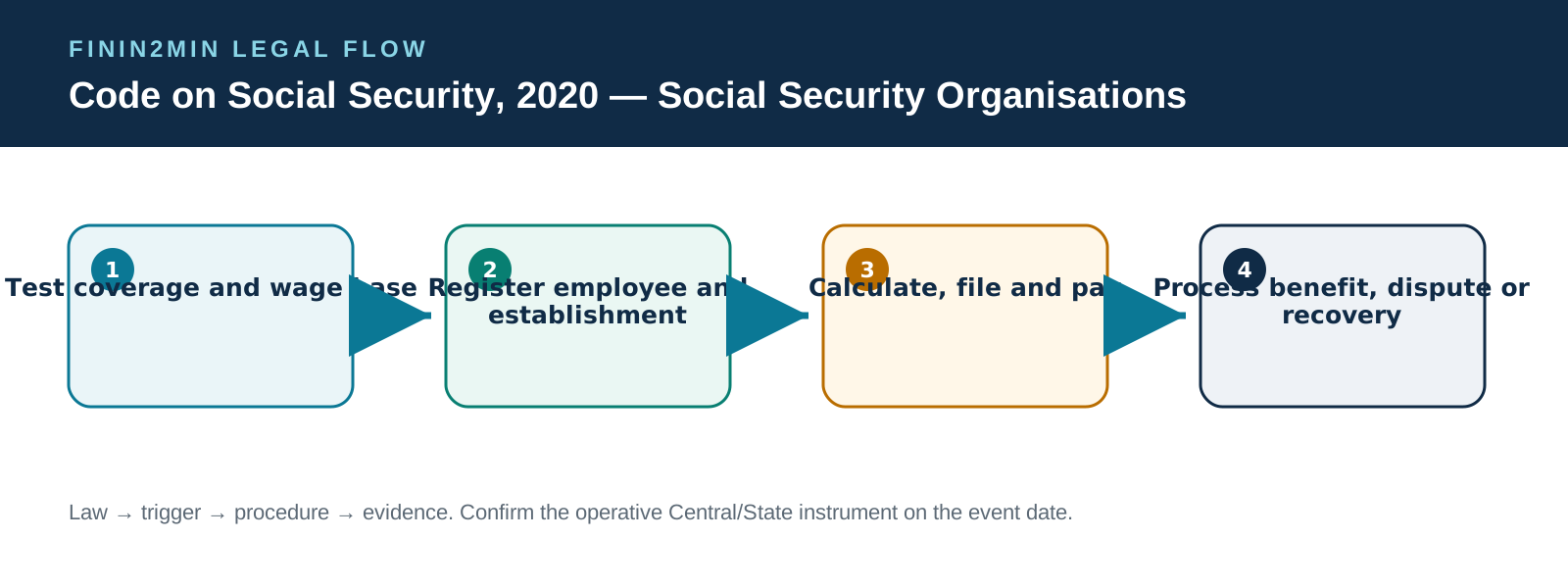
Chapter decision flow
Finin2min Summary - Chapter in 2 Minutes
This chapter turns social security organisations into an operational control file. It covers Constitution of Board of Trustees of Employees’ Provident Fund, Constitution of Employees’ State Insurance Corporation, National Social Security Board and State Unorganised Workers’ Board, Constitution of State Building Workers’ Welfare Boards; the practical sequence is to classify coverage and event date, apply the provision and mapped Rule, complete the form/register, calculate the entitlement or exposure, and retain evidence for inspection, claim or appeal.
Who is covered
Employers, employees, unorganised workers, gig/platform workers, beneficiaries and social-security authorities must identify the applicable chapter, establishment threshold and scheme.
Main obligations and rights
- Section 4: Constitution of Board of Trustees of Employees’ Provident Fund
- Section 5: Constitution of Employees’ State Insurance Corporation
- Section 6: National Social Security Board and State Unorganised Workers’ Board
- Section 7: Constitution of State Building Workers’ Welfare Boards
- Section 8: Disqualification and removal of a member of any Social Security Organisation
- Section 9: Procedure for transaction of business of Social Security Organisation, etc.
Key thresholds and timelines
- Use only the threshold, rate and limitation period effective on the event date; verify the Central/State instrument before acting.
Forms, registers and evidence
- Notice
- Retain classification, calculation, approval, communication, acknowledgement and payment/filing proof.
Employer risk snapshot
Highest practical risks: misclassification, missed filing/notice, unsupported calculation, incomplete records and use of the wrong Central/State instrument.
Employee/worker remedy snapshot
Core protection: the substantive protection in this chapter, access to the prescribed authority/forum and a documented remedy within limitation. Confirm the authority, limitation and appeal route stated in this chapter.
Old law / transition
Map the event date and savings position against: Employees’ Compensation Act, 1923; Employees’ State Insurance Act, 1948; EPF and MP Act, 1952; Employment Exchanges Act, 1959; Maternity Benefit Act, 1961.
Five-point professional checklist
- Freeze the event date, establishment, location and person/worker classification.
- Identify the controlling section/paragraph, mapped Rule, notification and appropriate Government.
- Reperform the calculation or decision test and document every exception or approval.
- Complete the prescribed form/register/portal step and retain acknowledgement, payment and communication evidence.
- Record the remedy, forum, limitation, appeal path and State variation before sign-off.
Finin2min takeaway: for social security organisations, the defensible answer is not a policy label - it is the event-date law, the mapped procedure, the calculation and a complete evidence trail.
Section-by-section provision map
| Provision | Subject | Implementation focus |
|---|---|---|
| Section 4 | Constitution of Board of Trustees of Employees’ Provident Fund | Trigger, linked Rule/form, evidence, consequence and remedy |
| Section 5 | Constitution of Employees’ State Insurance Corporation | Trigger, linked Rule/form, evidence, consequence and remedy |
| Section 6 | National Social Security Board and State Unorganised Workers’ Board | Trigger, linked Rule/form, evidence, consequence and remedy |
| Section 7 | Constitution of State Building Workers’ Welfare Boards | Trigger, linked Rule/form, evidence, consequence and remedy |
| Section 8 | Disqualification and removal of a member of any Social Security Organisation | Trigger, linked Rule/form, evidence, consequence and remedy |
| Section 9 | Procedure for transaction of business of Social Security Organisation, etc. | Trigger, linked Rule/form, evidence, consequence and remedy |
| Section 10 | Executive Heads of Central Board and Corporation | Trigger, linked Rule/form, evidence, consequence and remedy |
| Section 11 | Supersession of Corporation, Central Board, National Social Security Board or State Unorganised Workers’ Board or the Building Workers’ Welfare Board | Trigger, linked Rule/form, evidence, consequence and remedy |
| Section 12 | State Board, Regional Boards, local committees, etc. | Trigger, linked Rule/form, evidence, consequence and remedy |
| Section 13 | Entrustment of additional functions to Social Security Organisations | Trigger, linked Rule/form, evidence, consequence and remedy |
Section 4: Constitution of Board of Trustees of Employees’ Provident Fund
Current statutory text
4. Constitution of Board of Trustees of Employees’ Provident Fund.—(1) The Central Government
may, by notification, constitute, with effect from such date as may be specified therein, a Board of Trustees
of the Employees' Provident Fund to be called the Central Board, for the purposes of Chapter III and the
provisions of this Code relating to that Chapter, for the administration of the funds vested in it in such
manner as may be prescribed by the Central Government, consisting of the following members, namely:—

       (a) a Chairperson and a Vice-Chairperson to be appointed by the Central Government;

       (b) not more than five persons appointed by the Central Government from amongst its officials;

       (c) not more than fifteen persons representing Governments of such States as the Central Government
  may specify in this behalf, to be appointed by the Central Government;


       (d) ten persons representing employers of the establishments to which the schemes referred to in sub
   section (1) of section 15 applies, to be appointed by the Central Government after consultation with such
   organisations of employers as may be recognised by the Central Government in this behalf;

       (e) ten persons representing employees in the establishments to which schemes referred to in sub-
   section (1) of section 15 applies, who shall be appointed by the Central Government after consultation
   with such organisations of employees as may be recognised by that Government in this behalf; and

        (f) the Central Provident Fund Commissioner, ex officio.

   (2) The Central Board shall be a body corporate by the name of Board of Trustees of the Employees'
Provident Fund, having perpetual succession and a common seal and shall by the said name sue and be
sued.

   (3) The Central Government may, by notification, constitute, with effect from such date as may be
specified therein, an Executive Committee from amongst the members of the Central Board to assist the
Central Board in performance of its functions in such manner as may be prescribed by the Central
Government.

   (4) The Central Board may, by order, constitute one or more committees of such composition as may be
specified in the order to assist it in the discharge of its functions.

   (5) The Central Board may, by order, delegate to its Chairperson or to its Executive Committee or to
any of its officers and a State Board constituted under section 12 may, by order, delegate to its Chairperson
or to any of its officers, subject to such conditions and limitations, if any, as it may specify in such order,
such of its powers and functions under this Code as it may deem necessary for efficient administration of
the schemes referred to in sub-section (1) of section 15.

   (6) The terms and conditions, including tenure of office, subject to which a member of the Central Board
and Executive Committee shall discharge their respective duties may be such as may be prescribed by the
Central Government:

   Provided that a member of the Central Board shall, notwithstanding the expiry of the tenure of his office,
continue to hold office until his successor is appointed.

   (7) The Central Board, apart from the functions specified in this Code, shall also perform such other
functions in such manner as may be prescribed by the Central Government.
Finin2min clause-by-clause decode
- Legal test 1
- This section allocates legal responsibility for constitution of board of trustees of employees’ provident fund within the Social Security Organisations Chapter.
- Legal test 2
- Identify the statutory trigger, person obligated, authority, timing, exceptions and documentary output before applying the provision.
- Legal test 3
- Read every subsection, proviso, explanation and linked Schedule in the official text; the heading alone is not the legal test.
- Implementation control
- Trigger
- Document the facts that activate section 4: constitution of board of trustees of employees’ provident fund.
- Coverage and jurisdiction
Applicable Central Rules immediately below the provision
Central Rule 6: Rule 6 — Administration of funds vested in Central Board
Rule mapping is retained; read the official 2026 Gazette for the exact sub-rule text and forms.
Central Rule 7: Rule 7 — Executive Committee
Rule mapping is retained; read the official 2026 Gazette for the exact sub-rule text and forms.
Central Rule 11: Rule 11 — Meetings, notice of meetings, list of business and quorum
Rule mapping is retained; read the official 2026 Gazette for the exact sub-rule text and forms.
Central Rule 12: Rule 12 — Reconstitution of Corporation, Central Board, National Social Security Board, State Unorganised Workers’ Board, Building Workers’ Welfare Board or any of the Committees
Rule mapping is retained; read the official 2026 Gazette for the exact sub-rule text and forms.
Practical example
A multi-location employer prepares a legal classification memo, identifies the appropriate Government, maps the operative provision and Rule, records the decision owner and retains the documents needed to prove compliance during inspection or litigation.
Controls and evidence
- Employer: assign owner, configure system and retain approval/payment proof.
- Employee/worker: retain contract, attendance, wage/benefit proof and communication.
- Professional: reconcile the Act, Rule, notification, form, limitation and State overlay.
Consequence, remedy and limitation
Identify the substantive default first, then separately map arrears or benefit, interest/damages, administrative penalty, prosecution, compounding, company/officer liability, forum, appeal and limitation. Do not infer a remedy from the heading alone.
Mapped Rules: Rule 6, Rule 7, Rule 11, Rule 12 | Official source: section 4.
Section 5: Constitution of Employees’ State Insurance Corporation
Current statutory text
5. Constitution of Employees’ State Insurance Corporation.— (1) The Central Government may, by
notification, constitute with effect from such date as may be specified therein, the Employees' State
Insurance Corporation to be called the Corporation, for the purposes of Chapter IV and the provisions of
this Code relating to that Chapter and the administration thereof, in such manner as may be prescribed by
the Central Government, consisting of the following members, namely:—

       (a) a Chairperson to be appointed by the Central Government;

       (b) a Vice-Chairperson to be appointed by the Central Government;

       (c) not more than five persons to be appointed by the Central Government from amongst its officials;

       (d) one person representing each of such States in such manner, as may be prescribed by the Central
   Government;

       (e) one person to be appointed by the Central Government to represent the Union territories;

        (f) ten persons representing employers to be appointed by the Central Government in consultation
   with such organisations of employers as may be recognised for the purpose by the Central Government;

       (g) ten persons representing employees to be appointed by the Central Government in consultation
   with such organisations of employees as may be recognised for the purpose by the Central Government;

       (h) two persons representing the medical profession to be appointed by the Central Government in
   consultation with such organisations of medical practitioners as may be recognised for the purpose by
   the Central Government;


        (i) three members of Parliament of whom two shall be members of the House of the People (Lok
   Sabha) and one shall be a member of the Council of States (Rajya Sabha) elected respectively by the
  members of the House of the People and the members of the Council of States; and

        (j) the Director General of the Corporation, ex officio.

   (2) The Corporation shall be a body corporate by the name of Employees' State Insurance Corporation,
having perpetual succession and a common seal and shall by the said name sue and be sued.

   (3) The Central Government may, by notification, constitute, with effect from such date as may be
specified therein, a Standing Committee from amongst the members of the Corporation, in such manner
as may be prescribed by the Central Government.

   (4) Subject to the general superintendence and control of the Corporation, the Standing Committee—

       (a) shall administer the affairs of the Corporation and may exercise any of the powers and perform
   any of the functions of the Corporation in such manner as may be prescribed by the Central Government;

       (b) shall submit for the consideration and decision of the Corporation all such cases and matters as
  may be specified in the regulations made in this behalf; and

       (c) may, in its discretion, submit any other case or matter for the decision of the Corporation.

   (5) (a) The Central Government may, by notification, constitute, with effect from such date as may be
specified therein, a Medical Benefit Committee of such composition as may be specified therein, to assist
the Corporation and the Standing Committee in performance of its functions relating to administration of
medical benefits.

   (b) the Medical Benefit Committee shall perform such duties and exercise such powers as may be
prescribed by the Central Government.

   (6) The Corporation may, by order, constitute one or more committees of such composition as may be
specified in the regulations to assist it in the discharge of its functions.

   (7) The terms and conditions, including tenure of office, subject to which a member of the Corporation
and Standing Committee shall discharge their respective duties may be such as may be prescribed by the
Central Government:

   Provided that a member of the Corporation shall, notwithstanding the expiry of the tenure of his office,
continue to hold office until his successor is appointed.
Finin2min clause-by-clause decode
- Legal test 1
- This section allocates legal responsibility for constitution of employees’ state insurance corporation within the Social Security Organisations Chapter.
- Legal test 2
- Identify the statutory trigger, person obligated, authority, timing, exceptions and documentary output before applying the provision.
- Legal test 3
- Read every subsection, proviso, explanation and linked Schedule in the official text; the heading alone is not the legal test.
- Implementation control
- Trigger
- Document the facts that activate section 5: constitution of employees’ state insurance corporation.
- Coverage and jurisdiction
Applicable Central Rules immediately below the provision
Central Rule 8: Rule 8 — The Employees’ State Insurance Corporation, Standing Committee and Medical Benefit Committee
Rule mapping is retained; read the official 2026 Gazette for the exact sub-rule text and forms.
Central Rule 11: Rule 11 — Meetings, notice of meetings, list of business and quorum
Rule mapping is retained; read the official 2026 Gazette for the exact sub-rule text and forms.
Central Rule 12: Rule 12 — Reconstitution of Corporation, Central Board, National Social Security Board, State Unorganised Workers’ Board, Building Workers’ Welfare Board or any of the Committees
Rule mapping is retained; read the official 2026 Gazette for the exact sub-rule text and forms.
Practical example
A multi-location employer prepares a legal classification memo, identifies the appropriate Government, maps the operative provision and Rule, records the decision owner and retains the documents needed to prove compliance during inspection or litigation.
Controls and evidence
- Employer: assign owner, configure system and retain approval/payment proof.
- Employee/worker: retain contract, attendance, wage/benefit proof and communication.
- Professional: reconcile the Act, Rule, notification, form, limitation and State overlay.
Consequence, remedy and limitation
Identify the substantive default first, then separately map arrears or benefit, interest/damages, administrative penalty, prosecution, compounding, company/officer liability, forum, appeal and limitation. Do not infer a remedy from the heading alone.
Mapped Rules: Rule 8, Rule 11, Rule 12 | Official source: section 5.
Section 6: National Social Security Board and State Unorganised Workers’ Board
Current statutory text
6. National Social Security Board and State Unorganised Workers’ Board.—(1) The Central
Government shall, by notification, constitute a National Social Security Board for unorganised workers to
exercise the powers conferred on, and to perform the functions assigned to, it under this Code, in such
manner as may be prescribed by the Central Government.

   (2) The National Social Security Board shall consist of the following members, namely:—

       (a) Union Minister for Labour and Employment as Chairperson;

       (b) Secretary, Ministry of Labour and Employment as Vice-Chairperson;

       (c) forty members to be nominated by the Central Government, out of whom—

            (i) seven members representing unorganised sector workers;

             (ii) seven members representing employers of unorganised sector;

             (iii) seven members representing eminent persons from civil society;

           (iv) two members representing the Lok Sabha and one from the Rajya Sabha;

          (v) ten members representing Central Government Ministries and Departments concerned;

           (vi) five members representing State Governments;

            (vii) one member representing the Union territories; and


       (d) the Director General Labour Welfare, as Member-Secretary, ex officio.

   (3) All members except Chairperson of the National Social Security Board shall be from amongst
persons of eminence in the fields of labour welfare, management, finance, law and administration.

   (4) The manner in which members shall be nominated from each of the categories specified in clause
(c) of sub-section (2), the term of office and other conditions of service of members, the procedure to be
followed in the discharge of their functions by, and the manner of filling vacancies among the members of,
the National Social Security Board shall be such as may be prescribed by the Central Government:

   Provided that adequate representation shall be given to persons belonging to the Scheduled Castes, the
Scheduled Tribes, the minorities and women.

   (5) The term of the National Social Security Board shall be three years.

   (6) The National Social Security Board shall meet at least thrice a year, at such time and place and shall
observe such rules of procedure relating to the transaction of business at its meetings, as may be prescribed
by the Central Government.

   (7) The National Social Security Board shall perform the following functions, namely:—

       (a) recommend to the Central Government for framing suitable schemes for different sections of
   unorganised workers, gig workers and platform workers;

       (b) advise the Central Government on such matters arising out of the administration of this Code as
  may be referred to it;

       (c) monitor such social welfare schemes for unorganised workers, gig workers and platform workers
   as are administered by the Central Government;

       (d) review the record keeping functions performed at the State level;

       (e) review the expenditure from the fund and account; and

        (f) undertake such other functions as are assigned to it by the Central Government from time to time.

   (8) The Central Government may, by notification, constitute with effect from such date as may be
specified therein one or more advisory committee to advise the Central Government upon such matters
arising out of the administration of this Code relating to unorganised workers and such other matters as the
Central Government may refer to it for advice.

   (9) Every State Government shall, by notification, constitute a State Board to be known as (name of the
State) Unorganised Workers' Social Security Board to exercise the powers conferred on, and to perform the
functions assigned to, it under this Code, in such manner as may be prescribed by the State Government.

   (10) Every State Unorganised Workers' Board shall consist of the following members, namely:—

       (a) Minister of Labour and Employment of the concerned State as Chairperson, ex officio;

       (b) Principal Secretary or Secretary (Labour) as Vice-Chairperson;

       (c) one member representing the Central Government in the Ministry of Labour and Employment;

       (d) thirty-one members to be nominated by the State Government, out of whom—

            (i) seven representing the unorganised workers;

             (ii) seven representing employers of unorganised workers;

             (iii) two members representing the Legislative Assembly of the concerned State;

           (iv) five members representing eminent persons from civil society;

          (v) ten members representing the State Government Departments concerned; and

          (e) Member-Secretary as notified by the State Government.


   (11) All members except Chairperson of the State Unorganised Workers' Board shall be from amongst
persons of eminence in the fields of labour welfare, management, finance, law and administration.

   (12) The manner in which members shall be nominated from each of the categories specified in clause
(d) of sub-section (10), the term of office and other conditions of service of members, the procedure to be
followed in the discharge of their functions by, and the manner of filling vacancies among the members of,
the State Unorganised Workers' Board shall be such as may be prescribed by the State Government:

   Provided that adequate representation shall be given to persons belonging to the Scheduled Castes, the
Scheduled Tribes, the minorities and women.

   (13) The term of the State Unorganised Workers' Board shall be three years.

   (14) The State Unorganised Workers' Board shall meet at least once in a quarter at such time and place
and shall observe such rules of procedure relating to the transaction of business at its meetings, as may be
prescribed by the State Government.

   (15) The State Board shall perform the following functions, namely:—

       (a) recommend the State Government for framing suitable schemes for different sections of the
   unorganised sector workers;

       (b) advise the State Government on such matters arising out of the administration of this Code as
  may be referred to it;

       (c) monitor such social welfare schemes for unorganised workers as are administered by the State
   Government;

       (d) review the record keeping functions performed at the district level;

       (e) review the progress of registration and issue of cards to unorganised sector workers;

        (f) review the expenditure from the funds under various schemes; and

       (g) undertake such other functions as are assigned to it by the State Government from time to time.

   (16) The State Government may, by notification, constitute with effect from such date as may be
specified therein, one or more advisory committee to advise the State Government upon such matters arising
out of the administration of this Code relating to unorganised workers and such other matters as the State
Government may refer to it for advice.
Finin2min clause-by-clause decode
- Legal test 1
- This section allocates legal responsibility for national social security board and state unorganised workers’ board within the Social Security Organisations Chapter.
- Legal test 2
- Identify the statutory trigger, person obligated, authority, timing, exceptions and documentary output before applying the provision.
- Legal test 3
- Read every subsection, proviso, explanation and linked Schedule in the official text; the heading alone is not the legal test.
- Implementation control
- Trigger
- Document the facts that activate section 6: national social security board and state unorganised workers’ board.
- Coverage and jurisdiction
Applicable Central Rules immediately below the provision
Central Rule 9: Rule 9 — National Social Security Board
Rule mapping is retained; read the official 2026 Gazette for the exact sub-rule text and forms.
Central Rule 10: Rule 10 — Other welfare measures and facilities
Rule mapping is retained; read the official 2026 Gazette for the exact sub-rule text and forms.
Central Rule 11: Rule 11 — Meetings, notice of meetings, list of business and quorum
Rule mapping is retained; read the official 2026 Gazette for the exact sub-rule text and forms.
Central Rule 12: Rule 12 — Reconstitution of Corporation, Central Board, National Social Security Board, State Unorganised Workers’ Board, Building Workers’ Welfare Board or any of the Committees
Rule mapping is retained; read the official 2026 Gazette for the exact sub-rule text and forms.
Practical example
A multi-location employer prepares a legal classification memo, identifies the appropriate Government, maps the operative provision and Rule, records the decision owner and retains the documents needed to prove compliance during inspection or litigation.
Controls and evidence
- Employer: assign owner, configure system and retain approval/payment proof.
- Employee/worker: retain contract, attendance, wage/benefit proof and communication.
- Professional: reconcile the Act, Rule, notification, form, limitation and State overlay.
Consequence, remedy and limitation
Identify the substantive default first, then separately map arrears or benefit, interest/damages, administrative penalty, prosecution, compounding, company/officer liability, forum, appeal and limitation. Do not infer a remedy from the heading alone.
Mapped Rules: Rule 9, Rule 10, Rule 11, Rule 12 | Official source: section 6.
Section 7: Constitution of State Building Workers’ Welfare Boards
Current statutory text
7. Constitution of State Building Workers’ Welfare Boards.—(1) Every State Government shall,
with effect from such date as  it may, by notification, appoint, constitute a Board to be known as
the................(name of the State) Building and Other Construction Workers' Welfare Board to exercise the
powers conferred on, and perform the functions assigned to, it under this section and Chapter VIII.

   (2) The Building Workers' Welfare Board shall be a body corporate by the name aforesaid, having
perpetual succession and a common seal and shall by the said name sue and be sued.

   (3) The Building Workers' Welfare Board shall consist of a chairperson to be nominated by the State
Government, one member to be nominated by the Central Government and such number of other members,
not exceeding fifteen, as may be appointed to it by the State Government:

   Provided that the Building Workers' Welfare Board shall include an equal number of members
representing the State Government, the employers and the building workers and that at least one member
of the Board shall be a woman.

   (4) The terms and conditions of appointment and the salaries and other allowances payable to the
chairperson and the other members of the Building Workers' Welfare Board, and the manner of filling of
casual vacancies of the members of the Building Workers' Welfare Board, shall be such as may be
prescribed by the State Government.

   (5) (a) The Building Workers' Welfare Board shall appoint a Secretary and such officers and employees
as it considers necessary for the efficient discharge of its functions under this Code.


   (b) The Secretary of the Building Workers' Welfare Board shall be its chief executive officer.

   (c) The terms and conditions of appointment and the salary and allowances payable to the Secretary and
the other officers and employees of the Building Workers' Welfare Board shall be such as may be prescribed
by the State Government.

   (6) The Building Workers' Welfare Board shall perform the following functions, namely:—

       (a) provide death and disability benefits to a beneficiary or his dependants;

       (b) make payment of pension to the beneficiaries who have completed the age of sixty years;

       (c) pay such amount in connection with premium for Group Insurance Scheme of the beneficiaries
   as may be prescribed by the appropriate Government;

       (d) frame educational schemes for the benefit of children of the beneficiaries as may be prescribed
   by the appropriate Government;

       (e) meet such medical expenses for treatment of major ailments of a beneficiary or, such dependant,
   as may be prescribed by the appropriate Government;

        (f) make payment of maternity benefit to the beneficiaries;

       (g) frame skill development and awareness schemes for the beneficiaries;

       (h) provide transit accommodation or hostel facility to the beneficiaries;

        (i) formulation of any other welfare scheme for the building worker beneficiaries by State
   Government in concurrence with the Central Government; and

        (j) make provision and improvement of such other welfare measures and facilities as may be
   prescribed by the Central Government.

   (7) The State Government may, by notification, constitute with effect from such date as may be specified
therein one or more advisory committee to advise the State Government upon such matters arising out of
the administration of this Code relating to building workers and such other matters as the State Government
may refer to it for advice.
Finin2min clause-by-clause decode
- Legal test 1
- This section allocates legal responsibility for constitution of state building workers’ welfare boards within the Social Security Organisations Chapter.
- Legal test 2
- Identify the statutory trigger, person obligated, authority, timing, exceptions and documentary output before applying the provision.
- Legal test 3
- Read every subsection, proviso, explanation and linked Schedule in the official text; the heading alone is not the legal test.
- Implementation control
- Trigger
- Document the facts that activate section 7: constitution of state building workers’ welfare boards.
- Coverage and jurisdiction
Applicable Central Rules immediately below the provision
Central Rule 10: Rule 10 — Other welfare measures and facilities
Rule mapping is retained; read the official 2026 Gazette for the exact sub-rule text and forms.
Central Rule 11: Rule 11 — Meetings, notice of meetings, list of business and quorum
Rule mapping is retained; read the official 2026 Gazette for the exact sub-rule text and forms.
Central Rule 12: Rule 12 — Reconstitution of Corporation, Central Board, National Social Security Board, State Unorganised Workers’ Board, Building Workers’ Welfare Board or any of the Committees
Rule mapping is retained; read the official 2026 Gazette for the exact sub-rule text and forms.
Practical example
A multi-location employer prepares a legal classification memo, identifies the appropriate Government, maps the operative provision and Rule, records the decision owner and retains the documents needed to prove compliance during inspection or litigation.
Controls and evidence
- Employer: assign owner, configure system and retain approval/payment proof.
- Employee/worker: retain contract, attendance, wage/benefit proof and communication.
- Professional: reconcile the Act, Rule, notification, form, limitation and State overlay.
Consequence, remedy and limitation
Identify the substantive default first, then separately map arrears or benefit, interest/damages, administrative penalty, prosecution, compounding, company/officer liability, forum, appeal and limitation. Do not infer a remedy from the heading alone.
Mapped Rules: Rule 10, Rule 11, Rule 12 | Official source: section 7.
Section 8: Disqualification and removal of a member of any Social Security Organisation
Current statutory text
8. Disqualification and removal of a member of any Social Security Organisation.—(1) No person
shall be chosen as, or continue to be, a member of a Social Security Organisation, or any Committee thereof
who,—
(a) is or at any time has been adjudged an insolvent; or
(b) is found to be a lunatic or becomes of unsound mind; or
(c) is or has been convicted of any offence involving moral turpitude; or
(d) is an employer in an establishment and has defaulted in the payment of any dues under this Code;
or
(e) is a member of a Social Security Organisation being a member of the Parliament or a member of
a State Legislative Assembly, when he ceases to be such member of the Parliament or State Legislative
Assembly, as the case may be; or
(f) is a member of Social Security Organisation being a member of the Parliament or a member of a
State Legislative Assembly, and he becomes a—
(i) Minister of Central or State Government; or
(ii) Speaker or Deputy Speaker of House of the People or a State Legislative Assembly; or
(iii) Deputy Chairman of the Council of States.
By Corrigenda Dated 29-9-2020
Explanation 1.—If any question arises whether any person is disqualified under clause (d), it shall be
referred to the appropriate Government and the decision of the appropriate Government on any such
question shall be final.
Explanation 2.—Clause (f) shall not apply in case of persons who are members of the Social Security
Organisation ex officio, by virtue of being a Minister.
(2) The Central Government, in case of the Central Board, the Corporation and the National Social
Security Board and the State Government in case of the State Unorganised Workers' Board and the Building
Workers' Welfare Board, may remove any member of such Social Security Organisation from his office,
who,—
(a) is or has become subject to any of the disqualifications mentioned in sub-section (1); or
(b) is absent without leave of the Social Security Organisation of which he is a member for more
than three consecutive meetings of the Social Security Organisation or a Committee thereof;
(c) in the opinion of such Government, has so abused the position of his office as to render that
member's continuation in the office detrimental to the public interest or is otherwise unfit or unsuitable
to continue as such member in the opinion of such Government:
Provided that no person shall be removed under clauses (b) and (c), unless that person has been given
an opportunity to show cause as to why he should not be removed:
Provided further that a member of the Executive Committee of the Central Board or the Standing
Committee of the Corporation shall cease to hold office if he ceases to be a member of the Central Board
or the Corporation, as the case may be.
(3) Any member of a Social Security Organisation or a Committee thereof may at any time resign from
his office in writing under his hand addressed to the Central Government or the State Government, as the
case may be, which had made his appointment and on acceptance of such resignation, his office shall
become vacant.
(4) If in a Social Security Organisation or a Committee thereof, the Central Government or the State
Government, as the case may be, is of the opinion that—
(a) any member thereof representing employers or the employees or the unorganised workers, as the
case may be, ceases to adequately represent so; or
(b) any member thereof representing to be an expert in a specified area, is later on found not to
possess sufficient expertise in that area; or
(c) having regard to exigencies of circumstances or services in such Government, the member thereof
representing such Government cannot continue to represent the Government,
then, such Government may, by order, remove such member from his office:
Provided that no person shall be removed under clause (a) or clause (b), unless that person has been
given an opportunity to show cause as to why he should not be removed.
(5) If any member of a Social Security Organisation or a Committee thereof, who is a director of a
company and who as such director, has any direct or indirect pecuniary interest in any matter coming up
for consideration of the Social Security Organisation or a Committee thereof, then, he shall, as soon as may
be possible after such fact of interest has come to his knowledge, disclose the nature of the interest and such
disclosure shall be recorded in the proceedings of the Social Security Organisation or the Committee
thereof, as the case may be, and such member, thereafter, shall not take part in any proceeding or decision
of the Social Security Organisation, or a Committee thereof relating to that matter.Finin2min clause-by-clause decode
- Legal test 1
- This section allocates legal responsibility for disqualification and removal of a member of any social security organisation within the Social Security Organisations Chapter.
- Legal test 2
- Identify the statutory trigger, person obligated, authority, timing, exceptions and documentary output before applying the provision.
- Legal test 3
- Read every subsection, proviso, explanation and linked Schedule in the official text; the heading alone is not the legal test.
- Implementation control
- Trigger
- Document the facts that activate section 8: disqualification and removal of a member of any social security organisation.
- Coverage and jurisdiction
Applicable Central Rules immediately below the provision
No direct Central Rule is mapped. Check general procedural Rules, State Rules and later notifications.
Practical example
A multi-location employer prepares a legal classification memo, identifies the appropriate Government, maps the operative provision and Rule, records the decision owner and retains the documents needed to prove compliance during inspection or litigation.
Controls and evidence
- Employer: assign owner, configure system and retain approval/payment proof.
- Employee/worker: retain contract, attendance, wage/benefit proof and communication.
- Professional: reconcile the Act, Rule, notification, form, limitation and State overlay.
Consequence, remedy and limitation
Identify the substantive default first, then separately map arrears or benefit, interest/damages, administrative penalty, prosecution, compounding, company/officer liability, forum, appeal and limitation. Do not infer a remedy from the heading alone.
Mapped Rules: No direct Central Rule mapped in the repository concordance | Official source: section 8.
Section 9: Procedure for transaction of business of Social Security Organisation, etc.
Current statutory text
9. Procedure for transaction of business of Social Security Organisation, etc. (1) A Social Security
Organisation or any Committee thereof shall meet at such intervals and observe such procedure in regard
to the transaction of business at its meetings (including the quorum at such meetings) as may be prescribed
by the Central Government.


    (2) All orders and decisions of the Social Security Organisation shall be authenticated by the Central
Provident Fund Commissioner, Director General, Director General Labour Welfare, State Principal
Secretary or Secretary (Labour) of the respective Social Security Organisations or such other officer as may
be notified by the appropriate Government and  all other instruments issued by the Social Security
Organisation shall be authenticated by the signature of such officer as may be authorised by an order by the
respective Social Security Organisations.

    (3) No act done or proceeding taken by a Social Security Organisation or any Committee thereof shall
be questioned on the ground merely of the existence of any vacancy in, or any defect in the constitution of
the Social Security Organisation or the Committee thereof, as the case may be.

    (4) Such members of a Social Security Organisation or any Committee thereof shall be entitled for such
fee and allowances as may be prescribed by the Central Government.
Finin2min clause-by-clause decode
- Legal test 1
- This section allocates legal responsibility for procedure for transaction of business of social security organisation, etc. within the Social Security Organisations Chapter.
- Legal test 2
- Identify the statutory trigger, person obligated, authority, timing, exceptions and documentary output before applying the provision.
- Legal test 3
- Read every subsection, proviso, explanation and linked Schedule in the official text; the heading alone is not the legal test.
- Implementation control
- Trigger
- Document the facts that activate section 9: procedure for transaction of business of social security organisation, etc..
- Coverage and jurisdiction
Applicable Central Rules immediately below the provision
No direct Central Rule is mapped. Check general procedural Rules, State Rules and later notifications.
Practical example
A multi-location employer prepares a legal classification memo, identifies the appropriate Government, maps the operative provision and Rule, records the decision owner and retains the documents needed to prove compliance during inspection or litigation.
Controls and evidence
- Employer: assign owner, configure system and retain approval/payment proof.
- Employee/worker: retain contract, attendance, wage/benefit proof and communication.
- Professional: reconcile the Act, Rule, notification, form, limitation and State overlay.
Consequence, remedy and limitation
Identify the substantive default first, then separately map arrears or benefit, interest/damages, administrative penalty, prosecution, compounding, company/officer liability, forum, appeal and limitation. Do not infer a remedy from the heading alone.
Mapped Rules: No direct Central Rule mapped in the repository concordance | Official source: section 9.
Section 10: Executive Heads of Central Board and Corporation
Current statutory text
10.  Executive Heads  of  Central Board and Corporation.—The  Central  Provident Fund
Commissioner and the Director General shall be the whole-time officer of the Central Board and the
Corporation, respectively, and such officer shall not undertake any work unconnected with his office
without the prior approval of the Central Government.
Finin2min clause-by-clause decode
- Legal test 1
- This section allocates legal responsibility for executive heads of central board and corporation within the Social Security Organisations Chapter.
- Legal test 2
- Identify the statutory trigger, person obligated, authority, timing, exceptions and documentary output before applying the provision.
- Legal test 3
- Read every subsection, proviso, explanation and linked Schedule in the official text; the heading alone is not the legal test.
- Implementation control
- Trigger
- Document the facts that activate section 10: executive heads of central board and corporation.
- Coverage and jurisdiction
Applicable Central Rules immediately below the provision
No direct Central Rule is mapped. Check general procedural Rules, State Rules and later notifications.
Practical example
A multi-location employer prepares a legal classification memo, identifies the appropriate Government, maps the operative provision and Rule, records the decision owner and retains the documents needed to prove compliance during inspection or litigation.
Controls and evidence
- Employer: assign owner, configure system and retain approval/payment proof.
- Employee/worker: retain contract, attendance, wage/benefit proof and communication.
- Professional: reconcile the Act, Rule, notification, form, limitation and State overlay.
Consequence, remedy and limitation
Identify the substantive default first, then separately map arrears or benefit, interest/damages, administrative penalty, prosecution, compounding, company/officer liability, forum, appeal and limitation. Do not infer a remedy from the heading alone.
Mapped Rules: No direct Central Rule mapped in the repository concordance | Official source: section 10.
Section 11: Supersession of Corporation, Central Board, National Social Security Board or State Unorganised Workers’ Board or the Building Workers’ Welfare Board
Current statutory text
11. Supersession of Corporation, Central Board National Social Security Board or State
Unorganised Workers’ Board or the Building Workers’ Welfare Board.— (1)  If the Central
Government in case of the Central Board, the Corporation or the National Social Security Board and the
State Government, in case of the State Unorganised Workers' Board or the Building Workers' Welfare
Board, is of the opinion that the Corporation or the Central Board or the National Social Security Board or
the State Unorganised Workers’ Board or the Building Workers' Welfare Board or any of the Committee
thereof, as the case may be, is unable to perform its functions, or, has persistently made delay in the
discharge of its functions or has exceeded or abused its powers or jurisdiction, then such Government may,
by notification, supersede the Corporation or the Central Board or the National Social Security Board or
the State Unorganised Workers' Board or the Building Workers’ Welfare Board, or any of the Committees
thereof, as the case may be, and reconstitute it in such manner as may be prescribed by the Central
Government:

    Provided that, before issuing a notification under this sub-section on any of the grounds specified
herein, such Government shall give an opportunity to the Corporation or the Central Board or the National
Social Security Board or the State Unorganised Workers’ Board or the Building Workers' Welfare Board
or any Committee thereof, as the case may be, to show cause as to why it should not be superseded and
shall consider the explanations and objections raised by it and take appropriate action thereon.

    (2) After the supersession of the Corporation, or the Central Board or the National Social Security
Board, the State Unorganised Workers’ Board or the Building Workers’ Welfare Board, or any of the
Committee thereof, as the case may be, and until it is reconstituted, the Central Government or the State
Government, as the case may be, shall make such alternate arrangements for the purpose of administration
of the relevant provisions of this Code, as may be prescribed by the Central Government.

    (3) The Central Government or the State Government, as the case may be, shall cause, a full report of
any action taken by it under this section and the circumstances leading to such action, to be laid before each
House of Parliament or the State Legislature, as the case may be, at the earliest opportunity and in any case
not later than three months from the date of the notification of supersession issued under sub-section (1).
Finin2min clause-by-clause decode
- Legal test 1
- This section allocates legal responsibility for supersession of corporation, central board, national social security board or state unorganised workers’ board or the building workers’ welfare board within the Social Security Organisations Chapter.
- Legal test 2
- Identify the statutory trigger, person obligated, authority, timing, exceptions and documentary output before applying the provision.
- Legal test 3
- Read every subsection, proviso, explanation and linked Schedule in the official text; the heading alone is not the legal test.
- Implementation control
- Trigger
- Document the facts that activate section 11: supersession of corporation, central board, national social security board or state unorganised workers’ board or the building workers’ welfare board.
- Coverage and jurisdiction
Applicable Central Rules immediately below the provision
No direct Central Rule is mapped. Check general procedural Rules, State Rules and later notifications.
Practical example
A multi-location employer prepares a legal classification memo, identifies the appropriate Government, maps the operative provision and Rule, records the decision owner and retains the documents needed to prove compliance during inspection or litigation.
Controls and evidence
- Employer: assign owner, configure system and retain approval/payment proof.
- Employee/worker: retain contract, attendance, wage/benefit proof and communication.
- Professional: reconcile the Act, Rule, notification, form, limitation and State overlay.
Consequence, remedy and limitation
Identify the substantive default first, then separately map arrears or benefit, interest/damages, administrative penalty, prosecution, compounding, company/officer liability, forum, appeal and limitation. Do not infer a remedy from the heading alone.
Mapped Rules: No direct Central Rule mapped in the repository concordance | Official source: section 11.
Section 12: State Board, Regional Boards, local committees, etc.
Current statutory text
12. State Board, Regional Boards, local committees etc.— (1) The Central Government may, by
notification,—

          (i) after consultation with the Government of any State, constitute for that State, a Board of Trustees
    (hereinafter in this Code referred to as a State Board) which shall exercise such powers and perform
    such functions as may be assigned by notification, to it by the Central Government from time to time;

           (ii) specify the manner of constitution of a State Board, the terms and conditions of the appointment
    of its members and the procedure of its meeting and other proceedings relating thereto.


    (2) The Corporation may, by order, appoint Regional Boards and local committees in such area and in
such manner to perform such functions and to exercise such powers as may be specified in the regulations.
Finin2min clause-by-clause decode
- Legal test 1
- This section allocates legal responsibility for state board, regional boards, local committees, etc. within the Social Security Organisations Chapter.
- Legal test 2
- Identify the statutory trigger, person obligated, authority, timing, exceptions and documentary output before applying the provision.
- Legal test 3
- Read every subsection, proviso, explanation and linked Schedule in the official text; the heading alone is not the legal test.
- Implementation control
- Trigger
- Document the facts that activate section 12: state board, regional boards, local committees, etc..
- Coverage and jurisdiction
Applicable Central Rules immediately below the provision
No direct Central Rule is mapped. Check general procedural Rules, State Rules and later notifications.
Practical example
A multi-location employer prepares a legal classification memo, identifies the appropriate Government, maps the operative provision and Rule, records the decision owner and retains the documents needed to prove compliance during inspection or litigation.
Controls and evidence
- Employer: assign owner, configure system and retain approval/payment proof.
- Employee/worker: retain contract, attendance, wage/benefit proof and communication.
- Professional: reconcile the Act, Rule, notification, form, limitation and State overlay.
Consequence, remedy and limitation
Identify the substantive default first, then separately map arrears or benefit, interest/damages, administrative penalty, prosecution, compounding, company/officer liability, forum, appeal and limitation. Do not infer a remedy from the heading alone.
Mapped Rules: No direct Central Rule mapped in the repository concordance | Official source: section 12.
Section 13: Entrustment of additional functions to Social Security Organisations
Current statutory text
13. Entrustment of additional functions to Social Security Organisations.—Notwithstanding
anything contained in this Code, the Central Government may, by notification,—

          (i) assign additional functions to a Social Security Organisation including administration of any
    other Act or scheme relating to social security subject to such provisions as may be specified in this
    behalf in the notification:

       Provided that while the additional function of administering the Act or scheme are assigned under
     this clause to a Social Security Organisation, the officer or authority of such organisation, to whom
    such function has been assigned, shall exercise the powers under the enactment or scheme required for
    discharging such function in the manner as may be specified in the notification:

       Provided further that the Social Security Organisations may assign such additional functions to
    existing officers or appoint or engage new officers necessary for such purpose, if such functions may
    not be performed and completed with the assistance of its personnel as existing immediately before the
    assignment of the additional functions;

           (ii) specify the terms and conditions of discharging the functions under clause (i) by the Social
    Security Organisation;

           (iii) provide that the expenditure incurred in discharging the functions specified in clause (i)
    including appointment or engagement of personnel necessary for proper discharge of such functions
    shall be borne by the Central Government;

         (iv) specify the powers which the Social Security Organisation shall exercise while discharging the
    functions specified in clause (i); and

         (v) provide that any expenditure referred to in clause (iii) shall be made by the Social Security
    Organisation after prior approval of the Central Government.

                            CHAPTER III
                            EMPLOYEES’ PROVIDENT FUND
Finin2min clause-by-clause decode
- Legal test 1
- This section allocates legal responsibility for entrustment of additional functions to social security organisations within the Social Security Organisations Chapter.
- Legal test 2
- Identify the statutory trigger, person obligated, authority, timing, exceptions and documentary output before applying the provision.
- Legal test 3
- Read every subsection, proviso, explanation and linked Schedule in the official text; the heading alone is not the legal test.
- Implementation control
- Trigger
- Document the facts that activate section 13: entrustment of additional functions to social security organisations.
- Coverage and jurisdiction
Applicable Central Rules immediately below the provision
Central Rule 10: Rule 10 — Other welfare measures and facilities
Rule mapping is retained; read the official 2026 Gazette for the exact sub-rule text and forms.
Practical example
A multi-location employer prepares a legal classification memo, identifies the appropriate Government, maps the operative provision and Rule, records the decision owner and retains the documents needed to prove compliance during inspection or litigation.
Controls and evidence
- Employer: assign owner, configure system and retain approval/payment proof.
- Employee/worker: retain contract, attendance, wage/benefit proof and communication.
- Professional: reconcile the Act, Rule, notification, form, limitation and State overlay.
Consequence, remedy and limitation
Identify the substantive default first, then separately map arrears or benefit, interest/damages, administrative penalty, prosecution, compounding, company/officer liability, forum, appeal and limitation. Do not infer a remedy from the heading alone.
Mapped Rules: Rule 10 | Official source: section 13.
Rules, forms, registers, portals and due dates
| Rule | Subject | Text/control status |
|---|---|---|
| 6 | Rule 6 — Administration of funds vested in Central Board | Source-controlled mapping |
| 7 | Rule 7 — Executive Committee | Source-controlled mapping |
| 11 | Rule 11 — Meetings, notice of meetings, list of business and quorum | Source-controlled mapping |
| 12 | Rule 12 — Reconstitution of Corporation, Central Board, National Social Security Board, State Unorganised Workers’ Board, Building Workers’ Welfare Board or any of the Committees | Source-controlled mapping |
| 8 | Rule 8 — The Employees’ State Insurance Corporation, Standing Committee and Medical Benefit Committee | Source-controlled mapping |
| 9 | Rule 9 — National Social Security Board | Source-controlled mapping |
| 10 | Rule 10 — Other welfare measures and facilities | Source-controlled mapping |
Forms and registers must be confirmed from the appended 2026 Central Rules and the live portal applicable to the appropriate Government. A form is not treated as current merely because an earlier law used the same number.
Notifications and effective-date history
| Control | Required action |
|---|---|
| Enactment | Record Act number, assent and Gazette publication. |
| Commencement | Use the provision-specific commencement notification; the four Codes became broadly operative from 21 November 2025 subject to earlier partial commencement and corrigenda. |
| Central Rules | Read the applicable 2026 Central Rules from their Gazette date and verify subsequent amendments. |
| State instrument | Check final State Rules, authority notifications, forms and rates where the State is appropriate Government. |
Old-law/new-Code concordance
| Predecessor law | Transition control |
|---|---|
| Employees’ Compensation Act, 1923 | Classify the event date, accrued right, saved Rule/notification and pending proceeding before moving to the Code. |
| Employees’ State Insurance Act, 1948 | Classify the event date, accrued right, saved Rule/notification and pending proceeding before moving to the Code. |
| EPF and MP Act, 1952 | Classify the event date, accrued right, saved Rule/notification and pending proceeding before moving to the Code. |
| Employment Exchanges Act, 1959 | Classify the event date, accrued right, saved Rule/notification and pending proceeding before moving to the Code. |
| Maternity Benefit Act, 1961 | Classify the event date, accrued right, saved Rule/notification and pending proceeding before moving to the Code. |
| Payment of Gratuity Act, 1972 | Classify the event date, accrued right, saved Rule/notification and pending proceeding before moving to the Code. |
| Cine Workers Welfare Fund Act, 1981 | Classify the event date, accrued right, saved Rule/notification and pending proceeding before moving to the Code. |
| BOCW Welfare Cess Act, 1996 | Classify the event date, accrued right, saved Rule/notification and pending proceeding before moving to the Code. |
| Unorganised Workers’ Social Security Act, 2008 | Classify the event date, accrued right, saved Rule/notification and pending proceeding before moving to the Code. |
Practical calculations and control file
Calculation sequence
- Freeze the employee/worker population and event date.
- Apply the statutory wage/benefit base and notified threshold.
- Reconcile attendance, service, payroll and contractor records.
- Calculate principal amount, interest/damages and any statutory compensation separately.
- Obtain legal/payroll approval and retain the versioned worksheet.
Three-owner sign-off
- Employer/HR: facts, classification, communication and workflow.
- Employee/worker: notice, records, nomination/claim and acknowledgement.
- Professional: source, formula, forum, limitation and evidence reconciliation.
Binding and highly relevant case-law principles
| Decision | Principle and present-use caution |
|---|---|
| Regional Director, ESI Corporation v. Ramanuja Match Industries | Social-security legislation is beneficial, but coverage and contribution liability still turn on statutory definitions and evidence. |
| Organo Chemical Industries v. Union of India | Social-security defaults may attract compensatory and deterrent consequences; separate principal contribution, interest, damages and prosecution. |
| Jeewanlal (1929) Ltd. v. Appellate Authority | Gratuity is a statutory terminal benefit; eligibility and forfeiture require strict application of the governing text. |
| Municipal Corporation of Delhi v. Female Workers | Maternity protection is interpreted purposively, while present claims must be tested under the Code and current Rules. |
State-law variation alerts
- Confirm whether the Central or State Government is the appropriate Government.
- Central Rules do not automatically displace valid State Rules, rates, registers, authorities or portal procedures.
- Minimum-wage rates, holidays, working-hours permissions, licences and local welfare obligations require State-specific verification.
- Record Gazette number, effective date and supersession status in the location compliance register.
Practical examples and calculations
Classify the worker and establishment, identify the operative provision and notified instrument on the event date, compute the entitlement or exposure from source records, obtain approval, complete the filing/payment/action, and retain evidence. Do not use a portal value or payroll label as a substitute for the statutory test.
Calculation/control template: Control calculation: verified population or transaction base × applicable notified rate/amount × eligible period, adjusted for statutory inclusions, exclusions, ceilings, interest, compensation and prior payments. Reperform the calculation from retained source data.
Finin2min implementation explanation
Maintain a controlled implementation file for Chapter II - Social Security Organisations: coverage and event date, operative Central/State instrument, responsible owner, approval and authority, form/portal step, due date, calculation basis, supporting evidence, exception, escalation and closure proof. Reconcile payroll, HR, finance, contractor and legal records before sign-off.
Practical transaction application
Use the chapter in hiring, payroll migration, contractor onboarding, M&A diligence, business transfer, employee exits, death/injury claims, gratuity, maternity, gig/platform arrangements and benefit-fund reconciliations. Test coverage and contribution periods at employee and establishment level.
Authority, consent and execution controls
Assign responsibility among the employer, principal employer, payroll owner, authorised officer, nominee/claimant, social-security organisation and competent authority. Board approval or employee consent does not replace statutory registration, contribution, nomination, deposit or claim procedure.
Stamp duty and registration alerts
Contribution records and statutory returns ordinarily do not require registration, but nominations, settlements, assignments, security documents and business-transfer instruments may have separate State stamp or registration implications. Preserve the distinction between benefit filing and instrument validity.
Evidence and document-retention checklist
Retain the operative law/rule version, classification note, approvals, signed instruments, statutory forms, portal acknowledgements, registers, calculations, bank proof, correspondence, inspection records, service proof, decision and appeal file. Apply the longer of the statutory retention rule, litigation hold, tax/audit need and contractual requirement; restrict access to personal and sensitive data.
Performance, delivery and payment controls
Reconcile employee master, wage base, contribution file, challan, bank debit, return, nomination and benefit claim. For exits, deaths, injuries and transfers, create an event-date checklist with owner, statutory clock, documentary dependency and payment evidence.
Breach, loss, mitigation and remedy framework
On detecting a breach, stop continuing exposure, preserve evidence, quantify employee and government dues, identify affected persons, make lawful corrective payment/filing, notify the authorised decision-maker, assess self-disclosure or compounding where available, and reserve contractual recovery against responsible vendors without delaying statutory remediation.
Limitation and forum controls
Use the designated social-security authority, competent authority, tribunal or appellate forum. Track assessment, determination, recovery, benefit rejection and appeal dates independently; a contractual forum clause cannot defeat the statutory remedy.
Arbitration and mediation interface
Mediation may narrow factual or computation disputes but cannot waive mandatory contributions, statutory benefit eligibility, recovery powers or offences. Any settlement must identify what remains subject to authority approval or statutory adjudication.
Company, partnership, GST and tax overlays
For a company, align board/delegation and officer-in-default controls; for an LLP or partnership, identify the designated partner/partner and authorised employer representative. Labour dues can affect transaction price, indemnities, director/partner exposure and insolvency claims. Salary/TDS, perquisite, contractor TDS, GST on outsourced services and accounting provisions must be reconciled without treating tax treatment as proof of labour-law classification.
Finin2min Q&A
Which law and version should be applied?
Use the current text of Code on Social Security, 2020, the commencement notification, the applicable Central or State Rules and any later instrument effective on the event date.
How is the appropriate Government identified?
Classify ownership/control, sector, establishment and contractor relationship before selecting the Central or State authority.
Can a company policy override the statutory protection?
No. A policy may improve a benefit or control, but it cannot contract out of a mandatory statutory floor.
What evidence should be retained?
Retain the classification memo, source instrument, form/portal record, calculation, approval, employee communication, acknowledgement and payment or authority proof.
Do the Central Rules apply to every establishment?
No. They govern the Central sphere. State Rules and State notifications must be checked where the State is the appropriate Government.
How should a historical event be tested?
Apply the law and subordinate instrument effective on the event date, then use the repeal-and-savings provision for pending rights and proceedings.
What happens when portal practice conflicts with the statute?
Record the conflict, follow the higher legal instrument, seek authority clarification where necessary and preserve screenshots and correspondence.
Can criminal and monetary consequences arise together?
They may. Separate wages/benefits, interest, damages, civil penalty, prosecution, compounding and director/officer liability.
Is a contractor arrangement enough to shift liability?
No. Principal-employer and contractor liabilities depend on the specific provision and facts; the contract should allocate evidence and recovery without diluting worker rights.
What is the first professional review step?
Freeze the event date and facts, identify the applicable provision, then map Rules, forms, notification status, authority, limitation and evidence.
What is the operational focus of section 4 - Constitution of Board of Trustees of Employees’ Provident Fund?
The section must be decomposed into actor, trigger, threshold, procedure, exception, consequence and evidence. Read the full official text and the mapped Rules before applying the Finin2min control summary.
What is the operational focus of section 5 - Constitution of Employees’ State Insurance Corporation?
The section must be decomposed into actor, trigger, threshold, procedure, exception, consequence and evidence. Read the full official text and the mapped Rules before applying the Finin2min control summary.
What is the operational focus of section 6 - National Social Security Board and State Unorganised Workers’ Board?
The section must be decomposed into actor, trigger, threshold, procedure, exception, consequence and evidence. Read the full official text and the mapped Rules before applying the Finin2min control summary.
What is the operational focus of section 7 - Constitution of State Building Workers’ Welfare Boards?
The section must be decomposed into actor, trigger, threshold, procedure, exception, consequence and evidence. Read the full official text and the mapped Rules before applying the Finin2min control summary.
What is the operational focus of section 8 - Disqualification and removal of a member of any Social Security Organisation?
The section must be decomposed into actor, trigger, threshold, procedure, exception, consequence and evidence. Read the full official text and the mapped Rules before applying the Finin2min control summary.
What is the operational focus of section 9 - Procedure for transaction of business of Social Security Organisation, etc.?
The section must be decomposed into actor, trigger, threshold, procedure, exception, consequence and evidence. Read the full official text and the mapped Rules before applying the Finin2min control summary.
What is the operational focus of section 10 - Executive Heads of Central Board and Corporation?
The section must be decomposed into actor, trigger, threshold, procedure, exception, consequence and evidence. Read the full official text and the mapped Rules before applying the Finin2min control summary.
What is the operational focus of section 11 - Supersession of Corporation, Central Board, National Social Security Board or State Unorganised Workers’ Board or the Building Workers’ Welfare Board?
The section must be decomposed into actor, trigger, threshold, procedure, exception, consequence and evidence. Read the full official text and the mapped Rules before applying the Finin2min control summary.