Finin2min SummarySection 53Section 54Section 55Section 56Section 57Section 58Rules/formsOld lawCase lawState alertsQ&AProvision mapTransaction and cross-law controls
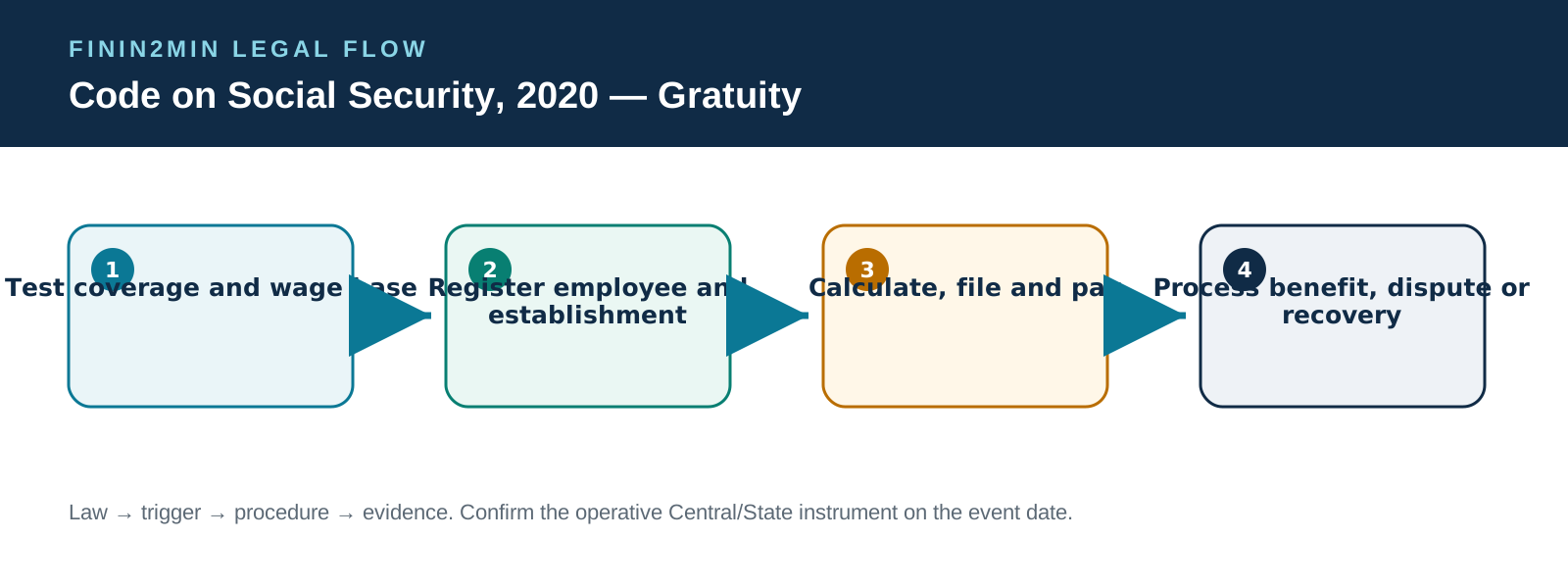
Chapter decision flow
Finin2min Summary - Chapter in 2 Minutes
This chapter turns gratuity into an operational control file. It covers Payment of gratuity, Continuous service, Nomination, Determination of amount of gratuity; the practical sequence is to classify coverage and event date, apply the provision and mapped Rule, complete the form/register, calculate the entitlement or exposure, and retain evidence for inspection, claim or appeal.
For the connected rule or filing step, see Gratuity Calculator 2026: Social Security Code Method.
Who is covered
Employers, employees, unorganised workers, gig/platform workers, beneficiaries and social-security authorities must identify the applicable chapter, establishment threshold and scheme.
Main obligations and rights
- Section 53: Payment of gratuity
- Section 54: Continuous service
- Section 55: Nomination
- Section 56: Determination of amount of gratuity
- Section 57: Compulsory insurance
- Section 58: Competent authority
Key thresholds and timelines
- Use only the threshold, rate and limitation period effective on the event date; verify the Central/State instrument before acting.
Forms, registers and evidence
- Nomination
- Retain classification, calculation, approval, communication, acknowledgement and payment/filing proof.
Employer risk snapshot
Highest practical risks: wrong continuous-service test, wage base, nomination, forfeiture or delayed payment.
Employee/worker remedy snapshot
Core protection: determination and timely payment of gratuity, nomination rights and interest/remedy for delay. Confirm the authority, limitation and appeal route stated in this chapter.
Old law / transition
Map the event date and savings position against: Employees’ Compensation Act, 1923; Employees’ State Insurance Act, 1948; EPF and MP Act, 1952; Employment Exchanges Act, 1959; Maternity Benefit Act, 1961.
Five-point professional checklist
- Freeze the event date, establishment, location and person/worker classification.
- Identify the controlling section/paragraph, mapped Rule, notification and appropriate Government.
- Reperform the calculation or decision test and document every exception or approval.
- Complete the prescribed form/register/portal step and retain acknowledgement, payment and communication evidence.
- Record the remedy, forum, limitation, appeal path and State variation before sign-off.
Finin2min takeaway: for gratuity, the defensible answer is not a policy label - it is the event-date law, the mapped procedure, the calculation and a complete evidence trail.
Section-by-section provision map
| Provision | Subject | Implementation focus |
|---|---|---|
| Section 53 | Payment of gratuity | Trigger, linked Rule/form, evidence, consequence and remedy |
| Section 54 | Continuous service | Trigger, linked Rule/form, evidence, consequence and remedy |
| Section 55 | Nomination | Trigger, linked Rule/form, evidence, consequence and remedy |
| Section 56 | Determination of amount of gratuity | Trigger, linked Rule/form, evidence, consequence and remedy |
| Section 57 | Compulsory insurance | Trigger, linked Rule/form, evidence, consequence and remedy |
| Section 58 | Competent authority | Trigger, linked Rule/form, evidence, consequence and remedy |
Section 53: Payment of gratuity
Current statutory text
53. Payment of gratuity.— (1) Gratuity shall be payable to an employee on the termination of his
employment after he has rendered continuous service for not less than five years,—
(a) on his superannuation; or
(b) on his retirement or resignation; or
(c) on his death or disablement due to accident or disease; or
(d) on termination of his contract period under fixed term employment; or
(e) on happening of any such event as may be notified by the Central Government:
Provided that in case of working journalist as defined in clause (f) of section 2 of the Working
Journalists and Other Newspaper Employees (Conditions of Service) and Miscellaneous Provisions Act,
1955 (45 of 1955), the expression “five years” occurring in this sub-section shall be deemed to be three
years:
Provided further that the completion of continuous service of five years shall not be necessary where
the termination of the employment of any employee is due to death or disablement or expiration of fixed
term employment or happening of any such event as may be notified by the Central Government:
Provided also that in the case of death of the employee, gratuity payable to him shall be paid to his
nominee or, if no nomination has been made, to his heirs, and where any such nominees or heirs is a minor,
the share of such minor, shall be deposited with the competent authority as may be notified by the
By Corrigenda dated 29-9-2020.
appropriate Government who shall invest the same for the benefit of such minor in such bank or other
financial institution, as may be prescribed by the appropriate Government, until such minor attains majority.
(2) For every completed year of service or part thereof in excess of six months, the employer shall pay
gratuity to an employee at the rate of fifteen days' wages or such number of days as may be notified by the
Central Government, based on the rate of wages last drawn by the employee concerned:
Provided that in the case of a piece-rated employee, daily wages shall be computed on the average of
the total wages received by him for a period of three months immediately preceding the termination of his
employment, and, for this purpose, the wages paid for any overtime work shall not be taken into account:
Provided further that in the case of an employee who is employed in a seasonal establishment and who
is not so employed throughout the year, the employer shall pay the gratuity at the rate of seven days' wages
for each season:
Provided also that in the case of an employee employed on fixed term employment or a deceased
employee, the employer shall pay gratuity on pro rata basis.
(3) The amount of gratuity payable to an employee shall not exceed such amount as may be notified by
the Central Government.
(4) For the purpose of computing the gratuity payable to an employee who is employed, after his
disablement, on reduced wages, his wages for the period preceding his disablement shall be taken to be the
wages received by him during that period, and his wages for the period subsequent to his disablement shall
be taken to be the wages as so reduced.
(5) Nothing in this section shall affect the right of an employee to receive better terms of gratuity under
any award or agreement or contract with the employer.
(6) Notwithstanding anything contained in sub-section (1),—
(a) the gratuity of an employee, whose services have been terminated for any act, wilful omission
or negligence causing any damage or loss to, or destruction of, property belonging to the employer,
shall be forfeited to the extent of the damage or loss so caused;
(b) the gratuity payable to an employee may be wholly or partially forfeited—
(i) if the services of such employee have been terminated for his riotous or disorderly conduct
or any other act of violence on his part, or
(ii) if the services of such employee have been terminated for any act which constitutes an
offence involving moral turpitude, provided such offence is committed by him in the course of his
employment.
Explanation 1.— For the purposes of this Chapter, employee does not include any such person who
holds a post under the Central Government or a State Government and is governed by any other Act or by
any rules providing for payment of gratuity.
Explanation 2.— For the purposes of this section, disablement means such disablement as incapacitates
an employee for the work which he was capable of performing before the accident or disease, resulting in
such disablement.
Explanation 3.— For the purposes of this section, it is clarified that in the case of a monthly rated
employee, the fifteen days' wages shall be calculated by dividing the monthly rate of wages last drawn by
him by twenty-six and multiplying the quotient by fifteen.Finin2min clause-by-clause decode
- Legal test 1
- Test qualifying service, category of cessation, fixed-term treatment, death/disablement exceptions and the statutory wage base.
- Implementation control
- Trigger
- Document the facts that activate section 53: payment of gratuity.
- Coverage and jurisdiction
- Identify establishment, employee/worker category, appropriate Government, First Schedule threshold and territorial authority.
- Decision owner
- Assign a named owner for gratuity eligibility, nomination, determination, insurance and appeal; identify HR, payroll, finance, legal, contractor and authorised-signatory roles.
- Evidence pack
Applicable Central Rules immediately below the provision
No direct Central Rule is mapped. Check general procedural Rules, State Rules and later notifications.
Practical example
A multi-location employer prepares a legal classification memo, identifies the appropriate Government, maps the operative provision and Rule, records the decision owner and retains the documents needed to prove compliance during inspection or litigation.
Controls and evidence
- Employer: assign owner, configure system and retain approval/payment proof.
- Employee/worker: retain contract, attendance, wage/benefit proof and communication.
- Professional: reconcile the Act, Rule, notification, form, limitation and State overlay.
Consequence, remedy and limitation
Identify the substantive default first, then separately map arrears or benefit, interest/damages, administrative penalty, prosecution, compounding, company/officer liability, forum, appeal and limitation. Do not infer a remedy from the heading alone.
Mapped Rules: No direct Central Rule mapped in the repository concordance | Official source: section 53.
Section 54: Continuous service
Current statutory text
54. Continuous service.—For the purposes of this Chapter,—

    (A) an employee shall be said to be in continuous service for a period if he has, for that period, been in
uninterrupted service, including service which may be interrupted on account of sickness, accident, leave,
absence from duty without leave (not being absence in respect of which an order treating the absence as
break in service has been passed in accordance with the standing orders, rules or regulations governing the
employees of the establishment), lay-off, strike or a lock-out or cessation of work not due to any fault of


the employee, whether such uninterrupted or interrupted service was rendered before or after the
commencement of this Code;

    (B) where an employee (not being an employee employed in a seasonal establishment) is not in
continuous service within the meaning of clause (A), for any period of one year or six months, he shall be
deemed to be in continuous service under the employer—

        (a) for the said period of one year, if the employee during the period of twelve calendar months
    preceding the date with reference to which calculation is to be made, has actually worked under the
   employer for not less than—

               (i) one hundred and ninety days, in the case of any employee employed below the ground in a
       mine or in an establishment which works for less than six days in a week; and

                (ii) two hundred and forty days, in any other case;

        (b) for the said period of six months, if the employee during the period of six calendar months
    preceding the date with reference to which the calculation is to be made, has actually worked under the
   employer for not less than—

               (i) ninety-five days, in the case of an employee employed below the ground in a mine or in an
        establishment which works for less than six days in a week; and

                (ii) one hundred and twenty days, in any other case.

       Explanation.— For the purposes of this clause, the number of days on which an employee has
    actually worked under an employer shall include the days on which—

               (i) he has been laid-off under an agreement or as permitted by standing orders made under the
         Industrial Employment (Standing Orders) Act, 1946 (20 of 1946), or under the Industrial Disputes
        Act, 1947 (14 of 1947), or under any other law applicable to the establishment;

                (ii) he has been on leave with full wages, earned in the previous year;

                (iii) he has been absent due to temporary disablement caused by accident arising out of and in
        the course of his employment; and

              (iv) in the case of a female, she has been on maternity leave; so, however, that the total period
        of such maternity leave does not exceed twenty-six weeks;

    (C) where an employee, employed in a seasonal establishment, is not in continuous service within the
meaning of clause (A), for any period of one year or six months, he shall be deemed to be in continuous
service under the employer for such period if he has actually worked for not less than seventy-five per cent.
of the number of days on which the establishment was in operation during such period.
Finin2min clause-by-clause decode
- Legal test 1
- Continuous service includes deemed-service rules; absence, lay-off, leave and seasonal establishment treatment must be reconstructed from records.
- Implementation control
- Trigger
- Document the facts that activate section 54: continuous service.
- Coverage and jurisdiction
- Identify establishment, employee/worker category, appropriate Government, First Schedule threshold and territorial authority.
- Decision owner
- Assign a named owner for gratuity eligibility, nomination, determination, insurance and appeal; identify HR, payroll, finance, legal, contractor and authorised-signatory roles.
- Evidence pack
Controls and evidence
- Employer: assign owner, configure system and retain approval/payment proof.
- Employee/worker: retain contract, attendance, wage/benefit proof and communication.
- Professional: reconcile the Act, Rule, notification, form, limitation and State overlay.
Mapped Rules: No direct Central Rule mapped in the repository concordance | Official source: section 54.
Section 55: Nomination
Current statutory text
55.  Nomination.—(1) Each employee, who has completed one year of service, shall make, a
nomination within such time, in such form and in such manner, as may be prescribed by the appropriate
Government.

    (2) An employee may, in his nomination, distribute the amount of gratuity payable to him under this
Chapter amongst more than one nominee.

    (3) If an employee has a family at the time of making a nomination, the nomination shall be made in
favour of one or more members of his family, and any nomination made by such employee in favour of a
person who is not a member of his family shall be void.

    (4) If at the time of making a nomination the employee has no family, the nomination may be made in
favour of any person or persons but if the employee subsequently acquires a family, such nomination shall
forthwith become invalid and the employee shall make, within such time as may be prescribed by the
appropriate Government, a fresh nomination in favour of one or more members of his family.

    (5) A nomination may, subject to the provisions of sub-sections (3) and (4), be modified by an employee
at any time, after giving to his employer a written intimation in such form and in such manner as may be
prescribed by the appropriate Government, of his intention to do so.


    (6) If a nominee predeceases the employee, the interest of the nominee shall revert to the employee
who shall make a fresh nomination, in the form prescribed by the appropriate Government, in respect of
such interest.

    (7) Every nomination, fresh nomination or alteration of nomination, as the case may be, shall be sent
by the employee to his employer, who shall keep the same in his safe custody.
Finin2min clause-by-clause decode
- Legal test 1
- Nomination does not replace the substantive right of legal heirs where the Code says otherwise; family status changes require fresh action.
- Implementation control
- Trigger
- Document the facts that activate section 55: nomination.
- Coverage and jurisdiction
- Identify establishment, employee/worker category, appropriate Government, First Schedule threshold and territorial authority.
- Decision owner
- Assign a named owner for gratuity eligibility, nomination, determination, insurance and appeal; identify HR, payroll, finance, legal, contractor and authorised-signatory roles.
- Evidence pack
Applicable Central Rules immediately below the provision
Central Rule 31: Rule 31 — Gratuity invested for benefit of minor
Rule mapping is retained; read the official 2026 Gazette for the exact sub-rule text and forms.
Controls and evidence
- Employer: assign owner, configure system and retain approval/payment proof.
- Employee/worker: retain contract, attendance, wage/benefit proof and communication.
- Professional: reconcile the Act, Rule, notification, form, limitation and State overlay.
Mapped Rules: Rule 31, Rule 32 | Official source: section 55.
Section 56: Determination of amount of gratuity
Current statutory text
56. Determination of amount of gratuity.—(1) A person who is eligible for payment of gratuity under
this Chapter or any person authorised, in writing, to act on his behalf shall send a written application to the
employer, within such time and in such form, as may be prescribed by the appropriate Government, for
payment of such gratuity.

    (2) As soon as gratuity becomes payable, the employer shall, whether an application referred to in sub-
section (1) has been made or not, determine the amount of gratuity and give notice in writing to the person
to whom the gratuity is payable and also to the competent authority specifying the amount of gratuity so
determined.

    (3) The employer shall arrange to pay the amount of gratuity within thirty days from the date it becomes
payable to the person to whom the gratuity is payable.

    (4) If the amount of gratuity payable under sub-section (3) is not paid by the employer within the period
specified in sub-section (3), the employer shall pay, from the date on which the gratuity becomes payable
to the date on which it is paid, simple interest at such rate, not exceeding the rate notified by the Central
Government from time to time for repayment of long term deposits:

    Provided that no such interest shall be payable if the delay in the payment is due to the fault of the
employee and the employer has obtained permission in writing from the competent authority for the delayed
payment on this ground.

    (5) (a) If there is any dispute as to the amount of gratuity payable to an employee under this Chapter or
as to the admissibility of any claim of, or in relation to, an employee for payment of gratuity, or as to the
person entitled to receive the gratuity, the employer shall deposit with the competent authority such amount
as he admits to be payable by him as gratuity.

    (b) Where there is a dispute with regard to any matter or matters specified in clause (a), the employer
or employee or any other person raising the dispute may make an application to the competent authority in
the form prescribed by the appropriate Government for deciding the dispute.

    (c) The competent authority shall, after due inquiry and after giving the parties to the dispute a
reasonable opportunity of being heard, determine the matter or matters in dispute and if, as a result of such
inquiry any amount is found to be payable to the employee, the competent authority shall direct the
employer to pay such amount or, as the case may be, such amount as reduced by the amount already
deposited by the employer.

    (d) The competent authority shall pay the amount deposited, including the excess amount, if any,
deposited by the employer, to the person entitled thereto.

    (e) As soon as may be after a deposit is made under clause (a), the competent authority shall pay the
amount of the deposit—

          (i) to the applicant where he is the employee; or

           (ii) where the applicant is not the employee, to the nominee or, as the case may be, the guardian of
    such nominee or heir of the employee if the competent authority is satisfied that there is no dispute as
    to the right of the applicant to receive the amount of gratuity.

    (6) For the purpose of conducting an inquiry under sub-section (5), the competent authority shall have
the same powers as are vested in a court, while trying a suit, under the Code of Civil Procedure, 1908 (5 of
1908), in respect of the following matters, namely:—

        (a) enforcing the attendance of any person or examining him on oath;

        (b) requiring the discovery and production of documents;


         (c) receiving evidence on affidavits;

        (d) issuing commissions for the examination of witnesses.

    (7) Any inquiry under this section shall be a judicial proceeding within the meaning of section 193,
section 228 and for the purpose of section 196 of the Indian Penal Code (45 of 1860).

    (8) Any person aggrieved by an order under sub-section (5) may, within sixty days from the date of the
receipt of the order, prefer an appeal to the appropriate Government or such other authority as may be
specified by the appropriate Government in this behalf:

    Provided that the appropriate Government or the appellate authority, as the case may be, may, if it is
satisfied that the appellant was prevented by sufficient cause from preferring the appeal within the said
period of sixty days, extend the said period by a further period of sixty days:

    Provided further that no appeal by an employer shall be admitted unless at the time of preferring the
appeal, the appellant either produces a certificate of the competent authority to the effect that the appellant
has deposited with him an amount equal to the amount of gratuity required to be deposited under sub-
section (5), or deposits with the appellate authority such amount.

    (9) The appropriate Government or the appellate authority, as the case may be, may, after giving the
parties to the appeal a reasonable opportunity of being heard, confirm, modify, or reverse the decision of
the competent authority.
Finin2min clause-by-clause decode
- Legal test 1
- Employer determination, notice, payment, deposit of disputed amount, competent-authority application and appeal are separate controls.
- Implementation control
- Trigger
- Document the facts that activate section 56: determination of amount of gratuity.
- Coverage and jurisdiction
- Identify establishment, employee/worker category, appropriate Government, First Schedule threshold and territorial authority.
- Decision owner
- Assign a named owner for gratuity eligibility, nomination, determination, insurance and appeal; identify HR, payroll, finance, legal, contractor and authorised-signatory roles.
- Evidence pack
Applicable Central Rules immediately below the provision
Controls and evidence
- Employer: assign owner, configure system and retain approval/payment proof.
- Employee/worker: retain contract, attendance, wage/benefit proof and communication.
- Professional: reconcile the Act, Rule, notification, form, limitation and State overlay.
Mapped Rules: Rule 31, Rule 33 | Official source: section 56.
Section 57: Compulsory insurance
Current statutory text
57. Compulsory insurance.—(1) With effect from such date as may be notified by the appropriate
Government in this behalf, every employer, other than an employer or an establishment belonging to, or
under the control of, the Central Government or a State Government, shall, subject to the provisions of sub-
section (2), obtain an insurance in the manner prescribed by the Central Government, for his liability for
payment towards the gratuity under this Chapter, from any insurance company regulated by the Authority
as defined under clause (b) of sub-section (1) of section 2 of the Insurance Regulatory and Development
Authority Act, 1999 (41 of 1999):

    Provided that different dates may be appointed for different establishments or class of establishments
or for different areas.

    (2) The appropriate Government may, subject to such conditions as may be prescribed by the Central
Government, exempt any employer who had already established an approved gratuity fund in respect of his
employees and who desires to continue such arrangement, and every employer employing five hundred or
more persons who establishes an approved gratuity fund in the manner prescribed by the Central
Government from the provisions of sub-section (1).

    (3) For the purposes of effectively implementing the provisions of this section, every employer shall
within such time as may be prescribed by the Central Government get his establishment registered with the
competent authority in the manner prescribed by the appropriate Government and no employer shall be
registered under the provisions of  this  section unless he has taken an insurance  referred  to  in
sub-section (1) or has established an approved gratuity fund referred to in sub-section (2).

    (4) The appropriate Government may provide for the composition of the Board of Trustees of the
approved gratuity fund and for the recovery by the competent authority of the amount of the gratuity payable
to an employee from the insurer with whom an insurance has been taken under sub-section (1), or as the
case may be, the Board of Trustees of the approved gratuity fund, in such manner as may be prescribed.

    (5) Where an employer fails to make any payment by way of premium in respect of the insurance
referred to in sub-section (1) or by way of contribution to an approved gratuity fund referred to in
sub-section (2), he shall be liable to pay the amount of gratuity due under this Chapter (including interest,
if any, for delayed payments) forthwith to the competent authority.

    Explanation.— In this section, “approved gratuity fund” shall have the same meaning as assigned to it
in sub-section (5) of section 2 of the Income-tax Act, 1961 (43 of 1961).
Finin2min clause-by-clause decode
- Legal test 1
- Where compulsory insurance applies, policy/trust coverage must match the statutory liability and remain funded.
- Implementation control
- Trigger
- Document the facts that activate section 57: compulsory insurance.
- Coverage and jurisdiction
- Identify establishment, employee/worker category, appropriate Government, First Schedule threshold and territorial authority.
- Decision owner
- Assign a named owner for gratuity eligibility, nomination, determination, insurance and appeal; identify HR, payroll, finance, legal, contractor and authorised-signatory roles.
- Evidence pack
Controls and evidence
- Employer: assign owner, configure system and retain approval/payment proof.
- Employee/worker: retain contract, attendance, wage/benefit proof and communication.
- Professional: reconcile the Act, Rule, notification, form, limitation and State overlay.
Mapped Rules: No direct Central Rule mapped in the repository concordance | Official source: section 57.
Section 58: Competent authority
Current statutory text
58. Competent authority.—(1) The appropriate Government may, by notification, appoint any officer
of that Government having such qualifications and experience as may be prescribed by that Government to


be a competent authority for implementation of any provision of this Chapter for such area as may be
specified in the notification.

    (2) Where more than one competent authority has been appointed for any area, the appropriate
Government may, by general or special order, regulate the distribution of business among them.

    (3) Any competent authority may, for the purpose of deciding any matter referred to him for decision
under this Chapter, choose one or more persons possessing special knowledge of any matter relevant to the
matter under reference to assist him in holding the inquiry relating thereto.


                            CHAPTER VI
                              MATERNITY BENEFIT
Finin2min clause-by-clause decode
- Legal test 1
- This section allocates legal responsibility for competent authority within the Gratuity Chapter.
- Legal test 2
- Identify the statutory trigger, person obligated, authority, timing, exceptions and documentary output before applying the provision.
- Legal test 3
- Read every subsection, proviso, explanation and linked Schedule in the official text; the heading alone is not the legal test.
- Implementation control
- Trigger
- Document the facts that activate section 58: competent authority.
- Coverage and jurisdiction
Applicable Central Rules immediately below the provision
Controls and evidence
- Employer: assign owner, configure system and retain approval/payment proof.
- Employee/worker: retain contract, attendance, wage/benefit proof and communication.
- Professional: reconcile the Act, Rule, notification, form, limitation and State overlay.
Mapped Rules: Rule 33, Rule 34 | Official source: section 58.
Rules, forms, registers, portals and due dates
| Rule | Subject | Text/control status |
|---|---|---|
| 31 | Rule 31 — Gratuity invested for benefit of minor | Source-controlled mapping |
| 32 | Rule 32 — Nomination, fresh nomination and modification | Source-controlled mapping |
| 33 | Rule 33 — Application for gratuity and appeal, etc. | Source-controlled mapping |
| 34 | Rule 34 — Qualifications and experience of competent authority | Source-controlled mapping |
Forms and registers must be confirmed from the appended 2026 Central Rules and the live portal applicable to the appropriate Government. A form is not treated as current merely because an earlier law used the same number.
Notifications and effective-date history
| Control | Required action |
|---|---|
| Enactment | Record Act number, assent and Gazette publication. |
| Commencement | Use the provision-specific commencement notification; the four Codes became broadly operative from 21 November 2025 subject to earlier partial commencement and corrigenda. |
| Central Rules | Read the applicable 2026 Central Rules from their Gazette date and verify subsequent amendments. |
| State instrument | Check final State Rules, authority notifications, forms and rates where the State is appropriate Government. |
Old-law/new-Code concordance
| Predecessor law | Transition control |
|---|---|
| Employees’ Compensation Act, 1923 | Classify the event date, accrued right, saved Rule/notification and pending proceeding before moving to the Code. |
| Employees’ State Insurance Act, 1948 | Classify the event date, accrued right, saved Rule/notification and pending proceeding before moving to the Code. |
| EPF and MP Act, 1952 | Classify the event date, accrued right, saved Rule/notification and pending proceeding before moving to the Code. |
| Employment Exchanges Act, 1959 | Classify the event date, accrued right, saved Rule/notification and pending proceeding before moving to the Code. |
| Maternity Benefit Act, 1961 | Classify the event date, accrued right, saved Rule/notification and pending proceeding before moving to the Code. |
| Payment of Gratuity Act, 1972 | Classify the event date, accrued right, saved Rule/notification and pending proceeding before moving to the Code. |
| Cine Workers Welfare Fund Act, 1981 | Classify the event date, accrued right, saved Rule/notification and pending proceeding before moving to the Code. |
| BOCW Welfare Cess Act, 1996 | Classify the event date, accrued right, saved Rule/notification and pending proceeding before moving to the Code. |
| Unorganised Workers’ Social Security Act, 2008 | Classify the event date, accrued right, saved Rule/notification and pending proceeding before moving to the Code. |
Practical calculations and control file
Calculation sequence
- Freeze the employee/worker population and event date.
- Apply the statutory wage/benefit base and notified threshold.
- Reconcile attendance, service, payroll and contractor records.
- Calculate principal amount, interest/damages and any statutory compensation separately.
- Obtain legal/payroll approval and retain the versioned worksheet.
Three-owner sign-off
- Employer/HR: facts, classification, communication and workflow.
- Employee/worker: notice, records, nomination/claim and acknowledgement.
- Professional: source, formula, forum, limitation and evidence reconciliation.
Binding and highly relevant case-law principles
| Decision | Principle and present-use caution |
|---|---|
| Regional Director, ESI Corporation v. Ramanuja Match Industries | Social-security legislation is beneficial, but coverage and contribution liability still turn on statutory definitions and evidence. |
| Organo Chemical Industries v. Union of India | Social-security defaults may attract compensatory and deterrent consequences; separate principal contribution, interest, damages and prosecution. |
| Jeewanlal (1929) Ltd. v. Appellate Authority | Gratuity is a statutory terminal benefit; eligibility and forfeiture require strict application of the governing text. |
| Municipal Corporation of Delhi v. Female Workers | Maternity protection is interpreted purposively, while present claims must be tested under the Code and current Rules. |
State-law variation alerts
- Confirm whether the Central or State Government is the appropriate Government.
- Central Rules do not automatically displace valid State Rules, rates, registers, authorities or portal procedures.
- Minimum-wage rates, holidays, working-hours permissions, licences and local welfare obligations require State-specific verification.
- Record Gazette number, effective date and supersession status in the location compliance register.
Practical examples and calculations
Classify the worker and establishment, identify the operative provision and notified instrument on the event date, compute the entitlement or exposure from source records, obtain approval, complete the filing/payment/action, and retain evidence. Do not use a portal value or payroll label as a substitute for the statutory test.
Calculation/control template: Control calculation: verified population or transaction base × applicable notified rate/amount × eligible period, adjusted for statutory inclusions, exclusions, ceilings, interest, compensation and prior payments. Reperform the calculation from retained source data.
Finin2min implementation explanation
Maintain a controlled implementation file for Chapter V - Gratuity: coverage and event date, operative Central/State instrument, responsible owner, approval and authority, form/portal step, due date, calculation basis, supporting evidence, exception, escalation and closure proof. Reconcile payroll, HR, finance, contractor and legal records before sign-off.
Practical transaction application
Use the chapter in hiring, payroll migration, contractor onboarding, M&A diligence, business transfer, employee exits, death/injury claims, gratuity, maternity, gig/platform arrangements and benefit-fund reconciliations. Test coverage and contribution periods at employee and establishment level.
Authority, consent and execution controls
Assign responsibility among the employer, principal employer, payroll owner, authorised officer, nominee/claimant, social-security organisation and competent authority. Board approval or employee consent does not replace statutory registration, contribution, nomination, deposit or claim procedure.
Stamp duty and registration alerts
Contribution records and statutory returns ordinarily do not require registration, but nominations, settlements, assignments, security documents and business-transfer instruments may have separate State stamp or registration implications. Preserve the distinction between benefit filing and instrument validity.
Evidence and document-retention checklist
Retain the operative law/rule version, classification note, approvals, signed instruments, statutory forms, portal acknowledgements, registers, calculations, bank proof, correspondence, inspection records, service proof, decision and appeal file. Apply the longer of the statutory retention rule, litigation hold, tax/audit need and contractual requirement; restrict access to personal and sensitive data.
Performance, delivery and payment controls
Reconcile employee master, wage base, contribution file, challan, bank debit, return, nomination and benefit claim. For exits, deaths, injuries and transfers, create an event-date checklist with owner, statutory clock, documentary dependency and payment evidence.
Breach, loss, mitigation and remedy framework
On detecting a breach, stop continuing exposure, preserve evidence, quantify employee and government dues, identify affected persons, make lawful corrective payment/filing, notify the authorised decision-maker, assess self-disclosure or compounding where available, and reserve contractual recovery against responsible vendors without delaying statutory remediation.
Limitation and forum controls
Use the designated social-security authority, competent authority, tribunal or appellate forum. Track assessment, determination, recovery, benefit rejection and appeal dates independently; a contractual forum clause cannot defeat the statutory remedy.
Arbitration and mediation interface
Mediation may narrow factual or computation disputes but cannot waive mandatory contributions, statutory benefit eligibility, recovery powers or offences. Any settlement must identify what remains subject to authority approval or statutory adjudication.
Company, partnership, GST and tax overlays
For a company, align board/delegation and officer-in-default controls; for an LLP or partnership, identify the designated partner/partner and authorised employer representative. Labour dues can affect transaction price, indemnities, director/partner exposure and insolvency claims. Salary/TDS, perquisite, contractor TDS, GST on outsourced services and accounting provisions must be reconciled without treating tax treatment as proof of labour-law classification.
Finin2min Q&A
Which law and version should be applied?
Use the current text of Code on Social Security, 2020, the commencement notification, the applicable Central or State Rules and any later instrument effective on the event date.
How is the appropriate Government identified?
Classify ownership/control, sector, establishment and contractor relationship before selecting the Central or State authority.
Can a company policy override the statutory protection?
No. A policy may improve a benefit or control, but it cannot contract out of a mandatory statutory floor.
What evidence should be retained?
Retain the classification memo, source instrument, form/portal record, calculation, approval, employee communication, acknowledgement and payment or authority proof.
Do the Central Rules apply to every establishment?
No. They govern the Central sphere. State Rules and State notifications must be checked where the State is the appropriate Government.
How should a historical event be tested?
Apply the law and subordinate instrument effective on the event date, then use the repeal-and-savings provision for pending rights and proceedings.
What happens when portal practice conflicts with the statute?
Record the conflict, follow the higher legal instrument, seek authority clarification where necessary and preserve screenshots and correspondence.
Can criminal and monetary consequences arise together?
They may. Separate wages/benefits, interest, damages, civil penalty, prosecution, compounding and director/officer liability.
Is a contractor arrangement enough to shift liability?
No. Principal-employer and contractor liabilities depend on the specific provision and facts; the contract should allocate evidence and recovery without diluting worker rights.
What is the first professional review step?
Freeze the event date and facts, identify the applicable provision, then map Rules, forms, notification status, authority, limitation and evidence.
What is the operational focus of section 53 - Payment of gratuity?
The section must be decomposed into actor, trigger, threshold, procedure, exception, consequence and evidence. Read the full official text and the mapped Rules before applying the Finin2min control summary.
What is the operational focus of section 54 - Continuous service?
What is the operational focus of section 55 - Nomination?
What is the operational focus of section 56 - Determination of amount of gratuity?
What is the operational focus of section 57 - Compulsory insurance?
What is the operational focus of section 58 - Competent authority?
What is review control 17 for this chapter?
Confirm source currency, State variation, internal ownership, documentary proof and the next statutory deadline before closing the compliance ticket.
What is review control 18 for this chapter?
Confirm source currency, State variation, internal ownership, documentary proof and the next statutory deadline before closing the compliance ticket.
Source and review trail
Use the current official instrument, portal or regulator publication before acting. This panel separates the category authority from page-specific references.
- Official starting point
- www.labour.gov.in