Finin2min SummarySection 1Section 2Section 3Rules/formsOld lawCase lawState alertsQ&AProvision mapTransaction and cross-law controls
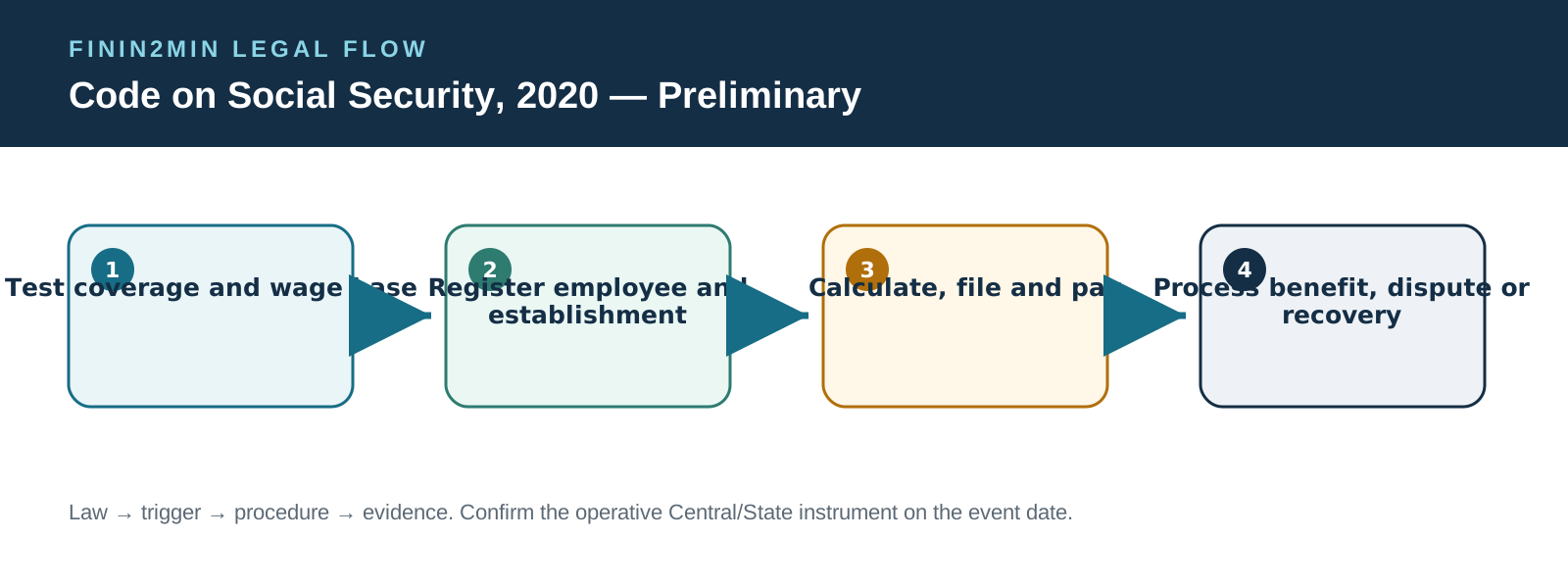
Chapter decision flow
Finin2min Summary - Chapter in 2 Minutes
This chapter turns preliminary into an operational control file. It covers Short title, extent, commencement and application, Definitions, Registration and cancellation of an establishment; the practical sequence is to classify coverage and event date, apply the provision and mapped Rule, complete the form/register, calculate the entitlement or exposure, and retain evidence for inspection, claim or appeal.
Who is covered
Employers, employees, unorganised workers, gig/platform workers, beneficiaries and social-security authorities must identify the applicable chapter, establishment threshold and scheme.
Main obligations and rights
- Section 1: Short title, extent, commencement and application
- Section 2: Definitions
- Section 3: Registration and cancellation of an establishment
Key thresholds and timelines
- Use only the threshold, rate and limitation period effective on the event date; verify the Central/State instrument before acting.
Forms, registers and evidence
- Applicable form/register, calculation file, approval and acknowledgement evidence
- Retain classification, calculation, approval, communication, acknowledgement and payment/filing proof.
Employer risk snapshot
Highest practical risks: misclassification, missed filing/notice, unsupported calculation, incomplete records and use of the wrong Central/State instrument.
Employee/worker remedy snapshot
Core protection: the substantive protection in this chapter, access to the prescribed authority/forum and a documented remedy within limitation. Confirm the authority, limitation and appeal route stated in this chapter.
Old law / transition
Map the event date and savings position against: Employees’ Compensation Act, 1923; Employees’ State Insurance Act, 1948; EPF and MP Act, 1952; Employment Exchanges Act, 1959; Maternity Benefit Act, 1961.
Five-point professional checklist
- Freeze the event date, establishment, location and person/worker classification.
- Identify the controlling section/paragraph, mapped Rule, notification and appropriate Government.
- Reperform the calculation or decision test and document every exception or approval.
- Complete the prescribed form/register/portal step and retain acknowledgement, payment and communication evidence.
- Record the remedy, forum, limitation, appeal path and State variation before sign-off.
Finin2min takeaway: for preliminary, the defensible answer is not a policy label - it is the event-date law, the mapped procedure, the calculation and a complete evidence trail.
Section-by-section provision map
| Provision | Subject | Implementation focus |
|---|---|---|
| Section 1 | Short title, extent, commencement and application | Trigger, linked Rule/form, evidence, consequence and remedy |
| Section 2 | Definitions | Trigger, linked Rule/form, evidence, consequence and remedy |
| Section 3 | Registration and cancellation of an establishment | Trigger, linked Rule/form, evidence, consequence and remedy |
Section 1: Short title, extent, commencement and application
Current statutory text
1. Short title, extent, commencement and application.—(1) This Act may be called the Code on
Social Security, 2020.

    (2) It extends to the whole of India.
    (3) It shall come into force on such date1 as the Central Government may, by notification in the Official
Gazette, appoint; and *different dates may be appointed for different provisions of this Code and any
reference in any such provision to the commencement of this Code shall be construed as a reference to the
coming into force of that provision.

    (4) The applicability of the Chapters specified in columns (1) and (2) of the First Schedule shall, without
prejudice to the applicability of the other provisions of this Code, be such as is specified in corresponding
entry in column (3) of that Schedule.

    (5) Notwithstanding anything contained in sub-section (4), where it appears to the Central Provident
Fund Commissioner, whether on an application made to him by the employer of an establishment or
otherwise, that the employer and majority of employees of that establishment have agreed that the
provisions of Chapter III should be made applicable to that establishment, the Central Provident Fund
Commissioner, may, by notification, apply the provisions of the said Chapter to that establishment on and
from the date of such agreement or from any subsequent date specified in the agreement:

    Provided that where the employer of an establishment to which the provisions of Chapter III applied
under this sub-section desires to come out of such applicability, he may make an application to the Central
Provident Fund Commissioner and the Central Provident Fund Commissioner shall, if satisfied that there
is an agreement between the employer and majority of the employees to this effect, make the provisions of
that Chapter inapplicable to such establishment, in such manner and subject to such conditions as may be
prescribed by the Central Government.

    (6) The Central Government may, after giving not less than two months' notice of its intention so to do,
by notification, apply the provisions of this Code to any establishment employing not less than such number
of persons as may be specified in the notification.

    (7) Notwithstanding anything contained in sub-section (4), where it appears to the Director General of
the Corporation, whether on an application made to him by the employer of an establishment or otherwise,
that the employer and majority of employees of that establishment have agreed that the provisions of
Chapter IV should be made applicable to that establishment, the Director General of the Corporation, may,


1*. 3rd May, 2021—S. 142, vide notification No. S.O. 1730(E), dated 30th April, 2021, see Gazette of India, Extraordinary, Part
     II, sec. 3(ii).
  21st day of November, 2025—Ss.1 to 14, sub-sections (1) and (2) of section 15, clause (c) of sub-section (1) of section 16,
    sections 17 to 141, section 143, except the provisions of the Code specified at serial number (v) of S.O. 2060 (E), dated the 3rd
   May, 2023, sections 144 to 163, Items 1 and 2 and items 4 to 9 of sub-section (1) of section 164, clause (a) and clause (c) of
    sub-section (2) and sub-section (3) of section 164, vide notification no. S.O. 5319 (E), dated 21st November, 2025, see Gazette
    of India, Extraordinary, Part II, s. 3(ii).


by notification, apply the provisions of the said Chapter to that establishment on and from the date of such
agreement or from any subsequent date specified in the agreement:

    Provided that where the employer of an establishment to which the provisions of Chapter IV applied
under this sub-section desires to come out of such applicability, he may make an application to the Director
General of the Corporation and Director General of the Corporation shall, if satisfied that there is an
agreement between the employer and majority of the employees to this effect, make the provisions of that
Chapter inapplicable to such establishment, in such manner and subject to such conditions as may be
prescribed by the Central Government.

    (8) Notwithstanding anything contained in sub-section (4), an establishment to which any Chapter
applies at the first instance shall continue to be applied thereafter even if the number of employees therein
at any subsequent time falls below the threshold specified in the First Schedule in respect of that Chapter.
Finin2min clause-by-clause decode
- Legal test 1
- Confirm whether the relevant Chapter applies through the First Schedule and any voluntary-extension or inapplicability mechanism.
- Legal test 2
- Record the exact commencement notification applicable to each provision; the Code was not commenced as a single undifferentiated block.
- Implementation control
- Trigger
- Document the facts that activate section 1: short title, extent, commencement and application.
- Coverage and jurisdiction
- Identify establishment, employee/worker category, appropriate Government, First Schedule threshold and territorial authority.
- Decision owner
Applicable Central Rules immediately below the provision
Central Rule 3: Rule 3 — Manner and conditions of making the provisions of Chapter III or Chapter IV inapplicable to an establishment
Rule mapping is retained; read the official 2026 Gazette for the exact sub-rule text and forms.
Practical example
A multi-location employer prepares a legal classification memo, identifies the appropriate Government, maps the operative provision and Rule, records the decision owner and retains the documents needed to prove compliance during inspection or litigation.
Controls and evidence
- Employer: assign owner, configure system and retain approval/payment proof.
- Employee/worker: retain contract, attendance, wage/benefit proof and communication.
- Professional: reconcile the Act, Rule, notification, form, limitation and State overlay.
Consequence, remedy and limitation
Identify the substantive default first, then separately map arrears or benefit, interest/damages, administrative penalty, prosecution, compounding, company/officer liability, forum, appeal and limitation. Do not infer a remedy from the heading alone.
Mapped Rules: Rule 3 | Official source: section 1.
Section 2: Definitions
Current statutory text
2. Definitions.— In this Code, unless the context otherwise requires,—

    (1) “agent” when used in relation to an establishment, means every person, whether appointed as such
or not, who acting or purporting to act on behalf of the owner, takes part in the management, control,
supervision or direction of such establishment or part thereof;

    (2) “aggregator” means a digital intermediary or a market place for a buyer or user of a service to
connect with the seller or the service provider;

    (3) “appropriate Government” means—

        (a) in relation to, an establishment carried on by or under the authority of the Central Government
    or concerning any such controlled industry as may be specified by notification in this behalf, by the
    Central Government or the establishment of railways including metro railways, mines, oil field, major
    ports, air transport service, telecommunication, banking and insurance company or a corporation or
    other authority established by a Central Act or the central public sector undertaking or subsidiary
   companies set up by the central public sector undertakings, subsidiary companies set up by the principal
    undertakings or autonomous bodies owned or controlled by the Central Government, including
    establishment of contractors for the purposes of such establishment, corporation or other authority,
    central public sector undertakings, subsidiary companies or autonomous bodies or any company in
   which not less than fifty-one per cent. of the paid up share capital is held by the Central Government,
    as the case may be, or in relation to an establishment having departments or branches in more than one
    State, as the case may be, the Central Government; and

        (b) in relation to any other establishment, the State Government.

    Explanation 1.—For the purposes of this clause, the expression “metro railway” means the metro
railway as defined in sub-clause (i) of clause (1) of section 2 of the Metro Railways (Operation and
Maintenance ) Act, 2002 (60 of 2002).

    Explanation 2.—For the purposes of this clause, the Central Government shall continue to be the
appropriate Government for the central public sector undertakings even  if the holding of the Central
Government reduces to less than  fifty per cent. equity in that public sector undertaking after the
commencement of this Code;

    (4) “audio-visual production” means audio-visual produced wholly or partly in India and includes—

          (i) animation, cartoon depiction, audio-visual advertisement;

           (ii) digital production or any of the activities in respect of making thereof; and

           (iii) features films, non-feature films, television, web-based serials, talk shows, reality shows and
    sport shows;

    (5) “Authorised Officer” means such officer of the Central Board, or as the case may be, of the
Corporation notified by the Central Government;

    (6) “building or other construction work” means the construction, alteration, repairs, maintenance or
demolition in relation to buildings, streets, roads, railways, tramways, airfields, irrigation, drainage,


embankment and navigation works, flood control works (including storm water drainage works),
generation, transmission and distribution of power, water works (including channels for distribution of
water), oil and gas installations, electric lines, internet towers, wireless, radio, television, telephone,
telegraph and overseas communications, dams, canals, reservoirs, watercourses, tunnels, bridges, viaducts,
aquaducts, pipelines, towers, cooling towers, transmission towers and such other work as may be specified
in this behalf by the Central Government, by notification, but does not include any building or other
construction work which is related to any factory or mine or any building or other construction work
employing less than ten workers in the preceding twelve months or where such work is related to own
residential purposes of an individual or group of individuals for their own residence and the total cost of
such work does not exceed fifty lakhs rupees or such higher amount and employing more than such number
of workers as may be notified by the appropriate Government;

    (7) “building worker” means a person who is employed to do any skilled, semi-skilled or unskilled,
manual, technical or clerical work for hire or reward, whether the terms of such employment are express or
implied, in connection with any building or other construction work, but does not include any such person
who is employed mainly in a managerial or supervisory or administrative capacity;

    (8) “Building Workers' Welfare Board” means the State Building and other Construction Workers'
Welfare Board constituted under sub-section (1) of section 7;

    (9) “career centre” means any office (including employment exchange, place or portal) established and
maintained in the manner prescribed by the Central Government for providing such career services
(including registration, collection and furnishing of information, either by the keeping of registers or
otherwise, manually, digitally, virtually or through any other mode) as may be prescribed by the Central
Government, which may, inter alia, relate generally or specifically to—

          (i) persons who seek to employ employees;

           (ii) persons who seek employment;

           (iii) occurrence of vacancies; and

         (iv)  persons who  seek  vocational  guidance and  career  counselling  or  guidance  to  start
    self-employment;

    (10) “Central Board” means the Board of Trustees of the Employees' Provident Fund constituted under
section 4;

    (11) “Central Provident Fund Commissioner” means the Central Provident Fund Commissioner of the
Central Board appointed under sub-section (1) of section 14;

    (12) “child”, for the purposes of Chapter VI, includes a stillborn child;

    (13) “Commissioning mother” means a biological mother who uses her egg to create an embryo
implanted in any other woman;

    (14) “company” means a company as defined in clause (20) of section 2 of the Companies Act, 2013
(18 of 2013);

    (15) “compensation” means compensation as provided under Chapter VII;

    (16) “competent authority” means any authority appointed under section 58 for the purposes of Chapter
V or notified for the purposes of Chapter VI or appointed under section 91 for the purposes of Chapter VII,
as the case may be, as competent authority by the appropriate Government or the State Government, as the
case may be;

    (17) “completed year of service” means continuous service for twelve months;

    (18) “confinement” means labour resulting in the issue of a living child, or labour after twenty-six
weeks of pregnancy resulting in the issue of a child whether alive or dead;

    (19) “contract labour” means a worker who shall be deemed to be employed in or in connection with
the work of an establishment when he is hired in or in connection with such work by or through a contractor,
with or without the knowledge of the principal employer and includes inter-State migrant worker but does

not include an employee (other than part time employee) who is regularly employed by the contractor for
any activity of his establishment and his employment is governed by mutually accepted standards of the
conditions of employment (including engagement on permanent basis), and gets periodical increment in the
pay, social security coverage and other welfare benefits in accordance with the law for the time being in
force in such employment;

    (20) “contractor”, in relation to an establishment means a person, who—

          (i) undertakes to produce a given result for the establishment, other than a mere supply of goods or
     articles of manufacture to such establishment through contract labour; or

           (ii) supplies contract labour for any work of the establishment as mere human resource, and includes
    a sub-contractor;

    (21) “contribution” means the sum of money payable by the employer, under this Code, to the Central
Board and to the Corporation, as the case may be, and includes any amount payable by or on behalf of the
employee in accordance with the provisions of this Code;

    (22) “Corporation” means the Employees' State Insurance Corporation constituted under section 5;

    (23) “delivery” means the birth of a child;

    (24) “dependant” means any of the following relatives of deceased employee, namely:—

        (a) a widow, a minor legitimate or adopted son, an unmarried legitimate or adopted daughter or a
   widowed mother:

           Provided that for the purposes of Chapter IV, a legitimate adopted son, who has not attained
        the age of twenty-five years, shall be dependant of the deceased employee;

        (b) if wholly dependant on the earnings of the employee at the time of his death, a legitimate or
    adopted son or a daughter who has attained the age of eighteen years and who is infirm; except for the
    purposes of Chapter IV wherein the word “eighteen” occurring in this sub-clause shall be deemed to
   have been substituted by the word “twenty-five”;

         (c) if wholly or in part dependent on the earnings of the employee at the time of his death,—

               (i) a widower;

                (ii) a parent other than a widowed mother;

                (iii) a minor illegitimate son, an unmarried illegitimate daughter or a daughter legitimate or
         illegitimate or adopted if married and a minor or if widowed and a minor;

              (iv) a minor brother or an unmarried sister or a widowed sister if a minor;

             (v) a widowed daughter-in-law;

              (vi) a minor child of a pre-deceased son;

               (vii) a minor child of a pre-deceased daughter where no parent of the child is alive, or;

               (viii) a grandparent if no parent of the employee is alive.

       Explanation.—For the purposes of sub-clause (b) and items (vi) and (vii) of sub-clause (c),
    references to a son, daughter or child include an adopted son, daughter or child, respectively;

    (25) “dock work” means any work in or within the vicinity of any port in connection with, or required
for, or incidental to, the loading, unloading, movement or storage of cargoes into or from ship or other
vessel, port, dock, storage place or landing place, and includes—

          (i) work in connection with the preparation of ships or other vessels for receipt or discharge of
    cargoes or leaving port;

           (ii) all repairing and maintenance processes connected with any hold, tank structure or lifting
   machinery or any other storage area on board the ship or in the docks; and


           (iii) chipping, painting or cleaning of any hold, tank, structure or lifting machinery or any other
    storage area in board the ship or in the docks;

    (26) “employee” means any person (other than an apprentice engaged under the Apprentices Act, 1961)
(52 of 1961) employed on wages by an establishment, either directly or through a contractor, to do any
skilled, semi-skilled or unskilled, manual, operational, supervisory, managerial, administrative, technical,
clerical or any other work, whether the terms of employment be express or implied, and also includes a
person declared to be an employee by the appropriate Government, but does not include any member of the
Armed Forces of the Union:

    Provided that for the purposes of Chapter III, except in case of the Employees’ Provident Fund Scheme
and Chapter IV, the term “employee” shall mean such employee drawing wages less than or equal to the
wage ceiling notified by the Central Government and includes such other persons or class of persons as the
Central Government may by notification, specify to be employee, for the purposes of those Chapters:

    Provided further that for the purposes of counting of employees for the coverage of an establishment
under Chapter III and Chapter IV, as the case may be, the employees, whose wages are more than the wage
ceiling so notified by the Central Government, shall also be taken into account:

    Provided also that for the purposes of Chapter VII, the term “employee” shall mean only such persons
as specified in the Second Schedule and such other persons or class of persons as the Central Government,
or as the case may be, the State Government may add to the said Schedule, by notification, for the purposes
of that Government;

    (27) “employer” means a person who employs, whether directly or through any person, or on his behalf,
or on behalf of any person, one or more employees in his establishment and where the establishment is
carried on by any department of the Central Government or the State Government, the authority specified,
by the head of such department, in this behalf or where no authority is so specified, the head of the
department and in relation to an establishment carried on by a local authority, the chief executive of that
authority, and includes,—

        (a) in relation to an establishment which is a factory, the occupier of the factory;

        (b) in relation to mine, the owner of the mine or agent or manager having requisite qualification
    under the law for the time being in force and appointed by the owner or agent of the mine as such;

         (c) in relation to any other establishment, the person who, or the authority which has ultimate
    control over the affairs of the establishment and where the said affairs are entrusted to a manager or
   managing director, such manager or managing director;

        (d) contractor; and

         (e) legal representative of a deceased employer;

    (28) “employment injury” means a personal injury to an employee, caused by accident or an
occupational disease, as the case may be, arising out of and in the course of his employment,—

          (i) for the purposes of Chapter IV, if the employee is an insured or insurable employee under
    section 28 whether such accident occurs or the occupational disease is contracted within or outside the
     territorial limits of India; and

           (ii) for the purposes of Chapter VII, whether such accident occurs or the occupational disease is
    contracted within or outside the territorial limits of India;

    (29) “establishment” means—

        (a) a place where any industry, trade, business, manufacture or occupation is carried on; or

        (b) a factory, motor transport undertaking, newspaper establishment, audiovisual production,
    building and other construction work or plantation; or

         (c) a mine, port or vicinity of port where dock work is carried out.


   Explanation.—For  the purposes  of Chapter  III, where an establishment  consists  of  different
departments or has branches, whether situate in the same place or in different places, all such departments
or branches shall be treated as parts of the same establishment;

    (30) “executive officer” means such officer of the appropriate Government as may be notified by that
Government for the purposes of Chapter XIII or an officer authorised in writing by such executive officer
to discharge his duties under that Chapter;

    (31) “exempted employee” for the purposes of Chapter III, means an employee to whom any of the
schemes referred to in section 15, but for the exemption granted under this Code, would have applied and
for the purposes of Chapter IV, means an employee, whose wage is specified in the notification by the
Central Government and who is not liable to pay employee's contribution;

    (32) “factory” means any premises including the precincts thereof—

        (a) whereon ten or more employees are working, or were working on any day of the preceding
    twelve months, and in any part of which a manufacturing process is being carried on with the aid of
    power, or is ordinarily so carried on, or

        (b) whereon twenty or more employees are working, or were working on any day of the preceding
    twelve months, and in any part of which a manufacturing process is being carried on without the aid of
    power, or is ordinarily so carried on,

but does not include a mine, or a mobile unit belonging to the Armed Forces of the Union, railways running
shed or a hotel, restaurant or eating place.

    Explanation 1.—For computing the number of employees for the purposes of this clause, all the
employees in (different groups and relays) a day shall be taken into account.

    Explanation 2.—For the purposes of this clause, the mere fact that an Electronic Data Processing Unit
or a Computer Unit is installed in any premises or part thereof, shall not be construed as factory if no
manufacturing process is being carried on in such premises or part thereof;

    (33) “family” means all or any of the following relatives of an employee or an unorganised worker, as
the case may be, namely:—

        (a) a spouse;

        (b) a minor legitimate or adopted child dependent upon the employee or an unorganised worker, as
    the case may be;

         (c) a child who is wholly dependent on the earnings of the employee or an unorganised worker, as
    the case may be, and who is—

             (i) receiving education, till he attains the age of twenty-one years; and

             (ii) an unmarried daughter;

        (d) a child who is infirm by reason of any physical or mental abnormality or injury and is wholly
    dependent on the earnings of the employee or an unorganized worker, as the case may be, so long as
    the infirmity continues;

         (e) dependent parents (including father-in-law and mother-in-law of a woman employee), whose
   income from all sources does not exceed such income as may be prescribed by the Central Government;

          (f) in case the employee or an unorganised worker, as the case may be, is unmarried and his parents
    are not alive, a minor brother or sister wholly dependent upon the earnings of the Insured Person;

    (34) “fixed term employment” means the engagement of an employee on the basis of a written contract
of employment for a fixed period:

    Provided that—

        (a) his hours of work, wages, allowances and other benefits shall not be less than that of a permanent
   employee doing the same work or work of a similar nature; and


        (b) he shall be eligible for all benefits, under any law for the time being in force, available to a
   permanent employee proportionately according to the period of service rendered by him even if his
    period of employment does not extend to the required qualifying period of employment;

    (35) “gig worker” means a person who performs work or participates in a work arrangement and earns
from such activities outside of traditional employer-employee relationship;

    (36) “home-based worker” means a person engaged in, the production of goods or services for an
employer in his home or other premises of his choice other than the workplace of the employer, for
remuneration, irrespective of whether or not the employer provides the equipment, materials or other inputs;

    (37) “Inspector-cum-Facilitator” means an Inspector-cum-Facilitator appointed under section 122;

    (38) “Insurance Fund” means the Deposit-Linked Insurance Fund established under clause (c) of
sub-section (1) of section 16;

    (39) “Insured Person” means the Insured Person referred to in section 28;

    (40) “Insurance Scheme” means the Deposit-Linked Insurance Scheme framed under clause (c) of sub-
section (1) of section 15;

    (41) “inter-State migrant worker” means a person who is employed in an establishment and who—

          (i) has been recruited directly by the employer or indirectly through contractor in one State for
   employment in such establishment situated in another State; or

           (ii) has come on his own from one State and obtained employment in an establishment of another
    State (hereinafter called destination State) or has subsequently changed the establishment within the
    destination State,

 under an agreement or other arrangement for such employment and drawing wages not exceeding eighteen
thousand rupees per month or such higher amount as may be notified by the Central Government from time
to time;

    (42) “manufacturing process” means any process for—

          (i) making, altering, repairing, ornamenting, finishing, oiling, washing, cleaning, breaking up,
    demolishing, refining, or otherwise treating or adapting any article or substance with a view to its use,
     sale, transport, delivery or disposal; or

           (ii) pumping oil, water, sewage or any other substance; or

           (iii) generating, transforming or transmitting power; or

         (iv) composing, offset printing, printing by letter press, lithography, photogravure screen printing,
    three or four dimensional printing, prototyping, flexography or other types of printing process or book
    binding; or

         (v) constructing, reconstructing, repairing, refitting, finishing or breaking up ships or vessels; or

         (vi) preserving or storing any article in cold storage; or

          (vii) such other activities as the Central Government may notify;

    (43) “maternity benefit”, in respect of Chapter VI, means the payment referred to in sub-section (1) of
section 60;

    (44) “medical practitioner” means a person registered under any law for the time being in force, or, any
person declared by the State Government, by notification, to be qualified as medical practitioner for the
purposes of this Code:

    Provided that different class or classes of medical practitioner having specific qualification may be
notified by the Central Government for the purposes of Chapter IV and by the appropriate Government for
other Chapters of this Code;


    (45) “medical termination of pregnancy” means the termination of pregnancy permissible under the
provisions of the Medical Termination of Pregnancy Act, 1971 (34 of 1971);

    (46) “mine” shall have the meaning assigned to it in clause (j) of sub-section (1) of section 2 of the
Mines Act, 1952 (35 of 1952);

    (47) “minor” means a person who has not attained the age of eighteen years;

    (48) “miscarriage” means expulsion of the contents of a pregnant uterus at any period prior to or during
the twenty-sixth week of pregnancy, but does not include any miscarriage, the causing of which is
punishable under the Indian Penal Code (45 of 1860);

    (49) “National Social Security Board” means the National Social Security Board for Unorganised
Workers constituted under sub-section (1) of section 6;

    (50) “notification” means a notification published in the Gazette of India or the Official Gazette of a
State, as the case may be, and the expression “notify” with its grammatical variations and cognate
expressions shall be construed accordingly;

    (51) “occupational disease” means a disease specified in the Third Schedule as a disease peculiar to the
employment of the employee;

    (52) “occupier” in respect of a factory means the person who has ultimate control over the affairs of
the factory:

    Provided that—

        (a) in the case of a firm or other association of individuals, any one of the individual partners or
   members thereof;

        (b) in the case of a company, any one of the directors, except any independent director within the
   meaning of sub-section (6) of section 149 of the Companies Act, 2013 (18 of 2013);

         (c) in the case of a factory owned or controlled by the Central Government or any State
   Government, or any local authority, the person or persons appointed to manage the affairs of the factory
   by the Central Government, the State Government or the local authority or such other authority as may
   be prescribed by the Central Government,

shall be deemed to be the occupier:

    Provided further that in the case of a ship which is being repaired, or on which maintenance work is
being carried out, in a dry dock which is available for hire, the owner of the dock shall be deemed to be the
occupier for all purposes except the matters as may be prescribed by the Central Government which are
directly related to the condition of ship for which the owner of ship shall be deemed to be the occupier;

    (53) “oilfield” shall have the meaning assigned to it in clause (e) of section 3 of the Oilfields (Regulation
and Development) Act, 1948 (53 of 1948);

    (54) “organised sector” means an enterprise which is not an unorganised sector;

    (55) “permanent partial disablement” means, where the disablement is of a permanent nature, such
disablement as reduces the earning capacity of an employee in every employment which he was capable of
undertaking at the time of the accident resulting in the disablement:

    Provided that every injury specified in Part II of the Fourth Schedule shall be deemed to result in
permanent partial disablement;

    (56) “permanent total disablement” means such disablement of a permanent nature as incapacitates an
employee for all work which he was capable of performing at the time of the accident resulting in such
disablement:

    Provided that permanent total disablement shall be deemed to result from every injury specified in
Part I of the Fourth Schedule or from any combination of injuries specified in Part II thereof where the
aggregate percentage of the loss of earning capacity, as specified in the said Part II against those injuries,
amounts to one hundred per cent.;

    (57) “Pension Fund” means the Pension Fund established under clause (b) of sub-section (1) of
section 16;

    (58) “Pension Scheme” means  the Employees' Pension Scheme framed under  clause  (b)  of
sub-section (1) of section 15;

    (59) “plantation” means—

        (a) any land used or intended to be used for—

               (i) growing tea, coffee, rubber, cinchona or cardamom which admeasures five hectares or more;

                (ii) growing any other plant, which admeasures five hectares or more and in which ten or more
       persons are employed or were employed on any day of the preceding twelve months, if, after
        obtaining the approval of the Central Government, the State Government, by notification, so
         directs.

       Explanation.—Where any piece of land used for growing any plant referred to in this sub-clause
    admeasures less than five hectares and is contiguous to any other piece of land not being so used, but
    capable of being so used, and both such pieces of land are under the management of the same employer,
    then, for the purposes of this sub-clause, the piece of land first mentioned shall be deemed to be a
    plantation, if the total area of both such pieces of land admeasures five hectares or more;

        (b) any land which the State Government may, by notification, declare and which is used or
    intended to be used for growing any plant referred to in sub-clause (a), notwithstanding that  it
    admeasures less than five hectares:

       Provided that no such declaration shall be made in respect of such land which admeasures less than
    five hectares immediately before the commencement of this Code; and

         (c) offices, hospitals, dispensaries, schools and any other premises used for any purpose connected
    with any plantation within the meaning of sub-clause (a) and sub-clause (b); but does not include
    factory on the premises;

    (60) “platform work” means a work arrangement outside of a  traditional employer employee
relationship in which organisations or individuals use an online platform to access other organisations or
individuals to solve specific problems or to provide specific services or any such other activities which may
be notified by the Central Government, in exchange for payment;

    (61) “platform worker” means a person engaged in or undertaking platform work;

    (62) “port” shall have the meaning assigned to it in clause (4) of section 3 of the Indian Ports Act, 1908
(15 of 1908);

    (63) “Provident Fund” means the Employees' Provident Fund established under clause (a) of
sub-section (1) of section 16;

    (64) “Provident Fund Scheme” means the Employees' Provident Fund Scheme framed under clause (a)
of sub-section (1) of section 15;

    (65) “prescribed” means prescribed by rules made under this Code;

    (66) “railway” shall have the meaning assigned to it in clause (31) of section 2 of the Railways Act,
1989 (24 of 1989);

    (67) “railway company” includes any persons whether incorporated or not, who are owners or lessees
of a railway or parties to an agreement for working a railway;

    (68) “Recovery Officer” means any officer of the Central Government, the State Government, the
Central Board or the Corporation, who may be authorised by the Central Government or the State
Government, as the case may be, by notification, to discharge the functions and to exercise the powers of a
Recovery Officer under this Code;

    (69) “regulations” means regulations made by the Corporation under this Code;


    (70) “retirement” means termination of the service of an employee otherwise than on superannuation;

    (71) “sales promotion employees” means the sales promotion employees as defined in clause (d) of
section 2 of the Sales Promotion Employees (Conditions of Service) Act, 1976 (11 of 1976);

    (72) “Schedule” means a Schedule to this Code;

    (73) “seamen” means any person forming part of the crew of any ship, but does not include the master
of the ship;

    (74) “seasonal factory “ means a factory which is exclusively engaged in one or more of the following
manufacturing processes, namely, cotton ginning, cotton or jute pressing, decortication of ground-nuts, the
manufacture of indigo, lac, sugar (including gur) or any manufacturing process which is incidental to or
connected with any of the aforesaid processes and includes a factory which is engaged for a period not
exceeding seven months in a year in a manufacturing process as the Central Government may, by
notification, specify;

    (75) “self-employed worker” means any person who is not employed by an employer, but engages
himself in any occupation in the unorganised sector subject to a monthly earning of an amount as may be
notified by the Central Government or the State Government, as the case may be, from time to time or holds
cultivable land subject to such ceiling as may be notified by the State Government;

    (76) “shop”, in respect of a State, means a shop as defined in any law for the time being in force dealing
with the shop in that State;

    (77) “sickness” means a condition which requires medical treatment and attendance and necessitates
abstention from work on medical ground;

    (78) “social security” means the measures of protection afforded to employees, unorganised workers,
gig workers and platform workers to ensure access to health care and to provide income security,
particularly in cases of old age, unemployment, sickness, invalidity, work injury, maternity or loss of a
breadwinner by means of rights conferred on them and schemes framed, under this Code;

    (79) “Social Security Organisation” means any of the following organisations established under this
Code, namely:—

        (a) the Central Board of Trustees of Employees' Provident Fund constituted under section 4;

        (b) the Employees' State Insurance Corporation constituted under section 5;

         (c) the National Social Security Board for Unorganised Workers constituted under section 6;

        (d) the State Unorganised Workers' Social Security Board constituted under section 6;

         (e) the State Building and other Construction Workers' Welfare Boards  constituted under
    section 7; and

          (f) any other organisation or special purpose vehicle declared to be the social security organisation
   by the Central Government;

    (80) “State Government” includes—

        (a) in relation to a Union territory with legislature, the Government of the Union territory; and

        (b) in relation to a Union territory without legislature, the administrator appointed under article 239
    of the Constitution as an administrator thereof;

    (81) “State Unorganised Workers' Board” means the State Unorganised Workers' Social Security Board
constituted under sub-section (9) of section 6;

    (82) “superannuation”, in relation to an employee, means the attainment by the employee of such age
as is fixed in the contract or conditions of service, as the age on the attainment of which the employee shall
vacate the employment:

    Provided that for the purposes of Chapter III, the age of superannuation shall be fifty-eight years;


    (83) “temporary disablement” means a condition resulting from an employment injury which requires
medical treatment and renders an employee, as a result of such injury, temporarily incapable of doing the
work which he was doing prior to or at the time of the injury;

    (84) “Tribunal” means the Industrial Tribunal constituted by the appropriate Government under section
7A of the Industrial Disputes Act, 1947 (14 of 1947);

    (85) “unorganised sector” means an enterprise owned by individuals or self-employed workers and
engaged in the production or sale of goods or providing service of any kind whatsoever, and where the
enterprise employs workers, the number of such workers is less than ten;

    (86) “unorganised worker” means a home-based worker, self-employed worker or a wage worker in
the unorganised sector and includes a worker in the organised sector who is not covered by the Industrial
Disputes Act, 1947 or Chapters III to VII of this Code;

    (87) “vacancy”, for the purposes of Chapter XIII, means an unoccupied post (including newly created
post, post of trainee, post to be filled through apprentice or any unoccupied post created in an establishment
by any other means) in a cadre or occupation for the purpose of employing a person and carrying
remuneration;

    (88) “wages” means all remuneration, whether by way of salaries, allowances or otherwise, expressed
in terms of money or capable of being so expressed which would, if the terms of employment, express or
implied, were fulfilled, be payable to a person employed in respect of his employment or of work done in
such employment, and includes,—

        (a) basic pay;

        (b) dearness allowance; and

         (c) retaining allowance, if any,

but does not include—

        (a) any bonus payable under any law for the time being in force, which does not form part of the
    remuneration payable under the terms of employment;

        (b) the value of any house-accommodation, or of the supply of light, water, medical attendance or
    other amenity or of any service excluded from the computation of wages by a general or special order
    of the appropriate Government;

         (c) any contribution paid by the employer to any pension or provident fund, and the interest which
   may have accrued thereon;

        (d) any conveyance allowance or the value of any travelling concession;

         (e) any sum paid to the employed person to defray special expenses entailed on him by the nature
    of his employment;

          (f) house rent allowance;

        (g) remuneration payable under any award or settlement between the parties or order of a court or
    Tribunal;

        (h) any overtime allowance;

          (i) any commission payable to the employee;

          (j) any gratuity payable on the termination of employment;

         (k) any retrenchment compensation or other retirement benefit payable to the employee or any
    ex gratia payment made to him on the termination of employment, under any law for the time being in
    force:

    Provided that for calculating the wages under this clause, if payments made by the employer to the
employee under sub-clauses (a) to (i) exceeds one-half, or such other per cent. as may be notified by the
Central Government, of the all remuneration calculated under this clause, the amount which exceeds such

one-half, or the per cent. so notified, shall be deemed as remuneration and shall be accordingly added in
wages under this clause:

    Provided further that for the purpose of equal wages to all genders and for the purpose of payment of
wages, the emoluments specified in sub-clauses (d), (f), (g) and (h) shall be taken for computation of wage.

   Explanation.—Where an employee is given in lieu of the whole or part of the wages payable to him,
any remuneration in kind by his employer, the value of such remuneration in kind which does not exceed
fifteen per cent. of the total wages payable to him, shall be deemed to form part of the wages of such
employee;

    (89) “wage ceiling” means such amount of wages as may be notified by the Central Government, for
the purposes of becoming a member under Chapter III and Chapter IV;

    (90) “wage worker” means a person employed for remuneration in the unorganized sector, directly by
an employer or through any contractor, irrespective of place of work, whether exclusively for one employer
or for one or more employers, whether in cash or in kind, whether as a home-based worker, or as a temporary
or casual worker, or as a migrant worker, or workers employed by households including domestic workers,
with a monthly wage of an amount as may be notified by the Central Government and the State Government,
as the case may be;

    (91) “woman” means a woman employed, whether directly or through any contractor, for wages in any
establishment:

    Provided that for the purposes of Chapter IV, a woman who is or was an employee in respect of whom
contribution is or were payable under the said Chapter and who is by reason thereof, entitled to any of the
benefits provided under the said Chapter shall be called “insured woman” and shall include—

          (i) a commissioning mother who as biological mother wishes to have a child and prefers to get
   embryo implanted in any other woman;

           (ii) a woman who legally adopts a child of up to three months of age.
Finin2min clause-by-clause decode
- Legal test 1
- Apply definitions before thresholds or benefits. The same individual may be an employee, building worker, gig worker, platform worker or unorganised worker for different Chapters.
- Legal test 2
- Wages, dependant, family, employer, establishment, aggregator and appropriate Government require separate documented tests.
- High-value definition matrix
- Defined expression
- Why it matters operationally
- Aggregator
- Digital intermediary or marketplace category relevant to gig/platform-worker schemes and contribution.
- Appropriate Government
Applicable Central Rules immediately below the provision
Practical example
A multi-location employer prepares a legal classification memo, identifies the appropriate Government, maps the operative provision and Rule, records the decision owner and retains the documents needed to prove compliance during inspection or litigation.
Controls and evidence
- Employer: assign owner, configure system and retain approval/payment proof.
- Employee/worker: retain contract, attendance, wage/benefit proof and communication.
- Professional: reconcile the Act, Rule, notification, form, limitation and State overlay.
Mapped Rules: Rule 2, Rule 4 | Official source: section 2.
Section 3: Registration and cancellation of an establishment
Current statutory text
3. Registration and cancellation of an establishment.—(1) Every establishment to which this Code
applies shall be electronically or otherwise, registered within such time and in such manner as may be
prescribed by the Central Government:

   Provided that the establishment which is already registered under any other Central labour law for the
time being in force shall not be required to obtain registration again under this Code and such registration
shall be deemed to be registration for the purposes of this Code:

   (2) Any establishment to which Chapter III or Chapter IV applies, and whose business activities are in
the process of closure, may make an application for cancellation of registration granted under this section.

   (3) The manner of making application for cancellation of the registration under sub-section (2), the
conditions subject to which the registration shall be cancelled and the procedure of cancellation and other
matters relating thereto, shall be such as may be prescribed by the Central Government.

                            CHAPTER II
                           SOCIAL SECURITY ORGANISATIONS
Finin2min clause-by-clause decode
- Legal test 1
- Central registration is establishment-based and must be reconciled with common labour registration, PAN and portal data.
- Legal test 2
- Cancellation cannot be treated as a simple closure action; statutory notice, grounds and continuing liabilities remain relevant.
- Implementation control
- Trigger
- Document the facts that activate section 3: registration and cancellation of an establishment.
- Coverage and jurisdiction
- Identify establishment, employee/worker category, appropriate Government, First Schedule threshold and territorial authority.
- Decision owner
Applicable Central Rules immediately below the provision
Practical example
The establishment creates a trigger ticket when coverage changes, assigns the authorised signatory, uploads the prescribed attachments, captures the acknowledgement and retains a versioned copy of the form, payment and approval.
Controls and evidence
- Employer: assign owner, configure system and retain approval/payment proof.
- Employee/worker: retain contract, attendance, wage/benefit proof and communication.
- Professional: reconcile the Act, Rule, notification, form, limitation and State overlay.
Mapped Rules: Rule 5 | Official source: section 3.
Rules, forms, registers, portals and due dates
| Rule | Subject | Text/control status |
|---|---|---|
| 3 | Rule 3 — Manner and conditions of making the provisions of Chapter III or Chapter IV inapplicable to an establishment | Source-controlled mapping |
| 2 | Rule 2 — Definitions | Source-controlled mapping |
| 4 | Rule 4 — Income of dependent parents of employee | Source-controlled mapping |
| 5 | Rule 5 — Registration of establishments and cancellation thereof | Source-controlled mapping |
Forms and registers must be confirmed from the appended 2026 Central Rules and the live portal applicable to the appropriate Government. A form is not treated as current merely because an earlier law used the same number.
Notifications and effective-date history
| Control | Required action |
|---|---|
| Enactment | Record Act number, assent and Gazette publication. |
| Commencement | Use the provision-specific commencement notification; the four Codes became broadly operative from 21 November 2025 subject to earlier partial commencement and corrigenda. |
| Central Rules | Read the applicable 2026 Central Rules from their Gazette date and verify subsequent amendments. |
| State instrument | Check final State Rules, authority notifications, forms and rates where the State is appropriate Government. |
Old-law/new-Code concordance
| Predecessor law | Transition control |
|---|---|
| Employees’ Compensation Act, 1923 | Classify the event date, accrued right, saved Rule/notification and pending proceeding before moving to the Code. |
| Employees’ State Insurance Act, 1948 | Classify the event date, accrued right, saved Rule/notification and pending proceeding before moving to the Code. |
| EPF and MP Act, 1952 | Classify the event date, accrued right, saved Rule/notification and pending proceeding before moving to the Code. |
| Employment Exchanges Act, 1959 | Classify the event date, accrued right, saved Rule/notification and pending proceeding before moving to the Code. |
| Maternity Benefit Act, 1961 | Classify the event date, accrued right, saved Rule/notification and pending proceeding before moving to the Code. |
| Payment of Gratuity Act, 1972 | Classify the event date, accrued right, saved Rule/notification and pending proceeding before moving to the Code. |
| Cine Workers Welfare Fund Act, 1981 | Classify the event date, accrued right, saved Rule/notification and pending proceeding before moving to the Code. |
| BOCW Welfare Cess Act, 1996 | Classify the event date, accrued right, saved Rule/notification and pending proceeding before moving to the Code. |
| Unorganised Workers’ Social Security Act, 2008 | Classify the event date, accrued right, saved Rule/notification and pending proceeding before moving to the Code. |
Practical calculations and control file
Calculation sequence
- Freeze the employee/worker population and event date.
- Apply the statutory wage/benefit base and notified threshold.
- Reconcile attendance, service, payroll and contractor records.
- Calculate principal amount, interest/damages and any statutory compensation separately.
- Obtain legal/payroll approval and retain the versioned worksheet.
Three-owner sign-off
- Employer/HR: facts, classification, communication and workflow.
- Employee/worker: notice, records, nomination/claim and acknowledgement.
- Professional: source, formula, forum, limitation and evidence reconciliation.
Binding and highly relevant case-law principles
| Decision | Principle and present-use caution |
|---|---|
| Regional Director, ESI Corporation v. Ramanuja Match Industries | Social-security legislation is beneficial, but coverage and contribution liability still turn on statutory definitions and evidence. |
| Organo Chemical Industries v. Union of India | Social-security defaults may attract compensatory and deterrent consequences; separate principal contribution, interest, damages and prosecution. |
| Jeewanlal (1929) Ltd. v. Appellate Authority | Gratuity is a statutory terminal benefit; eligibility and forfeiture require strict application of the governing text. |
| Municipal Corporation of Delhi v. Female Workers | Maternity protection is interpreted purposively, while present claims must be tested under the Code and current Rules. |
State-law variation alerts
- Confirm whether the Central or State Government is the appropriate Government.
- Central Rules do not automatically displace valid State Rules, rates, registers, authorities or portal procedures.
- Minimum-wage rates, holidays, working-hours permissions, licences and local welfare obligations require State-specific verification.
- Record Gazette number, effective date and supersession status in the location compliance register.
Practical examples and calculations
Classify the worker and establishment, identify the operative provision and notified instrument on the event date, compute the entitlement or exposure from source records, obtain approval, complete the filing/payment/action, and retain evidence. Do not use a portal value or payroll label as a substitute for the statutory test.
Calculation/control template: Control calculation: verified population or transaction base × applicable notified rate/amount × eligible period, adjusted for statutory inclusions, exclusions, ceilings, interest, compensation and prior payments. Reperform the calculation from retained source data.
Finin2min implementation explanation
Maintain a controlled implementation file for Code on Social Security, 2020 — Chapter I - Preliminary: coverage and event date, operative Central/State instrument, responsible owner, approval and authority, form/portal step, due date, calculation basis, supporting evidence, exception, escalation and closure proof. Reconcile payroll, HR, finance, contractor and legal records before sign-off.
Practical transaction application
Use the chapter in hiring, payroll migration, contractor onboarding, M&A diligence, business transfer, employee exits, death/injury claims, gratuity, maternity, gig/platform arrangements and benefit-fund reconciliations. Test coverage and contribution periods at employee and establishment level.
Authority, consent and execution controls
Assign responsibility among the employer, principal employer, payroll owner, authorised officer, nominee/claimant, social-security organisation and competent authority. Board approval or employee consent does not replace statutory registration, contribution, nomination, deposit or claim procedure.
Stamp duty and registration alerts
Contribution records and statutory returns ordinarily do not require registration, but nominations, settlements, assignments, security documents and business-transfer instruments may have separate State stamp or registration implications. Preserve the distinction between benefit filing and instrument validity.
Evidence and document-retention checklist
Retain the operative law/rule version, classification note, approvals, signed instruments, statutory forms, portal acknowledgements, registers, calculations, bank proof, correspondence, inspection records, service proof, decision and appeal file. Apply the longer of the statutory retention rule, litigation hold, tax/audit need and contractual requirement; restrict access to personal and sensitive data.
Performance, delivery and payment controls
Reconcile employee master, wage base, contribution file, challan, bank debit, return, nomination and benefit claim. For exits, deaths, injuries and transfers, create an event-date checklist with owner, statutory clock, documentary dependency and payment evidence.
Breach, loss, mitigation and remedy framework
On detecting a breach, stop continuing exposure, preserve evidence, quantify employee and government dues, identify affected persons, make lawful corrective payment/filing, notify the authorised decision-maker, assess self-disclosure or compounding where available, and reserve contractual recovery against responsible vendors without delaying statutory remediation.
Limitation and forum controls
Use the designated social-security authority, competent authority, tribunal or appellate forum. Track assessment, determination, recovery, benefit rejection and appeal dates independently; a contractual forum clause cannot defeat the statutory remedy.
Arbitration and mediation interface
Mediation may narrow factual or computation disputes but cannot waive mandatory contributions, statutory benefit eligibility, recovery powers or offences. Any settlement must identify what remains subject to authority approval or statutory adjudication.
Company, partnership, GST and tax overlays
For a company, align board/delegation and officer-in-default controls; for an LLP or partnership, identify the designated partner/partner and authorised employer representative. Labour dues can affect transaction price, indemnities, director/partner exposure and insolvency claims. Salary/TDS, perquisite, contractor TDS, GST on outsourced services and accounting provisions must be reconciled without treating tax treatment as proof of labour-law classification.
Finin2min Q&A
Which law and version should be applied?
Use the current text of Code on Social Security, 2020, the commencement notification, the applicable Central or State Rules and any later instrument effective on the event date.
How is the appropriate Government identified?
Classify ownership/control, sector, establishment and contractor relationship before selecting the Central or State authority.
Can a company policy override the statutory protection?
No. A policy may improve a benefit or control, but it cannot contract out of a mandatory statutory floor.
What evidence should be retained?
Retain the classification memo, source instrument, form/portal record, calculation, approval, employee communication, acknowledgement and payment or authority proof.
Do the Central Rules apply to every establishment?
No. They govern the Central sphere. State Rules and State notifications must be checked where the State is the appropriate Government.
How should a historical event be tested?
Apply the law and subordinate instrument effective on the event date, then use the repeal-and-savings provision for pending rights and proceedings.
What happens when portal practice conflicts with the statute?
Record the conflict, follow the higher legal instrument, seek authority clarification where necessary and preserve screenshots and correspondence.
Can criminal and monetary consequences arise together?
They may. Separate wages/benefits, interest, damages, civil penalty, prosecution, compounding and director/officer liability.
Is a contractor arrangement enough to shift liability?
No. Principal-employer and contractor liabilities depend on the specific provision and facts; the contract should allocate evidence and recovery without diluting worker rights.
What is the first professional review step?
Freeze the event date and facts, identify the applicable provision, then map Rules, forms, notification status, authority, limitation and evidence.
What is the operational focus of section 1 - Short title, extent, commencement and application?
The section must be decomposed into actor, trigger, threshold, procedure, exception, consequence and evidence. Read the full official text and the mapped Rules before applying the Finin2min control summary.
What is the operational focus of section 2 - Definitions?
What is the operational focus of section 3 - Registration and cancellation of an establishment?
What is review control 14 for this chapter?
Confirm source currency, State variation, internal ownership, documentary proof and the next statutory deadline before closing the compliance ticket.
What is review control 15 for this chapter?
Confirm source currency, State variation, internal ownership, documentary proof and the next statutory deadline before closing the compliance ticket.
Source and review trail
Use the current official instrument, portal or regulator publication before acting. This panel separates the category authority from page-specific references.
- Official starting point
- www.labour.gov.in