Finin2min SummarySection 90Section 91Section 92Section 93Section 94Section 95Section 96Section 97Section 98Section 99Section 100Section 101Section 102Section 103Section 104Rules/formsOld lawCase lawState alertsQ&AProvision mapTransaction and cross-law controls
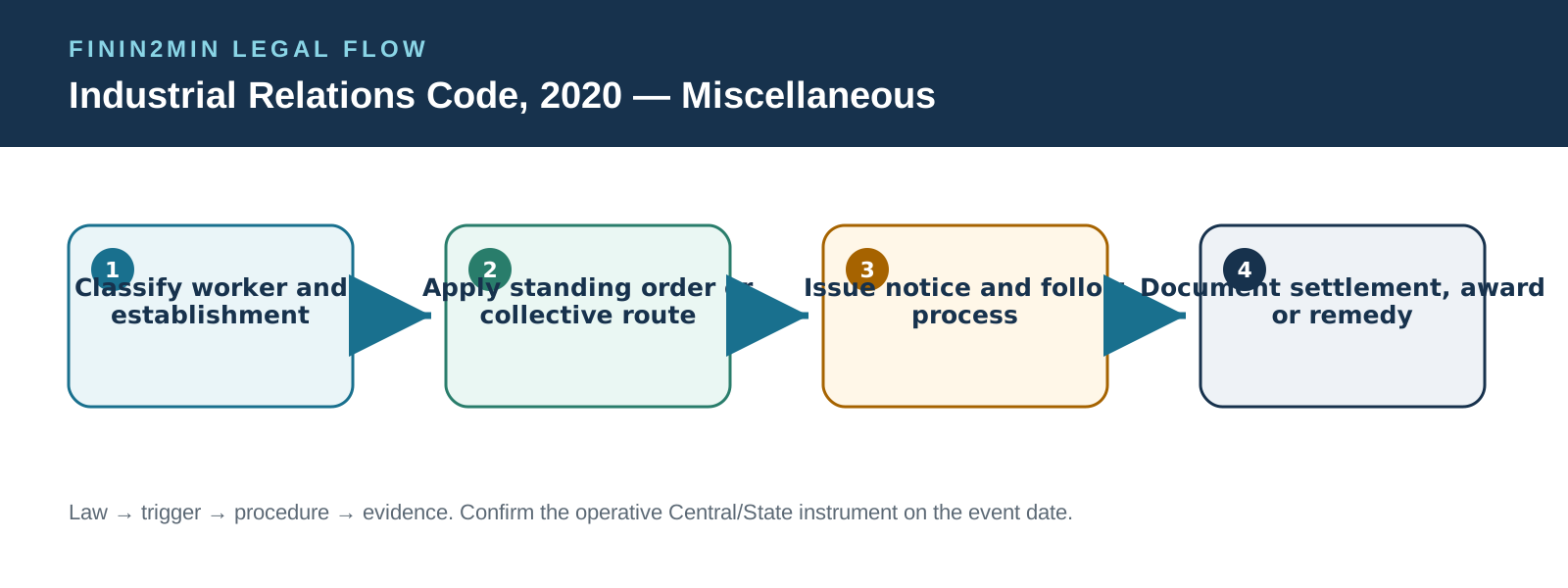
Chapter decision flow
Finin2min Summary - Chapter in 2 Minutes
This chapter turns miscellaneous into an operational control file. It covers Conditions of service, etc., to remain unchanged under certain circumstances during pendency of proceedings, Special provision for adjudication as to whether conditions of service, etc., changed during pendency of proceedings, Power to transfer certain proceedings, Protection of persons; the practical sequence is to classify coverage and event date, apply the provision and mapped Rule, complete the form/register, calculate the entitlement or exposure, and retain evidence for inspection, claim or appeal.
Who is covered
Employers, workers, trade unions, negotiating bodies, standing-order establishments and dispute-resolution authorities should classify the industrial establishment and worker population first.
Main obligations and rights
- Section 90: Conditions of service, etc., to remain unchanged under certain circumstances during pendency of proceedings
- Section 91: Special provision for adjudication as to whether conditions of service, etc., changed during pendency of proceedings
- Section 92: Power to transfer certain proceedings
- Section 93: Protection of persons
- Section 94: Representation of parties
- Section 95: Removal of doubts in interpretation of award or settlement
Key thresholds and timelines
- Use only the threshold, rate and limitation period effective on the event date; verify the Central/State instrument before acting.
Forms, registers and evidence
- Applicable form/register, calculation file, approval and acknowledgement evidence
- Retain classification, calculation, approval, communication, acknowledgement and payment/filing proof.
Employer risk snapshot
Highest practical risks: misclassification, missed filing/notice, unsupported calculation, incomplete records and use of the wrong Central/State instrument.
Employee/worker remedy snapshot
Core protection: the substantive protection in this chapter, access to the prescribed authority/forum and a documented remedy within limitation. Confirm the authority, limitation and appeal route stated in this chapter.
Old law / transition
Map the event date and savings position against: Trade Unions Act, 1926; Industrial Employment (Standing Orders) Act, 1946; Industrial Disputes Act, 1947.
Five-point professional checklist
- Freeze the event date, establishment, location and person/worker classification.
- Identify the controlling section/paragraph, mapped Rule, notification and appropriate Government.
- Reperform the calculation or decision test and document every exception or approval.
- Complete the prescribed form/register/portal step and retain acknowledgement, payment and communication evidence.
- Record the remedy, forum, limitation, appeal path and State variation before sign-off.
Finin2min takeaway: for miscellaneous, the defensible answer is not a policy label - it is the event-date law, the mapped procedure, the calculation and a complete evidence trail.
Section-by-section provision map
| Provision | Subject | Implementation focus |
|---|---|---|
| Section 90 | Conditions of service, etc., to remain unchanged under certain circumstances during pendency of proceedings | Trigger, linked Rule/form, evidence, consequence and remedy |
| Section 91 | Special provision for adjudication as to whether conditions of service, etc., changed during pendency of proceedings | Trigger, linked Rule/form, evidence, consequence and remedy |
| Section 92 | Power to transfer certain proceedings | Trigger, linked Rule/form, evidence, consequence and remedy |
| Section 93 | Protection of persons | Trigger, linked Rule/form, evidence, consequence and remedy |
| Section 94 | Representation of parties | Trigger, linked Rule/form, evidence, consequence and remedy |
| Section 95 | Removal of doubts in interpretation of award or settlement | Trigger, linked Rule/form, evidence, consequence and remedy |
| Section 96 | Power to exempt | Trigger, linked Rule/form, evidence, consequence and remedy |
| Section 97 | Jurisdiction of civil courts barred | Trigger, linked Rule/form, evidence, consequence and remedy |
| Section 98 | Protection of action taken in good faith | Trigger, linked Rule/form, evidence, consequence and remedy |
| Section 99 | Power of appropriate Government to make rules | Trigger, linked Rule/form, evidence, consequence and remedy |
| Section 100 | Delegation of powers | Trigger, linked Rule/form, evidence, consequence and remedy |
| Section 101 | Power to amend Schedules | Trigger, linked Rule/form, evidence, consequence and remedy |
| Section 102 | Amendment of Act 7 of 2017 | Trigger, linked Rule/form, evidence, consequence and remedy |
| Section 103 | Power to remove difficulties | Trigger, linked Rule/form, evidence, consequence and remedy |
| Section 104 | Repeal and savings | Trigger, linked Rule/form, evidence, consequence and remedy |
Section 90: Conditions of service, etc., to remain unchanged under certain circumstances during pendency of proceedings
Current statutory text
90. Conditions of service, etc., to remain unchanged under certain circumstances during
pendency of proceedings.—(1) Where an industrial dispute pertaining to an establishment or
undertaking is already pending before a conciliation officer or an Arbitrator or a Tribunal or a National
Industrial Tribunal, as the case may be, with regard to matters not covered by the notice of change
issued by an employer under section 40, no employer shall—

       (a) in regard to any matter connected with such dispute, alter to the prejudice of the workers
   concerned in such dispute the conditions of service applicable to them immediately before the
  commencement of such proceedings; or
       (b) for any misconduct connected with the dispute, discharge or punish, whether by dismissal or
   otherwise any worker concerned in such dispute,

save with the express permission in writing of the authority before which the proceeding is pending.

    (2) During the pendency of any such proceeding in respect of an industrial dispute referred in sub-
section (1), the employer may, in accordance with standing orders applicable to a worker concerned in
such dispute or, where there are no such standing orders, in accordance with the terms of the contract,
whether express or implied, between him and the worker—

       (a) alter, in regard to any matter not connected with the dispute, the conditions of service
   applicable to that worker immediately before the commencement of such proceeding; or

       (b) for any misconduct not connected with the dispute, discharge or punish, whether by dismissal
   or otherwise, that worker:

   Provided that no such worker shall be discharged or dismissed, unless he has been paid wages for
one month and an application has been made by the employer to the authority before which the
proceeding is pending for approval of the action taken by the employer.

   (3) Notwithstanding anything contained in sub-section (2), no employer shall, during the pendency
of any proceeding in respect of an industrial dispute, take any action against any protected worker
concerned in such dispute—

       (a) by altering, to the prejudice of such protected worker, the conditions of service applicable to
  him immediately before the commencement of such proceeding; or

       (b) by discharging or punishing, whether by dismissal or otherwise, such protected worker,

 save with the express permission in writing of the authority before which the proceeding is pending.

   Explanation.—For the purposes of  this sub-section, a "protected worker"  in  relation to an
establishment, means a worker who, being a member of the executive or other office-bearer of a
registered Trade Union connected with the establishment, is recognised as such in accordance with rules
made in this behalf.

   (4) In every establishment, the number of workers to be recognised as protected workers for the
purposes of sub-section (3) shall be one per cent. of the total number of workers employed therein
subject to a minimum number of five protected workers and a maximum number of one hundred
protected workers and for the aforesaid purpose, the appropriate Government may make rules providing
for the distribution of such protected workers among various Trade Unions, if any, connected with the
establishment and the manner in which the workers may be chosen and recognised as protected workers.

   (5) Where an employer makes an application to conciliation officer, arbitrator, Tribunal or National
Industrial Tribunal, as the case may be, under the proviso to sub-section (2) for approval of the action
taken by him, the authority concerned shall, without delay, hear such application and pass, within a
period of three months from the date of receipt of such application, such order in relation thereto as it
deems fit:

   Provided that where any such authority considers it necessary or expedient so to do, it may, for
reasons to be recorded in writing, extend such period by such further periods as it may think fit:

   Provided further that no proceedings before any such authority shall lapse merely on the ground that
any period specified in this sub-section had expired without such proceedings being completed.
Finin2min clause-by-clause decode
- Test 1
- During pending proceedings, the employer must not prejudicially alter connected service conditions or punish protected workers except through the statutory permission/approval route.
- Implementation control
- Trigger
- Document the fact pattern that activates section 90: conditions of service, etc., to remain unchanged under certain circumstances during pendency of proceedings.
- Coverage and jurisdiction
- Record worker/employee status, establishment, appropriate Government, threshold and territorial authority.
- Decision owner
- Assign HR/ER, legal, payroll/finance and authorised signatory roles; no action should depend on an undocumented oral decision.
- Evidence pack
Applicable Central Rules immediately below the provision
Central Rule 39: Rule 39 — Protected workers
Practical example
A multi-location employer prepares a legal classification memo, identifies the appropriate Government, maps the operative provision and Rule, records the decision owner and retains the documents needed to prove compliance during inspection or litigation.
Controls and evidence
- Employer: assign owner, configure system and retain approval/payment proof.
- Employee/worker: retain contract, attendance, wage/benefit proof and communication.
- Professional: reconcile the Act, Rule, notification, form, limitation and State overlay.
Consequence, remedy and limitation
Identify the substantive default first, then separately map arrears or benefit, interest/damages, administrative penalty, prosecution, compounding, company/officer liability, forum, appeal and limitation. Do not infer a remedy from the heading alone.
Mapped Rules: Rule 39 | Official source: section 90.
Section 91: Special provision for adjudication as to whether conditions of service, etc., changed during pendency of proceedings
Current statutory text
91. Special provision for adjudication as to whether conditions of service, etc., changed during
pendency of proceedings.—Where an employer contravenes the provisions of section 90 during the
pendency of proceedings before conciliation officer, arbitrator, Tribunal or National Industrial Tribunal,
as the case may be, any employee aggrieved by such contravention, may make a complaint in writing
in such manner as may be prescribed—

       (a) to such conciliation officer, and the conciliation officer shall take such complaint into account
   in mediating in, and promoting the settlement of, such industrial dispute; and

       (b) to such arbitrator, Tribunal or National Industrial Tribunal and on receipt of such complaint,
   the arbitrator, Tribunal or National Industrial Tribunal, as the case may be, shall adjudicate upon the
   complaint as if it were a dispute referred to or pending before it, in accordance with the provisions
   of this Code and shall submit his or its award to the appropriate Government and the provisions of
    this Code shall apply accordingly.
Finin2min clause-by-clause decode
- Test 1
- A complaint alleging contravention of section 90 is made to the pending conciliation/arbitration/Tribunal forum in Form XVI under Rule 40.
- Implementation control
- Trigger
- Document the fact pattern that activates section 91: special provision for adjudication as to whether conditions of service, etc., changed during pendency of proceedings.
- Coverage and jurisdiction
- Record worker/employee status, establishment, appropriate Government, threshold and territorial authority.
- Decision owner
- Assign HR/ER, legal, payroll/finance and authorised signatory roles; no action should depend on an undocumented oral decision.
- Evidence pack
Applicable Central Rules immediately below the provision
Central Rule 40: Rule 40 — Complaint by aggrieved employee
Controls and evidence
- Employer: assign owner, configure system and retain approval/payment proof.
- Employee/worker: retain contract, attendance, wage/benefit proof and communication.
- Professional: reconcile the Act, Rule, notification, form, limitation and State overlay.
Mapped Rules: Rule 40 | Official source: section 91.
Section 92: Power to transfer certain proceedings
Current statutory text
92. Power to transfer certain proceedings. (1) The appropriate Government may, by order in
writing and for reasons to be stated therein, withdraw any proceeding under this Code pending before
a Tribunal and transfer the same to another Tribunal, as the case may be, for the disposal of the
proceeding and the Tribunal to which the proceeding is so transferred may, subject to special directions
in the order of transfer, proceed either de novo or from the stage at which it was so transferred.

   (2) The Central Government may, by order in writing and for reasons to be stated therein, withdraw
any proceeding pending under this Code before a Tribunal constituted by the Central Government or
the State Government and transfer to a National Industrial Tribunal for disposal of the proceeding and
the National Industrial Tribunal to which the proceeding is so transferred may, subject to special
directions in the order of transfer, proceed either de novo or from the stage at which it was so transferred.

   (3) The Central Government may, by notification, and for reasons to be stated therein, empower a
Tribunal constituted by the State Government to entertain and dispose of the cases arising within their
respective jurisdiction under the provisions of this Code where the appropriate Government is the
Central Government.
Finin2min clause-by-clause decode
- Test 1
- The provision creates the legal rule for power to transfer certain proceedings.
- Test 2
- Identify the actor, trigger, appropriate Government, prescribed manner and effective date before implementation.
- Test 3
- Keep contemporaneous approvals, notices, registers, filings, acknowledgements and decision evidence.
- Test 4
- Use the linked rules, notification and remedy route; unresolved classification or jurisdiction questions require professional review.
- Implementation control
- Trigger
Applicable Central Rules immediately below the provision
No direct Central Rule is mapped. Check general procedural Rules, State Rules and later notifications.
Controls and evidence
- Employer: assign owner, configure system and retain approval/payment proof.
- Employee/worker: retain contract, attendance, wage/benefit proof and communication.
- Professional: reconcile the Act, Rule, notification, form, limitation and State overlay.
Mapped Rules: No direct Central Rule mapped in the repository concordance | Official source: section 92.
Section 93: Protection of persons
Current statutory text
93. Protection of persons.—(1) No person refusing to take part or to continue to take part in any
strike or lock-out which is illegal under this Code shall, by reason of such refusal or by reason of any
action taken by him under this section, be subject to expulsion from any Trade Union or society, or to
any fine or penalty, or to deprivation of any right or benefit to which he or his legal representatives
would otherwise be entitled, or be liable to be placed in any respect, either directly or indirectly, under
any disability or at any disadvantage as compared with other members of the Union or society, anything
to the contrary in rules of a Trade Union or society notwithstanding.

   (2) Nothing in the rules of a Trade Union or society requiring the settlement of dispute in any manner
shall apply to any proceeding for enforcing any right or exemption secured by this section, and in any
such proceeding the civil court may, in lieu of ordering a person who has been expelled from
membership of a Trade Union or society to be restored to membership, order that he be paid out of the
funds of the Trade Union or society such sum by way of compensation or damages as that court thinks
just.
Finin2min clause-by-clause decode
- Test 1
- The provision creates the legal rule for protection of persons.
- Test 2
- Identify the actor, trigger, appropriate Government, prescribed manner and effective date before implementation.
- Test 3
- Keep contemporaneous approvals, notices, registers, filings, acknowledgements and decision evidence.
- Test 4
- Use the linked rules, notification and remedy route; unresolved classification or jurisdiction questions require professional review.
- Implementation control
- Trigger
Controls and evidence
- Employer: assign owner, configure system and retain approval/payment proof.
- Employee/worker: retain contract, attendance, wage/benefit proof and communication.
- Professional: reconcile the Act, Rule, notification, form, limitation and State overlay.
Mapped Rules: No direct Central Rule mapped in the repository concordance | Official source: section 93.
Section 94: Representation of parties
Current statutory text
94. Representation of parties.—(1) A worker who is a party to a dispute shall be entitled to be
represented in any proceeding under this Code by—

            (a) any member of the executive or other office-bearer of a registered Trade Union of which
     he is a member;
            (b) any member of the executive or other office-bearer of a federation of Trade Unions to
     which the Trade Union referred to in clause (a) is affiliated;

            (c) where the worker is not a member of any Trade Union, any member of the executive or
      other office-bearer of any Trade Union connected with, or by any other worker employed in the
      industry in which the worker is employed and authorised in such manner as may be prescribed.

       (2) An employer who is a party to a dispute shall be entitled to be represented in any proceeding
   under this Code by—

            (a) an officer of an association of employer of which he is a member;

            (b) an officer of a federation of associations of employers to which the association referred
       to in clause (a) is affiliated;

            (c) where the employer is not a member of any association of employers, an officer of any
      association of employers connected with, or by any other employer engaged in, the industry in
     which the employer is engaged and authorised in such manner as may be prescribed.

   (3) No party to a dispute shall be entitled to be represented by a legal practitioner in any conciliation
proceedings under this Code or any proceedings before Tribunal or National Industrial Tribunal.

    (4) Notwithstanding anything contained in sub-section (3), in any proceeding before a Tribunal or
a National Industrial Tribunal, a party to a dispute may be represented by a legal practitioner with the
consent of the other parties to the proceeding and with the leave of the Tribunal or National Industrial
Tribunal, as the case may be.
Finin2min clause-by-clause decode
- Test 1
- Representation depends on the forum and party status; employers, workers and unions must use the authorised representative categories stated in the section.
- Implementation control
- Trigger
- Document the fact pattern that activates section 94: representation of parties.
- Coverage and jurisdiction
- Record worker/employee status, establishment, appropriate Government, threshold and territorial authority.
- Decision owner
- Assign HR/ER, legal, payroll/finance and authorised signatory roles; no action should depend on an undocumented oral decision.
- Evidence pack
Applicable Central Rules immediately below the provision
Central Rule 41: Rule 41 — Authorisation of worker for representing in proceeding
Central Rule 42: Rule 42 — Authorisation of employer for representing in proceeding
Central Rule 43: Rule 43 — Parties bound by acts of representative
Controls and evidence
- Employer: assign owner, configure system and retain approval/payment proof.
- Employee/worker: retain contract, attendance, wage/benefit proof and communication.
- Professional: reconcile the Act, Rule, notification, form, limitation and State overlay.
Mapped Rules: Rule 41, Rule 42, Rule 43 | Official source: section 94.
Section 95: Removal of doubts in interpretation of award or settlement
Current statutory text
95. Removal of doubts in interpretation of award or settlement.—(1) If, in the opinion of the
appropriate Government, any difficulty or doubt arises as to the interpretation of any provision of an
award or settlement, it may refer the question to such Tribunal or National Industrial Tribunal as it may
think fit.

   (2) A Tribunal or National Industrial Tribunal to which such question is referred shall, after giving
the parties an opportunity of being heard, decide such question and its decision shall be final and binding
on all such parties.
Finin2min clause-by-clause decode
- Test 1
- Doubts about interpretation of an award or settlement may be referred by the appropriate Government to the Tribunal/National Tribunal.
- Implementation control
- Trigger
- Document the fact pattern that activates section 95: removal of doubts in interpretation of award or settlement.
- Coverage and jurisdiction
- Record worker/employee status, establishment, appropriate Government, threshold and territorial authority.
- Decision owner
- Assign HR/ER, legal, payroll/finance and authorised signatory roles; no action should depend on an undocumented oral decision.
- Evidence pack
Controls and evidence
- Employer: assign owner, configure system and retain approval/payment proof.
- Employee/worker: retain contract, attendance, wage/benefit proof and communication.
- Professional: reconcile the Act, Rule, notification, form, limitation and State overlay.
Mapped Rules: No direct Central Rule mapped in the repository concordance | Official source: section 95.
Section 96: Power to exempt
Current statutory text
96. Power to exempt.—(1) Where the appropriate Government is satisfied in relation to any
industrial establishment or undertaking or any class of industrial establishments or undertakings that
adequate provisions exist to fulfil the objects of any provision of this Code, it may, by notification,
exempt, conditionally or unconditionally such establishment or undertaking or, class of establishments
or undertakings from that provision of this Code.

   (2) Notwithstanding anything contained in sub-section (1), where the appropriate Government is
satisfied in relation to any new industrial establishment or new undertaking or class of new industrial
establishments or new undertakings that it is necessary in the public interest so to do, it may, by
notification, exempt, conditionally or unconditionally, any such new establishment or new undertaking
or class of new establishments or new undertakings from all or any of the provisions of this Code for
such period from the date of establishment of such new industrial establishment or new undertaking or
class of new establishments or new undertakings, as the case may be, as may be specified in the
notification:

   Provided that any notification issued by a State Government under the Industrial Disputes Act, 1947
(14 of 1947), prior to the commencement of this Code, to achieve the purpose as is specified in this sub-
section in the State, shall remain in force after such commencement for its remaining period as if the
provisions of this Code have not been brought into force to the extent they defeat any purpose to be
achieved by such notification issued by that State Government.

   Explanation.—For the purposes of this sub-section, the expression "new industrial establishment or
new undertaking or class of new industrial establishments or new undertakings" means such industrial
establishment or undertaking or class of industrial establishments or undertakings which are established
within a period as may be specified in the notification.
Finin2min clause-by-clause decode
- Test 1
- Exemptions require a valid notification and are construed with their conditions; do not rely on an assumed sector exemption.
- Implementation control
- Trigger
- Document the fact pattern that activates section 96: power to exempt.
- Coverage and jurisdiction
- Record worker/employee status, establishment, appropriate Government, threshold and territorial authority.
- Decision owner
- Assign HR/ER, legal, payroll/finance and authorised signatory roles; no action should depend on an undocumented oral decision.
- Evidence pack
Controls and evidence
- Employer: assign owner, configure system and retain approval/payment proof.
- Employee/worker: retain contract, attendance, wage/benefit proof and communication.
- Professional: reconcile the Act, Rule, notification, form, limitation and State overlay.
Mapped Rules: No direct Central Rule mapped in the repository concordance | Official source: section 96.
Section 97: Jurisdiction of civil courts barred
Current statutory text
97. Jurisdiction of civil courts barred.—No civil court shall have jurisdiction in respect of any
matter to which any provision of this Code applies and no injunction shall be granted by any civil court
in respect of anything which is done or intended to be done by or under this Code.
Finin2min clause-by-clause decode
- Test 1
- Civil-court jurisdiction is barred for matters assigned to the Code; identify the correct statutory forum before filing.
- Implementation control
- Trigger
- Document the fact pattern that activates section 97: jurisdiction of civil courts barred.
- Coverage and jurisdiction
- Record worker/employee status, establishment, appropriate Government, threshold and territorial authority.
- Decision owner
- Assign HR/ER, legal, payroll/finance and authorised signatory roles; no action should depend on an undocumented oral decision.
- Evidence pack
Controls and evidence
- Employer: assign owner, configure system and retain approval/payment proof.
- Employee/worker: retain contract, attendance, wage/benefit proof and communication.
- Professional: reconcile the Act, Rule, notification, form, limitation and State overlay.
Mapped Rules: No direct Central Rule mapped in the repository concordance | Official source: section 97.
Section 98: Protection of action taken in good faith
Current statutory text
98. Protection of action taken in good faith.—No suit, prosecution or other legal proceeding shall
lie against any person for anything which is in good faith done or intended to be done in pursuance of
this Code or any rules made thereunder.
Finin2min clause-by-clause decode
- Test 1
- The provision creates the legal rule for protection of action taken in good faith.
- Test 2
- Identify the actor, trigger, appropriate Government, prescribed manner and effective date before implementation.
- Test 3
- Keep contemporaneous approvals, notices, registers, filings, acknowledgements and decision evidence.
- Test 4
- Use the linked rules, notification and remedy route; unresolved classification or jurisdiction questions require professional review.
- Implementation control
- Trigger
Controls and evidence
- Employer: assign owner, configure system and retain approval/payment proof.
- Employee/worker: retain contract, attendance, wage/benefit proof and communication.
- Professional: reconcile the Act, Rule, notification, form, limitation and State overlay.
Mapped Rules: No direct Central Rule mapped in the repository concordance | Official source: section 98.
Section 99: Power of appropriate Government to make rules
Current statutory text
99. Power of appropriate Government to make rules.—(1) The appropriate Government may,
subject to the condition of previous publication, make rules for the purpose of giving effect to the
provisions of this Code:

   Provided that the appropriate Government may, if it is satisfied that circumstances exist which render
it necessary or expedient in the public interest so to do, dispense with the condition of previous
publication or reduce the required time period for inviting objections or suggestions on such previous
publication to the extent as it may deem fit.

   (2) In particular and without prejudice to the generality of the foregoing power, such rules may
provide for all or any of the following matters, namely:—

       (a) written agreement between the employer and worker arrived at otherwise than in the course
   of conciliation proceeding to arrive at a settlement under clause (zi) of section 2;

       (b) constitution of Works Committee and choosing of representatives of employer and workers
   engaged in the establishment under section 3;

        (c) manner of choosing members from the employer and the workers for Grievance Redressal
   Committee under sub-section (2) of section 4;

       (d) application in respect of any dispute to be filed before the Grievance Redressal Committee
   by any aggrieved worker under sub-section (5) of section 4;

        (e) manner of filing application for the conciliation of grievance as against the decision of the
   Grievance Redressal Committee to the conciliation officer under sub-section (8) of section 4;

         (f) the payment of a subscription by members of the Trade Union and donation from such
  members and others under clause (f) of section 7;

       (g) manner of annual audit under clause (j) of section 7;

       (h) form of declaration to be made by an affidavit and the manner of making the same under
   clause (a) of sub-section (1) of section 8;

         (i) general statement of the assets and liabilities of the Trade Union prepared in such form and
   containing such particulars under sub-section (2) of section 8;

        (j) the form of application for registration under sub-section (1), and the form of issuing certificate
   of registration to be issued by the Registrar to the applicant Trade Union under sub-section (2) of
   section 9;
   (k) the form of entering the name and other particulars of Trade Union in a register maintained
by the Registrar in this behalf under sub-section (3) of section 9;

    (l) verification of application of the Trade Union under sub-section (5) of section 9;

   (m) period within which appeal is to be preferred by Trade Union to Tribunal under sub-section
(1) of section 10;

   (n) sending of communication and notices under sub-section (1) and the manner to inform the
Registrar under sub-section (3) of section 11;

   (o) matters on which negotiating union or negotiating council, as the case may be, in an industrial
establishment may negotiate with the employer of the industrial establishment under sub-section (1)
and the criteria to be followed by the employer of industrial establishment under sub-section (2) of
section 14;

   (p) manner of verification of workers on the muster roll of the industrial establishment, under
sub-sections (3) and (4) and the facilities to be provided by industrial establishment to a negotiating
union or negotiating council under sub-section (7) of section 14;

   (q) the objects under sub-section (1) and sub-section (2) and the subscription payable under sub-
section (4) of section 15;

    (r) manner of making application for adjudication before the Tribunal under sub-section (1) of
section 22;

    (s) manner of amalgamation under sub-section  (2), and the manner of sending signed
amalgamation to the Registrar of a different State under sub-section (3) of section 24;

    (t) distribution of funds of the Trade Union on dissolution by Registrar under sub-section (2) of
section 25;

   (u) the date before which a general statement shall be forwarded annually to the Registrar, the
particulars to be contained in general statement and its form, the person by whom and the manner in
which such general statement shall be audited under clause (a) of sub-section (1) of section 26;

   (v) manner and purpose of recognition of a Trade Union or a federation of Trade Unions by the
State Government as a State Trade Union at the State level and the authority and the manner of
deciding dispute by it under sub-section (2) of section 27;

   (w) the manner of forwarding information to the certifying officer under sub-section (3) of section
30 and the period within which the amendment of standing order is to be done as observed by the
certifying officer under the proviso thereof;

   (x) manner of choosing representatives of the workers of the industrial establishment or
undertaking for issuing notice by certifying officer, where there is no Trade Union operating, under
sub-section (5) and the manner of authentication of certified standing orders under sub-section (8)
of section 30;

   (y) statement to be accompanied with draft standing orders under sub-section (9) of section 30;

    (z) conditions for submission of draft standing orders by group of employers in similar
establishment under sub-section (10) of section 30;

   (za) manner of disposal of appeal by the appellate authority under section 32;

   (zb) the manner of sending copies of the order of the appellate authority under sub-section (1)
and the language and the manner of maintaining standing order under sub-section (2) of section 33;
   (zc) form of register for filing finally certified standing orders by the certifying officer and fee
for furnishing certified copy of such orders under section 34;

   (zd) application for modification of standing orders to be made before certifying officer under
sub-section (2) of section 35;

   (ze) the manner of giving of notice of the nature of the change proposed to be effected under
clause (i) of section 40;

     (zf) form of arbitration agreement and the manner to be signed by the parties thereto under sub-
section (3) of section 42;

    (zg) manner of issuance of notification where an industrial dispute has been referred to
arbitration under sub-section (5) of section 42;

   (zh) manner of choosing representatives of the workers where there is no Trade Union under the
proviso to sub-section (5) of section 42;

     (zi) manner of filling up the vacancy under sub-section (9) of section 44;

    (zj) the procedure for selection, salaries and allowances and other terms and conditions of Judicial
and Administrative Members of the National Industrial Tribunal under sub-section (6) of section 46;

   (zk) such other matters in respect of which a conciliation officer, Tribunal and National Industrial
Tribunal shall have the same powers as are vested in a civil court under the Code of Civil
Procedure,1908 under sub-section (3) of section 49;

     (zl) manner of holding conciliation proceedings under sub-section (1), form of full report under
sub-section (4), and the form of application and the manner of deciding such application under sub-
section (6), of section 53;

   (zm) the number of persons by whom the notice of strike shall be given, the person or persons to
whom such notice shall be given, and the manner of giving such notice, under sub-section (4) of
section 62;

   (zn) manner of giving notice of lock-out under sub-section (5) and the authority under sub-section
(6) of section 62;

   (zo) manner of serving notice before retrenchment of a worker employed in the industry who has
been in continuous service for not less than one year by an employer on the appropriate Government
or such authority as may be specified by the appropriate Government by notification under clause
(c) of section 70;

    (zp) manner in which the employer shall give an opportunity to the retrenched workers who are
citizens of India to offer themselves for re-employment under section 72;

    (zq) manner in which the employer shall serve notice on the appropriate Government stating
clearly the reasons for the intended closure of the undertaking under sub-section (1) of section 74;

    (zr) manner of making application by the employer stating clearly the reasons for the intended
lay-off and the manner of serving copy of such application to workers under sub-section (2) of
section 78;

    (zs) manner of applying to the appropriate Government for permission to continue the lay-off by
the employer under sub-section (3) of section 78;

     (zt) time-limit for review under sub-section (7) of section 78;
       (zu) manner of making application by the employer stating clearly the reasons for the intended
   retrenchment and the manner of serving copy of such application to workers under sub-section (2)
   of section 79;

       (zv) time-limit for review under sub-section (6) of section 79;

      (zw) manner of making application by the employer stating clearly the reasons for the intended
   closing down of an undertaking of an industrial establishment and the manner of serving copy of
   such application to the representatives of workers under sub-section (1) of section 80;

       (zx) time-limit for review under sub-section (5) of section 80;

        (zy) contribution from such other sources to be made to the worker re-skilling fund under clause
   (b) of sub-section (2) of section 83;

       (zz) manner of utilisation of fund under sub-section (3) of section 83;

       (zza) manner of composition of offence by a Gazetted Officer specified under sub-section (1) of
   section 89;

       (zzb) manner of making application for the compounding of an offence specified under sub-
   section (4) of section 89;

       (zzc) manner of making complaint by an aggrieved employee under section 91;

       (zzd) manner of authorisation of worker for representing in any proceeding under sub-section (1)
   of section 94;

       (zze) manner of authorisation of employer for representing in any proceeding under sub-section
   (2) of section 94;

       (zzf) any other matter which is required to be, or may be, prescribed under the provisions of this
   Code. (3) The Central Government shall make rules for the—

           (a) manner of recognition of a Trade Union or federation of Trade Unions by the Central
     Government as a Central Trade Union at the Central level and the authority and the manner of
      deciding dispute by it under sub-section (1) of section 27; and

          (b) manner of holding an enquiry under sub-section (1) of section 85.

   (4) All rules made under this section by the State Government shall, as soon as possible after they
are made, be laid before the State Legislature.

    (5) Every rule made under this section and notification issued under clause (p) of section 2, by the
Central Government shall be laid, as soon as may be after it is made, before each House of Parliament
while it is in session for a total period of thirty days which may be comprised in one session or in two
or more successive sessions, and if, before the expiry of the session immediately following the session
or the successive sessions aforesaid, both Houses agree in making any modification in the rule or
notification, or both Houses agree that the rule or notification should not be made, the rule or notification
shall thereafter have effect only in such modified form or be of no effect, as the case may be; so,
however, that any such modification or annulment shall be without prejudice to the validity of anything
previously done under that rule or notification.
Finin2min clause-by-clause decode
- Test 1
- Central and State Governments make rules for their respective spheres. Central Rules do not eliminate the need to check valid State rules.
- Implementation control
- Trigger
- Document the fact pattern that activates section 99: power of appropriate government to make rules.
- Coverage and jurisdiction
- Record worker/employee status, establishment, appropriate Government, threshold and territorial authority.
- Decision owner
- Assign HR/ER, legal, payroll/finance and authorised signatory roles; no action should depend on an undocumented oral decision.
- Evidence pack
Controls and evidence
- Employer: assign owner, configure system and retain approval/payment proof.
- Employee/worker: retain contract, attendance, wage/benefit proof and communication.
- Professional: reconcile the Act, Rule, notification, form, limitation and State overlay.
Mapped Rules: No direct Central Rule mapped in the repository concordance | Official source: section 99.
Section 100: Delegation of powers
Current statutory text
100. Delegation of powers.—The appropriate Government may, by notification, direct that any
power exercisable by it under this Code or rules made thereunder shall, in relation to such matters and
subject to such conditions, if any, as may be specified in the direction, be exercisable also,—
       (a) where the appropriate Government is the Central Government, by such officer or authority
   subordinate to the Central Government or by the State Government, or by such officer or authority
   subordinate to the State Government, as may be specified in the notification;

       (b) where the appropriate Government is a State Government, by such officer or authority
   subordinate to the State Government as may be specified in the notification.
Finin2min clause-by-clause decode
- Test 1
- Delegation must be supported by a notification and observed within its subject, officer and territorial limits.
- Implementation control
- Trigger
- Document the fact pattern that activates section 100: delegation of powers.
- Coverage and jurisdiction
- Record worker/employee status, establishment, appropriate Government, threshold and territorial authority.
- Decision owner
- Assign HR/ER, legal, payroll/finance and authorised signatory roles; no action should depend on an undocumented oral decision.
- Evidence pack
Controls and evidence
- Employer: assign owner, configure system and retain approval/payment proof.
- Employee/worker: retain contract, attendance, wage/benefit proof and communication.
- Professional: reconcile the Act, Rule, notification, form, limitation and State overlay.
Mapped Rules: No direct Central Rule mapped in the repository concordance | Official source: section 100.
Section 101: Power to amend Schedules
Current statutory text
101. Power to amend Schedules.—(1) The Central Government may, by notification, add to or
alter or amend the First Schedule or the Second Schedule or the Third Schedule and on any such
notification being issued, the First Schedule or the Second Schedule or the Third Schedule, as the case
may be, shall be deemed to be amended accordingly.

    (2) Every notification issued by the Central Government under sub-section (1) shall be laid as soon
as may be after it is made before each House of Parliament while it is in session for a total period of
thirty days which may be comprised in one session or in two or more successive sessions, and if, before
the expiry of the session immediately following the session or the successive sessions aforesaid, both
Houses agree in making any modification in the notification, or both Houses agree that the modification
should not be made, the notification shall thereafter have effect only in such modified form or be of no
effect, as the case may be; so, however, that any such modification or annulment shall be without
prejudice to the validity of anything previously done in pursuance of that notification.
Finin2min clause-by-clause decode
- Test 1
- The Central Government may amend the three Schedules by notification; monitor changes because they alter standing orders, unfair practices and notice-of-change coverage.
- Implementation control
- Trigger
- Document the fact pattern that activates section 101: power to amend schedules.
- Coverage and jurisdiction
- Record worker/employee status, establishment, appropriate Government, threshold and territorial authority.
- Decision owner
- Assign HR/ER, legal, payroll/finance and authorised signatory roles; no action should depend on an undocumented oral decision.
- Evidence pack
Controls and evidence
- Employer: assign owner, configure system and retain approval/payment proof.
- Employee/worker: retain contract, attendance, wage/benefit proof and communication.
- Professional: reconcile the Act, Rule, notification, form, limitation and State overlay.
Mapped Rules: No direct Central Rule mapped in the repository concordance | Official source: section 101.
Section 102: Amendment of Act 7 of 2017
Current statutory text
102. Amendment of Act 7 of 2017.—In the Finance Act, 2017, in the Eighth Schedule, against
serial number 1,—

        (a) in column (2), for the words “Industrial Tribunal constituted by the Central Government”,
   the words, brackets and figures "Industrial Tribunal constituted by the Central Government under
   sub-section (1) of section 44 of the Industrial Relations Code, 2020” shall be substituted;

        (b) in column (3), for the words and figures “The Industrial Disputes Act, 1947” (14 of 1947),
   the words and figures “The Industrial Relations Code, 2020" shall be substituted.
Finin2min clause-by-clause decode
- Test 1
- The provision creates the legal rule for amendment of act 7 of 2017.
- Test 2
- Identify the actor, trigger, appropriate Government, prescribed manner and effective date before implementation.
- Test 3
- Keep contemporaneous approvals, notices, registers, filings, acknowledgements and decision evidence.
- Test 4
- Use the linked rules, notification and remedy route; unresolved classification or jurisdiction questions require professional review.
- Implementation control
- Trigger
Controls and evidence
- Employer: assign owner, configure system and retain approval/payment proof.
- Employee/worker: retain contract, attendance, wage/benefit proof and communication.
- Professional: reconcile the Act, Rule, notification, form, limitation and State overlay.
Mapped Rules: No direct Central Rule mapped in the repository concordance | Official source: section 102.
Section 103: Power to remove difficulties
Current statutory text
103. Power to remove difficulties.— (1) If any difficulty arises in giving effect to the provisions of
this Code, the Central Government may, by order published in the Official Gazette, make such
provisions, not inconsistent with the provisions of this Code as may appear to it to be necessary for
removing the difficulty: Provided that no order shall be made under this section after the expiry of three
years from the date of commencement of this Code.

   (2) Every order made under this section shall be laid before each House of Parliament.
Finin2min clause-by-clause decode
- Test 1
- Removal-of-difficulty orders must remain consistent with the Code and can only be made within three years from commencement.
- Implementation control
- Trigger
- Document the fact pattern that activates section 103: power to remove difficulties.
- Coverage and jurisdiction
- Record worker/employee status, establishment, appropriate Government, threshold and territorial authority.
- Decision owner
- Assign HR/ER, legal, payroll/finance and authorised signatory roles; no action should depend on an undocumented oral decision.
- Evidence pack
Controls and evidence
- Employer: assign owner, configure system and retain approval/payment proof.
- Employee/worker: retain contract, attendance, wage/benefit proof and communication.
- Professional: reconcile the Act, Rule, notification, form, limitation and State overlay.
Mapped Rules: No direct Central Rule mapped in the repository concordance | Official source: section 103.
Section 104: Repeal and savings
Current statutory text
104. Repeal and savings.—1[(1) The following enactments shall stand repealed on and from the
date appointed in the notification issued under sub-section (3) of section 1, namely:—

        (a) the Trade Unions Act, 1926 (16 of 1926);

        (b) the Industrial Employment (Standing Orders) Act, 1946 (20 of 1946); and

         (c) the Industrial Disputes Act, 1947 (14 of 1947).

    (1A) Notwithstanding such repeal under sub-section (1), the functioning of the Tribunals and
statutory authorities functioning under the Acts so repealed shall continue to function till such Tribunals
and other statutory authorities becomes functional under this Code.]


1. Subs. by Act 1 of 2026, s. 2, for sub-section (1) (w.e.f. 21-11-2025).
    (2) Notwithstanding such repeal under sub-section (1), anything done or any action taken under the
provisions of the enactments so repealed including any rule, regulation, notification, nomination,
appointment, order or direction made thereunder shall be deemed to have been done or taken under the
corresponding provisions of this Code and shall be in force to the extent they are not contrary to the
provisions of this Code.

    (3) Without prejudice to the provisions of sub-section (2), the provisions of section 6 of the General
Clauses Act, 1897 shall apply to the repeal of such enactments.
                        THE FIRST SCHEDULE

                           [See sections 2 (zj), 30 (1), (6) and 101 (1)]

MATTERS TO BE PROVIDED IN STANDING ORDERS UNDER THIS CODE

 1. Classification of workers, whether permanent, temporary, apprentices, probationers, badlis or fixed
   term employment.

 2. Manner of intimating to workers periods and hours of work, holidays, pay-days and wage rates.

3. Shift working.

4. Attendance and late coming.

5. Conditions of, procedure in applying for, and the authority which may grant leave and holidays.

 6. Requirement to enter premises by certain gates, and liability to search.

7. Closing and reporting of sections of the industrial establishment, temporary stoppages of work and
   the rights and liabilities of the employer and workers arising therefrom.

8. Termination of employment, and the notice thereof to be given by employer and workers.

 9. Suspension or dismissal for misconduct, and acts or omissions which constitute misconduct.

10. Means of redress for workers against unfair treatment or wrongful exactions by the employer or his
   agents or servants.

11. Any other matter which may be specified by the appropriate Government by notification.
                       THE SECOND SCHEDULE

                            [See sections 2 (zo), 84, 86 (5) and 101(1)]

                      UNFAIR LABOUR PRACTICES

     I. ON THE PART OF EMPLOYERS AND TRADE UNIONS OF EMPLOYERS

(1) To interfere with, restrain from, or coerce, workers in the exercise of their right to organise, form,
   join or assist a Trade Union or to engage in concerted activities for the purposes of collective
   bargaining or other mutual aid or protection, that is to say,—

   (a) threatening workers with discharge or dismissal, if they join a Trade Union;

   (b) threatening a lock-out or closure, if a Trade Union is organised;

   (c) granting wage increase to workers at crucial periods of Trade Union organisation, with a view to
      undermining the efforts of the Trade Union organisation.

(2) To dominate, interfere with or contribute support, financial or otherwise, to any Trade Union, that
is to say,—

     (a) an employer taking an active interest in organising a Trade Union of his workers; and

     (b) an employer showing partiality or granting favour to one of several Trade Unions attempting
        to organise his workers or to its members, where such a Trade Union is not a recognised Trade
       Union.

 (3) To establish employer sponsored Trade Unions of workers.

 (4) To encourage or discourage membership in any Trade Union by discriminating against any worker,
     that is to say,—

     (a) discharging or punishing a worker, because he urged other workers to join or organise a Trade
       Union;

     (b) discharging or dismissing a worker for taking part in any strike (not being a strike which is
      deemed to be an illegal strike under this Code);

     (c) changing seniority rating of workers because of Trade Union activities;

     (d) refusing to promote workers to higher posts on account of their Trade Union activities;

     (e) giving unmerited promotions to certain workers with a view to creating discord amongst other
       workers, or to undermine the strength of their Trade Union;

      (f) discharging office-bearers or active members of the Trade Union on account of their Trade
      Union activities.

 (5) To discharge or dismiss workers,—

   (a) by way of victimisation;

   (b) not in good faith, but in the colourable exercise of the employer's rights;

   (c) by falsely implicating a worker in a criminal case on false evidence or on concocted evidence;

   (d) for patently false reasons;

   (e) on untrue or trumped up allegations of absence without leave;
    (f) in utter disregard of the principles of natural justice in the conduct of domestic enquiry or with
     undue haste;

   (g) for misconduct of a minor or technical character, without having any regard to the nature of the
       particular misconduct or the past record or service of the worker, thereby leading to a
      disproportionate punishment.

 (6) To abolish the work of a regular nature being done by workers, and to give such work to contractors
     as a measure of breaking a strike.

(7) To transfer a worker mala fide from one place to another, under the guise of following management
   policy.

(8) To insist upon individual workers, who are on a legal strike to sign a good conduct bond, as a
     precondition to allowing them to resume work.

(9) To show favouritism or partiality to one set of workers regardless of merit.

(10) To employ workers as badli workers, casuals or temporaries and to continue them as such for years,
    with the object of depriving them of the status and privileges of permanent workers.

(11) To discharge or discriminate against any worker for filing charges or testifying against an employer
     in any enquiry or proceeding relating to any industrial dispute.

(12) To recruit worker during a strike which is not an illegal strike.

(13) Failure to implement award, settlement or agreement.

(14) To indulge in acts of force or violence.

(15) To refuse to bargain collectively, in good faith with the recognised Trade Unions.

(16) Proposing or continuing a lock-out deemed to be illegal under this Code.

      II. ON THE PART OF WORKERS AND TRADE UNIONS OF WORKERS

(1) To advise or actively support or instigate any strike deemed to be illegal under this Code.

(2) To coerce workers in the exercise of their right to self-organisation or to join a Trade Union or
     refrain from, joining any Trade Union, that is to say—

     (a) for a Trade Union or its members to picketing in such a manner that non-striking workers are
        physically debarred from entering the work places;

     (b) to indulge in acts of force or violence or to hold out threats of intimidation in connection with
       a strike against non-striking workers or against managerial staff.

(3) For a recognised union to refuse to bargain collectively in good faith with the employer.

(4) To indulge in coercive activities against certification of a bargaining representative.

(5) To stage, encourage or instigate such forms of coercive actions as wilful, "go-slow", squatting on
     the work premises after working hours or "gherao" of any of the members of the managerial or
     other staff.

    Explanation 1.—For the removal of doubts, it is clarified that “go-slow” shall mean an occasion
when more than one worker in an establishment conjointly work more slowly and with less effort than
usual to try to persuade the employer of the establishment to agree to higher pay or better service
condition or such other demand.

     Explanation 2.—For the purposes of Explanation 1, the expression “usual” shall mean,—
         (i) where the standard has been specified for a worker for his work either daily, weekly or
         monthly basis, such work; and

         (ii) where no such standard has been specified such rate of work which is the average of work in
           the previous three months calculated on daily or weekly or monthly basis, as the case may
           be.

(6) To stage demonstrations at the residence of the employers or the managerial staff members.

(7) To incite or indulge in wilful damage to employer's property connected with the industry.

(8) To indulge in acts of force or violence or to hold out threats of intimidation against any worker with
   a view to prevent him from attending work.
                       THE THIRD SCHEDULE

                                  [See sections 40 and 101 (1)]

     CONDITIONS OF SERVICE FOR CHANGE OF WHICH NOTICE IS TO BE GIVEN

1. Wages, including the period and mode of payment.

2. Contribution paid, or payable, by the employer to any provident fund or pension fund or for the
   benefit of the workers under any law for the time being in force.

3. Compensatory and other allowances.

4. Hours of work and rest intervals.

5. Leave with wages and holidays.

6. Starting, alteration or discontinuance of shift working otherwise than in accordance with standing
   orders.

 7. Classification by grades.

8. Withdrawal of any customary concession or privilege or change in usage.

9. Introduction of new rules of discipline, or alteration of existing rules, except in so far as they are
   provided in standing orders.

10. Rationalisation, standardisation or improvement of plant or technique which is likely to lead to
   retrenchment of workers.

11. Any increase or reduction (other than casual) in the number of persons employed or to be employed
   in any occupation or process or department or shift, not occasioned by circumstances over which the
   employer has no control.

                  ————
              STATEMENT OF OBJECTS AND REASONS

  The Second National Commission on Labour, which submitted  its report in June 2002, had
recommended that the existing set of labour laws should be broadly amalgamated into the following
groups, namely:––

       (a) industrial relations;

       (b) wages;

       (c) social security;

       (d) safety; and

       (e) welfare and working conditions.

   2. In pursuance of the recommendations of the said Commission relating to industrial relations and
the deliberations made in the tripartite meeting comprising of the Government, employers’ and industry
representatives, it has been decided to bring the proposed legislation for amalgamating, simplifying and
rationalising the relevant provisions of ––

       (a) the Trade Unions Act, 1926;

       (b) the Industrial Employment (Standing Orders) Act, 1946; and

       (c) the Industrial Disputes Act, 1947.

   3. Accordingly, the Industrial Relations Code, 2019 was introduced in Lok Sabha on the 28th
November, 2019, which was referred to the Department-related Parliamentary Standing Committee on
Labour for its examination and report. The said Committee submitted its Eighth Report on the 23rd
April, 2020 recommending various modifications in the said Bill to give impetus to the economic
activity in the country without compromising on the basic aspects of the benefit to workers. Considering
the valuable recommendations of the said Parliamentary Standing Committee, the Government
proposes to withdraw the Industrial Relations Code, 2019 pending in Parliament and introduce a new
Bill, namely, the Industrial Relations Code, 2020 with certain modifications.

   4. The proposed legislation provides for a broader framework to protect the rights of workers to form
unions, to minimise the friction between the employers and workers and to provide provisions for
investigation and settlement of industrial disputes. The object of the proposed legislation is to achieve
industrial peace and harmony as the ultimate pursuit in resolving industrial disputes and to advance the
progress of industry by bringing about the existence of harmony and cordial relationship between the
employers and workers.

   5. The salient features of the Industrial Relations Code, 2020, inter alia, are as follows:—

        (i) to define “workers” which includes the persons in supervisory capacity getting wages up to
   eighteen thousand rupees per month or an amount as may be notified by the Central Government
   from time to time;

        (ii) to provide for fixed term employment with the objective that the employee gets all the benefits
   like that of a permanent worker (including gratuity), except for notice period after conclusion of a
   fixed period, and retrenchment compensation. The employer has been provided with the flexibility
   to employ workers on fixed term basis on the basis of requirement and without restriction on any
   sector;

         (iii) to revise the definition of “industry” that any systematic activity carried on by co-operation
   between the employer and workers for the production, supply or distribution of goods or services
with a view to satisfy human wants or wishes (not being wants or wishes which are merely spiritual
or religious in nature) with certain exceptions;

    (iv) to bring concerted casual leave within the ambit of the definition of strike;

   (v) to provide the maximum number of members in the Grievance Redressal Committee up to ten
in an industrial establishment employing twenty or more workers. There shall be adequate
representation of the women workers therein in the proportion of the women workers to the total
workers employed in the industrial establishment;

    (vi) to provide for a new feature of recognition of negotiating union and negotiating council in
an industrial establishment by an employer for the purpose of negotiations. The criterion for
recognition of negotiating union has been fixed at fifty-one per cent. or more workers on a muster
roll of that industrial establishment. As regards negotiating council, a Trade Union having support
of every twenty per cent. of workers will get one seat in the negotiating council and the fraction
above twenty per cent. shall be disregarded;

    (vii) to provide for appeal against non-registration or cancellation of registration of Trade Union
before the Industrial Tribunal;

    (viii) to empower the Central Government and the State Governments to recognise a Trade Union
or a federation of Trade Unions as the Central Trade Union or State Trade Unions, respectively;

    (ix) to provide for applicability of threshold of three hundred or more workers for an industrial
establishment to obtain certification of standing orders, if the standing order differ from the model
standing order made by the Central Government;

   (x) to provide that if the employer prepares and adopts model standing order of the Central
Government with respect to the matters relevant to the employer’s industrial establishment, then the
model standing order would be deemed to be certified. Otherwise, the industrial establishment may
seek certification of only those clauses which are different from the model standing orders;

    (xi) to set up Industrial Tribunal consisting of a Judicial Member and an Administrative Member,
in place of only Judicial Member who presently presides the Tribunal. For certain specified cases,
the matters will be decided by the two-member Tribunal and the remaining shall be decided by
single-member Tribunal as may be provided for in the rules;

    (xii) to set up Industrial Tribunals in the place of existing multiple adjudicating bodies like the
Court of Inquiry, Board of Conciliation and Labour Courts;

    (xiii) to remove the reference system for adjudication of Industrial Disputes, except the reference
to the National Industrial Tribunal for adjudication;

   (xiv) to provide that the commencement of conciliation proceedings shall be deemed to have
commenced on the date of the first meeting held by the conciliation officer in an industrial dispute
after the receipt of the notice of strike or lock-out by the conciliation officer;

   (xv) to prohibit strikes and lock-outs in all industrial establishments without giving notice of
fourteen days;

   (xvi) to provide for the obligation on the part of industrial establishments pertaining to mine,
factories and plantation having three hundred or more workers to take prior permission of the
appropriate Government before lay-off, retrenchment and closure with flexibility to the appropriate
Government to increase the threshold to higher numbers, by notification;
       (xvii) to set up a re-skilling fund for training of retrenched workers. The fund shall, inter alia,
   consist of the contribution of the employer of an amount equal to fifteen days wages last drawn by
   the worker immediately before the retrenchment or such other number of days, as may be notified
   by the Central Government, in case of retrenchment only. The fund shall be utilised by crediting
   fifteen days wages last drawn by the worker to his account who is retrenched, within forty-five days
   of the retrenchment as may be provided by rules;

        (xviii) to provide for compounding of offences by a Gazetted Officer, as the appropriate
   Government may, by notification, specify, for a sum of fifty per cent. Of the maximum fine provided
   for such offence punishable with fine only and for a sum of seventy-five per cent. provided for such
   offence punishable with imprisonment for a term which is not more than one year, or with fine;

       (xix)  to  provide  for  penalties  for  different  types  of  violations  to  rationalise  with
   such offences and commensurate with the gravity of the violations;

       (xx) to empower the appropriate Government to exempt any industrial establishment from any of
   the provisions of the Code in the public interest for the specified period.

   6. The notes on clauses explain in detail the various provisions contained in the Bill.

   7. The Bill seeks to achieve the above objectives.


                                         SANTOSH KUMAR GANGWAR.


   NEW DELHI;
The 14th September, 2020.
Finin2min clause-by-clause decode
- Test 1
- The Trade Unions Act, 1926, Industrial Employment (Standing Orders) Act, 1946 and Industrial Disputes Act, 1947 stand repealed from commencement.
- Test 2
- The Industrial Relations Code (Amendment) Act, 2026 inserted a transitional continuation for Tribunals and statutory authorities until the Code bodies become functional, deemed effective from 21 November 2025.
- Test 3
- Earlier rules, notifications, appointments, orders and actions continue only to the extent saved and not contrary to the Code.
- Implementation control
- Trigger
- Document the fact pattern that activates section 104: repeal and savings.
- Coverage and jurisdiction
Controls and evidence
- Employer: assign owner, configure system and retain approval/payment proof.
- Employee/worker: retain contract, attendance, wage/benefit proof and communication.
- Professional: reconcile the Act, Rule, notification, form, limitation and State overlay.
Mapped Rules: No direct Central Rule mapped in the repository concordance | Official source: section 104.
Rules, forms, registers, portals and due dates
| Rule | Subject | Text/control status |
|---|---|---|
| 39 | Rule 39 — Protected workers | Exact Gazette extract embedded |
| 40 | Rule 40 — Complaint by aggrieved employee | Exact Gazette extract embedded |
| 41 | Rule 41 — Authorisation of worker for representing in proceeding | Exact Gazette extract embedded |
| 42 | Rule 42 — Authorisation of employer for representing in proceeding | Exact Gazette extract embedded |
| 43 | Rule 43 — Parties bound by acts of representative | Exact Gazette extract embedded |
Forms and registers must be confirmed from the appended 2026 Central Rules and the live portal applicable to the appropriate Government. A form is not treated as current merely because an earlier law used the same number.
Notifications and effective-date history
| Control | Required action |
|---|---|
| Enactment | Record Act number, assent and Gazette publication. |
| Commencement | Use the provision-specific commencement notification; the four Codes became broadly operative from 21 November 2025 subject to earlier partial commencement and corrigenda. |
| Central Rules | Read the applicable 2026 Central Rules from their Gazette date and verify subsequent amendments. |
| State instrument | Check final State Rules, authority notifications, forms and rates where the State is appropriate Government. |
Old-law/new-Code concordance
| Predecessor law | Transition control |
|---|---|
| Trade Unions Act, 1926 | Classify the event date, accrued right, saved Rule/notification and pending proceeding before moving to the Code. |
| Industrial Employment (Standing Orders) Act, 1946 | Classify the event date, accrued right, saved Rule/notification and pending proceeding before moving to the Code. |
| Industrial Disputes Act, 1947 | Classify the event date, accrued right, saved Rule/notification and pending proceeding before moving to the Code. |
Practical calculations and control file
Calculation sequence
- Freeze the employee/worker population and event date.
- Apply the statutory wage/benefit base and notified threshold.
- Reconcile attendance, service, payroll and contractor records.
- Calculate principal amount, interest/damages and any statutory compensation separately.
- Obtain legal/payroll approval and retain the versioned worksheet.
Three-owner sign-off
- Employer/HR: facts, classification, communication and workflow.
- Employee/worker: notice, records, nomination/claim and acknowledgement.
- Professional: source, formula, forum, limitation and evidence reconciliation.
Binding and highly relevant case-law principles
| Decision | Principle and present-use caution |
|---|---|
| Bangalore Water Supply v. A. Rajappa | The industry test remains an important interpretive starting point, subject to the Code definition and later statutory developments. |
| Workmen of Firestone Tyre v. Management | Domestic enquiry fairness and the adjudicatory power to examine dismissal remain central principles, subject to the Code and certified standing orders. |
| Bharat Bank Ltd. v. Employees | Industrial adjudication is specialised statutory adjudication; forum, reference and award provisions must be followed. |
| Karnal Leather Karamchari Sanghatan v. Liberty Footwear | Settlement and collective-bargaining outcomes require genuine authority, representativeness and statutory compliance. |
State-law variation alerts
- Confirm whether the Central or State Government is the appropriate Government.
- Central Rules do not automatically displace valid State Rules, rates, registers, authorities or portal procedures.
- Minimum-wage rates, holidays, working-hours permissions, licences and local welfare obligations require State-specific verification.
- Record Gazette number, effective date and supersession status in the location compliance register.
Practical examples and calculations
Classify the worker and establishment, identify the operative provision and notified instrument on the event date, compute the entitlement or exposure from source records, obtain approval, complete the filing/payment/action, and retain evidence. Do not use a portal value or payroll label as a substitute for the statutory test.
Calculation/control template: Control calculation: verified population or transaction base × applicable notified rate/amount × eligible period, adjusted for statutory inclusions, exclusions, ceilings, interest, compensation and prior payments. Reperform the calculation from retained source data.
Finin2min implementation explanation
Maintain a controlled implementation file for Industrial Relations Code, 2020 — Chapter XIV - Miscellaneous: coverage and event date, operative Central/State instrument, responsible owner, approval and authority, form/portal step, due date, calculation basis, supporting evidence, exception, escalation and closure proof. Reconcile payroll, HR, finance, contractor and legal records before sign-off.
Practical transaction application
Apply the chapter to workforce restructuring, standing orders, union recognition, disciplinary action, settlement drafting, transfer of undertaking, lay-off, retrenchment, closure and industrial-dispute strategy. Build the transaction timeline before notices or board approvals are issued.
Authority, consent and execution controls
Map powers among the board, occupier/employer, HR, disciplinary authority, authorised signatory and legal team. Verify delegation, standing orders, service rules, union/negotiating-council status and government permission or notice requirements; informal consent cannot cure a mandatory statutory step.
Stamp duty and registration alerts
Industrial settlements, service instruments and transfer documents may attract State stamp consequences depending on form and subject matter. Statutory filing, publication or registration under labour law is separate from document registration under the Registration Act and stamping under State law.
Evidence and document-retention checklist
Retain the operative law/rule version, classification note, approvals, signed instruments, statutory forms, portal acknowledgements, registers, calculations, bank proof, correspondence, inspection records, service proof, decision and appeal file. Apply the longer of the statutory retention rule, litigation hold, tax/audit need and contractual requirement; restrict access to personal and sensitive data.
Performance, delivery and payment controls
Create a milestone file for notice, consultation, permission, compensation, re-skilling contribution, service of orders and payment. No restructuring should close until payroll, bank proof, employee-wise computation, statutory filing and possession/access controls reconcile.
Breach, loss, mitigation and remedy framework
On detecting a breach, stop continuing exposure, preserve evidence, quantify employee and government dues, identify affected persons, make lawful corrective payment/filing, notify the authorised decision-maker, assess self-disclosure or compounding where available, and reserve contractual recovery against responsible vendors without delaying statutory remediation.
Limitation and forum controls
Use the conciliation officer, tribunal, national industrial tribunal, appellate channel or other prescribed forum as applicable. Track the dispute date, cause of action, pending proceedings, protected status and service of notices; private jurisdiction clauses cannot override the statutory adjudication scheme.
Arbitration and mediation interface
Voluntary arbitration and settlement mechanisms may be available where the Code permits. Draft the reference, issues, arbitrator appointment, publication/filing and settlement authority carefully; mediation is useful for commercial terms but must preserve non-waivable worker protections.
Company, partnership, GST and tax overlays
For a company, align board/delegation and officer-in-default controls; for an LLP or partnership, identify the designated partner/partner and authorised employer representative. Labour dues can affect transaction price, indemnities, director/partner exposure and insolvency claims. Salary/TDS, perquisite, contractor TDS, GST on outsourced services and accounting provisions must be reconciled without treating tax treatment as proof of labour-law classification.
Finin2min Q&A
Which law and version should be applied?
Use the current text of Industrial Relations Code, 2020, the commencement notification, the applicable Central or State Rules and any later instrument effective on the event date.
How is the appropriate Government identified?
Classify ownership/control, sector, establishment and contractor relationship before selecting the Central or State authority.
Can a company policy override the statutory protection?
No. A policy may improve a benefit or control, but it cannot contract out of a mandatory statutory floor.
What evidence should be retained?
Retain the classification memo, source instrument, form/portal record, calculation, approval, employee communication, acknowledgement and payment or authority proof.
Do the Central Rules apply to every establishment?
No. They govern the Central sphere. State Rules and State notifications must be checked where the State is the appropriate Government.
How should a historical event be tested?
Apply the law and subordinate instrument effective on the event date, then use the repeal-and-savings provision for pending rights and proceedings.
What happens when portal practice conflicts with the statute?
Record the conflict, follow the higher legal instrument, seek authority clarification where necessary and preserve screenshots and correspondence.
Can criminal and monetary consequences arise together?
They may. Separate wages/benefits, interest, damages, civil penalty, prosecution, compounding and director/officer liability.
Is a contractor arrangement enough to shift liability?
No. Principal-employer and contractor liabilities depend on the specific provision and facts; the contract should allocate evidence and recovery without diluting worker rights.
What is the first professional review step?
Freeze the event date and facts, identify the applicable provision, then map Rules, forms, notification status, authority, limitation and evidence.
What is the operational focus of section 90 - Conditions of service, etc., to remain unchanged under certain circumstances during pendency of proceedings?
The section must be decomposed into actor, trigger, threshold, procedure, exception, consequence and evidence. Read the full official text and the mapped Rules before applying the Finin2min control summary.
What is the operational focus of section 91 - Special provision for adjudication as to whether conditions of service, etc., changed during pendency of proceedings?
What is the operational focus of section 92 - Power to transfer certain proceedings?
What is the operational focus of section 93 - Protection of persons?
What is the operational focus of section 94 - Representation of parties?
What is the operational focus of section 95 - Removal of doubts in interpretation of award or settlement?
What is the operational focus of section 96 - Power to exempt?
What is the operational focus of section 97 - Jurisdiction of civil courts barred?
Source and review trail
Use the current official instrument, portal or regulator publication before acting. This panel separates the category authority from page-specific references.
- Official starting point
- www.labour.gov.in