Person-related
Control, joint control, significant influence or KMP role.
Reviewed by CA Nikhil Gupta · Last reviewed 11 October 2026
Relationship identification, transactions, balances, KMP and government-related entities. Ensure that financial statements disclose the possibility that financial position and performance were affected by related parties and related-party transactions.
Ensure that financial statements disclose the possibility that financial position and performance were affected by related parties and related-party transactions.
Control, joint control, significant influence or KMP role.
Group, associate/JV, benefit-plan and person-controlled links.
Transfer of resources, services or obligations, whether priced or not.
Relationship, amounts, balances, terms, commitments, guarantees and impairment.
| Paragraphs | Requirement and simple decode |
|---|---|
| 1–4 | Objective and scope Requires relationship, transaction, balance and commitment disclosures, including in statements where consolidation eliminations do not remove the need. |
| 5–8 | Purpose and substance Related parties may influence decisions even without transactions; substance prevails over legal form. |
| 9 | Definitions Defines related party, transaction, close family, KMP, government and government-related entity. |
| 9(a) | Related persons A person or close family is related through control/joint control, significant influence or KMP status. |
| 9(b)(i)–(ii) | Group and associate/JV relationships Entities in the same group are related; associate/JV relationships extend through relevant group structures. |
| 9(b)(iii)–(iv) | Common third-party links Two JVs of the same third party, or an associate and JV of the same third party, are related. |
| 9(b)(v) | Benefit plans Post-employment benefit plans for employees of the reporting entity or related entities are related parties. |
| 9(b)(vi)–(vii) | Person-controlled entities Entities controlled or jointly controlled by related persons, and specified influence/KMP links, are related. |
| 9(b)(viii) | KMP service providers A management entity or group member providing KMP services is related. |
| 10 | Substance over form Assess actual influence and control, not labels alone. |
| 11 | Not automatically related Common director alone, two venturers, lenders, unions, utilities, government departments, major customers or suppliers and economic dependence are insufficient by themselves. |
| 12–13 | Extended relationships and government Covers associate/subsidiary chains and common-government relationships. |
| 14–16 | Control disclosures Disclose parent and ultimate controlling party even without transactions. |
| 17 | KMP compensation Disclose short-term, post-employment, other long-term, termination and share-based payment categories. |
| 17A–17B | KMP service entity Disclose the management-service fee; the reporting entity need not split the provider’s employee compensation. |
| 18 | Transaction disclosures Disclose relationship nature and information needed to understand effects. |
| 18(a)–(d) | Minimum information Amounts, balances, commitments, terms, security, guarantees, doubtful-debt provisions and bad-debt expense. |
| 19 | Categories Disclose separately by parent/control, subsidiaries, associates, JVs, KMP and other related parties. |
| 20–22 | Examples Includes goods, property, services, leases, R&D, licences, finance, guarantees, commitments and settlements. |
| 23 | Arm’s-length claim Make the claim only when it can be substantiated. |
| 24 | Aggregation Aggregate similar items unless separation is needed for understanding. |
| 25–28 | Government-related exemption Reduced detailed disclosure, but government relationship, individually significant and collectively significant transactions remain disclosed. |
Completeness begins with persons and entities, not the transaction ledger.
Focuses on people expected to influence or be influenced in dealings.
Free guarantees, services and liability settlements still qualify.
Reduces detail rather than eliminating identification and all disclosure.
Benchmarking and approval do not automatically prove equivalent market terms.
Companies Act and SEBI LODR may capture different parties and approvals.

Editable SVG and high-resolution PNG are included in the batch assets.
A’s CFO is a non-executive director of B.
The CEO’s spouse controls a vendor.
A separate entity supplies the entire executive team.
Two state-controlled entities transact extensively on market terms.
Management wants a generic arm’s-length assertion without benchmarking.
| Topic | Ind AS | IFRS | US GAAP |
|---|---|---|---|
| Definition | Broad person/entity model. | Broadly aligned. | US definition and emphasis differ. |
| Government exemption | Reduced disclosure. | Same concept. | No broad equivalent. |
| KMP compensation | Five categories plus service-provider fee. | Broadly aligned. | SEC/ASC requirements differ. |
| No-price transactions | Included. | Included. | Included in principle. |
| Legal overlay | Companies Act and LODR apply separately. | Jurisdiction-specific. | SEC and corporate law apply. |
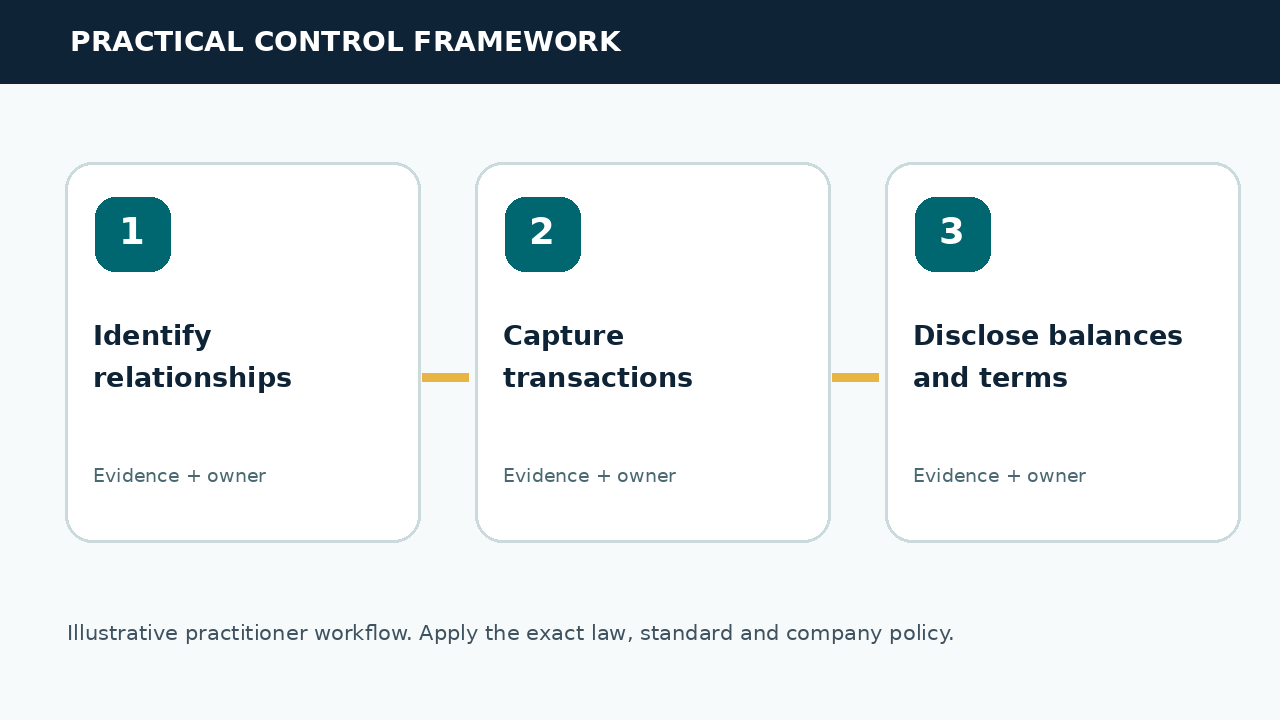
Maintain legal and accounting related-party registers.
Capture balances, commitments, guarantees and ECL.
Flag related counterparties at onboarding.
Maintain KMP and family declarations.
Review completeness, terms and approvals.
Added and reviewed on 11 October 2026. This section adds a practitioner workflow to the standard-by-standard guide above: how to build, reconcile and sign off the related-party schedule. Where the two differ, follow the standard and the latest ICAI material.
Start with the entity’s ownership, control, joint-control and significant-influence structure. Then obtain lists of key management personnel, their close family members where relevant, and entities affected by those relationships as defined under the standard. Capture the nature of each relationship and evidence from share registers, declarations, organisation charts and control agreements. Business partners with common surnames are not related parties merely because they appear connected; conversely some relationships exist even without any transaction.
For each counterparty record its legal name, identification number, relationship category, beginning and ending balance, sales, purchases, management charges, lease arrangements, finance, guarantees, compensation and other transfers of resources, services or obligations. Flag whether pricing is contractually documented. Transactions can occur without consideration; a no-charge corporate guarantee can still be a related-party transaction requiring careful disclosure assessment.
A ₹10-lakh service fee recorded during the year and a ₹6-lakh closing payable are not alternative figures: both may need disclosure with terms and conditions. Capture whether balances are secured, settlement terms, guarantees given or received, commitments and impairment-related amounts to the extent required. Loans require opening principal, new drawdowns, repayments, interest and closing outstanding. Where different entity codes disguise the same counterparty, create an identity bridge rather than duplicating the counterparty.
Employee payroll may fail to capture stock-based payments, employer benefit obligations or compensation from another group entity. Prepare a schedule consistent with Ind AS 24 compensation categories and include appropriate remuneration disclosures. Do not assume that a director’s expenses are automatically part of remuneration or that every director-related reimbursement has the same accounting treatment. Reconcile compensation to payroll, stock-option records and directors’ declarations.
Ind AS 24 is an accounting disclosure standard. Section 188 of the Companies Act and, for applicable listed entities, SEBI rules may impose approval and governance requirements through separate tests. One register can support both, but the definitions and exemptions must not be assumed identical. Add independent columns for accounting related-party classification, corporate-law approval and any market-regulator disclosure obligations.
Intra-group items are generally eliminated in consolidated financial statements in accordance with consolidation requirements, but separate financial statements of each entity can still require transactions and balances to be disclosed. Identify the reporting entity before deciding the disclosure treatment. Transactions with a parent, subsidiary, associate, joint venture or KMP require the exact relationship classification; the mere fact that a balance cancels in consolidation is not proof that it should disappear from every disclosure.
Reconcile counterparty totals to general ledger, intercompany confirmations, board minutes, statutory registers, commitments and contingent liability assessments. Add an exception register for missing terms, unsupported interest rates, unconfirmed advances and unrecorded guarantees. Sign off the population, not just the final note. ICAI’s February 2026 educational material specifically addresses practical questions on transactions, balances and relationships and is a useful primary benchmark for preparing the review file.
They can: a transfer of resources, services or obligations may qualify even without a stated price.
Certain control relationships require disclosure regardless of whether transactions occurred.
No; evaluate key management and the standard’s particular criteria.
No. Format compliance does not replace identification, classification and full disclosure requirements.
Disclose relevant period transactions and balances/terms separately.
An agreement supports documentation but not independent validation of pricing or other statutory approvals.
Identify controlling parties, joint controllers, persons with significant influence, key management personnel and relevant close family members. Then extend the map through group entities, associates, joint ventures, post-employment benefit plans and entities controlled or jointly controlled by relevant persons. The accounting definition is substance-based. A common director, major customer, lender or supplier is not related merely because it is important to the business. A signed annual declaration is useful, but it should be cross-checked against corporate records, investment structures and the current management roster.
A related-party transaction is a transfer of resources, services or obligations, whether or not a price is charged. The close process should therefore scan loans, purchases, services, leases, guarantees, commitments, reimbursements, asset transfers and settlement of liabilities. Outstanding balances need their terms, security, guarantees and impairment information. KMP compensation is disclosed by the required categories. The parent and ultimate controlling party relationship can require disclosure even where no transaction occurred during the period.
Ind AS 24 answers who is related and what must be disclosed in the financial statements. Companies Act sections, listing rules and internal governance policies can use different definitions, approval thresholds and processes. Do not infer that a transaction is legally approved because it has been disclosed, or that a legally approved transaction needs no accounting disclosure. An “arm’s length” statement should be made only when it can be substantiated. Similar transactions can be aggregated only when aggregation does not obscure information needed to understand their effect.
A subsidiary receives an interest-free Rs 5 crore loan from its parent and the parent also gives a guarantee to the subsidiary’s bank without charging a fee. Both are within the related-party information system even though one item carries no interest and the guarantee carries no explicit price. The year-end file should reconcile the loan balance, terms, guarantee exposure, impairment or measurement consequences under other standards, and the disclosures required by Ind AS 24.
Not automatically; the defined relationship criteria must be met.
Yes, a transfer of service or obligation can qualify even with no price.
Yes, control relationships have disclosure requirements independent of transaction volume.
No. Aggregation is appropriate only when it does not obscure material understanding.
For periods affected by later notified amendments, read the compendium together with the applicable MCA notification listed by ICAI.
Use the current official instrument, portal or regulator publication before acting. Page-specific references are listed below.
For Ind AS 24, the Companies (Indian Accounting Standards) Rules and the MCA-notified text control the Indian financial statements. ICAI educational material and IFRS resources can assist interpretation, but they do not replace this notified Indian text or later MCA amendments.
Build the related-party universe from control, joint control, significant influence, key management personnel and close-family facts before testing balances, commitments, terms and key-management compensation disclosures.
For Ind AS 24, a correct answer begins with the scope and facts, identifies the relationship first, transaction second issue, applies the notified paragraphs, quantifies the accounting entry, and then states the required presentation and disclosures. A conclusion based only on an international summary should be checked for Indian carve-outs and amendment dates.
Finin2min summary: anchor the analysis in the MCA-notified Ind AS 24, document judgements and reconcile every conclusion to the books and disclosures.