Finin2min SummarySection 141Section 142Section 143Section 144Section 145Section 146Section 147Section 148Section 149Section 150Section 151Section 152Section 153Section 154Section 155Section 156Section 157Section 158Section 159Section 160Section 161Section 162Section 163Section 164Rules/formsOld lawCase lawState alertsQ&AProvision mapTransaction and cross-law controls
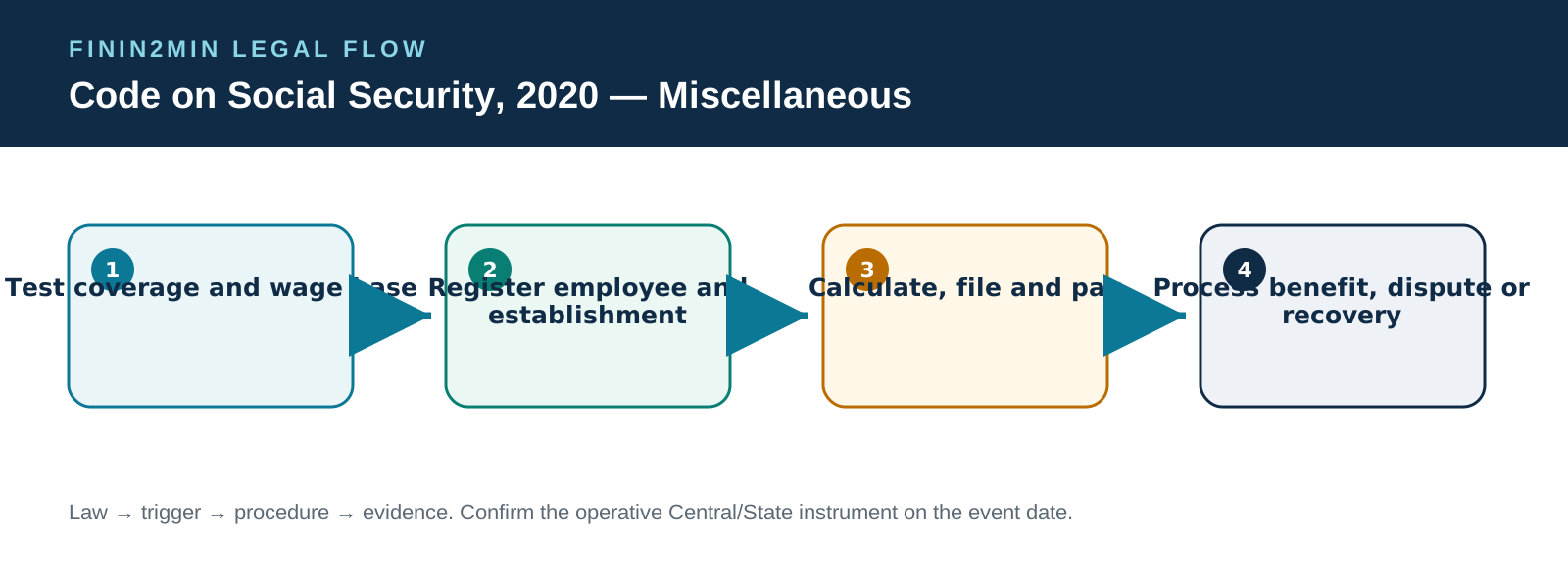
Chapter decision flow
Finin2min Summary - Chapter in 2 Minutes
This chapter turns miscellaneous into an operational control file. It covers Social Security Fund, Application of Aadhaar, Power to exempt establishment, Power to defer or reduce; the practical sequence is to classify coverage and event date, apply the provision and mapped Rule, complete the form/register, calculate the entitlement or exposure, and retain evidence for inspection, claim or appeal.
Who is covered
Employers, employees, unorganised workers, gig/platform workers, beneficiaries and social-security authorities must identify the applicable chapter, establishment threshold and scheme.
Main obligations and rights
- Section 141: Social Security Fund
- Section 142: Application of Aadhaar
- Section 143: Power to exempt establishment
- Section 144: Power to defer or reduce
- Section 145: Liability in case of transfer of establishment
- Section 146: Members, officers and staff to be public servants
Key thresholds and timelines
- Use only the threshold, rate and limitation period effective on the event date; verify the Central/State instrument before acting.
Forms, registers and evidence
- Applicable form/register, calculation file, approval and acknowledgement evidence
- Retain classification, calculation, approval, communication, acknowledgement and payment/filing proof.
Employer risk snapshot
Highest practical risks: misclassification, missed filing/notice, unsupported calculation, incomplete records and use of the wrong Central/State instrument.
Employee/worker remedy snapshot
Core protection: the substantive protection in this chapter, access to the prescribed authority/forum and a documented remedy within limitation. Confirm the authority, limitation and appeal route stated in this chapter.
Old law / transition
Apply the instrument effective on the event date and preserve any accrued right, saved notification, pending proceeding or scheme-specific transition.
Five-point professional checklist
- Freeze the event date, establishment, location and person/worker classification.
- Identify the controlling section/paragraph, mapped Rule, notification and appropriate Government.
- Reperform the calculation or decision test and document every exception or approval.
- Complete the prescribed form/register/portal step and retain acknowledgement, payment and communication evidence.
- Record the remedy, forum, limitation, appeal path and State variation before sign-off.
Finin2min takeaway: for miscellaneous, the defensible answer is not a policy label - it is the event-date law, the mapped procedure, the calculation and a complete evidence trail.
Section-by-section provision map
| Provision | Subject | Implementation focus |
|---|---|---|
| Section 141 | Social Security Fund | Trigger, linked Rule/form, evidence, consequence and remedy |
| Section 142 | Application of Aadhaar | Trigger, linked Rule/form, evidence, consequence and remedy |
| Section 143 | Power to exempt establishment | Trigger, linked Rule/form, evidence, consequence and remedy |
| Section 144 | Power to defer or reduce | Trigger, linked Rule/form, evidence, consequence and remedy |
| Section 145 | Liability in case of transfer of establishment | Trigger, linked Rule/form, evidence, consequence and remedy |
| Section 146 | Members, officers and staff to be public servants | Trigger, linked Rule/form, evidence, consequence and remedy |
| Section 147 | Protection of action taken in good faith | Trigger, linked Rule/form, evidence, consequence and remedy |
| Section 148 | Misuse of benefits | Trigger, linked Rule/form, evidence, consequence and remedy |
| Section 149 | Power of Central Government to give directions to State Government and Social Security Organisations | Trigger, linked Rule/form, evidence, consequence and remedy |
| Section 150 | Power to frame schemes | Trigger, linked Rule/form, evidence, consequence and remedy |
| Section 151 | Protection against attachment, etc. | Trigger, linked Rule/form, evidence, consequence and remedy |
| Section 152 | Power to amend Schedule | Trigger, linked Rule/form, evidence, consequence and remedy |
| Section 153 | Transitional provisions | Trigger, linked Rule/form, evidence, consequence and remedy |
| Section 154 | Power of appropriate Government to make rules | Trigger, linked Rule/form, evidence, consequence and remedy |
| Section 155 | Power of Central Government to make rules | Trigger, linked Rule/form, evidence, consequence and remedy |
| Section 156 | Power of State Government to make rules | Trigger, linked Rule/form, evidence, consequence and remedy |
| Section 157 | Power of Corporation to make regulations | Trigger, linked Rule/form, evidence, consequence and remedy |
| Section 158 | Prior publication of rules, regulations, etc. | Trigger, linked Rule/form, evidence, consequence and remedy |
| Section 159 | Rules to give effect to arrangements with other countries for the transfer of money paid as compensation | Trigger, linked Rule/form, evidence, consequence and remedy |
| Section 160 | Laying of rules, regulations and schemes, etc. | Trigger, linked Rule/form, evidence, consequence and remedy |
| Section 161 | Effect of laws and agreements inconsistent with this Code | Trigger, linked Rule/form, evidence, consequence and remedy |
| Section 162 | Delegation of powers | Trigger, linked Rule/form, evidence, consequence and remedy |
| Section 163 | Power to remove difficulties | Trigger, linked Rule/form, evidence, consequence and remedy |
| Section 164 | Repeal and savings | Trigger, linked Rule/form, evidence, consequence and remedy |
Section 141: Social Security Fund
Current statutory text
141. Social Security Fund.—(1) There shall be established by the Central Government a Social
Security Fund for social security and welfare of the unorganised workers, gig workers and platform workers
and the sources of the fund shall comprise of funding received—

          (i) under sub-section (3) of section 109;

           (ii) under sub-section (3) of section 114;

           (iii) from the composition of the offences under this Code relating to Central Government and from
   any other Social Security Fund established under any other central labour law.

    (2) A separate account shall be established and maintained for the funding mentioned under each of the
clauses (i), (ii) and (iii).

    (3) Social Security Fund referred to in sub-section (1) shall be expended for the purposes for which
each separate account has been established and maintained under sub-section (2).

    (4) The Social Security Fund shall be established and administered in the manner prescribed by the
Central Government.

    (5) There shall be established by the State Government a Social Security Fund for the welfare of the
unorganised workers in which there shall be credited the amount received from—

          (i) the composition of offences under this Code relating to the State Government; and

           (ii) such other sources as may be prescribed by the State Government,

and the fund shall be administered and expended for the welfare of the unorganised workers in such manner
as may be prescribed by the State Government.
Finin2min clause-by-clause decode
- Legal test 1
- The Social Security Fund requires separate administration, credited sources, permitted uses and reporting.
- Implementation control
- Trigger
- Document the facts that activate section 141: social security fund.
- Coverage and jurisdiction
- Identify establishment, employee/worker category, appropriate Government, First Schedule threshold and territorial authority.
- Decision owner
- Assign a named owner for funds, Aadhaar, exemptions, transitions, delegated legislation and savings; identify HR, payroll, finance, legal, contractor and authorised-signatory roles.
- Evidence pack
Applicable Central Rules immediately below the provision
Central Rule 64: Rule 64 — Establishment and administration of Social Security Fund
Rule mapping is retained; read the official 2026 Gazette for the exact sub-rule text and forms.
Practical example
A multi-location employer prepares a legal classification memo, identifies the appropriate Government, maps the operative provision and Rule, records the decision owner and retains the documents needed to prove compliance during inspection or litigation.
Controls and evidence
- Employer: assign owner, configure system and retain approval/payment proof.
- Employee/worker: retain contract, attendance, wage/benefit proof and communication.
- Professional: reconcile the Act, Rule, notification, form, limitation and State overlay.
Consequence, remedy and limitation
Identify the substantive default first, then separately map arrears or benefit, interest/damages, administrative penalty, prosecution, compounding, company/officer liability, forum, appeal and limitation. Do not infer a remedy from the heading alone.
Mapped Rules: Rule 64 | Official source: section 141.
Section 142: Application of Aadhaar
Current statutory text
142. Application of Aadhaar.— (1) An employee or unorganised worker or any other person, as the
case may be, for—
(a) registration as member or beneficiary; or
(b) seeking benefit whether in kind, cash or medical sickness benefit or pension, gratuity or
maternity benefit or any other benefit or for withdrawal of fund; or
(c) availing services of career centre; or
(d) receiving any payment or medical attendance as Insured Person himself or for his dependants,
under this Code or rules, regulations or schemes made or framed thereunder, shall establish his identity or,
as the case may be, the identity of his family members or dependants through Aadhaar number and for such
purpose the expression “Aadhaar” shall have the meaning as defined in clause (a) of section 2 of the
Aadhaar (Targeted Delivery of Financial and Other Subsidies, Benefits and Services) Act, 2016 (18 of
2016):
Provided that any foreigner employee shall obtain and submit Aadhaar number for establishing his
identity, as soon as possible, on becoming resident within the meaning of clause (v) of section 2 of the
Aadhaar (Targeted Delivery of Financial and Other Subsidies, Benefits and Services) Act, 2016 (18 of
2016).
(2) For the purposes of sub-section (1), the Aadhaar number issued to an individual shall be in
accordance with the provisions of section 3 of the Aadhaar (Targeted Delivery of Financial and Other
Subsidies, Benefits and Services) Act, 2016 (18 of 2016).Finin2min clause-by-clause decode
- Legal test 1
- Aadhaar use must follow the exact commenced provision, purpose, authentication law and data-protection controls.
- Implementation control
- Trigger
- Document the facts that activate section 142: application of aadhaar.
- Coverage and jurisdiction
- Identify establishment, employee/worker category, appropriate Government, First Schedule threshold and territorial authority.
- Decision owner
- Assign a named owner for funds, Aadhaar, exemptions, transitions, delegated legislation and savings; identify HR, payroll, finance, legal, contractor and authorised-signatory roles.
- Evidence pack
Applicable Central Rules immediately below the provision
No direct Central Rule is mapped. Check general procedural Rules, State Rules and later notifications.
Controls and evidence
- Employer: assign owner, configure system and retain approval/payment proof.
- Employee/worker: retain contract, attendance, wage/benefit proof and communication.
- Professional: reconcile the Act, Rule, notification, form, limitation and State overlay.
Mapped Rules: No direct Central Rule mapped in the repository concordance | Official source: section 142.
Section 143: Power to exempt establishment
Current statutory text
143. Power to exempt establishment.—(1)Notwithstanding anything contained in this Code, the
appropriate Government may, by notification, and subject to the conditions which may include the
eligibility conditions to be fulfilled prior to grant of exemption and the conditions to be complied with after
exemption, as may be prescribed by the Central Government in this behalf, grant exemption to an
establishment or class of establishments (including factory or other establishments under the control of
Central Government or State Government or local bodies) or employees or class of employees, from any
or all of the provisions of this Code or the scheme framed thereunder as may be specified in the notification
and may renew for further period such exemption by like notification:
Provided that no such exemption,—
(i) in respect of Provident Fund Scheme, Pension Scheme and Insurance Scheme, without prior
consultation with the Central Board; and
(ii) in respect of Chapter IV, without prior consultation with the Corporation,
shall be granted or renewed and the Central Board or the Corporation, as the case may be, shall on such
consultation forward its view to the appropriate Government within such time as may be prescribed by that
Government.
(2) The appropriate Government may, in the notification referred to in sub-section (1), specify therein
conditions as may be prescribed by that Government, which the exempted establishment or the class of
establishments or an employee or class of employees, as the case may be, shall comply with after such
exemption:
Provided that for the purpose of grant of exemption in respect of Provident Fund Scheme, Pension
Scheme and Insurance Scheme, the terms and conditions of exemption shall be specified in such respective
schemes.
By Corrigenda Dated 29-9-2020.
(3) The exemption granted under sub-section (1) to an establishment or class of establishments or an
employee or class of employees, as the case may be, shall be initially for a period of three years from the
date of publication of such notification and may be extended by the appropriate Government to the extent
of such period as may be prescribed by the Central Government:
Provided that for the purpose of grant of exemption in respect of Provident Fund Scheme, Pension
Scheme and Insurance Scheme, exemption may be extended for such period as may be specified in such
respective schemes.
(4) The exemption granted under sub-section (1) shall only be granted if the employees in the
establishment or class of establishments or an employee or the class of employees so exempted are
otherwise in receipt of benefits substantially similar or superior to the benefits provided in the provisions
of the Code or the scheme framed thereunder.
(5) For the purposes of administering the fund, managing the investments, maintaining accounts of the
contributions, withdrawals, credit of interest in respect of each employee of the fund created, and any other
matter specified in the scheme for any exempted establishment or class of establishments, or employees or
class of employees, a board of trustees shall be constituted by the employer which will be a legal entity
which can sue and can be sued and the conditions for management of the trust shall be prescribed by the
appropriate Government as part of the conditions for exemption:
Provided that conditions for administering the fund, managing the investments, maintaining accounts
of the contributions, withdrawals, credit of interest in respect of each employee of the fund created, in
respect of exemption from Provident Fund Scheme, Pension Scheme and Insurance Scheme shall be
specified in such respective schemes.
(6) Where an exemption is granted under this section from operation of any or all the provisions of the
Code or any of the scheme under Chapter III, to any establishment, class of establishments, employee or
class of employees, the employer in relation to such establishment shall furnish such returns electronically
in respect of persons employed, accounts maintained in respect of employees, investments made from the
fund, provide facilities for inspection and pay such inspection charges as the Central Government may
direct.
(7) If employer in relation to any establishment or class of establishments or employee or class of
employees in respect of whom the exemption has been granted under sub-section (1), fails to comply with
any of the conditions specified under this section, then, the appropriate Government may on such failure,
cancel the exemption so granted.
(8) Where any exemption granted under sub-section (1) is cancelled, the entire amount of surplus and
reserves, if any, and accumulations to the credit of every employee, to whom such exemption applied, in
the exempted fund of the establishment in which he is employed, shall be transferred to the respective
statutory fund created under this Code within such time and manner as specified in the conditions for grant
of exemption:
Provided that in respect of any cancellation of exemption from the Provident Fund Scheme, Pension
Scheme and Insurance Scheme, the time limit, form and manner of transfer of accumulations of exempted
employees from the exempted funds to such respective funds shall be specified in such respective schemes.
(9) Notwithstanding anything contained in this section, the employer of an establishment exempted
under sub-section (1), after the resolution of the board of trustees of the establishment to that effect may
make an application to the appropriate Government for surrender of the exemption granted under that sub-
section from the date specified in the application and the appropriate Government may on receipt of that
application, allow the employer to remit the contribution in the statutory funds under this Code from the
date specified in the application and process the application for cancellation of exemption and on such
cancellation, the employer and the board of trustees shall transfer accumulation of each employee and
surplus and reserves from the fund referred to in sub-section (5), to the concerned statutory funds under this
Code within such time and in such manner as may be notified by the appropriate Government:
Provided that in respect of any surrender of exemption from the Provident Fund Scheme, the Pension
Scheme and the Insurance Scheme, the time limit, form and manner of transfer of accumulation of exempted
employees and surplus and reserves from the fund referred to in sub-section (5), to the concerned statutory
funds under this Code shall be such as may be specified in the concerned schemes framed under
Chapter III.Finin2min clause-by-clause decode
- Legal test 1
- Exemption requires benefits that are not less favourable and continuous compliance with conditions; partial earlier commencement must be checked.
- Implementation control
- Trigger
- Document the facts that activate section 143: power to exempt establishment.
- Coverage and jurisdiction
- Identify establishment, employee/worker category, appropriate Government, First Schedule threshold and territorial authority.
- Decision owner
- Assign a named owner for funds, Aadhaar, exemptions, transitions, delegated legislation and savings; identify HR, payroll, finance, legal, contractor and authorised-signatory roles.
- Evidence pack
Applicable Central Rules immediately below the provision
Controls and evidence
- Employer: assign owner, configure system and retain approval/payment proof.
- Employee/worker: retain contract, attendance, wage/benefit proof and communication.
- Professional: reconcile the Act, Rule, notification, form, limitation and State overlay.
Mapped Rules: Rule 65, Rule 66, Rule 67, Rule 68 | Official source: section 143.
Section 144: Power to defer or reduce
Current statutory text
144. Power to defer or reduce.— Notwithstanding anything contained in Chapter III or Chapter IV,
the Central Government may by order, defer or reduce employer's contribution, or employee's contribution,
or both, payable under Chapter III or Chapter IV, as the case may be, for a period up to three months at a
time, in respect of establishment to which Chapter III or Chapter IV, as the case may be, applies, for whole
of India or part thereof in the event of pandemic, endemic or national disaster.
Finin2min clause-by-clause decode
- Legal test 1
- This section allocates legal responsibility for power to defer or reduce within the Miscellaneous Chapter.
- Legal test 2
- Identify the statutory trigger, person obligated, authority, timing, exceptions and documentary output before applying the provision.
- Legal test 3
- Read every subsection, proviso, explanation and linked Schedule in the official text; the heading alone is not the legal test.
- Implementation control
- Trigger
- Document the facts that activate section 144: power to defer or reduce.
- Coverage and jurisdiction
Controls and evidence
- Employer: assign owner, configure system and retain approval/payment proof.
- Employee/worker: retain contract, attendance, wage/benefit proof and communication.
- Professional: reconcile the Act, Rule, notification, form, limitation and State overlay.
Mapped Rules: No direct Central Rule mapped in the repository concordance | Official source: section 144.
Section 145: Liability in case of transfer of establishment
Current statutory text
145. Liability in case of transfer of establishment.— Where an employer transfers his establishment
in whole or in part, by sale, gift, lease or licence or in any other manner whatsoever, the employer and the
person to whom the establishment is so transferred shall jointly and severally be liable to pay the amount
due in respect of any liabilities, cess or any other amount payable under this Code in respect of the periods
up to the date of such transfer:

    Provided that the liability of the transferee shall be limited to the value of the assets obtained by him
by such transfer.
Finin2min clause-by-clause decode
- Legal test 1
- Transferor and transferee may face joint liability for pre-transfer dues within the statutory framework; due diligence must quantify the period and cap.
- Implementation control
- Trigger
- Document the facts that activate section 145: liability in case of transfer of establishment.
- Coverage and jurisdiction
- Identify establishment, employee/worker category, appropriate Government, First Schedule threshold and territorial authority.
- Decision owner
- Assign a named owner for funds, Aadhaar, exemptions, transitions, delegated legislation and savings; identify HR, payroll, finance, legal, contractor and authorised-signatory roles.
- Evidence pack
Controls and evidence
- Employer: assign owner, configure system and retain approval/payment proof.
- Employee/worker: retain contract, attendance, wage/benefit proof and communication.
- Professional: reconcile the Act, Rule, notification, form, limitation and State overlay.
Mapped Rules: No direct Central Rule mapped in the repository concordance | Official source: section 145.
Section 146: Members, officers and staff to be public servants
Current statutory text
146. Members officers and staff to be public servants.— Every member of a Social Security
Organisation and the officers and  staff thereof, any Inspector-cum-Facilitator, competent authority,
Authorised Officer, Recovery Officer and any other person discharging any function under this Code, shall
be deemed to be a public servant within the meaning of section 21 of the Indian Penal Code (45 of 1860).
Finin2min clause-by-clause decode
- Legal test 1
- This section allocates legal responsibility for members, officers and staff to be public servants within the Miscellaneous Chapter.
- Legal test 2
- Identify the statutory trigger, person obligated, authority, timing, exceptions and documentary output before applying the provision.
- Legal test 3
- Read every subsection, proviso, explanation and linked Schedule in the official text; the heading alone is not the legal test.
- Implementation control
- Trigger
- Document the facts that activate section 146: members, officers and staff to be public servants.
- Coverage and jurisdiction
Controls and evidence
- Employer: assign owner, configure system and retain approval/payment proof.
- Employee/worker: retain contract, attendance, wage/benefit proof and communication.
- Professional: reconcile the Act, Rule, notification, form, limitation and State overlay.
Mapped Rules: No direct Central Rule mapped in the repository concordance | Official source: section 146.
Section 147: Protection of action taken in good faith
Current statutory text
147. Protection of action taken in good faith.—No suit, prosecution or other legal proceeding shall
lie against—

          (i) the Central Government;

           (ii) a State Government;

           (iii) a Social Security Organisation;

         (iv) a competent authority;

         (v) any officer or staff of a Social Security Organisation; or

         (vi) any other person or authority,

discharging the functions or exercising the powers under this Code, for anything which is in good faith
done or intended to be done in pursuance of this Code or of any rules, regulations or schemes made or
framed thereunder.
Finin2min clause-by-clause decode
- Legal test 1
- This section allocates legal responsibility for protection of action taken in good faith within the Miscellaneous Chapter.
- Legal test 2
- Identify the statutory trigger, person obligated, authority, timing, exceptions and documentary output before applying the provision.
- Legal test 3
- Read every subsection, proviso, explanation and linked Schedule in the official text; the heading alone is not the legal test.
- Implementation control
- Trigger
- Document the facts that activate section 147: protection of action taken in good faith.
- Coverage and jurisdiction
Controls and evidence
- Employer: assign owner, configure system and retain approval/payment proof.
- Employee/worker: retain contract, attendance, wage/benefit proof and communication.
- Professional: reconcile the Act, Rule, notification, form, limitation and State overlay.
Mapped Rules: No direct Central Rule mapped in the repository concordance | Official source: section 147.
Section 148: Misuse of benefits
Current statutory text
148. Misuse of benefits.—If the appropriate Government is satisfied in the manner prescribed by it
that any establishment or any other person has misused any benefit provided to him under this Code or
rules, regulations or schemes made or framed thereunder, then, such Government may, by notification,
deprive such establishment or other person, as the case may be, from such benefit for such time as may be
specified in the notification:

    Provided that no such order shall be passed unless an opportunity of being heard is given to such
establishment or other person, as the case may be:

    Provided further that the manner to ascertain misuse of any benefit under this section relating to
Chapter III, shall be specified in the Provident Fund Scheme or the Pension Scheme or the Insurance
Scheme, as the case may be.
Finin2min clause-by-clause decode
- Legal test 1
- Misuse finding requires evidence, attribution, notice/hearing and proportionate deprivation/recovery.
- Implementation control
- Trigger
- Document the facts that activate section 148: misuse of benefits.
- Coverage and jurisdiction
- Identify establishment, employee/worker category, appropriate Government, First Schedule threshold and territorial authority.
- Decision owner
- Assign a named owner for funds, Aadhaar, exemptions, transitions, delegated legislation and savings; identify HR, payroll, finance, legal, contractor and authorised-signatory roles.
- Evidence pack
Applicable Central Rules immediately below the provision
Controls and evidence
- Employer: assign owner, configure system and retain approval/payment proof.
- Employee/worker: retain contract, attendance, wage/benefit proof and communication.
- Professional: reconcile the Act, Rule, notification, form, limitation and State overlay.
Mapped Rules: Rule 69 | Official source: section 148.
Section 149: Power of Central Government to give directions to State Government and Social Security Organisations
Current statutory text
149. Power of Central Government to give directions to State Government and Social Security
Organisations.—The Central Government may give directions to—

        (i) any State Government or a State Board constituted under section 12 to execute in that State, of
   any of the provisions of this Code; or

        (ii) any of the Social Security Organisations in respect of the matters relating to the implementation
    of the provisions of this Code.
Finin2min clause-by-clause decode
- Legal test 1
- This section allocates legal responsibility for power of central government to give directions to state government and social security organisations within the Miscellaneous Chapter.
- Legal test 2
- Identify the statutory trigger, person obligated, authority, timing, exceptions and documentary output before applying the provision.
- Legal test 3
- Read every subsection, proviso, explanation and linked Schedule in the official text; the heading alone is not the legal test.
- Implementation control
- Trigger
- Document the facts that activate section 149: power of central government to give directions to state government and social security organisations.
- Coverage and jurisdiction
Controls and evidence
- Employer: assign owner, configure system and retain approval/payment proof.
- Employee/worker: retain contract, attendance, wage/benefit proof and communication.
- Professional: reconcile the Act, Rule, notification, form, limitation and State overlay.
Mapped Rules: No direct Central Rule mapped in the repository concordance | Official source: section 149.
Section 150: Power to frame schemes
Current statutory text
150. Power to frame schemes.— The appropriate Government may, subject to the condition of
previous publication, frame schemes not inconsistent with this Code, for the purposes of giving effect to
the provisions thereof.
Finin2min clause-by-clause decode
- Legal test 1
- This section allocates legal responsibility for power to frame schemes within the Miscellaneous Chapter.
- Legal test 2
- Identify the statutory trigger, person obligated, authority, timing, exceptions and documentary output before applying the provision.
- Legal test 3
- Read every subsection, proviso, explanation and linked Schedule in the official text; the heading alone is not the legal test.
- Implementation control
- Trigger
- Document the facts that activate section 150: power to frame schemes.
- Coverage and jurisdiction
Controls and evidence
- Employer: assign owner, configure system and retain approval/payment proof.
- Employee/worker: retain contract, attendance, wage/benefit proof and communication.
- Professional: reconcile the Act, Rule, notification, form, limitation and State overlay.
Mapped Rules: No direct Central Rule mapped in the repository concordance | Official source: section 150.
Section 151: Protection against attachment, etc.
Current statutory text
151. Protection against attachment etc.— (1) Notwithstanding anything contained in any other law
for the time being in force, the amount standing to be credited in favour of the employee under Chapters
III, IV, V, VI or VII of any member of any fund under this Code, or of any exempted employee in a
provident fund maintained by his employer, shall not in any way be capable of being assigned or charged
and shall not be liable to attachment under any decree or order of any Court in respect of any debt or liability
incurred by such employee or member or the exempted employee, as the case may be.

    (2) Any amount standing to the credit of a member in the fund or of an exempted employee in a
provident fund maintained by his employer at the time of the death of such member or the exempted
employee, as the case may be, and payable to his nominee or in case of failure of nomination, to his family
under the scheme or the rules of the fund shall, subject to any deduction authorised by the said scheme or
rules, as the case may be, vest in the nominee or such family and shall be free from any debt or other liability
incurred by the deceased or the nominee before his death and shall also not be liable to attachment under
any decree or order of any court.

    (3) Notwithstanding anything contained in any other law for the time being in force, any amount due
under the Chapters referred to in sub-section (1) shall be the charge on the assets of the establishment to
which it relates and shall be paid in priority in accordance with the provisions of the Insolvency and
Bankruptcy Code, 2016 (31 of 2016).
Finin2min clause-by-clause decode
- Legal test 1
- This section allocates legal responsibility for protection against attachment, etc. within the Miscellaneous Chapter.
- Legal test 2
- Identify the statutory trigger, person obligated, authority, timing, exceptions and documentary output before applying the provision.
- Legal test 3
- Read every subsection, proviso, explanation and linked Schedule in the official text; the heading alone is not the legal test.
- Implementation control
- Trigger
- Document the facts that activate section 151: protection against attachment, etc..
- Coverage and jurisdiction
Controls and evidence
- Employer: assign owner, configure system and retain approval/payment proof.
- Employee/worker: retain contract, attendance, wage/benefit proof and communication.
- Professional: reconcile the Act, Rule, notification, form, limitation and State overlay.
Mapped Rules: No direct Central Rule mapped in the repository concordance | Official source: section 151.
Section 152: Power to amend Schedule
Current statutory text
152. Power to amend Schedule.—(1) If the Central Government is satisfied that it is necessary or
expedient so to do, it may, by notification amend the First Schedule, Fourth Schedule, Fifth Schedule, Sixth
Schedule and Seventh Schedule by way of addition or deletion therein and upon such addition or deletion,
the Schedules shall stand to have been amended accordingly.

    (2) If the appropriate Government is satisfied that it is necessary or expedient so to do, it may, by
notification amend the Second Schedule and Third Schedule by way of addition therein and not otherwise,
and upon such addition, the Schedules shall stand to have been amended accordingly.
Finin2min clause-by-clause decode
- Legal test 1
- This section allocates legal responsibility for power to amend schedule within the Miscellaneous Chapter.
- Legal test 2
- Identify the statutory trigger, person obligated, authority, timing, exceptions and documentary output before applying the provision.
- Legal test 3
- Read every subsection, proviso, explanation and linked Schedule in the official text; the heading alone is not the legal test.
- Implementation control
- Trigger
- Document the facts that activate section 152: power to amend schedule.
- Coverage and jurisdiction
Controls and evidence
- Employer: assign owner, configure system and retain approval/payment proof.
- Employee/worker: retain contract, attendance, wage/benefit proof and communication.
- Professional: reconcile the Act, Rule, notification, form, limitation and State overlay.
Mapped Rules: No direct Central Rule mapped in the repository concordance | Official source: section 152.
Section 153: Transitional provisions
Current statutory text
153. Transitional provisions.— Notwithstanding anything contained in this Code, the following
organisations constituted or established under the enactments repealed under section 164, namely:—

          (i) the Central Board constituted under section 5A of the Employees' Provident Funds and
    Miscellaneous Provisions Act, 1952 (19 of 1952);

           (ii) Executive Committee constituted under section 5AA of the Employees' Provident Funds and
    Miscellaneous Provisions Act, 1952 (19 of 1952);

           (iii) the Corporation established under section 3 of the Employees' State Insurance Act, 1948 (34
    of 1948);

         (iv) the Medical Benefit Council constituted under section 10 of the Employees' State Insurance
    Act, 1948 (34 of 1948);

         (v) the Standing Committee of the Corporation constituted under section 8 of the Employees' State
    Insurance Act, 1948 (34 of 1948); and

         (vi) the Board constituted under sub-section (1) of section 18 of the Building and Other
    Construction Workers (Regulation of Employment and Condition of Service) Act, 1996, shall, after the
   commencement of this Code, continue to exercise the powers and discharge the functions of the
    corresponding organisations under this Code, respectively, the Central Board of Trustees for Employees
    Provident Fund constituted under section 4, the Executive Committee constituted under sub-section (3)
    of section 4, the Employees State Insurance Corporation, constituted under section 5, the Medical
    Benefit Committee constituted under sub-section (5) of section 5, the Standing Committee constituted
    under sub-section (3) of section 5, Building Workers' Welfare Board constituted under sub-section (1)
    of section 7, as if such organisations constituted or, as the case may be, established under such repealed
    enactments, had been constituted under the respective provisions of this Code, till such corresponding


    organisations are constituted under this Code or till their respective time period under the repealed
    enactments expire, whichever is earlier.
Finin2min clause-by-clause decode
- Legal test 1
- Transition preserves specified actions and moves funds, liabilities, proceedings, records and authorities; create a law-by-law migration register.
- Implementation control
- Trigger
- Document the facts that activate section 153: transitional provisions.
- Coverage and jurisdiction
- Identify establishment, employee/worker category, appropriate Government, First Schedule threshold and territorial authority.
- Decision owner
- Assign a named owner for funds, Aadhaar, exemptions, transitions, delegated legislation and savings; identify HR, payroll, finance, legal, contractor and authorised-signatory roles.
- Evidence pack
Applicable Central Rules immediately below the provision
Controls and evidence
- Employer: assign owner, configure system and retain approval/payment proof.
- Employee/worker: retain contract, attendance, wage/benefit proof and communication.
- Professional: reconcile the Act, Rule, notification, form, limitation and State overlay.
Mapped Rules: Rule 61, Rule 62 | Official source: section 153.
Section 154: Power of appropriate Government to make rules
Current statutory text
154. Power of appropriate Government to make rules.—(1) The appropriate Government may, by
notification, and subject to the condition of previous publication, make rules not inconsistent with this Code
for the purpose of giving effect to the provisions thereof.

    (2) In particular and without prejudice to the generality of the foregoing power, such rules may provide
for all or any of the following matters, namely:—

        (a) the amount in connection with premium for Group Insurance Scheme of the beneficiaries under
    clause (c), the educational schemes for the benefit of children of the beneficiaries under clause (d) and
    the medical expenses for treatment of major ailments of a beneficiary or, such dependant under
    clause (e) of sub-section (6) of section 7;

        (b) manner and time within which second appeal may be filed to the Employees' Insurance Court
   by the Insured Person or the Corporation under clause (b) of sub-section (7) of section 37;

         (c) the manner of commencement of proceedings before the Employees' Insurance Court, fees and
    procedure thereof under sub-section (1) of section 51;

        (d) bank or other financial institution in which the gratuity shall be invested for the benefit of minor
    under the third proviso to sub-section (1) of section 53;

         (e) the time, form and manner of nomination by an employee under sub-section (1), the time to
   make fresh nomination under sub-section (4), the form and manner of modification of a nomination
    under sub-section (5) and the form for fresh nomination under sub-section (6) of section 55;

          (f) time within which and the form  in which a written application  shall be made under
    sub-section  (1) and  the form of  application  to  the competent  authority under  clause  (b) of
    sub-section (5) of section 56;

        (g) the manner of registration of an establishment by the employer under sub-section (3) and the
   manner of composition of the Board of Trustees of the approved gratuity fund and the manner in which
    the competent authority may recover the amount of the gratuity payable to an employee from the insurer
    under sub-section (4) of section 57;

        (h) the qualifications and experience of the officer appointed as the competent authority under sub-
    section (1) of section 58;

          (i) authority to whom an appeal may be preferred under sub-section (3) of section 72;

          (j) class of employers and the form of notice-book under sub-section (4) of section 82;

         (k) the manner of recording the memorandum in a register by the competent authority under
    sub-section (1) of section 89;

          (l) such other experience and qualifications for appointment as a competent authority under
    sub-section (1) of section 91;

       (m) time limit to pay the amount of cess under section 101;

        (n) fees for appeal under sub-section (2) of section 105;

        (o) conditions to acquire, hold, sell or otherwise transfer any movable or immovable property under
    sub-section (1), conditions to invest moneys, re-invest or realise investments under sub-section (2)
    terms to raise loans and take measures for discharging such loans under sub-section (3) and terms to
    constitute for the benefit of officers and staff or any class of them, provident or other benefit funds
    under sub-section (4) of section 120;

        (p) conditions and manner of writing off irrecoverable dues under section 121;

        (q) other powers of Inspector-cum-Facilitator under clause (e) of sub-section (6) of section 122;


         (r) form and manner for maintenance of records and registers and other particulars and details under
    clause (a), manner and form for display of notices at the work places of the employees under clause (b)
   and the manner and period of filing returns to the officers or authority under clause (d) of section 123;

         (s) the form and manner of application for compounding of an offence under sub-section (4) of
    section 138;

          (t) the manner and form for reporting vacancies and form for filing the return by the employer, to
    the concerned career centre under sub-section (2) of section 139;

        (u) the time within which the Central Board or the Corporation, as the case may be, shall forward
     its view to the appropriate Government under sub-section (1), conditions which the exempted
    establishment or the class of establishments or an employee or class of employees, as the case may be,
    shall comply with after such exemption under sub-section (2) and conditions for management of the
     trust under sub-section (5) of section 143;

         (v) manner of determining the misuse of any benefit by an establishment or by any other person
    under section 148; and

       (w) any other matter which is required to be, or may be, prescribed by the appropriate Government
    under the provisions of this Code.
Finin2min clause-by-clause decode
- Legal test 1
- This section allocates legal responsibility for power of appropriate government to make rules within the Miscellaneous Chapter.
- Legal test 2
- Identify the statutory trigger, person obligated, authority, timing, exceptions and documentary output before applying the provision.
- Legal test 3
- Read every subsection, proviso, explanation and linked Schedule in the official text; the heading alone is not the legal test.
- Implementation control
- Trigger
- Document the facts that activate section 154: power of appropriate government to make rules.
- Coverage and jurisdiction
Applicable Central Rules immediately below the provision
Controls and evidence
- Employer: assign owner, configure system and retain approval/payment proof.
- Employee/worker: retain contract, attendance, wage/benefit proof and communication.
- Professional: reconcile the Act, Rule, notification, form, limitation and State overlay.
Mapped Rules: Rule 1 | Official source: section 154.
Section 155: Power of Central Government to make rules
Current statutory text
155. Power of Central Government to make rules.—(1) The Central Government may, by
notification, and subject to the condition of previous publication, make rules not inconsistent with this Code,
for the purpose of giving effect to the provisions thereof.

    (2) In particular and without prejudice to the generality of the foregoing power, such rules may provide
for all or any of the following matters, namely:—

        (a) the manner, and the conditions subject to which, the provisions of Chapter III shall be made
    inapplicable to an establishment by the Central Provident Fund Commissioner, under sub-section (5)
   and the manner, and the conditions subject to which the provisions of that Chapter IV shall be made
    inapplicable to an establishment by the Director General of the Corporation under sub-section (7) of
    section 1;

        (b) manner of establishment and maintenance of career centre and the career services under clause
     (9), the income of dependant parents (including father-in-law and mother-in-law of a woman
    employee), under sub-clause (e) of clause (33) and other authority who shall be deemed to be the
    occupier under sub-clause (c) and the matters which are directly related to the condition of ship, for
   which the owner of ship shall be deemed to be the occupier under the proviso to the said sub-clause (c)
    of clause (52), of section 2;

         (c) the time and manner of registration of establishment, the manner of making application for
    cancellation of the registration, the conditions subject to which the registration shall be cancelled and
    the procedure of cancellation and other matters relating thereto in respect of an establishment to which
    Chapter III or Chapter IV applies, and whose business activities are in the process of closure, under
    section 3;

        (d) the manner of administration of the funds vested in the Central Board under sub-section (1), the
   manner to assist the Central Board in performance of its functions by Executive Committee under sub-
    section (3), the terms and conditions, including tenure of office of members of the Central Board and
    Executive Committee under sub-section (6) and the other functions and the manner of performing such
    functions under sub-section (7), of section 4;

         (e) the manner of administration of the Corporation and the manner of representation of States
    under clause (d) of sub-section (1), the manner of constitution of Standing Committee under sub-section
     (3), the manner of administration of the affairs of the Corporation, exercise of powers and performance
    of functions by the Standing Committee under clause (a) of sub-section (4), the duties and powers of
   Medical Benefit Committee under clause (b) of sub-section (5) and the terms and conditions, including
    tenure of office, subject to which a member of the Corporation and Standing Committee shall discharge
    their respective duties under sub-section (7) of section 5;


     (f) the manner of exercising the powers and performance of the functions by the National Social
Security Board under sub-section (1), the manner of nomination of members, their term of office and
other conditions of service, procedure to be followed in the discharge of their functions and manner of
filling vacancies under sub-section (4) and time, place and rules of procedure relating to the transaction
of business under sub-section (6) of section 6;

    (g) other welfare measures and facilities under clause (j) of sub-section (6) of section 7;

    (h) the intervals at which Social Security Organisation or any Committee thereof shall meet and
the procedure in regard to the transaction of business at meetings under sub-section (1), and the fee and
allowances of members of such Social Security Organisation or Committee under sub-section (4) of
section 9;

     (i) manner of reconstitution of the Corporation or the Central Board or the National Social Security
Board or the State Unorganised Workers' Board or the Building Workers' Welfare Board or any of the
Committees under sub-section (1) and the alternate arrangements for the purpose of administration of
the relevant provisions of this Code under sub-section (2) of section 11;

     (j) the manner of maintenance of a provident fund account in relation to the establishment under
sub-section (1) of section 21;

    (k) the form, manner, time limits and fees for filing of appeal under sub-section (2) of section 23;

     (l) salary and allowances of the Director General or the Financial Commissioner under sub-section
(3), their powers and duties under sub-section (4) and maximum monthly salary limit under the proviso
to sub-section (7) of section 24;

    (m) the manner of investment of Employees' State Insurance Fund or any other money which is
held by Corporation under sub-section (4) of section 25;

    (n) limits for defraying of expenditure under clause (k) of section 26;

    (o) conditions to acquire, hold, sell or otherwise transfer any movable or immovable property under
sub-section (1), conditions to invest moneys by the Corporation under sub-section (2) and the terms to
raise loans and taking measures for discharging such loans under sub-section (3) of section 27;

    (p) manner of insurance of employees under sub-section (1) of section 28;

    (q) the rate of contributions under sub-section (2) of section 29;

     (r) the type of administrative expenses and percentage of income which may be spent on expenses
and the limits for such expenses under section 30;

     (s) the limit for the amount of payment under the proviso to clause (f) of sub-section (1), and the
qualifications to claim benefits, conditions, rate and period thereof under sub-section (3) of section 32;

     (t) the limits within which the Corporation may incur expenditure from the Employees' State
Insurance Fund under section 33;

    (u) the manner and time within which the Insured person or the Corporation may file appeal under
clause (a) of sub-section (7) of section 37;

    (v) the rates, periods and conditions for payment of dependants' benefit under sub-section (1) and
to other dependants under sub-section (2), of section 38;

    (w) the qualification of an Insured Person and his family to claim medical benefit and the conditions
subject to which such benefit may be given and the scale and period thereof, under sub-section (3) of
section 39, and the payment of contribution and other conditions under the third proviso thereof;

    (x) the structure, functions, powers and activities of the organisation for providing certain benefits
to employees in case of sickness, maternity and employment injury, under sub-section (6) of section
40;

    (y) extended period for insurance, the manner of satisfaction and the manner of calculation of
capitalised value of benefit payable to the employee under sub-section (1) of section 42;

         (z) terms and conditions subject to which the scheme may be operated under section 44;

        (za) the manner of obtaining an insurance by every employer, other than an employer or an
    establishment belonging to, or under the control of, the Central Government or a State Government
    under sub-section (1) and conditions to exempt and manner of establishing an approved gratuity fund
    under sub-section (2) and the time limit to get establishment registered by the employer under
    sub-section (3), of section 57;

        (zb) the form of notice under sub-section (1) and the proof of pregnancy and proof of delivery under
    sub-section (5) of section 62;

         (zc) the proof of miscarriage or medical termination of pregnancy under sub-section (1), the proof
    of tubectomy operation under sub-section (2) and the proof of illness under sub-section (3) of section
    65;

        (zd) the duration of breaks under section 66;

         (ze) the number of employees and distance for crèche facility under sub-section (1) of section 67;

          (zf) gross misconduct under the second proviso to sub-section (1) of section 68;

        (zg) rate of interest to be paid by the employer under clause (a) of sub-section (3) of section 77;

        (zh) the manner of notice under sub-section (1) and the manner of transmitting money under
    sub-section (3), of section 92;

          (zi) the form, manner and fee for application for claim or settlement under sub-section (3) of section
    93;

          (zj) the manner and time of collection of cess under sub-section (2), manner of deposit of the cess
    so collected under sub-section (3), and the uniform rate or rates of advance cess under sub-section (4)
    of section 100;

         (zk) the rate of interest in case of delayed payment of cess under section 101;

          (zl) the manner of self-assessment of cess under sub-section (1) of section 103;

       (zm) the authority to inquire and impose penalty under section 104;

        (zn) time  limit  to  prefer  appeal,  appellate  authority, form and manner  of appeal  under
    sub-section (1) of section 105;

        (zo) manner of registration as beneficiary under section 106;

        (zp) benefits of a beneficiary under sub-section (2) of section 107;

        (zq) eligible age for registration under clause (a) and form and manner of information under
    clause (b), of sub-section (1) and the form of application, documents for registration and manner of self
    registration under sub-section (2), of section 113;

         (zr) carrying out the matters specified in clause (i) of sub-section (7) of section 114;

         (zs) manner of compounding of offences under sub-section (1) of section 138;

          (zt)  the manner  of  establishment and  administration  of  the  Social  Security Fund  under
    sub-section (4) of section 141;

        (zu) eligibility conditions to be fulfilled prior to grant of exemption and the conditions to be
    complied with after exemption under sub-section (1); and extension period of exemption under
    sub-section (3) of section 143; and

         (zv) any other matter which is required to be, or may be, prescribed by the Central Government
    under the provisions of this Code.
Finin2min clause-by-clause decode
- Legal test 1
- This section allocates legal responsibility for power of central government to make rules within the Miscellaneous Chapter.
- Legal test 2
- Identify the statutory trigger, person obligated, authority, timing, exceptions and documentary output before applying the provision.
- Legal test 3
- Read every subsection, proviso, explanation and linked Schedule in the official text; the heading alone is not the legal test.
- Implementation control
- Trigger
- Document the facts that activate section 155: power of central government to make rules.
- Coverage and jurisdiction
Applicable Central Rules immediately below the provision
Controls and evidence
- Employer: assign owner, configure system and retain approval/payment proof.
- Employee/worker: retain contract, attendance, wage/benefit proof and communication.
- Professional: reconcile the Act, Rule, notification, form, limitation and State overlay.
Mapped Rules: Rule 1 | Official source: section 155.
Section 156: Power of State Government to make rules
Current statutory text
156. Power of State Government to make rules.— (1) The State Government may, by notification,
and subject to the condition of previous publication, make rules not inconsistent with this Code, for the
purpose of giving effect to the provisions thereof.

    (2) In particular and without prejudice to the generality of the foregoing power, such rules may provide
for all or any of the following matters, namely:—

        (a) the manner of exercising the powers and performance of functions by State Unorganised
    Workers' Board under sub-section (9), the manner of nomination of members of the Board, their term
    of office and other conditions of service, the procedure to be followed in the discharge of their functions
    by, and the manner of filling vacancies among the members of, the Board under sub-section (12), and
    the time, place and rules of procedure relating to the transaction of business at its meetings under
    sub-section (14) of section 6;

        (b) the terms and conditions of appointment and the salaries and other allowances payable to the
    chairperson and the other members of the Building Workers' Welfare Board and the manner of filling
    of casual vacancies of such members, under sub-section (4), the terms and conditions of appointment
   and the salary and allowances payable to the Secretary and the other officers and employees of the said
   Board under clause (c) of sub-section (5) of section 7;

         (c) procedure to be followed by the Employees' Insurance Court under sub-section (2) and the rules
    under sub-section (3) of section 50;

        (d) the amount to be deposited towards the expenditure of the funeral of the employee with the
    competent authority by the employer under sub-section (7) of section 76;

         (e) conditions when application for review is made without certificate of a medical practitioner
    under sub-section (1) of section 79;

          (f) the frequent interval for medical examination under the proviso to sub-section (1) of section 84;

        (g) the form of statement to be submitted by the employer under sub-section (1) of section 88;

        (h) the manner in which matters may be dealt with by or before a competent authority under
    sub-section (1) of section 92;

          (i) time-limit for disposal of application and costs incidental to the proceedings under sub-section
    (4) of section 93;

          (j) the manner of authentication of memorandum under section 97;

         (k) such other sources of funding and the manner of administering and expending of the fund under
    sub-section (5) of section 141; and

          (l) any other matter which is required to be, or may be, prescribed by the State Government under
    the provisions of this Code.
Finin2min clause-by-clause decode
- Legal test 1
- This section allocates legal responsibility for power of state government to make rules within the Miscellaneous Chapter.
- Legal test 2
- Identify the statutory trigger, person obligated, authority, timing, exceptions and documentary output before applying the provision.
- Legal test 3
- Read every subsection, proviso, explanation and linked Schedule in the official text; the heading alone is not the legal test.
- Implementation control
- Trigger
- Document the facts that activate section 156: power of state government to make rules.
- Coverage and jurisdiction
Controls and evidence
- Employer: assign owner, configure system and retain approval/payment proof.
- Employee/worker: retain contract, attendance, wage/benefit proof and communication.
- Professional: reconcile the Act, Rule, notification, form, limitation and State overlay.
Mapped Rules: No direct Central Rule mapped in the repository concordance | Official source: section 156.
Section 157: Power of Corporation to make regulations
Current statutory text
157. Power of Corporation to make regulations.— (1) The Corporation may, by notification, and
subject to the condition of previous publication, make regulations, not inconsistent with this Code and the
rules and schemes made or framed thereunder, for the administration of the affairs of the Corporation and
for carrying into effect the provisions of Chapter IV and the provisions of this Code relating to that Chapter.

    (2) In particular and without prejudice to the generality of the foregoing power, such regulations may
provide for all or any of the following matters, namely:—

        (a) the cases and matters to be submitted for the decision of the Corporation under clause (b) of
    sub-section (4) and the composition of committees under sub-section (6) of section 5;

        (b) the areas in respect of which the Corporation may appoint Regional Boards and local
    committees and the manner in which such Boards and committees shall perform the functions and
    exercise the powers under sub-section (2) of section 12;

         (c) such other functions of the Director General and the Financial Commissioner under sub-section
     (4), the method of recruitment, salary and allowances, discipline and other conditions of service of the
    officers and employees under clause (a) of sub-section (8) and minimum qualifying service for
    promotion to next higher grade under the second proviso to sub-section (9) of section 24;


        (d) the unit in respect of which all contribution shall be payable under sub-section (3), and the days
   on which the contributions shall fall due under sub-section (4) of section 29;

         (e) maintenance of register of employees by or through the contractor under sub-section (7), and
   any matter relating or incidental to the payment and collection of contribution under sub-section (9) of
    section 31;

          (f) qualifications and experience of other person to certify sickness under clause (a), authority to
    certify eligibility of a woman under clause (b), authority to certify eligibility for payment under clause
    (c) of sub-section (1), the conditions for extension of medical benefits under sub-section (2) and any
    matter relating or incidental to the accrual and payment of benefits under sub-section (4) of section 32;

        (g) continuous period in which the employee contracts occupational disease under sub-section (1)
    of section 36;

        (h) constitution of medical board under sub-section (1) and constitution of medical appeal tribunal
    under sub-section (5) of section 37;

          (i) the period and the nature of medical benefit which may be allowed to a person under the first
    proviso, conditions for voluntary retirement scheme under the second proviso, payment of contribution
   and other conditions for eligibility to receive medical benefits under the second proviso and the
    conditions for grant of medical benefits to the Insured Person during employment injury under the
    fourth proviso, to sub-section (3), the time for which students of medical education institutions shall
    serve the Corporation and the manner in which the bond shall be furnished under clause (b) of
    sub-section (4) and manner of carrying out occupational and epidemiological surveys and studies for
    assessment of health and working conditions of Insured Persons under sub-section (6) of section 39;

          (j) other authority for providing permission to leave the area in which medical treatment provided
    under clause (c) of sub-section (3), form of nomination under sub-section (6) and the authority to
    determine benefits under sub-section (9) of section 41;

         (k) user charges to be paid by other beneficiaries for medical facilities under clause (c) of the
    Explanation to section 44;

          (l) time within which the claims, recovery or contribution, from employer by the Corporation and
    recovery of contribution by the employer from the Contractor, shall be made under the second proviso
    to sub-section (1) of section 51;

       (m) the forms of records and registers and of returns to be filed under the second proviso to
    clause (d) of section 123;

        (n) the appellate authority not below the rank of the Joint Director of the Corporation before whom
    appeal shall be preferred and the interest to be refunded to the employer by the Corporation under
    section 126;

        (o) manner of levy and recovery of damages from the employer who makes default in the payment
    of any contribution which he is liable to pay under section 128;

        (p) the circumstances in which and the condition subject to which any regulation may be relaxed,
    the extent of such relaxation, and the authority by whom such relaxation may be granted; and

        (q) any matter in respect of which regulations are required or permitted to be made by this Code.
Finin2min clause-by-clause decode
- Legal test 1
- This section allocates legal responsibility for power of corporation to make regulations within the Miscellaneous Chapter.
- Legal test 2
- Identify the statutory trigger, person obligated, authority, timing, exceptions and documentary output before applying the provision.
- Legal test 3
- Read every subsection, proviso, explanation and linked Schedule in the official text; the heading alone is not the legal test.
- Implementation control
- Trigger
- Document the facts that activate section 157: power of corporation to make regulations.
- Coverage and jurisdiction
Controls and evidence
- Employer: assign owner, configure system and retain approval/payment proof.
- Employee/worker: retain contract, attendance, wage/benefit proof and communication.
- Professional: reconcile the Act, Rule, notification, form, limitation and State overlay.
Mapped Rules: No direct Central Rule mapped in the repository concordance | Official source: section 157.
Section 158: Prior publication of rules, regulations, etc.
Current statutory text
158. Prior publication of rules regulations, etc.—The power to make rules, regulations and schemes
under this Code (except the schemes to be framed under Chapter III), shall be subject to the condition of
the previous publication of the same being made, in the following manner, namely:—

        (a) the date to be specified after a draft of such rules, regulations and schemes under consideration,
    shall not be less than forty-five days from the date on which the draft of the proposed rules, regulations
   and schemes is published for general information in the Official Gazette;

        (b) such rules, regulations and schemes shall finally be published in the Official Gazette and, on
    such publication, shall have effect as if enacted in this Code:


       Provided that the Central Government may, in the circumstances of epidemic, pandemic or disaster,
    dispense with the condition of previous publication under this section.
Finin2min clause-by-clause decode
- Legal test 1
- This section allocates legal responsibility for prior publication of rules, regulations, etc. within the Miscellaneous Chapter.
- Legal test 2
- Identify the statutory trigger, person obligated, authority, timing, exceptions and documentary output before applying the provision.
- Legal test 3
- Read every subsection, proviso, explanation and linked Schedule in the official text; the heading alone is not the legal test.
- Implementation control
- Trigger
- Document the facts that activate section 158: prior publication of rules, regulations, etc..
- Coverage and jurisdiction
Controls and evidence
- Employer: assign owner, configure system and retain approval/payment proof.
- Employee/worker: retain contract, attendance, wage/benefit proof and communication.
- Professional: reconcile the Act, Rule, notification, form, limitation and State overlay.
Mapped Rules: No direct Central Rule mapped in the repository concordance | Official source: section 158.
Section 159: Rules to give effect to arrangements with other countries for the transfer of money paid as compensation
Current statutory text
159. Rules to give effect to arrangements with other countries for the transfer of money paid as
compensation.— (1) The Central Government may, by notification, make rules for the transfer to any
foreign country of money deposited with a competent authority under Chapter VII which has been awarded
to or may be due to, any person residing or about to reside in such foreign country and for the receipt,
distribution and administration in any State of any money deposited under the law relating to employees'
compensation in any foreign country, which has been awarded to, or may be due to any person residing or
about to reside in any State:

    Provided that no sum deposited under Chapter VII in respect of fatal accidents shall be so transferred
without the consent of the employer concerned after the competent authority receiving the sum has passed
orders determining its distribution and apportionment under section 81.

    (2) Where money deposited with a competent authority has been so transferred in accordance with the
rules made under this section, the provisions elsewhere contained in this Code regarding distribution by the
competent authority of compensation deposited with him shall cease to apply in respect of any such money.
Finin2min clause-by-clause decode
- Legal test 1
- This section allocates legal responsibility for rules to give effect to arrangements with other countries for the transfer of money paid as compensation within the Miscellaneous Chapter.
- Legal test 2
- Identify the statutory trigger, person obligated, authority, timing, exceptions and documentary output before applying the provision.
- Legal test 3
- Read every subsection, proviso, explanation and linked Schedule in the official text; the heading alone is not the legal test.
- Implementation control
- Trigger
- Document the facts that activate section 159: rules to give effect to arrangements with other countries for the transfer of money paid as compensation.
- Coverage and jurisdiction
Applicable Central Rules immediately below the provision
Controls and evidence
- Employer: assign owner, configure system and retain approval/payment proof.
- Employee/worker: retain contract, attendance, wage/benefit proof and communication.
- Professional: reconcile the Act, Rule, notification, form, limitation and State overlay.
Mapped Rules: Rule 60 | Official source: section 159.
Section 160: Laying of rules, regulations and schemes, etc.
Current statutory text
160. Laying of rules, regulations and schemes, etc.—(1) Every rule, regulation, notification and
scheme made or framed by the Central Government or the Corporation, as the case may be, under this Code
shall be laid, as soon as may be after it is made or framed, before each House of Parliament, while it is in
session, for a total period of thirty days which may be comprised in one session or in two or more successive
sessions, and if, before the expiry of the session immediately following the session or the successive
sessions aforesaid, both Houses agree in making any modification in the rule, regulation, notification or
scheme, as the case may be, or both Houses agree that the rule, regulation, notification or scheme, as the
case may be, should not be made, such rule, regulation, notification or scheme shall thereafter have effect
only in such modified form or be of no effect, as the case may be; so, however, that any such modification
or annulment shall be without prejudice to the validity of anything previously done under that rule,
regulation, notification or scheme, as the case may be.

    (2) Every rule and scheme made or framed, and every notification issued by, the State Government
under this Code, shall be laid as soon as may be after it is made or framed, before the State Legislatures,
where it consists of two Houses, or where such legislature consists of one House, before that House.
Finin2min clause-by-clause decode
- Legal test 1
- This section allocates legal responsibility for laying of rules, regulations and schemes, etc. within the Miscellaneous Chapter.
- Legal test 2
- Identify the statutory trigger, person obligated, authority, timing, exceptions and documentary output before applying the provision.
- Legal test 3
- Read every subsection, proviso, explanation and linked Schedule in the official text; the heading alone is not the legal test.
- Implementation control
- Trigger
- Document the facts that activate section 160: laying of rules, regulations and schemes, etc..
- Coverage and jurisdiction
Controls and evidence
- Employer: assign owner, configure system and retain approval/payment proof.
- Employee/worker: retain contract, attendance, wage/benefit proof and communication.
- Professional: reconcile the Act, Rule, notification, form, limitation and State overlay.
Mapped Rules: No direct Central Rule mapped in the repository concordance | Official source: section 160.
Section 161: Effect of laws and agreements inconsistent with this Code
Current statutory text
161. Effect of laws and agreements inconsistent with this Code.—(1) The provisions of this Code
shall have effect notwithstanding anything inconsistent therewith contained in any other law for the time
being in force, or in the terms of any award, agreement or contract of service, whether made before or after
the coming into force of this Code:

    Provided that where under any such award, agreement, contract of service or otherwise, a person is
entitled to benefits in respect of any matter which are more favourable to him than those to which he would
be entitled under this Code, the person shall continue to be entitled to the more favourable benefits in respect
of that matter, notwithstanding that he is entitled to receive benefits in respect of other matters under this
Code.

    (2) Nothing contained in this Code shall be construed to preclude a person from entering into an
agreement with his employer for granting him rights or privileges in respect of any matter which are more
favourable to him than those to which he would be entitled under this Code.
Finin2min clause-by-clause decode
- Legal test 1
- This section allocates legal responsibility for effect of laws and agreements inconsistent with this code within the Miscellaneous Chapter.
- Legal test 2
- Identify the statutory trigger, person obligated, authority, timing, exceptions and documentary output before applying the provision.
- Legal test 3
- Read every subsection, proviso, explanation and linked Schedule in the official text; the heading alone is not the legal test.
- Implementation control
- Trigger
- Document the facts that activate section 161: effect of laws and agreements inconsistent with this code.
- Coverage and jurisdiction
Controls and evidence
- Employer: assign owner, configure system and retain approval/payment proof.
- Employee/worker: retain contract, attendance, wage/benefit proof and communication.
- Professional: reconcile the Act, Rule, notification, form, limitation and State overlay.
Mapped Rules: No direct Central Rule mapped in the repository concordance | Official source: section 161.
Section 162: Delegation of powers
Current statutory text
162. Delegation of powers.—The appropriate Government may, by notification, direct that all or any
of the powers and functions which may be exercised or performed by that Government may, in relation to
such matters and subject to such conditions, if any, as may be specified, be also exercisable by the Central
Board, the Corporation, the National Social Security Board, the State Unorganised Workers' Board,
Building Workers' Welfare Board or any officer or authority subordinate to the Central Board, the
Corporation, the National Social Security Board, the State Unorganised Workers' Board, Building Workers'
Welfare Board.
Finin2min clause-by-clause decode
- Legal test 1
- This section allocates legal responsibility for delegation of powers within the Miscellaneous Chapter.
- Legal test 2
- Identify the statutory trigger, person obligated, authority, timing, exceptions and documentary output before applying the provision.
- Legal test 3
- Read every subsection, proviso, explanation and linked Schedule in the official text; the heading alone is not the legal test.
- Implementation control
- Trigger
- Document the facts that activate section 162: delegation of powers.
- Coverage and jurisdiction
Controls and evidence
- Employer: assign owner, configure system and retain approval/payment proof.
- Employee/worker: retain contract, attendance, wage/benefit proof and communication.
- Professional: reconcile the Act, Rule, notification, form, limitation and State overlay.
Mapped Rules: No direct Central Rule mapped in the repository concordance | Official source: section 162.
Section 163: Power to remove difficulties
Current statutory text
163. Power to remove difficulties.—(1) If any difficulty arises in giving effect to the provisions of
this Code, the Central Government may, by order, published in the Official Gazette, make such provisions,


not inconsistent with the provisions of this Code, as may be necessary or expedient for removing the
difficulty:

    Provided that no such order shall be made under this section after the expiry of a period of two years
from the commencement of this Code.

    (2) Every order made under this section shall be laid, as soon as may be after it is made, before each
House of Parliament.
Finin2min clause-by-clause decode
- Legal test 1
- This section allocates legal responsibility for power to remove difficulties within the Miscellaneous Chapter.
- Legal test 2
- Identify the statutory trigger, person obligated, authority, timing, exceptions and documentary output before applying the provision.
- Legal test 3
- Read every subsection, proviso, explanation and linked Schedule in the official text; the heading alone is not the legal test.
- Implementation control
- Trigger
- Document the facts that activate section 163: power to remove difficulties.
- Coverage and jurisdiction
Controls and evidence
- Employer: assign owner, configure system and retain approval/payment proof.
- Employee/worker: retain contract, attendance, wage/benefit proof and communication.
- Professional: reconcile the Act, Rule, notification, form, limitation and State overlay.
Mapped Rules: No direct Central Rule mapped in the repository concordance | Official source: section 163.
Section 164: Repeal and savings
Current statutory text
164. Repeal and savings.—(1) The following enactments are hereby repealed, namely:—
1. The Employee's Compensation Act, 1923 (8 of 1923);
2. The Employees' State Insurance Act, 1948 (34 of 1948);
3. The Employees' Provident Funds and Miscellaneous Provisions Act, 1952 (19 of 1952);
4. The Employment Exchanges (Compulsory Notification of Vacancies) Act, 1959 (31 of 1959);
5. The Maternity Benefit Act, 1961 (53 of 1961);
6. The Payment of Gratuity Act, 1972 (39 of 1972);
7. The Cine-Workers Welfare Fund Act, 1981 (33 of 1981);
8. The Building and Other Construction Workers' Welfare Cess Act, 1996 (28 of 1996);
9. The Unorganised Workers' Social Security Act, 2008 (33 of 2008).
(2) Notwithstanding such repeal,—
(a) anything done or any action taken under the enactments so repealed including any rule,
regulation, notification (including the notifications issued by the States), scheme, appointment, order
or direction made thereunder or any benefit provided or given under any provision of such enactments,
rules, regulations, notifications or schemes made thereunder for any purpose shall be deemed to have
been done or taken or provided for such purpose under the corresponding provisions of this Code
including any rule, regulation, notification, scheme, appointment, order or direction made thereunder
and shall be in force to the extent they are not contrary to the provisions of this Code including any
rule, regulation, notification, scheme, appointment, order or direction made thereunder till they are
repealed under the corresponding provisions of this Code including any rule, regulation, notification,
scheme, appointment, order or direction made thereunder by the appropriate Government;
(b) the Employees' Provident Funds Scheme, 1952, the Employees' Deposit Linked Insurance
Scheme, 1976, the Employees' Pension Scheme, 1995 and the Tribunal (Procedure) Rules, 1997 framed
or made under the Employees' Provident Funds and Miscellaneous Provisions Act, 1952 (19 of 1952)
and the rules, regulations and schemes made or framed under the Employees' State Insurance Act, 1948
(34 of 1948), shall remain in force, to the extent they are not inconsistent with the provisions of this
Code for a period of one year from the date of commencement of this Code;
(c) any exemption given under any enactments so repealed shall continue to be in force till its
validity expires or it ceases to be in operation under the provisions of this Code or till any direction is
made thereunder for such purpose.
(3) Without prejudice to the provisions of sub-section (2), the provisions of section 6 of the General
Clauses Act, 1897 (10 of 1897) shall apply to the repeal of such enactments.
THE FIRST SCHEDULE
[See sections 1(4), (8) and 152 (1)]
APPLICABILITY
Chapter No. Chapter Heading Applicability
(1) (2) (3)
III Employees' Provident Every establishment in which twenty or more
Fund employees are employed.
IV Employees’ State Every establishment in which ten or more
Insurance Corporation persons are employed other than a seasonal
factory:
Provided that Chapter IV shall also be
applicable to an establishment, which carries on
such hazardous or life threatening occupation as
notified by the Central Government, in which
even a single employee is employed:
Provided further that an employer of a
plantation, may opt the application of Chapter
IV in respect of the plantation by giving
willingness to the corporation, where the
benefits available to the employees under that
Chapter are better than what the employer is
providing to them:
Provided also that the contribution from the
employers and employees of an establishment
shall be payable under section 29 on and from
the date on which any benefits under Chapter IV
relating to the Employees State Insurance
Corporation are provided by the Corporation to
the employees of the establishment and such
date shall be notified by the Central
Government.
V Gratuity (a) every factory, mine, oilfield, plantation, port
and railway company; and
(b) every shop or establishment in which ten or
more employees are employed, or were
employed, on any day of the preceding twelve
months; and such shops or establishments as
may be notified by the appropriate Government
from time to time.
(1) (2) (3)
VI Maternity Benefit (a) to every establishment being a factory, mine
or plantation including any such establishment
belonging to Government; and
(b) to every shop or establishment in which ten
or more employees are employed, or were
employed, on any day of the preceding twelve
months; and such other shops or establishments
notified by the appropriate Government.
VII Employee's Compensation Subject to the provisions of the Second
Schedule, it applies to the employers and
employees to whom Chapter IV does not apply.
VIII Social Security and Cess Every establishment which falls under the
in respect of Building and building and other construction work.
Other Construction
Workers
IX Social Security for Unorganised sector, unorganised workers', gig
Unorganised Workers' worker, platform worker.
XIII Employment Information Career centres, vacancies, persons seeking
and Monitoring services of career centres and employers.
THE SECOND SCHEDULE
[See sections 2(26), 74(3), (5), 132 and 152(2)]
LIST OF PERSONS WHO ARE EMPLOYEES WITHIN THE MEANING OF
THE THIRD PROVISO TO CLAUSE (26) OF SECTION 2
The following persons are employees within the meaning of third proviso to clause (26) of section 2
and subject to the said proviso, any person who is—
(i) employed in railways, in connection with the operation, repair or maintenance of a lift or a
vehicle propelled by steam or other mechanical power or by electricity or in connection with the loading
or unloading of any such vehicle; or
(ii) employed, in any premises wherein or within the precincts whereof a manufacturing process as
defined in clause (k) of section 2 of the Factories Act, 1948 (63 of 1948), is being carried on, or in any
kind of work whatsoever incidental to or connected with any such manufacturing process or with the
article made whether or not employment in any such work is within such premises or precincts, and
steam, water or other mechanical power or electrical power is used; or
(iii) employed for the purpose of making, altering, repairing, ornamenting, finishing or otherwise
adapting for use, transport or sale any article or part of an article in any premises; or
Explanation.—For the purposes of this clause, persons employed outside such premises or
precincts but in any work incidental to, or connected with, the work relating to making, altering,
repairing, ornamenting, finishing or otherwise adapting for use, transport or sale of any article or part
of an article shall be deemed to be employed within such premises or precincts; or
(iv) employed in the manufacture or handling of explosives in connection with the employer's trade
or business; or
(v) employed, in any mine as defined in clause (j) of section 2 of the Mines Act, 1952 (35 of 1952),
in any mining operation or in any kind of work, incidental to or connected with any mining operation
or with the mineral obtained, or in any kind of work whatsoever below ground; or
(vi) employed as the master or as a seaman of—
(a) any ship which is propelled wholly or in part by steam or other mechanical power or by
electricity or which is towed or intended to be towed by a ship so propelled; or
(b) any sea going ship not included in sub-clause (a) provided with sufficient area for
navigation under sails alone; or
(vii) employed for the purpose of—
(a) loading, unloading, fuelling, constructing, repairing, demolishing, cleaning or painting any
ship of which he is not the master or a member of the crew, or handling or transport within the
limits of any port subject to the Ports Act, 1908 (15 of 1908), or the Major Port Trusts Act, 1963
(38 of 1963), of goods which have been discharged from or are to be loaded into any vessel; or
(b) warping a ship through the lock; or
(c) mooring and unmooring ships at harbour wall berths or in pier; or
(d) removing or replacing dry dock caissons when vessels are entering or leaving dry docks; or
(e) the docking or undocking of any vessel during an emergency; or
(f) preparing splicing coir springs and check wires, painting depth marks on lock-sides,
removing or replacing fenders whenever necessary, landing of gangways, maintaining life-buoys
up to standard or any other maintenance work of a like nature; or
(g) any work on jolly-boats for bringing a ship's line to the wharf; or
(viii) employed in the construction, maintenance, repair or demolition of—
(a) any building which is designed to be or is or has been more than one storey in height above
the ground or twelve feet or more from the ground level to the apex of the roof; or
(b) any dam or embankment which is twelve feet or more in height from its lowest to its highest
point; or
(c) any road, bridge, tunnel or canal; or
(d) any wharf, quay, sea-wall or other marine work including any moorings of ships; or
(ix) employed in setting up, maintaining, repairing or taking down any telegraph or telephone line
or post or any overhead electric line or cable or post or standard or fittings and fixtures for the same; or
(x) employed, in the construction, working, repair or demolition of any aerial ropeway, canal,
pipeline or sewer; or
(xi) employed in the service of any fire brigade; or
(xii) employed upon a railway as defined in clause (31) of section 2 and sub-section (1) of section
197 of the Railways Act, 1989 (24 of 1989), either directly or through a sub-contractor, by a person
fulfilling a contract with the railway administration; or
(xiii) employed as an inspector, mail guard, sorter or van peon in the Railway Mail Service or as a
telegraphist or as a postal or railway signaller, or employed in any occupation ordinarily involving
outdoor work in the Indian Posts and Telegraphs Department; or
(xiv) employed, in connection with operation for winning natural petroleum or natural gas; or
(xv) employed in any occupation involving blasting operations; or
(xvi) employed in the making of any excavation for which explosives have been used, or whose
depth from its highest to its lowest point exceeds twelve feet; or
(xvii) employed in the operation of any ferry boat capable of carrying more than ten persons; or
(xviii) employed on any estate which is maintained for the purpose of growing cardamom,
cinchona, coffee, rubber or tea; or
(xix) employed in the generating, transforming, transmitting or distribution of electrical energy or
in generation or supply of gas; or
(xx) employed in a lighthouse as defined in clause (d) of section 2 of the Indian Lighthouse Act,
1927 (17 of 1927); or
(xxi) employed in producing cinematograph pictures intended for public exhibition or in exhibiting
such pictures; or
(xxii) employed in the training, keeping or working of elephants or wild animals; or
(xxiii) employed in the tapping of palm-trees or the felling or logging of trees, or the transport of
timber by inland waters, or the control or extinguishing of forests fires; or
(xxiv) employed in operations for the catching or hunting of elephants or other wild animals; or
(xxv) employed as a diver; or
(xxvi) employed in the handling or transport of goods in, or within the precincts of,—
(a) any warehouse or other place in which goods are stored; or
(b) any market; or
(xxvii) employed in any occupation involving the handling and manipulation of radium or X-rays
apparatus, or contact with radioactive substances; or
(xxviii) employed in or in connection with the construction, erection, dismantling, operation or
maintenance of an aircraft as defined in section 2 of the Indian Aircraft Act, 1934 (22 of 1934); or
(xxix) employed in horticultural operations, forestry, bee-keeping or farming by tractors or other
contrivances driven by steam or other mechanical power or by electricity; or
(xxx) employed in the construction, working, repair or maintenance of a tube-well; or
(xxxi) employed in the maintenance, repair or renewal of electric fittings in a building; or
(xxxii) employed in a circus; or
(xxxiii) employed as watchman in any factory or establishment; or
(xxxiv) employed in any operation in the sea for catching fish; or
(xxxv) employed in any employment which requires handling of snakes for the purpose of
extraction of venom or for the purpose of looking after snakes or handling any other poisonous animal
or insect; or
(xxxvi) employed in handling animals like horses, mules and bulls; or
(xxxvii) employed for the purpose of loading or unloading any mechanically propelled vehicle or
in the handling or transport of goods which have been loaded in such vehicles; or
(xxxviii) employed in cleaning of sewer lines or septic tanks within the limits of a local authority;
or
(xxxix) employed on surveys and investigation, exploration or gauge or discharge observation of
rivers including drilling operations, hydrological observations and flood forecasting activities, ground
water surveys and exploration; or
(xl) employed in cleaning of jungles or reclaiming land or ponds; or
(xli) employed in cultivation of land or rearing and maintenance of live-stock or forest operations
or fishing; or
(xlii) employed in installation, maintenance or repair of pumping equipment used for lifting of
water from wells, tube-wells, ponds, lakes, streams and the like; or
(xliii) employed in the construction, boring or deepening of an open well or dug well, bore well,
bore-cum-dug well, filter point and the like; or
(xliv) employed in spraying and dusting of insecticides or pesticides in agricultural operations or
plantations; or
(xlv) employed in mechanised harvesting and threshing operations; or
(xlvi) employed in working or repair or maintenance of bulldozers, tractors, power tillers and the
like; or
(xlvii) employed as artist for drawing pictures on advertisement boards at a height of 3.66 metres
or more from the ground level; or
(xlviii) employed in any newspaper establishment as defined in the Working Journalists and Other
Newspaper Employees (Conditions of Service) and Miscellaneous Provisions Act, 1955 (45 of 1955)
and engaged in outdoor work; or
(xlix) employed as sales promotion employee; or
(l) any other employee or class of employee employed in an establishment or class of
establishments to which the Employees' Compensation Act, 1923 (8 of 1923) was applicable in any
State immediately before the commencement of this Code.
THE THIRD SCHEDULE
[See sections 2 (51), 36(1), 74 (1), (3), (5), 131(5), 132 and 152(2)]
LIST OF OCCUPATIONAL DISEASES
Serial No. Occupational disease Employment
(1) (2) (3)
PART A
1. Infectious and parasitic diseases contracted in (a) all work involving exposure to health or
an occupation where there is a particular risk laboratory work;
of contamination (b) all work involving exposure to veterinary
work;
(c) work relating to handling animals, animal
carcasses, part of such carcasses, or merchandise
which may have been contaminated by animals or
animal carcasses;
(d) other work carrying a particular risk of
contamination.
2. Diseases caused by work in compressed air All work involving exposure to the risk
concerned.
3. Diseases caused by lead or its toxic compounds All work involving exposure to the risk
concerned.
4. Poisoning by nitrous fumes All work involving exposure to the risk
concerned.
5. Poisoning by organo phosphorus compounds All work involving exposure to the risk
concerned.
PART B
1. Diseases caused by phosphorus or its toxic All work involving exposure to the risk
compounds concerned.
2. Diseases caused by mercury or its toxic All work involving exposure to the risk
compounds concerned.
3. Diseases caused by benzene or its toxic All work involving exposure to the risk
homologues concerned.
4. Diseases caused by nitro and amido toxic All work involving exposure to the risk
derivatives of benzene or its homologues concerned.
5. Diseases caused by chromium or its toxic All work involving exposure to the risk
compounds concerned.
6. Diseases caused by arsenic or its toxic All work involving exposure to the risk
compounds concerned.
7. Diseases caused by radioactive substances and All work involving exposure to the action of
ionising radiations radioactive substances or ionising radiations.
8. Primary epitheliomatous cancer of the skin All work involving exposure to the risk
caused by tar, pitch, bitumen, mineral oil, concerned.
anthracene, or the compounds, products or
residues of these substances
9. Diseases caused by the toxic halogen All work involving exposure to the risk
derivatives of hydrocarbons (of the aliphatic concerned.
and aromatic series).
10. Diseases caused by carbon disulphide All work involving exposure to the risk
concerned.
11. Occupational cataract due to infra-red All work involving exposure to the risk
radiations concerned.
12. Diseases caused by manganese or its toxic All work involving exposure to the risk
compounds concerned.
13. Skin diseases caused by physical, chemical or All work involving exposure to the risk
biological agents not included in other items concerned.
14. Hearing impairment caused by noise All work involving exposure to the risk
concerned.
15. Poisoning by dinitrophenol or a homologue or All work involving exposure to the risk
by substituted dinitro-phenol or by the salts of concerned.
such substances
16. Diseases caused by beryllium or its toxic All work involving exposure to the risk
compounds concerned.
17. Diseases caused by cadmium or its toxic All work involving exposure to the risk
compounds concerned.
18. Occupational asthma caused by recognised All work involving exposure to the risk
sensitising agents inherent to the work concerned.
process
19. Diseases caused by fluorine or its toxic All work involving exposure to the risk
compounds concerned.
20. Diseases caused by nitroglycerin or other All work involving exposure to the risk
nitroacid esters concerned.
21. Diseases caused by alcohols and ketones All work involving exposure to the risk
concerned.
22. Diseases caused by asphyxiants, carbon All work involving exposure to the risk
monoxide and its toxic derivatives, hydrogen concerned.
sulphide
23. Lung cancer and mesotheliomas caused by All work involving exposure to the risk
asbestos concerned.
24. Primary neoplasm of the epithelial lining of All work involving exposure to the risk
the urinary bladder or the kidney or the ureter concerned.
25. Snow blindness in snow bound areas All work involving exposure to the risk
concerned.
26. Diseases due to effect of heat in extreme hot All work involving exposure to the risk
climate concerned.
27. Diseases due to effect of cold in extreme cold All work involving exposure to the risk
climate concerned.
PART C
1. Pneumoconioses caused by sclerogenic mineral All work involving exposure to the risk
dust (silicoses, anthraoosilicosis, asbestosis) concerned.
and silico-tuberculosis provided that silicosis is
an essential factor in causing the resultant
incapacity or death
2. Bagassosis All work involving exposure to the risk
concerned.
3. Bronchopulmonary diseases caused by cotton, All work involving exposure to the risk
flax hemp and sisal dust (Byssionsis). concerned.
4. Extrinsic allergic alveelitis caused by the All work involving exposure to the risk
inhalation of organic dusts concerned.
5. Bronchopulmonary diseases caused by hard All work involving exposure to the risk
metals concerned.
6. Acute Pulmonary oedema of high altitude. All work involving exposure to the risk
concerned.
THE FOURTH SCHEDULE
[See sections 2(55), (56), 76(1) and 152(1)]
PART I
LIST OF INJURIES DEEMED TO RESULT IN PERMANENT
TOTAL DISABLEMENT
Serial Description of Injury Percentage of
No. loss of earning capacity
(1) (2) (3)
1. Loss of both hands or amputation at higher sites 100
2. Loss of a hand and a foot 100
3. Double amputation through leg or thigh, or amputation 100
through leg or thigh on one side and loss of other foot
4. Loss of sight to such an extent as to render the claimant 100
unable to perform any work for which eye-sight is essential
5. Very severe facial disfigurement 100
6. Absolute deafness 100
PART II
LIST OF INJURIES DEEMED TO RESULT IN PERMANENT
PARTIAL DISABLEMENT
Serial Description of Injury Percentage of
No. loss of earning capacity
(1) (2) (3)
1. Amputation through shoulder joint 90
2. Amputation below shoulder with stump less than [20.32 80
Cms.] from tip of acromion
3. Amputation form [20.32 Cms.] from tip of acromion to less 70
than [11.43 Cms.] below tip of olecranon
4. Loss of a hand or of the thumb and four fingers of one hand 60
or amputation from [11.43 Cms.] below tip of olecranon
5. Loss of thumb 30
6. Loss of thumb and its metacarpal bone 40
7. Loss of four fingers of one hand 50
8. Loss of three fingers of one hand 30
9. Loss of two fingers of one hand 20
10. Loss of terminal phalanx of thumb 20
11. Guillotine amputation of tip of thumb without loss of bone 10
Amputation cases-lower limbs
12. Amputation of both feet resulting in end bearing stumps 90
13. Amputation through both feet proximal to the metatarso- 80
phalangeal joint
14. Loss of all toes of both feet through the metatarso-phalangeal 40
joint
15. Loss of all toes of both feet proximal to the proximal inter- 30
phalangeal joint
16. Loss of all toes of both feet distal to the proximal inter- 20
phalangeal joint
17. Amputation at hip 90
18. Amputation below hip with stump not exceeding [12.70 80
Cms.] in length measured from tip of great trenchanter
19. Amputation below hip with stump exceeding [12.70 Cms.] 70
in length measured from tip of great trenchanter but not
beyond middle thigh
20. Amputation below middle thigh to [8.89 Cms.] below knee 60
21. Amputation below knee with stump exceeding [8.89 Cms.] 50
but not exceeding [12.70 Cms.]
22. Amputation below knee with stump exceeding [12.70 Cms.] 50
23. Amputation of one foot resulting in end bearing 50
24. Amputation through one foot proximal to the metatarso- 50
phalangeal joint
25. Loss of all toes of one foot through the metatarso- 20
phalangeal joint
Other injuries
26. Loss of one eye, without complications, the other being 40
normal
27. Loss of vision of one eye, without complications or 30
disfigurement of eye-ball, the other being normal
28. Loss of partial vision of one eye 10
Loss of—
A-Fingers of right or left hand
Index finger
29. Whole 14
30. Two phalanges 11
31. One phalanx 9
32. Guillotine amputation of tip without loss of bone 5
Middle finger
33. Whole 12
34. Two phalanges 9
35. One phalanx 7
36. Guillotine amputation of tip without loss of bone 4
Ring or little finger
37. Whole 7
38. Two phalanges 6
39. One phalanx 5
40. Guillotine amputation of tip without loss of bone 2
B-Toes of right or left foot
Great toe
41. Through metatarso-phalangeal joint 14
42. Part, with some loss of bone 3
Any other toe
43. Through metatarso-phalangeal joint 3
44. Part, with some loss of bone 1
Two toes of one foot, excluding great toe
45. Through metatarso-phalangeal joint 5
46. Part, with some loss of bone 2
Three toes of one foot, excluding great toe
47. Through metatarso-phalangeal joint 6
48. Part, with some loss of bone 3
Four toes of one foot, excluding great toe
49. Through metatarso-phalangeal joint 9
50. Part, with some loss of bone 3
THE FIFTH SCHEDULE
[See sections 15(2) and 152(1)]
MATTERS THAT MAY BE PROVIDED FOR IN THE SCHEMES
Any scheme framed under section 15 may provide for any or all of the matters as
specified below, namely:—
PART A
Serial No. Matters on which the Provident Fund Scheme may make provisions
(1) (2)
1. The employees or class of employees who shall join the Fund, and the conditions
under which employees may be exempted from joining the Fund or from making
any contribution.
2. The time and manner in which contributions shall be made to the Fund by employers
and by, or on behalf of, employees, (whether employed by him directly or by or
through a contractor), the contributions which an employee may, if he so desires,
make under section 16, and the manner in which such contributions may be
recovered.
3. The manner in which employees' contributions may be recovered by contractors
from employees employed by or through such contractors.
4. The payment by the employer of such sums of money as may be necessary to meet
the cost of administering the Fund and the rate at which and the manner in which
the payment shall be made.
5. The constitution of any committee for assisting any board of trustees.
6. The opening of regional and other offices of any board of trustees.
7. The manner in which accounts shall be kept, the investment of moneys belonging
to the Fund in accordance with any directions issued or conditions specified by
the Central Government, the preparation of the budget, the audit of accounts and
the submission of reports to the Central Government, or to any specified State
Government.
8. The conditions under which withdrawals from the Fund may be permitted and any
deduction or forfeiture may be made and the maximum amount of such deduction
or forfeiture.
9. The fixation by the Central Government in consultation with the boards of trustees
concerned of the rate of interest payable to members.
10. The form in which an employee shall furnish particulars about himself and his
family whenever required.
11. The nomination of a person to receive the amount standing to the credit of a
member after his death and the cancellation or variation of such nomination.
12. The registers and records to be maintained with respect to employees and the
returns to be furnished by employers or contractors.
13. The form or design of any identity card, token or disc for the purpose of identifying
any employee, and for the issue, custody and replacement thereof.
14. The fees to be levied for any of the purposes specified in this Schedule.
15. The contraventions or defaults which shall be punishable under section 135.
16. The further powers, if any, which may be exercised by Inspector-cum-Facilitators.
17. The manner in which accumulations in any existing provident fund shall be
transferred to the Fund and the mode of valuation of any assets which may be
transferred by the employers in this behalf.
18. The conditions under which a member may be permitted to pay premia on life
insurance, from the Fund.
19. Any other matter which is to be provided for in the Scheme or which may be
necessary or proper for the purpose of implementing the Scheme.
PART B
MATTERS THAT MAY BE PROVIDED FOR IN THE PENSION SCHEME
1. The employees or class of employees to whom the Pension Scheme shall apply.
2. The portion of employers' contribution to the Provident Fund which shall be credited
to the Pension Fund and the manner in which it is credited.
3. The regulation of the manner in which and the period of service for which, no
contribution is received.
4. The manner in which employees' interest will be protected against default in payment
of contribution by the employer.
5. The manner in which the accounts of the Pension Fund shall be kept and investment
of moneys belonging to Pension Fund to be made subject to such pattern of
investment as may be determined by the Central Government.
6. The form in which an employee shall furnish particulars about himself and the
members of his family whenever required.
7. The forms, registers and records to be maintained in respect of employees, required
for the administration of the Pension Scheme.
8. The scale of pension and pensionary benefits and the conditions relating to grant
of such benefits to the employees.
9. The manner in which the exempted establishments have to pay contribution towards
the Pension Scheme and the submission of returns relating thereto.
10. The mode of disbursement of pension and arrangements to be entered into with
such disbursing agencies as may be specified for the purpose.
11. The manner in which the expenses for administering the Pension Scheme will be
met from the income of the Pension Fund.
12. Any other matter which is to be provided for in the Pension Scheme or which may
be necessary or proper for the purpose of implementation of the Pension Scheme.
PART C
MATTERS THAT MAY BE PROVIDED FOR IN THE EMPLOYEES' DEPOSIT-LINKED
INSURANCE SCHEME
1. The employees or class of employees who shall be covered by the Insurance
Scheme.
2. The manner in which the accounts of the Insurance Fund shall be kept and the
investment of moneys belonging to the Insurance Fund subject to such pattern of
investment as may be determined, by order, by the Central Government.
3. The form in which an employee shall furnish particulars about himself and the
members of his family whenever required.
4. The nomination of a person to receive the insurance amount due to the employee
after his death and the cancellation or variation of such nomination.
5. The registers and records to be maintained in respect of employees; the form or
design of any identity card, token or disc for the purpose of identifying any
employee or his nominee or member of his family entitled to receive the insurance
amount.
6. The scales of insurance benefits and conditions relating to the grant of such
benefits to the employees.
7. The manner in which the amount due to the nominee or the member of the family of
the employee under the scheme is to be paid including a provision that the amount
shall not be paid otherwise than in the form of a deposit in a savings bank account,
in the name of such nominee or member of family, in any corresponding new bank
specified in the First Schedule to the Banking Companies (Acquisition and Transfer
of Undertakings) Act, 1970 (5 of 1970).
8. Any other matter which is to be provided for in the Employees' Deposit-linked
Insurance Scheme or which may be necessary or proper for the purpose of
implementing that Scheme.
THE SIXTH SCHEDULE
[See sections 75, 76(1) and 152(1)]
FACTORS FOR WORKING OUT LUMP SUM EQUIVALENT OF COMPENSATION
AMOUNT IN CASE OF PERMANENT DISABLEMENT AND DEATH
Completed years of age on the last birthday of the Factors
employee immediately preceding the date on which
the compensation fell due
(1) (2) (3)
Not more than 16 228.54
17 227.49
18 226.38
19 225.22
20 224.00
21 222.71
22 221.37
23 219.95
24 218.47
25 216.91
26 215.28
27 213.57
28 211.79
29 209.92
30 207.98
31 205.95
32 203.85
33 201.66
34 199.40
35 197.06
36 194.64
37 192.14
38 189.56
39 186.90
40 184.17
41 181.37
42 178.49
43 175.54
44 172.52
45 169.44
46 166.29
47 163.07
48 159.80
49 156.47
50 153.09
51 149.67
52 146.20
53 142.68
54 139.13
55 135.56
56 131.95
57 128.33
58 124.70
59 121.05
60 117.41
61 113.77
62 110.14
63 106.52
64 102.93
65 or more 99.37
THE SEVENTH SCHEDULE
[See section 114(4)]
CLASSIFICATION OF AGGREGATORS
Sl. No. Classification of Aggregator
1. Ride sharing services
2. Food and grocery delivery services
3. Logistic services
4. e-Market place (both market place and inventory model) for wholesale/
retail sale of goods and/or services (B2B/B2C)
5. Professional services provider
6. Healthcare
7. Travel and hospitality
8. Content and media services
9. Any other goods and services provider platform
STATEMENT OF OBJECTS AND REASONS
The Second National Commission on Labour, which submitted its report in June, 2002 had
recommended that the existing set of labour laws should be broadly amalgamated into the following groups,
namely:—
(a) industrial relations;
(b) wages;
(c) social security;
(d) safety; and
(e) welfare and working conditions.
2. In pursuance of the recommendations of the said Commission and the deliberations made in the
tripartite meeting comprising of the Government, employers' and industry representatives, the Code on
Social Security, 2019 was introduced in the Lok Sabha on 11th December, 2019 with a view to amalgamate,
simplify and rationalise the relevant provisions of the following nine central labour enactments relating to
social security, namely:—
(i) The Employees' Compensation Act, 1923;
(ii) The Employees' State Insurance Act, 1948;
(iii) The Employees' Provident Funds and Miscellaneous Provisions Act, 1952;
(iv) The Employment Exchanges (Compulsory Notification of Vacancies) Act, 1959;
(v) The Maternity Benefit Act, 1961;
(vi) The Payment of Gratuity Act, 1972;
(vii) The Cine Workers Welfare Fund Act, 1981;
(viii) The Building and Other Construction Workers Welfare Cess Act, 1996; and
(ix) The Unorganised Workers' Social Security Act, 2008.
3. The amalgamation of the said laws will facilitate the implementation and remove the multiplicity of
definitions and authorities without compromising the basic concepts of welfare and benefits to workers.
Further, the use of technology for effective enforcement of the provisions of the Bill has been intended with
a view to ensure transparency and accountability and facilitating ease of compliance. Widening the scope
of the benefits to the fixed term employees would be a big step towards equity.
4. The Code on Social Security, 2019 was referred to the Parliamentary Standing Committee on Labour
on 24th December, 2019 and the Committee has submitted its report on 31st July, 2020 with certain
recommendations. After incorporating the valuable suggestions of the Committee, it has now been decided
to withdraw the pending Code on Social Security, 2019 and to propose a fresh Bill, namely, the Code on
Social Security, 2020.
5. The salient features of the Code on Social Security, 2020, inter alia, are—
(i) to amend and consolidate the laws relating to social security with the goal to extend social
security to all employees and workers either in the organised or unorganised or any other sectors;
(ii) to provide for an establishment to be covered under Chapter III relating to Employees' Provident
Fund (EPF) and under Chapter IV relating to Employees State Insurance Corporation (ESIC) on
voluntary basis even if the number of employees in that establishment is less than the threshold. It further
seeks to make those Chapters inapplicable to such establishments on fulfilment of certain conditions;
(iii) to define various expressions used in the Bill such as, “career centre”, “aggregator”, “gig
worker”, “platform worker”, “wage ceiling”, etc. Further, the definition of “employee” has been
comprehensively elaborated to cover maximum number of employees and workers;
(iv) to provide for registration, electronically or otherwise, of every establishment to which the Bill
applies, within such time and in such manner as the Central Government may by rules determine. It
further provides for an option for cancellation of registration by any establishment whose business
activities are in the process of closure, subject to the conditions as may be prescribed by the Central
Government;
(v) constitution of various social security organisations for the administration of the Bill, namely,
(a) the Central Board of Trustees of the Employees' Provident Fund (Central Board),
(b) the Employees' State Insurance Corporation (Corporation),
(c) the National Social Security Board for Unorganised Workers (National Social Security
Board),
(d) the State Unorganised Workers' Social Security Board and
(e) the State Building Workers Welfare Boards;
(vi) to provide that the medical education institutions and training institutes of the Employees' State
Insurance Corporation may be run by the Corporation itself or on the request of the Corporation, by the
Central Government, any State Government, any Public Sector Undertaking of the Central Government
or the State Government or any other body notified by the Central Government;
(vii) to empower the Central Government to frame schemes for unorganised workers, gig workers
and platform workers and the members of their families for providing benefits relating to Employees'
State Insurance Corporation;
(viii) provisions for maternity benefits such as prohibition from work during certain periods,
provision of nursing breaks, crèche facility, claim for maternity benefits, etc.;
(ix) to empower the Central Government, by notification, to assign additional work, including
administration of any other enactment or scheme relating to social security, to any of the social security
organisations and the expenses towards such additional work shall be borne by the Central Government;
(x) to empower the Central Government to frame schemes for the purposes of providing social
security benefits to self-employed workers or any other class of persons;
(xi) to empower the Central Government to specify by notification, rates of employees'
contributions to the Employees' Provident Fund Scheme and the period for which such rates shall apply
for any class of employee;
(xii) to provide for appeal against an order passed by any authority in regard to determination and
assessment of dues and levy of damages relating to Employees' Provident Fund by an employer only
after depositing with Social Security Organisation concerned, twenty-five per cent. of the amount due
from him as determined by the authority against whose order the appeal has been preferred;
(xiii) to provide that in the case of an employee employed on fixed term employment or a deceased
employee, the employer shall pay gratuity on pro rata basis and not on the basis of continuous service
of five years;
(xiv) to make provision for payment of cess by employer in case of building and other construction
work, payable under Chapter VIII on the basis of his self-assessment;
(xv) to provide for registration of every unorganised worker, gig worker or platform worker on the
basis of self-declaration electronically or otherwise, along with such documents including Aadhaar
number, in such form and in such manner, containing such information as may be prescribed by the
Central Government;
(xvi) to empower the Central Government by order, to defer or reduce employer's contribution, or
employee's contribution, or both, payable under Chapter III or Chapter IV, as the case may be, for a
period up to three months at a time, in respect of establishment to which Chapter III or Chapter IV, as
the case may be, applies, for whole of India or part thereof in the event of pandemic, endemic or national
disaster;
(xvii) to provide for establishment and maintenance of separate accounts under social security fund,
for the welfare of unorganised workers, gig workers and platform workers; and a separate account for
the amount received from the composition of offences under the Bill or under any other central labour
laws.
6. The notes on clauses explain in detail the various provisions contained in the Bill.
7. The Bill seeks to achieve the above objectives.
SANTOSH KUMAR GANGWAR.
NEW DELHI;
The 15th September, 2020.Finin2min clause-by-clause decode
- Legal test 1
- Repeal does not erase accrued rights, liabilities, investigations or valid subordinate instruments saved by the Code and notifications.
- Implementation control
- Trigger
- Document the facts that activate section 164: repeal and savings.
- Coverage and jurisdiction
- Identify establishment, employee/worker category, appropriate Government, First Schedule threshold and territorial authority.
- Decision owner
- Assign a named owner for funds, Aadhaar, exemptions, transitions, delegated legislation and savings; identify HR, payroll, finance, legal, contractor and authorised-signatory roles.
- Evidence pack
Controls and evidence
- Employer: assign owner, configure system and retain approval/payment proof.
- Employee/worker: retain contract, attendance, wage/benefit proof and communication.
- Professional: reconcile the Act, Rule, notification, form, limitation and State overlay.
Mapped Rules: No direct Central Rule mapped in the repository concordance | Official source: section 164.
Rules, forms, registers, portals and due dates
| Rule | Subject | Text/control status |
|---|---|---|
| 64 | Rule 64 — Establishment and administration of Social Security Fund | Source-controlled mapping |
| 65 | Rule 65 — Eligibility conditions for grant of exemption | Source-controlled mapping |
| 66 | Rule 66 — Time limit for Central Board or Corporation to provide views on application for exemption | Source-controlled mapping |
| 67 | Rule 67 — Terms and conditions for compliance of exempted establishment | Source-controlled mapping |
| 68 | Rule 68 — Terms and conditions for management of trust | Source-controlled mapping |
| 69 | Rule 69 — Manner of determining misuse of any benefit by an establishment or by any other person under section 148 | Source-controlled mapping |
| 61 | Rule 61 — Proceedings after transfer of matters | Source-controlled mapping |
| 62 | Rule 62 — Transfer of records or money | Source-controlled mapping |
| 1 | Rule 1 — Short title and commencement | Source-controlled mapping |
| 60 | Rule 60 — Rules to give effect to arrangements with other countries for transfer of money paid as compensation under section 159 | Source-controlled mapping |
Forms and registers must be confirmed from the appended 2026 Central Rules and the live portal applicable to the appropriate Government. A form is not treated as current merely because an earlier law used the same number.
Notifications and effective-date history
| Control | Required action |
|---|---|
| Enactment | Record Act number, assent and Gazette publication. |
| Commencement | Use the provision-specific commencement notification; the four Codes became broadly operative from 21 November 2025 subject to earlier partial commencement and corrigenda. |
| Central Rules | Read the applicable 2026 Central Rules from their Gazette date and verify subsequent amendments. |
| State instrument | Check final State Rules, authority notifications, forms and rates where the State is appropriate Government. |
Old-law/new-Code concordance
| Predecessor law | Transition control |
|---|---|
| Employees’ Compensation Act, 1923 | Classify the event date, accrued right, saved Rule/notification and pending proceeding before moving to the Code. |
| Employees’ State Insurance Act, 1948 | Classify the event date, accrued right, saved Rule/notification and pending proceeding before moving to the Code. |
| EPF and MP Act, 1952 | Classify the event date, accrued right, saved Rule/notification and pending proceeding before moving to the Code. |
| Employment Exchanges Act, 1959 | Classify the event date, accrued right, saved Rule/notification and pending proceeding before moving to the Code. |
| Maternity Benefit Act, 1961 | Classify the event date, accrued right, saved Rule/notification and pending proceeding before moving to the Code. |
| Payment of Gratuity Act, 1972 | Classify the event date, accrued right, saved Rule/notification and pending proceeding before moving to the Code. |
| Cine Workers Welfare Fund Act, 1981 | Classify the event date, accrued right, saved Rule/notification and pending proceeding before moving to the Code. |
| BOCW Welfare Cess Act, 1996 | Classify the event date, accrued right, saved Rule/notification and pending proceeding before moving to the Code. |
| Unorganised Workers’ Social Security Act, 2008 | Classify the event date, accrued right, saved Rule/notification and pending proceeding before moving to the Code. |
Practical calculations and control file
Calculation sequence
- Freeze the employee/worker population and event date.
- Apply the statutory wage/benefit base and notified threshold.
- Reconcile attendance, service, payroll and contractor records.
- Calculate principal amount, interest/damages and any statutory compensation separately.
- Obtain legal/payroll approval and retain the versioned worksheet.
Three-owner sign-off
- Employer/HR: facts, classification, communication and workflow.
- Employee/worker: notice, records, nomination/claim and acknowledgement.
- Professional: source, formula, forum, limitation and evidence reconciliation.
Binding and highly relevant case-law principles
| Decision | Principle and present-use caution |
|---|---|
| Regional Director, ESI Corporation v. Ramanuja Match Industries | Social-security legislation is beneficial, but coverage and contribution liability still turn on statutory definitions and evidence. |
| Organo Chemical Industries v. Union of India | Social-security defaults may attract compensatory and deterrent consequences; separate principal contribution, interest, damages and prosecution. |
| Jeewanlal (1929) Ltd. v. Appellate Authority | Gratuity is a statutory terminal benefit; eligibility and forfeiture require strict application of the governing text. |
| Municipal Corporation of Delhi v. Female Workers | Maternity protection is interpreted purposively, while present claims must be tested under the Code and current Rules. |
State-law variation alerts
- Confirm whether the Central or State Government is the appropriate Government.
- Central Rules do not automatically displace valid State Rules, rates, registers, authorities or portal procedures.
- Minimum-wage rates, holidays, working-hours permissions, licences and local welfare obligations require State-specific verification.
- Record Gazette number, effective date and supersession status in the location compliance register.
Practical examples and calculations
Classify the worker and establishment, identify the operative provision and notified instrument on the event date, compute the entitlement or exposure from source records, obtain approval, complete the filing/payment/action, and retain evidence. Do not use a portal value or payroll label as a substitute for the statutory test.
Calculation/control template: Control calculation: verified population or transaction base × applicable notified rate/amount × eligible period, adjusted for statutory inclusions, exclusions, ceilings, interest, compensation and prior payments. Reperform the calculation from retained source data.
Finin2min implementation explanation
Maintain a controlled implementation file for Code on Social Security, 2020 — Chapter XIV - Miscellaneous: coverage and event date, operative Central/State instrument, responsible owner, approval and authority, form/portal step, due date, calculation basis, supporting evidence, exception, escalation and closure proof. Reconcile payroll, HR, finance, contractor and legal records before sign-off.
Practical transaction application
Use the chapter in hiring, payroll migration, contractor onboarding, M&A diligence, business transfer, employee exits, death/injury claims, gratuity, maternity, gig/platform arrangements and benefit-fund reconciliations. Test coverage and contribution periods at employee and establishment level.
Authority, consent and execution controls
Assign responsibility among the employer, principal employer, payroll owner, authorised officer, nominee/claimant, social-security organisation and competent authority. Board approval or employee consent does not replace statutory registration, contribution, nomination, deposit or claim procedure.
Stamp duty and registration alerts
Contribution records and statutory returns ordinarily do not require registration, but nominations, settlements, assignments, security documents and business-transfer instruments may have separate State stamp or registration implications. Preserve the distinction between benefit filing and instrument validity.
Evidence and document-retention checklist
Retain the operative law/rule version, classification note, approvals, signed instruments, statutory forms, portal acknowledgements, registers, calculations, bank proof, correspondence, inspection records, service proof, decision and appeal file. Apply the longer of the statutory retention rule, litigation hold, tax/audit need and contractual requirement; restrict access to personal and sensitive data.
Performance, delivery and payment controls
Reconcile employee master, wage base, contribution file, challan, bank debit, return, nomination and benefit claim. For exits, deaths, injuries and transfers, create an event-date checklist with owner, statutory clock, documentary dependency and payment evidence.
Breach, loss, mitigation and remedy framework
On detecting a breach, stop continuing exposure, preserve evidence, quantify employee and government dues, identify affected persons, make lawful corrective payment/filing, notify the authorised decision-maker, assess self-disclosure or compounding where available, and reserve contractual recovery against responsible vendors without delaying statutory remediation.
Limitation and forum controls
Use the designated social-security authority, competent authority, tribunal or appellate forum. Track assessment, determination, recovery, benefit rejection and appeal dates independently; a contractual forum clause cannot defeat the statutory remedy.
Arbitration and mediation interface
Mediation may narrow factual or computation disputes but cannot waive mandatory contributions, statutory benefit eligibility, recovery powers or offences. Any settlement must identify what remains subject to authority approval or statutory adjudication.
Company, partnership, GST and tax overlays
For a company, align board/delegation and officer-in-default controls; for an LLP or partnership, identify the designated partner/partner and authorised employer representative. Labour dues can affect transaction price, indemnities, director/partner exposure and insolvency claims. Salary/TDS, perquisite, contractor TDS, GST on outsourced services and accounting provisions must be reconciled without treating tax treatment as proof of labour-law classification.
Finin2min Q&A
Which law and version should be applied?
Use the current text of Code on Social Security, 2020, the commencement notification, the applicable Central or State Rules and any later instrument effective on the event date.
How is the appropriate Government identified?
Classify ownership/control, sector, establishment and contractor relationship before selecting the Central or State authority.
Can a company policy override the statutory protection?
No. A policy may improve a benefit or control, but it cannot contract out of a mandatory statutory floor.
What evidence should be retained?
Retain the classification memo, source instrument, form/portal record, calculation, approval, employee communication, acknowledgement and payment or authority proof.
Do the Central Rules apply to every establishment?
No. They govern the Central sphere. State Rules and State notifications must be checked where the State is the appropriate Government.
How should a historical event be tested?
Apply the law and subordinate instrument effective on the event date, then use the repeal-and-savings provision for pending rights and proceedings.
What happens when portal practice conflicts with the statute?
Record the conflict, follow the higher legal instrument, seek authority clarification where necessary and preserve screenshots and correspondence.
Can criminal and monetary consequences arise together?
They may. Separate wages/benefits, interest, damages, civil penalty, prosecution, compounding and director/officer liability.
Is a contractor arrangement enough to shift liability?
No. Principal-employer and contractor liabilities depend on the specific provision and facts; the contract should allocate evidence and recovery without diluting worker rights.
What is the first professional review step?
Freeze the event date and facts, identify the applicable provision, then map Rules, forms, notification status, authority, limitation and evidence.
What is the operational focus of section 141 - Social Security Fund?
The section must be decomposed into actor, trigger, threshold, procedure, exception, consequence and evidence. Read the full official text and the mapped Rules before applying the Finin2min control summary.
What is the operational focus of section 142 - Application of Aadhaar?
What is the operational focus of section 143 - Power to exempt establishment?
What is the operational focus of section 144 - Power to defer or reduce?
What is the operational focus of section 145 - Liability in case of transfer of establishment?
What is the operational focus of section 146 - Members, officers and staff to be public servants?
What is the operational focus of section 147 - Protection of action taken in good faith?
What is the operational focus of section 148 - Misuse of benefits?
Source and review trail
Use the current official instrument, portal or regulator publication before acting. This panel separates the category authority from page-specific references.
- Official starting point
- www.labour.gov.in