Finin2min SummarySection 1Section 2Rules/formsOld lawCase lawState alertsQ&AProvision mapTransaction and cross-law controls
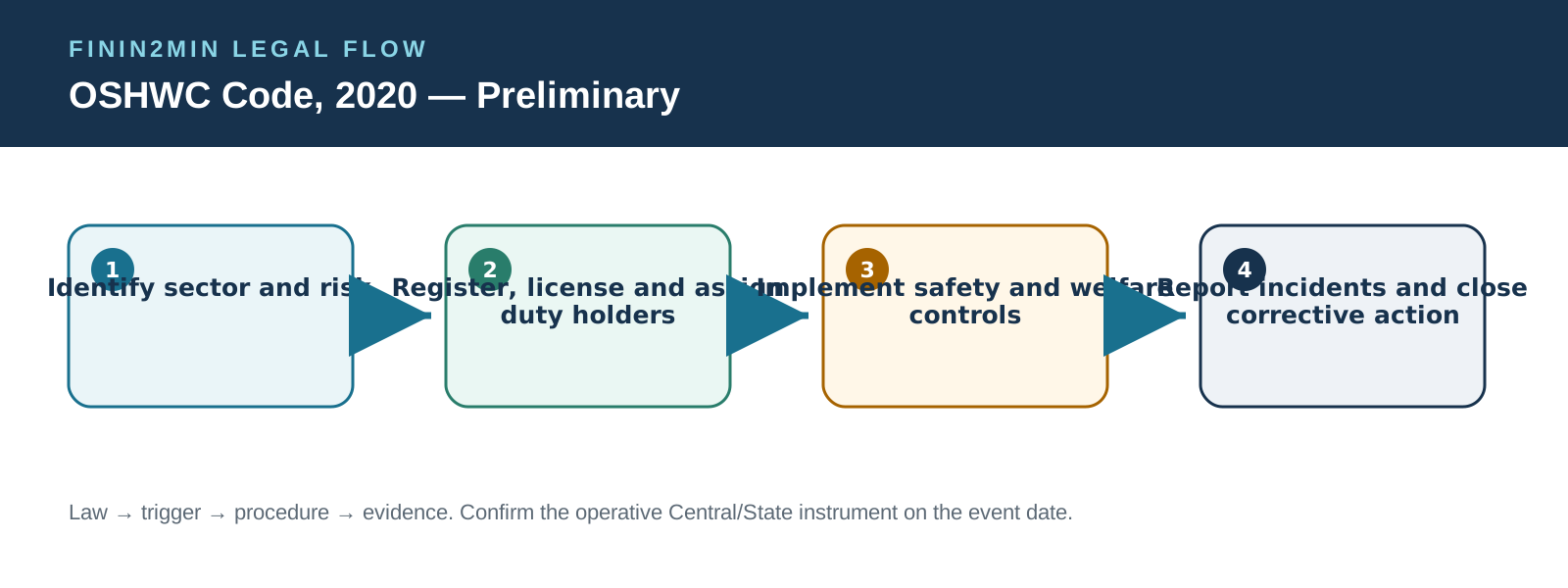
Chapter decision flow
Finin2min Summary - Chapter in 2 Minutes
This chapter turns preliminary into an operational control file. It covers Short title, commencement and application, Definitions; the practical sequence is to classify coverage and event date, apply the provision and mapped Rule, complete the form/register, calculate the entitlement or exposure, and retain evidence for inspection, claim or appeal.
Who is covered
Employers, occupiers, contractors, principal employers, workers and sector-specific establishments must identify the establishment type, worker category and appropriate Government.
Main obligations and rights
- Section 1: Short title, commencement and application
- Section 2: Definitions
Key thresholds and timelines
- Use only the threshold, rate and limitation period effective on the event date; verify the Central/State instrument before acting.
Forms, registers and evidence
- Applicable form/register, calculation file, approval and acknowledgement evidence
- Retain classification, calculation, approval, communication, acknowledgement and payment/filing proof.
Employer risk snapshot
Highest practical risks: misclassification, missed filing/notice, unsupported calculation, incomplete records and use of the wrong Central/State instrument.
Employee/worker remedy snapshot
Core protection: the substantive protection in this chapter, access to the prescribed authority/forum and a documented remedy within limitation. Confirm the authority, limitation and appeal route stated in this chapter.
Old law / transition
Map the event date and savings position against: Factories Act, 1948; Plantations Labour Act, 1951; Mines Act, 1952; Working Journalists laws; Motor Transport Workers Act, 1961.
Five-point professional checklist
- Freeze the event date, establishment, location and person/worker classification.
- Identify the controlling section/paragraph, mapped Rule, notification and appropriate Government.
- Reperform the calculation or decision test and document every exception or approval.
- Complete the prescribed form/register/portal step and retain acknowledgement, payment and communication evidence.
- Record the remedy, forum, limitation, appeal path and State variation before sign-off.
Finin2min takeaway: for preliminary, the defensible answer is not a policy label - it is the event-date law, the mapped procedure, the calculation and a complete evidence trail.
Section-by-section provision map
| Provision | Subject | Implementation focus |
|---|---|---|
| Section 1 | Short title, commencement and application | Trigger, linked Rule/form, evidence, consequence and remedy |
| Section 2 | Definitions | Trigger, linked Rule/form, evidence, consequence and remedy |
Section 1: Short title, commencement and application
Current statutory text
1. Short title, commencement and application.—(1) This Act may be called the Occupational
Safety, Health and Working Conditions Code, 2020.
    (2) It shall come into force on such date1 as the Central Government may, by notification appoint; and
different dates may be appointed for different provisions of this Code and any reference in any such
provision to the commencement of this Code shall be construed as a reference to the coming into force of
that provision.

    (3) It shall not apply to the offices of the Central Government, offices of the State Government and
any ship of war of any nationality:

    Provided that the Code shall apply in case of contract labour employed through contractor in the
offices of the Central Government or in the offices of the State Government, where, the Central
Government or, as the case may be, the State Government is the principal employer.
Finin2min clause-by-clause decode
- This page does not replace the statutory text. It separates the operative legal transaction into controls so that each subsection, proviso, exception and delegated instrument can be checked against the official India Code source before use.
- Identify the covered establishment, worker category, appropriate Government and event date.
- Confirm whether the establishment, contractor or premises falls within the relevant threshold and jurisdiction.
- Convert each statutory condition and proviso into an assigned action with a clear deadline.
- Use the prescribed electronic form and attach identity, address, constitution and work-order evidence.
- Map the enabling Rule, form, Schedule, authority and any sector-specific notification.
- Track completeness, statutory processing period, deemed outcome where expressly provided, and portal acknowledgement.
- Preserve the decision memo, worker communication, register, portal acknowledgement and payment or inspection evidence.
- Update material changes within the prescribed period; registration or licence is not transferable unless law says otherwise.
- Record exceptions, non-compliance consequences, remedy, appeal forum and limitation period.
Applicable Central Rules immediately below the provision
Central Rule 1: Rule 1 — Short title and commencement
Rule mapping is retained; read the official 2026 Gazette for the exact sub-rule text and forms.
Practical example
A multi-location employer prepares a legal classification memo, identifies the appropriate Government, maps the operative provision and Rule, records the decision owner and retains the documents needed to prove compliance during inspection or litigation.
Controls and evidence
- Employer: assign owner, configure system and retain approval/payment proof.
- Employee/worker: retain contract, attendance, wage/benefit proof and communication.
- Professional: reconcile the Act, Rule, notification, form, limitation and State overlay.
Consequence, remedy and limitation
Identify the substantive default first, then separately map arrears or benefit, interest/damages, administrative penalty, prosecution, compounding, company/officer liability, forum, appeal and limitation. Do not infer a remedy from the heading alone.
Mapped Rules: Rule 1, Rule 2 | Official source: section 1.
Section 2: Definitions
Current statutory text
2. Definitions.— (1) In this Code, unless the context otherwise requires,—

       (a) “adolescent” shall have the same meaning as assigned to it in clause (i) of section 2 of the Child
   and Adolescent Labour (Prohibition and Regulation) Act, 1986 (61 of 1986);

       (b) “adult” means a person who has completed his eighteenth year of age;

       (c) “agent” when used in relation to a mine, means every person, whether appointed as such or not,
   who, acting or purporting to act on behalf of the owner, takes part in the management, control,
   supervision or direction of such mine or of any part thereof;

       (d) “appropriate Government” means—

            (i) in relation to, establishments [other than those specified in sub-clause (ii)] carried on by or
      under the authority of the Central Government or concerning any such controlled industry as may
     be specified in this behalf by the Central Government or the establishment of railways including
     metro railways, mines, oil field, major ports, air transport service or telecommunication service,
      banking company or any insurance company (by whatever name called) established by a Central
     Act or a corporation or other authority established by a Central Act or a Central public sector
      undertaking  or  subsidiary companies  set up by  the  Central  public  sector  undertakings  or
     autonomous bodies owned or controlled by the Central Government, including establishment of
      contractors for the purposes of such establishment, corporation or other authority, Central public
      sector undertakings, subsidiary companies or autonomous bodies, as the case may be, the Central
     Government:

         Provided that in the case of Central Public Sector Undertakings the appropriate Government
       shall continue to be the Central Government even if the holding of the Central Government reduces
       to less than fifty per cent. equity of the Central Government in that Public Sector Undertakings
       after the commencement of this Code; and


1.  21st day of November, 2025, vide Notifn. No. S.O. 5321 (E), dated 21st day of November, 2025, see Gazette of India,
    Extraordinary, Part II, sec. 3 (ii).
        (ii) in relation to a factory, motor transport undertaking, plantation, newspaper establishment
   and establishment  relating to beedi and cigar including the establishments not specified in
   clause (i), the concerned State Government where it is situated.

     Explanation.—For the removal of doubts it is hereby clarified that State Government shall be
   the appropriate Government in respect of occupational safety, health and working conditions in a
   factory situated in that State;

   (e)  “audio-visual  production” means  audio-visual produced wholly  or  partly  in  India and
includes—

        (i) animation, cartoon depiction, audio-visual advertisement;

        (ii) digital production or any of the activities in respect of making thereof; and

         (iii) features films, non-feature films, television, web-based serials, talk shows, reality shows
   and sport shows;

    (f) “audio-visual worker” means a person, who is employed, directly or through any contractor, in
or in connection with the audio-visual production to work as an artist including actor, musician, singer,
anchor, news reader, dancer, dubbing artist or stunt person or to do any work, skilled, unskilled,
manual, supervisory, technical,  artistic or otherwise, and his remuneration with respect to such
employment  in or  in connection with the production of audio-visual does not exceed, where
remuneration is by way of monthly wages or where such remuneration is by way of lump sum, in each
case, such amount as may be notified by the Central Government;

   (g) “banking company” means a banking company as defined in clause (c) of section 5 of the
Banking Regulation Act, 1949 (10 of 1949) and includes the Export-Import Bank of India, the
Industrial Reconstruction Bank of India, the Small Industries Development Bank of India established
under section 3 of the Small Industries Development Bank of India Act, 1989 (39 of 1989), the
Reserve Bank of India, the State Bank of India, a corresponding new bank constituted under section 3
of the Banking Companies (Acquisition and Transfer of Undertakings) Act, 1970 (5 of 1970), a
corresponding new bank constituted under section 3 of the Banking Companies (Acquisition and
Transfer of Undertakings) Act, 1980 (40 of 1980);

   (h) “building or other construction work” means the construction, alteration, repairs, maintenance
or demolition in relation to buildings, streets, roads, railways, tramways, airfields, irrigation, drainage,
embankment and navigation works, flood control works (including storm water drainage works),
generation, transmission and distribution of power, water works (including channels for distribution of
water), oil and gas installations, electric lines, internet towers, wireless, radio, television, telephone,
telegraph and overseas communications, dams, canals, reservoirs, watercourses, tunnels, bridges,
viaducts, aqua-ducts, pipelines, towers, cooling towers, transmission towers and such other work as
may be specified in this behalf by the Central Government, by notification, but does not include
building or other construction work which is related to any factory or mine and the building or other
construction work where such work is for own residential purposes of an individual or group of
individuals for their own residence and the total cost of such work does not exceed rupees fifty lakhs
or such higher amount and employing more than such number of workers as may be notified by the
appropriate Government;

    (i) “building worker” means a person who is employed to do any highly skilled, skilled, semi-
skilled or unskilled, manual, technical or clerical work for hire or reward, whether the terms of such
employment are express or implied, in connection with any building or other construction work, but
does not include any such person who  is employed mainly in a managerial or supervisory or
administrative capacity;

    (j) “cargo” includes anything carried or to be carried in a ship or other vessel, or vehicle;

   (k) “Chief Inspector-cum-Facilitator” means a Chief Inspector-cum-Facilitator appointed under
sub-section (5) of section 34;


    (l) “competent person”, means a person or an institution recognised as such by the Chief Inspector-
cum-Facilitator for the purposes of carrying out tests, examinations and inspections required to be
done in an establishment having regard to—

        (i) the qualifications and experience of the person and facilities available at his disposal; or

        (ii) the qualifications and experience of the persons employed in such institution and facilities
   available therein:

      Provided that in case of mines the competent person includes such other person who  is
   authorised by the manager referred to in section 67 to supervise or perform any work, or to
   supervise the operation of machinery, plant or equipment and  is responsible for such duties
   assigned to him and also includes a shot firer or blaster;

   (m) “contract labour” means a worker who shall be deemed to be employed in or in connection
with the work of an establishment when he is hired in or in connection with such work by or through a
contractor, with or without the knowledge of the principal employer and includes inter-State migrant
worker but does not include a worker (other than part time employee) who is regularly employed by
the contractor for any activity of his establishment and his employment is governed by mutually
accepted standards of the conditions of employment (including engagement on permanent basis), and
gets periodical increment in the pay, social security coverage and other welfare benefits in accordance
with the law for the time being in force in such employment;

   (n) “contractor”, in relation to an establishment, means a person, who—

        (i) undertakes to produce a given result for the establishment, other than a mere supply of goods
   or articles of manufacture to such establishment, through contract labour; or

        (ii) supplies contract labour for any work of the establishment as mere human resource,

and includes a sub-contractor;

   (o) “controlled industry” means any industry the control of which by the Central Government has
been declared under any Central Act in the public interest;

   (p) “core activity of an establishment” means any activity for which the establishment is set up and
includes any activity which is essential or necessary to such activity:

   Provided that the following shall not be considered as essential or necessary activity,  if the
establishment is not set up for such activity, namely:—

            (i) sanitation works, including sweeping, cleaning, dusting and collection and disposal of all
      kinds of waste;

             (ii) watch and ward services including security services;

             (iii) canteen and catering services;

           (iv) loading and unloading operations;

          (v) running of hospitals, educational and training Institutions, guest houses, clubs and the like
     where they are in the nature of support services of an establishment;

           (vi) courier services which are in nature of support services of an establishment;

            (vii) civil and other constructional works, including maintenance;

            (viii) gardening and maintenance of lawns and other like activities;

           (ix) housekeeping and laundry services, and other like activities, where these are in nature of
      support services of an establishment;

          (x) transport services including, ambulance services;

           (xi) any  activity of  intermittent nature even  if  that  constitutes a core  activity of an
      establishment;

       (q) “day” means a period of twenty-four hours beginning at mid-night;

       (r) “District Magistrate”, in relation to any mine, means the District Magistrate or the Deputy
   Commissioner, as the case may be, who is vested with the executive powers of maintaining law and
   order in the revenue district in which the mine is situated:

      Provided that in case of a mine, which is situated partly in one district and partly in another, the
   District Magistrate for the purpose shall be the District Magistrate authorised in this behalf by the
   Central Government;

       (s) “dock work” means any work in or within the vicinity of any port in connection with, or
   required for, or incidental to, the loading, unloading, movement or storage of cargoes into or from
   ship or other vessel, port, dock, storage place or landing place, and includes—

            (i) work in connection with the preparation of ships or other vessels for receipt or discharge
      of cargoes or leaving port;

             (ii) all repairing and maintenance processes connected with any hold, tank structure or lifting
      machinery or any other storage area on board the ship or in the docks; and

             (iii) chipping, painting or cleaning of any hold, tank, structure or lifting machinery or any
      other storage area on board the ship or in the docks;

        (t) “employee” means,—

            (i) in respect of an establishment, a person (other than an apprentice engaged under the
      Apprentices Act, 1961 (52 of 1961)) employed on wages by an establishment to do any skilled,
       semi-skilled, unskilled, manual, operational, supervisory, managerial, administrative, technical,
       clerical or any other work, whether the terms of employment be express or implied; and

             (ii) a person declared to be an employee by the appropriate Government,

but does not include any member of the Armed Forces of the Union:

         Provided that notwithstanding anything contained in this clause, in case of a mine a person is
      said to be “employed” in a mine who works as the manager or who works under appointment by
      the owner, agent or manager of the mine or with the knowledge of the manager, whether for
     wages or not—

          (a) in any mining operation (including the concomitant operations of handling and transport
      of minerals up to the point of dispatch and of gathering sand and transport thereof to the mine);

          (b) in operations or services relating to the development of the mine including construction
      of plant therein but excluding construction of buildings, roads, wells and any building work not
       directly connected with any existing or future mining operations;

          (c) in operating, servicing, maintaining or repairing any part of any machinery used in or
      about the mine;

          (d) in operations, within the premises of the mine, of loading for dispatch of minerals;

          (e) in any office of mine;

            (f) in any welfare, health, sanitary or conservancy services required to be provided under this
     Code relating to mine, or watch and ward, within the premises of the mine excluding residential
       area; or

          (g) in any kind of work, whatsoever, which is preparatory or incidental to, or connected with,
     mining operations;

       (u) “employer” means a person who employs, whether directly or through any person, or on his
   behalf, or on behalf of any person, one or more employees in his establishment and where the
   establishment is carried on by any Department of the Central Government or the State Government,
   the authority specified, by the head of such Department, in this behalf or where no authority, is so
   specified, the head of the Department and in relation to an establishment carried on by a local
   authority, the Chief Executive of that authority, and includes,—

            (i) in relation to an establishment which is a factory, the occupier of the factory;

                 (ii) in relation to mine, the owner of the mine, agent or manager referred to in section 67;

                 (iii) in relation to any other establishment, the person who, or the authority which has
         ultimate control over the affairs of the establishment and where said affairs are entrusted to a
        manager or managing director, such manager or managing director;

               (iv) contractor; and

              (v) legal representative of a deceased employer;

       (v) “establishment” means—

                (i) a place where any industry, trade, business, manufacturing or occupation is carried on in
        which ten or more workers are employed; or

                 (ii) motor transport undertaking, newspaper establishment, audio-video production, building
        and other construction work or plantation, in which ten or more workers are employed; or

                 (iii) factory, for the purpose of Chapter II, in which ten or more workers are employed,
         notwithstanding the threshold of workers provided in clause (w); or

               (iv) a mine or port or vicinity of port where dock work is carried out:

           Provided that in sub-clauses (i) and (ii), the threshold of worker specified therein shall not be
         applicable in case of such establishment or class of establishments, in which such hazardous or
            life threatening activity is being carried on, as may be notified by the Central Government:

           Provided further that notwithstanding any threshold provided in the definition of factory in
         clause (w), for the purposes of Chapter  II, the establishment specified in sub-clause (i) or
         sub-clause (ii) or sub-clause (iii) shall be deemed to be the establishment within the meaning of
           this clause though the number of employees employed are ten or more;

      (w) “factory” means any premises including the precincts thereof—

            (i) whereon twenty or more workers are working, or were working on any day of the preceding
      twelve months, and in any part of which a manufacturing process is being carried on with the aid of
      power, or is ordinarily so carried on; or

             (ii) whereon forty or more workers are working, or were working on any day of the preceding
      twelve months, and in any part of which a manufacturing process is being carried on without the
      aid of power, or is ordinarily so carried on,

but does not include a mobile unit belonging to the armed forces of the Union, railways running shed or a
hotel, restaurant or eating place:

   Provided that where under any law for the time being in force in a State immediately before the
commencement of this Code, the number of workers specified is more or less than the number specified
in clause (i) or clause (ii), then, the number specified under the law of the State shall prevail in that State
till it is amended by the competent Legislature.

   Explanation I.—For computing the number of workers for the purposes of this clause all the workers
(in different groups and relays) in a day shall be taken into account.

   Explanation II.—For the purposes of this clause, the mere fact that an Electronic Data Processing Unit
or a Computer Unit is installed in any premises or part thereof, shall not be construed as factory if no
manufacturing process is being carried on in such premises or part thereof;

       (x) “family”, when used in relation to a worker, means—

                (i) spouse;

                 (ii) children including adopted children of the worker who are dependent upon him and have
         not completed the age of eighteen years; and

                 (iii) parents, grand-parents, widowed daughter and widowed sister dependent upon such
         worker.


        Explanation.—For the purposes of this clause, such dependents shall not be included who
       are, for the time being, getting such income from such sources, as may be prescribed by the
      appropriate Government;

   (y) “godown” means any warehouse or other place, by whatever name called, used for the storage
of any article or substance required for any manufacturing process which means any process for, or
incidental to, making, finishing or packing or otherwise treating any article or substance with a view to
its use, sale, transport, delivery or disposal as finished products;

    (z) “hazardous” means involving danger or potential danger;

   (za) “hazardous process” means any process or activity in relation to an industry or plantation
specified in the First Schedule where, unless special care is taken, raw materials used therein or the
intermediate or finished products, bye-products, hazardous substances, wastes or effluents thereof or
spraying of any pesticides, insecticides or chemicals used therein, as the case may be, would—

            (i) cause material impairment to the health of the persons engaged in or connected therewith,
      or

             (ii) result in the pollution of the general environment;

   (zb) “hazardous substance” means any substance or such quantity of the substance as may be
prescribed by the appropriate Government or preparation of which by reason of its chemical or physio-
chemical properties or handling is liable to cause physical or health hazards to human being or may
cause harm to other living creatures, plants, micro-organisms, property or the environment;

   (zc) “industrial premises” means any place or premises (not being a private dwelling house),
including the precincts thereof, in which or in any part of which any industry, trade, business,
occupation or manufacturing is being ordinarily carried on with or without the aid of power and
includes a godown attached thereto;

   (zd) “industry” means any systematic activity carried on by co-operation between an employer and
worker (whether such worker is employed by such employer directly or by or through any agency,
including a contractor) for the production, supply or distribution of goods or services with a view to
satisfy human wants or wishes (not being wants or wishes which are merely spiritual or religious in
nature), whether or not,—

            (i) any capital has been invested for the purpose of carrying on such activity; or

             (ii) such activity is carried on with a motive to make any gain or profit,

but does not include—

          (a) institutions owned or managed by organisations wholly or substantially engaged in any
       charitable, social or philanthropic services; or

          (b) any activity of the appropriate Government relatable to the sovereign functions of the
      appropriate Government including all the activities carried on by the Departments of the Central
     Government dealing with defence research, atomic energy and space; or

          (c) any domestic service; or

          (d) any other activity as may be notified by the Central Government;

   (ze)   “Inspector-cum-Facilitator”  means   an   Inspector-cum-Facilitator   appointed   under
sub-section (1) of section 34;

    (zf) “inter-State migrant worker” means a person who is employed in an establishment and who—

            (i) has been recruited directly by the employer or indirectly through contractor in one State
       for employment in such establishment situated in another State; or

             (ii) has come on his own from one State and obtained employment in an establishment of
      another  State  (hereinafter  called  destination  State)  or  has  subsequently  changed  the
      establishment within the destination State,


under an agreement or other arrangement for such employment and draws wages not exceeding the
amount of rupees eighteen thousand per month or such higher amount as may be notified by the Central
Government from time to time;
       (zg) “machinery” means any article or combination of articles assembled, arranged or connected
   and which is used or intended to be used for converting any form of energy to perform work, or which
    is used or intended to be used, whether incidental thereto or not, for developing, receiving, storing,
   containing, confining, transforming, transmitting, transferring or controlling any form of energy;
       (zh) “major port” means a major port as defined in clause (8) of section 3 of the Indian Ports Act,
   1908 (15 of 1908);

        (zi) “manufacturing process” means any process for—

                (i) making, altering, repairing, ornamenting, finishing, packing, oiling, washing, cleaning,
         breaking up, demolishing, or otherwise treating or adapting any article or substance with a view
          to its use, sale, transport, delivery or disposal; or

                 (ii) pumping oil, water, sewage or any other substance; or

                 (iii) generating, transforming or transmitting power; or

               (iv) composing, printing, printing by letter press, lithography, offset, photogravure screen
          printing, three Dimensional or four Dimensional printing, prototyping, flexography or other
         types of printing process or book binding; or

              (v) constructing, reconstructing, repairing, refitting, finishing or breaking up ships or vessels;
         or

               (vi) preserving or storing any article in cold storage; or

               (vii) such other processes as the Central Government may notify;

        (zj) “medical officer” means the medical officer appointed under sub-section (1) of section 42;

       (zk) “metro railway” means the metro railway as defined in sub-clause (i) of clause (1) of section 2
   of the Metro Railways (Operation and Maintenance) Act, 2002 (60 of 2002);

        (zl) “mine” means any excavation where any operation for the purpose of searching for or obtaining
   minerals has been or is being carried on and includes—

                (i) all borings, bore holes, oil wells and accessory crude conditioning plants, including the
         pipe conveying mineral oil within the oilfields;

                 (ii) all shafts, in or adjacent to and belonging to a mine, whether in the course of being sunk
         or not;

                 (iii) all levels and inclined planes in the course of being driven;

               (iv) all open cast workings;

              (v) all conveyors or aerial ropeways provided for bringing into or removal from a mine of
         minerals or other articles or for the removal of refuse therefrom;

               (vi) all adits, levels, planes, machinery, works, railways, tramways and sidings in or adjacent
          to and belonging to a mine;

               (vii) all protective works being carried out in or adjacent to a mine;

                (viii) all workshops and stores situated within the precincts of a mine and under the same
        management and used primarily for the purposes connected with that mine or a number of
        mines under the same management;

               (ix) all power stations, transformer sub-stations, converter stations, rectifier stations and
         accumulator storage stations for supplying electricity solely or mainly for the purpose of
        working the mine or a number of mines under the same management;

              (x) any premises for the time being used for depositing sand or other material for use in a
        mine or for depositing refuse from a mine or in which any operations in connection with such
      sand refuse or other material is being carried on, being premises exclusively occupied by the
     owner of the mine;

           (xi) any premises in or adjacent to and belonging to a mine on which any process ancillary to
      the getting, dressing or preparation for sale of minerals or coke is being carried on;

            (xii) a mine owned by the Government;

   (zm) “minerals” means all substances which can be obtained from the earth by mining, digging,
drilling, dredging, hydraulicing, quarrying or by any other operation and includes mineral oils (such as
natural gas and petroleum);

   (zn) “motor transport undertaking” means a motor transport undertaking employing motor transport
worker and engaged in carrying passengers or goods or both by road for hire or reward, and includes a
private carrier;

   (zo) “motor transport worker” means a person who is employed in a motor transport undertaking
directly or through an agency, whether for wages or not, to work in a professional capacity on a
transport vehicle or to attend the duties in connection with the arrival, departure, loading or unloading
of such transport vehicle and includes a driver, conductor, cleaner, station staff, line checking staff,
booking clerk, cash clerk, depot clerk, time-keeper, watchman or attendant, but does not include any
such person—

            (i) who is employed in a factory;

             (ii) to whom the provisions of any other law for the time being in force regulating the
      conditions of service of persons employed in shops or commercial establishments apply;

   (zp) “newspaper” means any printed periodical work containing public news or comments on
public news and includes such other class of printed periodical work as may, from time to time, be
notified in this behalf by the Central Government;

   (zq) “newspaper establishment” means an establishment under the control of any person or body of
persons, whether incorporated or not, for the production or publication of one or more newspapers or
for conducting any news agency or syndicate and includes following newspaper establishments which
shall be deemed to be one establishment, namely:—

            (i) two or more newspaper establishments under common control;

             (ii) two or more newspaper establishments owned by an individual and his or her spouse
      unless it is shown that such spouse is a sole proprietor or partner or a shareholder of a corporate
     body on the basis of his or her own individual funds;

             (iii) two or more newspaper establishments publishing newspapers bearing the same or
      similar title and in the same language in any place in India or bearing the same or similar title
      but in different languages in the same State or Union territory.

         Explanation 1.—For the purposes of sub-clause (i) two or more establishments shall be
     deemed to be under common control where—

             (a) (i) the newspaper establishments are owned by a common individual or individuals;

                 (ii) the newspaper establishments are owned by firms, if such firms have a substantial
        number of common partners;

                 (iii) the newspaper establishments are owned by bodies corporate, if one body corporate
           is a subsidiary of the other body corporate, or both are subsidiaries of a common holding
       company or a substantial number of their equity shares are owned by the same person or
        group of persons, whether incorporated or not;

               (iv) one establishment is owned by a body corporate and the other is owned by a firm, if a
          substantial number of partners of the firm together hold a substantial number of equity shares
         of the body corporate;


                 (v) one is owned by a body corporate and the other is owned by a firm having bodies
            corporate as its partners if a substantial number of equity shares of such bodies corporate are
           owned, directly or indirectly, by the same person or group of persons, whether incorporated
            or not, or

                (b) there is functional integrality between concerned newspaper establishments.

              Explanation 2.—For the purposes of this clause,—

                            (i) different departments, branches and centres of newspaper establishments shall
                be treated as parts thereof;
                             (ii) a printing press shall be deemed to be a newspaper establishment  if the
                    principal business thereof is to print newspaper;


       (zr) “notification” means a notification published in the Gazette of India or the Official Gazette of a
   State, as the case may be, and the expression “notify” with its grammatical variations and cognate
   expressions shall be construed accordingly;

       (zs) “occupier” of a factory means the person who has ultimate control over the affairs of the
   factory:

      Provided that—

            (i) in the case of a firm or other association of individuals, any one of the individual partners or
     members thereof;

             (ii) in the case of a company, any one of the directors, except any independent director within
      the meaning of sub-section (6) of section 149 of the Companies Act, 2013;

             (iii) in the case of a factory owned or controlled by the Central Government or any State
     Government, or any local authority, the person or persons appointed to manage the affairs of the
      factory by the Central Government, the State Government or the local authority or such other
      authority as may be prescribed by the Central Government,

shall be deemed to be the occupier:

         Provided further that in the case of a ship which is being repaired, or on which maintenance
     work is being carried out, in a dry dock which is available for hire, the owner of the dock shall be
     deemed to be the occupier for all purposes except the matters as may be prescribed by the Central
     Government which are directly related to the condition of ship for which the owner of ship shall be
     deemed to be the occupier;

        (zt) “office of the mine” means an office at the surface of the mine concerned;

       (zu) “open cast working” means a quarry, that is to say, an excavation where any operation for the
   purpose of searching for or obtaining minerals has been or is being carried on, not being a shaft or an
   excavation which extends below superjacent ground;

       (zv) “ordinarily employed” with reference to any establishment or part thereof, means the average
   number of persons employed per day in the establishment or part thereof during the preceding calendar
   year obtained by dividing the number of man days worked by the number of working days excluding
    rest days and other non-working days;

      (zw) “owner”, in relation to a mine, means any person who is the immediate proprietor or lessee or
   occupier of the mine or of any part thereof and in case of a mine the business whereof is being carried
   on by a liquidator or receiver, such liquidator or receiver; but does not include a person who merely
   receives a royalty, rent or fine from the mine, or is merely the proprietor of the mine, subject to any
   lease grant or licence for the working thereof, or is merely the owner of the soil and not interested in
   the minerals of the mine; but any contractor or sub-lessee for the working of a mine or any part thereof
   shall be subject to this Code in like manner as if he were an owner but not so as to exempt the former
   from any liability;

    (zx) “plantation” means—

       (a) any land used or intended to be used for—

            (i) growing tea, coffee, rubber, cinchona or cardamom which admeasures five hectares or
      more;

             (ii) growing any other plant, which admeasures five hectares or more and in which persons
      are employed or were employed on any day of the preceding twelve months, if, after obtaining
      the approval of the Central Government, the State Government, by notification, so directs.

        Explanation.—Where any piece of land used for growing any plant referred to in this sub-
      clause admeasures less than five hectares and is contiguous to any other piece of land not being
      so used, but capable of being so used, and both such pieces of land are under the management of
      the same employer, then, for the purposes of this sub-clause, the former piece of land shall be
     deemed to be a plantation, if the total area of both such pieces of land admeasures five hectares
      or more; and

          (b) any land which the State Government may, by notification, declare and which is used or
      intended to be used for growing any plant referred to in sub-clause (a), notwithstanding that it
      admeasures less than five hectares:

         Provided that no such declaration shall be made in respect of such land which admeasures
       less than five hectares immediately before the commencement of this Code; and

          (c) offices, hospitals, dispensaries, schools and any other premises used for any purpose
      connected with any plantation within the meaning of sub-clause (a) and sub-clause (b); but does
      not include factory on the premises;

   (zy) “prescribed” means prescribed by rules made by the appropriate Government under this Code;

    (zz) “principal employer”, where the contract labour is employed or engaged, means—


            (i) in relation to any office or Department of the Government or a local authority, the head of
       that office or Department or such other officer as the Government or the local authority, may
      specify in this behalf;

             (ii) in a factory, the owner or occupier of the factory and where a person has been named as
      the manager of the factory, the person so named;

             (iii) in a mine, the owner or agent of the mine;

           (iv) in relation to any other establishment, any person responsible for the supervision and
      control of the establishment;

   (zza) “producer”, in relation to audio-visual production, means the company, firm or other person
by whom the arrangements necessary for producing such audio-visual (including the raising of
finances and engaging audio-visual workers for producing audio-visual) are undertaken.

   Explanation.—For the purposes of this clause, the expressions “company” and “firm” have the
same meaning as respectively assigned to them in the Companies Act, 2013 (18 of 2013) and the
Indian Partnership Act, 1932 (9 of 1932);

   (zzb) “qualified medical practitioner” means a medical practitioner who possesses any recognised
medical qualification as defined in clause (i) of section 2 of the Indian Medical Council Act, 1956
(102 of 1956) and who is enrolled on a Indian Medical Register as defined in clause (e) and on a State
Medical Register as defined in clause (l) of the said section;

   (zzc) “railway” means the railway as defined in clause (31) of section 2 of the Railways Act, 1989
(24 of 1989);

   (zzd) “relay” means a set of two or more persons carrying out the same kind of work during
different periods of the day and each such period is called a “shift”;

   (zze) “sales promotion employees” means any person by whatever name called employed or
engaged in any establishment for hire or reward to do any work relating to promotion of sales or
business, or both, but does not include any such person who,—

            (i) being employed or engaged in a supervisory capacity, draws wages exceeding eighteen
      thousand rupees per mensem or an amount as may be notified by the Central Government from
      time to time; or

             (ii) is employed or engaged mainly in a managerial or administrative capacity.

    (zzf) “Schedule” means the Schedule appended to this Code;

   (zzg) “serious bodily injury” means any injury which involves, or in all probability will involve, the
permanent loss of any part or section of a body or the use of any part or section of a body, or the
permanent loss of or injury to the sight or hearing or any permanent physical incapacity or the fracture
of any bone or one or more joints or bones of any phalanges of hand or foot;

   (zzh) “standards”, “regulations”, “rules”, “bye-laws” and “orders” respectively means standards,
regulations, rules, bye-laws and orders made or declared, as the case may be, under this Code;

    (zzi) “telecommunication service” means the telecommunication service as defined in clause (k) of
sub-section (1) of section 2 of the Telecom Regulatory Authority of India Act, 1997 (24 of 1997);

    (zzj) “wages” means  all remuneration whether by way of  salaries, allowances or otherwise,
expressed in terms of money or capable of being so expressed which would,  if the terms of
employment, express or implied, were fulfilled, be payable to a person employed in respect of his
employment or of work done in such employment, and includes,—

            (i) basic pay;

             (ii) dearness allowance; and

             (iii) retaining allowance, if any,

but does not include—


          (a) any bonus payable under any law for the time being in force, which does not form part of
      the remuneration payable under the terms of employment;

          (b) the value of any house-accommodation, or of the supply of  light, water, medical
      attendance or other amenity or of any service excluded from the computation of wages by a
      general or special order of the appropriate Government;

          (c) any contribution paid by the employer to any pension or provident fund, and the interest
     which may have accrued thereon;

          (d) any conveyance allowance or the value of any travelling concession;

          (e) any sum paid to the employed person to defray special expenses entailed on him by the
      nature of his employment;

            (f) house rent allowance;

          (g) remuneration payable under any award or settlement between the parties or order of a
      court or Tribunal;

          (h) any overtime allowance;

            (i) any commission payable to the employee;

            (j) any gratuity payable on the termination of employment;

          (k) any retrenchment compensation or other retirement benefit payable to the employee or
     any ex gratia payment made to him on the termination of employment:

         Provided that, for calculating the wages under this clause, if payments made by the employer
       to the employee under sub-clauses (a) to (i) exceeds one-half, or such other per cent. as may be
          notified by the Central Government, of the all remuneration calculated under this clause, the
        amount which exceeds such  one-half, or the per  cent. so  notified,  shall be deemed as
         remuneration and shall be accordingly added in wages under this clause:

           Provided further that for the purpose of equal wages to all genders and for the purpose of
        payment of wages, the emoluments specified in sub-clauses (d), (f), (g) and (h) shall be taken
          for computation of wages.

           Explanation.—Where an employee is given in lieu of the whole or part of the wages payable
          to him, any remuneration in kind by his employer, the value of such remuneration in kind which
        does not exceed fifteen per cent. of the total wages payable to him, shall be deemed to form part
         of the wages of such employee;

       (zzk) “week” means a period of seven days beginning at midnight on Saturday night or such other
   night as may be approved in writing for a particular area by the Chief Inspector-cum-Facilitator;

       (zzl) “worker” means any person employed in any establishment to do any manual, unskilled,
    skilled, technical, operational, clerical or supervisory work for hire or reward, whether the terms of
   employment be express or implied, and includes working journalists and sales promotion employees,
   but does not include any such person—

                (i) who is subject to the Air Force Act, 1950 (45 of 1950), or the Army Act, 1950 (46 of
         1950), or the Navy Act, 1957 (62 of 1957); or

                 (ii) who is employed in the police service or as an officer or other employee of a prison; or

                 (iii) who is employed mainly in a managerial or administrative capacity; or

               (iv) who is employed in a supervisory capacity drawing wage exceeding eighteen thousand
         rupees per month or an amount as may be notified by the Central Government from time to
         time;

      (zzm) “Working Journalist” means a person whose principal avocation is that of a journalist and
  who is employed as such, either whole-time or part-time, in, or in relation to, one or more newspaper
   establishment, or other establishment relating to any electronic media or digital media such as
   newspaper or radio or other likemedia and includes an editor, a leader-writer, news editor, sub-editor,
   feature-writer, copytester, reporter, correspondent, cartoonist, news-photographer and proof-reader,
   but does not include any such person who is employed mainly in a managerial, supervisory or
   administrative capacity;

   (2) For the purposes of this Code, a person working or employed in or in connection with mine is said
to be working or employed—

          (a) “below ground” if he is working or employed—

                (i) in a shaft which has been or is in the course being sunk; or

                 (ii) in any excavation which extends below superjacent ground; and

          (b) “above ground” if he is working in an opencast working or in any other manner not specified
       in clause (a).

                              CHAPTER II

                                       REGISTRATION
Finin2min clause-by-clause decode
- This page does not replace the statutory text. It separates the operative legal transaction into controls so that each subsection, proviso, exception and delegated instrument can be checked against the official India Code source before use.
- Identify the covered establishment, worker category, appropriate Government and event date.
- Identify the covered establishment, worker category, appropriate Government and sector-specific overlay.
- Convert each statutory condition and proviso into an assigned action with a clear deadline.
- Break the provision into trigger, actor, action, timing, evidence and consequence before configuring the process.
- Map the enabling Rule, form, Schedule, authority and any sector-specific notification.
- Read the corresponding Central Rule, prescribed form, Schedule and notified authority together.
- Preserve the decision memo, worker communication, register, portal acknowledgement and payment or inspection evidence.
- Create a named control owner and maker-checker evidence trail.
- Record exceptions, non-compliance consequences, remedy, appeal forum and limitation period.
Applicable Central Rules immediately below the provision
Practical example
A multi-location employer prepares a legal classification memo, identifies the appropriate Government, maps the operative provision and Rule, records the decision owner and retains the documents needed to prove compliance during inspection or litigation.
Controls and evidence
- Employer: assign owner, configure system and retain approval/payment proof.
- Employee/worker: retain contract, attendance, wage/benefit proof and communication.
- Professional: reconcile the Act, Rule, notification, form, limitation and State overlay.
Consequence, remedy and limitation
Identify the substantive default first, then separately map arrears or benefit, interest/damages, administrative penalty, prosecution, compounding, company/officer liability, forum, appeal and limitation. Do not infer a remedy from the heading alone.
Mapped Rules: Rule 1, Rule 2, Rule 186 | Official source: section 2.
Rules, forms, registers, portals and due dates
| Rule | Subject | Text/control status |
|---|---|---|
| 1 | Rule 1 — Short title and commencement | Source-controlled mapping |
| 2 | Rule 2 — Definitions | Source-controlled mapping |
| 186 | Rule 186 — Income from sources and quantity of hazardous substance | Source-controlled mapping |
Forms and registers must be confirmed from the appended 2026 Central Rules and the live portal applicable to the appropriate Government. A form is not treated as current merely because an earlier law used the same number.
Notifications and effective-date history
| Control | Required action |
|---|---|
| Enactment | Record Act number, assent and Gazette publication. |
| Commencement | Use the provision-specific commencement notification; the four Codes became broadly operative from 21 November 2025 subject to earlier partial commencement and corrigenda. |
| Central Rules | Read the applicable 2026 Central Rules from their Gazette date and verify subsequent amendments. |
| State instrument | Check final State Rules, authority notifications, forms and rates where the State is appropriate Government. |
Old-law/new-Code concordance
| Predecessor law | Transition control |
|---|---|
| Factories Act, 1948 | Classify the event date, accrued right, saved Rule/notification and pending proceeding before moving to the Code. |
| Plantations Labour Act, 1951 | Classify the event date, accrued right, saved Rule/notification and pending proceeding before moving to the Code. |
| Mines Act, 1952 | Classify the event date, accrued right, saved Rule/notification and pending proceeding before moving to the Code. |
| Working Journalists laws | Classify the event date, accrued right, saved Rule/notification and pending proceeding before moving to the Code. |
| Motor Transport Workers Act, 1961 | Classify the event date, accrued right, saved Rule/notification and pending proceeding before moving to the Code. |
| Beedi and Cigar Workers Act, 1966 | Classify the event date, accrued right, saved Rule/notification and pending proceeding before moving to the Code. |
| Contract Labour Act, 1970 | Classify the event date, accrued right, saved Rule/notification and pending proceeding before moving to the Code. |
| Inter-State Migrant Workmen Act, 1979 | Classify the event date, accrued right, saved Rule/notification and pending proceeding before moving to the Code. |
| Cine-Workers Act, 1981 | Classify the event date, accrued right, saved Rule/notification and pending proceeding before moving to the Code. |
| Dock Workers Act, 1986 | Classify the event date, accrued right, saved Rule/notification and pending proceeding before moving to the Code. |
| BOCW Act, 1996 | Classify the event date, accrued right, saved Rule/notification and pending proceeding before moving to the Code. |
Practical calculations and control file
Calculation sequence
- Freeze the employee/worker population and event date.
- Apply the statutory wage/benefit base and notified threshold.
- Reconcile attendance, service, payroll and contractor records.
- Calculate principal amount, interest/damages and any statutory compensation separately.
- Obtain legal/payroll approval and retain the versioned worksheet.
Three-owner sign-off
- Employer/HR: facts, classification, communication and workflow.
- Employee/worker: notice, records, nomination/claim and acknowledgement.
- Professional: source, formula, forum, limitation and evidence reconciliation.
Binding and highly relevant case-law principles
| Decision | Principle and present-use caution |
|---|---|
| Consumer Education and Research Centre v. Union of India | Worker health and safety are connected with dignity and life; statutory standards should be treated as minimum controls. |
| J.K. Industries Ltd. v. Chief Inspector of Factories | Responsibility attaches to the statutory person in control; internal delegation does not erase legal accountability. |
| Vellore Citizens Welfare Forum v. Union of India | Preventive and precautionary controls are relevant where industrial risk affects workers and surrounding communities. |
| Gammon India Ltd. v. Union of India | Construction-worker welfare and cess legislation is beneficial and must be applied consistently with the charging and machinery provisions. |
State-law variation alerts
- Confirm whether the Central or State Government is the appropriate Government.
- Central Rules do not automatically displace valid State Rules, rates, registers, authorities or portal procedures.
- Minimum-wage rates, holidays, working-hours permissions, licences and local welfare obligations require State-specific verification.
- Record Gazette number, effective date and supersession status in the location compliance register.
Practical examples and calculations
Classify the worker and establishment, identify the operative provision and notified instrument on the event date, compute the entitlement or exposure from source records, obtain approval, complete the filing/payment/action, and retain evidence. Do not use a portal value or payroll label as a substitute for the statutory test.
Calculation/control template: Control calculation: verified population or transaction base × applicable notified rate/amount × eligible period, adjusted for statutory inclusions, exclusions, ceilings, interest, compensation and prior payments. Reperform the calculation from retained source data.
Finin2min implementation explanation
Maintain a controlled implementation file for OSHWC Code, 2020 — Chapter I - Preliminary: coverage and event date, operative Central/State instrument, responsible owner, approval and authority, form/portal step, due date, calculation basis, supporting evidence, exception, escalation and closure proof. Reconcile payroll, HR, finance, contractor and legal records before sign-off.
Practical transaction application
Apply the chapter to site acquisition, factory/establishment registration, contractor mobilisation, licence conditions, migrant-worker deployment, construction, hazardous process, working hours, welfare, accident response and shutdown planning.
Authority, consent and execution controls
Identify the employer, occupier, manager, principal employer, contractor, safety officer, medical officer and authorised signatory. Verify licences, appointments, delegations and government approvals before mobilisation; contract allocation does not extinguish statutory responsibility.
Stamp duty and registration alerts
Licences and statutory registrations are distinct from stamping/registration of leases, construction contracts, contractor agreements, security instruments and land documents. Check State stamp and registration law for the underlying transaction while separately completing labour-law approvals.
Evidence and document-retention checklist
Retain the operative law/rule version, classification note, approvals, signed instruments, statutory forms, portal acknowledgements, registers, calculations, bank proof, correspondence, inspection records, service proof, decision and appeal file. Apply the longer of the statutory retention rule, litigation hold, tax/audit need and contractual requirement; restrict access to personal and sensitive data.
Performance, delivery and payment controls
Use pre-mobilisation gates for registration, licence, competency, medical fitness, training, PPE, welfare and emergency readiness. Link contractor invoices to attendance, wage payment, contribution proof, safety records and incident closure.
Breach, loss, mitigation and remedy framework
On detecting a breach, stop continuing exposure, preserve evidence, quantify employee and government dues, identify affected persons, make lawful corrective payment/filing, notify the authorised decision-maker, assess self-disclosure or compounding where available, and reserve contractual recovery against responsible vendors without delaying statutory remediation.
Limitation and forum controls
Route inspection, licence, prohibition, penalty and appeal matters to the prescribed authority and court. Preserve inspection records, sampling chain, accident evidence, notices and appeal clocks; contractual dispute forums do not displace regulatory action.
Arbitration and mediation interface
Arbitration or mediation may resolve employer-contractor allocation and indemnity disputes, but cannot bind inspectors, waive safety duties, suppress accident reporting or replace statutory prosecution/appeal channels.
Company, partnership, GST and tax overlays
For a company, align board/delegation and officer-in-default controls; for an LLP or partnership, identify the designated partner/partner and authorised employer representative. Labour dues can affect transaction price, indemnities, director/partner exposure and insolvency claims. Salary/TDS, perquisite, contractor TDS, GST on outsourced services and accounting provisions must be reconciled without treating tax treatment as proof of labour-law classification.
Finin2min Q&A
Which law and version should be applied?
Use the current text of OSHWC Code, 2020, the commencement notification, the applicable Central or State Rules and any later instrument effective on the event date.
How is the appropriate Government identified?
Classify ownership/control, sector, establishment and contractor relationship before selecting the Central or State authority.
Can a company policy override the statutory protection?
No. A policy may improve a benefit or control, but it cannot contract out of a mandatory statutory floor.
What evidence should be retained?
Retain the classification memo, source instrument, form/portal record, calculation, approval, employee communication, acknowledgement and payment or authority proof.
Do the Central Rules apply to every establishment?
No. They govern the Central sphere. State Rules and State notifications must be checked where the State is the appropriate Government.
How should a historical event be tested?
Apply the law and subordinate instrument effective on the event date, then use the repeal-and-savings provision for pending rights and proceedings.
What happens when portal practice conflicts with the statute?
Record the conflict, follow the higher legal instrument, seek authority clarification where necessary and preserve screenshots and correspondence.
Can criminal and monetary consequences arise together?
They may. Separate wages/benefits, interest, damages, civil penalty, prosecution, compounding and director/officer liability.
Is a contractor arrangement enough to shift liability?
No. Principal-employer and contractor liabilities depend on the specific provision and facts; the contract should allocate evidence and recovery without diluting worker rights.
What is the first professional review step?
Freeze the event date and facts, identify the applicable provision, then map Rules, forms, notification status, authority, limitation and evidence.
What is the operational focus of section 1 - Short title, commencement and application?
The section must be decomposed into actor, trigger, threshold, procedure, exception, consequence and evidence. Read the full official text and the mapped Rules before applying the Finin2min control summary.
What is the operational focus of section 2 - Definitions?
The section must be decomposed into actor, trigger, threshold, procedure, exception, consequence and evidence. Read the full official text and the mapped Rules before applying the Finin2min control summary.
What is review control 13 for this chapter?
Confirm source currency, State variation, internal ownership, documentary proof and the next statutory deadline before closing the compliance ticket.
What is review control 14 for this chapter?
What is review control 15 for this chapter?
Source and review trail
Use the current official instrument, portal or regulator publication before acting. This panel separates the category authority from page-specific references.
- Official starting point
- www.labour.gov.in