Source protocol. Retained provision/rule pages and official documents are consolidated below. The signed Gazette and current authority portal prevail over normalised formatting.
For the exact locally-verified statutory text of every section and rule referenced in this chapter, see the EPFO Schemes Repository (paragraphs, forms, transition). This chapter is the operational map and Finin2min synthesis layer.
Finin2min Summary - Chapter in 2 Minutes
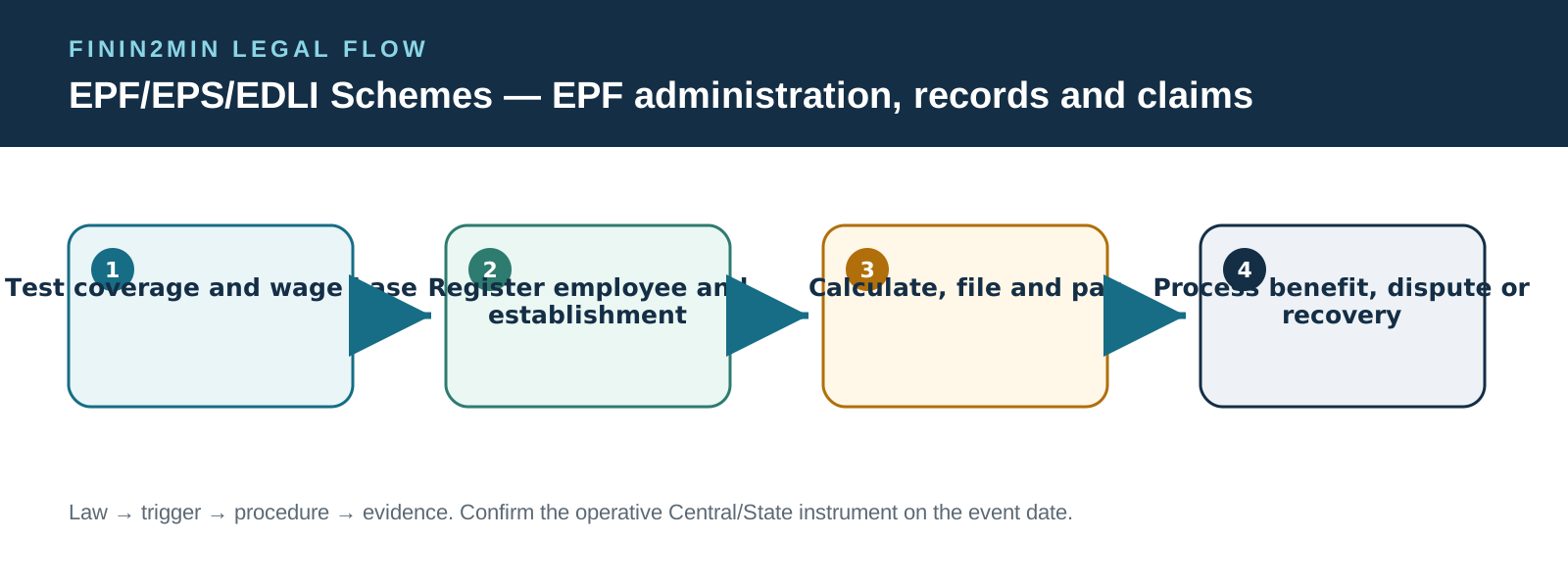
This chapter turns epf administration, records and claims into an operational control file. It covers Paragraph 01, Paragraph 02, Paragraph 03, Paragraph 04; the practical sequence is to classify coverage and event date, apply the provision and mapped Rule, complete the form/register, calculate the entitlement or exposure, and retain evidence for inspection, claim or appeal.
Who is covered
Covered establishments, members, excluded employees, employers, nominees and EPFO officers must identify membership, wage, contribution and claim status.
Main obligations and rights
Paragraph 01
Paragraph 02
Paragraph 03
Paragraph 04
Paragraph 05
Paragraph 06
Key thresholds and timelines
Timing and trigger Within 15 days of the close of each month.
Forms, registers and evidence
Register
Return
Nomination
Retain classification, calculation, approval, communication, acknowledgement and payment/filing proof.
Core protection: membership credit, contribution visibility, transfer/withdrawal and grievance/claim routes. Confirm the authority, limitation and appeal route stated in this chapter.
Old law / transition
Apply the instrument effective on the event date and preserve any accrued right, saved notification, pending proceeding or scheme-specific transition.
Five-point professional checklist
Freeze the event date, establishment, location and person/worker classification.
Identify the controlling section/paragraph, mapped Rule, notification and appropriate Government.
Reperform the calculation or decision test and document every exception or approval.
Complete the prescribed form/register/portal step and retain acknowledgement, payment and communication evidence.
Record the remedy, forum, limitation, appeal path and State variation before sign-off.
Finin2min takeaway: for epf administration, records and claims, the defensible answer is not a policy label - it is the event-date law, the mapped procedure, the calculation and a complete evidence trail.
Paragraph index | Employees’ Provident Funds Scheme, 2026 | Finin2min
Labour
› EPFO Schemes › Paragraphs
Paragraph index
Employees’ Provident Funds Scheme, 2026: all paragraphs
Searchable paragraph list; each page owns one current legal topic.
60 paragraphs
No duplicate canonicals
Paragraph 1
Short title, commencement and application
Paragraph 2
Definitions
Paragraph 3
Central Provident Fund Commissioner and Financial Adviser and Chief Accounts Officer
Paragraph 4
Regional and local offices
Paragraph 5
Appointment of officers and employees of Central Board
Paragraph 6
Information to Central Board regarding appointments
Paragraph 7
Administrative and financial powers of Commissioner
Paragraph 8
Staff Provident Fund and other benefits
Paragraph 9
Membership of the fund
Paragraph 10
Retention of membership
Paragraph 11
Resolution of questions about membership
Paragraph 12
Exemption of employee or class of employees
Paragraph 13
Terms and conditions after exemption
Paragraph 14
Composition of board of trustees
Paragraph 15
Extension of exemption
Paragraph 16
Cessation and surrender of exemption
Paragraph 17
Transfer of accumulation from existing provident fund
Paragraph 18
Contributions
Paragraph 19
Additional voluntary contributions
Paragraph 20
Responsibility for payment of contribution
Paragraph 21
Employer’s share not to be deducted from members
Paragraph 22
Recovery of member’s share of contributions
Paragraph 23
Levy and recovery of damages for default
Paragraph 24
Duties of employers
Paragraph 25
Duties of employee
Paragraph 26
Employer to furnish particulars of ownership and authorised signatories
Paragraph 27
Duties of principal employer and contractor
Paragraph 28
Payment of contributions etc.
Paragraph 29
Fixation of administrative charges or other fee
Paragraph 30
Annual statement of member’s account and e-Pass Book
Paragraph 31
Current Account
Paragraph 32
Administration Account
Paragraph 33
Provident Fund Account
Paragraph 34
Interest Account
Paragraph 35
Investment of moneys belonging to Employees’ Provident Fund
Paragraph 36
Disposal of the fund
Paragraph 37
Expenses of administration
Paragraph 38
Form and manner of maintenance of accounts
Paragraph 39
Audit
Paragraph 40
Budget
Paragraph 41
Accounts of members
Paragraph 42
Interest
Paragraph 43
Transfer of membership
Paragraph 44
Nomination
Paragraph 45
Financing of existing members’ Life Insurance Policy
Paragraph 46
Partial withdrawals from Fund
Paragraph 47
Computation of period of membership
Paragraph 48
Payment of partial withdrawal
Paragraph 49
Circumstances in which accumulations in Fund are payable to member
Paragraph 50
Accumulations of deceased member to whom payable
Paragraph 51
Payment of accumulations of funds of International Workers
Paragraph 52
Payment to person charged with offence of murder
Paragraph 53
Payment of Provident Fund
Paragraph 54
Filing of claims
Paragraph 55
Inoperative Account
Paragraph 56
Annual report of Board
Paragraph 57
Conduct of business of Central Board
Paragraph 58
Misuse of benefits
Paragraph 59
Writing off losses
Paragraph 60
Special provisions
Finin2min implementation decode
The establishment creates a trigger ticket when coverage changes, assigns the authorised signatory, uploads the prescribed attachments, captures the acknowledgement and retains a versioned copy of the form, payment and approval.
Identify actor, trigger, threshold and territorial authority.
Map form, record, portal, fee and due date.
Separate substantive entitlement from procedure, remedy and penal consequence.
Retain the official instrument and event-date evidence.
Paragraph 01
Paragraph 1: Short title, commencement and application | Employees’ Provident Funds Scheme, 2026 | Finin2min
Labour
EPFO Schemes
Employees’ Provident Funds Scheme, 2026
› Paragraph 1
Employees’ Provident Funds Scheme, 2026 · Paragraph 1
Paragraph 1: Short title, commencement and application
Paragraph-wise legal explanation, implementation control, evidence, remedy and transition mapping for Employees’ Provident Funds Scheme, 2026.
Chapter I — Preliminary
G.S.R. 525(E)
Scope and commencement
Scheme
Employees’ Provident Funds Scheme, 2026
Location
Chapter I — Preliminary
Notification
G.S.R. 525(E)
Source review
2026-07-17
What this paragraph regulates
Paragraph 1 is the canonical current-scheme provision for
Short title, commencement and application
. It must be read with the Code on Social Security, 2020, the defined terms, current Central Government notifications, EPFO implementation directions and saved legacy rights.
Legal source:
Employees’ Provident Funds Scheme, 2026, notified under section 15(1)(a) of the Code on Social Security, 2020. It supersedes Employees’ Provident Funds Scheme, 1952, except for things already done or omitted before supersession.
Open Gazette copy
Paragraph-specific legal and control map
Control 1: Names the scheme and anchors commencement to Gazette publication
Names the scheme and anchors commencement to Gazette publication.
Implementation test:
Identify the responsible person, source data, statutory event, approval and retained evidence for this control. A payroll label or portal status alone is not conclusive where underlying facts differ.
Control 2: Applies subject to Code sections 20, 21 and 143
Applies subject to Code sections 20, 21 and 143.
Implementation test:
Identify the responsible person, source data, statutory event, approval and retained evidence for this control. A payroll label or portal status alone is not conclusive where underlying facts differ.
Control 3: Covers establishments to which Chapter III applies and specified government-controlled establishments whose employees lack equivalent contributory protection
Covers establishments to which Chapter III applies and specified government-controlled establishments whose employees lack equivalent contributory protection.
Implementation test:
Identify the responsible person, source data, statutory event, approval and retained evidence for this control. A payroll label or portal status alone is not conclusive where underlying facts differ.
Responsible parties
EPFO / authorised officer
Employer or member, according to the transaction
Code linkage
Sections 15, 20, 21 and 143.
Timing and trigger
Effective from Gazette publication; coverage testing is event-driven when establishment or employee status changes.
Decision questions
Is the establishment and person covered on the event date?
Is this a current-scheme event, a saved legacy event or a correction?
Which wage, service, balance, family or fund data is legally relevant?
Which form, portal, authority and evidence are required?
Evidence and audit trail
coverage memorandum
establishment registration
employee population and threshold analysis
Gazette and commencement record
Minimum review controls
Maker-checker sign-off tied to employee/member ID.
Reconciliation to payroll, contractor, fund and bank records where relevant.
Current rate, ceiling, circular and portal version check.
Exception log and legal basis for overrides or delayed correction.
Retention of acknowledgement, order and proof of payment/benefit.
Non-compliance, remedy and escalation
Possible consequences include contribution assessment, interest, damages, recovery, penalty, benefit correction, delayed-claim interest, cancellation of exemption or litigation. The exact pathway depends on whether the issue concerns coverage, contribution, a Fund decision, a member benefit or an exempted establishment.
Employer correction
Correct master data, return and remittance with a preserved audit trail; do not overwrite the original default.
Member/claimant remedy
Use the prescribed claim, grievance, review or appeal route with complete supporting evidence.
Authority action
Assessment, interest, damages and recovery should be separately quantified and linked to the applicable Code order.
Worked control scenario
An establishment receives a transaction or employee event that falls within
Short title, commencement and application
. The compliance owner first fixes the event date and member status, then retrieves wage/service/nomination or fund data as relevant. The maker prepares the statutory computation or claim; an independent reviewer checks the Code link, paragraph conditions, current ceiling/rate and prior transactions. Only after reconciliation is the portal filing or payment completed. The acknowledgement, calculation and supporting records are retained together.
Failure pattern:
treating an EPFO portal acceptance as proof that the underlying legal classification, wage base or claimant entitlement is correct. Portal processing does not eliminate assessment, recovery, damages, benefit-revision or competing-claim risk.
Practical Q&A
Can a contract or payroll policy override this paragraph?
No. A contract may allocate operational responsibility but cannot reduce statutory liability or member entitlement.
Can an old-scheme paragraph still matter?
Yes, for things done, omitted, accrued or pending before supersession. Document the event date and savings basis; do not mix historic and current rules.
Is the Gazette page alone enough for live compliance?
No. Check later notifications, EPFO circulars, portal specifications, court orders and establishment-specific exemption orders.
Related provisions
Paragraph 2
Related provision
Code section 15 — Schemes
Related provision
Code section 16 — Funds
Related provision
Paragraph 2 →
Identify actor, trigger, threshold and territorial authority.
Map form, record, portal, fee and due date.
Separate substantive entitlement from procedure, remedy and penal consequence.
Retain the official instrument and event-date evidence.
Paragraph 02
Paragraph 2: Definitions | Employees’ Provident Funds Scheme, 2026 | Finin2min
Labour
EPFO Schemes
Employees’ Provident Funds Scheme, 2026
› Paragraph 2
Employees’ Provident Funds Scheme, 2026 · Paragraph 2
Paragraph 2: Definitions
Paragraph-wise legal explanation, implementation control, evidence, remedy and transition mapping for Employees’ Provident Funds Scheme, 2026.
Chapter I — Preliminary
G.S.R. 525(E)
Defined terms
Scheme
Employees’ Provident Funds Scheme, 2026
Location
Chapter I — Preliminary
Notification
G.S.R. 525(E)
Source review
2026-07-17
What this paragraph regulates
Paragraph 2 is the canonical current-scheme provision for
Definitions
. It must be read with the Code on Social Security, 2020, the defined terms, current Central Government notifications, EPFO implementation directions and saved legacy rights.
Legal source:
Employees’ Provident Funds Scheme, 2026, notified under section 15(1)(a) of the Code on Social Security, 2020. It supersedes Employees’ Provident Funds Scheme, 1952, except for things already done or omitted before supersession.
Open Gazette copy
Paragraph-specific legal and control map
Control 1: Defines authorised signatory, board of trustees, excluded employee, exempted establishment, international worker, member, principal employer, trustee and UAN
Defines authorised signatory, board of trustees, excluded employee, exempted establishment, international worker, member, principal employer, trustee and UAN.
Implementation test:
Identify the responsible person, source data, statutory event, approval and retained evidence for this control. A payroll label or portal status alone is not conclusive where underlying facts differ.
Control 2: Excluded-employee status is tested when the employee would otherwise enter membership; later wage growth does not by itself erase existing membership
Excluded-employee status is tested when the employee would otherwise enter membership; later wage growth does not by itself erase existing membership.
Implementation test:
Identify the responsible person, source data, statutory event, approval and retained evidence for this control. A payroll label or portal status alone is not conclusive where underlying facts differ.
Control 3: International-worker analysis requires nationality, passport, social-security agreement and detached-worker evidence
International-worker analysis requires nationality, passport, social-security agreement and detached-worker evidence.
Implementation test:
Identify the responsible person, source data, statutory event, approval and retained evidence for this control. A payroll label or portal status alone is not conclusive where underlying facts differ.
Control 4: Principal-employer control extends to contract labour and ultimate-control situations
Principal-employer control extends to contract labour and ultimate-control situations.
Implementation test:
Identify the responsible person, source data, statutory event, approval and retained evidence for this control. A payroll label or portal status alone is not conclusive where underlying facts differ.
Responsible parties
EPFO / authorised officer
Employer or member, according to the transaction
Code linkage
Sections 2, 14, 15, 20, 21 and 143.
Timing and trigger
Definitions apply throughout; classification should be documented at onboarding and whenever status changes.
Decision questions
Is the establishment and person covered on the event date?
Is this a current-scheme event, a saved legacy event or a correction?
Which wage, service, balance, family or fund data is legally relevant?
Which form, portal, authority and evidence are required?
Evidence and audit trail
classification memorandum
employee master
contracts and organisation chart
nationality/SSA documents where relevant
Minimum review controls
Maker-checker sign-off tied to employee/member ID.
Reconciliation to payroll, contractor, fund and bank records where relevant.
Current rate, ceiling, circular and portal version check.
Exception log and legal basis for overrides or delayed correction.
Retention of acknowledgement, order and proof of payment/benefit.
Non-compliance, remedy and escalation
Possible consequences include contribution assessment, interest, damages, recovery, penalty, benefit correction, delayed-claim interest, cancellation of exemption or litigation. The exact pathway depends on whether the issue concerns coverage, contribution, a Fund decision, a member benefit or an exempted establishment.
Employer correction
Correct master data, return and remittance with a preserved audit trail; do not overwrite the original default.
Member/claimant remedy
Use the prescribed claim, grievance, review or appeal route with complete supporting evidence.
Authority action
Assessment, interest, damages and recovery should be separately quantified and linked to the applicable Code order.
Worked control scenario
An establishment receives a transaction or employee event that falls within
Definitions
. The compliance owner first fixes the event date and member status, then retrieves wage/service/nomination or fund data as relevant. The maker prepares the statutory computation or claim; an independent reviewer checks the Code link, paragraph conditions, current ceiling/rate and prior transactions. Only after reconciliation is the portal filing or payment completed. The acknowledgement, calculation and supporting records are retained together.
Failure pattern:
treating an EPFO portal acceptance as proof that the underlying legal classification, wage base or claimant entitlement is correct. Portal processing does not eliminate assessment, recovery, damages, benefit-revision or competing-claim risk.
Practical Q&A
Can a contract or payroll policy override this paragraph?
No. A contract may allocate operational responsibility but cannot reduce statutory liability or member entitlement.
Can an old-scheme paragraph still matter?
Yes, for things done, omitted, accrued or pending before supersession. Document the event date and savings basis; do not mix historic and current rules.
Is the Gazette page alone enough for live compliance?
No. Check later notifications, EPFO circulars, portal specifications, court orders and establishment-specific exemption orders.
Related provisions
Paragraph 1
Related provision
Paragraph 3
Related provision
Code section 15 — Schemes
Related provision
Code section 16 — Funds
Related provision
← Paragraph 1
Paragraph 3 →
Identify actor, trigger, threshold and territorial authority.
Map form, record, portal, fee and due date.
Separate substantive entitlement from procedure, remedy and penal consequence.
Retain the official instrument and event-date evidence.
Paragraph 03
Paragraph 3: Central Provident Fund Commissioner and Financial Adviser and Chief Accounts Officer | Employees’ Provident Funds Scheme, 2026 | Finin2min
Labour
EPFO Schemes
Employees’ Provident Funds Scheme, 2026
› Paragraph 3
Employees’ Provident Funds Scheme, 2026 · Paragraph 3
Paragraph 3: Central Provident Fund Commissioner and Financial Adviser and Chief Accounts Officer
Paragraph-wise legal explanation, implementation control, evidence, remedy and transition mapping for Employees’ Provident Funds Scheme, 2026.
Chapter II — Officers of the Central Board
G.S.R. 525(E)
Fund and accounting
Scheme
Employees’ Provident Funds Scheme, 2026
Location
Chapter II — Officers of the Central Board
Notification
G.S.R. 525(E)
Source review
2026-07-17
What this paragraph regulates
Paragraph 3 is the canonical current-scheme provision for
Central Provident Fund Commissioner and Financial Adviser and Chief Accounts Officer
. It must be read with the Code on Social Security, 2020, the defined terms, current Central Government notifications, EPFO implementation directions and saved legacy rights.
Legal source:
Employees’ Provident Funds Scheme, 2026, notified under section 15(1)(a) of the Code on Social Security, 2020. It supersedes Employees’ Provident Funds Scheme, 1952, except for things already done or omitted before supersession.
Open Gazette copy
Paragraph-specific legal and control map
Control 1: Separate benefit fund, administration account and member ledgers
Separate benefit fund, administration account and member ledgers.
Implementation test:
Identify the responsible person, source data, statutory event, approval and retained evidence for this control. A payroll label or portal status alone is not conclusive where underlying facts differ.
Control 2: Follow approved investment, valuation, audit and reporting controls
Follow approved investment, valuation, audit and reporting controls.
Implementation test:
Identify the responsible person, source data, statutory event, approval and retained evidence for this control. A payroll label or portal status alone is not conclusive where underlying facts differ.
Control 3: Reconcile opening balance, inflows, benefits, expenses, income and closing balance
Reconcile opening balance, inflows, benefits, expenses, income and closing balance.
Implementation test:
Identify the responsible person, source data, statutory event, approval and retained evidence for this control. A payroll label or portal status alone is not conclusive where underlying facts differ.
Control 4: Apply the control specifically to “Central Provident Fund Commissioner and Financial Adviser and Chief Accounts Officer”, rather than treating it as a generic EPFO process
Apply the control specifically to “Central Provident Fund Commissioner and Financial Adviser and Chief Accounts Officer”, rather than treating it as a generic EPFO process.
Implementation test:
Identify the responsible person, source data, statutory event, approval and retained evidence for this control. A payroll label or portal status alone is not conclusive where underlying facts differ.
Responsible parties
Central Board / EPFO
Commissioner / authorised officer
Code linkage
Sections 15, 16, 17, 20, 21, 22, 123, 125–129, 143, 151, 153 and 164, as context requires.
Timing and trigger
Event-driven or periodic according to the paragraph; confirm the current EPFO portal and implementation direction before action.
Decision questions
Is the establishment and person covered on the event date?
Is this a current-scheme event, a saved legacy event or a correction?
Which wage, service, balance, family or fund data is legally relevant?
Which form, portal, authority and evidence are required?
Evidence and audit trail
general ledger
member sub-ledger
bank and investment reconciliation
valuation/audit report
board approval
Minimum review controls
Maker-checker sign-off tied to employee/member ID.
Reconciliation to payroll, contractor, fund and bank records where relevant.
Current rate, ceiling, circular and portal version check.
Exception log and legal basis for overrides or delayed correction.
Retention of acknowledgement, order and proof of payment/benefit.
Non-compliance, remedy and escalation
Possible consequences include contribution assessment, interest, damages, recovery, penalty, benefit correction, delayed-claim interest, cancellation of exemption or litigation. The exact pathway depends on whether the issue concerns coverage, contribution, a Fund decision, a member benefit or an exempted establishment.
Employer correction
Correct master data, return and remittance with a preserved audit trail; do not overwrite the original default.
Member/claimant remedy
Use the prescribed claim, grievance, review or appeal route with complete supporting evidence.
Authority action
Assessment, interest, damages and recovery should be separately quantified and linked to the applicable Code order.
Worked control scenario
An establishment receives a transaction or employee event that falls within
Central Provident Fund Commissioner and Financial Adviser and Chief Accounts Officer
. The compliance owner first fixes the event date and member status, then retrieves wage/service/nomination or fund data as relevant. The maker prepares the statutory computation or claim; an independent reviewer checks the Code link, paragraph conditions, current ceiling/rate and prior transactions. Only after reconciliation is the portal filing or payment completed. The acknowledgement, calculation and supporting records are retained together.
Failure pattern:
treating an EPFO portal acceptance as proof that the underlying legal classification, wage base or claimant entitlement is correct. Portal processing does not eliminate assessment, recovery, damages, benefit-revision or competing-claim risk.
Practical Q&A
Can a contract or payroll policy override this paragraph?
No. A contract may allocate operational responsibility but cannot reduce statutory liability or member entitlement.
Can an old-scheme paragraph still matter?
Yes, for things done, omitted, accrued or pending before supersession. Document the event date and savings basis; do not mix historic and current rules.
Is the Gazette page alone enough for live compliance?
No. Check later notifications, EPFO circulars, portal specifications, court orders and establishment-specific exemption orders.
Related provisions
Paragraph 2
Related provision
Paragraph 4
Related provision
Code section 15 — Schemes
Related provision
Code section 16 — Funds
Related provision
← Paragraph 2
Paragraph 4 →
Identify actor, trigger, threshold and territorial authority.
Map form, record, portal, fee and due date.
Separate substantive entitlement from procedure, remedy and penal consequence.
Retain the official instrument and event-date evidence.
Paragraph 04
Paragraph 4: Regional and local offices | Employees’ Provident Funds Scheme, 2026 | Finin2min
Labour
EPFO Schemes
Employees’ Provident Funds Scheme, 2026
› Paragraph 4
Employees’ Provident Funds Scheme, 2026 · Paragraph 4
Paragraph 4: Regional and local offices
Paragraph-wise legal explanation, implementation control, evidence, remedy and transition mapping for Employees’ Provident Funds Scheme, 2026.
Chapter II — Officers of the Central Board
G.S.R. 525(E)
Administration and control
Scheme
Employees’ Provident Funds Scheme, 2026
Location
Chapter II — Officers of the Central Board
Notification
G.S.R. 525(E)
Source review
2026-07-17
What this paragraph regulates
Paragraph 4 is the canonical current-scheme provision for
Regional and local offices
. It must be read with the Code on Social Security, 2020, the defined terms, current Central Government notifications, EPFO implementation directions and saved legacy rights.
Legal source:
Employees’ Provident Funds Scheme, 2026, notified under section 15(1)(a) of the Code on Social Security, 2020. It supersedes Employees’ Provident Funds Scheme, 1952, except for things already done or omitted before supersession.
Open Gazette copy
Paragraph-specific legal and control map
Control 1: Identify the statutory actor, decision and approval level
Identify the statutory actor, decision and approval level.
Implementation test:
Identify the responsible person, source data, statutory event, approval and retained evidence for this control. A payroll label or portal status alone is not conclusive where underlying facts differ.
Control 2: Document inputs, evidence, outcome and review trail
Document inputs, evidence, outcome and review trail.
Implementation test:
Identify the responsible person, source data, statutory event, approval and retained evidence for this control. A payroll label or portal status alone is not conclusive where underlying facts differ.
Control 3: Link the control to the Code, Scheme and current EPFO directions
Link the control to the Code, Scheme and current EPFO directions.
Implementation test:
Identify the responsible person, source data, statutory event, approval and retained evidence for this control. A payroll label or portal status alone is not conclusive where underlying facts differ.
Control 4: Apply the control specifically to “Regional and local offices”, rather than treating it as a generic EPFO process
Apply the control specifically to “Regional and local offices”, rather than treating it as a generic EPFO process.
Implementation test:
Identify the responsible person, source data, statutory event, approval and retained evidence for this control. A payroll label or portal status alone is not conclusive where underlying facts differ.
Responsible parties
EPFO / authorised officer
Employer or member, according to the transaction
Code linkage
Sections 15, 16, 17, 20, 21, 22, 123, 125–129, 143, 151, 153 and 164, as context requires.
Timing and trigger
Event-driven or periodic according to the paragraph; confirm the current EPFO portal and implementation direction before action.
Decision questions
Is the establishment and person covered on the event date?
Is this a current-scheme event, a saved legacy event or a correction?
Which wage, service, balance, family or fund data is legally relevant?
Which form, portal, authority and evidence are required?
Evidence and audit trail
authority order
input record
decision note
approval
audit trail
Minimum review controls
Maker-checker sign-off tied to employee/member ID.
Reconciliation to payroll, contractor, fund and bank records where relevant.
Current rate, ceiling, circular and portal version check.
Exception log and legal basis for overrides or delayed correction.
Retention of acknowledgement, order and proof of payment/benefit.
Non-compliance, remedy and escalation
Possible consequences include contribution assessment, interest, damages, recovery, penalty, benefit correction, delayed-claim interest, cancellation of exemption or litigation. The exact pathway depends on whether the issue concerns coverage, contribution, a Fund decision, a member benefit or an exempted establishment.
Employer correction
Correct master data, return and remittance with a preserved audit trail; do not overwrite the original default.
Member/claimant remedy
Use the prescribed claim, grievance, review or appeal route with complete supporting evidence.
Authority action
Assessment, interest, damages and recovery should be separately quantified and linked to the applicable Code order.
Worked control scenario
An establishment receives a transaction or employee event that falls within
Regional and local offices
. The compliance owner first fixes the event date and member status, then retrieves wage/service/nomination or fund data as relevant. The maker prepares the statutory computation or claim; an independent reviewer checks the Code link, paragraph conditions, current ceiling/rate and prior transactions. Only after reconciliation is the portal filing or payment completed. The acknowledgement, calculation and supporting records are retained together.
Failure pattern:
treating an EPFO portal acceptance as proof that the underlying legal classification, wage base or claimant entitlement is correct. Portal processing does not eliminate assessment, recovery, damages, benefit-revision or competing-claim risk.
Practical Q&A
Can a contract or payroll policy override this paragraph?
No. A contract may allocate operational responsibility but cannot reduce statutory liability or member entitlement.
Can an old-scheme paragraph still matter?
Yes, for things done, omitted, accrued or pending before supersession. Document the event date and savings basis; do not mix historic and current rules.
Is the Gazette page alone enough for live compliance?
No. Check later notifications, EPFO circulars, portal specifications, court orders and establishment-specific exemption orders.
Related provisions
Paragraph 3
Related provision
Paragraph 5
Related provision
Code section 15 — Schemes
Related provision
Code section 16 — Funds
Related provision
← Paragraph 3
Paragraph 5 →
Identify actor, trigger, threshold and territorial authority.
Map form, record, portal, fee and due date.
Separate substantive entitlement from procedure, remedy and penal consequence.
Retain the official instrument and event-date evidence.
Paragraph 05
Paragraph 5: Appointment of officers and employees of Central Board | Employees’ Provident Funds Scheme, 2026 | Finin2min
Labour
EPFO Schemes
Employees’ Provident Funds Scheme, 2026
› Paragraph 5
Employees’ Provident Funds Scheme, 2026 · Paragraph 5
Paragraph 5: Appointment of officers and employees of Central Board
Paragraph-wise legal explanation, implementation control, evidence, remedy and transition mapping for Employees’ Provident Funds Scheme, 2026.
Chapter II — Officers of the Central Board
G.S.R. 525(E)
Administration and control
Scheme
Employees’ Provident Funds Scheme, 2026
Location
Chapter II — Officers of the Central Board
Notification
G.S.R. 525(E)
Source review
2026-07-17
What this paragraph regulates
Paragraph 5 is the canonical current-scheme provision for
Appointment of officers and employees of Central Board
. It must be read with the Code on Social Security, 2020, the defined terms, current Central Government notifications, EPFO implementation directions and saved legacy rights.
Legal source:
Employees’ Provident Funds Scheme, 2026, notified under section 15(1)(a) of the Code on Social Security, 2020. It supersedes Employees’ Provident Funds Scheme, 1952, except for things already done or omitted before supersession.
Open Gazette copy
Paragraph-specific legal and control map
Control 1: Identify the statutory actor, decision and approval level
Identify the statutory actor, decision and approval level.
Implementation test:
Identify the responsible person, source data, statutory event, approval and retained evidence for this control. A payroll label or portal status alone is not conclusive where underlying facts differ.
Control 2: Document inputs, evidence, outcome and review trail
Document inputs, evidence, outcome and review trail.
Implementation test:
Identify the responsible person, source data, statutory event, approval and retained evidence for this control. A payroll label or portal status alone is not conclusive where underlying facts differ.
Control 3: Link the control to the Code, Scheme and current EPFO directions
Link the control to the Code, Scheme and current EPFO directions.
Implementation test:
Identify the responsible person, source data, statutory event, approval and retained evidence for this control. A payroll label or portal status alone is not conclusive where underlying facts differ.
Control 4: Apply the control specifically to “Appointment of officers and employees of Central Board”, rather than treating it as a generic EPFO process
Apply the control specifically to “Appointment of officers and employees of Central Board”, rather than treating it as a generic EPFO process.
Implementation test:
Identify the responsible person, source data, statutory event, approval and retained evidence for this control. A payroll label or portal status alone is not conclusive where underlying facts differ.
Responsible parties
Member / employee / claimant
Central Board / EPFO
Commissioner / authorised officer
Code linkage
Sections 15, 16, 17, 20, 21, 22, 123, 125–129, 143, 151, 153 and 164, as context requires.
Timing and trigger
Event-driven or periodic according to the paragraph; confirm the current EPFO portal and implementation direction before action.
Decision questions
Is the establishment and person covered on the event date?
Is this a current-scheme event, a saved legacy event or a correction?
Which wage, service, balance, family or fund data is legally relevant?
Which form, portal, authority and evidence are required?
Evidence and audit trail
authority order
input record
decision note
approval
audit trail
Minimum review controls
Maker-checker sign-off tied to employee/member ID.
Reconciliation to payroll, contractor, fund and bank records where relevant.
Current rate, ceiling, circular and portal version check.
Exception log and legal basis for overrides or delayed correction.
Retention of acknowledgement, order and proof of payment/benefit.
Non-compliance, remedy and escalation
Possible consequences include contribution assessment, interest, damages, recovery, penalty, benefit correction, delayed-claim interest, cancellation of exemption or litigation. The exact pathway depends on whether the issue concerns coverage, contribution, a Fund decision, a member benefit or an exempted establishment.
Employer correction
Correct master data, return and remittance with a preserved audit trail; do not overwrite the original default.
Member/claimant remedy
Use the prescribed claim, grievance, review or appeal route with complete supporting evidence.
Authority action
Assessment, interest, damages and recovery should be separately quantified and linked to the applicable Code order.
Worked control scenario
An establishment receives a transaction or employee event that falls within
Appointment of officers and employees of Central Board
. The compliance owner first fixes the event date and member status, then retrieves wage/service/nomination or fund data as relevant. The maker prepares the statutory computation or claim; an independent reviewer checks the Code link, paragraph conditions, current ceiling/rate and prior transactions. Only after reconciliation is the portal filing or payment completed. The acknowledgement, calculation and supporting records are retained together.
Failure pattern:
treating an EPFO portal acceptance as proof that the underlying legal classification, wage base or claimant entitlement is correct. Portal processing does not eliminate assessment, recovery, damages, benefit-revision or competing-claim risk.
Practical Q&A
Can a contract or payroll policy override this paragraph?
No. A contract may allocate operational responsibility but cannot reduce statutory liability or member entitlement.
Can an old-scheme paragraph still matter?
Yes, for things done, omitted, accrued or pending before supersession. Document the event date and savings basis; do not mix historic and current rules.
Is the Gazette page alone enough for live compliance?
No. Check later notifications, EPFO circulars, portal specifications, court orders and establishment-specific exemption orders.
Related provisions
Paragraph 4
Related provision
Paragraph 6
Related provision
Code section 15 — Schemes
Related provision
Code section 16 — Funds
Related provision
← Paragraph 4
Paragraph 6 →
Identify actor, trigger, threshold and territorial authority.
Map form, record, portal, fee and due date.
Separate substantive entitlement from procedure, remedy and penal consequence.
Retain the official instrument and event-date evidence.
Paragraph 06
Paragraph 6: Information to Central Board regarding appointments | Employees’ Provident Funds Scheme, 2026 | Finin2min
Labour
EPFO Schemes
Employees’ Provident Funds Scheme, 2026
› Paragraph 6
Employees’ Provident Funds Scheme, 2026 · Paragraph 6
Paragraph 6: Information to Central Board regarding appointments
Paragraph-wise legal explanation, implementation control, evidence, remedy and transition mapping for Employees’ Provident Funds Scheme, 2026.
Chapter II — Officers of the Central Board
G.S.R. 525(E)
Administration and control
Scheme
Employees’ Provident Funds Scheme, 2026
Location
Chapter II — Officers of the Central Board
Notification
G.S.R. 525(E)
Source review
2026-07-17
What this paragraph regulates
Paragraph 6 is the canonical current-scheme provision for
Information to Central Board regarding appointments
. It must be read with the Code on Social Security, 2020, the defined terms, current Central Government notifications, EPFO implementation directions and saved legacy rights.
Legal source:
Employees’ Provident Funds Scheme, 2026, notified under section 15(1)(a) of the Code on Social Security, 2020. It supersedes Employees’ Provident Funds Scheme, 1952, except for things already done or omitted before supersession.
Open Gazette copy
Paragraph-specific legal and control map
Control 1: Identify the statutory actor, decision and approval level
Identify the statutory actor, decision and approval level.
Implementation test:
Identify the responsible person, source data, statutory event, approval and retained evidence for this control. A payroll label or portal status alone is not conclusive where underlying facts differ.
Control 2: Document inputs, evidence, outcome and review trail
Document inputs, evidence, outcome and review trail.
Implementation test:
Identify the responsible person, source data, statutory event, approval and retained evidence for this control. A payroll label or portal status alone is not conclusive where underlying facts differ.
Control 3: Link the control to the Code, Scheme and current EPFO directions
Link the control to the Code, Scheme and current EPFO directions.
Implementation test:
Identify the responsible person, source data, statutory event, approval and retained evidence for this control. A payroll label or portal status alone is not conclusive where underlying facts differ.
Control 4: Apply the control specifically to “Information to Central Board regarding appointments”, rather than treating it as a generic EPFO process
Apply the control specifically to “Information to Central Board regarding appointments”, rather than treating it as a generic EPFO process.
Implementation test:
Identify the responsible person, source data, statutory event, approval and retained evidence for this control. A payroll label or portal status alone is not conclusive where underlying facts differ.
Responsible parties
Central Board / EPFO
Commissioner / authorised officer
Code linkage
Sections 15, 16, 17, 20, 21, 22, 123, 125–129, 143, 151, 153 and 164, as context requires.
Timing and trigger
Event-driven or periodic according to the paragraph; confirm the current EPFO portal and implementation direction before action.
Decision questions
Is the establishment and person covered on the event date?
Is this a current-scheme event, a saved legacy event or a correction?
Which wage, service, balance, family or fund data is legally relevant?
Which form, portal, authority and evidence are required?
Evidence and audit trail
authority order
input record
decision note
approval
audit trail
Minimum review controls
Maker-checker sign-off tied to employee/member ID.
Reconciliation to payroll, contractor, fund and bank records where relevant.
Current rate, ceiling, circular and portal version check.
Exception log and legal basis for overrides or delayed correction.
Retention of acknowledgement, order and proof of payment/benefit.
Non-compliance, remedy and escalation
Possible consequences include contribution assessment, interest, damages, recovery, penalty, benefit correction, delayed-claim interest, cancellation of exemption or litigation. The exact pathway depends on whether the issue concerns coverage, contribution, a Fund decision, a member benefit or an exempted establishment.
Employer correction
Correct master data, return and remittance with a preserved audit trail; do not overwrite the original default.
Member/claimant remedy
Use the prescribed claim, grievance, review or appeal route with complete supporting evidence.
Authority action
Assessment, interest, damages and recovery should be separately quantified and linked to the applicable Code order.
Worked control scenario
An establishment receives a transaction or employee event that falls within
Information to Central Board regarding appointments
. The compliance owner first fixes the event date and member status, then retrieves wage/service/nomination or fund data as relevant. The maker prepares the statutory computation or claim; an independent reviewer checks the Code link, paragraph conditions, current ceiling/rate and prior transactions. Only after reconciliation is the portal filing or payment completed. The acknowledgement, calculation and supporting records are retained together.
Failure pattern:
treating an EPFO portal acceptance as proof that the underlying legal classification, wage base or claimant entitlement is correct. Portal processing does not eliminate assessment, recovery, damages, benefit-revision or competing-claim risk.
Practical Q&A
Can a contract or payroll policy override this paragraph?
No. A contract may allocate operational responsibility but cannot reduce statutory liability or member entitlement.
Can an old-scheme paragraph still matter?
Yes, for things done, omitted, accrued or pending before supersession. Document the event date and savings basis; do not mix historic and current rules.
Is the Gazette page alone enough for live compliance?
No. Check later notifications, EPFO circulars, portal specifications, court orders and establishment-specific exemption orders.
Related provisions
Paragraph 5
Related provision
Paragraph 7
Related provision
Code section 15 — Schemes
Related provision
Code section 16 — Funds
Related provision
← Paragraph 5
Paragraph 7 →
Identify actor, trigger, threshold and territorial authority.
Map form, record, portal, fee and due date.
Separate substantive entitlement from procedure, remedy and penal consequence.
Retain the official instrument and event-date evidence.
Paragraph 07
Paragraph 7: Administrative and financial powers of Commissioner | Employees’ Provident Funds Scheme, 2026 | Finin2min
Labour
EPFO Schemes
Employees’ Provident Funds Scheme, 2026
› Paragraph 7
Employees’ Provident Funds Scheme, 2026 · Paragraph 7
Paragraph 7: Administrative and financial powers of Commissioner
Paragraph-wise legal explanation, implementation control, evidence, remedy and transition mapping for Employees’ Provident Funds Scheme, 2026.
Chapter II — Officers of the Central Board
G.S.R. 525(E)
Administration and control
Scheme
Employees’ Provident Funds Scheme, 2026
Location
Chapter II — Officers of the Central Board
Notification
G.S.R. 525(E)
Source review
2026-07-17
What this paragraph regulates
Paragraph 7 is the canonical current-scheme provision for
Administrative and financial powers of Commissioner
. It must be read with the Code on Social Security, 2020, the defined terms, current Central Government notifications, EPFO implementation directions and saved legacy rights.
Legal source:
Employees’ Provident Funds Scheme, 2026, notified under section 15(1)(a) of the Code on Social Security, 2020. It supersedes Employees’ Provident Funds Scheme, 1952, except for things already done or omitted before supersession.
Open Gazette copy
Paragraph-specific legal and control map
Control 1: Identify the statutory actor, decision and approval level
Identify the statutory actor, decision and approval level.
Implementation test:
Identify the responsible person, source data, statutory event, approval and retained evidence for this control. A payroll label or portal status alone is not conclusive where underlying facts differ.
Control 2: Document inputs, evidence, outcome and review trail
Document inputs, evidence, outcome and review trail.
Implementation test:
Identify the responsible person, source data, statutory event, approval and retained evidence for this control. A payroll label or portal status alone is not conclusive where underlying facts differ.
Control 3: Link the control to the Code, Scheme and current EPFO directions
Link the control to the Code, Scheme and current EPFO directions.
Implementation test:
Identify the responsible person, source data, statutory event, approval and retained evidence for this control. A payroll label or portal status alone is not conclusive where underlying facts differ.
Control 4: Apply the control specifically to “Administrative and financial powers of Commissioner”, rather than treating it as a generic EPFO process
Apply the control specifically to “Administrative and financial powers of Commissioner”, rather than treating it as a generic EPFO process.
Implementation test:
Identify the responsible person, source data, statutory event, approval and retained evidence for this control. A payroll label or portal status alone is not conclusive where underlying facts differ.
Responsible parties
Central Board / EPFO
Commissioner / authorised officer
Code linkage
Sections 15, 16, 17, 20, 21, 22, 123, 125–129, 143, 151, 153 and 164, as context requires.
Timing and trigger
Event-driven or periodic according to the paragraph; confirm the current EPFO portal and implementation direction before action.
Decision questions
Is the establishment and person covered on the event date?
Is this a current-scheme event, a saved legacy event or a correction?
Which wage, service, balance, family or fund data is legally relevant?
Which form, portal, authority and evidence are required?
Evidence and audit trail
authority order
input record
decision note
approval
audit trail
Minimum review controls
Maker-checker sign-off tied to employee/member ID.
Reconciliation to payroll, contractor, fund and bank records where relevant.
Current rate, ceiling, circular and portal version check.
Exception log and legal basis for overrides or delayed correction.
Retention of acknowledgement, order and proof of payment/benefit.
Non-compliance, remedy and escalation
Possible consequences include contribution assessment, interest, damages, recovery, penalty, benefit correction, delayed-claim interest, cancellation of exemption or litigation. The exact pathway depends on whether the issue concerns coverage, contribution, a Fund decision, a member benefit or an exempted establishment.
Employer correction
Correct master data, return and remittance with a preserved audit trail; do not overwrite the original default.
Member/claimant remedy
Use the prescribed claim, grievance, review or appeal route with complete supporting evidence.
Authority action
Assessment, interest, damages and recovery should be separately quantified and linked to the applicable Code order.
Worked control scenario
An establishment receives a transaction or employee event that falls within
Administrative and financial powers of Commissioner
. The compliance owner first fixes the event date and member status, then retrieves wage/service/nomination or fund data as relevant. The maker prepares the statutory computation or claim; an independent reviewer checks the Code link, paragraph conditions, current ceiling/rate and prior transactions. Only after reconciliation is the portal filing or payment completed. The acknowledgement, calculation and supporting records are retained together.
Failure pattern:
treating an EPFO portal acceptance as proof that the underlying legal classification, wage base or claimant entitlement is correct. Portal processing does not eliminate assessment, recovery, damages, benefit-revision or competing-claim risk.
Practical Q&A
Can a contract or payroll policy override this paragraph?
No. A contract may allocate operational responsibility but cannot reduce statutory liability or member entitlement.
Can an old-scheme paragraph still matter?
Yes, for things done, omitted, accrued or pending before supersession. Document the event date and savings basis; do not mix historic and current rules.
Is the Gazette page alone enough for live compliance?
No. Check later notifications, EPFO circulars, portal specifications, court orders and establishment-specific exemption orders.
Related provisions
Paragraph 6
Related provision
Paragraph 8
Related provision
Code section 15 — Schemes
Related provision
Code section 16 — Funds
Related provision
← Paragraph 6
Paragraph 8 →
Identify actor, trigger, threshold and territorial authority.
Map form, record, portal, fee and due date.
Separate substantive entitlement from procedure, remedy and penal consequence.
Retain the official instrument and event-date evidence.
Paragraph 08
Paragraph 8: Staff Provident Fund and other benefits | Employees’ Provident Funds Scheme, 2026 | Finin2min
Labour
EPFO Schemes
Employees’ Provident Funds Scheme, 2026
› Paragraph 8
Employees’ Provident Funds Scheme, 2026 · Paragraph 8
Paragraph 8: Staff Provident Fund and other benefits
Paragraph-wise legal explanation, implementation control, evidence, remedy and transition mapping for Employees’ Provident Funds Scheme, 2026.
Chapter II — Officers of the Central Board
G.S.R. 525(E)
Fund and accounting
Scheme
Employees’ Provident Funds Scheme, 2026
Location
Chapter II — Officers of the Central Board
Notification
G.S.R. 525(E)
Source review
2026-07-17
What this paragraph regulates
Paragraph 8 is the canonical current-scheme provision for
Staff Provident Fund and other benefits
. It must be read with the Code on Social Security, 2020, the defined terms, current Central Government notifications, EPFO implementation directions and saved legacy rights.
Legal source:
Employees’ Provident Funds Scheme, 2026, notified under section 15(1)(a) of the Code on Social Security, 2020. It supersedes Employees’ Provident Funds Scheme, 1952, except for things already done or omitted before supersession.
Open Gazette copy
Paragraph-specific legal and control map
Control 1: Separate benefit fund, administration account and member ledgers
Separate benefit fund, administration account and member ledgers.
Implementation test:
Identify the responsible person, source data, statutory event, approval and retained evidence for this control. A payroll label or portal status alone is not conclusive where underlying facts differ.
Control 2: Follow approved investment, valuation, audit and reporting controls
Follow approved investment, valuation, audit and reporting controls.
Implementation test:
Identify the responsible person, source data, statutory event, approval and retained evidence for this control. A payroll label or portal status alone is not conclusive where underlying facts differ.
Control 3: Reconcile opening balance, inflows, benefits, expenses, income and closing balance
Reconcile opening balance, inflows, benefits, expenses, income and closing balance.
Implementation test:
Identify the responsible person, source data, statutory event, approval and retained evidence for this control. A payroll label or portal status alone is not conclusive where underlying facts differ.
Control 4: Apply the control specifically to “Staff Provident Fund and other benefits”, rather than treating it as a generic EPFO process
Apply the control specifically to “Staff Provident Fund and other benefits”, rather than treating it as a generic EPFO process.
Implementation test:
Identify the responsible person, source data, statutory event, approval and retained evidence for this control. A payroll label or portal status alone is not conclusive where underlying facts differ.
Responsible parties
Member / employee / claimant
Central Board / EPFO
Commissioner / authorised officer
Code linkage
Sections 15, 16, 17, 20, 21, 22, 123, 125–129, 143, 151, 153 and 164, as context requires.
Timing and trigger
Event-driven or periodic according to the paragraph; confirm the current EPFO portal and implementation direction before action.
Decision questions
Is the establishment and person covered on the event date?
Is this a current-scheme event, a saved legacy event or a correction?
Which wage, service, balance, family or fund data is legally relevant?
Which form, portal, authority and evidence are required?
Evidence and audit trail
general ledger
member sub-ledger
bank and investment reconciliation
valuation/audit report
board approval
Minimum review controls
Maker-checker sign-off tied to employee/member ID.
Reconciliation to payroll, contractor, fund and bank records where relevant.
Current rate, ceiling, circular and portal version check.
Exception log and legal basis for overrides or delayed correction.
Retention of acknowledgement, order and proof of payment/benefit.
Non-compliance, remedy and escalation
Possible consequences include contribution assessment, interest, damages, recovery, penalty, benefit correction, delayed-claim interest, cancellation of exemption or litigation. The exact pathway depends on whether the issue concerns coverage, contribution, a Fund decision, a member benefit or an exempted establishment.
Employer correction
Correct master data, return and remittance with a preserved audit trail; do not overwrite the original default.
Member/claimant remedy
Use the prescribed claim, grievance, review or appeal route with complete supporting evidence.
Authority action
Assessment, interest, damages and recovery should be separately quantified and linked to the applicable Code order.
Worked control scenario
An establishment receives a transaction or employee event that falls within
Staff Provident Fund and other benefits
. The compliance owner first fixes the event date and member status, then retrieves wage/service/nomination or fund data as relevant. The maker prepares the statutory computation or claim; an independent reviewer checks the Code link, paragraph conditions, current ceiling/rate and prior transactions. Only after reconciliation is the portal filing or payment completed. The acknowledgement, calculation and supporting records are retained together.
Failure pattern:
treating an EPFO portal acceptance as proof that the underlying legal classification, wage base or claimant entitlement is correct. Portal processing does not eliminate assessment, recovery, damages, benefit-revision or competing-claim risk.
Practical Q&A
Can a contract or payroll policy override this paragraph?
No. A contract may allocate operational responsibility but cannot reduce statutory liability or member entitlement.
Can an old-scheme paragraph still matter?
Yes, for things done, omitted, accrued or pending before supersession. Document the event date and savings basis; do not mix historic and current rules.
Is the Gazette page alone enough for live compliance?
No. Check later notifications, EPFO circulars, portal specifications, court orders and establishment-specific exemption orders.
Related provisions
Paragraph 7
Related provision
Paragraph 9
Related provision
Code section 15 — Schemes
Related provision
Code section 16 — Funds
Related provision
← Paragraph 7
Paragraph 9 →
Identify actor, trigger, threshold and territorial authority.
Map form, record, portal, fee and due date.
Separate substantive entitlement from procedure, remedy and penal consequence.
Retain the official instrument and event-date evidence.
Paragraph 09
Paragraph 9: Membership of the fund | Employees’ Provident Funds Scheme, 2026 | Finin2min
Labour
EPFO Schemes
Employees’ Provident Funds Scheme, 2026
› Paragraph 9
Employees’ Provident Funds Scheme, 2026 · Paragraph 9
Paragraph 9: Membership of the fund
Paragraph-wise legal explanation, implementation control, evidence, remedy and transition mapping for Employees’ Provident Funds Scheme, 2026.
Chapter III — Membership
G.S.R. 525(E)
Membership and service
Scheme
Employees’ Provident Funds Scheme, 2026
Location
Chapter III — Membership
Notification
G.S.R. 525(E)
Source review
2026-07-17
What this paragraph regulates
Paragraph 9 is the canonical current-scheme provision for
Membership of the fund
. It must be read with the Code on Social Security, 2020, the defined terms, current Central Government notifications, EPFO implementation directions and saved legacy rights.
Legal source:
Employees’ Provident Funds Scheme, 2026, notified under section 15(1)(a) of the Code on Social Security, 2020. It supersedes Employees’ Provident Funds Scheme, 1952, except for things already done or omitted before supersession.
Open Gazette copy
Paragraph-specific legal and control map
Control 1: Carries forward persons who were members or required to be members under the superseded scheme
Carries forward persons who were members or required to be members under the superseded scheme.
Implementation test:
Identify the responsible person, source data, statutory event, approval and retained evidence for this control. A payroll label or portal status alone is not conclusive where underlying facts differ.
Control 2: Requires eligible employees to join from the later of scheme application or employment
Requires eligible employees to join from the later of scheme application or employment.
Implementation test:
Identify the responsible person, source data, statutory event, approval and retained evidence for this control. A payroll label or portal status alone is not conclusive where underlying facts differ.
Control 3: Permits joint employer-employee request for membership or contribution above the statutory wage ceiling, subject to administrative charges and full compliance
Permits joint employer-employee request for membership or contribution above the statutory wage ceiling, subject to administrative charges and full compliance.
Implementation test:
Identify the responsible person, source data, statutory event, approval and retained evidence for this control. A payroll label or portal status alone is not conclusive where underlying facts differ.
Control 4: Contains special rules for international workers and social-security-agreement cases
Contains special rules for international workers and social-security-agreement cases.
Implementation test:
Identify the responsible person, source data, statutory event, approval and retained evidence for this control. A payroll label or portal status alone is not conclusive where underlying facts differ.
Responsible parties
Member / employee / claimant
Central Board / EPFO
Commissioner / authorised officer
Code linkage
Sections 15, 17, 20 and 21.
Timing and trigger
Membership attaches from the statutory trigger; delayed enrolment does not postpone contribution liability.
Decision questions
Is the establishment and person covered on the event date?
Is this a current-scheme event, a saved legacy event or a correction?
Which wage, service, balance, family or fund data is legally relevant?
Which form, portal, authority and evidence are required?
Evidence and audit trail
UAN/member ID
date of joining and exit
monthly contribution ledger
transfer and service history
Minimum review controls
Maker-checker sign-off tied to employee/member ID.
Reconciliation to payroll, contractor, fund and bank records where relevant.
Current rate, ceiling, circular and portal version check.
Exception log and legal basis for overrides or delayed correction.
Retention of acknowledgement, order and proof of payment/benefit.
Non-compliance, remedy and escalation
Possible consequences include contribution assessment, interest, damages, recovery, penalty, benefit correction, delayed-claim interest, cancellation of exemption or litigation. The exact pathway depends on whether the issue concerns coverage, contribution, a Fund decision, a member benefit or an exempted establishment.
Employer correction
Correct master data, return and remittance with a preserved audit trail; do not overwrite the original default.
Member/claimant remedy
Use the prescribed claim, grievance, review or appeal route with complete supporting evidence.
Authority action
Assessment, interest, damages and recovery should be separately quantified and linked to the applicable Code order.
Worked control scenario
An establishment receives a transaction or employee event that falls within
Membership of the fund
. The compliance owner first fixes the event date and member status, then retrieves wage/service/nomination or fund data as relevant. The maker prepares the statutory computation or claim; an independent reviewer checks the Code link, paragraph conditions, current ceiling/rate and prior transactions. Only after reconciliation is the portal filing or payment completed. The acknowledgement, calculation and supporting records are retained together.
Failure pattern:
treating an EPFO portal acceptance as proof that the underlying legal classification, wage base or claimant entitlement is correct. Portal processing does not eliminate assessment, recovery, damages, benefit-revision or competing-claim risk.
Practical Q&A
Can a contract or payroll policy override this paragraph?
No. A contract may allocate operational responsibility but cannot reduce statutory liability or member entitlement.
Can an old-scheme paragraph still matter?
Yes, for things done, omitted, accrued or pending before supersession. Document the event date and savings basis; do not mix historic and current rules.
Is the Gazette page alone enough for live compliance?
No. Check later notifications, EPFO circulars, portal specifications, court orders and establishment-specific exemption orders.
Related provisions
Paragraph 8
Related provision
Paragraph 10
Related provision
Code section 15 — Schemes
Related provision
Code section 16 — Funds
Related provision
← Paragraph 8
Paragraph 10 →
Identify actor, trigger, threshold and territorial authority.
Map form, record, portal, fee and due date.
Separate substantive entitlement from procedure, remedy and penal consequence.
Retain the official instrument and event-date evidence.
Paragraph 10
Paragraph 10: Retention of membership | Employees’ Provident Funds Scheme, 2026 | Finin2min
Labour
EPFO Schemes
Employees’ Provident Funds Scheme, 2026
› Paragraph 10
Employees’ Provident Funds Scheme, 2026 · Paragraph 10
Paragraph 10: Retention of membership
Paragraph-wise legal explanation, implementation control, evidence, remedy and transition mapping for Employees’ Provident Funds Scheme, 2026.
Chapter III — Membership
G.S.R. 525(E)
Membership and service
Scheme
Employees’ Provident Funds Scheme, 2026
Location
Chapter III — Membership
Notification
G.S.R. 525(E)
Source review
2026-07-17
What this paragraph regulates
Paragraph 10 is the canonical current-scheme provision for
Retention of membership
. It must be read with the Code on Social Security, 2020, the defined terms, current Central Government notifications, EPFO implementation directions and saved legacy rights.
Legal source:
Employees’ Provident Funds Scheme, 2026, notified under section 15(1)(a) of the Code on Social Security, 2020. It supersedes Employees’ Provident Funds Scheme, 1952, except for things already done or omitted before supersession.
Open Gazette copy
Paragraph-specific legal and control map
Control 1: Identify entry date, carried-forward membership and excluded status
Identify entry date, carried-forward membership and excluded status.
Implementation test:
Identify the responsible person, source data, statutory event, approval and retained evidence for this control. A payroll label or portal status alone is not conclusive where underlying facts differ.
Control 2: Reconcile service with monthly contribution history and transfer records
Reconcile service with monthly contribution history and transfer records.
Implementation test:
Identify the responsible person, source data, statutory event, approval and retained evidence for this control. A payroll label or portal status alone is not conclusive where underlying facts differ.
Control 3: Resolve gaps before benefit or withdrawal processing
Resolve gaps before benefit or withdrawal processing.
Implementation test:
Identify the responsible person, source data, statutory event, approval and retained evidence for this control. A payroll label or portal status alone is not conclusive where underlying facts differ.
Control 4: Apply the control specifically to “Retention of membership”, rather than treating it as a generic EPFO process
Apply the control specifically to “Retention of membership”, rather than treating it as a generic EPFO process.
Implementation test:
Identify the responsible person, source data, statutory event, approval and retained evidence for this control. A payroll label or portal status alone is not conclusive where underlying facts differ.
Responsible parties
Member / employee / claimant
Code linkage
Sections 15, 16, 17, 20, 21, 22, 123, 125–129, 143, 151, 153 and 164, as context requires.
Timing and trigger
Event-driven or periodic according to the paragraph; confirm the current EPFO portal and implementation direction before action.
Decision questions
Is the establishment and person covered on the event date?
Is this a current-scheme event, a saved legacy event or a correction?
Which wage, service, balance, family or fund data is legally relevant?
Which form, portal, authority and evidence are required?
Evidence and audit trail
UAN/member ID
date of joining and exit
monthly contribution ledger
transfer and service history
Minimum review controls
Maker-checker sign-off tied to employee/member ID.
Reconciliation to payroll, contractor, fund and bank records where relevant.
Current rate, ceiling, circular and portal version check.
Exception log and legal basis for overrides or delayed correction.
Retention of acknowledgement, order and proof of payment/benefit.
Non-compliance, remedy and escalation
Possible consequences include contribution assessment, interest, damages, recovery, penalty, benefit correction, delayed-claim interest, cancellation of exemption or litigation. The exact pathway depends on whether the issue concerns coverage, contribution, a Fund decision, a member benefit or an exempted establishment.
Employer correction
Correct master data, return and remittance with a preserved audit trail; do not overwrite the original default.
Member/claimant remedy
Use the prescribed claim, grievance, review or appeal route with complete supporting evidence.
Authority action
Assessment, interest, damages and recovery should be separately quantified and linked to the applicable Code order.
Worked control scenario
An establishment receives a transaction or employee event that falls within
Retention of membership
. The compliance owner first fixes the event date and member status, then retrieves wage/service/nomination or fund data as relevant. The maker prepares the statutory computation or claim; an independent reviewer checks the Code link, paragraph conditions, current ceiling/rate and prior transactions. Only after reconciliation is the portal filing or payment completed. The acknowledgement, calculation and supporting records are retained together.
Failure pattern:
treating an EPFO portal acceptance as proof that the underlying legal classification, wage base or claimant entitlement is correct. Portal processing does not eliminate assessment, recovery, damages, benefit-revision or competing-claim risk.
Practical Q&A
Can a contract or payroll policy override this paragraph?
No. A contract may allocate operational responsibility but cannot reduce statutory liability or member entitlement.
Can an old-scheme paragraph still matter?
Yes, for things done, omitted, accrued or pending before supersession. Document the event date and savings basis; do not mix historic and current rules.
Is the Gazette page alone enough for live compliance?
No. Check later notifications, EPFO circulars, portal specifications, court orders and establishment-specific exemption orders.
Related provisions
Paragraph 9
Related provision
Paragraph 11
Related provision
Code section 15 — Schemes
Related provision
Code section 16 — Funds
Related provision
← Paragraph 9
Paragraph 11 →
Identify actor, trigger, threshold and territorial authority.
Map form, record, portal, fee and due date.
Separate substantive entitlement from procedure, remedy and penal consequence.
Retain the official instrument and event-date evidence.
Paragraph 11
Paragraph 11: Resolution of questions about membership | Employees’ Provident Funds Scheme, 2026 | Finin2min
Labour
EPFO Schemes
Employees’ Provident Funds Scheme, 2026
› Paragraph 11
Employees’ Provident Funds Scheme, 2026 · Paragraph 11
Paragraph 11: Resolution of questions about membership
Paragraph-wise legal explanation, implementation control, evidence, remedy and transition mapping for Employees’ Provident Funds Scheme, 2026.
Chapter III — Membership
G.S.R. 525(E)
Membership and service
Scheme
Employees’ Provident Funds Scheme, 2026
Location
Chapter III — Membership
Notification
G.S.R. 525(E)
Source review
2026-07-17
What this paragraph regulates
Paragraph 11 is the canonical current-scheme provision for
Resolution of questions about membership
. It must be read with the Code on Social Security, 2020, the defined terms, current Central Government notifications, EPFO implementation directions and saved legacy rights.
Legal source:
Employees’ Provident Funds Scheme, 2026, notified under section 15(1)(a) of the Code on Social Security, 2020. It supersedes Employees’ Provident Funds Scheme, 1952, except for things already done or omitted before supersession.
Open Gazette copy
Paragraph-specific legal and control map
Control 1: Identify entry date, carried-forward membership and excluded status
Identify entry date, carried-forward membership and excluded status.
Implementation test:
Identify the responsible person, source data, statutory event, approval and retained evidence for this control. A payroll label or portal status alone is not conclusive where underlying facts differ.
Control 2: Reconcile service with monthly contribution history and transfer records
Reconcile service with monthly contribution history and transfer records.
Implementation test:
Identify the responsible person, source data, statutory event, approval and retained evidence for this control. A payroll label or portal status alone is not conclusive where underlying facts differ.
Control 3: Resolve gaps before benefit or withdrawal processing
Resolve gaps before benefit or withdrawal processing.
Implementation test:
Identify the responsible person, source data, statutory event, approval and retained evidence for this control. A payroll label or portal status alone is not conclusive where underlying facts differ.
Control 4: Apply the control specifically to “Resolution of questions about membership”, rather than treating it as a generic EPFO process
Apply the control specifically to “Resolution of questions about membership”, rather than treating it as a generic EPFO process.
Implementation test:
Identify the responsible person, source data, statutory event, approval and retained evidence for this control. A payroll label or portal status alone is not conclusive where underlying facts differ.
Responsible parties
Member / employee / claimant
Code linkage
Sections 15, 16, 17, 20, 21, 22, 123, 125–129, 143, 151, 153 and 164, as context requires.
Timing and trigger
Event-driven or periodic according to the paragraph; confirm the current EPFO portal and implementation direction before action.
Decision questions
Is the establishment and person covered on the event date?
Is this a current-scheme event, a saved legacy event or a correction?
Which wage, service, balance, family or fund data is legally relevant?
Which form, portal, authority and evidence are required?
Evidence and audit trail
UAN/member ID
date of joining and exit
monthly contribution ledger
transfer and service history
Minimum review controls
Maker-checker sign-off tied to employee/member ID.
Reconciliation to payroll, contractor, fund and bank records where relevant.
Current rate, ceiling, circular and portal version check.
Exception log and legal basis for overrides or delayed correction.
Retention of acknowledgement, order and proof of payment/benefit.
Non-compliance, remedy and escalation
Possible consequences include contribution assessment, interest, damages, recovery, penalty, benefit correction, delayed-claim interest, cancellation of exemption or litigation. The exact pathway depends on whether the issue concerns coverage, contribution, a Fund decision, a member benefit or an exempted establishment.
Employer correction
Correct master data, return and remittance with a preserved audit trail; do not overwrite the original default.
Member/claimant remedy
Use the prescribed claim, grievance, review or appeal route with complete supporting evidence.
Authority action
Assessment, interest, damages and recovery should be separately quantified and linked to the applicable Code order.
Worked control scenario
An establishment receives a transaction or employee event that falls within
Resolution of questions about membership
. The compliance owner first fixes the event date and member status, then retrieves wage/service/nomination or fund data as relevant. The maker prepares the statutory computation or claim; an independent reviewer checks the Code link, paragraph conditions, current ceiling/rate and prior transactions. Only after reconciliation is the portal filing or payment completed. The acknowledgement, calculation and supporting records are retained together.
Failure pattern:
treating an EPFO portal acceptance as proof that the underlying legal classification, wage base or claimant entitlement is correct. Portal processing does not eliminate assessment, recovery, damages, benefit-revision or competing-claim risk.
Practical Q&A
Can a contract or payroll policy override this paragraph?
No. A contract may allocate operational responsibility but cannot reduce statutory liability or member entitlement.
Can an old-scheme paragraph still matter?
Yes, for things done, omitted, accrued or pending before supersession. Document the event date and savings basis; do not mix historic and current rules.
Is the Gazette page alone enough for live compliance?
No. Check later notifications, EPFO circulars, portal specifications, court orders and establishment-specific exemption orders.
Related provisions
Paragraph 10
Related provision
Paragraph 12
Related provision
Code section 15 — Schemes
Related provision
Code section 16 — Funds
Related provision
← Paragraph 10
Paragraph 12 →
Identify actor, trigger, threshold and territorial authority.
Map form, record, portal, fee and due date.
Separate substantive entitlement from procedure, remedy and penal consequence.
Retain the official instrument and event-date evidence.
Paragraph 12
Paragraph 12: Exemption of employee or class of employees | Employees’ Provident Funds Scheme, 2026 | Finin2min
Labour
EPFO Schemes
Employees’ Provident Funds Scheme, 2026
› Paragraph 12
Employees’ Provident Funds Scheme, 2026 · Paragraph 12
Paragraph 12: Exemption of employee or class of employees
Paragraph-wise legal explanation, implementation control, evidence, remedy and transition mapping for Employees’ Provident Funds Scheme, 2026.
Chapter IV — Exemption and transition
G.S.R. 525(E)
Exemption and trust governance
Scheme
Employees’ Provident Funds Scheme, 2026
Location
Chapter IV — Exemption and transition
Notification
G.S.R. 525(E)
Source review
2026-07-17
What this paragraph regulates
Paragraph 12 is the canonical current-scheme provision for
Exemption of employee or class of employees
. It must be read with the Code on Social Security, 2020, the defined terms, current Central Government notifications, EPFO implementation directions and saved legacy rights.
Legal source:
Employees’ Provident Funds Scheme, 2026, notified under section 15(1)(a) of the Code on Social Security, 2020. It supersedes Employees’ Provident Funds Scheme, 1952, except for things already done or omitted before supersession.
Open Gazette copy
Paragraph-specific legal and control map
Control 1: Confirm statutory power and whether benefits are at least as favourable
Confirm statutory power and whether benefits are at least as favourable.
Implementation test:
Identify the responsible person, source data, statutory event, approval and retained evidence for this control. A payroll label or portal status alone is not conclusive where underlying facts differ.
Control 2: Maintain approval, trust deed/policy, investment, returns and inspection records
Maintain approval, trust deed/policy, investment, returns and inspection records.
Implementation test:
Identify the responsible person, source data, statutory event, approval and retained evidence for this control. A payroll label or portal status alone is not conclusive where underlying facts differ.
Control 3: Track conditions, renewal and cancellation risk
Track conditions, renewal and cancellation risk.
Implementation test:
Identify the responsible person, source data, statutory event, approval and retained evidence for this control. A payroll label or portal status alone is not conclusive where underlying facts differ.
Control 4: Apply the control specifically to “Exemption of employee or class of employees”, rather than treating it as a generic EPFO process
Apply the control specifically to “Exemption of employee or class of employees”, rather than treating it as a generic EPFO process.
Implementation test:
Identify the responsible person, source data, statutory event, approval and retained evidence for this control. A payroll label or portal status alone is not conclusive where underlying facts differ.
Responsible parties
Member / employee / claimant
Appropriate Government
Board of trustees / exempted establishment
Code linkage
Sections 15, 16, 17, 20, 21, 22, 123, 125–129, 143, 151, 153 and 164, as context requires.
Timing and trigger
Event-driven or periodic according to the paragraph; confirm the current EPFO portal and implementation direction before action.
Decision questions
Is the establishment and person covered on the event date?
Is this a current-scheme event, a saved legacy event or a correction?
Which wage, service, balance, family or fund data is legally relevant?
Which form, portal, authority and evidence are required?
Evidence and audit trail
exemption order
trust deed/policy
board minutes
investment and return records
inspection reports
Minimum review controls
Maker-checker sign-off tied to employee/member ID.
Reconciliation to payroll, contractor, fund and bank records where relevant.
Current rate, ceiling, circular and portal version check.
Exception log and legal basis for overrides or delayed correction.
Retention of acknowledgement, order and proof of payment/benefit.
Non-compliance, remedy and escalation
Possible consequences include contribution assessment, interest, damages, recovery, penalty, benefit correction, delayed-claim interest, cancellation of exemption or litigation. The exact pathway depends on whether the issue concerns coverage, contribution, a Fund decision, a member benefit or an exempted establishment.
Employer correction
Correct master data, return and remittance with a preserved audit trail; do not overwrite the original default.
Member/claimant remedy
Use the prescribed claim, grievance, review or appeal route with complete supporting evidence.
Authority action
Assessment, interest, damages and recovery should be separately quantified and linked to the applicable Code order.
Worked control scenario
An establishment receives a transaction or employee event that falls within
Exemption of employee or class of employees
. The compliance owner first fixes the event date and member status, then retrieves wage/service/nomination or fund data as relevant. The maker prepares the statutory computation or claim; an independent reviewer checks the Code link, paragraph conditions, current ceiling/rate and prior transactions. Only after reconciliation is the portal filing or payment completed. The acknowledgement, calculation and supporting records are retained together.
Failure pattern:
treating an EPFO portal acceptance as proof that the underlying legal classification, wage base or claimant entitlement is correct. Portal processing does not eliminate assessment, recovery, damages, benefit-revision or competing-claim risk.
Practical Q&A
Can a contract or payroll policy override this paragraph?
No. A contract may allocate operational responsibility but cannot reduce statutory liability or member entitlement.
Can an old-scheme paragraph still matter?
Yes, for things done, omitted, accrued or pending before supersession. Document the event date and savings basis; do not mix historic and current rules.
Is the Gazette page alone enough for live compliance?
No. Check later notifications, EPFO circulars, portal specifications, court orders and establishment-specific exemption orders.
Related provisions
Paragraph 11
Related provision
Paragraph 13
Related provision
Code section 15 — Schemes
Related provision
Code section 16 — Funds
Related provision
← Paragraph 11
Paragraph 13 →
Identify actor, trigger, threshold and territorial authority.
Map form, record, portal, fee and due date.
Separate substantive entitlement from procedure, remedy and penal consequence.
Retain the official instrument and event-date evidence.
Paragraph 13
Paragraph 13: Terms and conditions after exemption | Employees’ Provident Funds Scheme, 2026 | Finin2min
Labour
EPFO Schemes
Employees’ Provident Funds Scheme, 2026
› Paragraph 13
Employees’ Provident Funds Scheme, 2026 · Paragraph 13
Paragraph 13: Terms and conditions after exemption
Paragraph-wise legal explanation, implementation control, evidence, remedy and transition mapping for Employees’ Provident Funds Scheme, 2026.
Chapter IV — Exemption and transition
G.S.R. 525(E)
Exemption and trust governance
Scheme
Employees’ Provident Funds Scheme, 2026
Location
Chapter IV — Exemption and transition
Notification
G.S.R. 525(E)
Source review
2026-07-17
What this paragraph regulates
Paragraph 13 is the canonical current-scheme provision for
Terms and conditions after exemption
. It must be read with the Code on Social Security, 2020, the defined terms, current Central Government notifications, EPFO implementation directions and saved legacy rights.
Legal source:
Employees’ Provident Funds Scheme, 2026, notified under section 15(1)(a) of the Code on Social Security, 2020. It supersedes Employees’ Provident Funds Scheme, 1952, except for things already done or omitted before supersession.
Open Gazette copy
Paragraph-specific legal and control map
Control 1: Confirm statutory power and whether benefits are at least as favourable
Confirm statutory power and whether benefits are at least as favourable.
Implementation test:
Identify the responsible person, source data, statutory event, approval and retained evidence for this control. A payroll label or portal status alone is not conclusive where underlying facts differ.
Control 2: Maintain approval, trust deed/policy, investment, returns and inspection records
Maintain approval, trust deed/policy, investment, returns and inspection records.
Implementation test:
Identify the responsible person, source data, statutory event, approval and retained evidence for this control. A payroll label or portal status alone is not conclusive where underlying facts differ.
Control 3: Track conditions, renewal and cancellation risk
Track conditions, renewal and cancellation risk.
Implementation test:
Identify the responsible person, source data, statutory event, approval and retained evidence for this control. A payroll label or portal status alone is not conclusive where underlying facts differ.
Control 4: Apply the control specifically to “Terms and conditions after exemption”, rather than treating it as a generic EPFO process
Apply the control specifically to “Terms and conditions after exemption”, rather than treating it as a generic EPFO process.
Implementation test:
Identify the responsible person, source data, statutory event, approval and retained evidence for this control. A payroll label or portal status alone is not conclusive where underlying facts differ.
Responsible parties
Appropriate Government
Board of trustees / exempted establishment
Code linkage
Sections 15, 16, 17, 20, 21, 22, 123, 125–129, 143, 151, 153 and 164, as context requires.
Timing and trigger
Event-driven or periodic according to the paragraph; confirm the current EPFO portal and implementation direction before action.
Decision questions
Is the establishment and person covered on the event date?
Is this a current-scheme event, a saved legacy event or a correction?
Which wage, service, balance, family or fund data is legally relevant?
Which form, portal, authority and evidence are required?
Evidence and audit trail
exemption order
trust deed/policy
board minutes
investment and return records
inspection reports
Minimum review controls
Maker-checker sign-off tied to employee/member ID.
Reconciliation to payroll, contractor, fund and bank records where relevant.
Current rate, ceiling, circular and portal version check.
Exception log and legal basis for overrides or delayed correction.
Retention of acknowledgement, order and proof of payment/benefit.
Non-compliance, remedy and escalation
Possible consequences include contribution assessment, interest, damages, recovery, penalty, benefit correction, delayed-claim interest, cancellation of exemption or litigation. The exact pathway depends on whether the issue concerns coverage, contribution, a Fund decision, a member benefit or an exempted establishment.
Employer correction
Correct master data, return and remittance with a preserved audit trail; do not overwrite the original default.
Member/claimant remedy
Use the prescribed claim, grievance, review or appeal route with complete supporting evidence.
Authority action
Assessment, interest, damages and recovery should be separately quantified and linked to the applicable Code order.
Worked control scenario
An establishment receives a transaction or employee event that falls within
Terms and conditions after exemption
. The compliance owner first fixes the event date and member status, then retrieves wage/service/nomination or fund data as relevant. The maker prepares the statutory computation or claim; an independent reviewer checks the Code link, paragraph conditions, current ceiling/rate and prior transactions. Only after reconciliation is the portal filing or payment completed. The acknowledgement, calculation and supporting records are retained together.
Failure pattern:
treating an EPFO portal acceptance as proof that the underlying legal classification, wage base or claimant entitlement is correct. Portal processing does not eliminate assessment, recovery, damages, benefit-revision or competing-claim risk.
Practical Q&A
Can a contract or payroll policy override this paragraph?
No. A contract may allocate operational responsibility but cannot reduce statutory liability or member entitlement.
Can an old-scheme paragraph still matter?
Yes, for things done, omitted, accrued or pending before supersession. Document the event date and savings basis; do not mix historic and current rules.
Is the Gazette page alone enough for live compliance?
No. Check later notifications, EPFO circulars, portal specifications, court orders and establishment-specific exemption orders.
Related provisions
Paragraph 12
Related provision
Paragraph 14
Related provision
Code section 15 — Schemes
Related provision
Code section 16 — Funds
Related provision
← Paragraph 12
Paragraph 14 →
Identify actor, trigger, threshold and territorial authority.
Map form, record, portal, fee and due date.
Separate substantive entitlement from procedure, remedy and penal consequence.
Retain the official instrument and event-date evidence.
Paragraph 14
Paragraph 14: Composition of board of trustees | Employees’ Provident Funds Scheme, 2026 | Finin2min
Labour
EPFO Schemes
Employees’ Provident Funds Scheme, 2026
› Paragraph 14
Employees’ Provident Funds Scheme, 2026 · Paragraph 14
Paragraph 14: Composition of board of trustees
Paragraph-wise legal explanation, implementation control, evidence, remedy and transition mapping for Employees’ Provident Funds Scheme, 2026.
Chapter IV — Exemption and transition
G.S.R. 525(E)
Exemption and trust governance
Scheme
Employees’ Provident Funds Scheme, 2026
Location
Chapter IV — Exemption and transition
Notification
G.S.R. 525(E)
Source review
2026-07-17
What this paragraph regulates
Paragraph 14 is the canonical current-scheme provision for
Composition of board of trustees
. It must be read with the Code on Social Security, 2020, the defined terms, current Central Government notifications, EPFO implementation directions and saved legacy rights.
Legal source:
Employees’ Provident Funds Scheme, 2026, notified under section 15(1)(a) of the Code on Social Security, 2020. It supersedes Employees’ Provident Funds Scheme, 1952, except for things already done or omitted before supersession.
Open Gazette copy
Paragraph-specific legal and control map
Control 1: Confirm statutory power and whether benefits are at least as favourable
Confirm statutory power and whether benefits are at least as favourable.
Implementation test:
Identify the responsible person, source data, statutory event, approval and retained evidence for this control. A payroll label or portal status alone is not conclusive where underlying facts differ.
Control 2: Maintain approval, trust deed/policy, investment, returns and inspection records
Maintain approval, trust deed/policy, investment, returns and inspection records.
Implementation test:
Identify the responsible person, source data, statutory event, approval and retained evidence for this control. A payroll label or portal status alone is not conclusive where underlying facts differ.
Control 3: Track conditions, renewal and cancellation risk
Track conditions, renewal and cancellation risk.
Implementation test:
Identify the responsible person, source data, statutory event, approval and retained evidence for this control. A payroll label or portal status alone is not conclusive where underlying facts differ.
Control 4: Apply the control specifically to “Composition of board of trustees”, rather than treating it as a generic EPFO process
Apply the control specifically to “Composition of board of trustees”, rather than treating it as a generic EPFO process.
Implementation test:
Identify the responsible person, source data, statutory event, approval and retained evidence for this control. A payroll label or portal status alone is not conclusive where underlying facts differ.
Responsible parties
Central Board / EPFO
Commissioner / authorised officer
Appropriate Government
Board of trustees / exempted establishment
Code linkage
Sections 15, 16, 17, 20, 21, 22, 123, 125–129, 143, 151, 153 and 164, as context requires.
Timing and trigger
Event-driven or periodic according to the paragraph; confirm the current EPFO portal and implementation direction before action.
Decision questions
Is the establishment and person covered on the event date?
Is this a current-scheme event, a saved legacy event or a correction?
Which wage, service, balance, family or fund data is legally relevant?
Which form, portal, authority and evidence are required?
Evidence and audit trail
exemption order
trust deed/policy
board minutes
investment and return records
inspection reports
Minimum review controls
Maker-checker sign-off tied to employee/member ID.
Reconciliation to payroll, contractor, fund and bank records where relevant.
Current rate, ceiling, circular and portal version check.
Exception log and legal basis for overrides or delayed correction.
Retention of acknowledgement, order and proof of payment/benefit.
Non-compliance, remedy and escalation
Possible consequences include contribution assessment, interest, damages, recovery, penalty, benefit correction, delayed-claim interest, cancellation of exemption or litigation. The exact pathway depends on whether the issue concerns coverage, contribution, a Fund decision, a member benefit or an exempted establishment.
Employer correction
Correct master data, return and remittance with a preserved audit trail; do not overwrite the original default.
Member/claimant remedy
Use the prescribed claim, grievance, review or appeal route with complete supporting evidence.
Authority action
Assessment, interest, damages and recovery should be separately quantified and linked to the applicable Code order.
Worked control scenario
An establishment receives a transaction or employee event that falls within
Composition of board of trustees
. The compliance owner first fixes the event date and member status, then retrieves wage/service/nomination or fund data as relevant. The maker prepares the statutory computation or claim; an independent reviewer checks the Code link, paragraph conditions, current ceiling/rate and prior transactions. Only after reconciliation is the portal filing or payment completed. The acknowledgement, calculation and supporting records are retained together.
Failure pattern:
treating an EPFO portal acceptance as proof that the underlying legal classification, wage base or claimant entitlement is correct. Portal processing does not eliminate assessment, recovery, damages, benefit-revision or competing-claim risk.
Practical Q&A
Can a contract or payroll policy override this paragraph?
No. A contract may allocate operational responsibility but cannot reduce statutory liability or member entitlement.
Can an old-scheme paragraph still matter?
Yes, for things done, omitted, accrued or pending before supersession. Document the event date and savings basis; do not mix historic and current rules.
Is the Gazette page alone enough for live compliance?
No. Check later notifications, EPFO circulars, portal specifications, court orders and establishment-specific exemption orders.
Related provisions
Paragraph 13
Related provision
Paragraph 15
Related provision
Code section 15 — Schemes
Related provision
Code section 16 — Funds
Related provision
← Paragraph 13
Paragraph 15 →
Identify actor, trigger, threshold and territorial authority.
Map form, record, portal, fee and due date.
Separate substantive entitlement from procedure, remedy and penal consequence.
Retain the official instrument and event-date evidence.
Paragraph 15
Paragraph 15: Extension of exemption | Employees’ Provident Funds Scheme, 2026 | Finin2min
Labour
EPFO Schemes
Employees’ Provident Funds Scheme, 2026
› Paragraph 15
Employees’ Provident Funds Scheme, 2026 · Paragraph 15
Paragraph 15: Extension of exemption
Paragraph-wise legal explanation, implementation control, evidence, remedy and transition mapping for Employees’ Provident Funds Scheme, 2026.
Chapter IV — Exemption and transition
G.S.R. 525(E)
Exemption and trust governance
Scheme
Employees’ Provident Funds Scheme, 2026
Location
Chapter IV — Exemption and transition
Notification
G.S.R. 525(E)
Source review
2026-07-17
What this paragraph regulates
Paragraph 15 is the canonical current-scheme provision for
Extension of exemption
. It must be read with the Code on Social Security, 2020, the defined terms, current Central Government notifications, EPFO implementation directions and saved legacy rights.
Legal source:
Employees’ Provident Funds Scheme, 2026, notified under section 15(1)(a) of the Code on Social Security, 2020. It supersedes Employees’ Provident Funds Scheme, 1952, except for things already done or omitted before supersession.
Open Gazette copy
Paragraph-specific legal and control map
Control 1: Confirm statutory power and whether benefits are at least as favourable
Confirm statutory power and whether benefits are at least as favourable.
Implementation test:
Identify the responsible person, source data, statutory event, approval and retained evidence for this control. A payroll label or portal status alone is not conclusive where underlying facts differ.
Control 2: Maintain approval, trust deed/policy, investment, returns and inspection records
Maintain approval, trust deed/policy, investment, returns and inspection records.
Implementation test:
Identify the responsible person, source data, statutory event, approval and retained evidence for this control. A payroll label or portal status alone is not conclusive where underlying facts differ.
Control 3: Track conditions, renewal and cancellation risk
Track conditions, renewal and cancellation risk.
Implementation test:
Identify the responsible person, source data, statutory event, approval and retained evidence for this control. A payroll label or portal status alone is not conclusive where underlying facts differ.
Control 4: Apply the control specifically to “Extension of exemption”, rather than treating it as a generic EPFO process
Apply the control specifically to “Extension of exemption”, rather than treating it as a generic EPFO process.
Implementation test:
Identify the responsible person, source data, statutory event, approval and retained evidence for this control. A payroll label or portal status alone is not conclusive where underlying facts differ.
Responsible parties
Appropriate Government
Board of trustees / exempted establishment
Code linkage
Sections 15, 16, 17, 20, 21, 22, 123, 125–129, 143, 151, 153 and 164, as context requires.
Timing and trigger
Event-driven or periodic according to the paragraph; confirm the current EPFO portal and implementation direction before action.
Decision questions
Is the establishment and person covered on the event date?
Is this a current-scheme event, a saved legacy event or a correction?
Which wage, service, balance, family or fund data is legally relevant?
Which form, portal, authority and evidence are required?
Evidence and audit trail
exemption order
trust deed/policy
board minutes
investment and return records
inspection reports
Minimum review controls
Maker-checker sign-off tied to employee/member ID.
Reconciliation to payroll, contractor, fund and bank records where relevant.
Current rate, ceiling, circular and portal version check.
Exception log and legal basis for overrides or delayed correction.
Retention of acknowledgement, order and proof of payment/benefit.
Non-compliance, remedy and escalation
Possible consequences include contribution assessment, interest, damages, recovery, penalty, benefit correction, delayed-claim interest, cancellation of exemption or litigation. The exact pathway depends on whether the issue concerns coverage, contribution, a Fund decision, a member benefit or an exempted establishment.
Employer correction
Correct master data, return and remittance with a preserved audit trail; do not overwrite the original default.
Member/claimant remedy
Use the prescribed claim, grievance, review or appeal route with complete supporting evidence.
Authority action
Assessment, interest, damages and recovery should be separately quantified and linked to the applicable Code order.
Worked control scenario
An establishment receives a transaction or employee event that falls within
Extension of exemption
. The compliance owner first fixes the event date and member status, then retrieves wage/service/nomination or fund data as relevant. The maker prepares the statutory computation or claim; an independent reviewer checks the Code link, paragraph conditions, current ceiling/rate and prior transactions. Only after reconciliation is the portal filing or payment completed. The acknowledgement, calculation and supporting records are retained together.
Failure pattern:
treating an EPFO portal acceptance as proof that the underlying legal classification, wage base or claimant entitlement is correct. Portal processing does not eliminate assessment, recovery, damages, benefit-revision or competing-claim risk.
Practical Q&A
Can a contract or payroll policy override this paragraph?
No. A contract may allocate operational responsibility but cannot reduce statutory liability or member entitlement.
Can an old-scheme paragraph still matter?
Yes, for things done, omitted, accrued or pending before supersession. Document the event date and savings basis; do not mix historic and current rules.
Is the Gazette page alone enough for live compliance?
No. Check later notifications, EPFO circulars, portal specifications, court orders and establishment-specific exemption orders.
Related provisions
Paragraph 14
Related provision
Paragraph 16
Related provision
Code section 15 — Schemes
Related provision
Code section 16 — Funds
Related provision
← Paragraph 14
Paragraph 16 →
Identify actor, trigger, threshold and territorial authority.
Map form, record, portal, fee and due date.
Separate substantive entitlement from procedure, remedy and penal consequence.
Retain the official instrument and event-date evidence.
Paragraph 16
Paragraph 16: Cessation and surrender of exemption | Employees’ Provident Funds Scheme, 2026 | Finin2min
Labour
EPFO Schemes
Employees’ Provident Funds Scheme, 2026
› Paragraph 16
Employees’ Provident Funds Scheme, 2026 · Paragraph 16
Paragraph 16: Cessation and surrender of exemption
Paragraph-wise legal explanation, implementation control, evidence, remedy and transition mapping for Employees’ Provident Funds Scheme, 2026.
Chapter IV — Exemption and transition
G.S.R. 525(E)
Exemption and trust governance
Scheme
Employees’ Provident Funds Scheme, 2026
Location
Chapter IV — Exemption and transition
Notification
G.S.R. 525(E)
Source review
2026-07-17
What this paragraph regulates
Paragraph 16 is the canonical current-scheme provision for
Cessation and surrender of exemption
. It must be read with the Code on Social Security, 2020, the defined terms, current Central Government notifications, EPFO implementation directions and saved legacy rights.
Legal source:
Employees’ Provident Funds Scheme, 2026, notified under section 15(1)(a) of the Code on Social Security, 2020. It supersedes Employees’ Provident Funds Scheme, 1952, except for things already done or omitted before supersession.
Open Gazette copy
Paragraph-specific legal and control map
Control 1: Confirm statutory power and whether benefits are at least as favourable
Confirm statutory power and whether benefits are at least as favourable.
Implementation test:
Identify the responsible person, source data, statutory event, approval and retained evidence for this control. A payroll label or portal status alone is not conclusive where underlying facts differ.
Control 2: Maintain approval, trust deed/policy, investment, returns and inspection records
Maintain approval, trust deed/policy, investment, returns and inspection records.
Implementation test:
Identify the responsible person, source data, statutory event, approval and retained evidence for this control. A payroll label or portal status alone is not conclusive where underlying facts differ.
Control 3: Track conditions, renewal and cancellation risk
Track conditions, renewal and cancellation risk.
Implementation test:
Identify the responsible person, source data, statutory event, approval and retained evidence for this control. A payroll label or portal status alone is not conclusive where underlying facts differ.
Control 4: Apply the control specifically to “Cessation and surrender of exemption”, rather than treating it as a generic EPFO process
Apply the control specifically to “Cessation and surrender of exemption”, rather than treating it as a generic EPFO process.
Implementation test:
Identify the responsible person, source data, statutory event, approval and retained evidence for this control. A payroll label or portal status alone is not conclusive where underlying facts differ.
Responsible parties
Appropriate Government
Board of trustees / exempted establishment
Code linkage
Sections 15, 16, 17, 20, 21, 22, 123, 125–129, 143, 151, 153 and 164, as context requires.
Timing and trigger
Event-driven or periodic according to the paragraph; confirm the current EPFO portal and implementation direction before action.
Decision questions
Is the establishment and person covered on the event date?
Is this a current-scheme event, a saved legacy event or a correction?
Which wage, service, balance, family or fund data is legally relevant?
Which form, portal, authority and evidence are required?
Evidence and audit trail
exemption order
trust deed/policy
board minutes
investment and return records
inspection reports
Minimum review controls
Maker-checker sign-off tied to employee/member ID.
Reconciliation to payroll, contractor, fund and bank records where relevant.
Current rate, ceiling, circular and portal version check.
Exception log and legal basis for overrides or delayed correction.
Retention of acknowledgement, order and proof of payment/benefit.
Non-compliance, remedy and escalation
Possible consequences include contribution assessment, interest, damages, recovery, penalty, benefit correction, delayed-claim interest, cancellation of exemption or litigation. The exact pathway depends on whether the issue concerns coverage, contribution, a Fund decision, a member benefit or an exempted establishment.
Employer correction
Correct master data, return and remittance with a preserved audit trail; do not overwrite the original default.
Member/claimant remedy
Use the prescribed claim, grievance, review or appeal route with complete supporting evidence.
Authority action
Assessment, interest, damages and recovery should be separately quantified and linked to the applicable Code order.
Worked control scenario
An establishment receives a transaction or employee event that falls within
Cessation and surrender of exemption
. The compliance owner first fixes the event date and member status, then retrieves wage/service/nomination or fund data as relevant. The maker prepares the statutory computation or claim; an independent reviewer checks the Code link, paragraph conditions, current ceiling/rate and prior transactions. Only after reconciliation is the portal filing or payment completed. The acknowledgement, calculation and supporting records are retained together.
Failure pattern:
treating an EPFO portal acceptance as proof that the underlying legal classification, wage base or claimant entitlement is correct. Portal processing does not eliminate assessment, recovery, damages, benefit-revision or competing-claim risk.
Practical Q&A
Can a contract or payroll policy override this paragraph?
No. A contract may allocate operational responsibility but cannot reduce statutory liability or member entitlement.
Can an old-scheme paragraph still matter?
Yes, for things done, omitted, accrued or pending before supersession. Document the event date and savings basis; do not mix historic and current rules.
Is the Gazette page alone enough for live compliance?
No. Check later notifications, EPFO circulars, portal specifications, court orders and establishment-specific exemption orders.
Related provisions
Paragraph 15
Related provision
Paragraph 17
Related provision
Code section 15 — Schemes
Related provision
Code section 16 — Funds
Related provision
← Paragraph 15
Paragraph 17 →
Identify actor, trigger, threshold and territorial authority.
Map form, record, portal, fee and due date.
Separate substantive entitlement from procedure, remedy and penal consequence.
Retain the official instrument and event-date evidence.
Paragraph 17
Paragraph 17: Transfer of accumulation from existing provident fund | Employees’ Provident Funds Scheme, 2026 | Finin2min
Labour
EPFO Schemes
Employees’ Provident Funds Scheme, 2026
› Paragraph 17
Employees’ Provident Funds Scheme, 2026 · Paragraph 17
Paragraph 17: Transfer of accumulation from existing provident fund
Paragraph-wise legal explanation, implementation control, evidence, remedy and transition mapping for Employees’ Provident Funds Scheme, 2026.
Chapter IV — Exemption and transition
G.S.R. 525(E)
Fund and accounting
Scheme
Employees’ Provident Funds Scheme, 2026
Location
Chapter IV — Exemption and transition
Notification
G.S.R. 525(E)
Source review
2026-07-17
What this paragraph regulates
Paragraph 17 is the canonical current-scheme provision for
Transfer of accumulation from existing provident fund
. It must be read with the Code on Social Security, 2020, the defined terms, current Central Government notifications, EPFO implementation directions and saved legacy rights.
Legal source:
Employees’ Provident Funds Scheme, 2026, notified under section 15(1)(a) of the Code on Social Security, 2020. It supersedes Employees’ Provident Funds Scheme, 1952, except for things already done or omitted before supersession.
Open Gazette copy
Paragraph-specific legal and control map
Control 1: Separate benefit fund, administration account and member ledgers
Separate benefit fund, administration account and member ledgers.
Implementation test:
Identify the responsible person, source data, statutory event, approval and retained evidence for this control. A payroll label or portal status alone is not conclusive where underlying facts differ.
Control 2: Follow approved investment, valuation, audit and reporting controls
Follow approved investment, valuation, audit and reporting controls.
Implementation test:
Identify the responsible person, source data, statutory event, approval and retained evidence for this control. A payroll label or portal status alone is not conclusive where underlying facts differ.
Control 3: Reconcile opening balance, inflows, benefits, expenses, income and closing balance
Reconcile opening balance, inflows, benefits, expenses, income and closing balance.
Implementation test:
Identify the responsible person, source data, statutory event, approval and retained evidence for this control. A payroll label or portal status alone is not conclusive where underlying facts differ.
Control 4: Apply the control specifically to “Transfer of accumulation from existing provident fund”, rather than treating it as a generic EPFO process
Apply the control specifically to “Transfer of accumulation from existing provident fund”, rather than treating it as a generic EPFO process.
Implementation test:
Identify the responsible person, source data, statutory event, approval and retained evidence for this control. A payroll label or portal status alone is not conclusive where underlying facts differ.
Responsible parties
Central Board / EPFO
Commissioner / authorised officer
Code linkage
Sections 15, 16, 17, 20, 21, 22, 123, 125–129, 143, 151, 153 and 164, as context requires.
Timing and trigger
Event-driven or periodic according to the paragraph; confirm the current EPFO portal and implementation direction before action.
Decision questions
Is the establishment and person covered on the event date?
Is this a current-scheme event, a saved legacy event or a correction?
Which wage, service, balance, family or fund data is legally relevant?
Which form, portal, authority and evidence are required?
Evidence and audit trail
general ledger
member sub-ledger
bank and investment reconciliation
valuation/audit report
board approval
Minimum review controls
Maker-checker sign-off tied to employee/member ID.
Reconciliation to payroll, contractor, fund and bank records where relevant.
Current rate, ceiling, circular and portal version check.
Exception log and legal basis for overrides or delayed correction.
Retention of acknowledgement, order and proof of payment/benefit.
Non-compliance, remedy and escalation
Possible consequences include contribution assessment, interest, damages, recovery, penalty, benefit correction, delayed-claim interest, cancellation of exemption or litigation. The exact pathway depends on whether the issue concerns coverage, contribution, a Fund decision, a member benefit or an exempted establishment.
Employer correction
Correct master data, return and remittance with a preserved audit trail; do not overwrite the original default.
Member/claimant remedy
Use the prescribed claim, grievance, review or appeal route with complete supporting evidence.
Authority action
Assessment, interest, damages and recovery should be separately quantified and linked to the applicable Code order.
Worked control scenario
An establishment receives a transaction or employee event that falls within
Transfer of accumulation from existing provident fund
. The compliance owner first fixes the event date and member status, then retrieves wage/service/nomination or fund data as relevant. The maker prepares the statutory computation or claim; an independent reviewer checks the Code link, paragraph conditions, current ceiling/rate and prior transactions. Only after reconciliation is the portal filing or payment completed. The acknowledgement, calculation and supporting records are retained together.
Failure pattern:
treating an EPFO portal acceptance as proof that the underlying legal classification, wage base or claimant entitlement is correct. Portal processing does not eliminate assessment, recovery, damages, benefit-revision or competing-claim risk.
Practical Q&A
Can a contract or payroll policy override this paragraph?
No. A contract may allocate operational responsibility but cannot reduce statutory liability or member entitlement.
Can an old-scheme paragraph still matter?
Yes, for things done, omitted, accrued or pending before supersession. Document the event date and savings basis; do not mix historic and current rules.
Is the Gazette page alone enough for live compliance?
No. Check later notifications, EPFO circulars, portal specifications, court orders and establishment-specific exemption orders.
Related provisions
Paragraph 16
Related provision
Paragraph 18
Related provision
Code section 15 — Schemes
Related provision
Code section 16 — Funds
Related provision
← Paragraph 16
Paragraph 18 →
Identify actor, trigger, threshold and territorial authority.
Map form, record, portal, fee and due date.
Separate substantive entitlement from procedure, remedy and penal consequence.
Retain the official instrument and event-date evidence.
Paragraph 18
Paragraph 18: Contributions | Employees’ Provident Funds Scheme, 2026 | Finin2min
Labour
EPFO Schemes
Employees’ Provident Funds Scheme, 2026
› Paragraph 18
Employees’ Provident Funds Scheme, 2026 · Paragraph 18
Paragraph 18: Contributions
Paragraph-wise legal explanation, implementation control, evidence, remedy and transition mapping for Employees’ Provident Funds Scheme, 2026.
Chapter V — Contributions and charges
G.S.R. 525(E)
Contributions and default
Scheme
Employees’ Provident Funds Scheme, 2026
Location
Chapter V — Contributions and charges
Notification
G.S.R. 525(E)
Source review
2026-07-17
What this paragraph regulates
Paragraph 18 is the canonical current-scheme provision for
Contributions
. It must be read with the Code on Social Security, 2020, the defined terms, current Central Government notifications, EPFO implementation directions and saved legacy rights.
Legal source:
Employees’ Provident Funds Scheme, 2026, notified under section 15(1)(a) of the Code on Social Security, 2020. It supersedes Employees’ Provident Funds Scheme, 1952, except for things already done or omitted before supersession.
Open Gazette copy
Paragraph-specific legal and control map
Control 1: Separates employee and employer statutory contributions and requires calculation on Code-defined wages subject to the notified ceiling
Separates employee and employer statutory contributions and requires calculation on Code-defined wages subject to the notified ceiling.
Implementation test:
Identify the responsible person, source data, statutory event, approval and retained evidence for this control. A payroll label or portal status alone is not conclusive where underlying facts differ.
Control 2: Preserves the general 12% contribution architecture, with 10% only for classes notified by the Central Government
Preserves the general 12% contribution architecture, with 10% only for classes notified by the Central Government.
Implementation test:
Identify the responsible person, source data, statutory event, approval and retained evidence for this control. A payroll label or portal status alone is not conclusive where underlying facts differ.
Control 3: Requires payroll to distinguish statutory contribution, voluntary contribution and pension diversion
Requires payroll to distinguish statutory contribution, voluntary contribution and pension diversion.
Implementation test:
Identify the responsible person, source data, statutory event, approval and retained evidence for this control. A payroll label or portal status alone is not conclusive where underlying facts differ.
Control 4: Rounding and wage-component treatment must follow the Scheme and Code definition of wages
Rounding and wage-component treatment must follow the Scheme and Code definition of wages.
Implementation test:
Identify the responsible person, source data, statutory event, approval and retained evidence for this control. A payroll label or portal status alone is not conclusive where underlying facts differ.
Responsible parties
Employer / principal employer
Payroll and compliance owner
Code linkage
Sections 16 and 17.
Timing and trigger
Calculate for each wage month and reconcile with the monthly electronic return.
Decision questions
Is the establishment and person covered on the event date?
Is this a current-scheme event, a saved legacy event or a correction?
Which wage, service, balance, family or fund data is legally relevant?
Which form, portal, authority and evidence are required?
Evidence and audit trail
wage register
contribution computation
electronic return/challan
bank proof
interest and damages working
Minimum review controls
Maker-checker sign-off tied to employee/member ID.
Reconciliation to payroll, contractor, fund and bank records where relevant.
Current rate, ceiling, circular and portal version check.
Exception log and legal basis for overrides or delayed correction.
Retention of acknowledgement, order and proof of payment/benefit.
Non-compliance, remedy and escalation
Possible consequences include contribution assessment, interest, damages, recovery, penalty, benefit correction, delayed-claim interest, cancellation of exemption or litigation. The exact pathway depends on whether the issue concerns coverage, contribution, a Fund decision, a member benefit or an exempted establishment.
Employer correction
Correct master data, return and remittance with a preserved audit trail; do not overwrite the original default.
Member/claimant remedy
Use the prescribed claim, grievance, review or appeal route with complete supporting evidence.
Authority action
Assessment, interest, damages and recovery should be separately quantified and linked to the applicable Code order.
Worked control scenario
An establishment receives a transaction or employee event that falls within
Contributions
. The compliance owner first fixes the event date and member status, then retrieves wage/service/nomination or fund data as relevant. The maker prepares the statutory computation or claim; an independent reviewer checks the Code link, paragraph conditions, current ceiling/rate and prior transactions. Only after reconciliation is the portal filing or payment completed. The acknowledgement, calculation and supporting records are retained together.
Failure pattern:
treating an EPFO portal acceptance as proof that the underlying legal classification, wage base or claimant entitlement is correct. Portal processing does not eliminate assessment, recovery, damages, benefit-revision or competing-claim risk.
Practical Q&A
Can a contract or payroll policy override this paragraph?
No. A contract may allocate operational responsibility but cannot reduce statutory liability or member entitlement.
Can an old-scheme paragraph still matter?
Yes, for things done, omitted, accrued or pending before supersession. Document the event date and savings basis; do not mix historic and current rules.
Is the Gazette page alone enough for live compliance?
No. Check later notifications, EPFO circulars, portal specifications, court orders and establishment-specific exemption orders.
Related provisions
Paragraph 17
Related provision
Paragraph 19
Related provision
Code section 15 — Schemes
Related provision
Code section 16 — Funds
Related provision
← Paragraph 17
Paragraph 19 →
Identify actor, trigger, threshold and territorial authority.
Map form, record, portal, fee and due date.
Separate substantive entitlement from procedure, remedy and penal consequence.
Retain the official instrument and event-date evidence.
Paragraph 19
Paragraph 19: Additional voluntary contributions | Employees’ Provident Funds Scheme, 2026 | Finin2min
Labour
EPFO Schemes
Employees’ Provident Funds Scheme, 2026
› Paragraph 19
Employees’ Provident Funds Scheme, 2026 · Paragraph 19
Paragraph 19: Additional voluntary contributions
Paragraph-wise legal explanation, implementation control, evidence, remedy and transition mapping for Employees’ Provident Funds Scheme, 2026.
Chapter V — Contributions and charges
G.S.R. 525(E)
Contributions and default
Scheme
Employees’ Provident Funds Scheme, 2026
Location
Chapter V — Contributions and charges
Notification
G.S.R. 525(E)
Source review
2026-07-17
What this paragraph regulates
Paragraph 19 is the canonical current-scheme provision for
Additional voluntary contributions
. It must be read with the Code on Social Security, 2020, the defined terms, current Central Government notifications, EPFO implementation directions and saved legacy rights.
Legal source:
Employees’ Provident Funds Scheme, 2026, notified under section 15(1)(a) of the Code on Social Security, 2020. It supersedes Employees’ Provident Funds Scheme, 1952, except for things already done or omitted before supersession.
Open Gazette copy
Paragraph-specific legal and control map
Control 1: Allows a member to contribute beyond the compulsory share by written or electronic election
Allows a member to contribute beyond the compulsory share by written or electronic election.
Implementation test:
Identify the responsible person, source data, statutory event, approval and retained evidence for this control. A payroll label or portal status alone is not conclusive where underlying facts differ.
Control 2: The employer is not automatically required to match the member’s additional voluntary amount
The employer is not automatically required to match the member’s additional voluntary amount.
Implementation test:
Identify the responsible person, source data, statutory event, approval and retained evidence for this control. A payroll label or portal status alone is not conclusive where underlying facts differ.
Control 3: Payroll must retain election, effective month, change or withdrawal instruction and contribution reconciliation
Payroll must retain election, effective month, change or withdrawal instruction and contribution reconciliation.
Implementation test:
Identify the responsible person, source data, statutory event, approval and retained evidence for this control. A payroll label or portal status alone is not conclusive where underlying facts differ.
Responsible parties
Employer / principal employer
Payroll and compliance owner
Code linkage
Sections 16 and 17.
Timing and trigger
Apply from the accepted election period; do not backdate without a legally supported correction.
Decision questions
Is the establishment and person covered on the event date?
Is this a current-scheme event, a saved legacy event or a correction?
Which wage, service, balance, family or fund data is legally relevant?
Which form, portal, authority and evidence are required?
Evidence and audit trail
wage register
contribution computation
electronic return/challan
bank proof
interest and damages working
Minimum review controls
Maker-checker sign-off tied to employee/member ID.
Reconciliation to payroll, contractor, fund and bank records where relevant.
Current rate, ceiling, circular and portal version check.
Exception log and legal basis for overrides or delayed correction.
Retention of acknowledgement, order and proof of payment/benefit.
Non-compliance, remedy and escalation
Possible consequences include contribution assessment, interest, damages, recovery, penalty, benefit correction, delayed-claim interest, cancellation of exemption or litigation. The exact pathway depends on whether the issue concerns coverage, contribution, a Fund decision, a member benefit or an exempted establishment.
Employer correction
Correct master data, return and remittance with a preserved audit trail; do not overwrite the original default.
Member/claimant remedy
Use the prescribed claim, grievance, review or appeal route with complete supporting evidence.
Authority action
Assessment, interest, damages and recovery should be separately quantified and linked to the applicable Code order.
Worked control scenario
An establishment receives a transaction or employee event that falls within
Additional voluntary contributions
. The compliance owner first fixes the event date and member status, then retrieves wage/service/nomination or fund data as relevant. The maker prepares the statutory computation or claim; an independent reviewer checks the Code link, paragraph conditions, current ceiling/rate and prior transactions. Only after reconciliation is the portal filing or payment completed. The acknowledgement, calculation and supporting records are retained together.
Failure pattern:
treating an EPFO portal acceptance as proof that the underlying legal classification, wage base or claimant entitlement is correct. Portal processing does not eliminate assessment, recovery, damages, benefit-revision or competing-claim risk.
Practical Q&A
Can a contract or payroll policy override this paragraph?
No. A contract may allocate operational responsibility but cannot reduce statutory liability or member entitlement.
Can an old-scheme paragraph still matter?
Yes, for things done, omitted, accrued or pending before supersession. Document the event date and savings basis; do not mix historic and current rules.
Is the Gazette page alone enough for live compliance?
No. Check later notifications, EPFO circulars, portal specifications, court orders and establishment-specific exemption orders.
Related provisions
Paragraph 18
Related provision
Paragraph 20
Related provision
Code section 15 — Schemes
Related provision
Code section 16 — Funds
Related provision
← Paragraph 18
Paragraph 20 →
Identify actor, trigger, threshold and territorial authority.
Map form, record, portal, fee and due date.
Separate substantive entitlement from procedure, remedy and penal consequence.
Retain the official instrument and event-date evidence.
Paragraph 20
Paragraph 20: Responsibility for payment of contribution | Employees’ Provident Funds Scheme, 2026 | Finin2min
Labour
EPFO Schemes
Employees’ Provident Funds Scheme, 2026
› Paragraph 20
Employees’ Provident Funds Scheme, 2026 · Paragraph 20
Paragraph 20: Responsibility for payment of contribution
Paragraph-wise legal explanation, implementation control, evidence, remedy and transition mapping for Employees’ Provident Funds Scheme, 2026.
Chapter V — Contributions and charges
G.S.R. 525(E)
Contributions and default
Scheme
Employees’ Provident Funds Scheme, 2026
Location
Chapter V — Contributions and charges
Notification
G.S.R. 525(E)
Source review
2026-07-17
What this paragraph regulates
Paragraph 20 is the canonical current-scheme provision for
Responsibility for payment of contribution
. It must be read with the Code on Social Security, 2020, the defined terms, current Central Government notifications, EPFO implementation directions and saved legacy rights.
Legal source:
Employees’ Provident Funds Scheme, 2026, notified under section 15(1)(a) of the Code on Social Security, 2020. It supersedes Employees’ Provident Funds Scheme, 1952, except for things already done or omitted before supersession.
Open Gazette copy
Paragraph-specific legal and control map
Control 1: Places primary responsibility on the employer for direct employees and employees engaged through contractors
Places primary responsibility on the employer for direct employees and employees engaged through contractors.
Implementation test:
Identify the responsible person, source data, statutory event, approval and retained evidence for this control. A payroll label or portal status alone is not conclusive where underlying facts differ.
Control 2: Requires principal-employer control over contractor wage and contribution data
Requires principal-employer control over contractor wage and contribution data.
Implementation test:
Identify the responsible person, source data, statutory event, approval and retained evidence for this control. A payroll label or portal status alone is not conclusive where underlying facts differ.
Control 3: Contribution liability is not displaced by a commercial indemnity in the service contract
Contribution liability is not displaced by a commercial indemnity in the service contract.
Implementation test:
Identify the responsible person, source data, statutory event, approval and retained evidence for this control. A payroll label or portal status alone is not conclusive where underlying facts differ.
Control 4: Monthly reconciliation should match employee master, wage register, contractor bill and electronic return
Monthly reconciliation should match employee master, wage register, contractor bill and electronic return.
Implementation test:
Identify the responsible person, source data, statutory event, approval and retained evidence for this control. A payroll label or portal status alone is not conclusive where underlying facts differ.
Responsible parties
Employer / principal employer
Payroll and compliance owner
Code linkage
Sections 17, 123, 125 and 129.
Timing and trigger
Monthly, before statutory remittance and contractor-payment release.
Decision questions
Is the establishment and person covered on the event date?
Is this a current-scheme event, a saved legacy event or a correction?
Which wage, service, balance, family or fund data is legally relevant?
Which form, portal, authority and evidence are required?
Evidence and audit trail
wage register
contribution computation
electronic return/challan
bank proof
interest and damages working
Minimum review controls
Maker-checker sign-off tied to employee/member ID.
Reconciliation to payroll, contractor, fund and bank records where relevant.
Current rate, ceiling, circular and portal version check.
Exception log and legal basis for overrides or delayed correction.
Retention of acknowledgement, order and proof of payment/benefit.
Non-compliance, remedy and escalation
Possible consequences include contribution assessment, interest, damages, recovery, penalty, benefit correction, delayed-claim interest, cancellation of exemption or litigation. The exact pathway depends on whether the issue concerns coverage, contribution, a Fund decision, a member benefit or an exempted establishment.
Employer correction
Correct master data, return and remittance with a preserved audit trail; do not overwrite the original default.
Member/claimant remedy
Use the prescribed claim, grievance, review or appeal route with complete supporting evidence.
Authority action
Assessment, interest, damages and recovery should be separately quantified and linked to the applicable Code order.
Worked control scenario
An establishment receives a transaction or employee event that falls within
Responsibility for payment of contribution
. The compliance owner first fixes the event date and member status, then retrieves wage/service/nomination or fund data as relevant. The maker prepares the statutory computation or claim; an independent reviewer checks the Code link, paragraph conditions, current ceiling/rate and prior transactions. Only after reconciliation is the portal filing or payment completed. The acknowledgement, calculation and supporting records are retained together.
Failure pattern:
treating an EPFO portal acceptance as proof that the underlying legal classification, wage base or claimant entitlement is correct. Portal processing does not eliminate assessment, recovery, damages, benefit-revision or competing-claim risk.
Practical Q&A
Can a contract or payroll policy override this paragraph?
No. A contract may allocate operational responsibility but cannot reduce statutory liability or member entitlement.
Can an old-scheme paragraph still matter?
Yes, for things done, omitted, accrued or pending before supersession. Document the event date and savings basis; do not mix historic and current rules.
Is the Gazette page alone enough for live compliance?
No. Check later notifications, EPFO circulars, portal specifications, court orders and establishment-specific exemption orders.
Related provisions
Paragraph 19
Related provision
Paragraph 21
Related provision
Code section 15 — Schemes
Related provision
Code section 16 — Funds
Related provision
← Paragraph 19
Paragraph 21 →
Identify actor, trigger, threshold and territorial authority.
Map form, record, portal, fee and due date.
Separate substantive entitlement from procedure, remedy and penal consequence.
Retain the official instrument and event-date evidence.
Paragraph 21
Paragraph 21: Employer’s share not to be deducted from members | Employees’ Provident Funds Scheme, 2026 | Finin2min
Labour
EPFO Schemes
Employees’ Provident Funds Scheme, 2026
› Paragraph 21
Employees’ Provident Funds Scheme, 2026 · Paragraph 21
Paragraph 21: Employer’s share not to be deducted from members
Paragraph-wise legal explanation, implementation control, evidence, remedy and transition mapping for Employees’ Provident Funds Scheme, 2026.
Chapter V — Contributions and charges
G.S.R. 525(E)
Administration and control
Scheme
Employees’ Provident Funds Scheme, 2026
Location
Chapter V — Contributions and charges
Notification
G.S.R. 525(E)
Source review
2026-07-17
What this paragraph regulates
Paragraph 21 is the canonical current-scheme provision for
Employer’s share not to be deducted from members
. It must be read with the Code on Social Security, 2020, the defined terms, current Central Government notifications, EPFO implementation directions and saved legacy rights.
Legal source:
Employees’ Provident Funds Scheme, 2026, notified under section 15(1)(a) of the Code on Social Security, 2020. It supersedes Employees’ Provident Funds Scheme, 1952, except for things already done or omitted before supersession.
Open Gazette copy
Paragraph-specific legal and control map
Control 1: Identify the statutory actor, decision and approval level
Identify the statutory actor, decision and approval level.
Implementation test:
Identify the responsible person, source data, statutory event, approval and retained evidence for this control. A payroll label or portal status alone is not conclusive where underlying facts differ.
Control 2: Document inputs, evidence, outcome and review trail
Document inputs, evidence, outcome and review trail.
Implementation test:
Identify the responsible person, source data, statutory event, approval and retained evidence for this control. A payroll label or portal status alone is not conclusive where underlying facts differ.
Control 3: Link the control to the Code, Scheme and current EPFO directions
Link the control to the Code, Scheme and current EPFO directions.
Implementation test:
Identify the responsible person, source data, statutory event, approval and retained evidence for this control. A payroll label or portal status alone is not conclusive where underlying facts differ.
Control 4: Apply the control specifically to “Employer’s share not to be deducted from members”, rather than treating it as a generic EPFO process
Apply the control specifically to “Employer’s share not to be deducted from members”, rather than treating it as a generic EPFO process.
Implementation test:
Identify the responsible person, source data, statutory event, approval and retained evidence for this control. A payroll label or portal status alone is not conclusive where underlying facts differ.
Responsible parties
Employer / principal employer
Payroll and compliance owner
Member / employee / claimant
Code linkage
Sections 15, 16, 17, 20, 21, 22, 123, 125–129, 143, 151, 153 and 164, as context requires.
Timing and trigger
Event-driven or periodic according to the paragraph; confirm the current EPFO portal and implementation direction before action.
Decision questions
Is the establishment and person covered on the event date?
Is this a current-scheme event, a saved legacy event or a correction?
Which wage, service, balance, family or fund data is legally relevant?
Which form, portal, authority and evidence are required?
Evidence and audit trail
authority order
input record
decision note
approval
audit trail
Minimum review controls
Maker-checker sign-off tied to employee/member ID.
Reconciliation to payroll, contractor, fund and bank records where relevant.
Current rate, ceiling, circular and portal version check.
Exception log and legal basis for overrides or delayed correction.
Retention of acknowledgement, order and proof of payment/benefit.
Non-compliance, remedy and escalation
Possible consequences include contribution assessment, interest, damages, recovery, penalty, benefit correction, delayed-claim interest, cancellation of exemption or litigation. The exact pathway depends on whether the issue concerns coverage, contribution, a Fund decision, a member benefit or an exempted establishment.
Employer correction
Correct master data, return and remittance with a preserved audit trail; do not overwrite the original default.
Member/claimant remedy
Use the prescribed claim, grievance, review or appeal route with complete supporting evidence.
Authority action
Assessment, interest, damages and recovery should be separately quantified and linked to the applicable Code order.
Worked control scenario
An establishment receives a transaction or employee event that falls within
Employer’s share not to be deducted from members
. The compliance owner first fixes the event date and member status, then retrieves wage/service/nomination or fund data as relevant. The maker prepares the statutory computation or claim; an independent reviewer checks the Code link, paragraph conditions, current ceiling/rate and prior transactions. Only after reconciliation is the portal filing or payment completed. The acknowledgement, calculation and supporting records are retained together.
Failure pattern:
treating an EPFO portal acceptance as proof that the underlying legal classification, wage base or claimant entitlement is correct. Portal processing does not eliminate assessment, recovery, damages, benefit-revision or competing-claim risk.
Practical Q&A
Can a contract or payroll policy override this paragraph?
No. A contract may allocate operational responsibility but cannot reduce statutory liability or member entitlement.
Can an old-scheme paragraph still matter?
Yes, for things done, omitted, accrued or pending before supersession. Document the event date and savings basis; do not mix historic and current rules.
Is the Gazette page alone enough for live compliance?
No. Check later notifications, EPFO circulars, portal specifications, court orders and establishment-specific exemption orders.
Related provisions
Paragraph 20
Related provision
Paragraph 22
Related provision
Code section 15 — Schemes
Related provision
Code section 16 — Funds
Related provision
← Paragraph 20
Paragraph 22 →
Identify actor, trigger, threshold and territorial authority.
Map form, record, portal, fee and due date.
Separate substantive entitlement from procedure, remedy and penal consequence.
Retain the official instrument and event-date evidence.
Paragraph 22
Paragraph 22: Recovery of member’s share of contributions | Employees’ Provident Funds Scheme, 2026 | Finin2min
Labour
EPFO Schemes
Employees’ Provident Funds Scheme, 2026
› Paragraph 22
Employees’ Provident Funds Scheme, 2026 · Paragraph 22
Paragraph 22: Recovery of member’s share of contributions
Paragraph-wise legal explanation, implementation control, evidence, remedy and transition mapping for Employees’ Provident Funds Scheme, 2026.
Chapter V — Contributions and charges
G.S.R. 525(E)
Contributions and default
Scheme
Employees’ Provident Funds Scheme, 2026
Location
Chapter V — Contributions and charges
Notification
G.S.R. 525(E)
Source review
2026-07-17
What this paragraph regulates
Paragraph 22 is the canonical current-scheme provision for
Recovery of member’s share of contributions
. It must be read with the Code on Social Security, 2020, the defined terms, current Central Government notifications, EPFO implementation directions and saved legacy rights.
Legal source:
Employees’ Provident Funds Scheme, 2026, notified under section 15(1)(a) of the Code on Social Security, 2020. It supersedes Employees’ Provident Funds Scheme, 1952, except for things already done or omitted before supersession.
Open Gazette copy
Paragraph-specific legal and control map
Control 1: Fix the correct wage base, rate, ceiling and responsible employer
Fix the correct wage base, rate, ceiling and responsible employer.
Implementation test:
Identify the responsible person, source data, statutory event, approval and retained evidence for this control. A payroll label or portal status alone is not conclusive where underlying facts differ.
Control 2: Reconcile payroll, contractor data, return, challan and bank debit
Reconcile payroll, contractor data, return, challan and bank debit.
Implementation test:
Identify the responsible person, source data, statutory event, approval and retained evidence for this control. A payroll label or portal status alone is not conclusive where underlying facts differ.
Control 3: Calculate interest, damages and correction exposure separately
Calculate interest, damages and correction exposure separately.
Implementation test:
Identify the responsible person, source data, statutory event, approval and retained evidence for this control. A payroll label or portal status alone is not conclusive where underlying facts differ.
Control 4: Apply the control specifically to “Recovery of member’s share of contributions”, rather than treating it as a generic EPFO process
Apply the control specifically to “Recovery of member’s share of contributions”, rather than treating it as a generic EPFO process.
Implementation test:
Identify the responsible person, source data, statutory event, approval and retained evidence for this control. A payroll label or portal status alone is not conclusive where underlying facts differ.
Responsible parties
Employer / principal employer
Payroll and compliance owner
Member / employee / claimant
Code linkage
Sections 15, 16, 17, 20, 21, 22, 123, 125–129, 143, 151, 153 and 164, as context requires.
Timing and trigger
Event-driven or periodic according to the paragraph; confirm the current EPFO portal and implementation direction before action.
Decision questions
Is the establishment and person covered on the event date?
Is this a current-scheme event, a saved legacy event or a correction?
Which wage, service, balance, family or fund data is legally relevant?
Which form, portal, authority and evidence are required?
Evidence and audit trail
wage register
contribution computation
electronic return/challan
bank proof
interest and damages working
Minimum review controls
Maker-checker sign-off tied to employee/member ID.
Reconciliation to payroll, contractor, fund and bank records where relevant.
Current rate, ceiling, circular and portal version check.
Exception log and legal basis for overrides or delayed correction.
Retention of acknowledgement, order and proof of payment/benefit.
Non-compliance, remedy and escalation
Possible consequences include contribution assessment, interest, damages, recovery, penalty, benefit correction, delayed-claim interest, cancellation of exemption or litigation. The exact pathway depends on whether the issue concerns coverage, contribution, a Fund decision, a member benefit or an exempted establishment.
Employer correction
Correct master data, return and remittance with a preserved audit trail; do not overwrite the original default.
Member/claimant remedy
Use the prescribed claim, grievance, review or appeal route with complete supporting evidence.
Authority action
Assessment, interest, damages and recovery should be separately quantified and linked to the applicable Code order.
Worked control scenario
An establishment receives a transaction or employee event that falls within
Recovery of member’s share of contributions
. The compliance owner first fixes the event date and member status, then retrieves wage/service/nomination or fund data as relevant. The maker prepares the statutory computation or claim; an independent reviewer checks the Code link, paragraph conditions, current ceiling/rate and prior transactions. Only after reconciliation is the portal filing or payment completed. The acknowledgement, calculation and supporting records are retained together.
Failure pattern:
treating an EPFO portal acceptance as proof that the underlying legal classification, wage base or claimant entitlement is correct. Portal processing does not eliminate assessment, recovery, damages, benefit-revision or competing-claim risk.
Practical Q&A
Can a contract or payroll policy override this paragraph?
No. A contract may allocate operational responsibility but cannot reduce statutory liability or member entitlement.
Can an old-scheme paragraph still matter?
Yes, for things done, omitted, accrued or pending before supersession. Document the event date and savings basis; do not mix historic and current rules.
Is the Gazette page alone enough for live compliance?
No. Check later notifications, EPFO circulars, portal specifications, court orders and establishment-specific exemption orders.
Related provisions
Paragraph 21
Related provision
Paragraph 23
Related provision
Code section 15 — Schemes
Related provision
Code section 16 — Funds
Related provision
← Paragraph 21
Paragraph 23 →
Identify actor, trigger, threshold and territorial authority.
Map form, record, portal, fee and due date.
Separate substantive entitlement from procedure, remedy and penal consequence.
Retain the official instrument and event-date evidence.
Paragraph 23
Paragraph 23: Levy and recovery of damages for default | Employees’ Provident Funds Scheme, 2026 | Finin2min
Labour
EPFO Schemes
Employees’ Provident Funds Scheme, 2026
› Paragraph 23
Employees’ Provident Funds Scheme, 2026 · Paragraph 23
Paragraph 23: Levy and recovery of damages for default
Paragraph-wise legal explanation, implementation control, evidence, remedy and transition mapping for Employees’ Provident Funds Scheme, 2026.
Chapter V — Contributions and charges
G.S.R. 525(E)
Contributions and default
Scheme
Employees’ Provident Funds Scheme, 2026
Location
Chapter V — Contributions and charges
Notification
G.S.R. 525(E)
Source review
2026-07-17
What this paragraph regulates
Paragraph 23 is the canonical current-scheme provision for
Levy and recovery of damages for default
. It must be read with the Code on Social Security, 2020, the defined terms, current Central Government notifications, EPFO implementation directions and saved legacy rights.
Legal source:
Employees’ Provident Funds Scheme, 2026, notified under section 15(1)(a) of the Code on Social Security, 2020. It supersedes Employees’ Provident Funds Scheme, 1952, except for things already done or omitted before supersession.
Open Gazette copy
Paragraph-specific legal and control map
Control 1: Permits damages where contribution or other Scheme dues are paid late
Permits damages where contribution or other Scheme dues are paid late.
Implementation test:
Identify the responsible person, source data, statutory event, approval and retained evidence for this control. A payroll label or portal status alone is not conclusive where underlying facts differ.
Control 2: The Scheme grades damages by length of default: below two months, 0
The Scheme grades damages by length of default: below two months, 0.25% per month; more than two but below four months, 0.50% per month; beyond four months, 1% per month, subject to the operative text and adjudication.
Implementation test:
Identify the responsible person, source data, statutory event, approval and retained evidence for this control. A payroll label or portal status alone is not conclusive where underlying facts differ.
Control 3: Damages are distinct from statutory interest under Code section 127
Damages are distinct from statutory interest under Code section 127.
Implementation test:
Identify the responsible person, source data, statutory event, approval and retained evidence for this control. A payroll label or portal status alone is not conclusive where underlying facts differ.
Control 4: An establishment should retain delay computation, reasons, payment proof and representations
An establishment should retain delay computation, reasons, payment proof and representations.
Implementation test:
Identify the responsible person, source data, statutory event, approval and retained evidence for this control. A payroll label or portal status alone is not conclusive where underlying facts differ.
Responsible parties
EPFO / authorised officer
Employer or member, according to the transaction
Code linkage
Sections 127, 128 and 133.
Timing and trigger
Exposure begins with default and continues until payment; assess separately from interest.
Decision questions
Is the establishment and person covered on the event date?
Is this a current-scheme event, a saved legacy event or a correction?
Which wage, service, balance, family or fund data is legally relevant?
Which form, portal, authority and evidence are required?
Evidence and audit trail
wage register
contribution computation
electronic return/challan
bank proof
interest and damages working
Minimum review controls
Maker-checker sign-off tied to employee/member ID.
Reconciliation to payroll, contractor, fund and bank records where relevant.
Current rate, ceiling, circular and portal version check.
Exception log and legal basis for overrides or delayed correction.
Retention of acknowledgement, order and proof of payment/benefit.
Non-compliance, remedy and escalation
Possible consequences include contribution assessment, interest, damages, recovery, penalty, benefit correction, delayed-claim interest, cancellation of exemption or litigation. The exact pathway depends on whether the issue concerns coverage, contribution, a Fund decision, a member benefit or an exempted establishment.
Employer correction
Correct master data, return and remittance with a preserved audit trail; do not overwrite the original default.
Member/claimant remedy
Use the prescribed claim, grievance, review or appeal route with complete supporting evidence.
Authority action
Assessment, interest, damages and recovery should be separately quantified and linked to the applicable Code order.
Worked control scenario
An establishment receives a transaction or employee event that falls within
Levy and recovery of damages for default
. The compliance owner first fixes the event date and member status, then retrieves wage/service/nomination or fund data as relevant. The maker prepares the statutory computation or claim; an independent reviewer checks the Code link, paragraph conditions, current ceiling/rate and prior transactions. Only after reconciliation is the portal filing or payment completed. The acknowledgement, calculation and supporting records are retained together.
Failure pattern:
treating an EPFO portal acceptance as proof that the underlying legal classification, wage base or claimant entitlement is correct. Portal processing does not eliminate assessment, recovery, damages, benefit-revision or competing-claim risk.
Practical Q&A
Can a contract or payroll policy override this paragraph?
No. A contract may allocate operational responsibility but cannot reduce statutory liability or member entitlement.
Can an old-scheme paragraph still matter?
Yes, for things done, omitted, accrued or pending before supersession. Document the event date and savings basis; do not mix historic and current rules.
Is the Gazette page alone enough for live compliance?
No. Check later notifications, EPFO circulars, portal specifications, court orders and establishment-specific exemption orders.
Related provisions
Paragraph 22
Related provision
Paragraph 24
Related provision
Code section 15 — Schemes
Related provision
Code section 16 — Funds
Related provision
← Paragraph 22
Paragraph 24 →
Identify actor, trigger, threshold and territorial authority.
Map form, record, portal, fee and due date.
Separate substantive entitlement from procedure, remedy and penal consequence.
Retain the official instrument and event-date evidence.
Paragraph 24
Paragraph 24: Duties of employers | Employees’ Provident Funds Scheme, 2026 | Finin2min
Labour
EPFO Schemes
Employees’ Provident Funds Scheme, 2026
› Paragraph 24
Employees’ Provident Funds Scheme, 2026 · Paragraph 24
Paragraph 24: Duties of employers
Paragraph-wise legal explanation, implementation control, evidence, remedy and transition mapping for Employees’ Provident Funds Scheme, 2026.
Chapter VI — Responsibilities, forms and returns
G.S.R. 525(E)
Returns and records
Scheme
Employees’ Provident Funds Scheme, 2026
Location
Chapter VI — Responsibilities, forms and returns
Notification
G.S.R. 525(E)
Source review
2026-07-17
What this paragraph regulates
Paragraph 24 is the canonical current-scheme provision for
Duties of employers
. It must be read with the Code on Social Security, 2020, the defined terms, current Central Government notifications, EPFO implementation directions and saved legacy rights.
Legal source:
Employees’ Provident Funds Scheme, 2026, notified under section 15(1)(a) of the Code on Social Security, 2020. It supersedes Employees’ Provident Funds Scheme, 1952, except for things already done or omitted before supersession.
Open Gazette copy
Paragraph-specific legal and control map
Control 1: Requires employer registration and member particulars, UAN/KYC discipline, electronic returns and event reporting
Requires employer registration and member particulars, UAN/KYC discipline, electronic returns and event reporting.
Implementation test:
Identify the responsible person, source data, statutory event, approval and retained evidence for this control. A payroll label or portal status alone is not conclusive where underlying facts differ.
Control 2: Covers entrants, exits, wages, contributions, ownership changes and exempted-establishment information
Covers entrants, exits, wages, contributions, ownership changes and exempted-establishment information.
Implementation test:
Identify the responsible person, source data, statutory event, approval and retained evidence for this control. A payroll label or portal status alone is not conclusive where underlying facts differ.
Control 3: Employer remains responsible for accuracy even where payroll or compliance work is outsourced
Employer remains responsible for accuracy even where payroll or compliance work is outsourced.
Implementation test:
Identify the responsible person, source data, statutory event, approval and retained evidence for this control. A payroll label or portal status alone is not conclusive where underlying facts differ.
Control 4: Correction controls should preserve original data, reason, approver and portal acknowledgement
Correction controls should preserve original data, reason, approver and portal acknowledgement.
Implementation test:
Identify the responsible person, source data, statutory event, approval and retained evidence for this control. A payroll label or portal status alone is not conclusive where underlying facts differ.
Responsible parties
Employer / principal employer
Payroll and compliance owner
Code linkage
Sections 123, 125 and 133.
Timing and trigger
Initial, monthly and event-based returns as specified; maintain an internal filing calendar.
Decision questions
Is the establishment and person covered on the event date?
Is this a current-scheme event, a saved legacy event or a correction?
Which wage, service, balance, family or fund data is legally relevant?
Which form, portal, authority and evidence are required?
Evidence and audit trail
prescribed form or electronic return
maker-checker evidence
portal acknowledgement
correction log
retention register
Minimum review controls
Maker-checker sign-off tied to employee/member ID.
Reconciliation to payroll, contractor, fund and bank records where relevant.
Current rate, ceiling, circular and portal version check.
Exception log and legal basis for overrides or delayed correction.
Retention of acknowledgement, order and proof of payment/benefit.
Non-compliance, remedy and escalation
Possible consequences include contribution assessment, interest, damages, recovery, penalty, benefit correction, delayed-claim interest, cancellation of exemption or litigation. The exact pathway depends on whether the issue concerns coverage, contribution, a Fund decision, a member benefit or an exempted establishment.
Employer correction
Correct master data, return and remittance with a preserved audit trail; do not overwrite the original default.
Member/claimant remedy
Use the prescribed claim, grievance, review or appeal route with complete supporting evidence.
Authority action
Assessment, interest, damages and recovery should be separately quantified and linked to the applicable Code order.
Worked control scenario
An establishment receives a transaction or employee event that falls within
Duties of employers
. The compliance owner first fixes the event date and member status, then retrieves wage/service/nomination or fund data as relevant. The maker prepares the statutory computation or claim; an independent reviewer checks the Code link, paragraph conditions, current ceiling/rate and prior transactions. Only after reconciliation is the portal filing or payment completed. The acknowledgement, calculation and supporting records are retained together.
Failure pattern:
treating an EPFO portal acceptance as proof that the underlying legal classification, wage base or claimant entitlement is correct. Portal processing does not eliminate assessment, recovery, damages, benefit-revision or competing-claim risk.
Practical Q&A
Can a contract or payroll policy override this paragraph?
No. A contract may allocate operational responsibility but cannot reduce statutory liability or member entitlement.
Can an old-scheme paragraph still matter?
Yes, for things done, omitted, accrued or pending before supersession. Document the event date and savings basis; do not mix historic and current rules.
Is the Gazette page alone enough for live compliance?
No. Check later notifications, EPFO circulars, portal specifications, court orders and establishment-specific exemption orders.
Related provisions
Paragraph 23
Related provision
Paragraph 25
Related provision
Code section 15 — Schemes
Related provision
Code section 16 — Funds
Related provision
← Paragraph 23
Paragraph 25 →
Identify actor, trigger, threshold and territorial authority.
Map form, record, portal, fee and due date.
Separate substantive entitlement from procedure, remedy and penal consequence.
Retain the official instrument and event-date evidence.
Paragraph 25
Paragraph 25: Duties of employee | Employees’ Provident Funds Scheme, 2026 | Finin2min
Labour
EPFO Schemes
Employees’ Provident Funds Scheme, 2026
› Paragraph 25
Employees’ Provident Funds Scheme, 2026 · Paragraph 25
Paragraph 25: Duties of employee
Paragraph-wise legal explanation, implementation control, evidence, remedy and transition mapping for Employees’ Provident Funds Scheme, 2026.
Chapter VI — Responsibilities, forms and returns
G.S.R. 525(E)
Returns and records
Scheme
Employees’ Provident Funds Scheme, 2026
Location
Chapter VI — Responsibilities, forms and returns
Notification
G.S.R. 525(E)
Source review
2026-07-17
What this paragraph regulates
Paragraph 25 is the canonical current-scheme provision for
Duties of employee
. It must be read with the Code on Social Security, 2020, the defined terms, current Central Government notifications, EPFO implementation directions and saved legacy rights.
Legal source:
Employees’ Provident Funds Scheme, 2026, notified under section 15(1)(a) of the Code on Social Security, 2020. It supersedes Employees’ Provident Funds Scheme, 1952, except for things already done or omitted before supersession.
Open Gazette copy
Paragraph-specific legal and control map
Control 1: Identify the event, filing owner, data source, form and portal
Identify the event, filing owner, data source, form and portal.
Implementation test:
Identify the responsible person, source data, statutory event, approval and retained evidence for this control. A payroll label or portal status alone is not conclusive where underlying facts differ.
Control 2: Use maker-checker validation and preserve acknowledgement
Use maker-checker validation and preserve acknowledgement.
Implementation test:
Identify the responsible person, source data, statutory event, approval and retained evidence for this control. A payroll label or portal status alone is not conclusive where underlying facts differ.
Control 3: Maintain records in inspection-ready form and retain correction history
Maintain records in inspection-ready form and retain correction history.
Implementation test:
Identify the responsible person, source data, statutory event, approval and retained evidence for this control. A payroll label or portal status alone is not conclusive where underlying facts differ.
Control 4: Apply the control specifically to “Duties of employee”, rather than treating it as a generic EPFO process
Apply the control specifically to “Duties of employee”, rather than treating it as a generic EPFO process.
Implementation test:
Identify the responsible person, source data, statutory event, approval and retained evidence for this control. A payroll label or portal status alone is not conclusive where underlying facts differ.
Responsible parties
Employer / principal employer
Payroll and compliance owner
Member / employee / claimant
Code linkage
Sections 15, 16, 17, 20, 21, 22, 123, 125–129, 143, 151, 153 and 164, as context requires.
Timing and trigger
Event-driven or periodic according to the paragraph; confirm the current EPFO portal and implementation direction before action.
Decision questions
Is the establishment and person covered on the event date?
Is this a current-scheme event, a saved legacy event or a correction?
Which wage, service, balance, family or fund data is legally relevant?
Which form, portal, authority and evidence are required?
Evidence and audit trail
prescribed form or electronic return
maker-checker evidence
portal acknowledgement
correction log
retention register
Minimum review controls
Maker-checker sign-off tied to employee/member ID.
Reconciliation to payroll, contractor, fund and bank records where relevant.
Current rate, ceiling, circular and portal version check.
Exception log and legal basis for overrides or delayed correction.
Retention of acknowledgement, order and proof of payment/benefit.
Non-compliance, remedy and escalation
Possible consequences include contribution assessment, interest, damages, recovery, penalty, benefit correction, delayed-claim interest, cancellation of exemption or litigation. The exact pathway depends on whether the issue concerns coverage, contribution, a Fund decision, a member benefit or an exempted establishment.
Employer correction
Correct master data, return and remittance with a preserved audit trail; do not overwrite the original default.
Member/claimant remedy
Use the prescribed claim, grievance, review or appeal route with complete supporting evidence.
Authority action
Assessment, interest, damages and recovery should be separately quantified and linked to the applicable Code order.
Worked control scenario
An establishment receives a transaction or employee event that falls within
Duties of employee
. The compliance owner first fixes the event date and member status, then retrieves wage/service/nomination or fund data as relevant. The maker prepares the statutory computation or claim; an independent reviewer checks the Code link, paragraph conditions, current ceiling/rate and prior transactions. Only after reconciliation is the portal filing or payment completed. The acknowledgement, calculation and supporting records are retained together.
Failure pattern:
treating an EPFO portal acceptance as proof that the underlying legal classification, wage base or claimant entitlement is correct. Portal processing does not eliminate assessment, recovery, damages, benefit-revision or competing-claim risk.
Practical Q&A
Can a contract or payroll policy override this paragraph?
No. A contract may allocate operational responsibility but cannot reduce statutory liability or member entitlement.
Can an old-scheme paragraph still matter?
Yes, for things done, omitted, accrued or pending before supersession. Document the event date and savings basis; do not mix historic and current rules.
Is the Gazette page alone enough for live compliance?
No. Check later notifications, EPFO circulars, portal specifications, court orders and establishment-specific exemption orders.
Related provisions
Paragraph 24
Related provision
Paragraph 26
Related provision
Code section 15 — Schemes
Related provision
Code section 16 — Funds
Related provision
← Paragraph 24
Paragraph 26 →
Identify actor, trigger, threshold and territorial authority.
Map form, record, portal, fee and due date.
Separate substantive entitlement from procedure, remedy and penal consequence.
Retain the official instrument and event-date evidence.
Paragraph 26
Paragraph 26: Employer to furnish particulars of ownership and authorised signatories | Employees’ Provident Funds Scheme, 2026 | Finin2min
Labour
EPFO Schemes
Employees’ Provident Funds Scheme, 2026
› Paragraph 26
Employees’ Provident Funds Scheme, 2026 · Paragraph 26
Paragraph 26: Employer to furnish particulars of ownership and authorised signatories
Paragraph-wise legal explanation, implementation control, evidence, remedy and transition mapping for Employees’ Provident Funds Scheme, 2026.
Chapter VI — Responsibilities, forms and returns
G.S.R. 525(E)
Returns and records
Scheme
Employees’ Provident Funds Scheme, 2026
Location
Chapter VI — Responsibilities, forms and returns
Notification
G.S.R. 525(E)
Source review
2026-07-17
What this paragraph regulates
Paragraph 26 is the canonical current-scheme provision for
Employer to furnish particulars of ownership and authorised signatories
. It must be read with the Code on Social Security, 2020, the defined terms, current Central Government notifications, EPFO implementation directions and saved legacy rights.
Legal source:
Employees’ Provident Funds Scheme, 2026, notified under section 15(1)(a) of the Code on Social Security, 2020. It supersedes Employees’ Provident Funds Scheme, 1952, except for things already done or omitted before supersession.
Open Gazette copy
Paragraph-specific legal and control map
Control 1: Identify the event, filing owner, data source, form and portal
Identify the event, filing owner, data source, form and portal.
Implementation test:
Identify the responsible person, source data, statutory event, approval and retained evidence for this control. A payroll label or portal status alone is not conclusive where underlying facts differ.
Control 2: Use maker-checker validation and preserve acknowledgement
Use maker-checker validation and preserve acknowledgement.
Implementation test:
Identify the responsible person, source data, statutory event, approval and retained evidence for this control. A payroll label or portal status alone is not conclusive where underlying facts differ.
Control 3: Maintain records in inspection-ready form and retain correction history
Maintain records in inspection-ready form and retain correction history.
Implementation test:
Identify the responsible person, source data, statutory event, approval and retained evidence for this control. A payroll label or portal status alone is not conclusive where underlying facts differ.
Control 4: Apply the control specifically to “Employer to furnish particulars of ownership and authorised signatories”, rather than treating it as a generic EPFO process
Apply the control specifically to “Employer to furnish particulars of ownership and authorised signatories”, rather than treating it as a generic EPFO process.
Implementation test:
Identify the responsible person, source data, statutory event, approval and retained evidence for this control. A payroll label or portal status alone is not conclusive where underlying facts differ.
Responsible parties
Employer / principal employer
Payroll and compliance owner
Code linkage
Sections 15, 16, 17, 20, 21, 22, 123, 125–129, 143, 151, 153 and 164, as context requires.
Timing and trigger
Event-driven or periodic according to the paragraph; confirm the current EPFO portal and implementation direction before action.
Decision questions
Is the establishment and person covered on the event date?
Is this a current-scheme event, a saved legacy event or a correction?
Which wage, service, balance, family or fund data is legally relevant?
Which form, portal, authority and evidence are required?
Evidence and audit trail
prescribed form or electronic return
maker-checker evidence
portal acknowledgement
correction log
retention register
Minimum review controls
Maker-checker sign-off tied to employee/member ID.
Reconciliation to payroll, contractor, fund and bank records where relevant.
Current rate, ceiling, circular and portal version check.
Exception log and legal basis for overrides or delayed correction.
Retention of acknowledgement, order and proof of payment/benefit.
Non-compliance, remedy and escalation
Possible consequences include contribution assessment, interest, damages, recovery, penalty, benefit correction, delayed-claim interest, cancellation of exemption or litigation. The exact pathway depends on whether the issue concerns coverage, contribution, a Fund decision, a member benefit or an exempted establishment.
Employer correction
Correct master data, return and remittance with a preserved audit trail; do not overwrite the original default.
Member/claimant remedy
Use the prescribed claim, grievance, review or appeal route with complete supporting evidence.
Authority action
Assessment, interest, damages and recovery should be separately quantified and linked to the applicable Code order.
Worked control scenario
An establishment receives a transaction or employee event that falls within
Employer to furnish particulars of ownership and authorised signatories
. The compliance owner first fixes the event date and member status, then retrieves wage/service/nomination or fund data as relevant. The maker prepares the statutory computation or claim; an independent reviewer checks the Code link, paragraph conditions, current ceiling/rate and prior transactions. Only after reconciliation is the portal filing or payment completed. The acknowledgement, calculation and supporting records are retained together.
Failure pattern:
treating an EPFO portal acceptance as proof that the underlying legal classification, wage base or claimant entitlement is correct. Portal processing does not eliminate assessment, recovery, damages, benefit-revision or competing-claim risk.
Practical Q&A
Can a contract or payroll policy override this paragraph?
No. A contract may allocate operational responsibility but cannot reduce statutory liability or member entitlement.
Can an old-scheme paragraph still matter?
Yes, for things done, omitted, accrued or pending before supersession. Document the event date and savings basis; do not mix historic and current rules.
Is the Gazette page alone enough for live compliance?
No. Check later notifications, EPFO circulars, portal specifications, court orders and establishment-specific exemption orders.
Related provisions
Paragraph 25
Related provision
Paragraph 27
Related provision
Code section 15 — Schemes
Related provision
Code section 16 — Funds
Related provision
← Paragraph 25
Paragraph 27 →
Identify actor, trigger, threshold and territorial authority.
Map form, record, portal, fee and due date.
Separate substantive entitlement from procedure, remedy and penal consequence.
Retain the official instrument and event-date evidence.
Paragraph 27
Paragraph 27: Duties of principal employer and contractor | Employees’ Provident Funds Scheme, 2026 | Finin2min
Labour
EPFO Schemes
Employees’ Provident Funds Scheme, 2026
› Paragraph 27
Employees’ Provident Funds Scheme, 2026 · Paragraph 27
Paragraph 27: Duties of principal employer and contractor
Paragraph-wise legal explanation, implementation control, evidence, remedy and transition mapping for Employees’ Provident Funds Scheme, 2026.
Chapter VI — Responsibilities, forms and returns
G.S.R. 525(E)
Returns and records
Scheme
Employees’ Provident Funds Scheme, 2026
Location
Chapter VI — Responsibilities, forms and returns
Notification
G.S.R. 525(E)
Source review
2026-07-17
What this paragraph regulates
Paragraph 27 is the canonical current-scheme provision for
Duties of principal employer and contractor
. It must be read with the Code on Social Security, 2020, the defined terms, current Central Government notifications, EPFO implementation directions and saved legacy rights.
Legal source:
Employees’ Provident Funds Scheme, 2026, notified under section 15(1)(a) of the Code on Social Security, 2020. It supersedes Employees’ Provident Funds Scheme, 1952, except for things already done or omitted before supersession.
Open Gazette copy
Paragraph-specific legal and control map
Control 1: Creates a three-way compliance chain among principal employer, contractor and employee
Creates a three-way compliance chain among principal employer, contractor and employee.
Implementation test:
Identify the responsible person, source data, statutory event, approval and retained evidence for this control. A payroll label or portal status alone is not conclusive where underlying facts differ.
Control 2: Requires contractor-wise employee identification, wage and contribution statements and principal-employer verification
Requires contractor-wise employee identification, wage and contribution statements and principal-employer verification.
Implementation test:
Identify the responsible person, source data, statutory event, approval and retained evidence for this control. A payroll label or portal status alone is not conclusive where underlying facts differ.
Control 3: Maps to Forms 10, 11 and 12 for declarations, contractor statements and monthly summary
Maps to Forms 10, 11 and 12 for declarations, contractor statements and monthly summary.
Implementation test:
Identify the responsible person, source data, statutory event, approval and retained evidence for this control. A payroll label or portal status alone is not conclusive where underlying facts differ.
Control 4: Principal employer should block invoice payment where UAN, wage or remittance evidence is incomplete
Principal employer should block invoice payment where UAN, wage or remittance evidence is incomplete.
Implementation test:
Identify the responsible person, source data, statutory event, approval and retained evidence for this control. A payroll label or portal status alone is not conclusive where underlying facts differ.
Responsible parties
Employer / principal employer
Payroll and compliance owner
Contractor
Principal employer
Code linkage
Sections 17, 123, 125 and 129.
Timing and trigger
Before contractor onboarding, monthly before invoice release, and on contract closure.
Decision questions
Is the establishment and person covered on the event date?
Is this a current-scheme event, a saved legacy event or a correction?
Which wage, service, balance, family or fund data is legally relevant?
Which form, portal, authority and evidence are required?
Evidence and audit trail
prescribed form or electronic return
maker-checker evidence
portal acknowledgement
correction log
retention register
Minimum review controls
Maker-checker sign-off tied to employee/member ID.
Reconciliation to payroll, contractor, fund and bank records where relevant.
Current rate, ceiling, circular and portal version check.
Exception log and legal basis for overrides or delayed correction.
Retention of acknowledgement, order and proof of payment/benefit.
Non-compliance, remedy and escalation
Possible consequences include contribution assessment, interest, damages, recovery, penalty, benefit correction, delayed-claim interest, cancellation of exemption or litigation. The exact pathway depends on whether the issue concerns coverage, contribution, a Fund decision, a member benefit or an exempted establishment.
Employer correction
Correct master data, return and remittance with a preserved audit trail; do not overwrite the original default.
Member/claimant remedy
Use the prescribed claim, grievance, review or appeal route with complete supporting evidence.
Authority action
Assessment, interest, damages and recovery should be separately quantified and linked to the applicable Code order.
Worked control scenario
An establishment receives a transaction or employee event that falls within
Duties of principal employer and contractor
. The compliance owner first fixes the event date and member status, then retrieves wage/service/nomination or fund data as relevant. The maker prepares the statutory computation or claim; an independent reviewer checks the Code link, paragraph conditions, current ceiling/rate and prior transactions. Only after reconciliation is the portal filing or payment completed. The acknowledgement, calculation and supporting records are retained together.
Failure pattern:
treating an EPFO portal acceptance as proof that the underlying legal classification, wage base or claimant entitlement is correct. Portal processing does not eliminate assessment, recovery, damages, benefit-revision or competing-claim risk.
Practical Q&A
Can a contract or payroll policy override this paragraph?
No. A contract may allocate operational responsibility but cannot reduce statutory liability or member entitlement.
Can an old-scheme paragraph still matter?
Yes, for things done, omitted, accrued or pending before supersession. Document the event date and savings basis; do not mix historic and current rules.
Is the Gazette page alone enough for live compliance?
No. Check later notifications, EPFO circulars, portal specifications, court orders and establishment-specific exemption orders.
Related provisions
Paragraph 26
Related provision
Paragraph 28
Related provision
Code section 15 — Schemes
Related provision
Code section 16 — Funds
Related provision
← Paragraph 26
Paragraph 28 →
Identify actor, trigger, threshold and territorial authority.
Map form, record, portal, fee and due date.
Separate substantive entitlement from procedure, remedy and penal consequence.
Retain the official instrument and event-date evidence.
Paragraph 28
Paragraph 28: Payment of contributions etc. | Employees’ Provident Funds Scheme, 2026 | Finin2min
Labour
EPFO Schemes
Employees’ Provident Funds Scheme, 2026
› Paragraph 28
Employees’ Provident Funds Scheme, 2026 · Paragraph 28
Paragraph 28: Payment of contributions etc.
Paragraph-wise legal explanation, implementation control, evidence, remedy and transition mapping for Employees’ Provident Funds Scheme, 2026.
Chapter VI — Responsibilities, forms and returns
G.S.R. 525(E)
Contributions and default
Scheme
Employees’ Provident Funds Scheme, 2026
Location
Chapter VI — Responsibilities, forms and returns
Notification
G.S.R. 525(E)
Source review
2026-07-17
What this paragraph regulates
Paragraph 28 is the canonical current-scheme provision for
Payment of contributions etc.
. It must be read with the Code on Social Security, 2020, the defined terms, current Central Government notifications, EPFO implementation directions and saved legacy rights.
Legal source:
Employees’ Provident Funds Scheme, 2026, notified under section 15(1)(a) of the Code on Social Security, 2020. It supersedes Employees’ Provident Funds Scheme, 1952, except for things already done or omitted before supersession.
Open Gazette copy
Paragraph-specific legal and control map
Control 1: Requires electronic payment of contribution and charges within fifteen days after close of the month
Requires electronic payment of contribution and charges within fifteen days after close of the month.
Implementation test:
Identify the responsible person, source data, statutory event, approval and retained evidence for this control. A payroll label or portal status alone is not conclusive where underlying facts differ.
Control 2: Employer bears remittance cost and remains accountable for direct and contract labour
Employer bears remittance cost and remains accountable for direct and contract labour.
Implementation test:
Identify the responsible person, source data, statutory event, approval and retained evidence for this control. A payroll label or portal status alone is not conclusive where underlying facts differ.
Control 3: Electronic return, challan, bank confirmation and ledger must reconcile exactly
Electronic return, challan, bank confirmation and ledger must reconcile exactly.
Implementation test:
Identify the responsible person, source data, statutory event, approval and retained evidence for this control. A payroll label or portal status alone is not conclusive where underlying facts differ.
Control 4: Late correction should not overwrite evidence of the original due date or default period
Late correction should not overwrite evidence of the original due date or default period.
Implementation test:
Identify the responsible person, source data, statutory event, approval and retained evidence for this control. A payroll label or portal status alone is not conclusive where underlying facts differ.
Responsible parties
Employer / principal employer
Payroll and compliance owner
Code linkage
Sections 16, 17, 127 and 128.
Timing and trigger
Within 15 days of the close of each month.
Decision questions
Is the establishment and person covered on the event date?
Is this a current-scheme event, a saved legacy event or a correction?
Which wage, service, balance, family or fund data is legally relevant?
Which form, portal, authority and evidence are required?
Evidence and audit trail
wage register
contribution computation
electronic return/challan
bank proof
interest and damages working
Minimum review controls
Maker-checker sign-off tied to employee/member ID.
Reconciliation to payroll, contractor, fund and bank records where relevant.
Current rate, ceiling, circular and portal version check.
Exception log and legal basis for overrides or delayed correction.
Retention of acknowledgement, order and proof of payment/benefit.
Non-compliance, remedy and escalation
Possible consequences include contribution assessment, interest, damages, recovery, penalty, benefit correction, delayed-claim interest, cancellation of exemption or litigation. The exact pathway depends on whether the issue concerns coverage, contribution, a Fund decision, a member benefit or an exempted establishment.
Employer correction
Correct master data, return and remittance with a preserved audit trail; do not overwrite the original default.
Member/claimant remedy
Use the prescribed claim, grievance, review or appeal route with complete supporting evidence.
Authority action
Assessment, interest, damages and recovery should be separately quantified and linked to the applicable Code order.
Worked control scenario
An establishment receives a transaction or employee event that falls within
Payment of contributions etc.
. The compliance owner first fixes the event date and member status, then retrieves wage/service/nomination or fund data as relevant. The maker prepares the statutory computation or claim; an independent reviewer checks the Code link, paragraph conditions, current ceiling/rate and prior transactions. Only after reconciliation is the portal filing or payment completed. The acknowledgement, calculation and supporting records are retained together.
Failure pattern:
treating an EPFO portal acceptance as proof that the underlying legal classification, wage base or claimant entitlement is correct. Portal processing does not eliminate assessment, recovery, damages, benefit-revision or competing-claim risk.
Practical Q&A
Can a contract or payroll policy override this paragraph?
No. A contract may allocate operational responsibility but cannot reduce statutory liability or member entitlement.
Can an old-scheme paragraph still matter?
Yes, for things done, omitted, accrued or pending before supersession. Document the event date and savings basis; do not mix historic and current rules.
Is the Gazette page alone enough for live compliance?
No. Check later notifications, EPFO circulars, portal specifications, court orders and establishment-specific exemption orders.
Related provisions
Paragraph 27
Related provision
Paragraph 29
Related provision
Code section 15 — Schemes
Related provision
Code section 16 — Funds
Related provision
← Paragraph 27
Paragraph 29 →
Identify actor, trigger, threshold and territorial authority.
Map form, record, portal, fee and due date.
Separate substantive entitlement from procedure, remedy and penal consequence.
Retain the official instrument and event-date evidence.
Paragraph 29
Paragraph 29: Fixation of administrative charges or other fee | Employees’ Provident Funds Scheme, 2026 | Finin2min
Labour
EPFO Schemes
Employees’ Provident Funds Scheme, 2026
› Paragraph 29
Employees’ Provident Funds Scheme, 2026 · Paragraph 29
Paragraph 29: Fixation of administrative charges or other fee
Paragraph-wise legal explanation, implementation control, evidence, remedy and transition mapping for Employees’ Provident Funds Scheme, 2026.
Chapter VI — Responsibilities, forms and returns
G.S.R. 525(E)
Contributions and default
Scheme
Employees’ Provident Funds Scheme, 2026
Location
Chapter VI — Responsibilities, forms and returns
Notification
G.S.R. 525(E)
Source review
2026-07-17
What this paragraph regulates
Paragraph 29 is the canonical current-scheme provision for
Fixation of administrative charges or other fee
. It must be read with the Code on Social Security, 2020, the defined terms, current Central Government notifications, EPFO implementation directions and saved legacy rights.
Legal source:
Employees’ Provident Funds Scheme, 2026, notified under section 15(1)(a) of the Code on Social Security, 2020. It supersedes Employees’ Provident Funds Scheme, 1952, except for things already done or omitted before supersession.
Open Gazette copy
Paragraph-specific legal and control map
Control 1: Fix the correct wage base, rate, ceiling and responsible employer
Fix the correct wage base, rate, ceiling and responsible employer.
Implementation test:
Identify the responsible person, source data, statutory event, approval and retained evidence for this control. A payroll label or portal status alone is not conclusive where underlying facts differ.
Control 2: Reconcile payroll, contractor data, return, challan and bank debit
Reconcile payroll, contractor data, return, challan and bank debit.
Implementation test:
Identify the responsible person, source data, statutory event, approval and retained evidence for this control. A payroll label or portal status alone is not conclusive where underlying facts differ.
Control 3: Calculate interest, damages and correction exposure separately
Calculate interest, damages and correction exposure separately.
Implementation test:
Identify the responsible person, source data, statutory event, approval and retained evidence for this control. A payroll label or portal status alone is not conclusive where underlying facts differ.
Control 4: Apply the control specifically to “Fixation of administrative charges or other fee”, rather than treating it as a generic EPFO process
Apply the control specifically to “Fixation of administrative charges or other fee”, rather than treating it as a generic EPFO process.
Implementation test:
Identify the responsible person, source data, statutory event, approval and retained evidence for this control. A payroll label or portal status alone is not conclusive where underlying facts differ.
Responsible parties
EPFO / authorised officer
Employer or member, according to the transaction
Code linkage
Sections 15, 16, 17, 20, 21, 22, 123, 125–129, 143, 151, 153 and 164, as context requires.
Timing and trigger
Event-driven or periodic according to the paragraph; confirm the current EPFO portal and implementation direction before action.
Decision questions
Is the establishment and person covered on the event date?
Is this a current-scheme event, a saved legacy event or a correction?
Which wage, service, balance, family or fund data is legally relevant?
Which form, portal, authority and evidence are required?
Evidence and audit trail
wage register
contribution computation
electronic return/challan
bank proof
interest and damages working
Minimum review controls
Maker-checker sign-off tied to employee/member ID.
Reconciliation to payroll, contractor, fund and bank records where relevant.
Current rate, ceiling, circular and portal version check.
Exception log and legal basis for overrides or delayed correction.
Retention of acknowledgement, order and proof of payment/benefit.
Non-compliance, remedy and escalation
Possible consequences include contribution assessment, interest, damages, recovery, penalty, benefit correction, delayed-claim interest, cancellation of exemption or litigation. The exact pathway depends on whether the issue concerns coverage, contribution, a Fund decision, a member benefit or an exempted establishment.
Employer correction
Correct master data, return and remittance with a preserved audit trail; do not overwrite the original default.
Member/claimant remedy
Use the prescribed claim, grievance, review or appeal route with complete supporting evidence.
Authority action
Assessment, interest, damages and recovery should be separately quantified and linked to the applicable Code order.
Worked control scenario
An establishment receives a transaction or employee event that falls within
Fixation of administrative charges or other fee
. The compliance owner first fixes the event date and member status, then retrieves wage/service/nomination or fund data as relevant. The maker prepares the statutory computation or claim; an independent reviewer checks the Code link, paragraph conditions, current ceiling/rate and prior transactions. Only after reconciliation is the portal filing or payment completed. The acknowledgement, calculation and supporting records are retained together.
Failure pattern:
treating an EPFO portal acceptance as proof that the underlying legal classification, wage base or claimant entitlement is correct. Portal processing does not eliminate assessment, recovery, damages, benefit-revision or competing-claim risk.
Practical Q&A
Can a contract or payroll policy override this paragraph?
No. A contract may allocate operational responsibility but cannot reduce statutory liability or member entitlement.
Can an old-scheme paragraph still matter?
Yes, for things done, omitted, accrued or pending before supersession. Document the event date and savings basis; do not mix historic and current rules.
Is the Gazette page alone enough for live compliance?
No. Check later notifications, EPFO circulars, portal specifications, court orders and establishment-specific exemption orders.
Related provisions
Paragraph 28
Related provision
Paragraph 30
Related provision
Code section 15 — Schemes
Related provision
Code section 16 — Funds
Related provision
← Paragraph 28
Paragraph 30 →
Identify actor, trigger, threshold and territorial authority.
Map form, record, portal, fee and due date.
Separate substantive entitlement from procedure, remedy and penal consequence.
Retain the official instrument and event-date evidence.
Paragraph 30
Paragraph 30: Annual statement of member’s account and e-Pass Book | Employees’ Provident Funds Scheme, 2026 | Finin2min
Labour
EPFO Schemes
Employees’ Provident Funds Scheme, 2026
› Paragraph 30
Employees’ Provident Funds Scheme, 2026 · Paragraph 30
Paragraph 30: Annual statement of member’s account and e-Pass Book
Paragraph-wise legal explanation, implementation control, evidence, remedy and transition mapping for Employees’ Provident Funds Scheme, 2026.
Chapter VII — Accounts and Fund administration
G.S.R. 525(E)
Fund and accounting
Scheme
Employees’ Provident Funds Scheme, 2026
Location
Chapter VII — Accounts and Fund administration
Notification
G.S.R. 525(E)
Source review
2026-07-17
What this paragraph regulates
Paragraph 30 is the canonical current-scheme provision for
Annual statement of member’s account and e-Pass Book
. It must be read with the Code on Social Security, 2020, the defined terms, current Central Government notifications, EPFO implementation directions and saved legacy rights.
Legal source:
Employees’ Provident Funds Scheme, 2026, notified under section 15(1)(a) of the Code on Social Security, 2020. It supersedes Employees’ Provident Funds Scheme, 1952, except for things already done or omitted before supersession.
Open Gazette copy
Paragraph-specific legal and control map
Control 1: Requires annual account statement and continuing electronic access through e-Pass Book or specified digital channel
Requires annual account statement and continuing electronic access through e-Pass Book or specified digital channel.
Implementation test:
Identify the responsible person, source data, statutory event, approval and retained evidence for this control. A payroll label or portal status alone is not conclusive where underlying facts differ.
Control 2: Statement should show opening balance, employee and employer credits, transfers, withdrawals, interest and closing balance
Statement should show opening balance, employee and employer credits, transfers, withdrawals, interest and closing balance.
Implementation test:
Identify the responsible person, source data, statutory event, approval and retained evidence for this control. A payroll label or portal status alone is not conclusive where underlying facts differ.
Control 3: Member-data mismatches should trigger a documented correction workflow rather than informal spreadsheet adjustment
Member-data mismatches should trigger a documented correction workflow rather than informal spreadsheet adjustment.
Implementation test:
Identify the responsible person, source data, statutory event, approval and retained evidence for this control. A payroll label or portal status alone is not conclusive where underlying facts differ.
Responsible parties
Member / employee / claimant
Central Board / EPFO
Commissioner / authorised officer
Code linkage
Sections 15 and 123.
Timing and trigger
Annual statement plus ongoing digital availability, subject to EPFO specifications.
Decision questions
Is the establishment and person covered on the event date?
Is this a current-scheme event, a saved legacy event or a correction?
Which wage, service, balance, family or fund data is legally relevant?
Which form, portal, authority and evidence are required?
Evidence and audit trail
general ledger
member sub-ledger
bank and investment reconciliation
valuation/audit report
board approval
Minimum review controls
Maker-checker sign-off tied to employee/member ID.
Reconciliation to payroll, contractor, fund and bank records where relevant.
Current rate, ceiling, circular and portal version check.
Exception log and legal basis for overrides or delayed correction.
Retention of acknowledgement, order and proof of payment/benefit.
Non-compliance, remedy and escalation
Possible consequences include contribution assessment, interest, damages, recovery, penalty, benefit correction, delayed-claim interest, cancellation of exemption or litigation. The exact pathway depends on whether the issue concerns coverage, contribution, a Fund decision, a member benefit or an exempted establishment.
Employer correction
Correct master data, return and remittance with a preserved audit trail; do not overwrite the original default.
Member/claimant remedy
Use the prescribed claim, grievance, review or appeal route with complete supporting evidence.
Authority action
Assessment, interest, damages and recovery should be separately quantified and linked to the applicable Code order.
Worked control scenario
An establishment receives a transaction or employee event that falls within
Annual statement of member’s account and e-Pass Book
. The compliance owner first fixes the event date and member status, then retrieves wage/service/nomination or fund data as relevant. The maker prepares the statutory computation or claim; an independent reviewer checks the Code link, paragraph conditions, current ceiling/rate and prior transactions. Only after reconciliation is the portal filing or payment completed. The acknowledgement, calculation and supporting records are retained together.
Failure pattern:
treating an EPFO portal acceptance as proof that the underlying legal classification, wage base or claimant entitlement is correct. Portal processing does not eliminate assessment, recovery, damages, benefit-revision or competing-claim risk.
Practical Q&A
Can a contract or payroll policy override this paragraph?
No. A contract may allocate operational responsibility but cannot reduce statutory liability or member entitlement.
Can an old-scheme paragraph still matter?
Yes, for things done, omitted, accrued or pending before supersession. Document the event date and savings basis; do not mix historic and current rules.
Is the Gazette page alone enough for live compliance?
No. Check later notifications, EPFO circulars, portal specifications, court orders and establishment-specific exemption orders.
Related provisions
Paragraph 29
Related provision
Paragraph 31
Related provision
Code section 15 — Schemes
Related provision
Code section 16 — Funds
Related provision
← Paragraph 29
Paragraph 31 →
Identify actor, trigger, threshold and territorial authority.
Map form, record, portal, fee and due date.
Separate substantive entitlement from procedure, remedy and penal consequence.
Retain the official instrument and event-date evidence.
Paragraph 31
Paragraph 31: Current Account | Employees’ Provident Funds Scheme, 2026 | Finin2min
Labour
EPFO Schemes
Employees’ Provident Funds Scheme, 2026
› Paragraph 31
Employees’ Provident Funds Scheme, 2026 · Paragraph 31
Paragraph 31: Current Account
Paragraph-wise legal explanation, implementation control, evidence, remedy and transition mapping for Employees’ Provident Funds Scheme, 2026.
Chapter VII — Accounts and Fund administration
G.S.R. 525(E)
Fund and accounting
Scheme
Employees’ Provident Funds Scheme, 2026
Location
Chapter VII — Accounts and Fund administration
Notification
G.S.R. 525(E)
Source review
2026-07-17
What this paragraph regulates
Paragraph 31 is the canonical current-scheme provision for
Current Account
. It must be read with the Code on Social Security, 2020, the defined terms, current Central Government notifications, EPFO implementation directions and saved legacy rights.
Legal source:
Employees’ Provident Funds Scheme, 2026, notified under section 15(1)(a) of the Code on Social Security, 2020. It supersedes Employees’ Provident Funds Scheme, 1952, except for things already done or omitted before supersession.
Open Gazette copy
Paragraph-specific legal and control map
Control 1: Separate benefit fund, administration account and member ledgers
Separate benefit fund, administration account and member ledgers.
Implementation test:
Identify the responsible person, source data, statutory event, approval and retained evidence for this control. A payroll label or portal status alone is not conclusive where underlying facts differ.
Control 2: Follow approved investment, valuation, audit and reporting controls
Follow approved investment, valuation, audit and reporting controls.
Implementation test:
Identify the responsible person, source data, statutory event, approval and retained evidence for this control. A payroll label or portal status alone is not conclusive where underlying facts differ.
Control 3: Reconcile opening balance, inflows, benefits, expenses, income and closing balance
Reconcile opening balance, inflows, benefits, expenses, income and closing balance.
Implementation test:
Identify the responsible person, source data, statutory event, approval and retained evidence for this control. A payroll label or portal status alone is not conclusive where underlying facts differ.
Control 4: Apply the control specifically to “Current Account”, rather than treating it as a generic EPFO process
Apply the control specifically to “Current Account”, rather than treating it as a generic EPFO process.
Implementation test:
Identify the responsible person, source data, statutory event, approval and retained evidence for this control. A payroll label or portal status alone is not conclusive where underlying facts differ.
Responsible parties
Central Board / EPFO
Commissioner / authorised officer
Code linkage
Sections 15, 16, 17, 20, 21, 22, 123, 125–129, 143, 151, 153 and 164, as context requires.
Timing and trigger
Event-driven or periodic according to the paragraph; confirm the current EPFO portal and implementation direction before action.
Decision questions
Is the establishment and person covered on the event date?
Is this a current-scheme event, a saved legacy event or a correction?
Which wage, service, balance, family or fund data is legally relevant?
Which form, portal, authority and evidence are required?
Evidence and audit trail
general ledger
member sub-ledger
bank and investment reconciliation
valuation/audit report
board approval
Minimum review controls
Maker-checker sign-off tied to employee/member ID.
Reconciliation to payroll, contractor, fund and bank records where relevant.
Current rate, ceiling, circular and portal version check.
Exception log and legal basis for overrides or delayed correction.
Retention of acknowledgement, order and proof of payment/benefit.
Non-compliance, remedy and escalation
Possible consequences include contribution assessment, interest, damages, recovery, penalty, benefit correction, delayed-claim interest, cancellation of exemption or litigation. The exact pathway depends on whether the issue concerns coverage, contribution, a Fund decision, a member benefit or an exempted establishment.
Employer correction
Correct master data, return and remittance with a preserved audit trail; do not overwrite the original default.
Member/claimant remedy
Use the prescribed claim, grievance, review or appeal route with complete supporting evidence.
Authority action
Assessment, interest, damages and recovery should be separately quantified and linked to the applicable Code order.
Worked control scenario
An establishment receives a transaction or employee event that falls within
Current Account
. The compliance owner first fixes the event date and member status, then retrieves wage/service/nomination or fund data as relevant. The maker prepares the statutory computation or claim; an independent reviewer checks the Code link, paragraph conditions, current ceiling/rate and prior transactions. Only after reconciliation is the portal filing or payment completed. The acknowledgement, calculation and supporting records are retained together.
Failure pattern:
treating an EPFO portal acceptance as proof that the underlying legal classification, wage base or claimant entitlement is correct. Portal processing does not eliminate assessment, recovery, damages, benefit-revision or competing-claim risk.
Practical Q&A
Can a contract or payroll policy override this paragraph?
No. A contract may allocate operational responsibility but cannot reduce statutory liability or member entitlement.
Can an old-scheme paragraph still matter?
Yes, for things done, omitted, accrued or pending before supersession. Document the event date and savings basis; do not mix historic and current rules.
Is the Gazette page alone enough for live compliance?
No. Check later notifications, EPFO circulars, portal specifications, court orders and establishment-specific exemption orders.
Related provisions
Paragraph 30
Related provision
Paragraph 32
Related provision
Code section 15 — Schemes
Related provision
Code section 16 — Funds
Related provision
← Paragraph 30
Paragraph 32 →
Identify actor, trigger, threshold and territorial authority.
Map form, record, portal, fee and due date.
Separate substantive entitlement from procedure, remedy and penal consequence.
Retain the official instrument and event-date evidence.
Paragraph 32
Paragraph 32: Administration Account | Employees’ Provident Funds Scheme, 2026 | Finin2min
Labour
EPFO Schemes
Employees’ Provident Funds Scheme, 2026
› Paragraph 32
Employees’ Provident Funds Scheme, 2026 · Paragraph 32
Paragraph 32: Administration Account
Paragraph-wise legal explanation, implementation control, evidence, remedy and transition mapping for Employees’ Provident Funds Scheme, 2026.
Chapter VII — Accounts and Fund administration
G.S.R. 525(E)
Fund and accounting
Scheme
Employees’ Provident Funds Scheme, 2026
Location
Chapter VII — Accounts and Fund administration
Notification
G.S.R. 525(E)
Source review
2026-07-17
What this paragraph regulates
Paragraph 32 is the canonical current-scheme provision for
Administration Account
. It must be read with the Code on Social Security, 2020, the defined terms, current Central Government notifications, EPFO implementation directions and saved legacy rights.
Legal source:
Employees’ Provident Funds Scheme, 2026, notified under section 15(1)(a) of the Code on Social Security, 2020. It supersedes Employees’ Provident Funds Scheme, 1952, except for things already done or omitted before supersession.
Open Gazette copy
Paragraph-specific legal and control map
Control 1: Separate benefit fund, administration account and member ledgers
Separate benefit fund, administration account and member ledgers.
Implementation test:
Identify the responsible person, source data, statutory event, approval and retained evidence for this control. A payroll label or portal status alone is not conclusive where underlying facts differ.
Control 2: Follow approved investment, valuation, audit and reporting controls
Follow approved investment, valuation, audit and reporting controls.
Implementation test:
Identify the responsible person, source data, statutory event, approval and retained evidence for this control. A payroll label or portal status alone is not conclusive where underlying facts differ.
Control 3: Reconcile opening balance, inflows, benefits, expenses, income and closing balance
Reconcile opening balance, inflows, benefits, expenses, income and closing balance.
Implementation test:
Identify the responsible person, source data, statutory event, approval and retained evidence for this control. A payroll label or portal status alone is not conclusive where underlying facts differ.
Control 4: Apply the control specifically to “Administration Account”, rather than treating it as a generic EPFO process
Apply the control specifically to “Administration Account”, rather than treating it as a generic EPFO process.
Implementation test:
Identify the responsible person, source data, statutory event, approval and retained evidence for this control. A payroll label or portal status alone is not conclusive where underlying facts differ.
Responsible parties
Central Board / EPFO
Commissioner / authorised officer
Code linkage
Sections 15, 16, 17, 20, 21, 22, 123, 125–129, 143, 151, 153 and 164, as context requires.
Timing and trigger
Event-driven or periodic according to the paragraph; confirm the current EPFO portal and implementation direction before action.
Decision questions
Is the establishment and person covered on the event date?
Is this a current-scheme event, a saved legacy event or a correction?
Which wage, service, balance, family or fund data is legally relevant?
Which form, portal, authority and evidence are required?
Evidence and audit trail
general ledger
member sub-ledger
bank and investment reconciliation
valuation/audit report
board approval
Minimum review controls
Maker-checker sign-off tied to employee/member ID.
Reconciliation to payroll, contractor, fund and bank records where relevant.
Current rate, ceiling, circular and portal version check.
Exception log and legal basis for overrides or delayed correction.
Retention of acknowledgement, order and proof of payment/benefit.
Non-compliance, remedy and escalation
Possible consequences include contribution assessment, interest, damages, recovery, penalty, benefit correction, delayed-claim interest, cancellation of exemption or litigation. The exact pathway depends on whether the issue concerns coverage, contribution, a Fund decision, a member benefit or an exempted establishment.
Employer correction
Correct master data, return and remittance with a preserved audit trail; do not overwrite the original default.
Member/claimant remedy
Use the prescribed claim, grievance, review or appeal route with complete supporting evidence.
Authority action
Assessment, interest, damages and recovery should be separately quantified and linked to the applicable Code order.
Worked control scenario
An establishment receives a transaction or employee event that falls within
Administration Account
. The compliance owner first fixes the event date and member status, then retrieves wage/service/nomination or fund data as relevant. The maker prepares the statutory computation or claim; an independent reviewer checks the Code link, paragraph conditions, current ceiling/rate and prior transactions. Only after reconciliation is the portal filing or payment completed. The acknowledgement, calculation and supporting records are retained together.
Failure pattern:
treating an EPFO portal acceptance as proof that the underlying legal classification, wage base or claimant entitlement is correct. Portal processing does not eliminate assessment, recovery, damages, benefit-revision or competing-claim risk.
Practical Q&A
Can a contract or payroll policy override this paragraph?
No. A contract may allocate operational responsibility but cannot reduce statutory liability or member entitlement.
Can an old-scheme paragraph still matter?
Yes, for things done, omitted, accrued or pending before supersession. Document the event date and savings basis; do not mix historic and current rules.
Is the Gazette page alone enough for live compliance?
No. Check later notifications, EPFO circulars, portal specifications, court orders and establishment-specific exemption orders.
Related provisions
Paragraph 31
Related provision
Paragraph 33
Related provision
Code section 15 — Schemes
Related provision
Code section 16 — Funds
Related provision
← Paragraph 31
Paragraph 33 →
Identify actor, trigger, threshold and territorial authority.
Map form, record, portal, fee and due date.
Separate substantive entitlement from procedure, remedy and penal consequence.
Retain the official instrument and event-date evidence.
Paragraph 33
Paragraph 33: Provident Fund Account | Employees’ Provident Funds Scheme, 2026 | Finin2min
Labour
EPFO Schemes
Employees’ Provident Funds Scheme, 2026
› Paragraph 33
Employees’ Provident Funds Scheme, 2026 · Paragraph 33
Paragraph 33: Provident Fund Account
Paragraph-wise legal explanation, implementation control, evidence, remedy and transition mapping for Employees’ Provident Funds Scheme, 2026.
Chapter VII — Accounts and Fund administration
G.S.R. 525(E)
Fund and accounting
Scheme
Employees’ Provident Funds Scheme, 2026
Location
Chapter VII — Accounts and Fund administration
Notification
G.S.R. 525(E)
Source review
2026-07-17
What this paragraph regulates
Paragraph 33 is the canonical current-scheme provision for
Provident Fund Account
. It must be read with the Code on Social Security, 2020, the defined terms, current Central Government notifications, EPFO implementation directions and saved legacy rights.
Legal source:
Employees’ Provident Funds Scheme, 2026, notified under section 15(1)(a) of the Code on Social Security, 2020. It supersedes Employees’ Provident Funds Scheme, 1952, except for things already done or omitted before supersession.
Open Gazette copy
Paragraph-specific legal and control map
Control 1: Separate benefit fund, administration account and member ledgers
Separate benefit fund, administration account and member ledgers.
Implementation test:
Identify the responsible person, source data, statutory event, approval and retained evidence for this control. A payroll label or portal status alone is not conclusive where underlying facts differ.
Control 2: Follow approved investment, valuation, audit and reporting controls
Follow approved investment, valuation, audit and reporting controls.
Implementation test:
Identify the responsible person, source data, statutory event, approval and retained evidence for this control. A payroll label or portal status alone is not conclusive where underlying facts differ.
Control 3: Reconcile opening balance, inflows, benefits, expenses, income and closing balance
Reconcile opening balance, inflows, benefits, expenses, income and closing balance.
Implementation test:
Identify the responsible person, source data, statutory event, approval and retained evidence for this control. A payroll label or portal status alone is not conclusive where underlying facts differ.
Control 4: Apply the control specifically to “Provident Fund Account”, rather than treating it as a generic EPFO process
Apply the control specifically to “Provident Fund Account”, rather than treating it as a generic EPFO process.
Implementation test:
Identify the responsible person, source data, statutory event, approval and retained evidence for this control. A payroll label or portal status alone is not conclusive where underlying facts differ.
Responsible parties
Central Board / EPFO
Commissioner / authorised officer
Code linkage
Sections 15, 16, 17, 20, 21, 22, 123, 125–129, 143, 151, 153 and 164, as context requires.
Timing and trigger
Event-driven or periodic according to the paragraph; confirm the current EPFO portal and implementation direction before action.
Decision questions
Is the establishment and person covered on the event date?
Is this a current-scheme event, a saved legacy event or a correction?
Which wage, service, balance, family or fund data is legally relevant?
Which form, portal, authority and evidence are required?
Evidence and audit trail
general ledger
member sub-ledger
bank and investment reconciliation
valuation/audit report
board approval
Minimum review controls
Maker-checker sign-off tied to employee/member ID.
Reconciliation to payroll, contractor, fund and bank records where relevant.
Current rate, ceiling, circular and portal version check.
Exception log and legal basis for overrides or delayed correction.
Retention of acknowledgement, order and proof of payment/benefit.
Non-compliance, remedy and escalation
Possible consequences include contribution assessment, interest, damages, recovery, penalty, benefit correction, delayed-claim interest, cancellation of exemption or litigation. The exact pathway depends on whether the issue concerns coverage, contribution, a Fund decision, a member benefit or an exempted establishment.
Employer correction
Correct master data, return and remittance with a preserved audit trail; do not overwrite the original default.
Member/claimant remedy
Use the prescribed claim, grievance, review or appeal route with complete supporting evidence.
Authority action
Assessment, interest, damages and recovery should be separately quantified and linked to the applicable Code order.
Worked control scenario
An establishment receives a transaction or employee event that falls within
Provident Fund Account
. The compliance owner first fixes the event date and member status, then retrieves wage/service/nomination or fund data as relevant. The maker prepares the statutory computation or claim; an independent reviewer checks the Code link, paragraph conditions, current ceiling/rate and prior transactions. Only after reconciliation is the portal filing or payment completed. The acknowledgement, calculation and supporting records are retained together.
Failure pattern:
treating an EPFO portal acceptance as proof that the underlying legal classification, wage base or claimant entitlement is correct. Portal processing does not eliminate assessment, recovery, damages, benefit-revision or competing-claim risk.
Practical Q&A
Can a contract or payroll policy override this paragraph?
No. A contract may allocate operational responsibility but cannot reduce statutory liability or member entitlement.
Can an old-scheme paragraph still matter?
Yes, for things done, omitted, accrued or pending before supersession. Document the event date and savings basis; do not mix historic and current rules.
Is the Gazette page alone enough for live compliance?
No. Check later notifications, EPFO circulars, portal specifications, court orders and establishment-specific exemption orders.
Related provisions
Paragraph 32
Related provision
Paragraph 34
Related provision
Code section 15 — Schemes
Related provision
Code section 16 — Funds
Related provision
← Paragraph 32
Paragraph 34 →
Identify actor, trigger, threshold and territorial authority.
Map form, record, portal, fee and due date.
Separate substantive entitlement from procedure, remedy and penal consequence.
Retain the official instrument and event-date evidence.
Paragraph 34
Paragraph 34: Interest Account | Employees’ Provident Funds Scheme, 2026 | Finin2min
Labour
EPFO Schemes
Employees’ Provident Funds Scheme, 2026
› Paragraph 34
Employees’ Provident Funds Scheme, 2026 · Paragraph 34
Paragraph 34: Interest Account
Paragraph-wise legal explanation, implementation control, evidence, remedy and transition mapping for Employees’ Provident Funds Scheme, 2026.
Chapter VII — Accounts and Fund administration
G.S.R. 525(E)
Fund and accounting
Scheme
Employees’ Provident Funds Scheme, 2026
Location
Chapter VII — Accounts and Fund administration
Notification
G.S.R. 525(E)
Source review
2026-07-17
What this paragraph regulates
Paragraph 34 is the canonical current-scheme provision for
Interest Account
. It must be read with the Code on Social Security, 2020, the defined terms, current Central Government notifications, EPFO implementation directions and saved legacy rights.
Legal source:
Employees’ Provident Funds Scheme, 2026, notified under section 15(1)(a) of the Code on Social Security, 2020. It supersedes Employees’ Provident Funds Scheme, 1952, except for things already done or omitted before supersession.
Open Gazette copy
Paragraph-specific legal and control map
Control 1: Separate benefit fund, administration account and member ledgers
Separate benefit fund, administration account and member ledgers.
Implementation test:
Identify the responsible person, source data, statutory event, approval and retained evidence for this control. A payroll label or portal status alone is not conclusive where underlying facts differ.
Control 2: Follow approved investment, valuation, audit and reporting controls
Follow approved investment, valuation, audit and reporting controls.
Implementation test:
Identify the responsible person, source data, statutory event, approval and retained evidence for this control. A payroll label or portal status alone is not conclusive where underlying facts differ.
Control 3: Reconcile opening balance, inflows, benefits, expenses, income and closing balance
Reconcile opening balance, inflows, benefits, expenses, income and closing balance.
Implementation test:
Identify the responsible person, source data, statutory event, approval and retained evidence for this control. A payroll label or portal status alone is not conclusive where underlying facts differ.
Control 4: Apply the control specifically to “Interest Account”, rather than treating it as a generic EPFO process
Apply the control specifically to “Interest Account”, rather than treating it as a generic EPFO process.
Implementation test:
Identify the responsible person, source data, statutory event, approval and retained evidence for this control. A payroll label or portal status alone is not conclusive where underlying facts differ.
Responsible parties
Central Board / EPFO
Commissioner / authorised officer
Code linkage
Sections 15, 16, 17, 20, 21, 22, 123, 125–129, 143, 151, 153 and 164, as context requires.
Timing and trigger
Event-driven or periodic according to the paragraph; confirm the current EPFO portal and implementation direction before action.
Decision questions
Is the establishment and person covered on the event date?
Is this a current-scheme event, a saved legacy event or a correction?
Which wage, service, balance, family or fund data is legally relevant?
Which form, portal, authority and evidence are required?
Evidence and audit trail
general ledger
member sub-ledger
bank and investment reconciliation
valuation/audit report
board approval
Minimum review controls
Maker-checker sign-off tied to employee/member ID.
Reconciliation to payroll, contractor, fund and bank records where relevant.
Current rate, ceiling, circular and portal version check.
Exception log and legal basis for overrides or delayed correction.
Retention of acknowledgement, order and proof of payment/benefit.
Non-compliance, remedy and escalation
Possible consequences include contribution assessment, interest, damages, recovery, penalty, benefit correction, delayed-claim interest, cancellation of exemption or litigation. The exact pathway depends on whether the issue concerns coverage, contribution, a Fund decision, a member benefit or an exempted establishment.
Employer correction
Correct master data, return and remittance with a preserved audit trail; do not overwrite the original default.
Member/claimant remedy
Use the prescribed claim, grievance, review or appeal route with complete supporting evidence.
Authority action
Assessment, interest, damages and recovery should be separately quantified and linked to the applicable Code order.
Worked control scenario
An establishment receives a transaction or employee event that falls within
Interest Account
. The compliance owner first fixes the event date and member status, then retrieves wage/service/nomination or fund data as relevant. The maker prepares the statutory computation or claim; an independent reviewer checks the Code link, paragraph conditions, current ceiling/rate and prior transactions. Only after reconciliation is the portal filing or payment completed. The acknowledgement, calculation and supporting records are retained together.
Failure pattern:
treating an EPFO portal acceptance as proof that the underlying legal classification, wage base or claimant entitlement is correct. Portal processing does not eliminate assessment, recovery, damages, benefit-revision or competing-claim risk.
Practical Q&A
Can a contract or payroll policy override this paragraph?
No. A contract may allocate operational responsibility but cannot reduce statutory liability or member entitlement.
Can an old-scheme paragraph still matter?
Yes, for things done, omitted, accrued or pending before supersession. Document the event date and savings basis; do not mix historic and current rules.
Is the Gazette page alone enough for live compliance?
No. Check later notifications, EPFO circulars, portal specifications, court orders and establishment-specific exemption orders.
Related provisions
Paragraph 33
Related provision
Paragraph 35
Related provision
Code section 15 — Schemes
Related provision
Code section 16 — Funds
Related provision
← Paragraph 33
Paragraph 35 →
Identify actor, trigger, threshold and territorial authority.
Map form, record, portal, fee and due date.
Separate substantive entitlement from procedure, remedy and penal consequence.
Retain the official instrument and event-date evidence.
Forms, records, portal and due-date control
Control
Evidence
Coverage and registration
Entity, location, headcount/category, registration number and portal acknowledgement.
Recurring compliance
Attendance/service, wage/benefit calculation, return/register, payment and employee communication.
Event compliance
Complaint, injury, termination, nomination, claim, inspection or dispute file with limitation diary.
Employer, employee and professional checklists
Employer
Assign responsible officer and backup.
Configure HRIS/payroll/portal controls.
Complete statutory communication and retain proof.
Employee/worker
Retain contract, identity, attendance, payment and correspondence.
Use the prescribed complaint/claim route within limitation.
Professional
Confirm current text, Rules, notification and State variation.
Reconcile calculation, form, authority, remedy and evidence.
Penalties, remedies, appeals and limitation
Create a remedy matrix rather than one combined conclusion: entitlement or arrears; interest/damages; administrative order; civil penalty; prosecution; compounding; company/officer liability; claim forum; appeal; writ/judicial review; and event-date limitation.
Case-law principles
Decision
Current-use principle
RPFC v. Hooghly Mills
Coverage and dues adjudication require evidence-based statutory determination.
Bridge and Roof Co. v. Union of India
Basic-wage exclusions cannot be used mechanically; universality and ordinary-payment tests remain relevant subject to the 2026 Scheme and Code.
Organo Chemical Industries v. Union of India
Interest, damages and penal consequences perform different functions and should be separately recorded.
State variation alert
Verify the appropriate Government and final State instrument. State forms, authorities, fees, rates and portal routes must be maintained in the location compliance register.
Finin2min Q&A
Which law and version should be applied?
Use the current text of EPF/EPS/EDLI Schemes, the commencement notification, the applicable Central or State Rules and any later instrument effective on the event date.
How is the appropriate Government identified?
Classify ownership/control, sector, establishment and contractor relationship before selecting the Central or State authority.
Can a company policy override the statutory protection?
No. A policy may improve a benefit or control, but it cannot contract out of a mandatory statutory floor.
What evidence should be retained?
Retain the classification memo, source instrument, form/portal record, calculation, approval, employee communication, acknowledgement and payment or authority proof.
Do the Central Rules apply to every establishment?
No. They govern the Central sphere. State Rules and State notifications must be checked where the State is the appropriate Government.
How should a historical event be tested?
Apply the law and subordinate instrument effective on the event date, then use the repeal-and-savings provision for pending rights and proceedings.
What happens when portal practice conflicts with the statute?
Record the conflict, follow the higher legal instrument, seek authority clarification where necessary and preserve screenshots and correspondence.
Can criminal and monetary consequences arise together?
They may. Separate wages/benefits, interest, damages, civil penalty, prosecution, compounding and director/officer liability.
Is a contractor arrangement enough to shift liability?
No. Principal-employer and contractor liabilities depend on the specific provision and facts; the contract should allocate evidence and recovery without diluting worker rights.
What is the first professional review step?
Freeze the event date and facts, identify the applicable provision, then map Rules, forms, notification status, authority, limitation and evidence.
What is the operational focus of section 1 - index?
The section must be decomposed into actor, trigger, threshold, procedure, exception, consequence and evidence. Read the full official text and the mapped Rules before applying the Finin2min control summary.
What is the operational focus of section 2 - paragraph-01?What is the operational focus of section 3 - paragraph-02?What is the operational focus of section 4 - paragraph-03?What is the operational focus of section 5 - paragraph-04?What is the operational focus of section 6 - paragraph-05?What is the operational focus of section 7 - paragraph-06?What is the operational focus of section 8 - paragraph-07?
Practical examples and calculations
A claim fails because name, date of birth and bank KYC differ across payroll and portal records. Create a correction pack with source identity documents, employer approval, portal acknowledgements and a closure check before resubmission.
Calculation/control template: Control calculation: verified population or transaction base × applicable notified rate/amount × eligible period, adjusted for statutory inclusions, exclusions, ceilings, interest, compensation and prior payments. Reperform the calculation from retained source data.
Finin2min implementation explanation
Maintain a controlled implementation file for Part 2 - EPF administration, records and claims: coverage and event date, operative Central/State instrument, responsible owner, approval and authority, form/portal step, due date, calculation basis, supporting evidence, exception, escalation and closure proof. Reconcile payroll, HR, finance, contractor and legal records before sign-off.
Practical transaction application
Apply the chapter to establishment coverage, employee onboarding, excluded-employee analysis, contribution computation, contractor compliance, transfer, nomination, withdrawal, pension and EDLI claims, inspections and M&A diligence.
Authority, consent and execution controls
Document employer/authorised-signatory responsibility, digital-signature access, payroll ownership and contractor escalation. Employee declarations or private contracts cannot waive statutory membership or contribution where coverage applies.
Stamp duty and registration alerts
EPF returns and challans do not ordinarily require registration. Settlement, trust, security, assignment or business-transfer instruments may have separate stamp and registration consequences and should be reviewed independently.
Evidence and document-retention checklist
Retain the operative law/rule version, classification note, approvals, signed instruments, statutory forms, portal acknowledgements, registers, calculations, bank proof, correspondence, inspection records, service proof, decision and appeal file. Apply the longer of the statutory retention rule, litigation hold, tax/audit need and contractual requirement; restrict access to personal and sensitive data.
Performance, delivery and payment controls
Reconcile UAN/member master, wage base, ECR, challan, bank debit, contractor proof and ledger every month. Maintain exception reports for excluded employees, international workers, damages/interest and rejected claims.
Breach, loss, mitigation and remedy framework
On detecting a breach, stop continuing exposure, preserve evidence, quantify employee and government dues, identify affected persons, make lawful corrective payment/filing, notify the authorised decision-maker, assess self-disclosure or compounding where available, and reserve contractual recovery against responsible vendors without delaying statutory remediation.
Limitation and forum controls
Use the statutory determination, review, appeal and recovery channels. Preserve coverage and assessment dates, service of orders and pre-deposit analysis; contractual dispute clauses do not override EPF authorities.
Arbitration and mediation interface
Mediation may resolve records or contractor indemnity disputes but cannot compromise statutory contribution, interest, damages or member benefits without lawful authority.
Company, partnership, GST and tax overlays
For a company, align board/delegation and officer-in-default controls; for an LLP or partnership, identify the designated partner/partner and authorised employer representative. Labour dues can affect transaction price, indemnities, director/partner exposure and insolvency claims. Salary/TDS, perquisite, contractor TDS, GST on outsourced services and accounting provisions must be reconciled without treating tax treatment as proof of labour-law classification.
Finin2min · Finance & Law Explained in 2 Minutes Authors: CA Nikhil Gupta · Kajri Singh · Legal position reviewed as at 18 July 2026. Educational purposes only. Exact notified law, rules, schemes, regulator instruments, judicial decisions, state overlays, portal behaviour and facts must be checked before reliance. Verify with a qualified professional.