Finin2min SummarySection 25Section 26Section 27Section 28Section 29Section 30Section 31Section 32Rules/formsOld lawCase lawState alertsQ&AProvision mapTransaction and cross-law controls
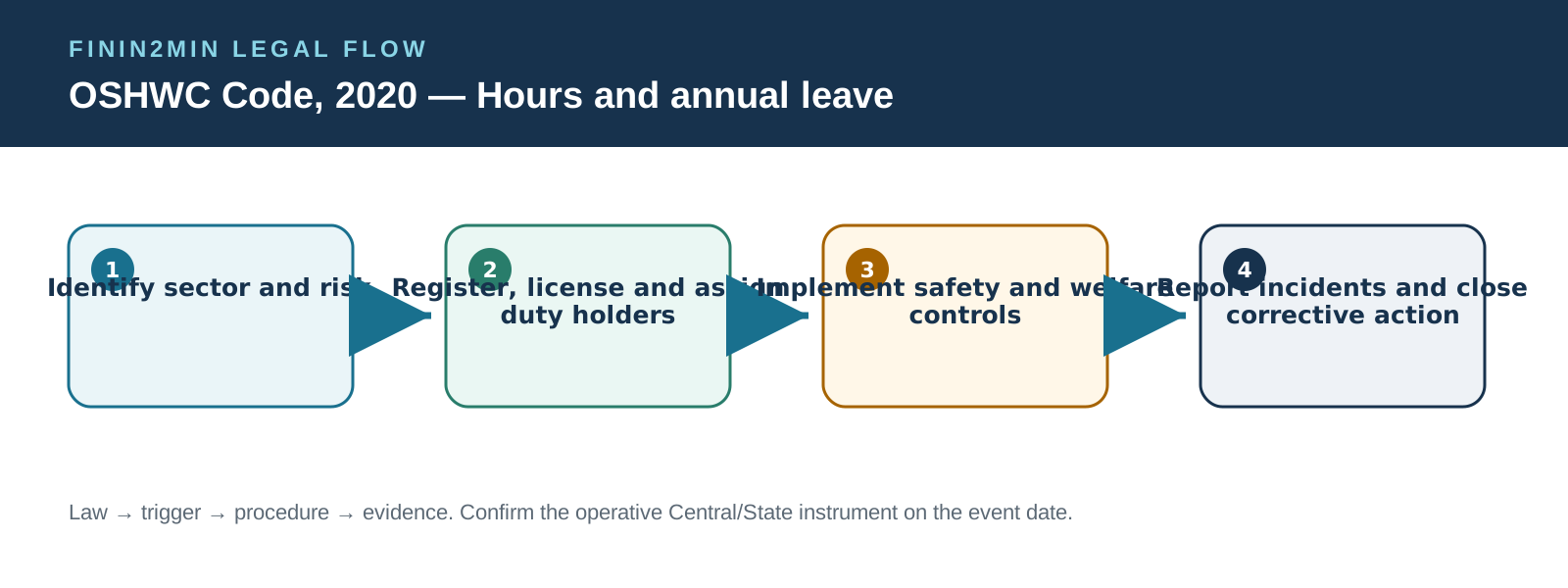
Chapter decision flow
Finin2min Summary - Chapter in 2 Minutes
This chapter turns hours and annual leave into an operational control file. It covers Daily and weekly working hours, leave, etc., Weekly and compensatory holidays, Extra wages for overtime, Night shifts; the practical sequence is to classify coverage and event date, apply the provision and mapped Rule, complete the form/register, calculate the entitlement or exposure, and retain evidence for inspection, claim or appeal.
Who is covered
Employers, occupiers, contractors, principal employers, workers and sector-specific establishments must identify the establishment type, worker category and appropriate Government.
Main obligations and rights
- Section 25: Daily and weekly working hours, leave, etc.
- Section 26: Weekly and compensatory holidays
- Section 27: Extra wages for overtime
- Section 28: Night shifts
- Section 29: Prohibition of overlapping shifts
- Section 30: Restriction on double employment in factory and mine
Key thresholds and timelines
- Use only the threshold, rate and limitation period effective on the event date; verify the Central/State instrument before acting.
Forms, registers and evidence
- Register
- Notice
- Retain classification, calculation, approval, communication, acknowledgement and payment/filing proof.
Employer risk snapshot
Highest practical risks: excess hours, rest-day, spread-over, overtime or leave-record failures.
Employee/worker remedy snapshot
Core protection: statutory hours, rest, overtime and leave protections subject to sector and State conditions. Confirm the authority, limitation and appeal route stated in this chapter.
Old law / transition
Map the event date and savings position against: Factories Act, 1948; Plantations Labour Act, 1951; Mines Act, 1952; Working Journalists laws; Motor Transport Workers Act, 1961.
Five-point professional checklist
- Freeze the event date, establishment, location and person/worker classification.
- Identify the controlling section/paragraph, mapped Rule, notification and appropriate Government.
- Reperform the calculation or decision test and document every exception or approval.
- Complete the prescribed form/register/portal step and retain acknowledgement, payment and communication evidence.
- Record the remedy, forum, limitation, appeal path and State variation before sign-off.
Finin2min takeaway: for hours and annual leave, the defensible answer is not a policy label - it is the event-date law, the mapped procedure, the calculation and a complete evidence trail.
Section-by-section provision map
| Provision | Subject | Implementation focus |
|---|---|---|
| Section 25 | Daily and weekly working hours, leave, etc. | Trigger, linked Rule/form, evidence, consequence and remedy |
| Section 26 | Weekly and compensatory holidays | Trigger, linked Rule/form, evidence, consequence and remedy |
| Section 27 | Extra wages for overtime | Trigger, linked Rule/form, evidence, consequence and remedy |
| Section 28 | Night shifts | Trigger, linked Rule/form, evidence, consequence and remedy |
| Section 29 | Prohibition of overlapping shifts | Trigger, linked Rule/form, evidence, consequence and remedy |
| Section 30 | Restriction on double employment in factory and mine | Trigger, linked Rule/form, evidence, consequence and remedy |
| Section 31 | Notice of periods of work | Trigger, linked Rule/form, evidence, consequence and remedy |
| Section 32 | Annual leave with wages, etc. | Trigger, linked Rule/form, evidence, consequence and remedy |
Section 25: Daily and weekly working hours, leave, etc.
Current statutory text
25. Daily and weekly working hours, leave, etc.— (1) No worker shall be required or allowed to
work, in any establishment or class of establishment for more than—

       (a) eight hours in a day; and

       (b) the period of work in each day under clause (a) shall be so fixed, as not to exceed such hours,
   with such intervals and spread overs , as may be notified by the appropriate Government:

   Provided that subject to clause (a) in the case of mines,—

            (i) the persons employed below ground in a mine shall not be allowed to work for more than
      such hours as may be notified by the Central Government in any day;

             (ii) no work shall be carried on below ground in any mine except by a system of shifts so
      arranged that the period of work for each shift is not spread over more than the daily maximum
      hours as notified under clause (i);

             (iii) no person employed in a mine shall be allowed to be present in any part of a mine below
     ground except during the periods of work shown in respect of him in the register maintained under
      clause (a) of section 33:

   Provided further that subject to clause (a) that the hours of work in case of motor transport worker
shall include—

            (i) the time spent in work done during the running time of the transport vehicle;

             (ii) the time spent in subsidiary work; and

             (iii) period of mere attendance at terminals of less than fifteen minutes.

   Explanation.—For the purposes of this sub-section—

          (a) “running time” in relation to a working day means the time from the moment a transport
      vehicle starts functioning at the beginning of the working day until the moment when the transport
      vehicle ceases to function at the end of the working day, excluding any time during which the
      running of the transport vehicle is interrupted for a period exceeding such duration as may be
      prescribed by the Central Government during which period the persons who drive, or perform any
      other work in connection with the transport vehicle are free to dispose of their time as they please
      or are engaged in subsidiary work;

          (b) “subsidiary work” means the work in connection with a transport vehicle, its passengers or
        its load which is done outside the running time of the transport vehicle, including in particular—

                (i) the work in connection with accounts, paying of cash, signing of registers, handover of
          service sheets, the checking of tickets and other similar work;

                 (ii) taking over and garaging of the transport vehicles;

                 (iii) travelling from the place where a person signs on to the place where he takes over the
          transport vehicle and from the place where he leaves the transport vehicle to the place where he
         signs off;

               (iv) work in connection with the upkeep and repair of the transport vehicle; and

              (v) the loading and unloading of the transport vehicle;

          (c) “period of mere attendance” means the period during which a person remains at his post
      solely in order to reply to possible calls or to resume action at the time fixed in the duty schedule.

       (2) Notwithstanding anything contained in sub-section (1), the hours of work for working journalist
    shall, subject to a maximum of one hundred and forty-four hours of work during any period of four
   consecutive weeks and a period of not less than twenty-four consecutive hours of rest during any
   period of seven consecutive days, be such as may be prescribed by the Central Government.

       (3) Notwithstanding anything contained in sub-sections (1) and (2), a sales promotion employee or
   the working journalist,—

            (i) in addition to such holidays, casual leave or other kinds of leave as may be prescribed by the
      Central Government, shall be granted, if requested for—

             (a) earned leave on full wages for not less than one-eleventh of the period spent on duty;

             (b) leave on medical certificate on one-half of the wages for not less than one-eighteenth of
         the period of service;

             (ii) may accumulate earned leave up to such maximum limit as may be prescribed by the Central
     Government;

             (iii) shall be entitled for the limit up to which the earned leave may be either encashed or availed
      of at a time by him and the reasons for which such limit may be exceeded shall be such as may be
      prescribed by the Central Government;

           (iv) shall,—

             (a) when he voluntarily relinquishes his post or retires from service; or

             (b) when his services are terminated for any reason whatsoever (not being termination as
         punishment),

be entitled to cash compensation, subject to such conditions and restrictions as may be prescribed by the
Central Government (including conditions by way of specifying the maximum period for which such cash
compensation shall be payable), in respect of the earned leave earned by him and not availed of;

          (v) who dies while in service, his heirs shall be entitled to cash compensation for the earned
      leave earned by him and not availed of his heirs shall be paid the cash compensation in respect of
     any period of earned leave for which he or his heirs, is or are entitled to cash compensation under
      clause (iv) or clause (v), which shall be an amount equal to the wages due to him for such period.


       (4) Notwithstanding anything contained in this section, the working hours of an adolescent worker
   shall be regulated in accordance with the provisions of the Child and Adolescent Labour (Prohibition
   and Regulation) Act, 1986 (61 of 1986).
Finin2min clause-by-clause decode
- This page does not replace the statutory text. It separates the operative legal transaction into controls so that each subsection, proviso, exception and delegated instrument can be checked against the official India Code source before use.
- Classify the worker, shift, establishment and State/Central sphere before applying hours or welfare conditions.
- Classify the employee and sector before applying daily, weekly, spread-over, rest and night-work rules.
- Map daily/weekly limits, spread-over, rest, consent, transport, security, leave and overtime requirements as applicable.
- Configure rosters so ordinary hours, intervals, weekly rest and compensatory holidays are visible before deployment.
- Configure roster, attendance and payroll controls so operational scheduling cannot bypass the statutory condition.
- Authorise and calculate overtime under the Code on Wages and preserve the approval/payment trail.
- Retain worker consent/communication, risk assessment, facility records, inspections and payment evidence.
- Prevent overlapping shifts and prohibited double employment through declarations and attendance analytics.
- Provide a complaint and correction route and test State variations, exemption conditions and consequences.
Applicable Central Rules immediately below the provision
Central Rule 64: Rule 64 — Working Hours
Rule mapping is retained; read the official 2026 Gazette for the exact sub-rule text and forms.
Central Rule 65: Rule 65 — Working hours of working journalist
Rule mapping is retained; read the official 2026 Gazette for the exact sub-rule text and forms.
Central Rule 66: Rule 66 — Holidays and leaves for sales promotion employees and working journalist
Rule mapping is retained; read the official 2026 Gazette for the exact sub-rule text and forms.
Practical example
A multi-location employer prepares a legal classification memo, identifies the appropriate Government, maps the operative provision and Rule, records the decision owner and retains the documents needed to prove compliance during inspection or litigation.
Controls and evidence
- Employer: assign owner, configure system and retain approval/payment proof.
- Employee/worker: retain contract, attendance, wage/benefit proof and communication.
- Professional: reconcile the Act, Rule, notification, form, limitation and State overlay.
Consequence, remedy and limitation
Identify the substantive default first, then separately map arrears or benefit, interest/damages, administrative penalty, prosecution, compounding, company/officer liability, forum, appeal and limitation. Do not infer a remedy from the heading alone.
Mapped Rules: Rule 64, Rule 65, Rule 66 | Official source: section 25.
Section 26: Weekly and compensatory holidays
Current statutory text
26. Weekly and compensatory holidays.—(1) No worker  shall be allowed  to work  in an
establishment for more than six days in any one week:

   Provided that in any motor transport undertaking, an employer may, in order to prevent any dislocation
of a motor transport service, require a worker to work on any day of weekly holiday which is not a
holiday so arranged that the worker does not work for more than ten days consecutively without a holiday
for a whole day intervening.

   (2) The appropriate Government may, by notification, exempt such workers as it thinks fit from the
provisions of sub-section (1), subject to such conditions as may be prescribed.

   (3) Where, as a result of the passing of an order or the making of a rule under the provisions of this
Code exempting an establishment or the workers therein from the provisions of sub-section (1), a worker
is deprived of any of the weekly holidays, the worker shall be allowed, within the month in which the
holidays were due or within the two months immediately following that month, compensatory holidays of
equal number to the holidays, so deprived.
Finin2min clause-by-clause decode
- This page does not replace the statutory text. It separates the operative legal transaction into controls so that each subsection, proviso, exception and delegated instrument can be checked against the official India Code source before use.
- Identify the covered establishment, worker category, appropriate Government and event date.
- Classify the employee and sector before applying daily, weekly, spread-over, rest and night-work rules.
- Convert each statutory condition and proviso into an assigned action with a clear deadline.
- Configure rosters so ordinary hours, intervals, weekly rest and compensatory holidays are visible before deployment.
- Map the enabling Rule, form, Schedule, authority and any sector-specific notification.
- Authorise and calculate overtime under the Code on Wages and preserve the approval/payment trail.
- Preserve the decision memo, worker communication, register, portal acknowledgement and payment or inspection evidence.
- Prevent overlapping shifts and prohibited double employment through declarations and attendance analytics.
- Record exceptions, non-compliance consequences, remedy, appeal forum and limitation period.
Applicable Central Rules immediately below the provision
Central Rule 67: Rule 67 — Weekly holiday
Rule mapping is retained; read the official 2026 Gazette for the exact sub-rule text and forms.
Central Rule 68: Rule 68 — Compensatory holidays
Rule mapping is retained; read the official 2026 Gazette for the exact sub-rule text and forms.
Practical example
A multi-location employer prepares a legal classification memo, identifies the appropriate Government, maps the operative provision and Rule, records the decision owner and retains the documents needed to prove compliance during inspection or litigation.
Controls and evidence
- Employer: assign owner, configure system and retain approval/payment proof.
- Employee/worker: retain contract, attendance, wage/benefit proof and communication.
- Professional: reconcile the Act, Rule, notification, form, limitation and State overlay.
Consequence, remedy and limitation
Identify the substantive default first, then separately map arrears or benefit, interest/damages, administrative penalty, prosecution, compounding, company/officer liability, forum, appeal and limitation. Do not infer a remedy from the heading alone.
Mapped Rules: Rule 67, Rule 68 | Official source: section 26.
Section 27: Extra wages for overtime
Current statutory text
27. Extra wages for overtime.—There shall be paid wages at the rate of twice the rate of wages in
respect of overtime work, where a worker works in an establishment or class of establishment for more
than such hours of work in any day or in any week as may be prescribed by the appropriate Government
and the period of overtime work shall be calculated on a daily basis or weekly basis, whichever is more
favourable to such worker:

   Provided that a worker shall be required to work overtime by the employer subject to the consent of
such worker for such work:

   Provided further that the appropriate Government may prescribe the total number of hours of overtime.
Finin2min clause-by-clause decode
- This page does not replace the statutory text. It separates the operative legal transaction into controls so that each subsection, proviso, exception and delegated instrument can be checked against the official India Code source before use.
- Identify the covered establishment, worker category, appropriate Government and event date.
- Classify the employee and sector before applying daily, weekly, spread-over, rest and night-work rules.
- Convert each statutory condition and proviso into an assigned action with a clear deadline.
- Configure rosters so ordinary hours, intervals, weekly rest and compensatory holidays are visible before deployment.
- Map the enabling Rule, form, Schedule, authority and any sector-specific notification.
- Authorise and calculate overtime under the Code on Wages and preserve the approval/payment trail.
- Preserve the decision memo, worker communication, register, portal acknowledgement and payment or inspection evidence.
- Prevent overlapping shifts and prohibited double employment through declarations and attendance analytics.
- Record exceptions, non-compliance consequences, remedy, appeal forum and limitation period.
Applicable Central Rules immediately below the provision
Central Rule 69: Rule 69 — Wages for overtime
Rule mapping is retained; read the official 2026 Gazette for the exact sub-rule text and forms.
Practical example
A payroll team tests the employee category, wage period, notified rate, permitted exclusions and documentary proof before releasing payroll. It records the calculation, approval, bank output and wage slip so that every disputed limb can be reconstructed.
Controls and evidence
- Employer: assign owner, configure system and retain approval/payment proof.
- Employee/worker: retain contract, attendance, wage/benefit proof and communication.
- Professional: reconcile the Act, Rule, notification, form, limitation and State overlay.
Consequence, remedy and limitation
Identify the substantive default first, then separately map arrears or benefit, interest/damages, administrative penalty, prosecution, compounding, company/officer liability, forum, appeal and limitation. Do not infer a remedy from the heading alone.
Mapped Rules: Rule 69 | Official source: section 27.
Section 28: Night shifts
Current statutory text
28. Night shifts.—Where a worker in an establishment works on a shift which extends beyond
midnight,—

       (a) for the purposes of section 26, a weekly holiday for a whole day shall mean in his case a period
   of twenty-four consecutive hours beginning when his shift ends;

       (b) the following day for him shall be deemed to be the period of twenty-four hours beginning
  when such shift ends, and the hours he has worked after midnight shall be counted in the previous day.
Finin2min clause-by-clause decode
- This page does not replace the statutory text. It separates the operative legal transaction into controls so that each subsection, proviso, exception and delegated instrument can be checked against the official India Code source before use.
- Classify the worker, shift, establishment and State/Central sphere before applying hours or welfare conditions.
- Classify the employee and sector before applying daily, weekly, spread-over, rest and night-work rules.
- Map daily/weekly limits, spread-over, rest, consent, transport, security, leave and overtime requirements as applicable.
- Configure rosters so ordinary hours, intervals, weekly rest and compensatory holidays are visible before deployment.
- Configure roster, attendance and payroll controls so operational scheduling cannot bypass the statutory condition.
- Authorise and calculate overtime under the Code on Wages and preserve the approval/payment trail.
- Retain worker consent/communication, risk assessment, facility records, inspections and payment evidence.
- Prevent overlapping shifts and prohibited double employment through declarations and attendance analytics.
- Provide a complaint and correction route and test State variations, exemption conditions and consequences.
Applicable Central Rules immediately below the provision
Central Rule 64: Rule 64 — Working Hours
Rule mapping is retained; read the official 2026 Gazette for the exact sub-rule text and forms.
Central Rule 65: Rule 65 — Working hours of working journalist
Rule mapping is retained; read the official 2026 Gazette for the exact sub-rule text and forms.
Central Rule 66: Rule 66 — Holidays and leaves for sales promotion employees and working journalist
Rule mapping is retained; read the official 2026 Gazette for the exact sub-rule text and forms.
Central Rule 67: Rule 67 — Weekly holiday
Rule mapping is retained; read the official 2026 Gazette for the exact sub-rule text and forms.
Central Rule 68: Rule 68 — Compensatory holidays
Rule mapping is retained; read the official 2026 Gazette for the exact sub-rule text and forms.
Central Rule 69: Rule 69 — Wages for overtime
Rule mapping is retained; read the official 2026 Gazette for the exact sub-rule text and forms.
Central Rule 70: Rule 70 — Restriction on double employment in mines
Rule mapping is retained; read the official 2026 Gazette for the exact sub-rule text and forms.
Central Rule 71: Rule 71 — Notice of periods of work
Rule mapping is retained; read the official 2026 Gazette for the exact sub-rule text and forms.
Practical example
A multi-location employer prepares a legal classification memo, identifies the appropriate Government, maps the operative provision and Rule, records the decision owner and retains the documents needed to prove compliance during inspection or litigation.
Controls and evidence
- Employer: assign owner, configure system and retain approval/payment proof.
- Employee/worker: retain contract, attendance, wage/benefit proof and communication.
- Professional: reconcile the Act, Rule, notification, form, limitation and State overlay.
Consequence, remedy and limitation
Identify the substantive default first, then separately map arrears or benefit, interest/damages, administrative penalty, prosecution, compounding, company/officer liability, forum, appeal and limitation. Do not infer a remedy from the heading alone.
Mapped Rules: Rule 64, Rule 65, Rule 66, Rule 67, Rule 68, Rule 69, Rule 70, Rule 71 | Official source: section 28.
Section 29: Prohibition of overlapping shifts
Current statutory text
29. Prohibition of overlapping shifts. — (1) The work shall not be carried on in any establishment by
means of a system of shifts so arranged that more than one relay of workers is engaged in work of the
same kind at the same time.

    (2) The appropriate Government or subject to the approval of the appropriate Government, the Chief
Inspector-cum-Facilitator, may, by written order and for the reasons specified therein, exempt on such
conditions as may be deemed expedient, any establishment or class of establishments or any department
or section of an establishment or any category or description of workers therein from the provisions of
sub-section (1):

   Provided that the provisions of this sub-section shall not apply to mines.
Finin2min clause-by-clause decode
- This page does not replace the statutory text. It separates the operative legal transaction into controls so that each subsection, proviso, exception and delegated instrument can be checked against the official India Code source before use.
- Identify the covered establishment, worker category, appropriate Government and event date.
- Identify the covered establishment, worker category, appropriate Government and sector-specific overlay.
- Convert each statutory condition and proviso into an assigned action with a clear deadline.
- Break the provision into trigger, actor, action, timing, evidence and consequence before configuring the process.
- Map the enabling Rule, form, Schedule, authority and any sector-specific notification.
- Read the corresponding Central Rule, prescribed form, Schedule and notified authority together.
- Preserve the decision memo, worker communication, register, portal acknowledgement and payment or inspection evidence.
- Create a named control owner and maker-checker evidence trail.
- Record exceptions, non-compliance consequences, remedy, appeal forum and limitation period.
Applicable Central Rules immediately below the provision
Central Rule 64: Rule 64 — Working Hours
Rule mapping is retained; read the official 2026 Gazette for the exact sub-rule text and forms.
Central Rule 65: Rule 65 — Working hours of working journalist
Rule mapping is retained; read the official 2026 Gazette for the exact sub-rule text and forms.
Central Rule 66: Rule 66 — Holidays and leaves for sales promotion employees and working journalist
Rule mapping is retained; read the official 2026 Gazette for the exact sub-rule text and forms.
Central Rule 67: Rule 67 — Weekly holiday
Rule mapping is retained; read the official 2026 Gazette for the exact sub-rule text and forms.
Central Rule 68: Rule 68 — Compensatory holidays
Rule mapping is retained; read the official 2026 Gazette for the exact sub-rule text and forms.
Central Rule 69: Rule 69 — Wages for overtime
Rule mapping is retained; read the official 2026 Gazette for the exact sub-rule text and forms.
Central Rule 70: Rule 70 — Restriction on double employment in mines
Rule mapping is retained; read the official 2026 Gazette for the exact sub-rule text and forms.
Central Rule 71: Rule 71 — Notice of periods of work
Rule mapping is retained; read the official 2026 Gazette for the exact sub-rule text and forms.
Practical example
A multi-location employer prepares a legal classification memo, identifies the appropriate Government, maps the operative provision and Rule, records the decision owner and retains the documents needed to prove compliance during inspection or litigation.
Controls and evidence
- Employer: assign owner, configure system and retain approval/payment proof.
- Employee/worker: retain contract, attendance, wage/benefit proof and communication.
- Professional: reconcile the Act, Rule, notification, form, limitation and State overlay.
Consequence, remedy and limitation
Identify the substantive default first, then separately map arrears or benefit, interest/damages, administrative penalty, prosecution, compounding, company/officer liability, forum, appeal and limitation. Do not infer a remedy from the heading alone.
Mapped Rules: Rule 64, Rule 65, Rule 66, Rule 67, Rule 68, Rule 69, Rule 70, Rule 71 | Official source: section 29.
Section 30: Restriction on double employment in factory and mine
Current statutory text
30. Restriction on double employment in factory and mine.—No worker shall be required or
allowed to work in a mine or factory  if he has already been working in any other such similar
establishment within the preceding twelve hours, save in such circumstances as may be prescribed by the
appropriate Government.
Finin2min clause-by-clause decode
- This page does not replace the statutory text. It separates the operative legal transaction into controls so that each subsection, proviso, exception and delegated instrument can be checked against the official India Code source before use.
- Confirm the sector definition, premises, process and statutory person in ultimate control.
- Classify the employee and sector before applying daily, weekly, spread-over, rest and night-work rules.
- Map the sector-specific registration, manager/agent/occupier appointment, technical standard and welfare duty.
- Configure rosters so ordinary hours, intervals, weekly rest and compensatory holidays are visible before deployment.
- Maintain shift, competence, medical, machinery, inspection and contractor records required for the activity.
- Authorise and calculate overtime under the Code on Wages and preserve the approval/payment trail.
- Integrate emergency, accident-reporting and worker-participation controls into site operations.
- Prevent overlapping shifts and prohibited double employment through declarations and attendance analytics.
- Test closure, prohibition, improvement direction, appeal and offence exposure against the current Rules and Schedules.
Applicable Central Rules immediately below the provision
Central Rule 70: Rule 70 — Restriction on double employment in mines
Rule mapping is retained; read the official 2026 Gazette for the exact sub-rule text and forms.
Practical example
Following a workplace event, the incident controller first protects life and the site, then completes statutory reporting, evidence preservation, medical documentation, contractor allocation and root-cause action without waiting for a compensation dispute.
Controls and evidence
- Employer: assign owner, configure system and retain approval/payment proof.
- Employee/worker: retain contract, attendance, wage/benefit proof and communication.
- Professional: reconcile the Act, Rule, notification, form, limitation and State overlay.
Consequence, remedy and limitation
Identify the substantive default first, then separately map arrears or benefit, interest/damages, administrative penalty, prosecution, compounding, company/officer liability, forum, appeal and limitation. Do not infer a remedy from the heading alone.
Mapped Rules: Rule 70 | Official source: section 30.
Section 31: Notice of periods of work
Current statutory text
31. Notice of periods of work.—(1) There shall be displayed and correctly maintained in every
establishment a notice of periods of work, showing clearly for every day the periods during which
workers may be required to work in accordance with the provisions of this Code.


   (2) The form of notice required by sub-section (1), the manner of display of such notice and the
manner in which such notice shall be sent to the Inspector-cum-Facilitator shall be such as may be
prescribed by the appropriate Government.

   (3) Any proposed change in the system of work in any establishment which will necessitate a change
in the notice referred to in sub-section (1) shall be intimated to the Inspector-cum-Facilitator before the
change is made, and except with the previous sanction of the Inspector-cum-Facilitator, no such change
shall be made until one week has elapsed since that last change.
Finin2min clause-by-clause decode
- This page does not replace the statutory text. It separates the operative legal transaction into controls so that each subsection, proviso, exception and delegated instrument can be checked against the official India Code source before use.
- Identify the covered establishment, worker category, appropriate Government and event date.
- Classify the employee and sector before applying daily, weekly, spread-over, rest and night-work rules.
- Convert each statutory condition and proviso into an assigned action with a clear deadline.
- Configure rosters so ordinary hours, intervals, weekly rest and compensatory holidays are visible before deployment.
- Map the enabling Rule, form, Schedule, authority and any sector-specific notification.
- Authorise and calculate overtime under the Code on Wages and preserve the approval/payment trail.
- Preserve the decision memo, worker communication, register, portal acknowledgement and payment or inspection evidence.
- Prevent overlapping shifts and prohibited double employment through declarations and attendance analytics.
- Record exceptions, non-compliance consequences, remedy, appeal forum and limitation period.
Applicable Central Rules immediately below the provision
Central Rule 71: Rule 71 — Notice of periods of work
Rule mapping is retained; read the official 2026 Gazette for the exact sub-rule text and forms.
Practical example
A multi-location employer prepares a legal classification memo, identifies the appropriate Government, maps the operative provision and Rule, records the decision owner and retains the documents needed to prove compliance during inspection or litigation.
Controls and evidence
- Employer: assign owner, configure system and retain approval/payment proof.
- Employee/worker: retain contract, attendance, wage/benefit proof and communication.
- Professional: reconcile the Act, Rule, notification, form, limitation and State overlay.
Consequence, remedy and limitation
Identify the substantive default first, then separately map arrears or benefit, interest/damages, administrative penalty, prosecution, compounding, company/officer liability, forum, appeal and limitation. Do not infer a remedy from the heading alone.
Mapped Rules: Rule 71 | Official source: section 31.
Section 32: Annual leave with wages, etc.
Current statutory text
32. Annual leave with wages, etc.—(1) Every worker employed in an establishment shall be entitled
for leave in a calendar year with wages subject to the following conditions, namely:—

        (i) that he has worked one hundred and eighty days or more in such calendar year;

        (ii) that he shall be entitled for one-day leave for every twenty days of his work, in the case of
   adolescent worker for fifteen days of his work, and in case of worker employed below ground mine, at
   the rate of one day for every fifteen days of his work, in such calendar year;

         (iii) any period of layoff, maternity leave or annual leave availed by such worker in such calendar
   year shall be counted for calculating the period of one hundred and eighty days or more under
   clause (i), but he shall not earn leave for the period so counted;

       (iv) any holidays falling between the leave availed by such worker (in a calendar year or prefixed or
   suffixed holiday) shall be excluded from the period of leave so availed;

       (v) in case of such worker whose service commences otherwise than on the first day of January
   shall be entitled to leave with wages at the rate specified in clause (ii), if he has worked for one-fourth
   of the total number of days in the remainder of the calendar year;

       (vi) in case such worker is discharged or dismissed from service or quits employment or  is
   superannuated or dies while in service, during the course of the calendar year, such worker or his heir
   or nominee, shall be entitled to wages in lieu of the quantum of leave to which such worker was
   entitled immediately before his discharge, dismissal, quitting of employment, superannuation or death,
   calculated as specified in preceding clauses, even if such worker has not worked for the required
   period under this sub-section making such worker eligible to avail such leave, and such payment shall
   be made—

          (a) where such worker is discharged or dismissed or quits employment before the expiry of the
      second working day from the date of such discharge, dismissal or quitting; and

          (b) where such worker is superannuated or dies while in service, before the expiry of two
     months from the date of such superannuation or death;

        (vii) if such worker does not in any one calendar year take the whole of the leave allowed to him
   under this sub-section and the rules made thereunder, then, any leave not taken by him shall be added
   to the leave to be allowed to him in the succeeding calendar year so that—

          (a) the total number of days of leave that may be carried forward to a succeeding year shall not
      exceed thirty days; and

          (b) such worker, who has applied for leave with wages but has not been given such leave in
      accordance with this sub-section and the rules made thereunder shall be entitled to carry forward
      the leave refused without any limit;

        (viii) without prejudice to clause (vi) such worker shall be entitled on his demand for encashment of
   leave at the end of calendar year;

       (ix) such worker shall be entitled, where his total number of leave exceeds thirty days under
   sub-clause (a) of clause (vii), to encash such exceeded leave.

   (2) The appropriate Government may, by notification, extend the provisions of sub-section (1) to any
other establishment except railway establishment.


   (3) The provisions of sub-section (1) shall not operate to the prejudice of any right to which a person
employed in a mine may be entitled under any other law or under the terms of any award, agreement or
contract of service:

   Provided that if such award, agreement or contract of service, provides for longer annual leave with
wages than that provided in sub-section (1), the quantum of leave, which the person employed shall be
entitled to, shall be in accordance with such award, agreement or contract of service but leave shall be
regulated in accordance with the provisions of sub-section (1) with respect of matters not provided for in
such award, agreement or contract of service:

   Provided further that where the Central Government is satisfied that the leave rules applicable to
persons employed in any mine provide benefits which in its opinion are not less favourable than those
provided for in sub-section (1) it may, by order in writing and subject to such conditions as may be
specified therein exempt the mine from all or any of the provisions of sub-section (1).

                              CHAPTER VIII

                     MAINTENANCE OF REGISTERS, RECORDS AND RETURNS
Finin2min clause-by-clause decode
- This page does not replace the statutory text. It separates the operative legal transaction into controls so that each subsection, proviso, exception and delegated instrument can be checked against the official India Code source before use.
- Classify the worker, shift, establishment and State/Central sphere before applying hours or welfare conditions.
- Classify the employee and sector before applying daily, weekly, spread-over, rest and night-work rules.
- Map daily/weekly limits, spread-over, rest, consent, transport, security, leave and overtime requirements as applicable.
- Configure rosters so ordinary hours, intervals, weekly rest and compensatory holidays are visible before deployment.
- Configure roster, attendance and payroll controls so operational scheduling cannot bypass the statutory condition.
- Authorise and calculate overtime under the Code on Wages and preserve the approval/payment trail.
- Retain worker consent/communication, risk assessment, facility records, inspections and payment evidence.
- Prevent overlapping shifts and prohibited double employment through declarations and attendance analytics.
- Provide a complaint and correction route and test State variations, exemption conditions and consequences.
Applicable Central Rules immediately below the provision
Central Rule 76: Rule 76 — Register of leave with wages
Rule mapping is retained; read the official 2026 Gazette for the exact sub-rule text and forms.
Practical example
A payroll team tests the employee category, wage period, notified rate, permitted exclusions and documentary proof before releasing payroll. It records the calculation, approval, bank output and wage slip so that every disputed limb can be reconstructed.
Controls and evidence
- Employer: assign owner, configure system and retain approval/payment proof.
- Employee/worker: retain contract, attendance, wage/benefit proof and communication.
- Professional: reconcile the Act, Rule, notification, form, limitation and State overlay.
Consequence, remedy and limitation
Identify the substantive default first, then separately map arrears or benefit, interest/damages, administrative penalty, prosecution, compounding, company/officer liability, forum, appeal and limitation. Do not infer a remedy from the heading alone.
Mapped Rules: Rule 76 | Official source: section 32.
Rules, forms, registers, portals and due dates
| Rule | Subject | Text/control status |
|---|---|---|
| 64 | Rule 64 — Working Hours | Source-controlled mapping |
| 65 | Rule 65 — Working hours of working journalist | Source-controlled mapping |
| 66 | Rule 66 — Holidays and leaves for sales promotion employees and working journalist | Source-controlled mapping |
| 67 | Rule 67 — Weekly holiday | Source-controlled mapping |
| 68 | Rule 68 — Compensatory holidays | Source-controlled mapping |
| 69 | Rule 69 — Wages for overtime | Source-controlled mapping |
| 70 | Rule 70 — Restriction on double employment in mines | Source-controlled mapping |
| 71 | Rule 71 — Notice of periods of work | Source-controlled mapping |
| 76 | Rule 76 — Register of leave with wages | Source-controlled mapping |
Forms and registers must be confirmed from the appended 2026 Central Rules and the live portal applicable to the appropriate Government. A form is not treated as current merely because an earlier law used the same number.
Notifications and effective-date history
| Control | Required action |
|---|---|
| Enactment | Record Act number, assent and Gazette publication. |
| Commencement | Use the provision-specific commencement notification; the four Codes became broadly operative from 21 November 2025 subject to earlier partial commencement and corrigenda. |
| Central Rules | Read the applicable 2026 Central Rules from their Gazette date and verify subsequent amendments. |
| State instrument | Check final State Rules, authority notifications, forms and rates where the State is appropriate Government. |
Old-law/new-Code concordance
| Predecessor law | Transition control |
|---|---|
| Factories Act, 1948 | Classify the event date, accrued right, saved Rule/notification and pending proceeding before moving to the Code. |
| Plantations Labour Act, 1951 | Classify the event date, accrued right, saved Rule/notification and pending proceeding before moving to the Code. |
| Mines Act, 1952 | Classify the event date, accrued right, saved Rule/notification and pending proceeding before moving to the Code. |
| Working Journalists laws | Classify the event date, accrued right, saved Rule/notification and pending proceeding before moving to the Code. |
| Motor Transport Workers Act, 1961 | Classify the event date, accrued right, saved Rule/notification and pending proceeding before moving to the Code. |
| Beedi and Cigar Workers Act, 1966 | Classify the event date, accrued right, saved Rule/notification and pending proceeding before moving to the Code. |
| Contract Labour Act, 1970 | Classify the event date, accrued right, saved Rule/notification and pending proceeding before moving to the Code. |
| Inter-State Migrant Workmen Act, 1979 | Classify the event date, accrued right, saved Rule/notification and pending proceeding before moving to the Code. |
| Cine-Workers Act, 1981 | Classify the event date, accrued right, saved Rule/notification and pending proceeding before moving to the Code. |
| Dock Workers Act, 1986 | Classify the event date, accrued right, saved Rule/notification and pending proceeding before moving to the Code. |
| BOCW Act, 1996 | Classify the event date, accrued right, saved Rule/notification and pending proceeding before moving to the Code. |
Practical calculations and control file
Calculation sequence
- Freeze the employee/worker population and event date.
- Apply the statutory wage/benefit base and notified threshold.
- Reconcile attendance, service, payroll and contractor records.
- Calculate principal amount, interest/damages and any statutory compensation separately.
- Obtain legal/payroll approval and retain the versioned worksheet.
Three-owner sign-off
- Employer/HR: facts, classification, communication and workflow.
- Employee/worker: notice, records, nomination/claim and acknowledgement.
- Professional: source, formula, forum, limitation and evidence reconciliation.
Binding and highly relevant case-law principles
| Decision | Principle and present-use caution |
|---|---|
| Consumer Education and Research Centre v. Union of India | Worker health and safety are connected with dignity and life; statutory standards should be treated as minimum controls. |
| J.K. Industries Ltd. v. Chief Inspector of Factories | Responsibility attaches to the statutory person in control; internal delegation does not erase legal accountability. |
| Vellore Citizens Welfare Forum v. Union of India | Preventive and precautionary controls are relevant where industrial risk affects workers and surrounding communities. |
| Gammon India Ltd. v. Union of India | Construction-worker welfare and cess legislation is beneficial and must be applied consistently with the charging and machinery provisions. |
State-law variation alerts
- Confirm whether the Central or State Government is the appropriate Government.
- Central Rules do not automatically displace valid State Rules, rates, registers, authorities or portal procedures.
- Minimum-wage rates, holidays, working-hours permissions, licences and local welfare obligations require State-specific verification.
- Record Gazette number, effective date and supersession status in the location compliance register.
Practical examples and calculations
Classify the worker and establishment, identify the operative provision and notified instrument on the event date, compute the entitlement or exposure from source records, obtain approval, complete the filing/payment/action, and retain evidence. Do not use a portal value or payroll label as a substitute for the statutory test.
Calculation/control template: Control calculation: verified population or transaction base × applicable notified rate/amount × eligible period, adjusted for statutory inclusions, exclusions, ceilings, interest, compensation and prior payments. Reperform the calculation from retained source data.
Finin2min implementation explanation
Maintain a controlled implementation file for Chapter VII - Hours and annual leave: coverage and event date, operative Central/State instrument, responsible owner, approval and authority, form/portal step, due date, calculation basis, supporting evidence, exception, escalation and closure proof. Reconcile payroll, HR, finance, contractor and legal records before sign-off.
Practical transaction application
Apply the chapter to site acquisition, factory/establishment registration, contractor mobilisation, licence conditions, migrant-worker deployment, construction, hazardous process, working hours, welfare, accident response and shutdown planning.
Authority, consent and execution controls
Identify the employer, occupier, manager, principal employer, contractor, safety officer, medical officer and authorised signatory. Verify licences, appointments, delegations and government approvals before mobilisation; contract allocation does not extinguish statutory responsibility.
Stamp duty and registration alerts
Licences and statutory registrations are distinct from stamping/registration of leases, construction contracts, contractor agreements, security instruments and land documents. Check State stamp and registration law for the underlying transaction while separately completing labour-law approvals.
Evidence and document-retention checklist
Retain the operative law/rule version, classification note, approvals, signed instruments, statutory forms, portal acknowledgements, registers, calculations, bank proof, correspondence, inspection records, service proof, decision and appeal file. Apply the longer of the statutory retention rule, litigation hold, tax/audit need and contractual requirement; restrict access to personal and sensitive data.
Performance, delivery and payment controls
Use pre-mobilisation gates for registration, licence, competency, medical fitness, training, PPE, welfare and emergency readiness. Link contractor invoices to attendance, wage payment, contribution proof, safety records and incident closure.
Breach, loss, mitigation and remedy framework
On detecting a breach, stop continuing exposure, preserve evidence, quantify employee and government dues, identify affected persons, make lawful corrective payment/filing, notify the authorised decision-maker, assess self-disclosure or compounding where available, and reserve contractual recovery against responsible vendors without delaying statutory remediation.
Limitation and forum controls
Route inspection, licence, prohibition, penalty and appeal matters to the prescribed authority and court. Preserve inspection records, sampling chain, accident evidence, notices and appeal clocks; contractual dispute forums do not displace regulatory action.
Arbitration and mediation interface
Arbitration or mediation may resolve employer-contractor allocation and indemnity disputes, but cannot bind inspectors, waive safety duties, suppress accident reporting or replace statutory prosecution/appeal channels.
Company, partnership, GST and tax overlays
For a company, align board/delegation and officer-in-default controls; for an LLP or partnership, identify the designated partner/partner and authorised employer representative. Labour dues can affect transaction price, indemnities, director/partner exposure and insolvency claims. Salary/TDS, perquisite, contractor TDS, GST on outsourced services and accounting provisions must be reconciled without treating tax treatment as proof of labour-law classification.
Finin2min Q&A
Which law and version should be applied?
Use the current text of OSHWC Code, 2020, the commencement notification, the applicable Central or State Rules and any later instrument effective on the event date.
How is the appropriate Government identified?
Classify ownership/control, sector, establishment and contractor relationship before selecting the Central or State authority.
Can a company policy override the statutory protection?
No. A policy may improve a benefit or control, but it cannot contract out of a mandatory statutory floor.
What evidence should be retained?
Retain the classification memo, source instrument, form/portal record, calculation, approval, employee communication, acknowledgement and payment or authority proof.
Do the Central Rules apply to every establishment?
No. They govern the Central sphere. State Rules and State notifications must be checked where the State is the appropriate Government.
How should a historical event be tested?
Apply the law and subordinate instrument effective on the event date, then use the repeal-and-savings provision for pending rights and proceedings.
What happens when portal practice conflicts with the statute?
Record the conflict, follow the higher legal instrument, seek authority clarification where necessary and preserve screenshots and correspondence.
Can criminal and monetary consequences arise together?
They may. Separate wages/benefits, interest, damages, civil penalty, prosecution, compounding and director/officer liability.
Is a contractor arrangement enough to shift liability?
No. Principal-employer and contractor liabilities depend on the specific provision and facts; the contract should allocate evidence and recovery without diluting worker rights.
What is the first professional review step?
Freeze the event date and facts, identify the applicable provision, then map Rules, forms, notification status, authority, limitation and evidence.
What is the operational focus of section 25 - Daily and weekly working hours, leave, etc.?
The section must be decomposed into actor, trigger, threshold, procedure, exception, consequence and evidence. Read the full official text and the mapped Rules before applying the Finin2min control summary.
What is the operational focus of section 26 - Weekly and compensatory holidays?
The section must be decomposed into actor, trigger, threshold, procedure, exception, consequence and evidence. Read the full official text and the mapped Rules before applying the Finin2min control summary.
What is the operational focus of section 27 - Extra wages for overtime?
The section must be decomposed into actor, trigger, threshold, procedure, exception, consequence and evidence. Read the full official text and the mapped Rules before applying the Finin2min control summary.
What is the operational focus of section 28 - Night shifts?
The section must be decomposed into actor, trigger, threshold, procedure, exception, consequence and evidence. Read the full official text and the mapped Rules before applying the Finin2min control summary.
What is the operational focus of section 29 - Prohibition of overlapping shifts?
The section must be decomposed into actor, trigger, threshold, procedure, exception, consequence and evidence. Read the full official text and the mapped Rules before applying the Finin2min control summary.
What is the operational focus of section 30 - Restriction on double employment in factory and mine?
The section must be decomposed into actor, trigger, threshold, procedure, exception, consequence and evidence. Read the full official text and the mapped Rules before applying the Finin2min control summary.
What is the operational focus of section 31 - Notice of periods of work?
The section must be decomposed into actor, trigger, threshold, procedure, exception, consequence and evidence. Read the full official text and the mapped Rules before applying the Finin2min control summary.
What is the operational focus of section 32 - Annual leave with wages, etc.?
The section must be decomposed into actor, trigger, threshold, procedure, exception, consequence and evidence. Read the full official text and the mapped Rules before applying the Finin2min control summary.