Downloads
Chapter VIII - Registers and returns
Reviewed by CA Nikhil Gupta · Last reviewed 15 September 2026
Use this chapter to apply chapter viii - registers and returns as an evidence-backed statutory workflow rather than a checklist label.
Finin2min Summary - in 2 minutes
Who should use this chapter
- Occupiers, employers, principal employers and contractors
- Workers, safety committees and worker representatives
- EHS, HR, plant, project and legal/compliance teams
- Professionals and students tracing licence, welfare, safety and remedy controls
What to do first
- Freeze the event date, establishment/person status and jurisdiction.
- Identify the exact provision, Rule/form/notification and current source.
- Apply the factual test and calculation/decision sequence.
- Retain notice, approval, payment/filing and exception/remediation evidence.
Highest-risk failures
- Wrong coverage or jurisdiction
- Stale Rule/notification/form
- Unsupported factual classification
- Missing evidence, notice, limitation or approval
Practical scenario
A live compliance question is documented as a dated fact pattern, mapped to the exact provision and subordinate instrument, independently checked, implemented, and closed with evidence.
How to use the legal material below
The material below brings together the relevant statutory text or provision map, linked Rules/forms, practical explanation, evidence controls and remedies for this chapter. For a live matter, read the exact provision together with the Rule, form, notification and Central/State instrument that applies on the event date.
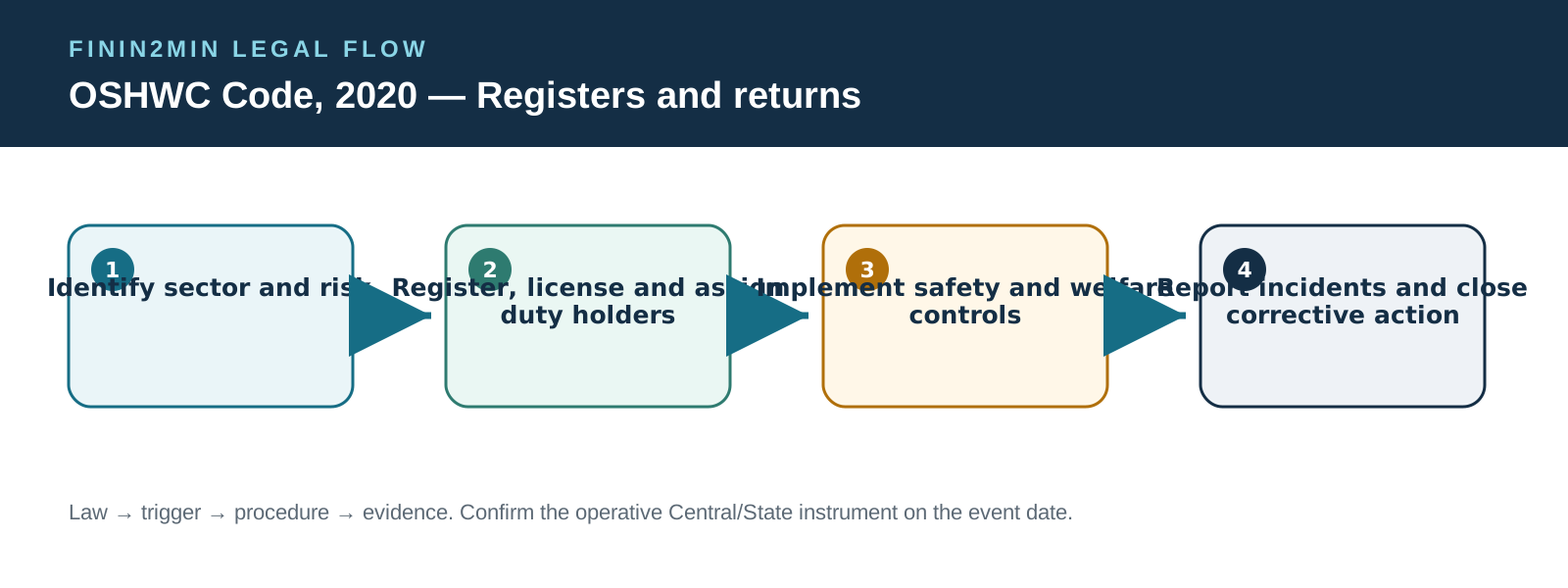
Section-by-section provision map
| Provision | Subject | Implementation focus |
|---|---|---|
| Section 33 | Maintenance of registers, records and filing of returns | Trigger, linked Rule/form, evidence, consequence and remedy |
Section 33: Maintenance of registers, records and filing of returns
Current statutory text
33. Maintenance of registers, records and filing of returns.—An employer of an establishment


shall—


          (a) maintain register in prescribed form, electronically or otherwise, containing such particulars


      of workers as may be prescribed by the appropriate Government including,—


                (i) work performed by them;


                 (ii) number of hours of work constituting normal working hours in a day;


                 (iii) day of rest allowed in every period of seven days;


               (iv) wage paid and receipts given therefor;


              (v) leave, leave wages, overtime work, attendance and dangerous occurrences; and


               (vi) employment of adolescent;


          (b) display notices at the work place of the workers in such manner and form as may be


      prescribed by the appropriate Government;


          (c) issue wage slips to the workers, in electronic forms or otherwise; and


          (d) file such return electronically or otherwise to the Inspector-cum-Facilitator in such manner


     and during such periods as may be prescribed by the appropriate Government.


                               CHAPTER IX


                        INSPECTOR-CUM-FACILITATORS AND OTHER AUTHORITY
Finin2min clause-by-clause decode
- This page does not replace the statutory text. It separates the operative legal transaction into controls so that each subsection, proviso, exception and delegated instrument can be checked against the official India Code source before use.
- Identify the covered establishment, worker category, appropriate Government and event date.
- Identify the prescribed form, data owner, filing frequency and competent recipient.
- Convert each statutory condition and proviso into an assigned action with a clear deadline.
- Maintain one controlled source of truth across HRIS, attendance, payroll, contractor and safety systems.
- Map the enabling Rule, form, Schedule, authority and any sector-specific notification.
- Use maker-checker validation and reconcile totals before filing or display.
- Preserve the decision memo, worker communication, register, portal acknowledgement and payment or inspection evidence.
- Preserve acknowledgements, corrections and version history for the required retention period.
- Record exceptions, non-compliance consequences, remedy, appeal forum and limitation period.
Applicable Central Rules immediately below the provision
Central Rule 72: Rule 72 — Maintenance and production of reports, registers and other records
Rule mapping is retained; read the official 2026 Gazette for the exact sub-rule text and forms.
Practical example
The establishment creates a trigger ticket when coverage changes, assigns the authorised signatory, uploads the prescribed attachments, captures the acknowledgement and retains a versioned copy of the form, payment and approval.
Controls and evidence
- Employee/worker: retain contract, attendance, wage/benefit proof and communication.
Consequence, remedy and limitation
Mapped Rules: Rule 72, Rule 73, Rule 74, Rule 75, Rule 76 | Official source: section 33.
Rules, forms, registers, portals and due dates
| Rule | Subject | Text/control status |
|---|---|---|
| 72 | Rule 72 — Maintenance and production of reports, registers and other records | Verify from official source |
| 73 | Rule 73 — Display on notice board | Verify from official source |
| 74 | Rule 74 — Annual Return | Verify from official source |
| 75 | Rule 75 — Register of accident and dangerous occurrences | Verify from official source |
| 76 | Rule 76 — Register of leave with wages | Verify from official source |
Forms and registers must be confirmed from the appended 2026 Central Rules and the live portal applicable to the appropriate Government. A form is not treated as current merely because an earlier law used the same number.
Notifications and effective-date history
| Control | Required action |
|---|---|
| Enactment | Record Act number, assent and Gazette publication. |
| Commencement | Use the provision-specific commencement notification; the four Codes became broadly operative from 21 November 2025 subject to earlier partial commencement and corrigenda. |
| Central Rules | Read the applicable 2026 Central Rules from their Gazette date and verify subsequent amendments. |
| State instrument | Check final State Rules, authority notifications, forms and rates where the State is appropriate Government. |
Old-law/new-Code concordance
| Predecessor law | Transition control |
|---|---|
| Factories Act, 1948 | Classify the event date, accrued right, saved Rule/notification and pending proceeding before moving to the Code. |
| Plantations Labour Act, 1951 | Classify the event date, accrued right, saved Rule/notification and pending proceeding before moving to the Code. |
| Mines Act, 1952 | Classify the event date, accrued right, saved Rule/notification and pending proceeding before moving to the Code. |
| Working Journalists laws | Classify the event date, accrued right, saved Rule/notification and pending proceeding before moving to the Code. |
| Motor Transport Workers Act, 1961 | Classify the event date, accrued right, saved Rule/notification and pending proceeding before moving to the Code. |
| Beedi and Cigar Workers Act, 1966 | Classify the event date, accrued right, saved Rule/notification and pending proceeding before moving to the Code. |
| Contract Labour Act, 1970 | Classify the event date, accrued right, saved Rule/notification and pending proceeding before moving to the Code. |
| Inter-State Migrant Workmen Act, 1979 | Classify the event date, accrued right, saved Rule/notification and pending proceeding before moving to the Code. |
| Cine-Workers Act, 1981 | Classify the event date, accrued right, saved Rule/notification and pending proceeding before moving to the Code. |
| Dock Workers Act, 1986 | Classify the event date, accrued right, saved Rule/notification and pending proceeding before moving to the Code. |
| BOCW Act, 1996 | Classify the event date, accrued right, saved Rule/notification and pending proceeding before moving to the Code. |
Practical calculations and control file
Calculation sequence
- Freeze the employee/worker population and event date.
- Apply the statutory wage/benefit base and notified threshold.
- Reconcile attendance, service, payroll and contractor records.
- Calculate principal amount, interest/damages and any statutory compensation separately.
- Obtain legal/payroll approval and retain the versioned worksheet.
Three-owner sign-off
- Employer/HR: facts, classification, communication and workflow.
- Employee/worker: notice, records, nomination/claim and acknowledgement.
- Professional: source, formula, forum, limitation and evidence reconciliation.
Binding and highly relevant case-law principles
| Decision | Principle and present-use caution |
|---|---|
| Consumer Education and Research Centre v. Union of India | Worker health and safety are connected with dignity and life; statutory standards should be treated as minimum controls. |
| J.K. Industries Ltd. v. Chief Inspector of Factories | Responsibility attaches to the statutory person in control; internal delegation does not erase legal accountability. |
| Vellore Citizens Welfare Forum v. Union of India | Preventive and precautionary controls are relevant where industrial risk affects workers and surrounding communities. |
| Gammon India Ltd. v. Union of India | Construction-worker welfare and cess legislation is beneficial and must be applied consistently with the charging and machinery provisions. |
State-law variation alerts
- Confirm whether the Central or State Government is the appropriate Government.
- Central Rules do not automatically displace valid State Rules, rates, registers, authorities or portal procedures.
- Minimum-wage rates, holidays, working-hours permissions, licences and local welfare obligations require State-specific verification.
- Record Gazette number, effective date and supersession status in the location compliance register.
Finin2min Q&A
Which law and version should be applied?
Use the current text of OSHWC Code, 2020, the commencement notification, the applicable Central or State Rules and any later instrument effective on the event date.
How is the appropriate Government identified?
Classify ownership/control, sector, establishment and contractor relationship before selecting the Central or State authority.
Can a company policy override the statutory protection?
No. A policy may improve a benefit or control, but it cannot contract out of a mandatory statutory floor.
What evidence should be retained?
Retain the classification memo, source instrument, form/portal record, calculation, approval, employee communication, acknowledgement and payment or authority proof.
Do the Central Rules apply to every establishment?
No. They govern the Central sphere. State Rules and State notifications must be checked where the State is the appropriate Government.
How should a historical event be tested?
Apply the law and subordinate instrument effective on the event date, then use the repeal-and-savings provision for pending rights and proceedings.
What happens when portal practice conflicts with the statute?
Record the conflict, follow the higher legal instrument, seek authority clarification where necessary and preserve screenshots and correspondence.
Can criminal and monetary consequences arise together?
They may. Separate wages/benefits, interest, damages, civil penalty, prosecution, compounding and director/officer liability.
Is a contractor arrangement enough to shift liability?
No. Principal-employer and contractor liabilities depend on the specific provision and facts; the contract should allocate evidence and recovery without diluting worker rights.
What is the first professional review step?
Freeze the event date and facts, identify the applicable provision, then map Rules, forms, notification status, authority, limitation and evidence.
What is the operational focus of section 33 - Maintenance of registers, records and filing of returns?
The section must be decomposed into actor, trigger, threshold, procedure, exception, consequence and evidence. Read the full official text and the mapped Rules before applying the Finin2min control summary.
What is review control 12 for this chapter?
Confirm source currency, State variation, internal ownership, documentary proof and the next statutory deadline before closing the compliance ticket.
What is review control 13 for this chapter?
What is review control 14 for this chapter?
What is review control 15 for this chapter?
Source and review trail
Use the current official instrument, portal or regulator publication before acting. Page-specific references are listed below.
- Official starting point
- www.labour.gov.in
Page source links
Related guidance: OSHWC Code, 2020 - Chapter VI: Welfare · Chapter XI - Contract labour | OSHWC Code, 2020
Finin2min Q&A
Official / primary-source starting points
- Ministry of Labour - OSHWC (Central) Rules, 2026
- Ministry of Labour - Labour Codes library
- India Code - OSHWC Code, 2020
Mutable rates, forms, portal steps, State rules, exemptions, authorities and later amendments must be verified from the exact official source effective on the event date.