Source protocol. Retained provision/rule pages and official documents are consolidated below. The signed Gazette and current authority portal prevail over normalised formatting.
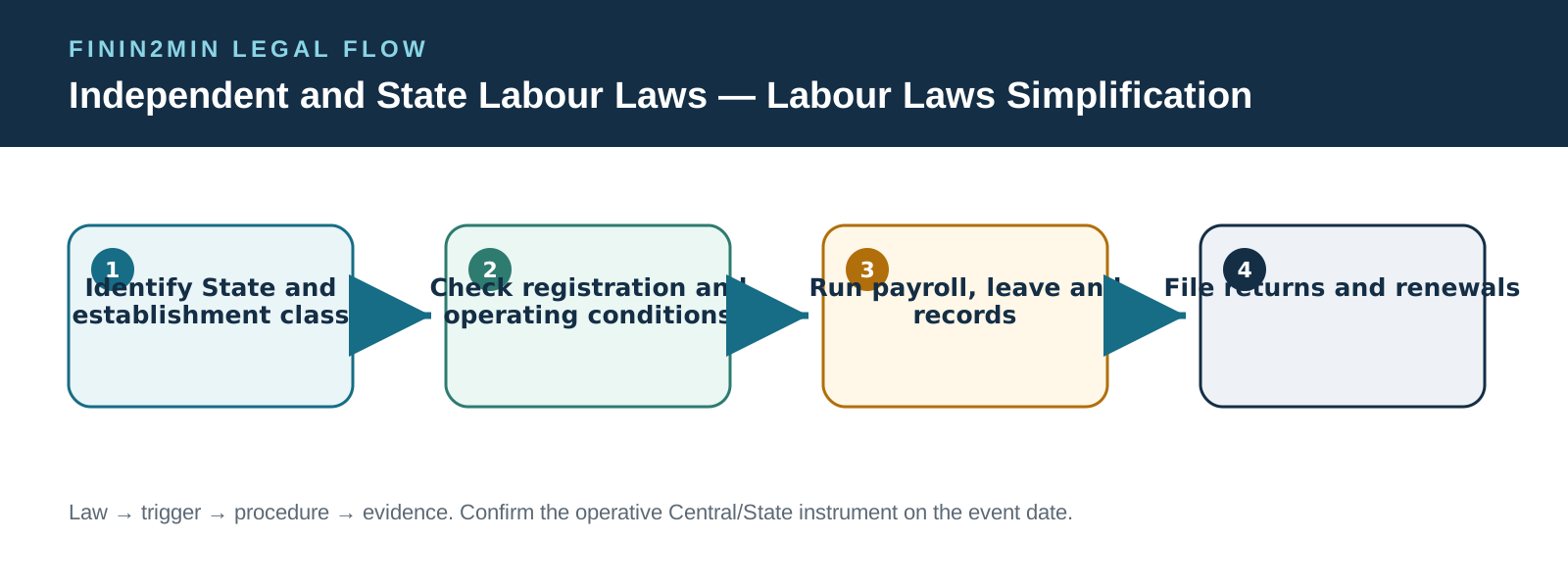
This chapter turns labour laws simplification into an operational control file. It covers First Schedule, Form A Annual Return, Form B Register Of Establishment, Form C Register Of Wages; the practical sequence is to classify coverage and event date, apply the provision and mapped Rule, complete the form/register, calculate the entitlement or exposure, and retain evidence for inspection, claim or appeal.
Who is covered
Coverage depends on the specific Central or State law, location, establishment type, workforce category and event date; State/UT instruments must be checked separately.
Main obligations and rights
First Schedule
Form A Annual Return
Form B Register Of Establishment
Form C Register Of Wages
Form D Muster Roll
Form E Register Of Accidents
Key thresholds and timelines
Use only the threshold, rate and limitation period effective on the event date; verify the Central/State instrument before acting.
Forms, registers and evidence
Register
Return
Nomination
Retain classification, calculation, approval, communication, acknowledgement and payment/filing proof.
Employer risk snapshot
Highest practical risks: using Central assumptions without checking the location-specific Act, Rules, rates, forms and authorities.
Employee/worker remedy snapshot
Core protection: location-specific working-condition, leave, holiday, welfare and wage protections under the applicable State law. Confirm the authority, limitation and appeal route stated in this chapter.
Old law / transition
There is no single all-India substitution rule. Apply the current State/UT Act, Rules, notifications and saved instruments for the location.
Five-point professional checklist
Freeze the event date, establishment, location and person/worker classification.
Identify the controlling section/paragraph, mapped Rule, notification and appropriate Government.
Reperform the calculation or decision test and document every exception or approval.
Complete the prescribed form/register/portal step and retain acknowledgement, payment and communication evidence.
Record the remedy, forum, limitation, appeal path and State variation before sign-off.
Finin2min takeaway: for labour laws simplification, the defensible answer is not a policy label - it is the event-date law, the mapped procedure, the calculation and a complete evidence trail.
First Schedule — Labour-Law Simplification | Finin2min
Finin
min
Home
Employment law
L11–L20
/ First Schedule — Labour-Law Simplification
L20 · Registers and Returns
First Schedule — Labour-Law Simplification
Operational mapping for First Schedule under the Labour Laws simplification framework.
Authors: Nikhil Gupta & Kajri Singh
Data reviewed on 17 July 2026
India-first legal repository
First Schedule
This module maps the statutory consolidation concept to the live law stack. It must not be used to suppress a return, register or field that remains required under a labour code, State law, scheme, portal direction or establishment-specific rule.
Control:
Maintain a field-by-field concordance from the prescribed form to the system of record, assign an owner, lock the period and preserve filing/display proof.
Transition caution:
The four labour codes and State laws changed the legacy-law landscape. Confirm whether this form continues, has been replaced, or operates only for a residual class before use.
Open official source
Finin2min implementation decode
A multi-location employer prepares a legal classification memo, identifies the appropriate Government, maps the operative provision and Rule, records the decision owner and retains the documents needed to prove compliance during inspection or litigation.
Identify actor, trigger, threshold and territorial authority.
Map form, record, portal, fee and due date.
Separate substantive entitlement from procedure, remedy and penal consequence.
Retain the official instrument and event-date evidence.
Form A Annual Return
Form A — Annual Return — Labour-Law Simplification | Finin2min
Finin
min
Home
Employment law
L11–L20
/ Form A — Annual Return — Labour-Law Simplification
L20 · Registers and Returns
Form A — Annual Return — Labour-Law Simplification
Operational mapping for Form A — Annual Return under the Labour Laws simplification framework.
Authors: Nikhil Gupta & Kajri Singh
Data reviewed on 17 July 2026
India-first legal repository
Form A — Annual Return
This module maps the statutory consolidation concept to the live law stack. It must not be used to suppress a return, register or field that remains required under a labour code, State law, scheme, portal direction or establishment-specific rule.
Control:
Maintain a field-by-field concordance from the prescribed form to the system of record, assign an owner, lock the period and preserve filing/display proof.
Transition caution:
The four labour codes and State laws changed the legacy-law landscape. Confirm whether this form continues, has been replaced, or operates only for a residual class before use.
Open official source
Finin2min implementation decode
A multi-location employer prepares a legal classification memo, identifies the appropriate Government, maps the operative provision and Rule, records the decision owner and retains the documents needed to prove compliance during inspection or litigation.
Identify actor, trigger, threshold and territorial authority.
Map form, record, portal, fee and due date.
Separate substantive entitlement from procedure, remedy and penal consequence.
Retain the official instrument and event-date evidence.
Form B Register Of Establishment
Form B — Register of Establishment — Labour-Law Simplification | Finin2min
Finin
min
Home
Employment law
L11–L20
/ Form B — Register of Establishment — Labour-Law Simplification
L20 · Registers and Returns
Form B — Register of Establishment — Labour-Law Simplification
Operational mapping for Form B — Register of Establishment under the Labour Laws simplification framework.
Authors: Nikhil Gupta & Kajri Singh
Data reviewed on 17 July 2026
India-first legal repository
Form B — Register of Establishment
This module maps the statutory consolidation concept to the live law stack. It must not be used to suppress a return, register or field that remains required under a labour code, State law, scheme, portal direction or establishment-specific rule.
Control:
Maintain a field-by-field concordance from the prescribed form to the system of record, assign an owner, lock the period and preserve filing/display proof.
Transition caution:
The four labour codes and State laws changed the legacy-law landscape. Confirm whether this form continues, has been replaced, or operates only for a residual class before use.
Open official source
Finin2min implementation decode
A multi-location employer prepares a legal classification memo, identifies the appropriate Government, maps the operative provision and Rule, records the decision owner and retains the documents needed to prove compliance during inspection or litigation.
Identify actor, trigger, threshold and territorial authority.
Map form, record, portal, fee and due date.
Separate substantive entitlement from procedure, remedy and penal consequence.
Retain the official instrument and event-date evidence.
Form C Register Of Wages
Form C — Register of Wages — Labour-Law Simplification | Finin2min
Finin
min
Home
Employment law
L11–L20
/ Form C — Register of Wages — Labour-Law Simplification
L20 · Registers and Returns
Form C — Register of Wages — Labour-Law Simplification
Operational mapping for Form C — Register of Wages under the Labour Laws simplification framework.
Authors: Nikhil Gupta & Kajri Singh
Data reviewed on 17 July 2026
India-first legal repository
Form C — Register of Wages
This module maps the statutory consolidation concept to the live law stack. It must not be used to suppress a return, register or field that remains required under a labour code, State law, scheme, portal direction or establishment-specific rule.
Control:
Maintain a field-by-field concordance from the prescribed form to the system of record, assign an owner, lock the period and preserve filing/display proof.
Transition caution:
The four labour codes and State laws changed the legacy-law landscape. Confirm whether this form continues, has been replaced, or operates only for a residual class before use.
Open official source
Finin2min implementation decode
A multi-location employer prepares a legal classification memo, identifies the appropriate Government, maps the operative provision and Rule, records the decision owner and retains the documents needed to prove compliance during inspection or litigation.
Identify actor, trigger, threshold and territorial authority.
Map form, record, portal, fee and due date.
Separate substantive entitlement from procedure, remedy and penal consequence.
Retain the official instrument and event-date evidence.
Form D Muster Roll
Form D — Muster Roll — Labour-Law Simplification | Finin2min
Finin
min
Home
Employment law
L11–L20
/ Form D — Muster Roll — Labour-Law Simplification
L20 · Registers and Returns
Form D — Muster Roll — Labour-Law Simplification
Operational mapping for Form D — Muster Roll under the Labour Laws simplification framework.
Authors: Nikhil Gupta & Kajri Singh
Data reviewed on 17 July 2026
India-first legal repository
Form D — Muster Roll
This module maps the statutory consolidation concept to the live law stack. It must not be used to suppress a return, register or field that remains required under a labour code, State law, scheme, portal direction or establishment-specific rule.
Control:
Maintain a field-by-field concordance from the prescribed form to the system of record, assign an owner, lock the period and preserve filing/display proof.
Transition caution:
The four labour codes and State laws changed the legacy-law landscape. Confirm whether this form continues, has been replaced, or operates only for a residual class before use.
Open official source
Finin2min implementation decode
A multi-location employer prepares a legal classification memo, identifies the appropriate Government, maps the operative provision and Rule, records the decision owner and retains the documents needed to prove compliance during inspection or litigation.
Identify actor, trigger, threshold and territorial authority.
Map form, record, portal, fee and due date.
Separate substantive entitlement from procedure, remedy and penal consequence.
Retain the official instrument and event-date evidence.
Form E Register Of Accidents
Form E — Register of Accidents — Labour-Law Simplification | Finin2min
Finin
min
Home
Employment law
L11–L20
/ Form E — Register of Accidents — Labour-Law Simplification
L20 · Registers and Returns
Form E — Register of Accidents — Labour-Law Simplification
Operational mapping for Form E — Register of Accidents under the Labour Laws simplification framework.
Authors: Nikhil Gupta & Kajri Singh
Data reviewed on 17 July 2026
India-first legal repository
Form E — Register of Accidents
This module maps the statutory consolidation concept to the live law stack. It must not be used to suppress a return, register or field that remains required under a labour code, State law, scheme, portal direction or establishment-specific rule.
Control:
Maintain a field-by-field concordance from the prescribed form to the system of record, assign an owner, lock the period and preserve filing/display proof.
Transition caution:
The four labour codes and State laws changed the legacy-law landscape. Confirm whether this form continues, has been replaced, or operates only for a residual class before use.
Open official source
Finin2min implementation decode
A multi-location employer prepares a legal classification memo, identifies the appropriate Government, maps the operative provision and Rule, records the decision owner and retains the documents needed to prove compliance during inspection or litigation.
Identify actor, trigger, threshold and territorial authority.
Map form, record, portal, fee and due date.
Separate substantive entitlement from procedure, remedy and penal consequence.
Retain the official instrument and event-date evidence.
Index
Labour Laws (Simplification of Procedure for Furnishing Returns and Maintaining Registers by Certain Establishments) Act, 1988 | Finin2min
Finin
min
Home
Employment law
L11–L20
/ Labour Laws (Simplification of Procedure for Furnishing Returns and Maintaining Registers by Certain Establishments) Act, 1988
L20 · Independent Protection Law
Labour Laws (Simplification of Procedure for Furnishing Returns and Maintaining Registers by Certain Establishments) Act, 1988
Provision, schedule and unified-form repository for statutory simplification of returns and registers, with a post-labour-code concordance and small-establishment control framework.
Authors: Nikhil Gupta & Kajri Singh
Data reviewed on 17 July 2026
India-first legal repository
Provision pages
Every operative or expressly repealed provision is separately indexed.
Rule/form layers
Current principal rules, amendments or forms are mapped.
Control lenses
Applicability, prevention, evidence, authority and consequence.
Provision index
Section 1
— Short title, extent and commencement.
Section 2
— Definitions.
Section 3
— Amendment of certain labour laws.
Section 4
— Exemption from furnishing or maintaining returns and registers required under certain labour laws.
Section 5
— Savings.
Section 6
— Penalty.
Section 7
— Power to amend Form.
Section 8
— Power to remove difficulties.
Rules and subordinate layer
2014 Amendment Act and commencement notification
Use the official instrument for exact text. Map each procedural requirement to the provision pages, records, authority and escalation route.
Forms A, B, C, D and E
Use the official instrument for exact text. Map each procedural requirement to the provision pages, records, authority and escalation route.
Open India Code source
How to use this repository
Start with definitions and territorial/applicability provisions.
Read the prohibition or entitlement with the connected procedure, authority and penalty provisions.
Map the result to vendor, HR, payroll, workplace, safety and grievance controls.
Preserve the evidence that existed at the time of the decision.
Check State rules, authorities, schemes and local implementation before acting.
Finin2min implementation decode
A multi-location employer prepares a legal classification memo, identifies the appropriate Government, maps the operative provision and Rule, records the decision owner and retains the documents needed to prove compliance during inspection or litigation.
Identify actor, trigger, threshold and territorial authority.
Map form, record, portal, fee and due date.
Separate substantive entitlement from procedure, remedy and penal consequence.
Retain the official instrument and event-date evidence.
Second Schedule
Second Schedule — Labour-Law Simplification | Finin2min
Finin
min
Home
Employment law
L11–L20
/ Second Schedule — Labour-Law Simplification
L20 · Registers and Returns
Second Schedule — Labour-Law Simplification
Operational mapping for Second Schedule under the Labour Laws simplification framework.
Authors: Nikhil Gupta & Kajri Singh
Data reviewed on 17 July 2026
India-first legal repository
Second Schedule
This module maps the statutory consolidation concept to the live law stack. It must not be used to suppress a return, register or field that remains required under a labour code, State law, scheme, portal direction or establishment-specific rule.
Control:
Maintain a field-by-field concordance from the prescribed form to the system of record, assign an owner, lock the period and preserve filing/display proof.
Transition caution:
The four labour codes and State laws changed the legacy-law landscape. Confirm whether this form continues, has been replaced, or operates only for a residual class before use.
Open official source
Finin2min implementation decode
A multi-location employer prepares a legal classification memo, identifies the appropriate Government, maps the operative provision and Rule, records the decision owner and retains the documents needed to prove compliance during inspection or litigation.
Identify actor, trigger, threshold and territorial authority.
Map form, record, portal, fee and due date.
Separate substantive entitlement from procedure, remedy and penal consequence.
Retain the official instrument and event-date evidence.
Section 1
Labour Laws (Simplification of Procedure for Furnishing Returns and Maintaining Registers by Certain Establishments) Act, 1988 — Section 1: Short title, extent and commencement. | Finin2min
Finin
min
Home
Employment law
L11–L20
/ Labour Laws (Simplification of Procedure for Furnishing Returns and Maintaining Registers by Certain Establishments) Act, 1988 — Section 1: Short title, extent and commencement.
L20 · Independent Protection Law
Labour Laws (Simplification of Procedure for Furnishing Returns and Maintaining Registers by Certain Establishments) Act, 1988 — Section 1: Short title, extent and commencement.
Finin2min operational interpretation, evidence pack and official-source gateway for section 1 of the Labour Laws (Simplification of Procedure for Furnishing Returns and Maintaining Registers by Certain Establishments) Act, 1988
Authors: Nikhil Gupta & Kajri Singh
Data reviewed on 17 July 2026
India-first legal repository
Provision map
Law:
Labour Laws (Simplification of Procedure for Furnishing Returns and Maintaining Registers by Certain Establishments) Act, 1988
Provision:
Section 1
Heading:
Short title, extent and commencement.
Open official source
Law index
Finin2min crux
This provision should be read with the definitions, connected rules, State implementation instruments and the facts of the work arrangement. The heading identifies the legal issue; the official text controls.
Operational interpretation
Translate the provision into a named control owner, trigger, evidence set, review frequency and escalation threshold.
Evidence pack:
Applicability note, policy or SOP, transaction record, reviewer sign-off and exception log.
Practical example:
The organisation records how this Labour Laws (Simplification of Procedure for Furnishing Returns and Maintaining Registers by Certain Establishments) Act, 1988 requirement changes a real hiring, payroll, vendor, workplace or dispute decision.
Compliance consequence:
A provision that is not mapped to operations is likely to fail during inspection, grievance or litigation.
Decision questions
What event or fact activates this provision?
Which establishment, worker, contractor or authority is responsible?
Which record proves compliance at the relevant time?
Does a State rule, notification, exemption or local procedure modify implementation?
What is the escalation route if the control fails?
Connected material
Master balance-law hub
Do not use this page as a substitute for the official statutory text or fact-specific advice.
Next →
Finin2min implementation decode
A multi-location employer prepares a legal classification memo, identifies the appropriate Government, maps the operative provision and Rule, records the decision owner and retains the documents needed to prove compliance during inspection or litigation.
Identify actor, trigger, threshold and territorial authority.
Map form, record, portal, fee and due date.
Separate substantive entitlement from procedure, remedy and penal consequence.
Retain the official instrument and event-date evidence.
Section 2
Labour Laws (Simplification of Procedure for Furnishing Returns and Maintaining Registers by Certain Establishments) Act, 1988 — Section 2: Definitions. | Finin2min
Finin
min
Home
Employment law
L11–L20
/ Labour Laws (Simplification of Procedure for Furnishing Returns and Maintaining Registers by Certain Establishments) Act, 1988 — Section 2: Definitions.
L20 · Independent Protection Law
Labour Laws (Simplification of Procedure for Furnishing Returns and Maintaining Registers by Certain Establishments) Act, 1988 — Section 2: Definitions.
Finin2min operational interpretation, evidence pack and official-source gateway for section 2 of the Labour Laws (Simplification of Procedure for Furnishing Returns and Maintaining Registers by Certain Establishments) Act, 1988
Authors: Nikhil Gupta & Kajri Singh
Data reviewed on 17 July 2026
India-first legal repository
Provision map
Law:
Labour Laws (Simplification of Procedure for Furnishing Returns and Maintaining Registers by Certain Establishments) Act, 1988
Provision:
Section 2
Heading:
Definitions.
Open official source
Law index
Finin2min crux
This provision should be read with the definitions, connected rules, State implementation instruments and the facts of the work arrangement. The heading identifies the legal issue; the official text controls.
Operational interpretation
Maintain a signed applicability memo that maps each statutory term to the establishment, worker category, contractor chain and factual evidence.
Evidence pack:
Entity chart, headcount extract, engagement documents, work-location list and dated legal applicability memo.
Practical example:
A payroll label does not decide coverage. The team tests the statutory definition against actual control, work and relationship facts.
Compliance consequence:
A wrong definition can contaminate registration, policy, payroll, inspection and litigation decisions.
Decision questions
What event or fact activates this provision?
Which establishment, worker, contractor or authority is responsible?
Which record proves compliance at the relevant time?
Does a State rule, notification, exemption or local procedure modify implementation?
What is the escalation route if the control fails?
Connected material
Master balance-law hub
Do not use this page as a substitute for the official statutory text or fact-specific advice.
← Previous
Next →
Finin2min implementation decode
A multi-location employer prepares a legal classification memo, identifies the appropriate Government, maps the operative provision and Rule, records the decision owner and retains the documents needed to prove compliance during inspection or litigation.
Identify actor, trigger, threshold and territorial authority.
Map form, record, portal, fee and due date.
Separate substantive entitlement from procedure, remedy and penal consequence.
Retain the official instrument and event-date evidence.
Section 3
Labour Laws (Simplification of Procedure for Furnishing Returns and Maintaining Registers by Certain Establishments) Act, 1988 — Section 3: Amendment of certain labour laws. | Finin2min
Finin
min
Home
Employment law
L11–L20
/ Labour Laws (Simplification of Procedure for Furnishing Returns and Maintaining Registers by Certain Establishments) Act, 1988 — Section 3: Amendment of certain labour laws.
L20 · Independent Protection Law
Labour Laws (Simplification of Procedure for Furnishing Returns and Maintaining Registers by Certain Establishments) Act, 1988 — Section 3: Amendment of certain labour laws.
Finin2min operational interpretation, evidence pack and official-source gateway for section 3 of the Labour Laws (Simplification of Procedure for Furnishing Returns and Maintaining Registers by Certain Establishments) Act, 1988
Authors: Nikhil Gupta & Kajri Singh
Data reviewed on 17 July 2026
India-first legal repository
Provision map
Law:
Labour Laws (Simplification of Procedure for Furnishing Returns and Maintaining Registers by Certain Establishments) Act, 1988
Provision:
Section 3
Heading:
Amendment of certain labour laws.
Open official source
Law index
Finin2min crux
This provision should be read with the definitions, connected rules, State implementation instruments and the facts of the work arrangement. The heading identifies the legal issue; the official text controls.
Operational interpretation
Translate the provision into a named control owner, trigger, evidence set, review frequency and escalation threshold.
Evidence pack:
Applicability note, policy or SOP, transaction record, reviewer sign-off and exception log.
Practical example:
The organisation records how this Labour Laws (Simplification of Procedure for Furnishing Returns and Maintaining Registers by Certain Establishments) Act, 1988 requirement changes a real hiring, payroll, vendor, workplace or dispute decision.
Compliance consequence:
A provision that is not mapped to operations is likely to fail during inspection, grievance or litigation.
Decision questions
What event or fact activates this provision?
Which establishment, worker, contractor or authority is responsible?
Which record proves compliance at the relevant time?
Does a State rule, notification, exemption or local procedure modify implementation?
What is the escalation route if the control fails?
Connected material
Master balance-law hub
Do not use this page as a substitute for the official statutory text or fact-specific advice.
← Previous
Next →
Finin2min implementation decode
A multi-location employer prepares a legal classification memo, identifies the appropriate Government, maps the operative provision and Rule, records the decision owner and retains the documents needed to prove compliance during inspection or litigation.
Identify actor, trigger, threshold and territorial authority.
Map form, record, portal, fee and due date.
Separate substantive entitlement from procedure, remedy and penal consequence.
Retain the official instrument and event-date evidence.
Section 4
Labour Laws (Simplification of Procedure for Furnishing Returns and Maintaining Registers by Certain Establishments) Act, 1988 — Section 4: Exemption from furnishing or maintaining returns and registers required under certain labour laws. | Finin2min
Finin
min
Home
Employment law
L11–L20
/ Labour Laws (Simplification of Procedure for Furnishing Returns and Maintaining Registers by Certain Establishments) Act, 1988 — Section 4: Exemption from furnishing or maintaining returns and registers required under certain labour laws.
L20 · Independent Protection Law
Labour Laws (Simplification of Procedure for Furnishing Returns and Maintaining Registers by Certain Establishments) Act, 1988 — Section 4: Exemption from furnishing or maintaining returns and registers required under certain labour laws.
Finin2min operational interpretation, evidence pack and official-source gateway for section 4 of the Labour Laws (Simplification of Procedure for Furnishing Returns and Maintaining Registers by Certain Establishments) Act, 1988
Authors: Nikhil Gupta & Kajri Singh
Data reviewed on 17 July 2026
India-first legal repository
Provision map
Law:
Labour Laws (Simplification of Procedure for Furnishing Returns and Maintaining Registers by Certain Establishments) Act, 1988
Provision:
Section 4
Heading:
Exemption from furnishing or maintaining returns and registers required under certain labour laws.
Open official source
Law index
Finin2min crux
This provision should be read with the definitions, connected rules, State implementation instruments and the facts of the work arrangement. The heading identifies the legal issue; the official text controls.
Operational interpretation
Assign a named owner, controlled format, retention period, due-date calendar and evidence of filing or display.
Evidence pack:
Current prescribed form, signed register, portal acknowledgement, display photograph, version log and retention index.
Practical example:
A spreadsheet is accepted only after mapping every prescribed field and preserving a locked monthly snapshot.
Compliance consequence:
Missing evidence may turn a technically correct process into an inspection failure.
Decision questions
What event or fact activates this provision?
Which establishment, worker, contractor or authority is responsible?
Which record proves compliance at the relevant time?
Does a State rule, notification, exemption or local procedure modify implementation?
What is the escalation route if the control fails?
Connected material
Master balance-law hub
Do not use this page as a substitute for the official statutory text or fact-specific advice.
← Previous
Next →
Finin2min implementation decode
A multi-location employer prepares a legal classification memo, identifies the appropriate Government, maps the operative provision and Rule, records the decision owner and retains the documents needed to prove compliance during inspection or litigation.
Identify actor, trigger, threshold and territorial authority.
Map form, record, portal, fee and due date.
Separate substantive entitlement from procedure, remedy and penal consequence.
Retain the official instrument and event-date evidence.
Section 5
Labour Laws (Simplification of Procedure for Furnishing Returns and Maintaining Registers by Certain Establishments) Act, 1988 — Section 5: Savings. | Finin2min
Finin
min
Home
Employment law
L11–L20
/ Labour Laws (Simplification of Procedure for Furnishing Returns and Maintaining Registers by Certain Establishments) Act, 1988 — Section 5: Savings.
L20 · Independent Protection Law
Labour Laws (Simplification of Procedure for Furnishing Returns and Maintaining Registers by Certain Establishments) Act, 1988 — Section 5: Savings.
Finin2min operational interpretation, evidence pack and official-source gateway for section 5 of the Labour Laws (Simplification of Procedure for Furnishing Returns and Maintaining Registers by Certain Establishments) Act, 1988
Authors: Nikhil Gupta & Kajri Singh
Data reviewed on 17 July 2026
India-first legal repository
Provision map
Law:
Labour Laws (Simplification of Procedure for Furnishing Returns and Maintaining Registers by Certain Establishments) Act, 1988
Provision:
Section 5
Heading:
Savings.
Open official source
Law index
Finin2min crux
This provision should be read with the definitions, connected rules, State implementation instruments and the facts of the work arrangement. The heading identifies the legal issue; the official text controls.
Operational interpretation
Translate the provision into a named control owner, trigger, evidence set, review frequency and escalation threshold.
Evidence pack:
Applicability note, policy or SOP, transaction record, reviewer sign-off and exception log.
Practical example:
The organisation records how this Labour Laws (Simplification of Procedure for Furnishing Returns and Maintaining Registers by Certain Establishments) Act, 1988 requirement changes a real hiring, payroll, vendor, workplace or dispute decision.
Compliance consequence:
A provision that is not mapped to operations is likely to fail during inspection, grievance or litigation.
Decision questions
What event or fact activates this provision?
Which establishment, worker, contractor or authority is responsible?
Which record proves compliance at the relevant time?
Does a State rule, notification, exemption or local procedure modify implementation?
What is the escalation route if the control fails?
Connected material
Master balance-law hub
Do not use this page as a substitute for the official statutory text or fact-specific advice.
← Previous
Next →
Finin2min implementation decode
A multi-location employer prepares a legal classification memo, identifies the appropriate Government, maps the operative provision and Rule, records the decision owner and retains the documents needed to prove compliance during inspection or litigation.
Identify actor, trigger, threshold and territorial authority.
Map form, record, portal, fee and due date.
Separate substantive entitlement from procedure, remedy and penal consequence.
Retain the official instrument and event-date evidence.
Section 6
Labour Laws (Simplification of Procedure for Furnishing Returns and Maintaining Registers by Certain Establishments) Act, 1988 — Section 6: Penalty. | Finin2min
Finin
min
Home
Employment law
L11–L20
/ Labour Laws (Simplification of Procedure for Furnishing Returns and Maintaining Registers by Certain Establishments) Act, 1988 — Section 6: Penalty.
L20 · Independent Protection Law
Labour Laws (Simplification of Procedure for Furnishing Returns and Maintaining Registers by Certain Establishments) Act, 1988 — Section 6: Penalty.
Finin2min operational interpretation, evidence pack and official-source gateway for section 6 of the Labour Laws (Simplification of Procedure for Furnishing Returns and Maintaining Registers by Certain Establishments) Act, 1988
Authors: Nikhil Gupta & Kajri Singh
Data reviewed on 17 July 2026
India-first legal repository
Provision map
Law:
Labour Laws (Simplification of Procedure for Furnishing Returns and Maintaining Registers by Certain Establishments) Act, 1988
Provision:
Section 6
Heading:
Penalty.
Open official source
Law index
Finin2min crux
This provision should be read with the definitions, connected rules, State implementation instruments and the facts of the work arrangement. The heading identifies the legal issue; the official text controls.
Operational interpretation
Escalate suspected breach to legal and leadership, preserve evidence, stop continuing exposure and document remediation without prejudicing defence.
Evidence pack:
Incident chronology, legal-hold notice, witness records, remediation approval, regulator correspondence and board/management escalation.
Practical example:
The business does not back-date records after an inspection; it preserves the gap and documents the corrective control prospectively.
Compliance consequence:
Continuing or repeated default may aggravate monetary, prosecution and officer-in-default exposure.
Decision questions
What event or fact activates this provision?
Which establishment, worker, contractor or authority is responsible?
Which record proves compliance at the relevant time?
Does a State rule, notification, exemption or local procedure modify implementation?
What is the escalation route if the control fails?
Connected material
Master balance-law hub
Do not use this page as a substitute for the official statutory text or fact-specific advice.
← Previous
Next →
Finin2min implementation decode
A multi-location employer prepares a legal classification memo, identifies the appropriate Government, maps the operative provision and Rule, records the decision owner and retains the documents needed to prove compliance during inspection or litigation.
Identify actor, trigger, threshold and territorial authority.
Map form, record, portal, fee and due date.
Separate substantive entitlement from procedure, remedy and penal consequence.
Retain the official instrument and event-date evidence.
Section 7
Labour Laws (Simplification of Procedure for Furnishing Returns and Maintaining Registers by Certain Establishments) Act, 1988 — Section 7: Power to amend Form. | Finin2min
Finin
min
Home
Employment law
L11–L20
/ Labour Laws (Simplification of Procedure for Furnishing Returns and Maintaining Registers by Certain Establishments) Act, 1988 — Section 7: Power to amend Form.
L20 · Independent Protection Law
Labour Laws (Simplification of Procedure for Furnishing Returns and Maintaining Registers by Certain Establishments) Act, 1988 — Section 7: Power to amend Form.
Finin2min operational interpretation, evidence pack and official-source gateway for section 7 of the Labour Laws (Simplification of Procedure for Furnishing Returns and Maintaining Registers by Certain Establishments) Act, 1988
Authors: Nikhil Gupta & Kajri Singh
Data reviewed on 17 July 2026
India-first legal repository
Provision map
Law:
Labour Laws (Simplification of Procedure for Furnishing Returns and Maintaining Registers by Certain Establishments) Act, 1988
Provision:
Section 7
Heading:
Power to amend Form.
Open official source
Law index
Finin2min crux
This provision should be read with the definitions, connected rules, State implementation instruments and the facts of the work arrangement. The heading identifies the legal issue; the official text controls.
Operational interpretation
Assign a named owner, controlled format, retention period, due-date calendar and evidence of filing or display.
Evidence pack:
Current prescribed form, signed register, portal acknowledgement, display photograph, version log and retention index.
Practical example:
A spreadsheet is accepted only after mapping every prescribed field and preserving a locked monthly snapshot.
Compliance consequence:
Missing evidence may turn a technically correct process into an inspection failure.
Decision questions
What event or fact activates this provision?
Which establishment, worker, contractor or authority is responsible?
Which record proves compliance at the relevant time?
Does a State rule, notification, exemption or local procedure modify implementation?
What is the escalation route if the control fails?
Connected material
Master balance-law hub
Do not use this page as a substitute for the official statutory text or fact-specific advice.
← Previous
Next →
Finin2min implementation decode
A multi-location employer prepares a legal classification memo, identifies the appropriate Government, maps the operative provision and Rule, records the decision owner and retains the documents needed to prove compliance during inspection or litigation.
Identify actor, trigger, threshold and territorial authority.
Map form, record, portal, fee and due date.
Separate substantive entitlement from procedure, remedy and penal consequence.
Retain the official instrument and event-date evidence.
Section 8
Labour Laws (Simplification of Procedure for Furnishing Returns and Maintaining Registers by Certain Establishments) Act, 1988 — Section 8: Power to remove difficulties. | Finin2min
Finin
min
Home
Employment law
L11–L20
/ Labour Laws (Simplification of Procedure for Furnishing Returns and Maintaining Registers by Certain Establishments) Act, 1988 — Section 8: Power to remove difficulties.
L20 · Independent Protection Law
Labour Laws (Simplification of Procedure for Furnishing Returns and Maintaining Registers by Certain Establishments) Act, 1988 — Section 8: Power to remove difficulties.
Finin2min operational interpretation, evidence pack and official-source gateway for section 8 of the Labour Laws (Simplification of Procedure for Furnishing Returns and Maintaining Registers by Certain Establishments) Act, 1988
Authors: Nikhil Gupta & Kajri Singh
Data reviewed on 17 July 2026
India-first legal repository
Provision map
Law:
Labour Laws (Simplification of Procedure for Furnishing Returns and Maintaining Registers by Certain Establishments) Act, 1988
Provision:
Section 8
Heading:
Power to remove difficulties.
Open official source
Law index
Finin2min crux
This provision should be read with the definitions, connected rules, State implementation instruments and the facts of the work arrangement. The heading identifies the legal issue; the official text controls.
Operational interpretation
Translate the provision into a named control owner, trigger, evidence set, review frequency and escalation threshold.
Evidence pack:
Applicability note, policy or SOP, transaction record, reviewer sign-off and exception log.
Practical example:
The organisation records how this Labour Laws (Simplification of Procedure for Furnishing Returns and Maintaining Registers by Certain Establishments) Act, 1988 requirement changes a real hiring, payroll, vendor, workplace or dispute decision.
Compliance consequence:
A provision that is not mapped to operations is likely to fail during inspection, grievance or litigation.
Decision questions
What event or fact activates this provision?
Which establishment, worker, contractor or authority is responsible?
Which record proves compliance at the relevant time?
Does a State rule, notification, exemption or local procedure modify implementation?
What is the escalation route if the control fails?
Connected material
Master balance-law hub
Do not use this page as a substitute for the official statutory text or fact-specific advice.
← Previous
Finin2min implementation decode
A multi-location employer prepares a legal classification memo, identifies the appropriate Government, maps the operative provision and Rule, records the decision owner and retains the documents needed to prove compliance during inspection or litigation.
Identify actor, trigger, threshold and territorial authority.
Map form, record, portal, fee and due date.
Separate substantive entitlement from procedure, remedy and penal consequence.
Retain the official instrument and event-date evidence.
Forms, records, portal and due-date control
Control
Evidence
Coverage and registration
Entity, location, headcount/category, registration number and portal acknowledgement.
Recurring compliance
Attendance/service, wage/benefit calculation, return/register, payment and employee communication.
Event compliance
Complaint, injury, termination, nomination, claim, inspection or dispute file with limitation diary.
Employer, employee and professional checklists
Employer
Assign responsible officer and backup.
Configure HRIS/payroll/portal controls.
Complete statutory communication and retain proof.
Employee/worker
Retain contract, identity, attendance, payment and correspondence.
Use the prescribed complaint/claim route within limitation.
Professional
Confirm current text, Rules, notification and State variation.
Reconcile calculation, form, authority, remedy and evidence.
Penalties, remedies, appeals and limitation
Create a remedy matrix rather than one combined conclusion: entitlement or arrears; interest/damages; administrative order; civil penalty; prosecution; compounding; company/officer liability; claim forum; appeal; writ/judicial review; and event-date limitation.
Case-law principles
Decision
Current-use principle
Bandhua Mukti Morcha v. Union of India
Bonded labour identification and rehabilitation engage fundamental rights and active State duties.
M.C. Mehta v. State of Tamil Nadu
Child-labour prohibitions require enforcement, education and rehabilitation measures.
State variation alert
Verify the appropriate Government and final State instrument. State forms, authorities, fees, rates and portal routes must be maintained in the location compliance register.
Finin2min Q&A
Which law and version should be applied?
Use the current text of Independent and State Labour Laws, the commencement notification, the applicable Central or State Rules and any later instrument effective on the event date.
How is the appropriate Government identified?
Classify ownership/control, sector, establishment and contractor relationship before selecting the Central or State authority.
Can a company policy override the statutory protection?
No. A policy may improve a benefit or control, but it cannot contract out of a mandatory statutory floor.
What evidence should be retained?
Retain the classification memo, source instrument, form/portal record, calculation, approval, employee communication, acknowledgement and payment or authority proof.
Do the Central Rules apply to every establishment?
No. They govern the Central sphere. State Rules and State notifications must be checked where the State is the appropriate Government.
How should a historical event be tested?
Apply the law and subordinate instrument effective on the event date, then use the repeal-and-savings provision for pending rights and proceedings.
What happens when portal practice conflicts with the statute?
Record the conflict, follow the higher legal instrument, seek authority clarification where necessary and preserve screenshots and correspondence.
Can criminal and monetary consequences arise together?
They may. Separate wages/benefits, interest, damages, civil penalty, prosecution, compounding and director/officer liability.
Is a contractor arrangement enough to shift liability?
No. Principal-employer and contractor liabilities depend on the specific provision and facts; the contract should allocate evidence and recovery without diluting worker rights.
What is the first professional review step?
Freeze the event date and facts, identify the applicable provision, then map Rules, forms, notification status, authority, limitation and evidence.
What is the operational focus of section 1 - first-schedule?
The section must be decomposed into actor, trigger, threshold, procedure, exception, consequence and evidence. Read the full official text and the mapped Rules before applying the Finin2min control summary.
What is the operational focus of section 2 - form-a-annual-return?
The section must be decomposed into actor, trigger, threshold, procedure, exception, consequence and evidence. Read the full official text and the mapped Rules before applying the Finin2min control summary.
What is the operational focus of section 3 - form-b-register-of-establishment?
The section must be decomposed into actor, trigger, threshold, procedure, exception, consequence and evidence. Read the full official text and the mapped Rules before applying the Finin2min control summary.
What is the operational focus of section 4 - form-c-register-of-wages?
The section must be decomposed into actor, trigger, threshold, procedure, exception, consequence and evidence. Read the full official text and the mapped Rules before applying the Finin2min control summary.
What is the operational focus of section 5 - form-d-muster-roll?
The section must be decomposed into actor, trigger, threshold, procedure, exception, consequence and evidence. Read the full official text and the mapped Rules before applying the Finin2min control summary.
What is the operational focus of section 6 - form-e-register-of-accidents?
The section must be decomposed into actor, trigger, threshold, procedure, exception, consequence and evidence. Read the full official text and the mapped Rules before applying the Finin2min control summary.
What is the operational focus of section 7 - index?
The section must be decomposed into actor, trigger, threshold, procedure, exception, consequence and evidence. Read the full official text and the mapped Rules before applying the Finin2min control summary.
What is the operational focus of section 8 - second-schedule?
The section must be decomposed into actor, trigger, threshold, procedure, exception, consequence and evidence. Read the full official text and the mapped Rules before applying the Finin2min control summary.
Practical examples and calculations
A common return is available, but a sector-specific register remains separately prescribed. Build an instrument-wise matrix before consolidating records; simplification does not repeal a surviving substantive obligation.
Calculation/control template: Control calculation: verified population or transaction base × applicable notified rate/amount × eligible period, adjusted for statutory inclusions, exclusions, ceilings, interest, compensation and prior payments. Reperform the calculation from retained source data.
Finin2min implementation explanation
Maintain a controlled implementation file for Part 3 - Labour Laws Simplification: coverage and event date, operative Central/State instrument, responsible owner, approval and authority, form/portal step, due date, calculation basis, supporting evidence, exception, escalation and closure proof. Reconcile payroll, HR, finance, contractor and legal records before sign-off.
Practical transaction application
Apply the chapter only after identifying the State/UT, establishment category, headcount, worker category, premises and event date. Build a State-specific matrix for registrations, working conditions, leave, welfare, notices, returns and local authorities.
Authority, consent and execution controls
Verify the employer/occupier/manager, authorised signatory and local registering or inspecting authority. Central policy approval does not replace State registration, licence, notice or display requirements.
Stamp duty and registration alerts
State stamp duty and registration are transaction-specific and may differ materially across States. Check the situs, instrument type, consideration and execution method; labour registration is a separate compliance layer.
Evidence and document-retention checklist
Retain the operative law/rule version, classification note, approvals, signed instruments, statutory forms, portal acknowledgements, registers, calculations, bank proof, correspondence, inspection records, service proof, decision and appeal file. Apply the longer of the statutory retention rule, litigation hold, tax/audit need and contractual requirement; restrict access to personal and sensitive data.
Performance, delivery and payment controls
Use a location-wise compliance calendar and evidence folder covering registrations, renewals, registers, payroll, leave, displays, welfare, inspections and closure/relocation events.
Breach, loss, mitigation and remedy framework
On detecting a breach, stop continuing exposure, preserve evidence, quantify employee and government dues, identify affected persons, make lawful corrective payment/filing, notify the authorised decision-maker, assess self-disclosure or compounding where available, and reserve contractual recovery against responsible vendors without delaying statutory remediation.
Limitation and forum controls
Identify the State authority, appellate forum, labour court/tribunal or criminal court from the applicable enactment. Do not assume a central limitation period or forum.
Arbitration and mediation interface
Private mediation or arbitration may resolve commercial allocation, but cannot displace inspections, statutory employee rights, local authority orders or prosecution.
Company, partnership, GST and tax overlays
For a company, align board/delegation and officer-in-default controls; for an LLP or partnership, identify the designated partner/partner and authorised employer representative. Labour dues can affect transaction price, indemnities, director/partner exposure and insolvency claims. Salary/TDS, perquisite, contractor TDS, GST on outsourced services and accounting provisions must be reconciled without treating tax treatment as proof of labour-law classification.