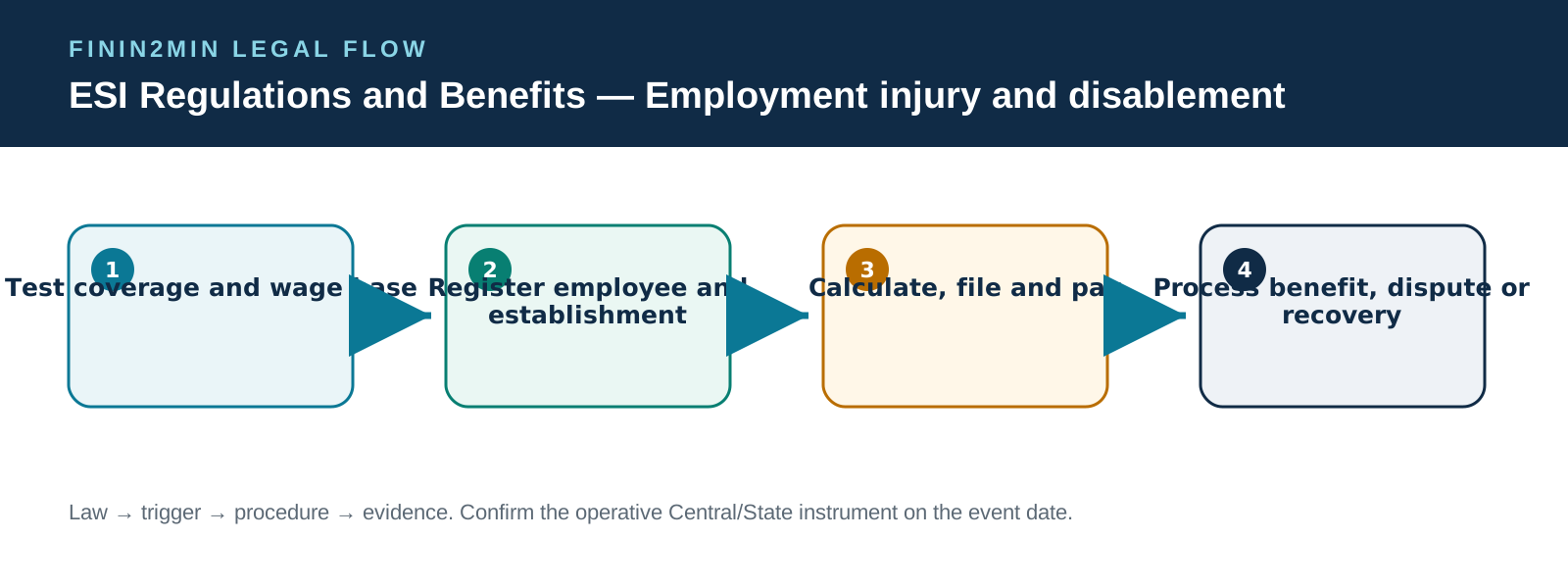
Decision flow
Official source
Finin2min Summary - Chapter in 2 Minutes
This chapter turns employment injury and disablement into an operational control file. It covers Disablement Medical Board; the practical sequence is to classify coverage and event date, apply the provision and mapped Rule, complete the form/register, calculate the entitlement or exposure, and retain evidence for inspection, claim or appeal.
Who is covered
Factories and establishments, insured persons, employers, dependants and ESIC authorities must identify coverage, wage/contribution periods and benefit eligibility.
Main obligations and rights
- Disablement Medical Board
Key thresholds and timelines
- Use only the threshold, rate and limitation period effective on the event date; verify the Central/State instrument before acting.
Forms, registers and evidence
- Register
- Return
- Nomination
- Retain classification, calculation, approval, communication, acknowledgement and payment/filing proof.
Employer risk snapshot
Highest practical risks: coverage, contribution, accident reporting, certification or benefit-period errors.
Employee/worker remedy snapshot
Core protection: medical and cash benefits, employment-injury protection and access to ESIC/Employees Insurance Court remedies. Confirm the authority, limitation and appeal route stated in this chapter.
Old law / transition
Apply the instrument effective on the event date and preserve any accrued right, saved notification, pending proceeding or scheme-specific transition.
Five-point professional checklist
- Freeze the event date, establishment, location and person/worker classification.
- Identify the controlling section/paragraph, mapped Rule, notification and appropriate Government.
- Reperform the calculation or decision test and document every exception or approval.
- Complete the prescribed form/register/portal step and retain acknowledgement, payment and communication evidence.
- Record the remedy, forum, limitation, appeal path and State variation before sign-off.
Finin2min takeaway: for employment injury and disablement, the defensible answer is not a policy label - it is the event-date law, the mapped procedure, the calculation and a complete evidence trail.
Disablement Medical Board
Finin2min implementation decode
Following a workplace event, the incident controller first protects life and the site, then completes statutory reporting, evidence preservation, medical documentation, contractor allocation and root-cause action without waiting for a compensation dispute.
- Identify actor, trigger, threshold and territorial authority.
- Map form, record, portal, fee and due date.
- Separate substantive entitlement from procedure, remedy and penal consequence.
- Retain the official instrument and event-date evidence.
Forms, records, portal and due-date control
| Control | Evidence |
|---|---|
| Coverage and registration | Entity, location, headcount/category, registration number and portal acknowledgement. |
| Recurring compliance | Attendance/service, wage/benefit calculation, return/register, payment and employee communication. |
| Event compliance | Complaint, injury, termination, nomination, claim, inspection or dispute file with limitation diary. |
Employer, employee and professional checklists
Employer
- Assign responsible officer and backup.
- Configure HRIS/payroll/portal controls.
- Complete statutory communication and retain proof.
Employee/worker
- Retain contract, identity, attendance, payment and correspondence.
- Use the prescribed complaint/claim route within limitation.
Professional
- Confirm current text, Rules, notification and State variation.
- Reconcile calculation, form, authority, remedy and evidence.
Penalties, remedies, appeals and limitation
Create a remedy matrix rather than one combined conclusion: entitlement or arrears; interest/damages; administrative order; civil penalty; prosecution; compounding; company/officer liability; claim forum; appeal; writ/judicial review; and event-date limitation.
Case-law principles
| Decision | Current-use principle |
|---|---|
| ESIC v. Ramanuja Match Industries | Coverage provisions receive a beneficial construction, but statutory thresholds and factual control remain essential. |
| Royal Talkies v. ESIC | Employees connected with establishment operations may be covered despite contractual arrangements, depending on the statutory control test. |
State variation alert
Verify the appropriate Government and final State instrument. State forms, authorities, fees, rates and portal routes must be maintained in the location compliance register.
Finin2min Q&A
Which law and version should be applied?
Use the current text of ESI Regulations and Benefits, the commencement notification, the applicable Central or State Rules and any later instrument effective on the event date.
How is the appropriate Government identified?
Classify ownership/control, sector, establishment and contractor relationship before selecting the Central or State authority.
Can a company policy override the statutory protection?
No. A policy may improve a benefit or control, but it cannot contract out of a mandatory statutory floor.
What evidence should be retained?
Retain the classification memo, source instrument, form/portal record, calculation, approval, employee communication, acknowledgement and payment or authority proof.
Do the Central Rules apply to every establishment?
No. They govern the Central sphere. State Rules and State notifications must be checked where the State is the appropriate Government.
How should a historical event be tested?
Apply the law and subordinate instrument effective on the event date, then use the repeal-and-savings provision for pending rights and proceedings.
What happens when portal practice conflicts with the statute?
Record the conflict, follow the higher legal instrument, seek authority clarification where necessary and preserve screenshots and correspondence.
Can criminal and monetary consequences arise together?
They may. Separate wages/benefits, interest, damages, civil penalty, prosecution, compounding and director/officer liability.
Is a contractor arrangement enough to shift liability?
No. Principal-employer and contractor liabilities depend on the specific provision and facts; the contract should allocate evidence and recovery without diluting worker rights.
What is the first professional review step?
Freeze the event date and facts, identify the applicable provision, then map Rules, forms, notification status, authority, limitation and evidence.
What is the operational focus of section 1 - disablement-medical-board?
The section must be decomposed into actor, trigger, threshold, procedure, exception, consequence and evidence. Read the full official text and the mapped Rules before applying the Finin2min control summary.
What is review control 12 for this chapter?
Confirm source currency, State variation, internal ownership, documentary proof and the next statutory deadline before closing the compliance ticket.
What is review control 13 for this chapter?
What is review control 14 for this chapter?
What is review control 15 for this chapter?
What is review control 16 for this chapter?
What is review control 17 for this chapter?
What is review control 18 for this chapter?
Practical examples and calculations
An injury occurs during employer-provided travel. Preserve route, timing, instructions, attendance, incident report, medical record and witness evidence before deciding whether the employment nexus test is met.
Calculation/control template: Control calculation: verified population or transaction base × applicable notified rate/amount × eligible period, adjusted for statutory inclusions, exclusions, ceilings, interest, compensation and prior payments. Reperform the calculation from retained source data.
Finin2min implementation explanation
Maintain a controlled implementation file for Part 4 - Employment injury and disablement: coverage and event date, operative Central/State instrument, responsible owner, approval and authority, form/portal step, due date, calculation basis, supporting evidence, exception, escalation and closure proof. Reconcile payroll, HR, finance, contractor and legal records before sign-off.
Practical transaction application
Use the chapter for coverage, registration, contribution periods, wage classification, accident reporting, sickness/maternity/disablement/dependants benefits, contractor compliance and claims management.
Authority, consent and execution controls
Map employer, principal employer, immediate employer, authorised branch officer and medical/benefit authority. Contract terms do not remove principal-employer exposure where the statute places responsibility on it.
Stamp duty and registration alerts
ESI registrations and returns are regulatory records, not substitutes for stamping of service, contractor, lease or settlement instruments under State law.
Evidence and document-retention checklist
Retain the operative law/rule version, classification note, approvals, signed instruments, statutory forms, portal acknowledgements, registers, calculations, bank proof, correspondence, inspection records, service proof, decision and appeal file. Apply the longer of the statutory retention rule, litigation hold, tax/audit need and contractual requirement; restrict access to personal and sensitive data.
Performance, delivery and payment controls
Reconcile insured-person records, contribution file, challan, bank debit, attendance, accident report, medical certificate and benefit claim. Escalate identity, wage and contribution mismatches before the benefit window closes.
Breach, loss, mitigation and remedy framework
On detecting a breach, stop continuing exposure, preserve evidence, quantify employee and government dues, identify affected persons, make lawful corrective payment/filing, notify the authorised decision-maker, assess self-disclosure or compounding where available, and reserve contractual recovery against responsible vendors without delaying statutory remediation.
Limitation and forum controls
Use the Employees’ Insurance Court and statutory appeal/recovery framework where applicable. Track contribution, accident, benefit rejection and order-service dates separately.
Arbitration and mediation interface
Employer-contractor allocation may be mediated or arbitrated, but statutory contributions, employee benefits and Corporation powers remain outside private waiver.
Company, partnership, GST and tax overlays
For a company, align board/delegation and officer-in-default controls; for an LLP or partnership, identify the designated partner/partner and authorised employer representative. Labour dues can affect transaction price, indemnities, director/partner exposure and insolvency claims. Salary/TDS, perquisite, contractor TDS, GST on outsourced services and accounting provisions must be reconciled without treating tax treatment as proof of labour-law classification.