Finin2min Summary - Chapter in 2 Minutes
This chapter turns minimum wages, floor wage, hours and overtime into an operational control file. It covers Legal status and reading protocol, Payment of minimum rate of wages, Fixation of minimum wages, Components of minimum wages; the practical sequence is to classify coverage and event date, apply the provision and mapped Rule, complete the form/register, calculate the entitlement or exposure, and retain evidence for inspection, claim or appeal.
Who is covered
Employers, employees, workers, contractors and payroll teams must first identify the appropriate Government, employment category and event date.
Main obligations and rights
- Legal status and reading protocol
- Section 5: Payment of minimum rate of wages
- Section 6: Fixation of minimum wages
- Section 7: Components of minimum wages
- Section 8: Procedure for fixing and revising minimum wages
- Section 9: Power of Central Government to fix floor wage
Key thresholds and timelines
- Use only the threshold, rate and limitation period effective on the event date; verify the Central/State instrument before acting.
Forms, registers and evidence
- Form I
- Form IV
- Form IX
- Form V
- Form II
- Retain classification, calculation, approval, communication, acknowledgement and payment/filing proof.
Employer risk snapshot
Highest practical risks: wrong wage base, late payment, unauthorised deduction or incomplete payroll evidence.
Employee/worker remedy snapshot
Core protection: timely and lawful wage payment, a transparent wage slip and a claims route for short-payment or unlawful deduction. Confirm the authority, limitation and appeal route stated in this chapter.
Old law / transition
Apply the instrument effective on the event date and preserve any accrued right, saved notification, pending proceeding or scheme-specific transition.
Five-point professional checklist
- Freeze the event date, establishment, location and person/worker classification.
- Identify the controlling section/paragraph, mapped Rule, notification and appropriate Government.
- Reperform the calculation or decision test and document every exception or approval.
- Complete the prescribed form/register/portal step and retain acknowledgement, payment and communication evidence.
- Record the remedy, forum, limitation, appeal path and State variation before sign-off.
Finin2min takeaway: for minimum wages, floor wage, hours and overtime, the defensible answer is not a policy label - it is the event-date law, the mapped procedure, the calculation and a complete evidence trail.
Legal status and reading protocol
The Code on Wages was enacted on 8 August 2019. The complete operational position must be read with S.O. 4604(E), S.O. 5322(E), the Code on Wages (Central) Rules, 2026 notified as G.S.R. 343(E), State Rules where the State Government is the appropriate Government, and current rate/authority notifications.
Text control: the statutory blocks below reproduce the current English text used for this edition from the official India Code consolidated PDF. Gazette footnotes are summarised in the effective-date table. The official PDF/Gazette prevails if a typographical discrepancy is found.
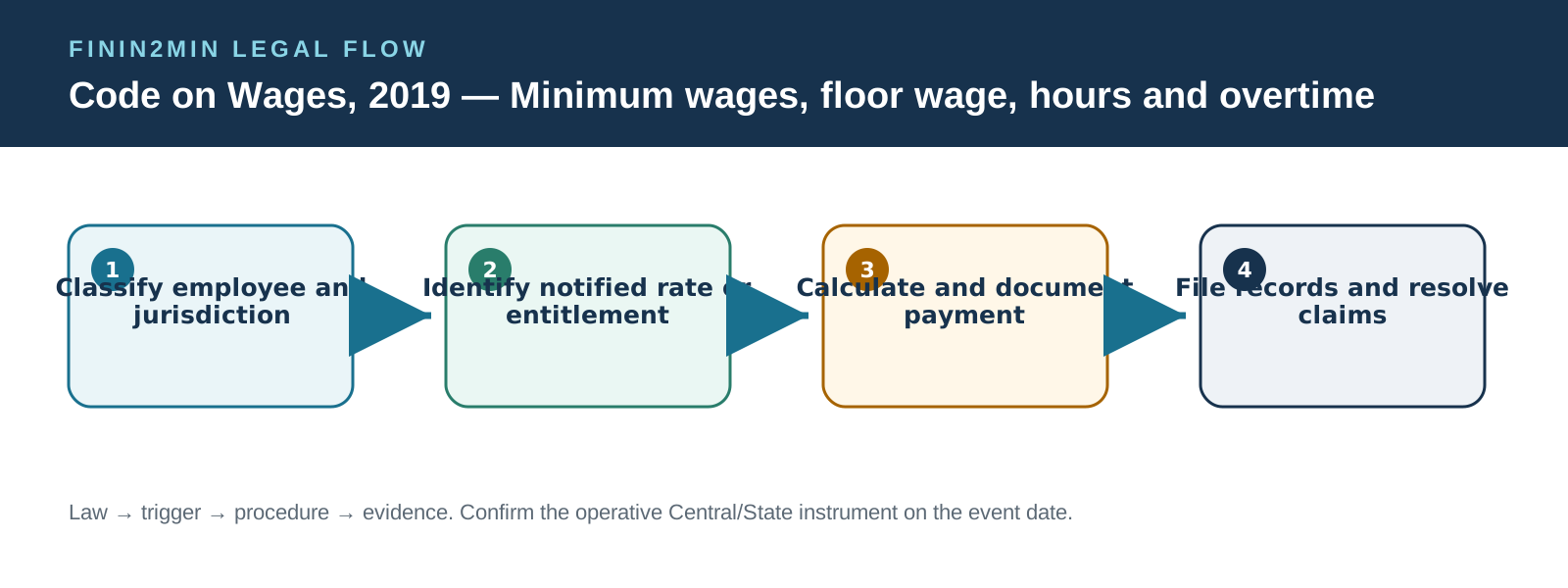
Chapter decision flow
Section 5: Payment of minimum rate of wages
Current statutory text
5. Payment of minimum rate of wages.—No employer shall pay to any employee wages less than
the minimum rate of wages notified by the appropriate Government.
No employer shall pay to any employee wages less than the minimum rate of wages notified by the appropriate Government.
Finin2min clause-by-clause decode
The notified minimum rate is a hard wage floor. Contract terms, consent or internal salary bands cannot authorise a lower payment.
Applicability
Every employee and establishment covered by the relevant Central or State minimum-wage notification.
Trigger and conditions
- Identify appropriate Government and scheduled/category mapping.
- Select skill level, occupation and zone.
- Apply current VDA and effective date.
Practical example / calculation
If the applicable notified monthly minimum is ₹18,900 including current VDA, a contract promising ₹18,000 cannot reduce the statutory entitlement. The ₹900 shortfall and consequential arrears remain payable.
Employer, employee and professional controls
- Maintain a location–category–skill wage matrix.
- Reconcile payroll monthly against current notifications.
- Block below-floor salary changes in HRIS.
Consequences, remedy and evidence
Employer exposure
Shortfall, arrears, compensation, inspection findings and downstream adjudication/offence exposure may arise. The precise consequence must be mapped to sections 45 and 51–56.
Employee route
Preserve appointment terms, rate notification, attendance, wage slip and bank proof. Claims are routed through the authority under section 45; appeals proceed under section 49.
Professional evidence
Retain classification memo, notification version, payroll calculation, approval trail, exception log and remediation proof.
Primary text: India Code consolidated Code on Wages, 2019, reviewed 2026-07-18. Rule text: G.S.R. 343(E), 8 May 2026. The signed Gazette prevails over extraction artefacts.
Section 6: Fixation of minimum wages
Current statutory text
6. Fixation of minimum wages.—(1) Subject to the provisions of section 9, the appropriate
Government shall fix the minimum rate of wages payable to employees in accordance with the provisions
of section 8.

    (2) For the purposes of sub-section (1), the appropriate Government shall fix a minimum rate of
wages—

        (a) for time work; or

        (b) for piece work.

    (3) Where employees are employed on piece work, for the purpose of sub-section (1), the appropriate
Government shall fix a minimum rate of wages for securing such employees a minimum rate of wages on
a time work basis.

    (4) The minimum rate of wages on time work basis may be fixed in accordance with any one or more
of the following wage periods, namely:—

               (i) by the hour; or

                (ii) by the day; or

                (iii) by the month.

    (5) Where the rates of wages are fixed by the hour or by the day or by the month, the manner of
calculating the wages shall be such, as may be prescribed.

    (6) For the purpose of fixation of minimum rate of wages under this section, the appropriate
Government,—

          (a) shall primarily take into account the skill of workers required for working under the
      categories of unskilled, skilled, semi-skilled and highly-skilled or geographical area or both; and

          (b) may, in addition to such minimum rate of wages for certain category of workers, take into
      account  their arduousness of work  like temperature or humidity normally  difficult  to bear,
     hazardous  occupations  or  processes  or  underground work  as may be  prescribed by  that
     Government; and

           (c) the norms of such fixation of minimum rate of wages shall be such as may be prescribed.

    (7) The number of minimum rates of wages referred to in sub-section (6) may, as far as possible, be
kept at minimum by the appropriate Government.
(1) Subject to the provisions of section 9, the appropriate Government shall fix the minimum rate of wages payable to employees in accordance with the provisions of section 8.
(2) For the purposes of sub-section (1), the appropriate Government shall fix a minimum rate of wages—
(a) for time work; or
(b) for piece work.
(3) Where employees are employed on piece work, for the purpose of sub-section (1), the appropriate Government shall fix a minimum rate of wages for securing such employees a minimum rate of wages on a time work basis.
(4) The minimum rate of wages on time work basis may be fixed in accordance with any one or more of the following wage periods, namely:—
(i) by the hour; or
(ii) by the day; or
(iii) by the month.
(5) Where the rates of wages are fixed by the hour or by the day or by the month, the manner of calculating the wages shall be such, as may be prescribed.
(6) For the purpose of fixation of minimum rate of wages under this section, the appropriate Government,—
(a) shall primarily take into account the skill of workers required for working under the categories of unskilled, skilled, semi-skilled and highly-skilled or geographical area or both; and
(b) may, in addition to such minimum rate of wages for certain category of workers, take into account their arduousness of work like temperature or humidity normally difficult to bear, hazardous occupations or processes or underground work as may be prescribed by that Government; and
(c) the norms of such fixation of minimum rate of wages shall be such as may be prescribed.
(7) The number of minimum rates of wages referred to in sub-section (6) may, as far as possible, be kept at minimum by the appropriate Government.
Finin2min clause-by-clause decode
The appropriate Government fixes time and piece rates. Classification should primarily reflect skill and geography and may also reflect arduousness and hazardous conditions.
Applicability
Every wage category notified by the appropriate Government.
Trigger and conditions
- Classify time or piece work.
- Apply skill and geographical category.
- Apply arduousness/hazard additions where notified.
- Use Rule 3 for day/hour/month conversion in the Central sphere.
Practical example / calculation
Under Central Rule 3, a notified daily rate of ₹800 converts to ₹100 per hour (₹800 ÷ 8) and ₹20,800 per month (₹800 × 26), subject to the Rule’s rounding convention.
Employer, employee and professional controls
- Document category evidence.
- Test rounding in payroll.
- Do not use a lower internal hourly divisor.
Rule 3: Manner of calculating minimum rate of wages
3. Manner of calculating minimum rate of wages.–(1) For the purposes of sub-section (5) of section 6, the minimum rate of wages shall be fixed by the day basis keeping in view the criteria which shall be separately specified by the Central Government by special or general order:
Provided that the Central Government shall not fix the minimum wages of the Central Government employees under this Code.
(2) Where the rate of wages for a day is fixed, such amount shall be divided by eight for fixing the rate of wages for an hour and multiplied by twenty six for fixing the rate of wages for a month and in such
division and multiplication the factors of one-half and more than one-half shall be rounded as next figure and the factors less than one-half shall be ignored.
(3) In case there is less than six days working week, the hourly rate of minimum wages so calculated shall be used to derive the minimum wages for the day.
Official source: Code on Wages (Central) Rules, 2026, G.S.R. 343(E), 8 May 2026.
Consequences, remedy and evidence
Employer exposure
Shortfall, arrears, compensation, inspection findings and downstream adjudication/offence exposure may arise. The precise consequence must be mapped to sections 45 and 51–56.
Employee route
Preserve appointment terms, rate notification, attendance, wage slip and bank proof. Claims are routed through the authority under section 45; appeals proceed under section 49.
Professional evidence
Retain classification memo, notification version, payroll calculation, approval trail, exception log and remediation proof.
Primary text: India Code consolidated Code on Wages, 2019, reviewed 2026-07-18. Rule text: G.S.R. 343(E), 8 May 2026. The signed Gazette prevails over extraction artefacts.
Section 7: Components of minimum wages
Current statutory text
7.  Components of minimum wages.—(1) Any minimum rate of wages fixed or revised by the
appropriate Government under section 8 may consist of—

        (a) a basic rate of wages and an allowance at a rate to be adjusted, at such intervals and in such
   manner as the appropriate Government may direct, to accord as nearly as practicable with the
    variation in the cost of living index number applicable to such workers (hereinafter referred to as
    “cost of living allowance”); or


        (b) a basic rate of wages with or without the cost of living allowance, and the cash value of the
    concessions in respect of supplies of essential commodities at concession rates, where so authorised;
    or

         (c) an all-inclusive rate allowing for the basic rate, the cost of living allowance and the cash value
    of the concessions, if any.

    (2) The cost of living allowance and the cash value of the concessions in respect of supplies of
essential commodities  at concession rate shall be computed by such authority, as the appropriate
Government may by notification, appoint, at such intervals and in accordance with such directions as may
be specified or given by the appropriate Government from time to time.
(1) Any minimum rate of wages fixed or revised by the appropriate Government under section 8 may consist of—
(a) a basic rate of wages and an allowance at a rate to be adjusted, at such intervals and in such manner as the appropriate Government may direct, to accord as nearly as practicable with the variation in the cost of living index number applicable to such workers (hereinafter referred to as “cost of living allowance”); or
(b) a basic rate of wages with or without the cost of living allowance, and the cash value of the concessions in respect of supplies of essential commodities at concession rates, where so authorised; or
(c) an all-inclusive rate allowing for the basic rate, the cost of living allowance and the cash value of the concessions, if any.
(2) The cost of living allowance and the cash value of the concessions in respect of supplies of essential commodities at concession rate shall be computed by such authority, as the appropriate Government may by notification, appoint, at such intervals and in accordance with such directions as may be specified or given by the appropriate Government from time to time.
Finin2min clause-by-clause decode
A minimum wage can be structured as basic plus cost-of-living allowance, basic plus concessions, or an all-inclusive rate. The notified computation authority and interval govern VDA/cash-value updates.
Applicability
Where a minimum-wage notification uses basic, VDA or concession components.
Trigger and conditions
- Read the notification’s component structure.
- Apply the latest cost-of-living index period.
- Use the appointed authority’s computation.
Practical example / calculation
Where the notification states basic ₹14,000 plus VDA ₹2,400, payroll must update the VDA on the operative cycle and cannot treat the basic component alone as the minimum wage.
Employer, employee and professional controls
- Retain CPI/VDA source and effective-date evidence.
- Separate arrears caused by retrospective VDA revisions.
- Do not freeze VDA beyond the notified cycle.
Rule 4: Interval for revision of variable dearness allowance
4. Interval for revision of variable dearness allowance.- The cost of living allowance and the cash value of the concession in respect of essential commodities at concession rate shall be computed once before 1st April and then before 1st October in every year to revise the variable dearness allowance payable to the employees on the minimum wages considering the Average Consumer Price Index Number for Industrial Workers published by the Labour Bureau, Ministry of Labour and Employment, Government of India.
Official source: Code on Wages (Central) Rules, 2026, G.S.R. 343(E), 8 May 2026.
Consequences, remedy and evidence
Employer exposure
Shortfall, arrears, compensation, inspection findings and downstream adjudication/offence exposure may arise. The precise consequence must be mapped to sections 45 and 51–56.
Employee route
Preserve appointment terms, rate notification, attendance, wage slip and bank proof. Claims are routed through the authority under section 45; appeals proceed under section 49.
Professional evidence
Retain classification memo, notification version, payroll calculation, approval trail, exception log and remediation proof.
Primary text: India Code consolidated Code on Wages, 2019, reviewed 2026-07-18. Rule text: G.S.R. 343(E), 8 May 2026. The signed Gazette prevails over extraction artefacts.
Section 8: Procedure for fixing and revising minimum wages
Current statutory text
8. Procedure for fixing and revising minimum wages.—(1) In fixing minimum rates of wages for
the first time or in revising minimum rates of wages under this Code, the appropriate Government shall
either—

        (a) appoint as many committees as it considers necessary to hold enquiries and recommend in
    respect of such fixation or revision, as the case may be; or

        (b) by notification publish its proposals for the information of persons likely to be affected
    thereby and specify a date not less than two months from the date of the notification on which the
    proposals shall be taken into consideration.

    (2) Every committee appointed by the appropriate Government under clause (a) of sub-section (1)
shall consist of persons—

        (a) representing employers;

        (b) representing employees which shall be equal in number of the members specified in clause
     (a); and

         (c) independent persons, not exceeding one-third of the total members of the committee.

    (3) After considering the recommendation of the committee appointed under clause (a) of sub-section
(1) or, as the case may be, all representations received by it before the date specified in the notification
under clause (b) of that sub-section, the appropriate Government shall by notification fix, or as the case
may be, revise the minimum rates of wages and unless such notification otherwise provides, it shall come
into force on the expiry of three months from the date of its issue:

    Provided that where the appropriate Government proposes to revise the minimum rates of wages in
the manner specified in clause (b) of sub-section (1), it shall also consult concerned Advisory Board
constituted under section 42.

    (4) The appropriate Government shall review or revise minimum rates of wages ordinarily at an
interval not exceeding five years.
(1) In fixing minimum rates of wages for the first time or in revising minimum rates of wages under this Code, the appropriate Government shall either—
(a) appoint as many committees as it considers necessary to hold enquiries and recommend in respect of such fixation or revision, as the case may be; or
(b) by notification publish its proposals for the information of persons likely to be affected thereby and specify a date not less than two months from the date of the notification on which the proposals shall be taken into consideration.
(2) Every committee appointed by the appropriate Government under clause (a) of sub-section (1) shall consist of persons—
(a) representing employers;
(b) representing employees which shall be equal in number of the members specified in clause (a); and
(c) independent persons, not exceeding one-third of the total members of the committee.
(3) After considering the recommendation of the committee appointed under clause (a) of sub-section (1) or, as the case may be, all representations received by it before the date specified in the notification under clause (b) of that sub-section, the appropriate Government shall by notification fix, or as the case may be, revise the minimum rates of wages and unless such notification otherwise provides, it shall come into force on the expiry of three months from the date of its issue:
Provided that where the appropriate Government proposes to revise the minimum rates of wages in the manner specified in clause (b) of sub-section (1), it shall also consult concerned Advisory Board constituted under section 42.
(4) The appropriate Government shall review or revise minimum rates of wages ordinarily at an interval not exceeding five years.
Finin2min clause-by-clause decode
Minimum-wage fixation may follow a committee route or a proposal-and-objection route. The final notification ordinarily becomes effective after three months unless it says otherwise, and rates should ordinarily be reviewed within five years.
Applicability
Government fixation/revision process and affected employers/employees.
Trigger and conditions
- Identify route used.
- For proposal route, confirm at least two months for representations.
- Read final notification for effective date.
- Track five-year ordinary review cycle.
Practical example / calculation
A proposal published on 1 July cannot specify a representation cut-off earlier than the statutory minimum two-month window. Payroll changes arise from the final notification and its effective-date clause, not from the proposal itself.
Employer, employee and professional controls
- Calendar draft and final notifications.
- File representations with evidence where relevant.
- Do not apply draft proposals as law.
Consequences, remedy and evidence
Employer exposure
Shortfall, arrears, compensation, inspection findings and downstream adjudication/offence exposure may arise. The precise consequence must be mapped to sections 45 and 51–56.
Employee route
Preserve appointment terms, rate notification, attendance, wage slip and bank proof. Claims are routed through the authority under section 45; appeals proceed under section 49.
Professional evidence
Retain classification memo, notification version, payroll calculation, approval trail, exception log and remediation proof.
Primary text: India Code consolidated Code on Wages, 2019, reviewed 2026-07-18. Rule text: G.S.R. 343(E), 8 May 2026. The signed Gazette prevails over extraction artefacts.
Section 9: Power of Central Government to fix floor wage
Current statutory text
9. Power of Central Government to fix floor wage.—(1) The Central Government shall fix floor
wage taking into account minimum living standards of a worker in such manner as may be prescribed:

    Provided that different floor wage may be fixed for different geographical areas.

    (2) The minimum rates of wages fixed by the appropriate Government under section 6 shall not be
less than the floor wage and if the minimum rates of wages fixed by the appropriate Government earlier is
more than the floor wage, then, the appropriate Government shall not reduce such minimum rates of
wages fixed by it earlier.

    (3) The Central Government may, before fixing the floor wage under sub-section (1), obtain the
advice of the Central Advisory Board constituted under sub-section (1) of section 42 and consult State
Governments in such manner as may be prescribed.
(1) The Central Government shall fix floor wage taking into account minimum living standards of a worker in such manner as may be prescribed:
Provided that different floor wage may be fixed for different geographical areas.
(2) The minimum rates of wages fixed by the appropriate Government under section 6 shall not be less than the floor wage and if the minimum rates of wages fixed by the appropriate Government earlier is more than the floor wage, then, the appropriate Government shall not reduce such minimum rates of wages fixed by it earlier.
(3) The Central Government may, before fixing the floor wage under sub-section (1), obtain the advice of the Central Advisory Board constituted under sub-section (1) of section 42 and consult State Governments in such manner as may be prescribed.
Finin2min clause-by-clause decode
The Central Government sets a floor wage based on minimum living standards. State or Central minimum rates cannot fall below it, and a previously higher rate cannot be reduced merely because the floor is lower.
Applicability
All appropriate Governments when fixing minimum wages; employers indirectly through the notified rates.
Trigger and conditions
- Locate current floor-wage instrument.
- Compare applicable minimum wage with floor wage.
- Preserve higher existing minimum rate.
Practical example / calculation
If the floor wage is ₹16,000 and a State rate is already ₹18,500, the State rate cannot be reduced to ₹16,000 merely because that is the floor.
Employer, employee and professional controls
- Maintain floor-vs-notified-rate exception report.
- Treat geographic floor wage separately where notified.
Consequences, remedy and evidence
Employer exposure
Shortfall, arrears, compensation, inspection findings and downstream adjudication/offence exposure may arise. The precise consequence must be mapped to sections 45 and 51–56.
Employee route
Preserve appointment terms, rate notification, attendance, wage slip and bank proof. Claims are routed through the authority under section 45; appeals proceed under section 49.
Professional evidence
Retain classification memo, notification version, payroll calculation, approval trail, exception log and remediation proof.
Primary text: India Code consolidated Code on Wages, 2019, reviewed 2026-07-18. Rule text: G.S.R. 343(E), 8 May 2026. The signed Gazette prevails over extraction artefacts.
Section 10: Wages of employee who works for less than normal working day
Current statutory text
10. Wages of employee who works for less than normal working day.—If an employee whose
minimum rate of wages has been fixed under this Code by the day works on any day on which he was
employed for a period of less than the requisite number of hours constituting a normal working day, he
shall, save as otherwise hereinafter provided, be entitled to receive wages in respect of work done on that
day, as if he had worked for a full normal working day:


    Provided that he shall not be entitled to receive wages for a full normal working day, —

     (i) in any case where his failure to work is caused by his unwillingness to work and not by the
omission of the employer to provide him with work; and

     (ii) in such other cases and circumstances, as may be prescribed.
If an employee whose minimum rate of wages has been fixed under this Code by the day works on any day on which he was employed for a period of less than the requisite number of hours constituting a normal working day, he shall, save as otherwise hereinafter provided, be entitled to receive wages in respect of work done on that day, as if he had worked for a full normal working day:
Provided that he shall not be entitled to receive wages for a full normal working day,—
(i) in any case where his failure to work is caused by his unwillingness to work and not by the omission of the employer to provide him with work; and
(ii) in such other cases and circumstances, as may be prescribed.
Finin2min clause-by-clause decode
A day-rated employee generally receives the full daily minimum wage if the employer fails to provide a full normal day. The protection does not apply where the employee was unwilling to work or another prescribed exception applies.
Applicability
Day-rated minimum-wage employees who work less than the normal daily hours.
Trigger and conditions
- Confirm employee reported and was willing to work.
- Identify who caused the shortfall.
- Check prescribed exceptions.
Practical example / calculation
A day-rated employee reports for an eight-hour shift, but the employer provides only four hours of work due to machine breakdown. Subject to the statutory exceptions, the full daily minimum wage remains protected.
Employer, employee and professional controls
- Record reporting time, work allocation and downtime cause.
- Do not auto-prorate employer-caused idle time.
Consequences, remedy and evidence
Employer exposure
Shortfall, arrears, compensation, inspection findings and downstream adjudication/offence exposure may arise. The precise consequence must be mapped to sections 45 and 51–56.
Employee route
Preserve appointment terms, rate notification, attendance, wage slip and bank proof. Claims are routed through the authority under section 45; appeals proceed under section 49.
Professional evidence
Retain classification memo, notification version, payroll calculation, approval trail, exception log and remediation proof.
Primary text: India Code consolidated Code on Wages, 2019, reviewed 2026-07-18. Rule text: G.S.R. 343(E), 8 May 2026. The signed Gazette prevails over extraction artefacts.
Section 11: Wages for two or more classes of work
Current statutory text
11. Wages for two or more classes of work.—Where an employee does two or more classes of work
to each of which a different minimum rate of wages is applicable, the employer shall pay to such
employee in respect of the time respectively occupied in each such class of work, wages at not less than
the minimum rate in force in respect of each such class.
Where an employee does two or more classes of work to each of which a different minimum rate of wages is applicable, the employer shall pay to such employee in respect of the time respectively occupied in each such class of work, wages at not less than the minimum rate in force in respect of each such class.
Finin2min clause-by-clause decode
Where one employee performs multiple classes of work carrying different rates, wages must be allocated by the time spent in each class.
Applicability
Multi-skilled or mixed-duty employees.
Trigger and conditions
- Identify each class and rate.
- Record time in each class.
- Pay at least the applicable rate for each period.
Practical example / calculation
An employee spends five hours on skilled electrical work and three hours on semi-skilled packing. Time must be recorded and each block paid at not less than its applicable rate.
Employer, employee and professional controls
- Use task/time coding.
- Avoid averaging that underpays a higher-rated activity.
Consequences, remedy and evidence
Employer exposure
Shortfall, arrears, compensation, inspection findings and downstream adjudication/offence exposure may arise. The precise consequence must be mapped to sections 45 and 51–56.
Employee route
Preserve appointment terms, rate notification, attendance, wage slip and bank proof. Claims are routed through the authority under section 45; appeals proceed under section 49.
Professional evidence
Retain classification memo, notification version, payroll calculation, approval trail, exception log and remediation proof.
Primary text: India Code consolidated Code on Wages, 2019, reviewed 2026-07-18. Rule text: G.S.R. 343(E), 8 May 2026. The signed Gazette prevails over extraction artefacts.
Section 12: Minimum time rate wages for piece work
Current statutory text
12. Minimum time rate wages for piece work.—Where a person is employed on piece work for
which minimum time rate and not a minimum piece rate has been fixed under this Code, the employer
shall pay to such person wages at not less than the minimum time rate.
Where a person is employed on piece work for which minimum time rate and not a minimum piece rate has been fixed under this Code, the employer shall pay to such person wages at not less than the minimum time rate.
Finin2min clause-by-clause decode
A piece worker remains protected by the minimum time rate where no piece rate has been fixed.
Applicability
Piece-rate work covered by a time-rate minimum wage but no notified piece rate.
Trigger and conditions
- Measure hours/time period.
- Calculate minimum time-rate entitlement.
- Compare with piece earnings and pay the higher protected amount.
Practical example / calculation
A piece worker earns ₹620 from output during an eight-hour day, while the protected time-rate minimum is ₹800. The employer must make up the ₹180 shortfall.
Employer, employee and professional controls
- Run time-rate floor reconciliation each wage period.
Consequences, remedy and evidence
Employer exposure
Shortfall, arrears, compensation, inspection findings and downstream adjudication/offence exposure may arise. The precise consequence must be mapped to sections 45 and 51–56.
Employee route
Preserve appointment terms, rate notification, attendance, wage slip and bank proof. Claims are routed through the authority under section 45; appeals proceed under section 49.
Professional evidence
Retain classification memo, notification version, payroll calculation, approval trail, exception log and remediation proof.
Primary text: India Code consolidated Code on Wages, 2019, reviewed 2026-07-18. Rule text: G.S.R. 343(E), 8 May 2026. The signed Gazette prevails over extraction artefacts.
Section 13: Fixing hours of work for normal working day
Current statutory text
13. Fixing hours of work for normal working day.—(1) Where the minimum rates of wages have
been fixed under this Code, the appropriate Government may—

        (a) fix the number of hours of work which shall constitute a normal working day inclusive of one
    or more specified intervals;

        (b) provide for a day of rest in every period of seven days which shall be allowed to  all
   employees or to any specified class of employees and for the payment of remuneration in respect of
    such days of rest;

         (c) provide for payment for work on a day of rest at a rate not less than the overtime rate.

    (2) The provisions of sub-section (1) shall, in relation to the following classes of employees apply,
only to such extent and subject to such conditions as may be prescribed, namely:—

        (a) employees engaged in any emergency which could not have been foreseen or prevented;

        (b) employees engaged in work of the nature of preparatory or complementary work which must
    necessarily be carried on outside the limits laid down for the general working in the employment
    concerned;

         (c) employees whose employment is essentially intermittent;

        (d) employees engaged in any work which for technical reasons has to be completed before the
    duty is over; and

         (e) employees engaged in a work which could not be carried on except at times dependent on the
    irregular action of natural forces.

    (3) For the purposes of clause (c) of sub-section (2), employment of an employee is essentially
intermittent when it is declared to be so by the appropriate Government on the ground that the daily hours
of duty of the employee, or if there be no daily hours of duty as such for the employee, the hours of duty
normally include periods of inaction during which the employee may be on duty but is not called upon to
display either physical activity or sustained attention.
(1) Where the minimum rates of wages have been fixed under this Code, the appropriate Government may—
(a) fix the number of hours of work which shall constitute a normal working day inclusive of one or more specified intervals;
(b) provide for a day of rest in every period of seven days which shall be allowed to all employees or to any specified class of employees and for the payment of remuneration in respect of such days of rest;
(c) provide for payment for work on a day of rest at a rate not less than the overtime rate.
(2) The provisions of sub-section (1) shall, in relation to the following classes of employees apply, only to such extent and subject to such conditions as may be prescribed, namely:—
(a) employees engaged in any emergency which could not have been foreseen or prevented;
(b) employees engaged in work of the nature of preparatory or complementary work which must necessarily be carried on outside the limits laid down for the general working in the employment concerned;
(c) employees whose employment is essentially intermittent;
(d) employees engaged in any work which for technical reasons has to be completed before the duty is over; and
(e) employees engaged in a work which could not be carried on except at times dependent on the irregular action of natural forces.
(3) For the purposes of clause (c) of sub-section (2), employment of an employee is essentially intermittent when it is declared to be so by the appropriate Government on the ground that the daily hours of duty of the employee, or if there be no daily hours of duty as such for the employee, the hours of duty normally include periods of inaction during which the employee may be on duty but is not called upon to display either physical activity or sustained attention.
Finin2min clause-by-clause decode
The appropriate Government may define the normal day, weekly rest and rest-day remuneration. Prescribed exceptions apply to emergencies, preparatory work, intermittent work, technically continuous work and work dependent on natural forces.
Applicability
Employees whose minimum rate has been fixed; Central Rule 5 supplies 8-hour/day and 48-hour/week architecture in the Central sphere.
Trigger and conditions
- Identify applicable hours notification and OSHWC interface.
- Schedule weekly rest.
- Classify any exception narrowly.
- Record rest-day substitution.
Practical example / calculation
A six-day Central-sphere schedule must align the eight-hour normal day, weekly rest and forty-eight-hour weekly ceiling, while separately checking the OSHWC rule on rest intervals.
Employer, employee and professional controls
- Time-system alerts for 8/48-hour limits.
- Weekly-rest dashboard.
- Exception approval and compensatory-rest record.
Rule 5: Hours of work for normal working day
5. Hours of work for normal working day. - (1) The number of hours of work which shall constitute normal working day for an employee whose wage period is on a daily basis shall be eight hours and interval for rest shall be in accordance with notification issued in this regard under Occupational Safety, Health and Working Conditions Code, 2020 (37 of 2020).
(2) The number of hours of work which shall constitute a normal working day for an employee whose wage period is other than on a daily basis shall be so fixed that the total number of weekly working hours shall not exceed forty-eight hours.
Official source: Code on Wages (Central) Rules, 2026, G.S.R. 343(E), 8 May 2026.
Rule 6: Weekly day of rest
6. Weekly day of rest.— (1) Subject to the provisions of this rule, an employee shall be allowed rest for one day in every week (hereinafter referred to as “the rest day”), in case of six-day working week which shall ordinarily be a Sunday and in case of less than six-days w o r k i n g week, t h e rest d a y shall include Saturday and Sunday, however, the employer may fix any other day of the week as the rest day for any employee or class of employees:
Provided that in a six-days working week or less than six days working week, as the case may be, the remaining days of the week shall be paid rest days for such employees:
Provided further that an employee shall be entitled for the rest day under this sub-rule, if he has worked under the same employer in case of six-days working week for a continuous period of not less than six days and in case of less than six-days working week for a continuous period of the stipulated number of working days, as the case may be:
Provided also that the employee shall be informed of the day fixed as the rest day and of any subsequent change in the rest day before the change is effected, by display of a notice to that effect at a conspicuous place in the place of employment or electronically.
Explanation.- For the purpose of computation of the continuous period of not less than six days or the stipulated number of days worked in a week specified in the second proviso to this sub-rule, (a) any day on which an employee is required to attend for work but is given only an allowance for attendance and is not provided with work; (b) any day on which an employee is laid off on payment of compensation under the Industrial Relations Code, 2020 (35 of 2020), and; (c) any leave or holiday, with or without pay, granted by the employer to an employee in the period of six days or during the stipulated number of working days of a week, as the case may
be, immediately preceding the rest days.
(2) An employee shall not be required or allowed to work on the rest day unless he is allowed a substituted rest day on one of the working days in a week immediately before or after the rest day:
Provided that no substitution shall be made, which shall result in the employee working for more than ten days consecutively without a rest day.
(3) Where any employee works on a rest day and has been given a substituted rest day on any working days before or after the rest day, the rest day shall, for the purposes of calculating the weekly hours of work, be included in the week in which the substituted rest day occurs.
(4) An employee shall be granted for rest day, wages calculated at the rate applicable to the previous working day; where he works on the rest day and has been given a substituted rest day, then, h e shall be paid wages for the rest day on which h e worked, at the overtime rate and wages for the substituted rest day at the rate applicable to the previous working day: Provided that in case of six-days working week where––– (i) the minimum rate of wages of the employee as notified under the Code has been worked out by dividing the minimum monthly rate of wages by twenty- six; or (ii) the actual daily rate of wages of the employee has been worked out by dividing the monthly rate of wages by twenty-six and such actual daily rate of wages is not less than the notified minimum daily rate of wages of the employee, then, no wages for the rest day shall be payable; and (iii) the employee works on the rest day and has been given a substituted rest day, then, the employee shall be paid, only for the rest day on which he worked, an amount equal to the wages payable at the overtime rate, which shall not be less than twice the normal rate of wages,
and, in case any dispute arises whether the daily rate of wages has been worked out in accordance with the provisions of this proviso, the Chief Labour Commissioner (Central) or the Deputy Chief Labour Commissioner (Central) having jurisdiction may, on application made in this behalf, decide the same, after giving an opportunity to the parties concerned to make written representations:
Provided further that in case of an employee governed by a piece-rate system, the employee shall be paid wages for the rest day on which he works, at the overtime rate and wages for the substituted rest day at the rate applicable to the previous working day.
Explanation.- For the purpose of this sub-rule, the words ‘previous working day’ means the last day on which the employee has worked, which precedes the rest day or the substituted rest day, as the case may be; and where the substituted rest day falls on a day immediately after the rest day, the previous working day means the last day on which the employee has worked, which precedes the rest day.
(5) The provisions of this rule shall not operate to the prejudice of more favourable terms, if any, to which an employee may be, entitled under any other law or under the terms of any award, agreement or contract of service, and in such a case, the employee shall be entitled only to more favorable terms.
Explanation.- For the purposes of this rule, the expression ‘week’ shall mean a period of seven days beginning at midnight on Saturday night.
Official source: Code on Wages (Central) Rules, 2026, G.S.R. 343(E), 8 May 2026.
Rule 7: Night shifts
7. Night shifts. —Where an employee works on a shift which extends beyond midnight, then, ––––
(i) a rest day for the whole day for the purposes of rule 6 shall, in this case means a period of twenty-four consecutive hours beginning from the time when his shift ends; and (ii) the following day in such a case shall be deemed to be the period of twenty-four hours beginning from the time when such shift ends and the hours after midnight during which such employee was engaged in work shall be counted towards the previous day.
Official source: Code on Wages (Central) Rules, 2026, G.S.R. 343(E), 8 May 2026.
Rule 8: Extent and conditions of working hours for certain categories of employees
8. Extent and conditions of working hours for certain categories of employees.- The number of working hours for certain categories of employees under sub-section (2) of section 13 may exceed the normal working hours, specified in rule 5:
Provided that the overtime of these categories of employees shall be as per section 14.
Official source: Code on Wages (Central) Rules, 2026, G.S.R. 343(E), 8 May 2026.
Consequences, remedy and evidence
Employer exposure
Shortfall, arrears, compensation, inspection findings and downstream adjudication/offence exposure may arise. The precise consequence must be mapped to sections 45 and 51–56.
Employee route
Preserve appointment terms, rate notification, attendance, wage slip and bank proof. Claims are routed through the authority under section 45; appeals proceed under section 49.
Professional evidence
Retain classification memo, notification version, payroll calculation, approval trail, exception log and remediation proof.
Primary text: India Code consolidated Code on Wages, 2019, reviewed 2026-07-18. Rule text: G.S.R. 343(E), 8 May 2026. The signed Gazette prevails over extraction artefacts.
Section 14: Wages for overtime work
Current statutory text
14. Wages for overtime work.—Where an employee whose minimum rate of wages has been fixed
under this Code by the hour, by the day or by such a longer wage-period as may be prescribed, works on
any day in excess of the number of hours constituting a normal working day, the employer shall pay him
for every hour or for part of an hour so worked in excess, at the overtime rate which shall not be less than
twice the normal rate of wages.

                            CHAPTER III

                             PAYMENT OF WAGES
Where an employee whose minimum rate of wages has been fixed under this Code by the hour, by the day or by such a longer wage-period as may be prescribed, works on any day in excess of the number of hours constituting a normal working day, the employer shall pay him for every hour or for part of an hour so worked in excess, at the overtime rate which shall not be less than twice the normal rate of wages.
Finin2min clause-by-clause decode
Work beyond the normal day attracts overtime at not less than twice the normal rate. A part of an excess hour is also protected.
Applicability
Employees with minimum rates fixed by hour, day or prescribed longer wage period who exceed the normal day.
Trigger and conditions
- Determine normal hours.
- Capture all excess time, including part-hours.
- Compute at least 2× normal rate.
- Overlay any more beneficial State/sector rule.
Practical example / calculation
Normal hourly wage is ₹125. Two hours and thirty minutes of covered overtime require at least ₹625: 2.5 × ₹250.
Employer, employee and professional controls
- No unauthorised overtime without payment.
- Reconcile attendance, production and payroll.
- Retain overtime approval and employee acknowledgment.
Rule 8: Extent and conditions of working hours for certain categories of employees
8. Extent and conditions of working hours for certain categories of employees.- The number of working hours for certain categories of employees under sub-section (2) of section 13 may exceed the normal working hours, specified in rule 5:
Provided that the overtime of these categories of employees shall be as per section 14.
Official source: Code on Wages (Central) Rules, 2026, G.S.R. 343(E), 8 May 2026.
Consequences, remedy and evidence
Employer exposure
Shortfall, arrears, compensation, inspection findings and downstream adjudication/offence exposure may arise. The precise consequence must be mapped to sections 45 and 51–56.
Employee route
Preserve appointment terms, rate notification, attendance, wage slip and bank proof. Claims are routed through the authority under section 45; appeals proceed under section 49.
Professional evidence
Retain classification memo, notification version, payroll calculation, approval trail, exception log and remediation proof.
Primary text: India Code consolidated Code on Wages, 2019, reviewed 2026-07-18. Rule text: G.S.R. 343(E), 8 May 2026. The signed Gazette prevails over extraction artefacts.
Forms, registers, portals and due dates
| Form / record | Purpose | Basis | Timing / control |
|---|---|---|---|
| Form I | Employee Register | Rule 51 | Maintain electronically or physically; preserve five years after last entry. |
| Form IV | Wages, overtime, advances, fines and deductions register | Rule 51 | Record minimum wage, overtime and deductions contemporaneously. |
| Form IX | Attendance Register-cum-Muster Roll | Rule 51 | Primary hours and overtime evidence. |
| Form V | Wage slip | Rule 52 | Issue on or before wage payment. |
| Form II / III | Claim / appeal | Rules 49–50 | Use for dispute remedy; employer appeal requires deposit of claim amount. |
Portal control: use the live Central or State labour portal specified for the establishment and transaction. Portal screens do not amend the Code or Rules. Retain acknowledgement, uploaded file, payment proof and the instruction version used.
Notifications and effective-date history
| Instrument | Date | Legal effect |
|---|---|---|
| S.O. 5322(E) | 21 Nov 2025 | Commencement of Chapter II provisions. |
| Minimum-wage notifications | Central or State, category/zone specific | Supply the operative rate, VDA, occupation, skill and geographical classification. |
| Section 7(2) authority instrument | Appropriate Government | Appoints the authority computing cost-of-living allowance and concession value. |
| Floor-wage instrument | Central Government | Sets the statutory floor; verify the current notified amount and geography immediately before use. |
Old-law / new-Code concordance
| Legacy framework | Current Code | Transition control |
|---|---|---|
| Minimum Wages Act, 1948 — sections 3–5 | Sections 5–9 | Universal Code architecture, floor wage and revised fixation process. |
| Minimum Wages Act — sections 12–17 | Sections 10–14 | Short-day, mixed-work, piece-work, hours, rest and overtime protections. |
| Saved State notifications/actions | Section 69 savings | Apply only after verifying survival, consistency and later replacement. |
Binding and highly relevant judicial principles
Pre-Code decisions remain useful only to the extent their principle is consistent with the current text. Always test amendment or legislative override before relying on an old ratio.
Principle: Minimum-wage legislation is a valid social-welfare restriction; the statutory floor is not defeated by ordinary freedom-of-contract arguments.
Current-law use: Legacy constitutional principle remains relevant to Code enforcement.
Principle: A statutory minimum wage is not fixed by reference to an individual employer’s capacity to pay.
Current-law use: Relevant to objections based only on affordability.
Principle: Needs-based wage analysis includes food, clothing, housing and additional essentials such as education, medical needs, recreation and old-age provision.
Current-law use: Useful context for living-standard and floor-wage methodology; the current statutory instrument controls the actual rate.
Principle: Where a notification specifies basic plus VDA, total remuneration and notification wording must be analysed before determining shortfall.
Current-law use: Apply only after reading current section 7 structure and the operative notification.
Official judgment retrieval: Supreme Court of India Verdict Finder / SCR portal. Case citations are included for professional verification.
State-law variation alerts
| Issue | Variation | Control |
|---|---|---|
| Rate notification | Occupation, skill, zone and VDA vary by appropriate Government. | Build a State/UT-specific rate matrix; never use one national amount. |
| Normal day / weekly rest | Central Rules apply in the Central sphere; State Rules and Shops laws may differ. | Overlay the binding State rule and any more beneficial sector condition. |
| Overtime | Section 14 floor is at least twice normal rate; other laws may be more specific. | Map OSHWC, Shops and Establishments, factory/mine or settlement provisions. |
| VDA cycle | Central Rule 4 uses 1 April and 1 October; State cycles vary. | Maintain jurisdiction-specific effective-date calendars. |
Practical examples and calculations
For 10 overtime hours, compute ordinary wages and overtime using the legally applicable wage base and notified multiplier for the establishment and period. Preserve attendance, roster, approval and rate notification; do not use basic salary automatically.
Calculation/control template: Control calculation: verified population or transaction base × applicable notified rate/amount × eligible period, adjusted for statutory inclusions, exclusions, ceilings, interest, compensation and prior payments. Reperform the calculation from retained source data.
Finin2min implementation explanation
Maintain a controlled implementation file for Chapter II — Minimum Wages, Floor Wage, Hours and Overtime: coverage and event date, operative Central/State instrument, responsible owner, approval and authority, form/portal step, due date, calculation basis, supporting evidence, exception, escalation and closure proof. Reconcile payroll, HR, finance, contractor and legal records before sign-off.
Practical transaction application
Use the chapter when drafting offer letters, wage structures, contractor work orders, payroll calendars, bonus workings, separation settlements and due-diligence requests. Classify the establishment, employee, wage components and relevant event date before applying the provision and linked Rule.
Authority, consent and execution controls
HR may prepare the computation, but the employer or duly authorised signatory should approve wage-period, deduction, bonus and claim responses. Contractor clauses must identify the principal employer, payment evidence owner and escalation authority; consent cannot validate a deduction prohibited by law.
Stamp duty and registration alerts
Ordinary payroll records do not attract registration. Employment, settlement, indemnity or service instruments should nevertheless be checked under the applicable State stamp law; an unstamped or insufficiently stamped instrument may face evidentiary or enforcement objections. Portal filing or statutory notice is not a substitute for stamping where independently applicable.
Evidence and document-retention checklist
Retain the operative law/rule version, classification note, approvals, signed instruments, statutory forms, portal acknowledgements, registers, calculations, bank proof, correspondence, inspection records, service proof, decision and appeal file. Apply the longer of the statutory retention rule, litigation hold, tax/audit need and contractual requirement; restrict access to personal and sensitive data.
Performance, delivery and payment controls
Link attendance, output and variable-pay conditions to objective records. Pay wages, overtime, bonus and final dues through traceable banking channels within the applicable statutory window; reconcile payroll, bank advice, ledger, return and employee acknowledgement.
Breach, loss, mitigation and remedy framework
On detecting a breach, stop continuing exposure, preserve evidence, quantify employee and government dues, identify affected persons, make lawful corrective payment/filing, notify the authorised decision-maker, assess self-disclosure or compounding where available, and reserve contractual recovery against responsible vendors without delaying statutory remediation.
Limitation and forum controls
Route statutory wage claims and appeals to the authority/appellate authority under the Code and Rules. Preserve the event date, service date and proof of payment because limitation and condonation are fact-sensitive. Contractual forum clauses cannot oust a mandatory statutory forum.
Arbitration and mediation interface
Mediation can resolve computation or factual disputes where lawful, but cannot contract out of minimum wages, prohibited deductions, statutory bonus or penal consequences. Record any settlement precisely and complete mandatory filing/approval steps.
Company, partnership, GST and tax overlays
For a company, align board/delegation and officer-in-default controls; for an LLP or partnership, identify the designated partner/partner and authorised employer representative. Labour dues can affect transaction price, indemnities, director/partner exposure and insolvency claims. Salary/TDS, perquisite, contractor TDS, GST on outsourced services and accounting provisions must be reconciled without treating tax treatment as proof of labour-law classification.
Detailed Finin2min Q&A
Is one national minimum wage rate applicable everywhere?
No. The Central Government fixes a floor wage, while the appropriate Government fixes operative minimum rates that cannot be lower.
Can a State reduce an existing higher rate to the floor wage?
No. Section 9 protects a previously higher minimum rate from reduction merely because the floor is lower.
Are minimum wages limited to scheduled employments?
The Code’s architecture is universal, subject to commencement, jurisdiction and notified classifications.
How is a daily rate converted to hourly and monthly in the Central sphere?
Rule 3 divides the daily rate by eight for hourly rate and multiplies it by twenty-six for monthly rate, applying the specified rounding rule.
What if the establishment works five days a week?
Rule 3(3) uses the hourly rate to derive the daily rate; Rule 6 separately addresses paid rest days and weekly-rest structure.
How often must VDA be revised under the Central Rules?
Rule 4 requires revision on 1 April and 1 October each year.
Is the normal day eight hours?
For a daily wage period in the Central sphere, Rule 5 states eight hours, with rest intervals linked to OSHWC instruments.
Is the weekly ceiling forty-eight hours?
Rule 5(2) states that, for wage periods other than daily, total weekly working hours shall not exceed forty-eight hours.
Is every Sunday necessarily the rest day?
Not invariably. Rule 6 provides the ordinary position and permits another fixed day with notice and conditions.
Must rest days be paid?
Rule 6 contains paid-rest-day protections; apply the exact sub-rule to the working-week model.
How is a night shift rest day calculated?
Rule 7 treats the rest day as twenty-four consecutive hours beginning when the shift ends.
Can overtime be paid at 1.5 times?
Not where section 14 applies: the statutory minimum is twice the normal rate.
Does part of an overtime hour count?
Yes. Section 14 covers every hour or part of an hour worked in excess.
Can a piece worker earn below the time-rate floor?
No, where section 12 applies and no minimum piece rate has been fixed.
What if an employee performs two skill categories in one shift?
Section 11 requires payment for the time in each class at not less than that class’s minimum rate.
Can employer-caused downtime be prorated?
Section 10 generally protects the full daily wage where the employee was willing to work and the employer did not provide work.
What is the ordinary revision cycle for minimum wages?
Section 8 says the appropriate Government shall ordinarily review or revise rates at an interval not exceeding five years.
Does a draft wage notification change payroll immediately?
No. A draft or proposal is not operative law. Apply the final notification from its stated effective date.
Which rate wins if a State law is more beneficial?
The specific statutory interaction and savings must be checked; employers should not reduce a more beneficial binding entitlement without legal review.
What records prove compliance?
Rate notification, classification basis, attendance, muster roll, wage register, wage slips, overtime approvals, bank payment proof and arrears reconciliation.
Primary-source register
- India Code — Code on Wages, 2019 consolidated PDF
- Ministry of Labour — Code on Wages (Central) Rules, 2026
- Ministry Labour Codes library — commencement, notifications, FAQs and handbook
- Supreme Court of India — judgment search
Last checked: 2026-07-18. Educational and professional reference; obtain fact-specific legal advice before action.