Finin2min Summary - Chapter in 2 Minutes
This chapter turns preliminary, definitions and equal remuneration into an operational control file. It covers Legal status and reading protocol, Short title, extent and commencement, Definitions, Prohibition of discrimination on ground of gender; the practical sequence is to classify coverage and event date, apply the provision and mapped Rule, complete the form/register, calculate the entitlement or exposure, and retain evidence for inspection, claim or appeal.
Who is covered
Employers, employees, workers, contractors and payroll teams must first identify the appropriate Government, employment category and event date.
Main obligations and rights
- Legal status and reading protocol
- Section 1: Short title, extent and commencement
- Section 2: Definitions
- Section 3: Prohibition of discrimination on ground of gender
- Section 4: Decision as to disputes with regard to same or similar nature of work
- Forms, registers, portals and due dates
Key thresholds and timelines
- Use only the threshold, rate and limitation period effective on the event date; verify the Central/State instrument before acting.
Forms, registers and evidence
- Form I
- Form IV
- Form IX
- Form V
- Retain classification, calculation, approval, communication, acknowledgement and payment/filing proof.
Employer risk snapshot
Highest practical risks: wrong wage base, late payment, unauthorised deduction or incomplete payroll evidence.
Employee/worker remedy snapshot
Core protection: timely and lawful wage payment, a transparent wage slip and a claims route for short-payment or unlawful deduction. Confirm the authority, limitation and appeal route stated in this chapter.
Old law / transition
Apply the instrument effective on the event date and preserve any accrued right, saved notification, pending proceeding or scheme-specific transition.
Five-point professional checklist
- Freeze the event date, establishment, location and person/worker classification.
- Identify the controlling section/paragraph, mapped Rule, notification and appropriate Government.
- Reperform the calculation or decision test and document every exception or approval.
- Complete the prescribed form/register/portal step and retain acknowledgement, payment and communication evidence.
- Record the remedy, forum, limitation, appeal path and State variation before sign-off.
Finin2min takeaway: for preliminary, definitions and equal remuneration, the defensible answer is not a policy label - it is the event-date law, the mapped procedure, the calculation and a complete evidence trail.
Legal status and reading protocol
The Code on Wages was enacted on 8 August 2019. The complete operational position must be read with S.O. 4604(E), S.O. 5322(E), the Code on Wages (Central) Rules, 2026 notified as G.S.R. 343(E), State Rules where the State Government is the appropriate Government, and current rate/authority notifications.
Text control: the statutory blocks below reproduce the current English text used for this edition from the official India Code consolidated PDF. Gazette footnotes are summarised in the effective-date table. The official PDF/Gazette prevails if a typographical discrepancy is found.
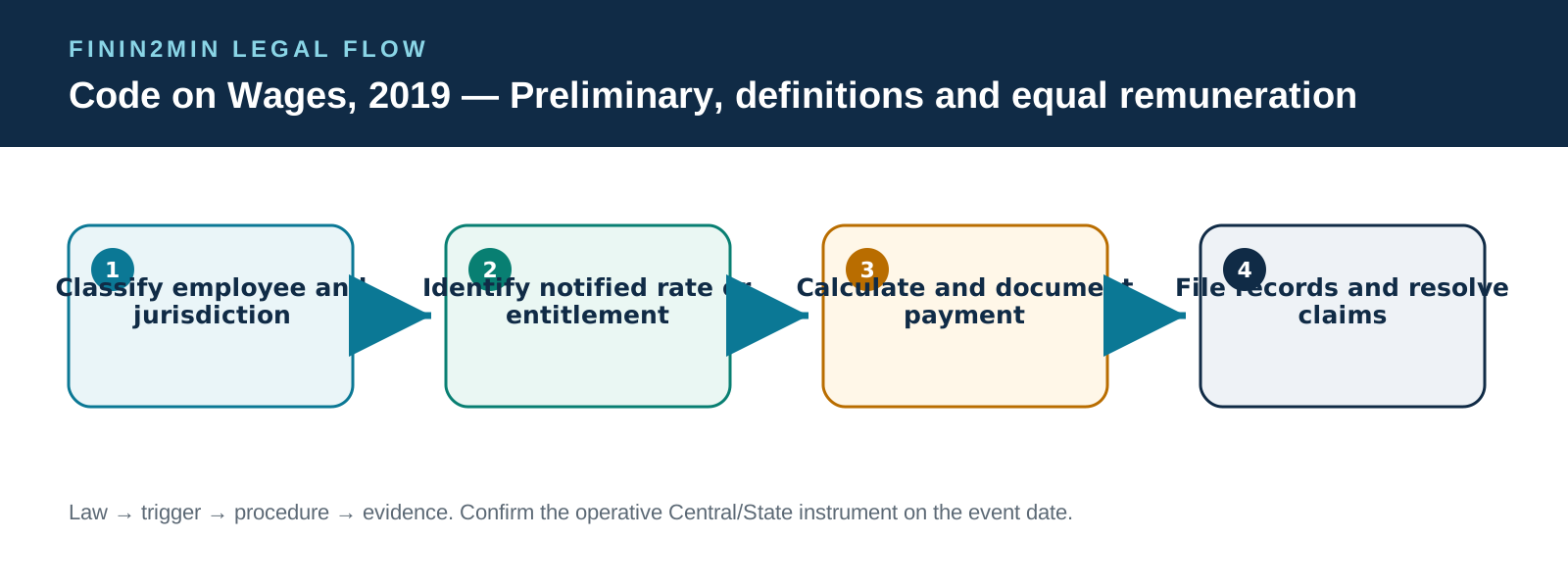
Chapter decision flow
Section 1: Short title, extent and commencement
Current statutory text
1. Short title, extent and commencement.—(1) This Act may be called the Code on Wages, 2019.

    (2) It extends to the whole of India.
    (3) It shall come into force on such date1 as the Central Government may, by notification in the
Official Gazette appoint; and different dates may be appointed for different provisions of this Code and
any reference in any such provision to the commencement of this Code shall be construed as a reference
to the coming into force of that provision.
(1) This Act may be called the Code on Wages, 2019.
(2) It extends to the whole of India.
(3) It shall come into force on such date as the Central Government may, by notification in the Official Gazette, appoint; and different dates may be appointed for different provisions of this Code and any reference in any such provision to the commencement of this Code shall be construed as a reference to the coming into force of that provision.
Finin2min clause-by-clause decode
The provision supplies the Code’s name, India-wide territorial reach and commencement mechanism. The operative date must be tested provision by provision; enactment in 2019 did not itself activate the complete Code.
Applicability
All establishments and persons potentially governed by the Code; the practical question is which provision has commenced and which Government is competent.
Trigger and conditions
- Identify the relevant provision.
- Confirm the commencement notification and effective date.
- Check whether a saved legacy action or State instrument continues through section 69.
Practical example / calculation
A payroll team should apply the Code from the notified commencement date for the relevant provision, while preserving the legacy-law calculation and evidence for earlier wage periods.
Employer, employee and professional controls
- Keep a commencement register with notification number and effective date.
- Do not use the enactment date as the payroll go-live date.
- Archive the pre-Code position for periods before commencement.
Rule 1: Short title and commencement
1. Short title and commencement.- (1) These rules may be called the Code on Wages (Central) Rules, 2026.
(2) They shall come into force on the date of their publication in the Official Gazette.
Official source: Code on Wages (Central) Rules, 2026, G.S.R. 343(E), 8 May 2026.
Consequences, remedy and evidence
Employer exposure
Shortfall, arrears, compensation, inspection findings and downstream adjudication/offence exposure may arise. The precise consequence must be mapped to sections 45 and 51–56.
Employee route
Preserve appointment terms, rate notification, attendance, wage slip and bank proof. Claims are routed through the authority under section 45; appeals proceed under section 49.
Professional evidence
Retain classification memo, notification version, payroll calculation, approval trail, exception log and remediation proof.
Primary text: India Code consolidated Code on Wages, 2019, reviewed 2026-07-18. Rule text: G.S.R. 343(E), 8 May 2026. The signed Gazette prevails over extraction artefacts.
Section 2: Definitions
Current statutory text
2. Definitions.—In this Code, unless the context otherwise requires,—

        (a) “accounting year” means the year commencing on the 1st day of April;

        (b) “Advisory Board” means the Central Advisory Board or, as the case may be, the State
    Advisory Board, constituted under section 42;

         (c) “agricultural income tax law” means any law for the time being in force relating to the levy of
    tax on agricultural income;

        (d) “appropriate Government” means, —

               (i) in relation to, an establishment carried on by or under the authority of the Central
       Government or the establishment of railways, mines, oil field, major ports, air transport service,
       telecommunication, banking and  insurance company  or  a  corporation  or  other  authority
        established by a Central Act or a central public sector undertaking or subsidiary companies set up
       by central public sector undertakings or autonomous bodies owned or controlled by the Central
       Government, including establishment of contractors for the purposes of such establishment,
        corporation or other authority, central public sector undertakings, subsidiary companies or
       autonomous bodies, as the case may be, the Central Government;

                (ii) in relation to any other establishment, the State Government;

         (e) “company” means a company as defined in clause (20) of section 2 of the Companies Act,
   2013 (18 of 2013);

          (f) “contractor”, in relation to an establishment, means a person, who—

               (i) undertakes to produce a given result for the establishment, other than a mere supply of
       goods or articles of manufacture to such establishment, through contract labour; or


1.18th December, 2020—Sub-section (1), (2), (3), (10) and (11) of section 42 (to the extent relate to the central Advisory Board);
  clauses (s) and (t) of sub-section (2) of section 67 (to the extent they relate to the Central advisory Board); section 69 [to the
  extent it relates to section 7 and 9 (to the extent relate to the Central Government) and section 8 of the Minimum Wages Act,
  1948 (11 of 1948)], vide notification No. S.O. 4604(E), dated 18th December, 2020, see Gazette of India, Extraordinary, Part II,
   sec. 3(ii).
  21st day of November, 2025—Ss. 1 to 41, sub-sections (4) to (9) of section 42, ss. 43 to 66, sub-section (1) and clauses (a) to
    (r) and (u) to (zc) of sub-section (2) and sub-sections (3) to (5) of section 67, section 68, section 69, except the provisions of
    the Code mentioned at serial number 3 of S.O. 4604 (E), dated the 18th December, 2020, vide notification no. S.O. 5322 (E),
    dated 21st November, 2025, see Gazette of India, Extraordinary, Part II, s. 3(ii).


           (ii) supplies contract labour for any work of the establishment as mere human resource and
    includes a sub-contractor;

    (g) “contract labour” means a worker who shall be deemed to be employed in or in connection
with the work of an establishment when he is hired in or in connection with such work by or through
a contractor, with or without the knowledge of the principal employer and includes inter-State
migrant worker but does not include a worker (other than part-time employee) who—

          (i) is regularly employed by the contractor for any activity of his establishment and his
   employment  is governed by mutually accepted standards of the conditions of employment
    (including engagement on permanent basis), and

           (ii) gets periodical increment in the pay, social security coverage and other welfare benefits in
    accordance with the law for the time being in force in such employment;

    (h) “co-operative society” means a society registered or deemed to be registered under the Co-
operative Societies Act, 1912 (2 of 1912), or any other law for the time being in force relating to co-
operative societies in any State;

     (i) “corporation” means any body corporate established by or under any Central Act, or State Act,
but does not include a company or a co-operative society;

     (j) “direct tax” means—

          (i) any tax chargeable under the—

           (A) Income-tax Act, 1961 (43 of 1961);

           (B) Companies (Profits) Surtax Act, 1964 (7 of 1964);

           (C) Agricultural income tax law; and

           (ii) any other tax which, having regard to its nature or incidence, may be declared by the
    Central Government, by notification, to be a direct tax for the purposes of this Code;

    (k) “employee” means, any person (other than an apprentice engaged under the Apprentices Act,
1961 (52 of 1961)), employed on wages by an establishment to do any skilled, semi-skilled or
unskilled, manual, operational, supervisory, managerial, administrative, technical or clerical work for
hire or reward, whether the terms of employment be express or implied, and also includes a person
declared to be an employee by the appropriate Government, but does not include any member of the
Armed Forces of the Union;

     (l) “employer” means a person who employs, whether directly or through any person, or on his
behalf or on behalf of any person, one or more employees in his establishment and where the
establishment is carried on by any department of the Central Government or the State Government,
the authority specified, by the head of such department, in this behalf or where no authority, is so
specified the head of the department and in relation to an establishment carried on by a local
authority, the chief executive of that authority, and includes,—

          (i) in relation to an establishment which is a factory, the occupier of the factory as defined in
    clause (n) of section 2 of the Factories Act, 1948 (63 of 1948) and, where a person has been
   named as a manager of the factory under clause (f) of sub-section (1) of section 7 of the said Act,
    the person so named;

           (ii) in relation to any other establishment, the person who, or the authority which, has
    ultimate control over the affairs of the establishment and where the said affairs is entrusted to a
   manager or managing director, such manager or managing director;

           (iii) contractor; and

         (iv) legal representative of a deceased employer;

    (m) “establishment” means any place where any industry,  trade, business, manufacture or
occupation is carried on and includes Government establishment;


        (n) “factory” means a factory as defined in clause (m) of section 2 of the Factories Act, 1948 (63
    of 1948);

        (o) “Government establishment” means any office or department of the Government or a local
    authority;

        (p) “Income-tax Act” means the Income-tax Act, 1961 (43 of 1961);

        (q) “industrial dispute” means,—

               (i) any dispute or difference between employers and employers, or between employers and
       workers or between workers and workers which is connected with the employment or non-
       employment or the terms of employment or with the conditions of labour, of any person; and

                (ii) any dispute or difference between an individual worker and an employer connected with,
        or arising out of, discharge, dismissal, retrenchment or termination of such worker;

         (r) “Inspector-cum-Facilitator” means a person appointed by the appropriate Government under
    sub-section (1) of section 51;

         (s) “minimum wage” means the wage fixed under section 6;

          (t) “notification” means a notification published in the Gazette of India or in the Official Gazette
    of a State, as the case may be, and the expression “notify” with its grammatical variations and cognate
    expressions shall be construed accordingly;

        (u) “prescribed” means prescribed by rules made by the appropriate Government;

         (v) “same work or work of a similar nature” means work in respect of which the skill, effort,
    experience and  responsibility required  are  the same, when performed under  similar working
    conditions by employees and the difference  if any, between the  skill,  effort, experience and
    responsibility required for employees of any gender, are not of practical importance in relation to the
    terms and conditions of employment;

       (w) “State” includes a Union territory;

         (x) “Tribunal” shall have the same meaning as assigned to it in clause (r) of section 2 of the
    Industrial Disputes Act, 1947 (14 of 1947);

         (y) “wages” means  all remuneration whether by way of salaries, allowances or otherwise,
    expressed in terms of money or capable of being so expressed which would (42 of 2005), if the terms
    of employment, express or implied, were fulfilled, be payable to a person employed in respect of his
   employment or of work done in such employment, and includes, —

               (i) basic pay;

                (ii) dearness allowance; and

                (iii) retaining allowance, if any,

but does not include—

                 (a) any bonus payable under any law for the time being in force, which does not form
             part of the remuneration payable under the terms of employment;

                 (b) the value of any house-accommodation, or of the supply of light, water, medical
           attendance or other amenity or of any service excluded from the computation of wages by a
            general or special order of the appropriate Government;

                  (c) any contribution paid by the employer to any pension or provident fund, and the
             interest which may have accrued thereon;

                 (d) any conveyance allowance or the value of any travelling concession;

                  (e) any sum paid to the employed person to defray special expenses entailed on him by
            the nature of his employment;

                     (f) house rent allowance;


                 (g) remuneration payable under any award or settlement between the parties or order of a
            court or Tribunal;

                 (h) any overtime allowance;

                     (i) any commission payable to the employee;

                     (j) any gratuity payable on the termination of employment;

                  (k) any retrenchment compensation or other retirement benefit payable to the employee or
          any ex gratia payment made to him on the termination of employment:

              Provided that, for calculating the wages under this clause, if payments made by the
          employer to the employee under clauses (a) to (i) exceeds one-half, or such other per cent. as
         may be notified by the Central Government, of the all remuneration calculated under this
            clause, the amount which exceeds such one-half, or the per cent. so notified, shall be deemed
            as remuneration and shall be accordingly added in wages under this clause:

              Provided further that for the purpose of equal wages to all genders and for the purpose of
          payment of wages, the emoluments specified in clauses (d), (f), (g) and (h) shall be taken for
           computation of wage.

              Explanation.—Where an employee is given in lieu of the whole or part of the wages
           payable to him, any remuneration in kind by his employer, the value of such remuneration in
           kind which does not exceed fifteen per cent. of the total wages payable to him, shall be
         deemed to form part of the wages of such employee;

         (z) “worker” means any person (except an apprentice as defined under clause (aa) of section 2 of
    the Apprentices Act, 1961 (52 of 1961)) employed in any industry to do any manual, unskilled,
    skilled, technical, operational, clerical or supervisory work for hire or reward, whether the terms of
   employment be express or implied, and includes—

               (i) working journalists as defined in clause (f) of section 2 of the Working Journalists and
        other Newspaper Employees (Conditions of Service) and Miscellaneous Provisions Act, 1955 (45
        of 1955); and

                (ii) sales promotion employees as defined in clause (d) of section 2 of the Sales Promotion
       Employees (Conditions of Service) Act, 1976 (11 of 1976), and for the purposes of any
       proceeding under this Code in relation to an industrial dispute, includes any such person who has
       been dismissed, discharged or retrenched or otherwise terminated in connection with, or as a
       consequence of, that dispute, or whose dismissal, discharge or retrenchment has led to that
        dispute,

but does not include any such person—

                 (a) who is subject to the Air Force Act, 1950 (45 of 1950), or the Army Act, 1950 (46 of
           1950), or the Navy Act, 1957 (62 of 1957); or

                 (b) who is employed in the police service or as an officer or other employee of a prison;
            or

                  (c) who is employed mainly in a managerial or administrative capacity; or

                 (d) who  is employed in a supervisory capacity drawing wage of exceeding fifteen
           thousand rupees per month or an amount as may be notified by the Central Government from
           time to time.
In this Code, unless the context otherwise requires,—
(a) “accounting year” means the year commencing on the 1st day of April;
(b) “Advisory Board” means the Central Advisory Board or, as the case may be, the State Advisory Board, constituted under section 42;
(c) “agricultural income tax law” means any law for the time being in force relating to the levy of tax on agricultural income;
(d) “appropriate Government” means,—
(i) in relation to, an establishment carried on by or under the authority of the Central Government or the establishment of railways, mines, oil field, major ports, air transport service, telecommunication, banking and insurance company or a corporation or other authority established by a Central Act or a central public sector undertaking or subsidiary companies set up by central public sector undertakings or autonomous bodies owned or controlled by the Central Government, including establishment of contractors for the purposes of such establishment, corporation or other authority, central public sector undertakings, subsidiary companies or autonomous bodies, as the case may be, the Central Government;
(ii) in relation to any other establishment, the State Government;
(e) “company” means a company as defined in clause (20) of section 2 of the Companies Act, 2013 (18 of 2013);
(f) “contractor”, in relation to an establishment, means a person, who—
(i) undertakes to produce a given result for the establishment, other than a mere supply of goods or articles of manufacture to such establishment, through contract labour; or
(ii) supplies contract labour for any work of the establishment as mere human resource and includes a sub-contractor;
(g) “contract labour” means a worker who shall be deemed to be employed in or in connection with the work of an establishment when he is hired in or in connection with such work by or through a contractor, with or without the knowledge of the principal employer and includes inter-State migrant worker but does not include a worker (other than part-time employee) who—
(i) is regularly employed by the contractor for any activity of his establishment and his employment is governed by mutually accepted standards of the conditions of employment (including engagement on permanent basis), and
(ii) gets periodical increment in the pay, social security coverage and other welfare benefits in accordance with the law for the time being in force in such employment;
(h) “co-operative society” means a society registered or deemed to be registered under the Co-operative Societies Act, 1912 (2 of 1912), or any other law for the time being in force relating to co-operative societies in any State;
(i) “corporation” means any body corporate established by or under any Central Act, or State Act, but does not include a company or a co-operative society;
(j) “direct tax” means—
(i) any tax chargeable under the—
(A) Income-tax Act, 1961 (43 of 1961);
(B) Companies (Profits) Surtax Act, 1964 (7 of 1964);
(C) agricultural income tax law; and
(ii) any other tax which, having regard to its nature or incidence, may be declared by the Central Government, by notification, to be a direct tax for the purposes of this Code;
(k) “employee” means, any person (other than an apprentice engaged under the Apprentices Act, 1961 (52 of 1961)), employed on wages by an establishment to do any skilled, semi-skilled or unskilled, manual, operational, supervisory, managerial, administrative, technical or clerical work for hire or reward, whether the terms of employment be express or implied, and also includes a person declared to be an employee by the appropriate Government, but does not include any member of the Armed Forces of the Union;
(l) “employer” means a person who employs, whether directly or through any person, or on his behalf or on behalf of any person, one or more employees in his establishment and where the establishment is carried on by any department of the Central Government or the State Government, the authority specified, by the head of such department, in this behalf or where no authority is so specified the head of the department and in relation to an establishment carried on by a local authority, the chief executive of that authority, and includes,—
(i) in relation to an establishment which is a factory, the occupier of the factory as defined in clause (n) of section 2 of the Factories Act, 1948 (63 of 1948) and, where a person has been named as a manager of the factory under clause (f) of sub-section (1) of section 7 of the said Act, the person so named;
(ii) in relation to any other establishment, the person who, or the authority which, has ultimate control over the affairs of the establishment and where the said affairs is entrusted to a manager or managing director, such manager or managing director;
(iii) contractor; and
(iv) legal representative of a deceased employer;
(m) “establishment” means any place where any industry, trade, business, manufacture or occupation is carried on and includes Government establishment;
(n) “factory” means a factory as defined in clause (m) of section 2 of the Factories Act, 1948 (63 of 1948);
(o) “Government establishment” means any office or department of the Government or a local authority;
(p) “Income-tax Act” means the Income-tax Act, 1961 (43 of 1961);
(q) “industrial dispute” means,—
(i) any dispute or difference between employers and employers, or between employers and workers or between workers and workers which is connected with the employment or non-employment or the terms of employment or with the conditions of labour, of any person; and
(ii) any dispute or difference between an individual worker and an employer connected with, or arising out of, discharge, dismissal, retrenchment or termination of such worker;
(r) “Inspector-cum-Facilitator” means a person appointed by the appropriate Government under sub-section (1) of section 51;
(s) “minimum wage” means the wage fixed under section 6;
(t) “notification” means a notification published in the Gazette of India or in the Official Gazette of a State, as the case may be, and the expression “notify” with its grammatical variations and cognate expressions shall be construed accordingly;
(u) “prescribed” means prescribed by rules made by the appropriate Government;
(v) “same work or work of a similar nature” means work in respect of which the skill, effort, experience and responsibility required are the same, when performed under similar working conditions by employees and the difference if any, between the skill, effort, experience and responsibility required for employees of any gender, are not of practical importance in relation to the terms and conditions of employment;
(w) “State” includes a Union territory;
(x) “Tribunal” shall have the same meaning as assigned to it in clause (r) of section 2 of the Industrial Disputes Act, 1947 (14 of 1947);
(y) “wages” means all remuneration whether by way of salaries, allowances or otherwise, expressed in terms of money or capable of being so expressed which would, if the terms of employment, express or implied, were fulfilled, be payable to a person employed in respect of his employment or of work done in such employment, and includes,—
(i) basic pay;
(ii) dearness allowance; and
(iii) retaining allowance, if any,
but does not include—
(a) any bonus payable under any law for the time being in force, which does not form part of the remuneration payable under the terms of employment;
(b) the value of any house-accommodation, or of the supply of light, water, medical attendance or other amenity or of any service excluded from the computation of wages by a general or special order of the appropriate Government;
(c) any contribution paid by the employer to any pension or provident fund, and the interest which may have accrued thereon;
(d) any conveyance allowance or the value of any travelling concession;
(e) any sum paid to the employed person to defray special expenses entailed on him by the nature of his employment;
(f) house rent allowance;
(g) remuneration payable under any award or settlement between the parties or order of a court or Tribunal;
(h) any overtime allowance;
(i) any commission payable to the employee;
(j) any gratuity payable on the termination of employment;
(k) any retrenchment compensation or other retirement benefit payable to the employee or any ex gratia payment made to him on the termination of employment:
Provided that, for calculating the wages under this clause, if payments made by the employer to the employee under clauses (a) to (i) exceeds one-half, or such other per cent. as may be notified by the Central Government, of all remuneration calculated under this clause, the amount which exceeds such one-half, or the per cent. so notified, shall be deemed as remuneration and shall be accordingly added in wages under this clause:
Provided further that for the purpose of equal wages to all genders and for the purpose of payment of wages, the emoluments specified in clauses (d), (f), (g) and (h) shall be taken for computation of wage.
Explanation.—Where an employee is given in lieu of the whole or part of the wages payable to him, any remuneration in kind by his employer, the value of such remuneration in kind which does not exceed fifteen per cent. of the total wages payable to him, shall be deemed to form part of the wages of such employee;
(z) “worker” means any person (except an apprentice as defined under clause (aa) of section 2 of the Apprentices Act, 1961 (52 of 1961)) employed in any industry to do any manual, unskilled, skilled, technical, operational, clerical or supervisory work for hire or reward, whether the terms of employment be express or implied, and includes—
(i) working journalists as defined in clause (f) of section 2 of the Working Journalists and other Newspaper Employees (Conditions of Service) and Miscellaneous Provisions Act, 1955 (45 of 1955); and
(ii) sales promotion employees as defined in clause (d) of section 2 of the Sales Promotion Employees (Conditions of Service) Act, 1976 (11 of 1976), and for the purposes of any proceeding under this Code in relation to an industrial dispute, includes any such person who has been dismissed, discharged or retrenched or otherwise terminated in connection with, or as a consequence of, that dispute, or whose dismissal, discharge or retrenchment has led to that dispute,
but does not include any such person—
(a) who is subject to the Air Force Act, 1950 (45 of 1950), or the Army Act, 1950 (46 of 1950), or the Navy Act, 1957 (62 of 1957); or
(b) who is employed in the police service or as an officer or other employee of a prison; or
(c) who is employed mainly in a managerial or administrative capacity; or
(d) who is employed in a supervisory capacity drawing wage exceeding fifteen thousand rupees per month or an amount as may be notified by the Central Government from time to time.
Finin2min clause-by-clause decode
Section 2 is the classification engine for the entire Code. It determines the responsible Government, who is an employee or worker, who is the employer, the breadth of the establishment, and what remuneration is counted as wages.
Applicability
Apply every definition contextually. “Employee” is broader than “worker”; the supervisory wage ceiling affects worker status, while managerial and administrative personnel remain employees for several wage obligations.
Trigger and conditions
- Classify establishment and appropriate Government.
- Identify employee, worker, contractor and principal employer roles.
- Rebuild the wage basket using the inclusive core and excluded components.
- Apply the 50% inclusion-back rule and the 15% in-kind ceiling.
Practical example / calculation
Monthly remuneration is ₹70,000. Core pay (basic + DA + retaining allowance) is ₹30,000 and listed exclusions are ₹40,000. Fifty per cent of total remuneration is ₹35,000. The exclusion excess of ₹5,000 is added back, producing statutory wages of ₹35,000 before any other provision-specific adjustment.
Employer, employee and professional controls
- Maintain a documented wage-definition reconciliation for every salary structure.
- Version-control the payroll rule whenever allowances change.
- Separate employee/worker classification from income-tax salary classification.
Rule 2: Definitions
2. Definitions.- (1) In these rules, unless the context otherwise requires. —
(a) “appeal” means an appeal under sub-section (1) of section 49; (b) “appellate authority” means the appellate authority appointed by the Central Government under sub-section (1) of section 49; (c) “appendix” means Appendix annexed to these rules; (d) “authority” means the authority appointed by the Central Government under sub-section (1) of section 45; (e) “Board” means the Central Advisory Board constituted by the Central Government under sub-
section (1) of section 42; (f) “Chairperson” means the Chairperson of the Board; (g) “Code” means the Code on Wages, 2019 (29 of 2019); (h) “Committee” means a committee appointed by the Central Government under clause (a) of sub- section (1) of section 8; (i) “day” means a period of twenty-four hours beginning at mid-night; (j) “electronically” means any information submitted by email or maintained or displayed on the designated portal or mobile application or website or digital payment in any mode for the purposes of the Code; (k) “form” means the forms appended to these rules; (l) “geographical area” means the areas notified by the Central Government from time to time. (m) “highly skilled occupation” means an occupation which calls in its performance a specific level of perfection and required competence acquired through intensive technical or professional training or practical occupational experience for a considerable period and also requires of an employee to assume full responsibility for judgment or decision involved in the execution of such occupation; (n) “Inspector-cum-Facilitator” means a person appointed by the Central Government, under sub- section (1) of section 51; (o) “member” means a member of the Board; (p) “normal rate of wage” means wage as defined under clause (y) of section 2; (q) “registered trade union” means a trade union registered under the Industrial Relations Code, 2020 (35 of 2020); (r) “section” means a section of the Code; (s) “semi-skilled occupation” means an occupation which in its performance requires the application of skill gained by the experience on job which is capable of being applied under the supervision or guidance of a skilled employee and includes supervision over the unskilled occupation; (t) “skilled occupation” means an occupation which involves skill and competence in its performance through experience on the job or through training as an apprentice in a technical or vocational institute and the performance of which calls for initiating and judgment; (u) “unskilled occupation” means an occupation which in its performance requires the application of simply the operating experience and involves no further skills.
(2) Words and expressions used in these rules but not defined herein, shall have the meanings respectively assigned to them under the Code.
CHAPTER II
M INIMUM WAGES
Official source: Code on Wages (Central) Rules, 2026, G.S.R. 343(E), 8 May 2026.
Consequences, remedy and evidence
Employer exposure
Shortfall, arrears, compensation, inspection findings and downstream adjudication/offence exposure may arise. The precise consequence must be mapped to sections 45 and 51–56.
Employee route
Preserve appointment terms, rate notification, attendance, wage slip and bank proof. Claims are routed through the authority under section 45; appeals proceed under section 49.
Professional evidence
Retain classification memo, notification version, payroll calculation, approval trail, exception log and remediation proof.
Primary text: India Code consolidated Code on Wages, 2019, reviewed 2026-07-18. Rule text: G.S.R. 343(E), 8 May 2026. The signed Gazette prevails over extraction artefacts.
Section 3: Prohibition of discrimination on ground of gender
Current statutory text
3. Prohibition of discrimination on ground of gender.—(1) There shall be no discrimination in an
establishment or any unit thereof among employees on the ground of gender in matters relating to wages
by the same employer, in respect of the same work or work of a similar nature done by any employee.

    (2) No employer shall, —

            (i) for the purposes of complying with the provisions of sub-section (1), reduce the rate of wages
     of any employee; and


            (ii) make any discrimination on the ground of sex while recruiting any employee for the same
    work or work of similar nature and in the conditions of employment, except where the employment
     of women in such work is prohibited or restricted by or under any law for the time being in force.
(1) There shall be no discrimination in an establishment or any unit thereof among employees on the ground of gender in matters relating to wages by the same employer, in respect of the same work or work of a similar nature done by any employee.
(2) No employer shall,—
(i) for the purposes of complying with the provisions of sub-section (1), reduce the rate of wages of any employee; and
(ii) make any discrimination on the ground of sex while recruiting any employee for the same work or work of similar nature and in the conditions of employment, except where the employment of women in such work is prohibited or restricted by or under any law for the time being in force.
Finin2min clause-by-clause decode
The employer must not discriminate on gender in wage rates for the same or substantially similar work and must not use recruitment or conditions of employment to recreate the same discrimination.
Applicability
All employees of the same employer where work comparability can be tested on skill, effort, experience, responsibility and working conditions.
Trigger and conditions
- Compare actual duties, not designations alone.
- Test skill, effort, experience and responsibility.
- Confirm similar working conditions.
- Do not cure inequality by reducing anyone’s wage.
Practical example / calculation
Two analysts have different job titles but perform the same reconciliations, carry the same approval responsibility and work under the same conditions. The employer must explain any gender-linked pay variance with objective evidence rather than the title difference alone.
Employer, employee and professional controls
- Run role-based pay-equity testing annually.
- Keep job descriptions, evaluation criteria and pay-band approvals.
- Escalate unexplained gender pay variances.
Consequences, remedy and evidence
Employer exposure
Shortfall, arrears, compensation, inspection findings and downstream adjudication/offence exposure may arise. The precise consequence must be mapped to sections 45 and 51–56.
Employee route
Preserve appointment terms, rate notification, attendance, wage slip and bank proof. Claims are routed through the authority under section 45; appeals proceed under section 49.
Professional evidence
Retain classification memo, notification version, payroll calculation, approval trail, exception log and remediation proof.
Primary text: India Code consolidated Code on Wages, 2019, reviewed 2026-07-18. Rule text: G.S.R. 343(E), 8 May 2026. The signed Gazette prevails over extraction artefacts.
Section 4: Decision as to disputes with regard to same or similar nature of work
Current statutory text
4. Decision as to disputes with regard to same or similar nature of work.—Where there is any
dispute as to whether a work is of same or similar nature for the purposes of section 3, the dispute shall be
decided by such authority as may be notified by the appropriate Government.

                            CHAPTER II

                              MINIMUM WAGES
Where there is any dispute as to whether a work is of same or similar nature for the purposes of section 3, the dispute shall be decided by such authority as may be notified by the appropriate Government.
Finin2min clause-by-clause decode
A notified authority—not the employer unilaterally—decides disputes over whether work is the same or similar for section 3.
Applicability
A dispute under section 3 where the parties disagree on comparability.
Trigger and conditions
- Identify the appropriate Government.
- Locate the current notification appointing the authority.
- Prepare evidence on actual work content and conditions.
Practical example / calculation
A same-work dispute file should contain job descriptions, actual work samples, responsibility matrices, shift conditions, qualification requirements and pay-band approvals before the notified authority.
Employer, employee and professional controls
- Preserve job evaluation evidence and witness records.
- Track service and hearing dates.
- Avoid relying only on job titles or grade codes.
Consequences, remedy and evidence
Employer exposure
Shortfall, arrears, compensation, inspection findings and downstream adjudication/offence exposure may arise. The precise consequence must be mapped to sections 45 and 51–56.
Employee route
Preserve appointment terms, rate notification, attendance, wage slip and bank proof. Claims are routed through the authority under section 45; appeals proceed under section 49.
Professional evidence
Retain classification memo, notification version, payroll calculation, approval trail, exception log and remediation proof.
Primary text: India Code consolidated Code on Wages, 2019, reviewed 2026-07-18. Rule text: G.S.R. 343(E), 8 May 2026. The signed Gazette prevails over extraction artefacts.
Forms, registers, portals and due dates
| Form / record | Purpose | Basis | Timing / control |
|---|---|---|---|
| Form I | Employee Register | Rule 51 | Maintain electronically or physically; preserve five years after last entry. |
| Form IV | Wages, overtime, advances, fines and deductions register | Rule 51 | Maintain contemporaneously; preserve five years. |
| Form IX | Attendance Register-cum-Muster Roll | Rule 51 | Maintain contemporaneously; preserve five years. |
| Form V | Wage slip | Rule 52 | Issue electronically or physically on or before payment of wages. |
Portal control: use the live Central or State labour portal specified for the establishment and transaction. Portal screens do not amend the Code or Rules. Retain acknowledgement, uploaded file, payment proof and the instruction version used.
Notifications and effective-date history
| Instrument | Date | Legal effect |
|---|---|---|
| S.O. 4604(E) | 18 Dec 2020 | Partial commencement affecting Central Advisory Board and specified rule-making/repeal provisions. |
| S.O. 5322(E) | 21 Nov 2025 | Commencement of the remaining Code on Wages provisions specified in the instrument. |
| Section 4 authority notification | Current instrument to be selected by appropriate Government | Determines the authority deciding same/similar-work disputes. |
Old-law / new-Code concordance
| Legacy framework | Current Code | Transition control |
|---|---|---|
| Equal Remuneration Act, 1976 — equal remuneration and recruitment | Sections 3–4 | Broader gender-neutral formulation; use Code definitions and current authority notification. |
| Minimum Wages / Payment of Wages / Bonus definitions | Section 2 | Unified definitions, especially wages, employee, worker, employer and appropriate Government. |
Binding and highly relevant judicial principles
Pre-Code decisions remain useful only to the extent their principle is consistent with the current text. Always test amendment or legislative override before relying on an old ratio.
Principle: Equal pay for equal work is a constitutional goal flowing from equality principles, but comparability must be established on relevant factors.
Current-law use: Legacy constitutional principle survives; apply through the broader gender-neutral text of sections 3–4.
Principle: The substance of work, skill, effort and responsibility matters more than labels or historic job segregation.
Current-law use: Highly relevant to the section 2(v) comparability test.
Principle: Where materially equal work is established in public employment, unequal basic pay may violate equality; classification and duties remain fact-sensitive.
Current-law use: Use cautiously outside its public-employment facts; do not convert it into an automatic private-sector parity rule.
Official judgment retrieval: Supreme Court of India Verdict Finder / SCR portal. Case citations are included for professional verification.
State-law variation alerts
| Issue | Variation | Control |
|---|---|---|
| Appropriate Government | Central sphere specified in section 2(d); State sphere for other establishments. | Do not assume Central Rules govern an ordinary State-sphere establishment. |
| Pay-equity authority | Authority is appointed by the relevant appropriate Government. | Check current State Gazette / labour department notification. |
| Salary and wage structuring | State wage notifications and local Shops/Establishments rules may add obligations. | Apply the more specific binding instrument and document the hierarchy analysis. |
Practical examples and calculations
A salary structure labels a large recurring amount as an allowance. Reconstruct wages from the statutory inclusions, exclusions and excess-exclusion mechanism before testing minimum wage, overtime, bonus, gratuity and social-security consequences.
Calculation/control template: Control calculation: verified population or transaction base × applicable notified rate/amount × eligible period, adjusted for statutory inclusions, exclusions, ceilings, interest, compensation and prior payments. Reperform the calculation from retained source data.
Finin2min implementation explanation
Maintain a controlled implementation file for Chapter I — Preliminary, Definitions and Equal Remuneration: coverage and event date, operative Central/State instrument, responsible owner, approval and authority, form/portal step, due date, calculation basis, supporting evidence, exception, escalation and closure proof. Reconcile payroll, HR, finance, contractor and legal records before sign-off.
Practical transaction application
Use the chapter when drafting offer letters, wage structures, contractor work orders, payroll calendars, bonus workings, separation settlements and due-diligence requests. Classify the establishment, employee, wage components and relevant event date before applying the provision and linked Rule.
Authority, consent and execution controls
HR may prepare the computation, but the employer or duly authorised signatory should approve wage-period, deduction, bonus and claim responses. Contractor clauses must identify the principal employer, payment evidence owner and escalation authority; consent cannot validate a deduction prohibited by law.
Stamp duty and registration alerts
Ordinary payroll records do not attract registration. Employment, settlement, indemnity or service instruments should nevertheless be checked under the applicable State stamp law; an unstamped or insufficiently stamped instrument may face evidentiary or enforcement objections. Portal filing or statutory notice is not a substitute for stamping where independently applicable.
Evidence and document-retention checklist
Retain the operative law/rule version, classification note, approvals, signed instruments, statutory forms, portal acknowledgements, registers, calculations, bank proof, correspondence, inspection records, service proof, decision and appeal file. Apply the longer of the statutory retention rule, litigation hold, tax/audit need and contractual requirement; restrict access to personal and sensitive data.
Performance, delivery and payment controls
Link attendance, output and variable-pay conditions to objective records. Pay wages, overtime, bonus and final dues through traceable banking channels within the applicable statutory window; reconcile payroll, bank advice, ledger, return and employee acknowledgement.
Breach, loss, mitigation and remedy framework
On detecting a breach, stop continuing exposure, preserve evidence, quantify employee and government dues, identify affected persons, make lawful corrective payment/filing, notify the authorised decision-maker, assess self-disclosure or compounding where available, and reserve contractual recovery against responsible vendors without delaying statutory remediation.
Limitation and forum controls
Route statutory wage claims and appeals to the authority/appellate authority under the Code and Rules. Preserve the event date, service date and proof of payment because limitation and condonation are fact-sensitive. Contractual forum clauses cannot oust a mandatory statutory forum.
Arbitration and mediation interface
Mediation can resolve computation or factual disputes where lawful, but cannot contract out of minimum wages, prohibited deductions, statutory bonus or penal consequences. Record any settlement precisely and complete mandatory filing/approval steps.
Company, partnership, GST and tax overlays
For a company, align board/delegation and officer-in-default controls; for an LLP or partnership, identify the designated partner/partner and authorised employer representative. Labour dues can affect transaction price, indemnities, director/partner exposure and insolvency claims. Salary/TDS, perquisite, contractor TDS, GST on outsourced services and accounting provisions must be reconciled without treating tax treatment as proof of labour-law classification.
Detailed Finin2min Q&A
Does the Code apply only to “workers”?
No. Several obligations use the broader term “employee”. Worker status becomes important for provisions that expressly use that narrower definition.
Are managers outside the Code?
Not automatically. A managerial person may be outside the worker definition yet remain an employee for wage-payment and other provisions.
Does CTC equal wages?
No. CTC is a commercial payroll concept. Section 2(y) requires a statutory reconstruction of included and excluded remuneration.
Is the 50% rule a salary-structure cap?
It is an inclusion-back mechanism. When specified exclusions exceed 50% of total remuneration, the excess is deemed wages.
Can an employer reduce higher-paid employees to create parity?
No. Section 3 expressly prevents reducing a rate of wages to comply with equal-pay requirements.
Are job titles decisive for same work?
No. Actual skill, effort, experience, responsibility and working conditions must be compared.
Does section 3 protect only women?
The current text prohibits discrimination on the ground of gender and is framed for employees of any gender.
Who decides a same-work dispute?
The authority notified by the appropriate Government under section 4.
Can HRA be ignored for every wage calculation?
No. It is generally excluded under section 2(y), subject to the 50% inclusion-back rule and the special second proviso for equal wages and payment of wages.
How is in-kind remuneration treated?
Up to 15% of total wages may be deemed part of wages where provided in lieu of whole or part of wages.
Is a contractor always the only employer?
No. The definition of employer includes the contractor, while principal-employer duties may arise under connected Codes and contractual arrangements.
Which Government is appropriate for a bank or mine?
The Central Government, subject to the full statutory classification in section 2(d).
Do State rules matter for a private shop?
Yes. In most ordinary private establishments, the State Government is the appropriate Government and State rules/notifications must be checked.
Is an apprentice an employee?
An apprentice engaged under the Apprentices Act is excluded from the employee definition. Mislabelled trainees require factual review.
Does a payroll allowance name control classification?
No. Substance, contractual entitlement and the statutory list control.
Can a settlement redefine wages below the Code?
No. Contracting or settlement cannot override the statutory floor where the Code applies.
What evidence supports pay equity?
Current job descriptions, actual task records, evaluation methodology, pay bands, qualifications, responsibility and working-condition evidence.
Should legacy Equal Remuneration Act cases be ignored?
No. Their principles may remain persuasive where consistent with the new wording, but the Code text and current notifications control.
Primary-source register
- India Code — Code on Wages, 2019 consolidated PDF
- Ministry of Labour — Code on Wages (Central) Rules, 2026
- Ministry Labour Codes library — commencement, notifications, FAQs and handbook
- Supreme Court of India — judgment search
Last checked: 2026-07-18. Educational and professional reference; obtain fact-specific legal advice before action.