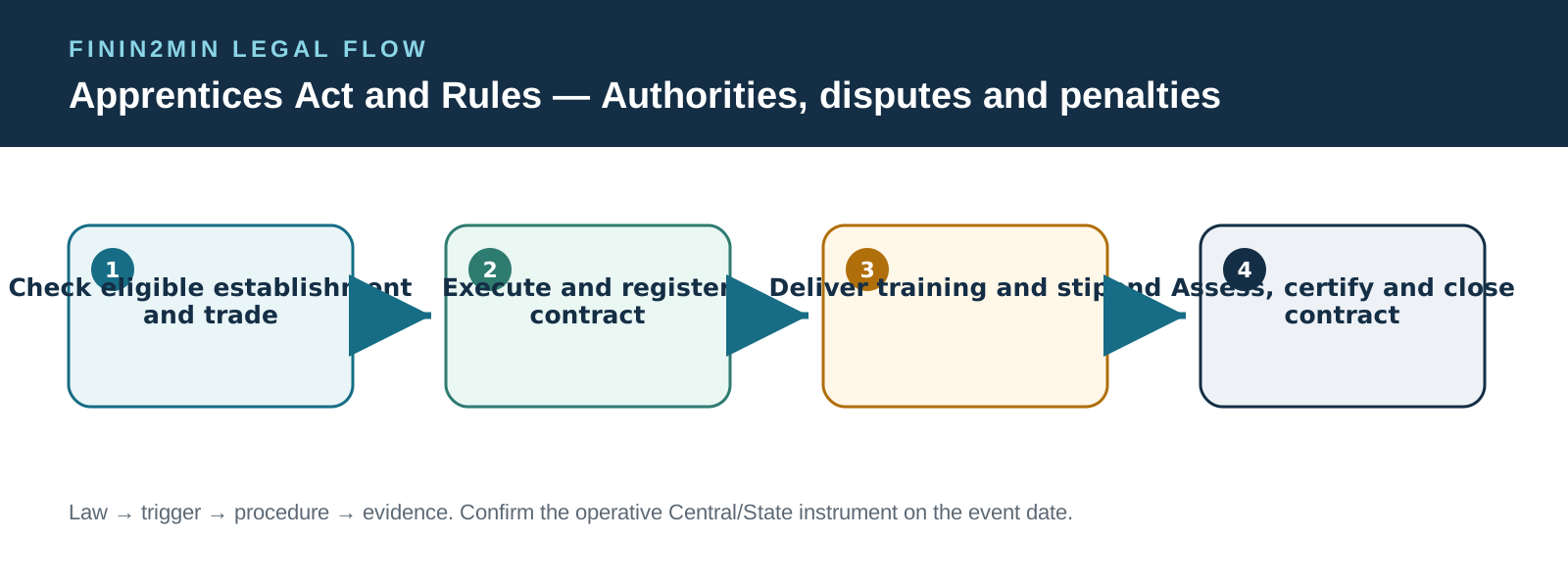
Source protocol. Retained provision/rule pages and official documents are consolidated below. The signed Gazette and current authority portal prevail over normalised formatting.
For the exact locally-verified statutory text of every section and rule referenced in this chapter, see the Apprenticeship Hub (sections, rules, schedules, guides). This chapter is the operational map and Finin2min synthesis layer.
Finin2min Summary - Chapter in 2 Minutes
This chapter turns authorities, disputes and penalties into an operational control file. It covers Section 19, Section 2, Section 20, Section 21; the practical sequence is to classify coverage and event date, apply the provision and mapped Rule, complete the form/register, calculate the entitlement or exposure, and retain evidence for inspection, claim or appeal.
Who is covered
Employers, establishments, apprentices, basic-training providers and apprenticeship authorities must identify the apprentice category, trade, contract and portal route.
Main obligations and rights
Section 19
Section 2
Section 20
Section 21
Section 22
Section 23
Key thresholds and timelines
First contravention attracts an advisory with 30 days to comply;
second contravention attracts a warning with 15 days to comply;
Forms, registers and evidence
Register
Return
Nomination
Retain classification, calculation, approval, communication, acknowledgement and payment/filing proof.
Employer risk snapshot
Highest practical risks: treating apprentices as ordinary employees without testing the statutory contract and training framework.
Employee/worker remedy snapshot
Core protection: a registered training contract, prescribed stipend/training conditions and access to the apprenticeship authority for disputes. Confirm the authority, limitation and appeal route stated in this chapter.
Old law / transition
Apply the instrument effective on the event date and preserve any accrued right, saved notification, pending proceeding or scheme-specific transition.
Five-point professional checklist
Freeze the event date, establishment, location and person/worker classification.
Identify the controlling section/paragraph, mapped Rule, notification and appropriate Government.
Reperform the calculation or decision test and document every exception or approval.
Complete the prescribed form/register/portal step and retain acknowledgement, payment and communication evidence.
Record the remedy, forum, limitation, appeal path and State variation before sign-off.
Finin2min takeaway: for authorities, disputes and penalties, the defensible answer is not a policy label - it is the event-date law, the mapped procedure, the calculation and a complete evidence trail.
Section 19 - Records and returns | Apprentices Act | Finin2min
Skip to content
finin
min
Home
Employment law
Apprenticeship
Apprentices Act, 1961
Section 19: Records and returns
Section 19 of the Apprentices Act, 1961 explained with current 2025-26 amendments, employer controls, evidence and connected Rules.
Law Hub L8
Data reviewed on 17 July 2026
India-first compliance
What section 19 does
Requires prescribed records and returns and supports portal-based supervision.
Connected instrument: Rules 10 and 14; Schedule III
Finin2min practical reading
Identify the apprentice category, trade, establishment jurisdiction and applicable portal before applying the provision.
Separate statutory apprenticeship from internships, probation, traineeships and ordinary employment.
Do not treat scheme reimbursement as a substitute for the employer’s underlying statutory obligations.
Preserve the contract, approvals, portal trail and training evidence as one auditable file.
Employer control and evidence pack
Executed/registered contract and portal acknowledgement
Training plan, attendance/work diary and supervisor records
Stipend bank/DBT evidence where relevant
Adviser approval, correspondence or order where the section requires it
Statutory text extract
Extracted from the bundled official/consolidated source. For sections amended in 2026, the current overlay above controls over older consolidated wording.
19. Records and returns.—(1) Every employer shall maintain records of the progress of training of
each apprentice undergoing apprenticeship training in his establishment in such form as may be
prescribed.
[(2) Until a portal-site is developed by the Central Government, every employer shall furnish such
information and return in such form as may be prescribed, to such authorities at such intervals as may be
prescribed.
(3) Every employer shall also give trade-wise requirement and engagement of apprentices in respect
of apprenticeship training on portal-site developed by the Central Government in this regard.]
Compliance consequence
Failure should be tested against sections 30, 31 and 31A as in force from 22 June 2026, alongside contract termination/compensation consequences and any portal or scheme action.
← Section 18
Section 20 →
Section navigation
All Act sections
All Rules
Employer checklist
Amendment tracker
Legacy full-text viewer
Finin2min implementation decode
A multi-location employer prepares a legal classification memo, identifies the appropriate Government, maps the operative provision and Rule, records the decision owner and retains the documents needed to prove compliance during inspection or litigation.
Identify actor, trigger, threshold and territorial authority.
Map form, record, portal, fee and due date.
Separate substantive entitlement from procedure, remedy and penal consequence.
Retain the official instrument and event-date evidence.
Section 2
Section 2 - Definitions | Apprentices Act | Finin2min
Skip to content
finin
min
Home
Employment law
Apprenticeship
Apprentices Act, 1961
Section 2: Definitions
Section 2 of the Apprentices Act, 1961 explained with current 2025-26 amendments, employer controls, evidence and connected Rules.
Law Hub L8
Data reviewed on 17 July 2026
India-first compliance
What section 2 does
Defines the people, trades, authorities, establishment concepts and other terms that control every downstream obligation.
2026 legal overlay:
From 22 June 2026, the definition section also recognises “advisory” and “warning” for the graduated compliance process introduced by the Jan Vishwas (Amendment of Provisions) Act, 2026.
Connected instrument: Rule 2
Finin2min practical reading
Identify the apprentice category, trade, establishment jurisdiction and applicable portal before applying the provision.
Separate statutory apprenticeship from internships, probation, traineeships and ordinary employment.
Do not treat scheme reimbursement as a substitute for the employer’s underlying statutory obligations.
Preserve the contract, approvals, portal trail and training evidence as one auditable file.
Employer control and evidence pack
Executed/registered contract and portal acknowledgement
Training plan, attendance/work diary and supervisor records
Stipend bank/DBT evidence where relevant
Adviser approval, correspondence or order where the section requires it
Statutory text extract
Extracted from the bundled official/consolidated source. For sections amended in 2026, the current overlay above controls over older consolidated wording.
2. Definitions.—In this Act, unless the context otherwise requires,—
[(a) “All India Council” means the All India Council of Technical Education established by the
resolution of the Government of India in the former Ministry of Education No. F. 16-10/44-E.III,
dated the 30th November, 1945;]
[(aa)] “apprentice” means a person who is undergoing apprenticeship training 8*** in pursuance
of a contract of apprenticeship;
[(aaa) “apprenticeship training” means a course of training in any industry or establishment
undergone in pursuance of a contract of apprenticeship and under prescribed terms and conditions
which may be different for different categories of apprentices;]
(b) “Apprenticeship Adviser” means the Central Apprenticeship Adviser appointed under sub-
section (1) of section 26 or the State Apprenticeship Adviser appointed under sub-section (2) of that
section;
(c) “Apprenticeship Council” means the Central Apprenticeship Council or the State
Apprenticeship Council established under sub-section (1) of section 24;
(d) “appropriate Government” means,—
(1) in relation to—
(a) the Central Apprenticeship Council, or
3. 1st March, 1962, vide notification No. G.S.R. 246, dated 12th February, 1962, see Gazette of India, Extraordinary, Part II,
sec. 3(i) and this Act has been extended in its application to the Union territory Goa, Daman and Diu by the Act 11 of 1963, s.
3 and the Schedule (w.e.f 1-2-1965).
4. Clause (b) omitted by Act 27 of 1973, s. 3 (w.e.f. 1-12-1974).
7. Clause (a) re-lettered as clause (aa) thereof by s. 4, ibid. (w.e.f. 1-12-1974).
Compliance consequence
Failure should be tested against sections 30, 31 and 31A as in force from 22 June 2026, alongside contract termination/compensation consequences and any portal or scheme action.
← Section 1
Section 3 →
Section navigation
All Act sections
All Rules
Employer checklist
Amendment tracker
Legacy full-text viewer
Finin2min implementation decode
A multi-location employer prepares a legal classification memo, identifies the appropriate Government, maps the operative provision and Rule, records the decision owner and retains the documents needed to prove compliance during inspection or litigation.
Identify actor, trigger, threshold and territorial authority.
Map form, record, portal, fee and due date.
Separate substantive entitlement from procedure, remedy and penal consequence.
Retain the official instrument and event-date evidence.
Section 20
Section 20 - Settlement of disputes | Apprentices Act | Finin2min
Skip to content
finin
min
Home
Employment law
Apprenticeship
Apprentices Act, 1961
Section 20: Settlement of disputes
Section 20 of the Apprentices Act, 1961 explained with current 2025-26 amendments, employer controls, evidence and connected Rules.
Law Hub L8
Data reviewed on 17 July 2026
India-first compliance
What section 20 does
Routes disputes arising from the apprenticeship contract to the Apprenticeship Adviser.
Connected instrument: Adviser process
Finin2min practical reading
Identify the apprentice category, trade, establishment jurisdiction and applicable portal before applying the provision.
Separate statutory apprenticeship from internships, probation, traineeships and ordinary employment.
Do not treat scheme reimbursement as a substitute for the employer’s underlying statutory obligations.
Preserve the contract, approvals, portal trail and training evidence as one auditable file.
Employer control and evidence pack
Executed/registered contract and portal acknowledgement
Training plan, attendance/work diary and supervisor records
Stipend bank/DBT evidence where relevant
Adviser approval, correspondence or order where the section requires it
Statutory text extract
Extracted from the bundled official/consolidated source. For sections amended in 2026, the current overlay above controls over older consolidated wording.
20. Settlement of disputes.—(1) Any disagreement or dispute between an employer and an
apprentice arising out of the contract of apprenticeship shall be referred to the Apprenticeship Adviser for
decision.
(2) Any person aggrieved by the decision of the Apprenticeship Adviser under sub-section (1) may,
within thirty days from the date of communication to him of such decision, prefer an appeal against the
decision to the Apprenticeship Council and such appeal shall be heard and determined by a Committee of
that Council appointed for the purpose.
(3) The decision of the Committee under sub-section (2) and subject only to such decision, the
decision of the Apprenticeship Adviser under sub-section (1) shall be final.
Compliance consequence
Failure should be tested against sections 30, 31 and 31A as in force from 22 June 2026, alongside contract termination/compensation consequences and any portal or scheme action.
← Section 19
Section 21 →
Section navigation
All Act sections
All Rules
Employer checklist
Amendment tracker
Legacy full-text viewer
Finin2min implementation decode
A multi-location employer prepares a legal classification memo, identifies the appropriate Government, maps the operative provision and Rule, records the decision owner and retains the documents needed to prove compliance during inspection or litigation.
Identify actor, trigger, threshold and territorial authority.
Map form, record, portal, fee and due date.
Separate substantive entitlement from procedure, remedy and penal consequence.
Retain the official instrument and event-date evidence.
Section 21
Section 21 - Tests, certificates and conclusion of training | Apprentices Act | Finin2min
Skip to content
finin
min
Home
Employment law
Apprenticeship
Apprentices Act, 1961
Section 21: Tests, certificates and conclusion of training
Section 21 of the Apprentices Act, 1961 explained with current 2025-26 amendments, employer controls, evidence and connected Rules.
Law Hub L8
Data reviewed on 17 July 2026
India-first compliance
What section 21 does
Provides for tests, assessment, certificates and completion outcomes.
Connected instrument: Curriculum and certification rules
Finin2min practical reading
Identify the apprentice category, trade, establishment jurisdiction and applicable portal before applying the provision.
Separate statutory apprenticeship from internships, probation, traineeships and ordinary employment.
Do not treat scheme reimbursement as a substitute for the employer’s underlying statutory obligations.
Preserve the contract, approvals, portal trail and training evidence as one auditable file.
Employer control and evidence pack
Executed/registered contract and portal acknowledgement
Training plan, attendance/work diary and supervisor records
Stipend bank/DBT evidence where relevant
Adviser approval, correspondence or order where the section requires it
Statutory text extract
Extracted from the bundled official/consolidated source. For sections amended in 2026, the current overlay above controls over older consolidated wording.
21. Holding of test and grant of certificate and conclusion of training.—3[(1) Every trade
apprenticewho has completed the period of training may appear for a test to be conducted by the National
Council or any other agency authorised by the Central Government to determine his proficiency in the
designated trade in which he has undergone apprenticeship training].
(2) Every4[trade apprentice] who passes the test referred to in sub-section (1) shall be granted a
certificate of proficiency in the trade by the National Council 5[or by the other agency authorised by the
Central Government].
[(3) The progress in apprenticeship training of every graduate or technician apprentice7[technician
(vocational) apprentice] shall be assessed by the employer from time to time.
[(4) Every graduate or technician apprentice or technician (vocational) apprentice, who completes his
apprenticeship training to the satisfaction of the concerned Regional Board, shall be granted a certificate
of proficiency by that Board.]]
STATE AMENDMENTS
Maharashtra
Amendment of section 21 of 52 of 1961.—In section 21 of the principal Act,—
(i) after the existing sub-section (1), the following sub-section shall be inserted, namely:—
Compliance consequence
Failure should be tested against sections 30, 31 and 31A as in force from 22 June 2026, alongside contract termination/compensation consequences and any portal or scheme action.
← Section 20
Section 22 →
Section navigation
All Act sections
All Rules
Employer checklist
Amendment tracker
Legacy full-text viewer
Finin2min implementation decode
A multi-location employer prepares a legal classification memo, identifies the appropriate Government, maps the operative provision and Rule, records the decision owner and retains the documents needed to prove compliance during inspection or litigation.
Identify actor, trigger, threshold and territorial authority.
Map form, record, portal, fee and due date.
Separate substantive entitlement from procedure, remedy and penal consequence.
Retain the official instrument and event-date evidence.
Section 22
Section 22 - Offer and acceptance of employment | Apprentices Act | Finin2min
Skip to content
finin
min
Home
Employment law
Apprenticeship
Apprentices Act, 1961
Section 22: Offer and acceptance of employment
Section 22 of the Apprentices Act, 1961 explained with current 2025-26 amendments, employer controls, evidence and connected Rules.
Law Hub L8
Data reviewed on 17 July 2026
India-first compliance
What section 22 does
Clarifies that post-training employment depends on the contract and is not automatically mandatory.
Connected instrument: Contract terms
Finin2min practical reading
Identify the apprentice category, trade, establishment jurisdiction and applicable portal before applying the provision.
Separate statutory apprenticeship from internships, probation, traineeships and ordinary employment.
Do not treat scheme reimbursement as a substitute for the employer’s underlying statutory obligations.
Preserve the contract, approvals, portal trail and training evidence as one auditable file.
Employer control and evidence pack
Executed/registered contract and portal acknowledgement
Training plan, attendance/work diary and supervisor records
Stipend bank/DBT evidence where relevant
Adviser approval, correspondence or order where the section requires it
Statutory text extract
Extracted from the bundled official/consolidated source. For sections amended in 2026, the current overlay above controls over older consolidated wording.
22. Offer and acceptance of employment.—1[(1) Every employer shall formulate its own policy for
recruiting any apprentice who has completed the period of apprenticeship training in his establishment.]
(2) Notwithstanding anything in sub-section (1), where there is a condition in a contract of
apprenticeship that the apprentice shall, after the successful completion of the apprenticeship training,
serve the employer, the employer shall, on such completion, be bound to offer suitable employment to the
apprentice, and the apprentice shall be bound to serve the employer in that capacity for such period and
on such remuneration as may be specified in the contract:
Provided that where such period or remuneration is not, in the opinion of the Apprenticeship Adviser,
reasonable, he may revise such period or remuneration so as to make it reasonable, and the period or
remuneration so revised shall be deemed to be the period or remuneration agreed to between the
apprentice and the employer.
CHAPTER III
AUTHORITIES
Compliance consequence
Failure should be tested against sections 30, 31 and 31A as in force from 22 June 2026, alongside contract termination/compensation consequences and any portal or scheme action.
← Section 21
Section 23 →
Section navigation
All Act sections
All Rules
Employer checklist
Amendment tracker
Legacy full-text viewer
Finin2min implementation decode
A multi-location employer prepares a legal classification memo, identifies the appropriate Government, maps the operative provision and Rule, records the decision owner and retains the documents needed to prove compliance during inspection or litigation.
Identify actor, trigger, threshold and territorial authority.
Map form, record, portal, fee and due date.
Separate substantive entitlement from procedure, remedy and penal consequence.
Retain the official instrument and event-date evidence.
Section 23
Section 23 - Authorities | Apprentices Act | Finin2min
Skip to content
finin
min
Home
Employment law
Apprenticeship
Apprentices Act, 1961
Section 23: Authorities
Section 23 of the Apprentices Act, 1961 explained with current 2025-26 amendments, employer controls, evidence and connected Rules.
Law Hub L8
Data reviewed on 17 July 2026
India-first compliance
What section 23 does
Identifies the statutory authorities responsible for apprenticeship governance.
Connected instrument: Rules and government notifications
Finin2min practical reading
Identify the apprentice category, trade, establishment jurisdiction and applicable portal before applying the provision.
Separate statutory apprenticeship from internships, probation, traineeships and ordinary employment.
Do not treat scheme reimbursement as a substitute for the employer’s underlying statutory obligations.
Preserve the contract, approvals, portal trail and training evidence as one auditable file.
Employer control and evidence pack
Executed/registered contract and portal acknowledgement
Training plan, attendance/work diary and supervisor records
Stipend bank/DBT evidence where relevant
Adviser approval, correspondence or order where the section requires it
Statutory text extract
Extracted from the bundled official/consolidated source. For sections amended in 2026, the current overlay above controls over older consolidated wording.
23. Authorities.—(1) In addition to the Government there shall be the following authorities under
this Act, namely:—
(a) The National Council,
(b) The Central Apprenticeship Council,
(c) The State Council,
(d) The State Apprenticeship Council,
[(e) The All India Council,
(f) The Regional Boards,
(g) The Boards or State Councils of Technical Education,]
[(h)] The Central Apprenticeship Adviser, and
[(i)] The State Apprenticeship Adviser.
(2) Every State Council shall be affiliated to the National Council and every State Apprenticeship
Council shall be affiliated to the Central Apprenticeship Council.
[(2A) Every Board or State Council of Technical Education and every Regional Board shall be
affiliated to the Central Apprenticeship Council.]
(3) Each of the authorities specified in sub-section (1) shall, in relation to apprenticeship training
under this Act, perform such functions as are assigned to it by or under this Act or by the Government:
3.Item (e) re-lettered as item (h) thereof by s. 17, ibid. (w.e.f. 1-12-1974).
4. Item (f) re-lettered as item (i) thereof by s. 17, ibid. (w.e.f. 1-12-1974).
Provided that a State Council shall also perform such functions as are assigned to it by the National
Council and the State Apprenticeship Council 1[and the Board or State Council of Technical Education]
shall also perform such functions as are assigned to it by the Central Apprenticeship Council.
STATE AMENDMENT
Rajasthan
Amendment of section 23, Central Act No. 52 of 1961.— For the existing sub-section (2)
of section 23 of the principal Act, the following shall be substituted, namely:-
“(2) Every State Council may be affiliated to the National Council and every State
Apprenticeship Council may be affiliated to the Central Apprenticeship Council.”.
[Vide Rajasthan Act 2 of 2015, s. 7]
Compliance consequence
Failure should be tested against sections 30, 31 and 31A as in force from 22 June 2026, alongside contract termination/compensation consequences and any portal or scheme action.
← Section 22
Section 24 →
Section navigation
All Act sections
All Rules
Employer checklist
Amendment tracker
Legacy full-text viewer
Finin2min implementation decode
A multi-location employer prepares a legal classification memo, identifies the appropriate Government, maps the operative provision and Rule, records the decision owner and retains the documents needed to prove compliance during inspection or litigation.
Identify actor, trigger, threshold and territorial authority.
Map form, record, portal, fee and due date.
Separate substantive entitlement from procedure, remedy and penal consequence.
Retain the official instrument and event-date evidence.
Section 24
Section 24 - Constitution of Councils | Apprentices Act | Finin2min
Skip to content
finin
min
Home
Employment law
Apprenticeship
Apprentices Act, 1961
Section 24: Constitution of Councils
Section 24 of the Apprentices Act, 1961 explained with current 2025-26 amendments, employer controls, evidence and connected Rules.
Law Hub L8
Data reviewed on 17 July 2026
India-first compliance
What section 24 does
Provides for constitution and functioning of apprenticeship councils.
Connected instrument: Central Apprenticeship Council Rules
Finin2min practical reading
Identify the apprentice category, trade, establishment jurisdiction and applicable portal before applying the provision.
Separate statutory apprenticeship from internships, probation, traineeships and ordinary employment.
Do not treat scheme reimbursement as a substitute for the employer’s underlying statutory obligations.
Preserve the contract, approvals, portal trail and training evidence as one auditable file.
Employer control and evidence pack
Executed/registered contract and portal acknowledgement
Training plan, attendance/work diary and supervisor records
Stipend bank/DBT evidence where relevant
Adviser approval, correspondence or order where the section requires it
Statutory text extract
Extracted from the bundled official/consolidated source. For sections amended in 2026, the current overlay above controls over older consolidated wording.
24. Constitution of Councils.—(1) The Central Government shall, bynotification in the Official
Gazette, establish the Central Apprenticeship Council and the State Government shall, by notification in
the Official Gazette, establish the State Apprenticeship Council.
(2) The Central Apprenticeship Council shall consist of 2[a Chairman and a Vice-Chairman] and such
number of other members as the Central Government may think expedient, to be appointed by that
Government by notification in the Official Gazette from among the following categories of persons,
namely:—
(a) representatives of employers in establishments in the public and private sectors,
(b) representatives of the Central Government and of the State Governments, 3***
(c) persons having special knowledge and experience on matters relating to 4[industry, labour and
technical education, and]
[(d) representatives of the All India Council and of the Regional Boards.]
(3) The number of persons to be appointed as members of the Central Apprenticeship Council from
each of the categories specified in sub-section (2), the term of office of, the procedure to be followed in
the discharge of their functions by, and the manner of filling vacancies among, the members of the
Council shall be such as may be prescribed.
(4) The State Apprenticeship Council shall consist of 2[a Chairman and a Vice-Chairman] and such
number of other members as the State Government may think expedient, to be appointed by that
Government by notification in the Official Gazette from among the following categories of persons,
namely:—
(a) representatives of employers in establishments in the public and private sectors,
(b) representatives of the Central Government and of the State Government 5***
(c) persons having special knowledge and experience of matters relating to 6[industry, labour and
technical education, and]
[(d) representatives of the Board or of the State Council of Technical Education.]
(5) The number of persons to be appointed as members of the State Apprenticeship Council from
each of the categories specified in sub-sections (4), the term of office of, the procedure to be followed in
the discharge of their functions by, and the manner of filling vacancies among, the members of the
Council shall be such as the State Government may, by notification in the Official Gazette, determine.
(6) The fees and allowances, if any, to be paid to 6[the Chairman and the Vice-Chairman] and the
other members of the Central Apprenticeship Council, shall be such as may be determined by the Central
Government and the fees and allowances, if any, to be paid to 6[the Chairman and the Vice-Chairman]
3. The word “and” omitted by s. 18, ibid. (w.e.f. 1-12-1974).
Compliance consequence
Failure should be tested against sections 30, 31 and 31A as in force from 22 June 2026, alongside contract termination/compensation consequences and any portal or scheme action.
← Section 23
Section 25 →
Section navigation
All Act sections
All Rules
Employer checklist
Amendment tracker
Legacy full-text viewer
Finin2min implementation decode
A multi-location employer prepares a legal classification memo, identifies the appropriate Government, maps the operative provision and Rule, records the decision owner and retains the documents needed to prove compliance during inspection or litigation.
Identify actor, trigger, threshold and territorial authority.
Map form, record, portal, fee and due date.
Separate substantive entitlement from procedure, remedy and penal consequence.
Retain the official instrument and event-date evidence.
Section 25
Section 25 - Vacancies not to invalidate acts and proceedings | Apprentices Act | Finin2min
Skip to content
finin
min
Home
Employment law
Apprenticeship
Apprentices Act, 1961
Section 25: Vacancies not to invalidate acts and proceedings
Section 25 of the Apprentices Act, 1961 explained with current 2025-26 amendments, employer controls, evidence and connected Rules.
Law Hub L8
Data reviewed on 17 July 2026
India-first compliance
What section 25 does
Protects council acts and proceedings from being invalid merely because of vacancies or defects.
Connected instrument: Council procedure
Finin2min practical reading
Identify the apprentice category, trade, establishment jurisdiction and applicable portal before applying the provision.
Separate statutory apprenticeship from internships, probation, traineeships and ordinary employment.
Do not treat scheme reimbursement as a substitute for the employer’s underlying statutory obligations.
Preserve the contract, approvals, portal trail and training evidence as one auditable file.
Employer control and evidence pack
Executed/registered contract and portal acknowledgement
Training plan, attendance/work diary and supervisor records
Stipend bank/DBT evidence where relevant
Adviser approval, correspondence or order where the section requires it
Statutory text extract
Extracted from the bundled official/consolidated source. For sections amended in 2026, the current overlay above controls over older consolidated wording.
25. Vacancies not to invalidate acts and proceedings.—No act done or proceeding taken by the
National Council, the Central Apprenticeship Council, the State Council or the State Apprenticeship
Council under this Act shall be questioned on the ground merely of the existence of any vacancy in, or
defect in the constitution of, such Council.
Compliance consequence
Failure should be tested against sections 30, 31 and 31A as in force from 22 June 2026, alongside contract termination/compensation consequences and any portal or scheme action.
← Section 24
Section 26 →
Section navigation
All Act sections
All Rules
Employer checklist
Amendment tracker
Legacy full-text viewer
Finin2min implementation decode
A multi-location employer prepares a legal classification memo, identifies the appropriate Government, maps the operative provision and Rule, records the decision owner and retains the documents needed to prove compliance during inspection or litigation.
Identify actor, trigger, threshold and territorial authority.
Map form, record, portal, fee and due date.
Separate substantive entitlement from procedure, remedy and penal consequence.
Retain the official instrument and event-date evidence.
Section 26
Section 26 - Apprenticeship Advisers | Apprentices Act | Finin2min
Skip to content
finin
min
Home
Employment law
Apprenticeship
Apprentices Act, 1961
Section 26: Apprenticeship Advisers
Section 26 of the Apprentices Act, 1961 explained with current 2025-26 amendments, employer controls, evidence and connected Rules.
Law Hub L8
Data reviewed on 17 July 2026
India-first compliance
What section 26 does
Provides for appointment and functions of Apprenticeship Advisers.
Connected instrument: Adviser notifications
Finin2min practical reading
Identify the apprentice category, trade, establishment jurisdiction and applicable portal before applying the provision.
Separate statutory apprenticeship from internships, probation, traineeships and ordinary employment.
Do not treat scheme reimbursement as a substitute for the employer’s underlying statutory obligations.
Preserve the contract, approvals, portal trail and training evidence as one auditable file.
Employer control and evidence pack
Executed/registered contract and portal acknowledgement
Training plan, attendance/work diary and supervisor records
Stipend bank/DBT evidence where relevant
Adviser approval, correspondence or order where the section requires it
Statutory text extract
Extracted from the bundled official/consolidated source. For sections amended in 2026, the current overlay above controls over older consolidated wording.
26. Apprenticeship Advisers.—(1) The Central Government shall, by notification in the Official
Gazette, appoint a suitable person as the Central Apprenticeship Adviser.
(2) The State Government shall, by notification in the Official Gazette, appoint a suitable person as
the State Apprenticeship Adviser.
(3) The Central Apprenticeship Adviser shall be the Secretary to the Central Apprenticeship Council
and the State Apprenticeship Adviser shall be Secretary to the State Apprenticeship Council.
Compliance consequence
Failure should be tested against sections 30, 31 and 31A as in force from 22 June 2026, alongside contract termination/compensation consequences and any portal or scheme action.
← Section 25
Section 27 →
Section navigation
All Act sections
All Rules
Employer checklist
Amendment tracker
Legacy full-text viewer
Finin2min implementation decode
A multi-location employer prepares a legal classification memo, identifies the appropriate Government, maps the operative provision and Rule, records the decision owner and retains the documents needed to prove compliance during inspection or litigation.
Identify actor, trigger, threshold and territorial authority.
Map form, record, portal, fee and due date.
Separate substantive entitlement from procedure, remedy and penal consequence.
Retain the official instrument and event-date evidence.
Section 27
Section 27 - Deputy and Assistant Apprenticeship Advisers | Apprentices Act | Finin2min
Skip to content
finin
min
Home
Employment law
Apprenticeship
Apprentices Act, 1961
Section 27: Deputy and Assistant Apprenticeship Advisers
Section 27 of the Apprentices Act, 1961 explained with current 2025-26 amendments, employer controls, evidence and connected Rules.
Law Hub L8
Data reviewed on 17 July 2026
India-first compliance
What section 27 does
Provides for supporting Deputy and Assistant Apprenticeship Advisers.
Connected instrument: Adviser notifications
Finin2min practical reading
Identify the apprentice category, trade, establishment jurisdiction and applicable portal before applying the provision.
Separate statutory apprenticeship from internships, probation, traineeships and ordinary employment.
Do not treat scheme reimbursement as a substitute for the employer’s underlying statutory obligations.
Preserve the contract, approvals, portal trail and training evidence as one auditable file.
Employer control and evidence pack
Executed/registered contract and portal acknowledgement
Training plan, attendance/work diary and supervisor records
Stipend bank/DBT evidence where relevant
Adviser approval, correspondence or order where the section requires it
Statutory text extract
Extracted from the bundled official/consolidated source. For sections amended in 2026, the current overlay above controls over older consolidated wording.
27. Deputy and Assistant Apprenticeship Advisers.—(1) The Government1[may appoint suitable
persons as Additional, Joint, Regional, Deputy and Assistant Apprenticeship Advisers] to assist the
Apprenticeship Adviser in the performance of his functions.
(2)2[Every Additional, Joint, Regional, Deputy or Assistant Apprenticeship Adviser] shall, subject to
the control of the Apprenticeship Adviser, perform such functions as may be assigned to him by the
Apprenticeship Adviser.
Compliance consequence
Failure should be tested against sections 30, 31 and 31A as in force from 22 June 2026, alongside contract termination/compensation consequences and any portal or scheme action.
← Section 26
Section 28 →
Section navigation
All Act sections
All Rules
Employer checklist
Amendment tracker
Legacy full-text viewer
Finin2min implementation decode
A multi-location employer prepares a legal classification memo, identifies the appropriate Government, maps the operative provision and Rule, records the decision owner and retains the documents needed to prove compliance during inspection or litigation.
Identify actor, trigger, threshold and territorial authority.
Map form, record, portal, fee and due date.
Separate substantive entitlement from procedure, remedy and penal consequence.
Retain the official instrument and event-date evidence.
Section 28
Section 28 - Apprenticeship Advisers to be public servants | Apprentices Act | Finin2min
Skip to content
finin
min
Home
Employment law
Apprenticeship
Apprentices Act, 1961
Section 28: Apprenticeship Advisers to be public servants
Section 28 of the Apprentices Act, 1961 explained with current 2025-26 amendments, employer controls, evidence and connected Rules.
Law Hub L8
Data reviewed on 17 July 2026
India-first compliance
What section 28 does
Treats specified apprenticeship advisers as public servants for legal purposes.
Connected instrument: Public-servant status
Finin2min practical reading
Identify the apprentice category, trade, establishment jurisdiction and applicable portal before applying the provision.
Separate statutory apprenticeship from internships, probation, traineeships and ordinary employment.
Do not treat scheme reimbursement as a substitute for the employer’s underlying statutory obligations.
Preserve the contract, approvals, portal trail and training evidence as one auditable file.
Employer control and evidence pack
Executed/registered contract and portal acknowledgement
Training plan, attendance/work diary and supervisor records
Stipend bank/DBT evidence where relevant
Adviser approval, correspondence or order where the section requires it
Statutory text extract
Extracted from the bundled official/consolidated source. For sections amended in 2026, the current overlay above controls over older consolidated wording.
28. Apprenticeship Advisers to be public servants.—Every Apprenticeship Adviser and3[every
Additional, Joint, Regional, Deputy or Assistant Apprenticeship Adviser] appointed under this Act shall
be deemed to be a public servant within the meaning of section 21 of the Indian Penal Code (45 of 1860).
Compliance consequence
Failure should be tested against sections 30, 31 and 31A as in force from 22 June 2026, alongside contract termination/compensation consequences and any portal or scheme action.
← Section 27
Section 29 →
Section navigation
All Act sections
All Rules
Employer checklist
Amendment tracker
Legacy full-text viewer
Finin2min implementation decode
A multi-location employer prepares a legal classification memo, identifies the appropriate Government, maps the operative provision and Rule, records the decision owner and retains the documents needed to prove compliance during inspection or litigation.
Identify actor, trigger, threshold and territorial authority.
Map form, record, portal, fee and due date.
Separate substantive entitlement from procedure, remedy and penal consequence.
Retain the official instrument and event-date evidence.
Section 29
Section 29 - Powers of entry, inspection, examination and inquiry | Apprentices Act | Finin2min
Skip to content
finin
min
Home
Employment law
Apprenticeship
Apprentices Act, 1961
Section 29: Powers of entry, inspection, examination and inquiry
Section 29 of the Apprentices Act, 1961 explained with current 2025-26 amendments, employer controls, evidence and connected Rules.
Law Hub L8
Data reviewed on 17 July 2026
India-first compliance
What section 29 does
Confers entry, inspection, examination and inquiry powers for enforcement.
Connected instrument: Rule 7C
Finin2min practical reading
Identify the apprentice category, trade, establishment jurisdiction and applicable portal before applying the provision.
Separate statutory apprenticeship from internships, probation, traineeships and ordinary employment.
Do not treat scheme reimbursement as a substitute for the employer’s underlying statutory obligations.
Preserve the contract, approvals, portal trail and training evidence as one auditable file.
Employer control and evidence pack
Executed/registered contract and portal acknowledgement
Training plan, attendance/work diary and supervisor records
Stipend bank/DBT evidence where relevant
Adviser approval, correspondence or order where the section requires it
Statutory text extract
Extracted from the bundled official/consolidated source. For sections amended in 2026, the current overlay above controls over older consolidated wording.
29. Powers of entry, inspection, etc.—(1) Subject to any rules made in this behalf, the4[Central
Apprenticeship Adviser or such other person, not below the rank of an Assistant Apprenticeship Adviser,
as may be authorised by the Central Apprenticeship Adviser in writing in this behalf] may—
(a) with such assistants, if any, as he thinks fit, enter, inspect and examine any establishment or
part thereof at any reasonable time;
(b) examine any apprentice employed therein or require the production of any register, record or
other documents maintained in pursuance of this Act and take on the spot or otherwise statements of
any person which he may consider necessary for carrying out the purposes of this Act;
(c) make such examination and inquiry as he thinks fit in order to ascertain whether the
provisions of this Act and the rules made thereunder are being observed in the establishment;
(d) exercise such other powers as may be prescribed:
Provided that5[a State Apprenticeship Adviser or such other person, not below the rank of an
Assistant Apprenticeship Adviser, as may be authorised by the State Apprenticeship Adviser in writing in
this behalf] may also exercise any of the powers specified in clause (a), (b), (c) or (d) of this sub-section
in relation to establishments for which the appropriate Government is the State Government.
(2) Notwithstanding anything in sub-section (1), no person shall be compelled under this section to
answer any question or make any statement which may tend directly or indirectly to incriminate him.
Compliance consequence
Failure should be tested against sections 30, 31 and 31A as in force from 22 June 2026, alongside contract termination/compensation consequences and any portal or scheme action.
← Section 28
Section 30 →
Section navigation
All Act sections
All Rules
Employer checklist
Amendment tracker
Legacy full-text viewer
Finin2min implementation decode
A multi-location employer prepares a legal classification memo, identifies the appropriate Government, maps the operative provision and Rule, records the decision owner and retains the documents needed to prove compliance during inspection or litigation.
Identify actor, trigger, threshold and territorial authority.
Map form, record, portal, fee and due date.
Separate substantive entitlement from procedure, remedy and penal consequence.
Retain the official instrument and event-date evidence.
Section 3
Section 3 - Qualifications for being engaged as an apprentice | Apprentices Act | Finin2min
Skip to content
finin
min
Home
Employment law
Apprenticeship
Apprentices Act, 1961
Section 3: Qualifications for being engaged as an apprentice
Section 3 of the Apprentices Act, 1961 explained with current 2025-26 amendments, employer controls, evidence and connected Rules.
Law Hub L8
Data reviewed on 17 July 2026
India-first compliance
What section 3 does
Creates the basic age, education and physical-fitness gate for designated-trade apprentices.
Connected instrument: Rules 3 and 4
Finin2min practical reading
Identify the apprentice category, trade, establishment jurisdiction and applicable portal before applying the provision.
Separate statutory apprenticeship from internships, probation, traineeships and ordinary employment.
Do not treat scheme reimbursement as a substitute for the employer’s underlying statutory obligations.
Preserve the contract, approvals, portal trail and training evidence as one auditable file.
Employer control and evidence pack
Executed/registered contract and portal acknowledgement
Training plan, attendance/work diary and supervisor records
Stipend bank/DBT evidence where relevant
Adviser approval, correspondence or order where the section requires it
Statutory text extract
Extracted from the bundled official/consolidated source. For sections amended in 2026, the current overlay above controls over older consolidated wording.
3. Qualifications for being engaged as an apprentice.—A person shall not be qualified for being
engaged as an apprentice to undergo apprenticeship training in any designated trade, unless he—
[(a) is not less than fourteen years of age, and for designated trades related to hazardous
industries, not less than eighteen years of age; and]
(b) satisfies such standards of education and physical fitness as may be prescribed:
Provided that different standards may be prescribed in relation to apprenticeship training in different
designated trades2[and for different categories of apprentices].
Compliance consequence
Failure should be tested against sections 30, 31 and 31A as in force from 22 June 2026, alongside contract termination/compensation consequences and any portal or scheme action.
← Section 2
Section 3A →
Section navigation
All Act sections
All Rules
Employer checklist
Amendment tracker
Legacy full-text viewer
Finin2min implementation decode
A multi-location employer prepares a legal classification memo, identifies the appropriate Government, maps the operative provision and Rule, records the decision owner and retains the documents needed to prove compliance during inspection or litigation.
Identify actor, trigger, threshold and territorial authority.
Map form, record, portal, fee and due date.
Separate substantive entitlement from procedure, remedy and penal consequence.
Retain the official instrument and event-date evidence.
Section 30
Section 30 - Offences and penalties | Apprentices Act | Finin2min
Skip to content
finin
min
Home
Employment law
Apprenticeship
Apprentices Act, 1961
Section 30: Offences and penalties
Section 30 of the Apprentices Act, 1961 explained with current 2025-26 amendments, employer controls, evidence and connected Rules.
Law Hub L8
Data reviewed on 17 July 2026
India-first compliance
What section 30 does
Creates a graduated enforcement ladder for specified contraventions.
2026 legal overlay:
Effective 22 June 2026, section 30 was substituted. First contravention attracts an advisory with 30 days to comply; second contravention attracts a warning with 15 days to comply; each subsequent contravention attracts a penalty of ₹1,000 to ₹5,000. The section lists engagement-number, information/return, inspection, overtime, training-connected work, piece-rate, incentive, qualification and contract-compliance failures.
Connected instrument: 2026 advisory-warning-penalty framework
Finin2min practical reading
Identify the apprentice category, trade, establishment jurisdiction and applicable portal before applying the provision.
Separate statutory apprenticeship from internships, probation, traineeships and ordinary employment.
Do not treat scheme reimbursement as a substitute for the employer’s underlying statutory obligations.
Preserve the contract, approvals, portal trail and training evidence as one auditable file.
Employer control and evidence pack
Executed/registered contract and portal acknowledgement
Training plan, attendance/work diary and supervisor records
Stipend bank/DBT evidence where relevant
Adviser approval, correspondence or order where the section requires it
Statutory text extract
Extracted from the bundled official/consolidated source. For sections amended in 2026, the current overlay above controls over older consolidated wording.
30. Offences and penalties.—6[(1) If any employer contravenes the provisions of this Act relating to
the number of apprentices which he is required to engage under those provisions, he shall be given a
month’s notice in writing, by an officer duly authorised in this behalf by the appropriate Government, for
explaining the reasons for such contravention.
Compliance consequence
Failure should be tested against sections 30, 31 and 31A as in force from 22 June 2026, alongside contract termination/compensation consequences and any portal or scheme action.
← Section 29
Section 31 →
Section navigation
All Act sections
All Rules
Employer checklist
Amendment tracker
Legacy full-text viewer
Finin2min implementation decode
A multi-location employer prepares a legal classification memo, identifies the appropriate Government, maps the operative provision and Rule, records the decision owner and retains the documents needed to prove compliance during inspection or litigation.
Identify actor, trigger, threshold and territorial authority.
Map form, record, portal, fee and due date.
Separate substantive entitlement from procedure, remedy and penal consequence.
Retain the official instrument and event-date evidence.
Section 31
Section 31 - Penalty where no specific penalty is provided | Apprentices Act | Finin2min
Skip to content
finin
min
Home
Employment law
Apprenticeship
Apprentices Act, 1961
Section 31: Penalty where no specific penalty is provided
Section 31 of the Apprentices Act, 1961 explained with current 2025-26 amendments, employer controls, evidence and connected Rules.
Law Hub L8
Data reviewed on 17 July 2026
India-first compliance
What section 31 does
Applies a graduated enforcement ladder to contraventions not specifically covered by section 30.
2026 legal overlay:
Effective 22 June 2026, section 31 follows the same advisory → warning → monetary-penalty ladder for contraventions for which section 30 does not provide a penalty.
Connected instrument: 2026 advisory-warning-penalty framework
Finin2min practical reading
Identify the apprentice category, trade, establishment jurisdiction and applicable portal before applying the provision.
Separate statutory apprenticeship from internships, probation, traineeships and ordinary employment.
Do not treat scheme reimbursement as a substitute for the employer’s underlying statutory obligations.
Preserve the contract, approvals, portal trail and training evidence as one auditable file.
Employer control and evidence pack
Executed/registered contract and portal acknowledgement
Training plan, attendance/work diary and supervisor records
Stipend bank/DBT evidence where relevant
Adviser approval, correspondence or order where the section requires it
Statutory text extract
Extracted from the bundled official/consolidated source. For sections amended in 2026, the current overlay above controls over older consolidated wording.
31. Penalty where no specific penalty is provided.—If any employer or any other person
contravenes any provision of this Act for which no punishment is provided in section 30, he shall be
punishable with fine4[which shall not be less than one thousand rupees but may extend to three thousand
rupees].
Compliance consequence
Failure should be tested against sections 30, 31 and 31A as in force from 22 June 2026, alongside contract termination/compensation consequences and any portal or scheme action.
← Section 30
Section 31A →
Section navigation
All Act sections
All Rules
Employer checklist
Amendment tracker
Legacy full-text viewer
Finin2min implementation decode
A multi-location employer prepares a legal classification memo, identifies the appropriate Government, maps the operative provision and Rule, records the decision owner and retains the documents needed to prove compliance during inspection or litigation.
Identify actor, trigger, threshold and territorial authority.
Map form, record, portal, fee and due date.
Separate substantive entitlement from procedure, remedy and penal consequence.
Retain the official instrument and event-date evidence.
Section 31A
Section 31A - Adjudication of penalties | Apprentices Act | Finin2min
Skip to content
finin
min
Home
Employment law
Apprenticeship
Apprentices Act, 1961
Section 31A: Adjudication of penalties
Section 31A of the Apprentices Act, 1961 explained with current 2025-26 amendments, employer controls, evidence and connected Rules.
Law Hub L8
Data reviewed on 17 July 2026
India-first compliance
What section 31A does
Creates administrative adjudication, appeal and recovery machinery for monetary penalties.
2026 legal overlay:
Inserted with effect from 22 June 2026. It replaces court-first handling of these monetary contraventions with an adjudicating officer, a 30-day appeal route, a 60-day disposal objective and recovery as arrears of land revenue.
Connected instrument: 2026 adjudication and appeal mechanism
Finin2min practical reading
Identify the apprentice category, trade, establishment jurisdiction and applicable portal before applying the provision.
Separate statutory apprenticeship from internships, probation, traineeships and ordinary employment.
Do not treat scheme reimbursement as a substitute for the employer’s underlying statutory obligations.
Preserve the contract, approvals, portal trail and training evidence as one auditable file.
Employer control and evidence pack
Executed/registered contract and portal acknowledgement
Training plan, attendance/work diary and supervisor records
Stipend bank/DBT evidence where relevant
Adviser approval, correspondence or order where the section requires it
Statutory text extract
Extracted from the bundled official/consolidated source. For sections amended in 2026, the current overlay above controls over older consolidated wording.
31A. Adjudication of penalties.—(1) For adjudicating penalties, the appropriate Government may appoint one or more adjudicating officers not below the rank of Assistant Apprenticeship Adviser. No penalty may be imposed without a reasonable opportunity of being heard.
(2) An aggrieved person may appeal within thirty days to an appellate authority not below the rank of Deputy Apprenticeship Adviser. Delay may be condoned for sufficient cause. The appeal should be disposed of within sixty days. Unpaid penalties may be recovered as arrears of land revenue.
Compliance consequence
Failure should be tested against sections 30, 31 and 31A as in force from 22 June 2026, alongside contract termination/compensation consequences and any portal or scheme action.
← Section 31
Section 32 →
Section navigation
All Act sections
All Rules
Employer checklist
Amendment tracker
Legacy full-text viewer
Finin2min implementation decode
A multi-location employer prepares a legal classification memo, identifies the appropriate Government, maps the operative provision and Rule, records the decision owner and retains the documents needed to prove compliance during inspection or litigation.
Identify actor, trigger, threshold and territorial authority.
Map form, record, portal, fee and due date.
Separate substantive entitlement from procedure, remedy and penal consequence.
Retain the official instrument and event-date evidence.
Section 32
Section 32 - Offences by companies | Apprentices Act | Finin2min
Skip to content
finin
min
Home
Employment law
Apprenticeship
Apprentices Act, 1961
Section 32: Offences by companies
Section 32 of the Apprentices Act, 1961 explained with current 2025-26 amendments, employer controls, evidence and connected Rules.
Law Hub L8
Data reviewed on 17 July 2026
India-first compliance
What section 32 does
Attributes company offences to responsible persons, subject to statutory defences and consent/connivance rules.
Connected instrument: Company responsibility
Finin2min practical reading
Identify the apprentice category, trade, establishment jurisdiction and applicable portal before applying the provision.
Separate statutory apprenticeship from internships, probation, traineeships and ordinary employment.
Do not treat scheme reimbursement as a substitute for the employer’s underlying statutory obligations.
Preserve the contract, approvals, portal trail and training evidence as one auditable file.
Employer control and evidence pack
Executed/registered contract and portal acknowledgement
Training plan, attendance/work diary and supervisor records
Stipend bank/DBT evidence where relevant
Adviser approval, correspondence or order where the section requires it
Statutory text extract
Extracted from the bundled official/consolidated source. For sections amended in 2026, the current overlay above controls over older consolidated wording.
32. Offences by companies.—(1) If the person committing an offence under this Act is a company,
every person who, at the time the offence was committed was in charge of, and was responsible to, the
company for the conduct of business of the company, as well as the company, shall be deemed to be
guilty of the offence and shall be liable to be proceeded against and punished accordingly:
Provided that nothing contained in this sub-section shall render any such person liable to such
punishment provided in this Act if he proves that the offence was committed without his knowledge or
that he exercised all due diligence to prevent the commission of such offence.
(2) Notwithstanding anything contained in sub-section (1), where an offence under this Act has been
committed by a company and it is proved that the offence has been committed with the consent or
connivance of, or is attributable to any negligence on the part of, any director, manager, secretary or other
Compliance consequence
Failure should be tested against sections 30, 31 and 31A as in force from 22 June 2026, alongside contract termination/compensation consequences and any portal or scheme action.
← Section 31A
Section 33 →
Section navigation
All Act sections
All Rules
Employer checklist
Amendment tracker
Legacy full-text viewer
Finin2min implementation decode
A multi-location employer prepares a legal classification memo, identifies the appropriate Government, maps the operative provision and Rule, records the decision owner and retains the documents needed to prove compliance during inspection or litigation.
Identify actor, trigger, threshold and territorial authority.
Map form, record, portal, fee and due date.
Separate substantive entitlement from procedure, remedy and penal consequence.
Retain the official instrument and event-date evidence.
Section 33
Section 33 - Cognizance of offences | Apprentices Act | Finin2min
Skip to content
finin
min
Home
Employment law
Apprenticeship
Apprentices Act, 1961
Section 33: Cognizance of offences
Section 33 of the Apprentices Act, 1961 explained with current 2025-26 amendments, employer controls, evidence and connected Rules.
Law Hub L8
Data reviewed on 17 July 2026
India-first compliance
What section 33 does
Controls how proceedings for offences are initiated and taken cognizance of.
Connected instrument: Revised enforcement architecture
Finin2min practical reading
Identify the apprentice category, trade, establishment jurisdiction and applicable portal before applying the provision.
Separate statutory apprenticeship from internships, probation, traineeships and ordinary employment.
Do not treat scheme reimbursement as a substitute for the employer’s underlying statutory obligations.
Preserve the contract, approvals, portal trail and training evidence as one auditable file.
Employer control and evidence pack
Executed/registered contract and portal acknowledgement
Training plan, attendance/work diary and supervisor records
Stipend bank/DBT evidence where relevant
Adviser approval, correspondence or order where the section requires it
Statutory text extract
Extracted from the bundled official/consolidated source. For sections amended in 2026, the current overlay above controls over older consolidated wording.
33. Cognizance of offences.—No court shall take cognizance of any offence under this Act or the
rules made thereunder except on a complaint thereof in writing made by the Apprenticeship Adviser1[or
the officer of the rank of Deputy Apprenticeship Adviser and above] within six months from the date on
which the offence is alleged to have been committed.
Compliance consequence
Failure should be tested against sections 30, 31 and 31A as in force from 22 June 2026, alongside contract termination/compensation consequences and any portal or scheme action.
← Section 32
Section 34 →
Section navigation
All Act sections
All Rules
Employer checklist
Amendment tracker
Legacy full-text viewer
Finin2min implementation decode
A multi-location employer prepares a legal classification memo, identifies the appropriate Government, maps the operative provision and Rule, records the decision owner and retains the documents needed to prove compliance during inspection or litigation.
Identify actor, trigger, threshold and territorial authority.
Map form, record, portal, fee and due date.
Separate substantive entitlement from procedure, remedy and penal consequence.
Retain the official instrument and event-date evidence.
Section 34
Section 34 - Delegation of powers | Apprentices Act | Finin2min
Skip to content
finin
min
Home
Employment law
Apprenticeship
Apprentices Act, 1961
Section 34: Delegation of powers
Section 34 of the Apprentices Act, 1961 explained with current 2025-26 amendments, employer controls, evidence and connected Rules.
Law Hub L8
Data reviewed on 17 July 2026
India-first compliance
What section 34 does
Permits delegation of statutory powers subject to notification and conditions.
Connected instrument: Delegation notifications
Finin2min practical reading
Identify the apprentice category, trade, establishment jurisdiction and applicable portal before applying the provision.
Separate statutory apprenticeship from internships, probation, traineeships and ordinary employment.
Do not treat scheme reimbursement as a substitute for the employer’s underlying statutory obligations.
Preserve the contract, approvals, portal trail and training evidence as one auditable file.
Employer control and evidence pack
Executed/registered contract and portal acknowledgement
Training plan, attendance/work diary and supervisor records
Stipend bank/DBT evidence where relevant
Adviser approval, correspondence or order where the section requires it
Statutory text extract
Extracted from the bundled official/consolidated source. For sections amended in 2026, the current overlay above controls over older consolidated wording.
34. Delegation of powers.—The appropriate Government may, by notification in the Official
Gazette, direct that any power exercisable by it under this Act or the rules made thereunder shall, in
relation to such matters and subject to such conditions, if any, as may be specified in the direction, be
exercisable also—
(a) where the appropriate Government is the Central Government, by such officer or authority
subordinate to the Central Government or by the State Government or by such officer or authority
subordinate to the State Government, as may be specified in the notification; and
(b) where the appropriate Government is the State Government, by such officer or authority
subordinate to the State Government as may be specified in the notification.
Compliance consequence
Failure should be tested against sections 30, 31 and 31A as in force from 22 June 2026, alongside contract termination/compensation consequences and any portal or scheme action.
← Section 33
Section 35 →
Section navigation
All Act sections
All Rules
Employer checklist
Amendment tracker
Legacy full-text viewer
Finin2min implementation decode
A multi-location employer prepares a legal classification memo, identifies the appropriate Government, maps the operative provision and Rule, records the decision owner and retains the documents needed to prove compliance during inspection or litigation.
Identify actor, trigger, threshold and territorial authority.
Map form, record, portal, fee and due date.
Separate substantive entitlement from procedure, remedy and penal consequence.
Retain the official instrument and event-date evidence.
Section 35
Section 35 - Construction of references | Apprentices Act | Finin2min
Skip to content
finin
min
Home
Employment law
Apprenticeship
Apprentices Act, 1961
Section 35: Construction of references
Section 35 of the Apprentices Act, 1961 explained with current 2025-26 amendments, employer controls, evidence and connected Rules.
Law Hub L8
Data reviewed on 17 July 2026
India-first compliance
What section 35 does
Maintains continuity when statutory references or authorities change.
Connected instrument: Transition and reference construction
Finin2min practical reading
Identify the apprentice category, trade, establishment jurisdiction and applicable portal before applying the provision.
Separate statutory apprenticeship from internships, probation, traineeships and ordinary employment.
Do not treat scheme reimbursement as a substitute for the employer’s underlying statutory obligations.
Preserve the contract, approvals, portal trail and training evidence as one auditable file.
Employer control and evidence pack
Executed/registered contract and portal acknowledgement
Training plan, attendance/work diary and supervisor records
Stipend bank/DBT evidence where relevant
Adviser approval, correspondence or order where the section requires it
Statutory text extract
Extracted from the bundled official/consolidated source. For sections amended in 2026, the current overlay above controls over older consolidated wording.
35. Construction of references.—(1) Any reference in this Act or in the rules made thereunder to the
Apprenticeship Council shall, unless the context otherwise requires, mean in relation to apprenticeship
training in a designated trade in an establishment in relation to which the Central Government is the
appropriate Government, the Central Apprenticeship Council and in relation to apprenticeship training in
a designated trade in an establishment in relation to which the State Government is the appropriate
Government, the State Apprenticeship Council.
(2) Any reference in this Act or in the rules made thereunder to the Apprenticeship Adviser shall,
unless the context otherwise requires,—
(a) mean in relation to apprenticeship training in a designated trade in an establishment in relation
to which the Central Government is the appropriate Government, the Central Apprenticeship Adviser
and in relation to apprenticeship training in a designated trade in an establishment in relation to which
the State Government is the appropriate Government, the State Apprenticeship Adviser;
(b) be deemed to include2[an Additional, a Joint, a Regional, a Deputy or an Assistant
Apprenticeship Adviser] performing the functions of the Apprenticeship Adviser assigned to him
under sub-section (2) of section 27.
Compliance consequence
Failure should be tested against sections 30, 31 and 31A as in force from 22 June 2026, alongside contract termination/compensation consequences and any portal or scheme action.
← Section 34
Section 36 →
Section navigation
All Act sections
All Rules
Employer checklist
Amendment tracker
Legacy full-text viewer
Finin2min implementation decode
A multi-location employer prepares a legal classification memo, identifies the appropriate Government, maps the operative provision and Rule, records the decision owner and retains the documents needed to prove compliance during inspection or litigation.
Identify actor, trigger, threshold and territorial authority.
Map form, record, portal, fee and due date.
Separate substantive entitlement from procedure, remedy and penal consequence.
Retain the official instrument and event-date evidence.
Section 36
Section 36 - Protection of action taken in good faith | Apprentices Act | Finin2min
Skip to content
finin
min
Home
Employment law
Apprenticeship
Apprentices Act, 1961
Section 36: Protection of action taken in good faith
Section 36 of the Apprentices Act, 1961 explained with current 2025-26 amendments, employer controls, evidence and connected Rules.
Law Hub L8
Data reviewed on 17 July 2026
India-first compliance
What section 36 does
Protects good-faith actions taken under the Act or Rules.
Connected instrument: Good-faith protection
Finin2min practical reading
Identify the apprentice category, trade, establishment jurisdiction and applicable portal before applying the provision.
Separate statutory apprenticeship from internships, probation, traineeships and ordinary employment.
Do not treat scheme reimbursement as a substitute for the employer’s underlying statutory obligations.
Preserve the contract, approvals, portal trail and training evidence as one auditable file.
Employer control and evidence pack
Executed/registered contract and portal acknowledgement
Training plan, attendance/work diary and supervisor records
Stipend bank/DBT evidence where relevant
Adviser approval, correspondence or order where the section requires it
Statutory text extract
Extracted from the bundled official/consolidated source. For sections amended in 2026, the current overlay above controls over older consolidated wording.
36. Protection of action taken in good faith.—No suit, prosecution or other legal proceeding shall
lie against any person for anything which is in good faith done or intended to be done under this Act.
Compliance consequence
Failure should be tested against sections 30, 31 and 31A as in force from 22 June 2026, alongside contract termination/compensation consequences and any portal or scheme action.
← Section 35
Section 37 →
Section navigation
All Act sections
All Rules
Employer checklist
Amendment tracker
Legacy full-text viewer
Finin2min implementation decode
A multi-location employer prepares a legal classification memo, identifies the appropriate Government, maps the operative provision and Rule, records the decision owner and retains the documents needed to prove compliance during inspection or litigation.
Identify actor, trigger, threshold and territorial authority.
Map form, record, portal, fee and due date.
Separate substantive entitlement from procedure, remedy and penal consequence.
Retain the official instrument and event-date evidence.
Section 37
Section 37 - Power to make rules | Apprentices Act | Finin2min
Skip to content
finin
min
Home
Employment law
Apprenticeship
Apprentices Act, 1961
Section 37: Power to make rules
Section 37 of the Apprentices Act, 1961 explained with current 2025-26 amendments, employer controls, evidence and connected Rules.
Law Hub L8
Data reviewed on 17 July 2026
India-first compliance
What section 37 does
Authorises the Central Government to make Apprenticeship Rules after consulting the Central Apprenticeship Council.
2026 legal overlay:
The Jan Vishwas (Amendment of Provisions) Act, 2026 omitted section 37(2) with effect from 22 June 2026. Integration must not reproduce the omitted sub-section as current law.
Connected instrument: Rule-making power; 2026 omission of sub-section (2)
Finin2min practical reading
Identify the apprentice category, trade, establishment jurisdiction and applicable portal before applying the provision.
Separate statutory apprenticeship from internships, probation, traineeships and ordinary employment.
Do not treat scheme reimbursement as a substitute for the employer’s underlying statutory obligations.
Preserve the contract, approvals, portal trail and training evidence as one auditable file.
Employer control and evidence pack
Executed/registered contract and portal acknowledgement
Training plan, attendance/work diary and supervisor records
Stipend bank/DBT evidence where relevant
Adviser approval, correspondence or order where the section requires it
Statutory text extract
Extracted from the bundled official/consolidated source. For sections amended in 2026, the current overlay above controls over older consolidated wording.
37. Power to make rules.—(1) The Central Government may, after consulting the Central
Apprenticeship Council, by notification in the Official Gazette, make rules for carrying out the purposes
of this Act.
[(1A) The powers to make rules under this section shall include the power to make such rules or any
of them retrospectively from a date not earlier than the date on which this Act received the assent of the
President, but no such retrospective effect shall be given to any such rule so as to prejudicially affect the
interests of any person to whom such rule may be applicable.]
Compliance consequence
Failure should be tested against sections 30, 31 and 31A as in force from 22 June 2026, alongside contract termination/compensation consequences and any portal or scheme action.
← Section 36
Section 38 →
Section navigation
All Act sections
All Rules
Employer checklist
Amendment tracker
Legacy full-text viewer
Finin2min implementation decode
A multi-location employer prepares a legal classification memo, identifies the appropriate Government, maps the operative provision and Rule, records the decision owner and retains the documents needed to prove compliance during inspection or litigation.
Identify actor, trigger, threshold and territorial authority.
Map form, record, portal, fee and due date.
Separate substantive entitlement from procedure, remedy and penal consequence.
Retain the official instrument and event-date evidence.
Section 38
Section 38 - Repeal | Apprentices Act | Finin2min
Skip to content
finin
min
Home
Employment law
Apprenticeship
Apprentices Act, 1961
Section 38: Repeal
Section 38 of the Apprentices Act, 1961 explained with current 2025-26 amendments, employer controls, evidence and connected Rules.
Law Hub L8
Data reviewed on 17 July 2026
India-first compliance
What section 38 does
Records the historical repeal position.
Connected instrument: Historical repeal provision
Finin2min practical reading
Identify the apprentice category, trade, establishment jurisdiction and applicable portal before applying the provision.
Separate statutory apprenticeship from internships, probation, traineeships and ordinary employment.
Do not treat scheme reimbursement as a substitute for the employer’s underlying statutory obligations.
Preserve the contract, approvals, portal trail and training evidence as one auditable file.
Employer control and evidence pack
Executed/registered contract and portal acknowledgement
Training plan, attendance/work diary and supervisor records
Stipend bank/DBT evidence where relevant
Adviser approval, correspondence or order where the section requires it
Statutory text extract
Extracted from the bundled official/consolidated source. For sections amended in 2026, the current overlay above controls over older consolidated wording.
38. [Repeal.]Rep. by the Repealing and Amending Act, 1964(52 of 1964), s. 2 and the First Schedule
(w.e.f. 29-12-1964).
Compliance consequence
Failure should be tested against sections 30, 31 and 31A as in force from 22 June 2026, alongside contract termination/compensation consequences and any portal or scheme action.
← Section 37
Section navigation
All Act sections
All Rules
Employer checklist
Amendment tracker
Legacy full-text viewer
Finin2min implementation decode
A multi-location employer prepares a legal classification memo, identifies the appropriate Government, maps the operative provision and Rule, records the decision owner and retains the documents needed to prove compliance during inspection or litigation.
Identify actor, trigger, threshold and territorial authority.
Map form, record, portal, fee and due date.
Separate substantive entitlement from procedure, remedy and penal consequence.
Retain the official instrument and event-date evidence.
Section 3A
Section 3A - Reservation for Scheduled Castes and Scheduled Tribes | Apprentices Act | Finin2min
Skip to content
finin
min
Home
Employment law
Apprenticeship
Apprentices Act, 1961
Section 3A: Reservation for Scheduled Castes and Scheduled Tribes
Section 3A of the Apprentices Act, 1961 explained with current 2025-26 amendments, employer controls, evidence and connected Rules.
Law Hub L8
Data reviewed on 17 July 2026
India-first compliance
What section 3A does
Requires reservation of designated-trade training places for Scheduled Castes and Scheduled Tribes.
Connected instrument: Rule 5 and Schedule IIA
Finin2min practical reading
Identify the apprentice category, trade, establishment jurisdiction and applicable portal before applying the provision.
Separate statutory apprenticeship from internships, probation, traineeships and ordinary employment.
Do not treat scheme reimbursement as a substitute for the employer’s underlying statutory obligations.
Preserve the contract, approvals, portal trail and training evidence as one auditable file.
Employer control and evidence pack
Executed/registered contract and portal acknowledgement
Training plan, attendance/work diary and supervisor records
Stipend bank/DBT evidence where relevant
Adviser approval, correspondence or order where the section requires it
Statutory text extract
Extracted from the bundled official/consolidated source. For sections amended in 2026, the current overlay above controls over older consolidated wording.
[3A. Reservation of training places for the Scheduled Castes and the Scheduled Tribes in
designated trades.—(1) In every designated trade, training places shall be reserved by the employer for
the Scheduled Castes and the Scheduled Tribes 4[and where there is more than one designated trade in an
establishment, such training places shall be reserved also on the basis of the total number of apprentices in
all the designated trades in such establishment].
(2) The number of training places to be reserved for the Scheduled Castes and the Scheduled Tribes
under sub-section (1) shall be such as may be prescribed, having regard to the population of the
Scheduled Castes and the Scheduled Tribes in the State concerned.
Explanation.—In this section, the expressions “Scheduled Castes” and “Scheduled Tribes” shall have
the meanings as in clauses (24) and (25) of article 366 of the Constitution.]
Compliance consequence
Failure should be tested against sections 30, 31 and 31A as in force from 22 June 2026, alongside contract termination/compensation consequences and any portal or scheme action.
← Section 3
Section 3B →
Section navigation
All Act sections
All Rules
Employer checklist
Amendment tracker
Legacy full-text viewer
Finin2min implementation decode
A multi-location employer prepares a legal classification memo, identifies the appropriate Government, maps the operative provision and Rule, records the decision owner and retains the documents needed to prove compliance during inspection or litigation.
Identify actor, trigger, threshold and territorial authority.
Map form, record, portal, fee and due date.
Separate substantive entitlement from procedure, remedy and penal consequence.
Retain the official instrument and event-date evidence.
Section 3B
Section 3B - Reservation for Other Backward Classes | Apprentices Act | Finin2min
Skip to content
finin
min
Home
Employment law
Apprenticeship
Apprentices Act, 1961
Section 3B: Reservation for Other Backward Classes
Section 3B of the Apprentices Act, 1961 explained with current 2025-26 amendments, employer controls, evidence and connected Rules.
Law Hub L8
Data reviewed on 17 July 2026
India-first compliance
What section 3B does
Requires reservation of designated-trade training places for Other Backward Classes.
Connected instrument: Rule 5
Finin2min practical reading
Identify the apprentice category, trade, establishment jurisdiction and applicable portal before applying the provision.
Separate statutory apprenticeship from internships, probation, traineeships and ordinary employment.
Do not treat scheme reimbursement as a substitute for the employer’s underlying statutory obligations.
Preserve the contract, approvals, portal trail and training evidence as one auditable file.
Employer control and evidence pack
Executed/registered contract and portal acknowledgement
Training plan, attendance/work diary and supervisor records
Stipend bank/DBT evidence where relevant
Adviser approval, correspondence or order where the section requires it
Statutory text extract
Extracted from the bundled official/consolidated source. For sections amended in 2026, the current overlay above controls over older consolidated wording.
[3B. Reservation of training places for Other Backward Classes in designated trades.—(1) In
every designated trade, training places shall be reserved by the employer for the Other Backward Classes
and where there is more than one designated trade in an establishment, such training places shall be
reserved also on the basis of the total number of apprentices in all the designated trades in such
establishment.
(2) The number of training places to be reserved for the Other Backward Classes under sub-section
(1) shall be such as may be prescribed, having regard to the population of the Other Backward Classes in
the State concerned.]
Compliance consequence
Failure should be tested against sections 30, 31 and 31A as in force from 22 June 2026, alongside contract termination/compensation consequences and any portal or scheme action.
← Section 3A
Section 4 →
Section navigation
All Act sections
All Rules
Employer checklist
Amendment tracker
Legacy full-text viewer
Finin2min implementation decode
A multi-location employer prepares a legal classification memo, identifies the appropriate Government, maps the operative provision and Rule, records the decision owner and retains the documents needed to prove compliance during inspection or litigation.
Identify actor, trigger, threshold and territorial authority.
Map form, record, portal, fee and due date.
Separate substantive entitlement from procedure, remedy and penal consequence.
Retain the official instrument and event-date evidence.
Forms, records, portal and due-date control
Control
Evidence
Coverage and registration
Entity, location, headcount/category, registration number and portal acknowledgement.
Recurring compliance
Attendance/service, wage/benefit calculation, return/register, payment and employee communication.
Event compliance
Complaint, injury, termination, nomination, claim, inspection or dispute file with limitation diary.
Employer, employee and professional checklists
Employer
Assign responsible officer and backup.
Configure HRIS/payroll/portal controls.
Complete statutory communication and retain proof.
Employee/worker
Retain contract, identity, attendance, payment and correspondence.
Use the prescribed complaint/claim route within limitation.
Professional
Confirm current text, Rules, notification and State variation.
Reconcile calculation, form, authority, remedy and evidence.
Penalties, remedies, appeals and limitation
Create a remedy matrix rather than one combined conclusion: entitlement or arrears; interest/damages; administrative order; civil penalty; prosecution; compounding; company/officer liability; claim forum; appeal; writ/judicial review; and event-date limitation.
Case-law principles
Decision
Current-use principle
U.P. State Electricity Board v. Shiv Mohan Singh
An apprentice under the statute is primarily a trainee; employment claims depend on the Act, contract and actual facts.
Employees’ State Insurance Corporation v. Tata Engineering
Statutory apprenticeship status and coverage questions must be resolved from the specific enactments and current definitions.
State variation alert
Verify the appropriate Government and final State instrument. State forms, authorities, fees, rates and portal routes must be maintained in the location compliance register.
Finin2min Q&A
Which law and version should be applied?
Use the current text of Apprentices Act and Rules, the commencement notification, the applicable Central or State Rules and any later instrument effective on the event date.
How is the appropriate Government identified?
Classify ownership/control, sector, establishment and contractor relationship before selecting the Central or State authority.
Can a company policy override the statutory protection?
No. A policy may improve a benefit or control, but it cannot contract out of a mandatory statutory floor.
What evidence should be retained?
Retain the classification memo, source instrument, form/portal record, calculation, approval, employee communication, acknowledgement and payment or authority proof.
Do the Central Rules apply to every establishment?
No. They govern the Central sphere. State Rules and State notifications must be checked where the State is the appropriate Government.
How should a historical event be tested?
Apply the law and subordinate instrument effective on the event date, then use the repeal-and-savings provision for pending rights and proceedings.
What happens when portal practice conflicts with the statute?
Record the conflict, follow the higher legal instrument, seek authority clarification where necessary and preserve screenshots and correspondence.
Can criminal and monetary consequences arise together?
They may. Separate wages/benefits, interest, damages, civil penalty, prosecution, compounding and director/officer liability.
Is a contractor arrangement enough to shift liability?
No. Principal-employer and contractor liabilities depend on the specific provision and facts; the contract should allocate evidence and recovery without diluting worker rights.
What is the first professional review step?
Freeze the event date and facts, identify the applicable provision, then map Rules, forms, notification status, authority, limitation and evidence.
What is the operational focus of section 1 - section-19?
The section must be decomposed into actor, trigger, threshold, procedure, exception, consequence and evidence. Read the full official text and the mapped Rules before applying the Finin2min control summary.
What is the operational focus of section 2 - section-2?
The section must be decomposed into actor, trigger, threshold, procedure, exception, consequence and evidence. Read the full official text and the mapped Rules before applying the Finin2min control summary.
What is the operational focus of section 3 - section-20?
The section must be decomposed into actor, trigger, threshold, procedure, exception, consequence and evidence. Read the full official text and the mapped Rules before applying the Finin2min control summary.
What is the operational focus of section 4 - section-21?
The section must be decomposed into actor, trigger, threshold, procedure, exception, consequence and evidence. Read the full official text and the mapped Rules before applying the Finin2min control summary.
What is the operational focus of section 5 - section-22?
The section must be decomposed into actor, trigger, threshold, procedure, exception, consequence and evidence. Read the full official text and the mapped Rules before applying the Finin2min control summary.
What is the operational focus of section 6 - section-23?
The section must be decomposed into actor, trigger, threshold, procedure, exception, consequence and evidence. Read the full official text and the mapped Rules before applying the Finin2min control summary.
What is the operational focus of section 7 - section-24?
The section must be decomposed into actor, trigger, threshold, procedure, exception, consequence and evidence. Read the full official text and the mapped Rules before applying the Finin2min control summary.
What is the operational focus of section 8 - section-25?
The section must be decomposed into actor, trigger, threshold, procedure, exception, consequence and evidence. Read the full official text and the mapped Rules before applying the Finin2min control summary.
Practical examples and calculations
A dispute arises over early termination. Freeze the contract, attendance, performance and notice record; identify the competent authority and applicable procedure; quantify unpaid stipend or recovery without withholding unrelated documents.
Calculation/control template: Control calculation: verified population or transaction base × applicable notified rate/amount × eligible period, adjusted for statutory inclusions, exclusions, ceilings, interest, compensation and prior payments. Reperform the calculation from retained source data.
Finin2min implementation explanation
Maintain a controlled implementation file for Part 6 - Authorities, disputes and penalties: coverage and event date, operative Central/State instrument, responsible owner, approval and authority, form/portal step, due date, calculation basis, supporting evidence, exception, escalation and closure proof. Reconcile payroll, HR, finance, contractor and legal records before sign-off.
Practical transaction application
Use the chapter for apprentice intake planning, designated/optional trade selection, contract execution, portal registration, training calendar, stipend budgeting, assessment, certification, NAPS/NATS reimbursement and exit controls.
Authority, consent and execution controls
The establishment and apprentice (and guardian where legally required) must execute the apprenticeship contract through authorised persons. Confirm portal registration, training provider roles and Basic Training Provider/authority approvals; an employment offer does not substitute for the apprenticeship contract.
Stamp duty and registration alerts
Check the applicable State stamp treatment of the apprenticeship contract and related indemnities. Portal registration is a statutory/administrative step and is not automatically equivalent to registration under the Registration Act.
Evidence and document-retention checklist
Retain the operative law/rule version, classification note, approvals, signed instruments, statutory forms, portal acknowledgements, registers, calculations, bank proof, correspondence, inspection records, service proof, decision and appeal file. Apply the longer of the statutory retention rule, litigation hold, tax/audit need and contractual requirement; restrict access to personal and sensitive data.
Performance, delivery and payment controls
Maintain apprentice-wise evidence of contract, attendance, basic and on-the-job training, stipend bank payment, assessment, certification and reimbursement claim. Reconcile the statutory minimum stipend and any scheme cap separately.
Breach, loss, mitigation and remedy framework
On detecting a breach, stop continuing exposure, preserve evidence, quantify employee and government dues, identify affected persons, make lawful corrective payment/filing, notify the authorised decision-maker, assess self-disclosure or compounding where available, and reserve contractual recovery against responsible vendors without delaying statutory remediation.
Limitation and forum controls
Use the Apprenticeship Adviser and prescribed statutory route for disputes and compliance. Track contract registration, termination and appeal dates; ordinary employment forums may not apply in the same way to a valid apprentice relationship.
Arbitration and mediation interface
Commercial disputes with training providers may be arbitrated or mediated if the contract permits, but apprentice rights, statutory registration, stipend and authority decisions remain governed by the Act, Rules and scheme.
Company, partnership, GST and tax overlays
For a company, align board/delegation and officer-in-default controls; for an LLP or partnership, identify the designated partner/partner and authorised employer representative. Labour dues can affect transaction price, indemnities, director/partner exposure and insolvency claims. Salary/TDS, perquisite, contractor TDS, GST on outsourced services and accounting provisions must be reconciled without treating tax treatment as proof of labour-law classification.