Zero-Cost EMI Ka Zero Kahan Hai?
A ₹60,000 phone, six EMIs of ₹10,000 and a “no-cost” label. Paisa Chacha opens the EMI X-ray: where the discount goes, where the interest sits, and why the total outflow can still differ from the sticker price.
Episode 2 at a glance
- Illustration: ₹60,000 price, 6 EMIs of ₹10,000, 15% a year (1.25% a month).
- How “no-cost” can work: upfront discount of about ₹2,540 offsets bank interest of about ₹2,540 on an amount financed of about ₹57,460.
- Extra layer: GST at 18% on the interest is about ₹457; a ₹199 processing fee adds about ₹36 GST. Illustrative outflow: about ₹60,692.
- RBI rule: principal, interest and upfront discount must be disclosed before conversion, and an interest-bearing EMI must not be camouflaged as no-cost.
Read the comic
Each panel is followed by its text version, so you can read it, search it or copy the numbers.
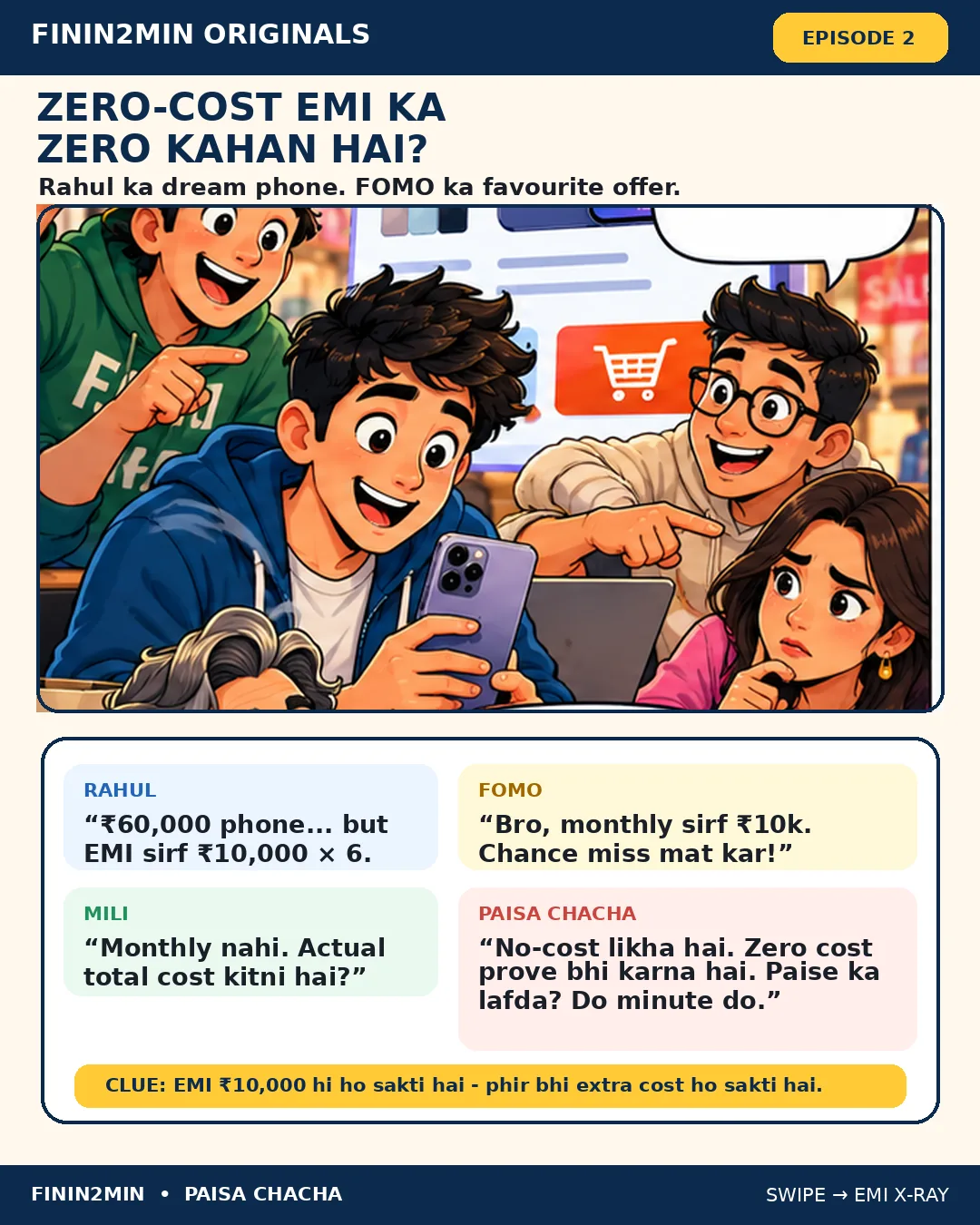
The offer
Clue: the EMI can be exactly ₹10,000 and there can still be an extra cost.
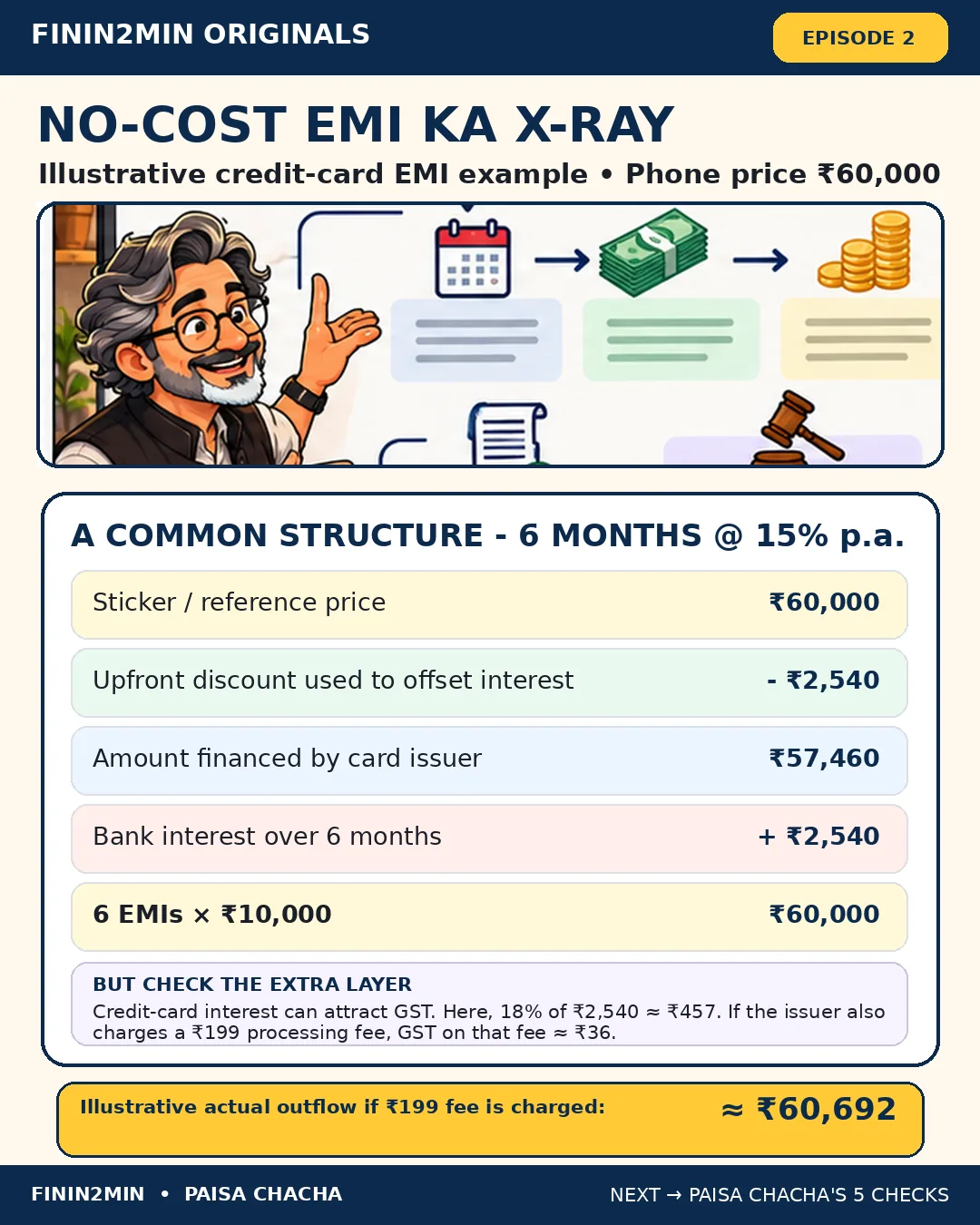
No-cost EMI ka X-ray
A common structure for a 6-month EMI at an illustrative 15% a year:
| Item | Amount (₹) |
|---|---|
| Sticker / reference price | 60,000 |
| Upfront discount used to offset interest | −2,540 |
| Amount financed by the card issuer | 57,460 |
| Bank interest over 6 months | +2,540 |
| 6 EMIs × ₹10,000 | 60,000 |
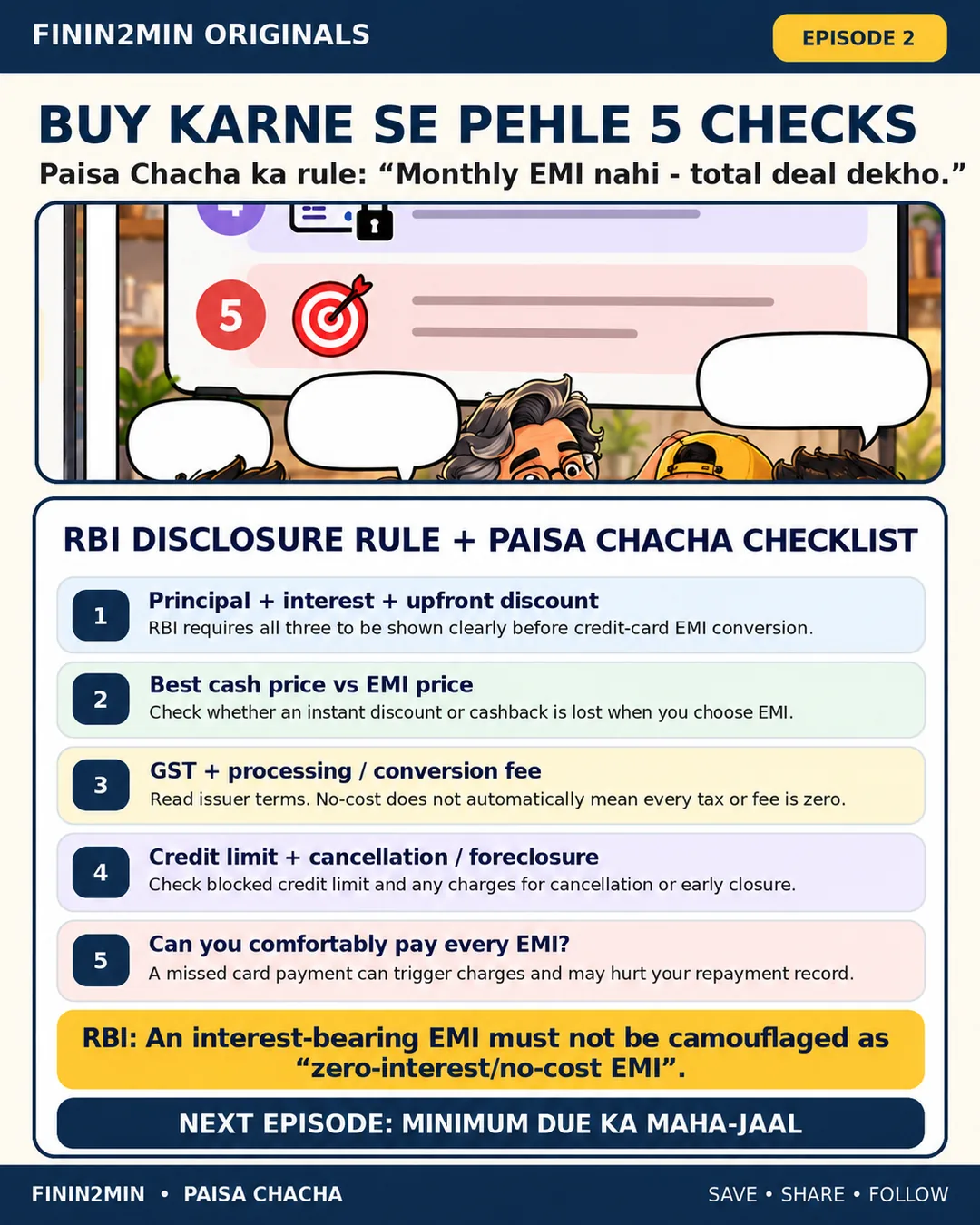
Buy karne se pehle 5 checks
Paisa Chacha’s rule: “Monthly EMI nahi — total deal dekho.”
- Principal + interest + upfront discount. RBI requires all three to be shown clearly before credit-card EMI conversion.
- Best cash price vs EMI price. Check whether an instant discount or cashback is lost when you choose EMI.
- GST + processing / conversion fee. Read the issuer's terms. No-cost does not automatically mean every tax or fee is zero.
- Credit limit + cancellation / foreclosure. Check the blocked credit limit and any charges for cancellation or early closure.
- Can you comfortably pay every EMI? A missed card payment can trigger charges and may hurt your repayment record.
The maths behind the comic
For six EMIs to be exactly ₹10,000 at 1.25% a month (15% a year), the card issuer can lend only the present value of those payments: about ₹57,460.10. The remaining ₹2,539.90 of the ₹60,000 price is the bank's interest, and an upfront discount of the same amount is what makes the deal read as “no cost”.
| Item | Working | Amount (₹) |
|---|---|---|
| Amount financed | present value of 6 × ₹10,000 at 1.25% a month | 57,460.10 |
| Bank interest | 60,000 − 57,460.10 | 2,539.90 |
| GST on interest | 18% of 2,539.90 | 457.18 |
| Processing fee (example only) | fixed fee | 199.00 |
| GST on fee | 18% of 199 | 35.82 |
| Illustrative total outflow | 60,000 + 457.18 + 199 + 35.82 | 60,692.00 |
The ₹199 fee is an example, not a claim that any particular card charges it. Use our EMI calculator to test your own amount, rate and tenure, and the loan APR calculator to see the effective rate once fees are included.
What RBI and CBIC say
- Disclosure (RBI). The Master Direction on Credit Card and Debit Card (Issuance and Conduct) Directions, 2022 requires card issuers to be transparent when converting a transaction to EMI. The principal, interest and the upfront discount provided by the merchant or card issuer to make it no cost must be clearly indicated before conversion and shown separately in the bill or statement.
- No camouflage (RBI). An EMI conversion with an interest component must not be camouflaged as a zero-interest or no-cost EMI.
- GST (CBIC). The general GST exemption for interest on deposits, loans and advances excludes interest involved in credit-card services, and financial and related services are generally taxed at 18%.
When the answer changes
- No-cost structures vary by merchant, issuer, card network, tenure and promotion. Some offers absorb some or all of the ancillary cost.
- The right comparison is the best immediately available cash or card price, not only the printed MRP.
- Lost cash discounts or reward eligibility change the real cost.
- Cancellation and foreclosure charges and the credit-limit treatment vary by issuer.
- Missed payments can attract charges and affect your credit history.
Frequently asked questions
Is a no-cost EMI really free?
Not automatically. A no-cost structure usually works because an upfront discount offsets the bank's interest, so the EMIs add up to the sticker price. In the illustration a ₹2,540 discount offsets ₹2,540 of interest. Whether you pay anything extra depends on GST, any processing or conversion fee, and what cash discount or reward you give up.
What does RBI require for credit-card EMI conversion?
The RBI Master Direction on Credit Card and Debit Card (Issuance and Conduct) Directions, 2022 requires transparency when a credit-card transaction is converted to EMI: the principal, interest and the upfront discount given by the merchant or card issuer to make it no cost must be clearly indicated before conversion and shown separately in the bill or statement. An EMI with an interest component must not be camouflaged as a zero-interest or no-cost EMI.
Does GST apply on credit-card EMI interest?
CBIC guidance states that the general GST exemption for interest on deposits, loans and advances does not cover interest involved in credit-card services, and financial and related services are generally taxed at 18%. In the illustration, 18% of ₹2,540 interest is about ₹457. A separate processing fee would carry GST too.
Does every no-cost EMI cost more than the sticker price?
No. Offers differ by merchant, issuer, card network and tenure, and some offers absorb some or all of the ancillary cost. The figures here are an illustration, not a card offer. Compare the total outflow with the best cash or card price available today.
Sources
- Reserve Bank of India: Master Direction on Credit Card and Debit Card, Issuance and Conduct Directions, 2022 (updated 7 March 2024), paragraph 6(b)(iii)
- CBIC: GST sectoral FAQs, financial services and credit-card interest
- CBIC: GST goods and services rates, heading 9971 financial and related services
Facts checked on 3 October 2026 against the RBI and CBIC material listed above. The ₹60,000 example is hypothetical.
Coming next: Episode 3, Minimum Due Ka Maha-Jaal.
Educational content only. The numbers are an illustration, not an offer or a recommendation, and this is not investment, tax or financial advice. Rates, charges, payroll treatment and tax outcomes depend on your own facts — verify against the primary sources above before acting. See our editorial policy and methodology.