₹12 Lakh CTC, ₹74,476 in the Bank: Where Did the Rest Go?
Rahul gets his first salary and the ₹12 lakh package turns into ₹74,476. The twist: in this example the gap is not income-tax TDS. Paisa Chacha explains CTC, take-home pay and why salary TDS can be nil.
Episode 1 at a glance
- CTC is not take-home. It bundles fixed pay, variable pay, employer PF and a gratuity provision.
- Monthly fixed gross: ₹79,276. After an illustrative employee PF of ₹4,800, the credit is about ₹74,476.
- Income-tax TDS: ₹0 in this case, because projected annual tax is nil under the new regime after the rebate.
- ₹12.75 lakh is a salary figure (with the ₹75,000 standard deduction), not a CTC figure.
Read the comic
Each panel is followed by its text version, so you can read it, search it or copy the numbers.
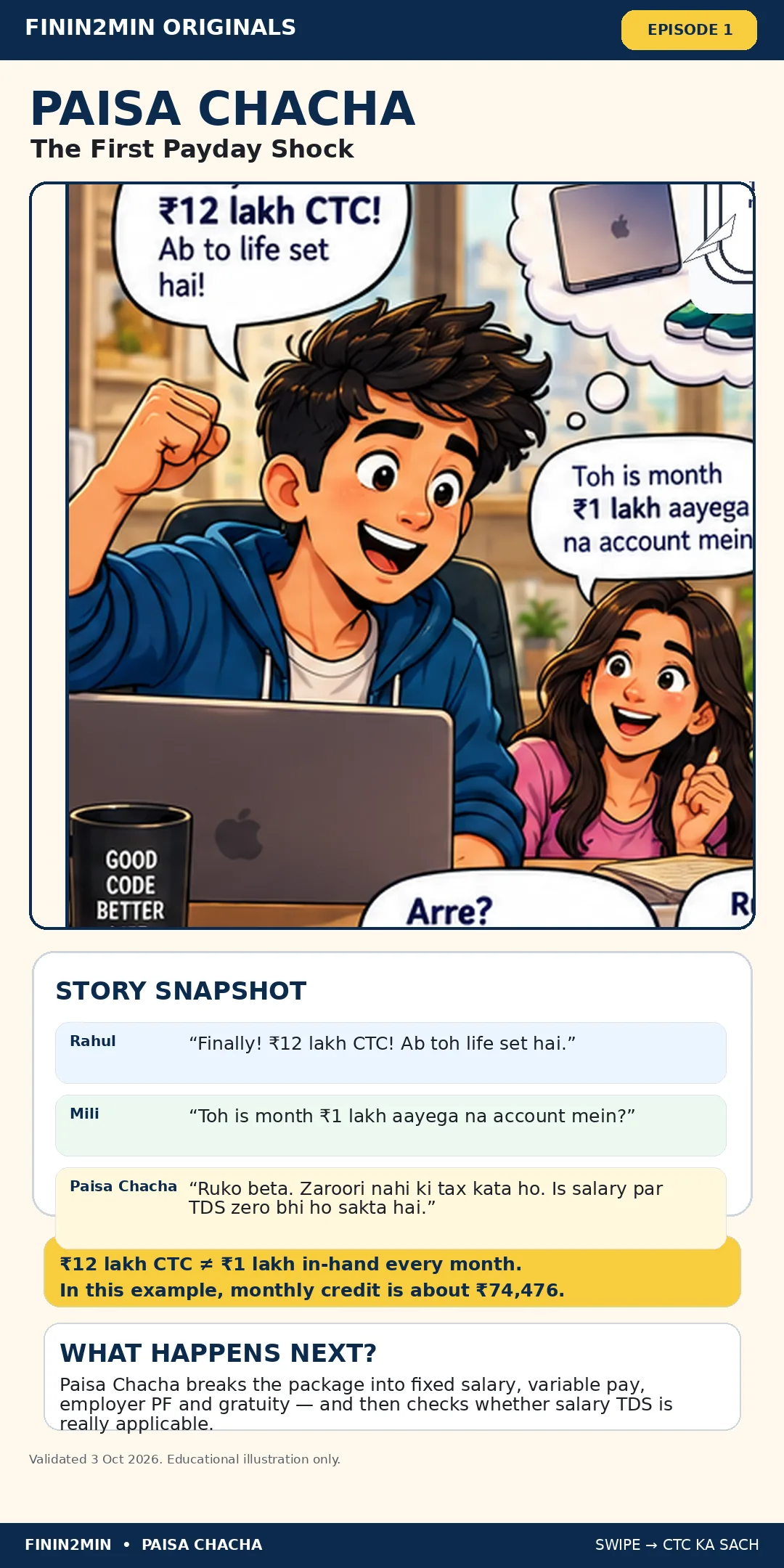
The shock
₹12 lakh CTC ≠ ₹1 lakh in-hand every month. In this example the monthly credit is about ₹74,476.
Rahul expects ₹1 lakh a month (₹12,00,000 ÷ 12). Paisa Chacha breaks the package into fixed salary, variable pay, employer PF and gratuity, and then checks whether salary TDS is really applicable.
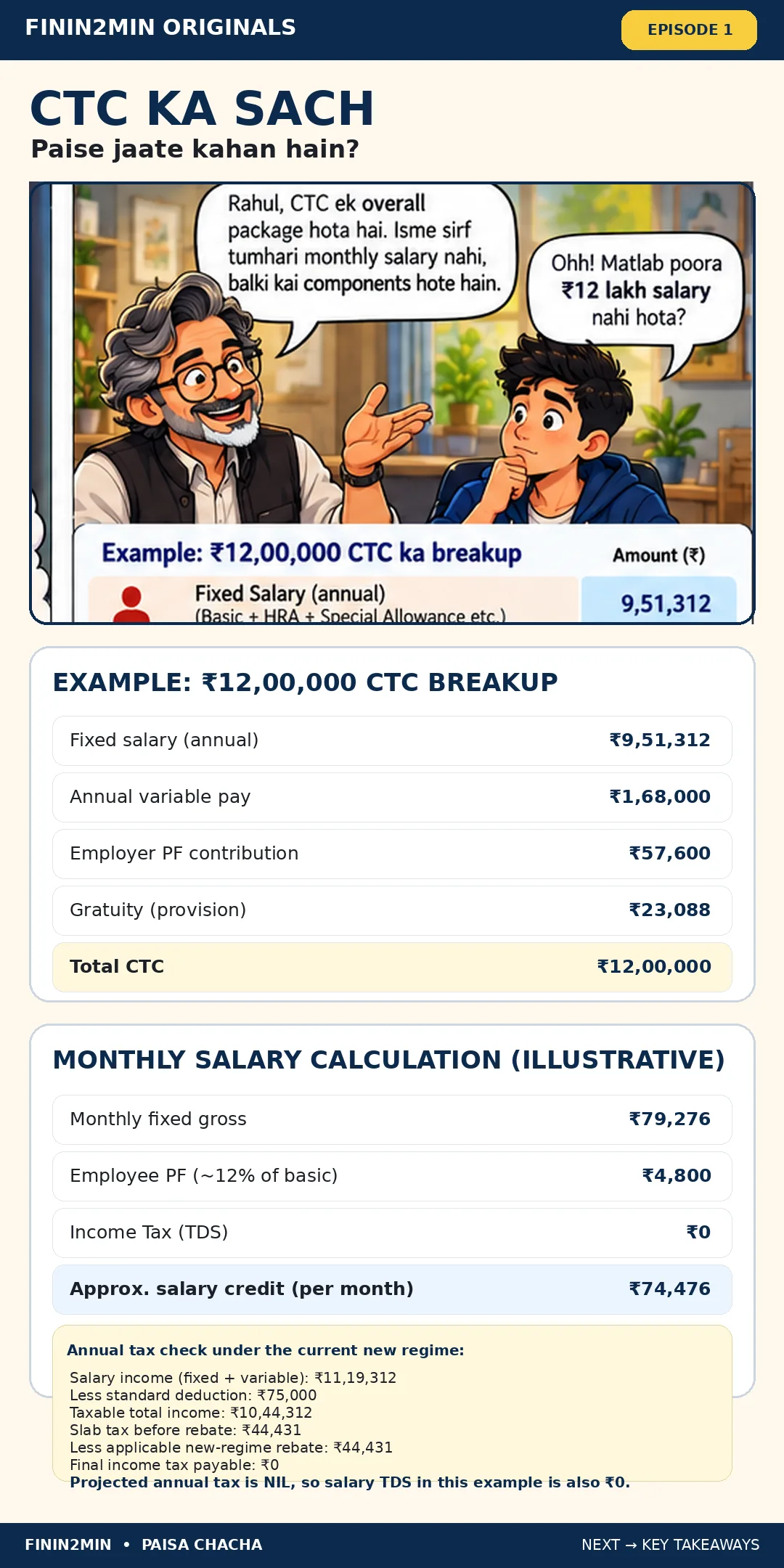
CTC ka sach: where the money goes
The illustrative ₹12,00,000 CTC breaks up like this:
| Component | Amount (₹) |
|---|---|
| Fixed salary (annual): basic, HRA, special allowance etc. | 9,51,312 |
| Annual variable pay (performance based) | 1,68,000 |
| Employer PF contribution (about 12% of basic, paid by the company) | 57,600 |
| Gratuity (provision) | 23,088 |
| Total CTC | 12,00,000 |
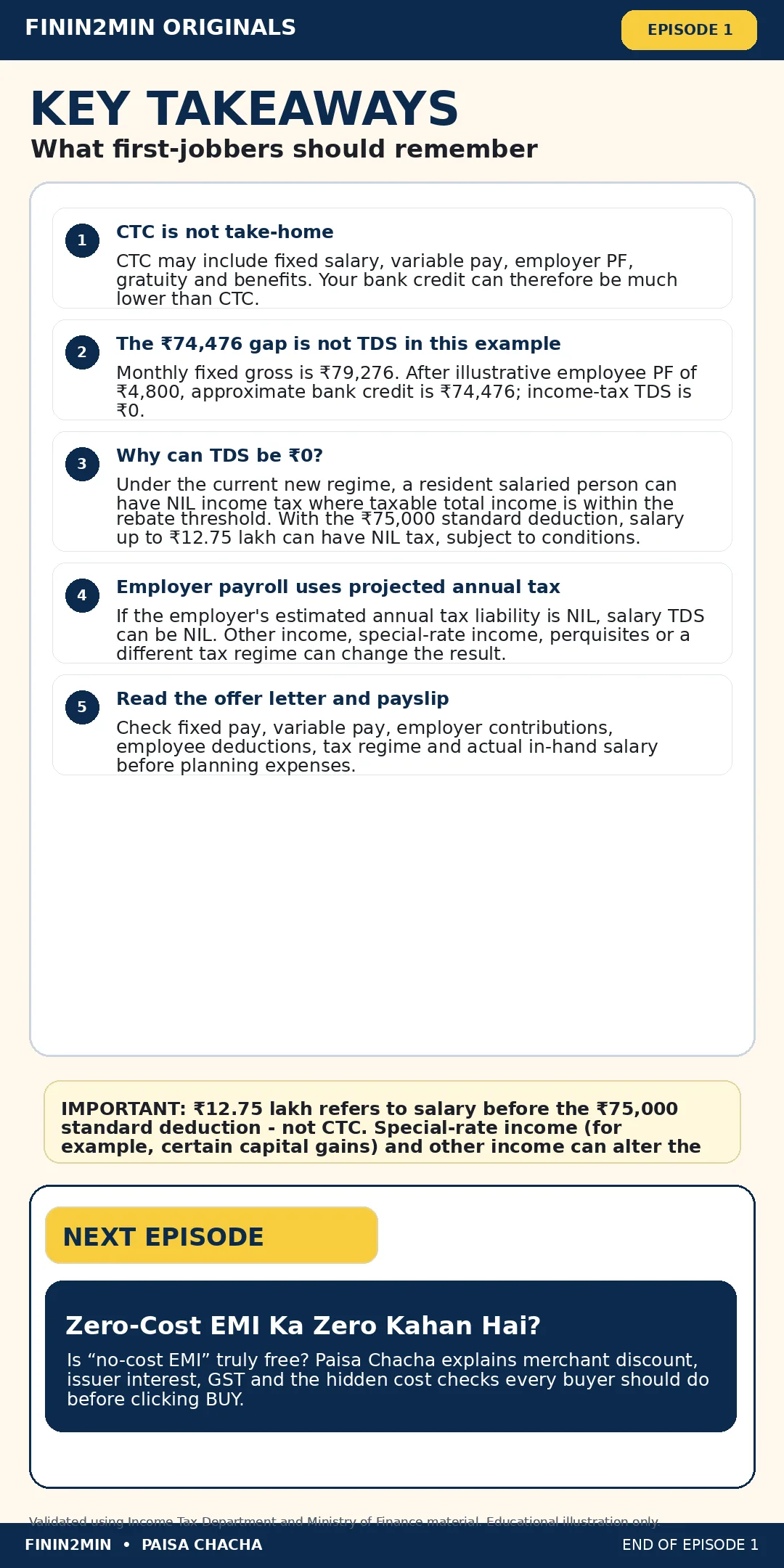
Key takeaways for first-jobbers
- CTC is not take-home. CTC may include fixed salary, variable pay, employer PF, gratuity and benefits, so your bank credit can be much lower than CTC.
- The ₹74,476 gap is not TDS in this example. Monthly fixed gross is ₹79,276; after illustrative employee PF of ₹4,800 the credit is about ₹74,476, with income-tax TDS at ₹0.
- Why can TDS be ₹0? Under the current new regime a resident salaried person can have nil income tax where taxable income is within the rebate threshold. With the ₹75,000 standard deduction, salary up to ₹12.75 lakh can have nil tax, subject to conditions.
- Employer payroll uses projected annual tax. If the employer's estimated liability is nil, salary TDS can be nil. Other income, special-rate income, perquisites or a different regime can change the result.
- Read the offer letter and payslip. Check fixed pay, variable pay, employer contributions, employee deductions, tax regime and actual in-hand salary before planning expenses.
Paisa Chacha’s rule: “Package headline hai. Payslip reality hai.”
Next episode: Zero-Cost EMI Ka Zero Kahan Hai? Is “no-cost EMI” truly free? Merchant discount, issuer interest, GST and the checks every buyer should do before clicking buy.
The numbers behind the comic
From CTC to the monthly bank credit
| Step | Amount (₹) |
|---|---|
| Monthly fixed gross (9,51,312 ÷ 12) | 79,276 |
| Less: employee PF (illustrative, about 12% of basic) | −4,800 |
| Less: income-tax TDS (projected tax is nil) | 0 |
| Approximate monthly credit | 74,476 |
The variable pay (₹1,68,000 a year) is not part of this monthly figure; it is paid, if earned, as the employer's policy decides. Other employer-specific deductions, if any, would reduce the credit further.
Why projected tax is nil (new regime, full variable pay earned)
| Step | Amount (₹) |
|---|---|
| Salary income (fixed + variable) | 11,19,312 |
| Less: standard deduction | −75,000 |
| Taxable total income | 10,44,312 |
| Slab tax before rebate (approx.) | 44,431 |
| Less: new-regime rebate (approx.) | −44,431 |
| Final income tax payable | 0 |
When the answer changes
- The example assumes a resident individual under the new tax regime with no other income that pushes total income above the rebate threshold.
- Special-rate income, including certain capital gains, can change rebate availability.
- Bonus, taxable perquisites and a different tax regime can change the projected tax and therefore the TDS.
- The PF basis varies with statutory applicability and employer policy; ₹4,800 is illustrative.
- Variable pay may be conditional and its timing differs. CTC composition differs between employers.
For salary paid from 1 April 2026, salary TDS is governed by the Income-tax Act, 2025, and the employer works it out on projected income, deductions and the applicable regime. Our salary tax hub collects the related guides.
Frequently asked questions
Is CTC the same as take-home salary?
No. CTC (cost to company) is the employer's total annual cost. It can include fixed salary, variable pay, the employer's PF contribution and a gratuity provision, so the monthly bank credit is usually well below CTC divided by 12. In this example a ₹12,00,000 CTC gives a fixed gross of ₹79,276 a month and an approximate credit of ₹74,476.
Why can salary TDS be nil on a ₹12 lakh CTC?
Payroll TDS follows the employer's projected annual tax. In the illustrated case (resident individual, new tax regime, no other income) salary income of ₹11,19,312 less the ₹75,000 standard deduction leaves ₹10,44,312. The slab tax of about ₹44,431 is fully covered by the new-regime rebate, so projected tax and salary TDS are both nil.
Does the ₹12.75 lakh nil-tax figure mean CTC?
No. ₹12.75 lakh refers to salary income before the ₹75,000 standard deduction, not to CTC. Other income, special-rate income such as certain capital gains, taxable perquisites or a different tax regime can change the result.
Will my payslip look exactly like this?
Not necessarily. CTC structures, variable-pay timing, the PF wage base and other employer-specific deductions differ. Use the offer letter and payslip, and try our CTC to in-hand calculator with your own numbers.
Sources
- Income Tax Department: Salaried Individuals for AY 2026-27, new-regime slabs and Section 87A rebate
- PIB: Union Budget 2025-26, no income tax up to ₹12 lakh and the ₹75,000 standard deduction
- Income Tax Department: Tax Deduction at Source (TDS) overview
Facts checked on 3 October 2026 against the Income Tax Department and Ministry of Finance material listed above. The salary structure is hypothetical.
Educational content only. The numbers are an illustration, not an offer or a recommendation, and this is not investment, tax or financial advice. Rates, charges, payroll treatment and tax outcomes depend on your own facts — verify against the primary sources above before acting. See our editorial policy and methodology.