Chapter XVI - Of International Law
Identify place of making, acceptance, endorsement, payment and dishonour, then obtain foreign-law evidence and conflict analysis.
Dedicated Finin2min Summary - Chapter in 2 Minutes
- Identify place of making, acceptance, endorsement, payment and dishonour, then obtain foreign-law evidence and conflict analysis.
- Primary control: conflict-of-laws gate.
- Map places, governing law, foreign-law proof and forum.
- Apply the exact current section text, amendment history and transaction evidence together.
- Do not confuse a negotiable instrument remedy with automatic proof of the underlying transaction.
Section-by-section provision map
| Provision / control | Subject | Legal effect / rule | Implementation | Evidence |
|---|---|---|---|---|
| Section 134 | Law governing liability of maker, acceptor or indorser of foreign instrument. | Section 134 allocates or releases liability concerning law governing liability of maker, acceptor or indorser of foreign instrument. | Map every party, capacity, signature, notice, consent, payment and loss before concluding exposure. | Keep instrument, authority, consideration, notices, releases and payment records. |
| Section 135 | Law of place of payment governs dishonour. | Section 135 controls the dishonour/notice process: Law of place of payment governs dishonour. | Create a date-and-service matrix and identify every liable party. | Keep return memo, notice, dispatch, delivery, response and limitation worksheet. |
| Section 136 | Instrument made, etc., out of India, but in accordance with the law of India. | Section 136 addresses instrument made, etc., out of india, but in accordance with the law of india. | Identify trigger, parties, conditions, exceptions, consequence and linked sections before execution. | Keep the current source, instrument, authority, commercial records, notices and outcome evidence. |
| Section 137 | Presumption as to foreign law. | Section 137 supplies an evidentiary rule: Presumption as to foreign law. | State the presumed fact, who bears the burden and what evidence can rebut or support it. | Keep originals, bank data, contract, ledger, correspondence and witness foundation. |
Finin2min clause-by-clause decode
Section 134 - Law governing liability of maker, acceptor or indorser of foreign instrument.
Decode: Section 134 allocates or releases liability concerning law governing liability of maker, acceptor or indorser of foreign instrument.
Implementation: Map every party, capacity, signature, notice, consent, payment and loss before concluding exposure.
Evidence: Keep instrument, authority, consideration, notices, releases and payment records.
Section 135 - Law of place of payment governs dishonour.
Decode: Section 135 controls the dishonour/notice process: Law of place of payment governs dishonour.
Implementation: Create a date-and-service matrix and identify every liable party.
Evidence: Keep return memo, notice, dispatch, delivery, response and limitation worksheet.
Section 136 - Instrument made, etc., out of India, but in accordance with the law of India.
Decode: Section 136 addresses instrument made, etc., out of india, but in accordance with the law of india.
Implementation: Identify trigger, parties, conditions, exceptions, consequence and linked sections before execution.
Evidence: Keep the current source, instrument, authority, commercial records, notices and outcome evidence.
Section 137 - Presumption as to foreign law.
Decode: Section 137 supplies an evidentiary rule: Presumption as to foreign law.
Implementation: State the presumed fact, who bears the burden and what evidence can rebut or support it.
Evidence: Keep originals, bank data, contract, ledger, correspondence and witness foundation.
Finin2min implementation explanation
Use a conflict-of-laws gate. Map places, governing law, foreign-law proof and forum. Assign an owner, due date, reviewer, source version and exception approver. No step is complete merely because a cheque exists.
Practical examples and calculations
Section 134 illustration
Example control: before relying on section 134, prepare a one-page fact matrix for law governing liability of maker, acceptor or indorser of foreign instrument, identify the document and date that proves each condition, and quantify principal, interest, fees or loss only from source records.
Section 135 illustration
Example control: before relying on section 135, prepare a one-page fact matrix for law of place of payment governs dishonour, identify the document and date that proves each condition, and quantify principal, interest, fees or loss only from source records.
Section 136 illustration
Example control: before relying on section 136, prepare a one-page fact matrix for instrument made, etc., out of india, but in accordance with the law of india, identify the document and date that proves each condition, and quantify principal, interest, fees or loss only from source records.
Section 137 illustration
Example control: before relying on section 137, prepare a one-page fact matrix for presumption as to foreign law, identify the document and date that proves each condition, and quantify principal, interest, fees or loss only from source records.
Practical transaction application
At transaction inception, document the underlying obligation, consideration, invoice/delivery/acceptance, payment terms, instrument purpose, signatory mandate, crossing, custody and alternative payment/return consequences. Reconcile books, GST/tax records and bank entries.
Authority, consent and execution controls
For a company/LLP/firm, verify board/partner authority, bank mandate, delegated limits, specimen signatures, signing capacity and complaint/settlement authority. Avoid ambiguous signatures and preserve appointment/resignation dates.
Stamp duty and registration alerts
Promissory notes and bills may attract the Indian Stamp Act and applicable State/territorial stamp framework. Cheque, agreement, guarantee, settlement and security documents can have distinct treatment. Verify current place of execution, instrument character, rate, timing and admissibility consequences before signing.
Evidence and document-retention checklist
- Current official Act and amendment source
- Original instrument / bank image and custody log
- Underlying contract, invoice, delivery and acceptance
- Authority, mandate and signatory records
- Consideration, ledger, bank and tax/GST reconciliation
- Presentation proof and bank return memo
- Notice, dispatch, tracking, service and response
- Interest, part-payment, credit-note and loss calculation
- Settlement, compounding and court orders
- Electronic record export, metadata and certification
- Case-law/limitation/jurisdiction research note
- Exception, mitigation and closure log
Use a legal-hold folder with immutable scans, originals register, metadata/export logs, bank-certified records, emails, delivery/acceptance, notices, service proofs, court filings and source-version records. Define retention beyond ordinary finance policy while litigation or limitation remains open.
Performance, delivery and payment controls
Link payment obligation to objective delivery/acceptance milestones. Record disputed quantity/quality, credit notes, set-off, part payment, interest and extension. Do not issue replacement cheques without cancelling and accounting for the earlier instrument.
Breach, loss, mitigation and remedy framework
Stop continuing loss, preserve evidence, verify the legally enforceable amount, issue contract/statutory notice, offer cure where appropriate, mitigate, quantify recoverable loss and select civil, criminal, insolvency or negotiated remedies without double recovery.
Limitation and forum controls
Maintain separate clocks for instrument maturity/presentation, notice, payment window, complaint, civil recovery, arbitration and appeal. Confirm territorial and subject-matter jurisdiction, filing authority, court holiday rules, service and condonation.
Arbitration and mediation interface
Arbitration/mediation can resolve the underlying commercial dispute and settlement terms, but cannot privately override mandatory criminal-court procedure. Coordinate compounding/withdrawal/disposal orders and default consequences.
Company, partnership, GST and tax overlays
Company/LLP law governs authority and officer responsibility; partnership law affects firm/partner exposure; GST and income-tax records help evidence supply, consideration and write-offs; IBC may alter recovery/proceeding strategy; FEMA applies to cross-border instruments; accounting standards govern recognition and impairment.
Finin2min Q&A
Does possession of a cheque alone prove the entire claim?
No. Statutory presumptions may assist, but the transaction, authority, amount, presentation, notice and other conditions should be evidenced.
Can a contract arbitration clause eliminate section 138 procedure?
No. It may govern the underlying civil dispute, while statutory criminal-court and compounding procedure continues to require proper handling.
Should altered cheques be manually corrected?
Ordinarily use a fresh instrument and preserve the cancelled instrument; CTS and material-alteration controls make overwriting high risk.
What is the first control after a cheque is returned?
Obtain and verify the bank memo, freeze the timeline, preserve the underlying debt file and assign notice/settlement/litigation owners.
How should entity liability be assessed?
Identify the drawer entity, signatory and persons in charge/responsible at the relevant time, plus any consent, connivance or neglect route and statutory defence evidence.
Is the cheque amount always the recoverable commercial amount?
Not necessarily. Reconcile part payments, credit notes, set-off, interest, tax, settlement and the legally enforceable balance.
Can the case be settled?
Section 147 permits compounding, but payment terms, default, court disposal and parallel civil remedies must be documented.
What source prevails?
The current official Act/Gazette, binding court law, applicable RBI direction and fact-specific court order prevail over the educational explanation.
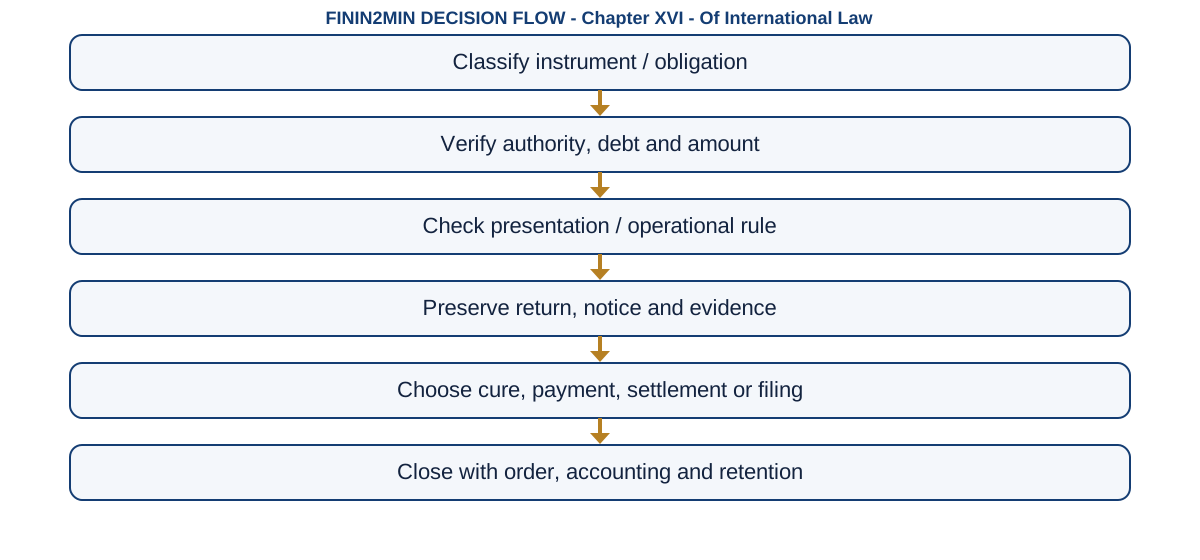
Chapter-specific decision flowchart