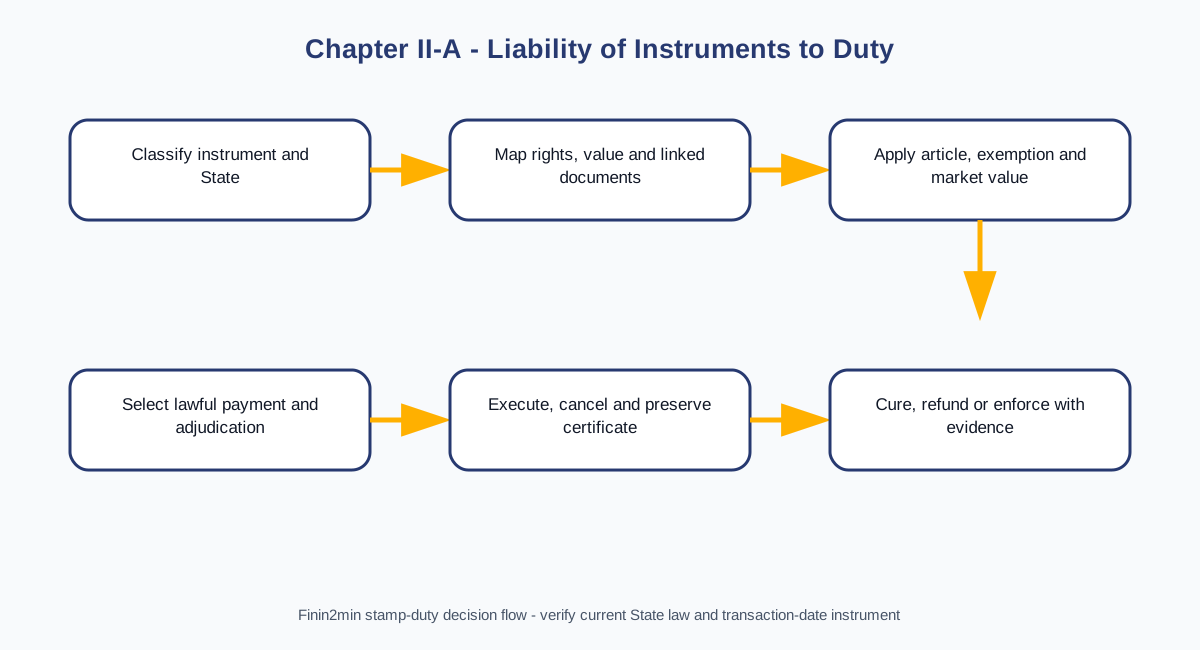
Chapter II-A - Liability of Instruments to Duty
Identify the chargeable instrument, composite transaction, distinct matters, exemptions and remissions before selecting any rate.
Dedicated Finin2min Summary - Chapter in 2 Minutes
- Section 3: Instruments chargeable with duty - convert the statutory rule into a classification, value, payer, evidence and State-source control.
- Section 3A: Repealed - convert the statutory rule into a classification, value, payer, evidence and State-source control.
- Section 4: Several instruments used in single transaction of sale, mortgage or settlement - convert the statutory rule into a classification, value, payer, evidence and State-source control.
- Identify the chargeable instrument, composite transaction, distinct matters, exemptions and remissions before selecting any rate.
- Do not quote a rate without the current State/UT Act, Schedule, amendments, surcharge/cess, market-value rule and authorised payment method.
Current statutory text / controlled source map
Section-by-section provision map
| Provision | Subject | Status | Finin2min clause-by-clause decode | Implementation | Evidence/control |
|---|---|---|---|---|---|
| Section 3 | Instruments chargeable with duty | CENTRAL ARCHITECTURE - STATE OVERLAY REQUIRED | Duty follows the legal instrument and embedded matters, not merely the document label. | Map principal and ancillary instruments, distinct matters and anti-avoidance risk. | Executed drafts, transaction map, consideration schedule and legal classification. |
| Section 3A | Repealed | REPEALED / HISTORICAL | This provision governs administration, inspection, rule-making, delegation or statutory savings. | Identify the competent government/authority and current published rule or direction. | Gazette, delegation, inspection record, rule register and authority notification. |
| Section 4 | Several instruments used in single transaction of sale, mortgage or settlement | CENTRAL ARCHITECTURE - STATE OVERLAY REQUIRED | Duty follows the legal instrument and embedded matters, not merely the document label. | Map principal and ancillary instruments, distinct matters and anti-avoidance risk. | Executed drafts, transaction map, consideration schedule and legal classification. |
| Section 5 | Instruments relating to several distinct matters | CENTRAL ARCHITECTURE - STATE OVERLAY REQUIRED | Duty follows the legal instrument and embedded matters, not merely the document label. | Map principal and ancillary instruments, distinct matters and anti-avoidance risk. | Executed drafts, transaction map, consideration schedule and legal classification. |
| Section 6 | Instruments coming within several descriptions in Schedule I | CENTRAL ARCHITECTURE - STATE OVERLAY REQUIRED | Duty follows the legal instrument and embedded matters, not merely the document label. | Map principal and ancillary instruments, distinct matters and anti-avoidance risk. | Executed drafts, transaction map, consideration schedule and legal classification. |
| Section 7 | Policies of sea-insurance | CENTRAL ARCHITECTURE - STATE OVERLAY REQUIRED | This provision governs administration, inspection, rule-making, delegation or statutory savings. | Identify the competent government/authority and current published rule or direction. | Gazette, delegation, inspection record, rule register and authority notification. |
| Section 8 | Bonds, debentures or other securities issued on loans under Act XI of 1879 | CENTRAL ARCHITECTURE - STATE OVERLAY REQUIRED | Apply the exact exemption, remission or securities collection rule only when every statutory condition is met. | Verify instrument, collecting agent, consideration, domicile State, effective date and Gazette conditions. | Exchange/depository reports, allotment/transfer records, Gazette and remittance evidence. |
| Section 8A | Securities dealt in depository not liable to stamp-duty | CENTRAL ARCHITECTURE - STATE OVERLAY REQUIRED | Apply the exact exemption, remission or securities collection rule only when every statutory condition is met. | Verify instrument, collecting agent, consideration, domicile State, effective date and Gazette conditions. | Exchange/depository reports, allotment/transfer records, Gazette and remittance evidence. |
| Section 8B | Corporatisation and demutualisation schemes and related instruments not liable to duty | CENTRAL ARCHITECTURE - STATE OVERLAY REQUIRED | Apply the exact exemption, remission or securities collection rule only when every statutory condition is met. | Verify instrument, collecting agent, consideration, domicile State, effective date and Gazette conditions. | Exchange/depository reports, allotment/transfer records, Gazette and remittance evidence. |
| Section 8C | Negotiable warehouse receipts not liable to stamp duty | CENTRAL ARCHITECTURE - STATE OVERLAY REQUIRED | Apply the exact exemption, remission or securities collection rule only when every statutory condition is met. | Verify instrument, collecting agent, consideration, domicile State, effective date and Gazette conditions. | Exchange/depository reports, allotment/transfer records, Gazette and remittance evidence. |
| Section 8D | Agreement or document for assignment of receivables not liable to stamp duty | CENTRAL ARCHITECTURE - STATE OVERLAY REQUIRED | Apply the exact exemption, remission or securities collection rule only when every statutory condition is met. | Verify instrument, collecting agent, consideration, domicile State, effective date and Gazette conditions. | Exchange/depository reports, allotment/transfer records, Gazette and remittance evidence. |
| Section 8E | Conversion of bank branch into wholly owned subsidiary or transfer of shareholding to holding company not liable to duty | CENTRAL ARCHITECTURE - STATE OVERLAY REQUIRED | Apply the exact exemption, remission or securities collection rule only when every statutory condition is met. | Verify instrument, collecting agent, consideration, domicile State, effective date and Gazette conditions. | Exchange/depository reports, allotment/transfer records, Gazette and remittance evidence. |
| Section 8F | Transfer or assignment of rights or interest in financial assets not liable to stamp duty | CENTRAL ARCHITECTURE - STATE OVERLAY REQUIRED | Apply the exact exemption, remission or securities collection rule only when every statutory condition is met. | Verify instrument, collecting agent, consideration, domicile State, effective date and Gazette conditions. | Exchange/depository reports, allotment/transfer records, Gazette and remittance evidence. |
| Section 8G | Strategic sale, disinvestment, etc., of immovable property by Government company not liable to stamp duty | CENTRAL ARCHITECTURE - STATE OVERLAY REQUIRED | Apply the exact exemption, remission or securities collection rule only when every statutory condition is met. | Verify instrument, collecting agent, consideration, domicile State, effective date and Gazette conditions. | Exchange/depository reports, allotment/transfer records, Gazette and remittance evidence. |
| Section 9 | Power to reduce, remit or compound duties | CENTRAL ARCHITECTURE - STATE OVERLAY REQUIRED | Apply the exact exemption, remission or securities collection rule only when every statutory condition is met. | Verify instrument, collecting agent, consideration, domicile State, effective date and Gazette conditions. | Exchange/depository reports, allotment/transfer records, Gazette and remittance evidence. |
Finin2min implementation explanation
Instrument and jurisdiction
Identify legal substance, execution location, property situs, parties, consideration, related instruments and the controlling State/UT law.
Rate and value
Apply the correct article, statutory base, market value, cap, minimum, surcharge, concession, remission and set-off with a reproducible calculation.
Payment and execution
Use an authorised stamp/e-stamp/franking channel, verify certificate, cancel where required and block execution until stamping controls are complete.
Cure and evidence
Preserve the original, payment proof, valuation and source pack. Route uncertainty through adjudication and defects through lawful impounding/cure or refund.
Practical examples and calculations
A transaction is ready to sign before the instrument class, State schedule, value, execution location and payment mode are confirmed. Stamp analysis must be completed as a legal closing condition.
| Calculation/control | Method | Evidence |
|---|---|---|
| Duty calculation | Rate x statutory base, subject to caps, minimums, surcharge, concession and set-off. | Calculation memo |
| Exposure | Deficit + penalty + delay + litigation/enforcement cost. | Risk model |
| Evidence | Tie legal opinion, instrument, value and payment certificate. | Closing file |
Practical transaction application
- Classify every operative instrument and linked document by substance.
- Identify State/UT, execution date/place, property situs, payer and market-value rule.
- Capture the current Act, Schedule, amendments, notifications, concessions and authorised payment method.
- Compute and approve duty, surcharge, set-off, registration fee and tax overlays before signing.
- Verify certificate, execute/cancel, register/file, preserve evidence and manage adjudication, impounding, refund or litigation.
Authority, consent and execution controls
- Correct legal entities, capacity and beneficial ownership.
- Board, partner, trustee, attorney or delegated authority.
- Final instrument version and all incorporated schedules.
- Execution date, place, witnesses, electronic signature and cross-border formalities.
- Independent confirmation that stamping method and amount are valid for the jurisdiction.
Stamp duty and registration alerts
Evidence and document-retention checklist
- Official Act, Schedule, amendment and Gazette used.
- Classification and linked-document memorandum.
- Valuation, consideration, debt and market-value workings.
- Adjudication/remission/concession approval.
- E-stamp/franking/adhesive certificate and verification result.
- Executed original, cancellation, registration and certified-copy records.
- Impounding, deficit, penalty, refund and appeal chronology.
Performance, delivery and payment controls
Closing gate
Do not release consideration, possession, securities or originals until stamping and execution conditions are satisfied.
Reconciliation
Reconcile duty and fee receipts to the exact instrument, amount, date, State, certificate and accounting entry.
Breach, loss, mitigation and remedy framework
Quantify deficit duty, penalty, interest/recovery, inadmissibility delay, transaction failure, registration consequences, counterparty indemnity and professional exposure. Consider adjudication, voluntary payment, impounding, endorsement, refund, appeal/reference, settlement and litigation.
Limitation and forum controls
Record the execution, first-receipt, impounding, Collector order, refund application, reference/appeal and underlying claim dates. The Stamp Act clock and the substantive contract/property/arbitration limitation clock must be managed separately.
Arbitration and mediation interface
Do not assume an arbitration clause or settlement avoids stamping questions. Apply current Supreme Court law, forum procedure and State amendments, and separate curability of stamp defects from validity, jurisdiction and merits.
Company, partnership, GST and tax overlays
Check Companies Act/LLP authority and filings, securities and depository rules, GST characterisation, income-tax/TDS, capitalisation or expense treatment, RERA/registration, FEMA and IBC consequences without netting them against stamp duty.
Finin2min Q&A
What is the first step?
Classify the legal instrument, State/UT and operative rights before applying Chapter II-A - Liability of Instruments to Duty.
Can an online rate calculator replace legal classification?
No. Duty depends on the instrument substance, State schedule, market value, amendments, exemptions and related documents.
Is insufficient stamping always fatal?
The consequences and cure depend on the forum, State amendments and statutory impounding/payment process. The original instrument and exact current law must be reviewed.
What should the evidence file contain?
Official legal sources, final instrument, valuation, linked-document matrix, adjudication, e-stamp/franking proof, execution/cancellation evidence, registration record and cure/refund chronology.
Chapter-specific decision flowchart