Finin2min SummarySection 133Section 134Section 135Section 136Section 137Section 138Rules/formsOld lawCase lawState alertsQ&AProvision mapTransaction and cross-law controls
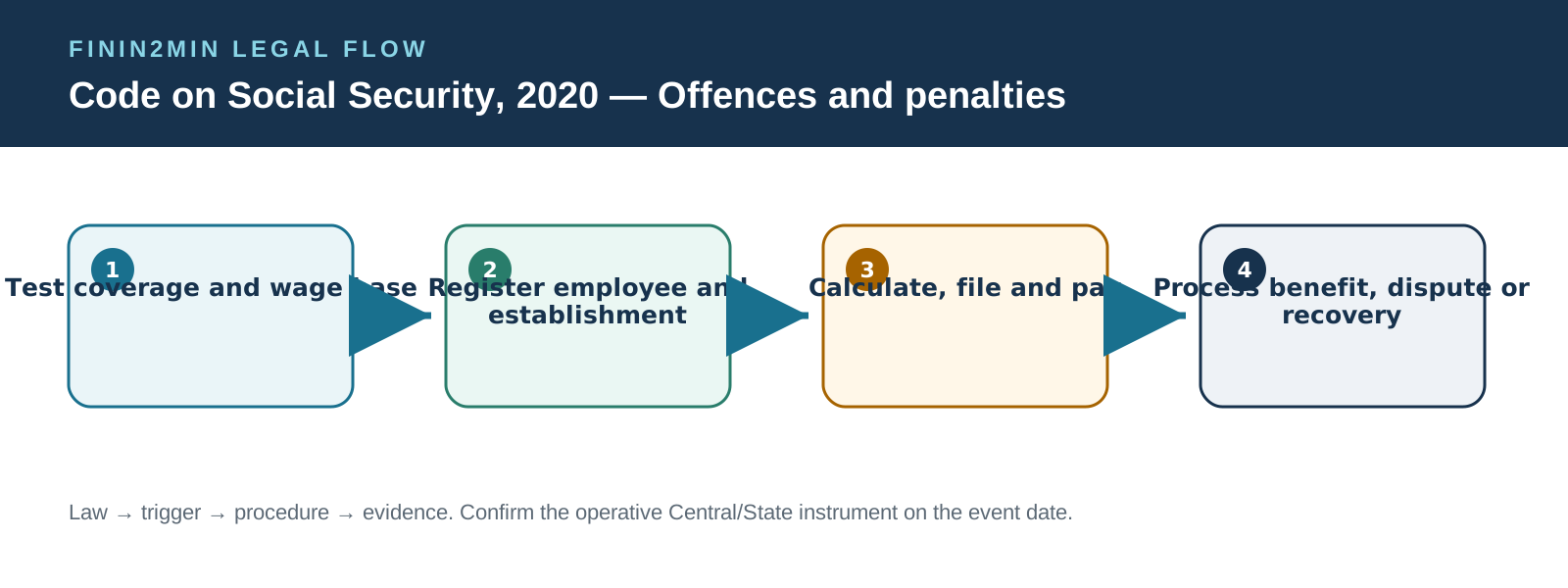
Chapter decision flow
Finin2min Summary - Chapter in 2 Minutes
This chapter turns offences and penalties into an operational control file. It covers Penalty for failure to pay contributions, etc., Enhanced punishment in certain cases after previous conviction, Offences by companies, Cognizance of offences; the practical sequence is to classify coverage and event date, apply the provision and mapped Rule, complete the form/register, calculate the entitlement or exposure, and retain evidence for inspection, claim or appeal.
Who is covered
Employers, employees, unorganised workers, gig/platform workers, beneficiaries and social-security authorities must identify the applicable chapter, establishment threshold and scheme.
Main obligations and rights
- Section 133: Penalty for failure to pay contributions, etc.
- Section 134: Enhanced punishment in certain cases after previous conviction
- Section 135: Offences by companies
- Section 136: Cognizance of offences
- Section 137: Prior opportunity before prosecution
- Section 138: Compounding of offences
Key thresholds and timelines
- Use only the threshold, rate and limitation period effective on the event date; verify the Central/State instrument before acting.
Forms, registers and evidence
- Applicable form/register, calculation file, approval and acknowledgement evidence
- Retain classification, calculation, approval, communication, acknowledgement and payment/filing proof.
Employer risk snapshot
Highest practical risks: failure to separate monetary liability, prosecution, compounding and officer-in-default exposure.
Employee/worker remedy snapshot
Core protection: access to the competent authority/court and protection against unsupported recovery or prosecution. Confirm the authority, limitation and appeal route stated in this chapter.
Old law / transition
Map the event date and savings position against: Employees’ Compensation Act, 1923; Employees’ State Insurance Act, 1948; EPF and MP Act, 1952; Employment Exchanges Act, 1959; Maternity Benefit Act, 1961.
Five-point professional checklist
- Freeze the event date, establishment, location and person/worker classification.
- Identify the controlling section/paragraph, mapped Rule, notification and appropriate Government.
- Reperform the calculation or decision test and document every exception or approval.
- Complete the prescribed form/register/portal step and retain acknowledgement, payment and communication evidence.
- Record the remedy, forum, limitation, appeal path and State variation before sign-off.
Finin2min takeaway: for offences and penalties, the defensible answer is not a policy label - it is the event-date law, the mapped procedure, the calculation and a complete evidence trail.
Section-by-section provision map
| Provision | Subject | Implementation focus |
|---|---|---|
| Section 133 | Penalty for failure to pay contributions, etc. | Trigger, linked Rule/form, evidence, consequence and remedy |
| Section 134 | Enhanced punishment in certain cases after previous conviction | Trigger, linked Rule/form, evidence, consequence and remedy |
| Section 135 | Offences by companies | Trigger, linked Rule/form, evidence, consequence and remedy |
| Section 136 | Cognizance of offences | Trigger, linked Rule/form, evidence, consequence and remedy |
| Section 137 | Prior opportunity before prosecution | Trigger, linked Rule/form, evidence, consequence and remedy |
| Section 138 | Compounding of offences | Trigger, linked Rule/form, evidence, consequence and remedy |
Section 133: Penalty for failure to pay contributions, etc.
Current statutory text
133. Penalty for failure to pay contributions, etc.— If any person,—

        (a) being an employer, fails to pay any contribution which he is liable to pay under this Code or
    rules, regulations or schemes made thereunder; or

        (b) deducts or attempts to deduct from the wages of an employee, the whole or any part of
    employer's contribution; or

         (c) in contravention of the provisions of this Code, reduces the wages or any privilege or benefits
    admissible to an employee; or

        (d) in contravention of the provisions of Chapter IV or Chapter VI or rules, regulations or schemes
   made or framed under this Code respectively, relating to such Chapters, dismisses, discharges, reduces
    in rank or otherwise penalises a woman employee; or

         (e) fails or refuses to submit any return, report, statement or any other information required under
     this Code or any rules, regulations or schemes made or framed thereunder; or

          (f) obstructs any Inspector-cum-Facilitator or other officer or staff of the Central Board or the
    Corporation or other Social Security Organisation or a competent authority in the discharge of his
    duties; or

        (g) fails to pay any amount of gratuity to which an employee is entitled under this Code; or

        (h) fails to pay any amount of compensation to which an employee is entitled under this Code; or

          (i) fails to provide any maternity benefit to which a woman is entitled under this Code; or

          (j) fails to send to a competent authority a statement which he  is required to send under
    Chapter VII; or


         (k) fails to produce on demand by the Inspector-cum-Facilitator any register or document in his
    custody kept in pursuance of this Code or the rules, regulations or schemes made or framed thereunder;
    or

          (l) fails to pay the cess for building workers which he is liable to pay under this Code; or

       (m) is guilty of any contravention of or non-compliance with any of the requirements of this Code
    or the rules or the regulations or schemes made or framed thereunder in respect of which no special
    penalty is provided in this Chapter; or

        (n) obstructs executive officer in exercising his functions under Chapter XIII; or

        (o) dishonestly makes a false return, report, statement or information to be submitted thereunder;
    or

        (p) fails or makes default in complying with any condition subject to which exemption under
    section 143 was granted; or

        (q) fails to pay any administrative or inspection charges payable under any of the schemes framed
    under Chapter III,

he shall be punishable,—

          (i) where he commits an offence under clause (a), with imprisonment for a term which may extend
    to three years, but—

          (a) which shall not be less than one year, in case of failure to pay the employee's contribution
     which has been deducted by him from the employee's wages and shall also be liable to fine of one
      lakh rupees;

          (b) which shall not be less than two months but may be extended to six months, in any other case
     and shall also be liable to fine of fifty thousand rupees:

    Provided that the court may, for any adequate and special reasons to be recorded in the judgment,
impose a sentence of imprisonment for a lesser term;

     (ii) where he commits an offence under clause (g), with imprisonment for a term which may extend to
one year or with fine which may extend to fifty thousand rupees, or with both;

     (iii) where he commits an offence under any of the clauses (d), (f), (i), (k), (l) or (o), with imprisonment
for a term which may extend to six months or with a fine which may extend to fifty thousand rupees, or
with both;

     (iv) where he commits an offence under any of the clauses (b), (c), (e), (h), (j), (m), (n), (p) or (q), with
fine which may extend to fifty thousand rupees.
Finin2min clause-by-clause decode
- Legal test 1
- Map each default to the specific penalty clause, continuing-offence exposure and responsible person.
- Implementation control
- Trigger
- Document the facts that activate section 133: penalty for failure to pay contributions, etc..
- Coverage and jurisdiction
- Identify establishment, employee/worker category, appropriate Government, First Schedule threshold and territorial authority.
- Decision owner
- Assign a named owner for offences, company liability, prosecution safeguards and compounding; identify HR, payroll, finance, legal, contractor and authorised-signatory roles.
- Evidence pack
Applicable Central Rules immediately below the provision
No direct Central Rule is mapped. Check general procedural Rules, State Rules and later notifications.
Practical example
A multi-location employer prepares a legal classification memo, identifies the appropriate Government, maps the operative provision and Rule, records the decision owner and retains the documents needed to prove compliance during inspection or litigation.
Controls and evidence
- Employer: assign owner, configure system and retain approval/payment proof.
- Employee/worker: retain contract, attendance, wage/benefit proof and communication.
- Professional: reconcile the Act, Rule, notification, form, limitation and State overlay.
Consequence, remedy and limitation
Identify the substantive default first, then separately map arrears or benefit, interest/damages, administrative penalty, prosecution, compounding, company/officer liability, forum, appeal and limitation. Do not infer a remedy from the heading alone.
Mapped Rules: No direct Central Rule mapped in the repository concordance | Official source: section 133.
Section 134: Enhanced punishment in certain cases after previous conviction
Current statutory text
134. Enhanced punishment in certain cases after previous conviction.—Whoever, having been
convicted by a court of an offence punishable under this Code, commits the same offence shall, for second,
or every subsequent such offence, be punishable with imprisonment for a term which may extend to two
years and with fine of two lakh rupees:

    Provided that where such second or subsequent offence is for failure by the employer to pay any
contribution, charges, cess, maternity benefit, gratuity or compensation which under this Code he is liable
to pay, he shall, for such second or subsequent offence, be punishable with imprisonment for a term which
may extend to three years but which shall not be less than two years and shall also be liable to fine of three
lakh rupees.
Finin2min clause-by-clause decode
- Legal test 1
- This section allocates legal responsibility for enhanced punishment in certain cases after previous conviction within the Offences And Penalties Chapter.
- Legal test 2
- Identify the statutory trigger, person obligated, authority, timing, exceptions and documentary output before applying the provision.
- Legal test 3
- Read every subsection, proviso, explanation and linked Schedule in the official text; the heading alone is not the legal test.
- Implementation control
- Trigger
- Document the facts that activate section 134: enhanced punishment in certain cases after previous conviction.
- Coverage and jurisdiction
Applicable Central Rules immediately below the provision
No direct Central Rule is mapped. Check general procedural Rules, State Rules and later notifications.
Practical example
A multi-location employer prepares a legal classification memo, identifies the appropriate Government, maps the operative provision and Rule, records the decision owner and retains the documents needed to prove compliance during inspection or litigation.
Controls and evidence
- Employer: assign owner, configure system and retain approval/payment proof.
- Employee/worker: retain contract, attendance, wage/benefit proof and communication.
- Professional: reconcile the Act, Rule, notification, form, limitation and State overlay.
Consequence, remedy and limitation
Identify the substantive default first, then separately map arrears or benefit, interest/damages, administrative penalty, prosecution, compounding, company/officer liability, forum, appeal and limitation. Do not infer a remedy from the heading alone.
Mapped Rules: No direct Central Rule mapped in the repository concordance | Official source: section 134.
Section 135: Offences by companies
Current statutory text
135. Offences by companies.— (1) Where an offence under this Chapter has been committed by a
company, every person who, at the time the offence was committed, was directly in charge of, and was
responsible to, the company for the conduct of the business of the company, as well as the company, shall
be deemed to be guilty of the offence and shall be liable to be proceeded against and punished accordingly:


    Provided that nothing contained in this sub-section shall render any such person liable to any
punishment, if he proves that the offence was committed without his knowledge or that he exercised all due
diligence to prevent the commission of such offence.

    (2) Notwithstanding anything contained in sub-section (1), where an offence has been committed by a
company and it is proved that the offence has been committed with the consent or connivance of, or is
attributable to any neglect on the part of, any director, secretary or other officer of the company, such
director, secretary or other officer shall also be deemed to be guilty of that offence and shall be liable to be
proceeded against and punished accordingly.

    Explanation.—For the purposes of this section,—

      (a) “company” means any body corporate, and includes a firm or other association of individuals;
   and

      (b) “Director”, in relation to a firm, means a partner in the firm.
Finin2min clause-by-clause decode
- Legal test 1
- This section allocates legal responsibility for offences by companies within the Offences And Penalties Chapter.
- Legal test 2
- Identify the statutory trigger, person obligated, authority, timing, exceptions and documentary output before applying the provision.
- Legal test 3
- Read every subsection, proviso, explanation and linked Schedule in the official text; the heading alone is not the legal test.
- Implementation control
- Trigger
- Document the facts that activate section 135: offences by companies.
- Coverage and jurisdiction
Applicable Central Rules immediately below the provision
No direct Central Rule is mapped. Check general procedural Rules, State Rules and later notifications.
Practical example
A multi-location employer prepares a legal classification memo, identifies the appropriate Government, maps the operative provision and Rule, records the decision owner and retains the documents needed to prove compliance during inspection or litigation.
Controls and evidence
- Employer: assign owner, configure system and retain approval/payment proof.
- Employee/worker: retain contract, attendance, wage/benefit proof and communication.
- Professional: reconcile the Act, Rule, notification, form, limitation and State overlay.
Consequence, remedy and limitation
Identify the substantive default first, then separately map arrears or benefit, interest/damages, administrative penalty, prosecution, compounding, company/officer liability, forum, appeal and limitation. Do not infer a remedy from the heading alone.
Mapped Rules: No direct Central Rule mapped in the repository concordance | Official source: section 135.
Section 136: Cognizance of offences
Current statutory text
136. Cognizance of offences.— (1) No court shall take cognizance of an offence punishable under this
Code, except on a complaint made by an aggrieved person or such officer as may be notified by the Central
Government for the purposes of offences relating to Chapter III and Chapter IV and the rules, regulations
or schemes made or framed under this Code relating to those Chapters, and for the purposes of offences
relating to other provisions of this Code and the rules, regulations or schemes made or framed thereunder,
by the officer notified by the appropriate Government.

    (2) Notwithstanding anything contained in sub-section (1), no prosecution under this Code shall be
instituted, except by or with the previous sanction of the authority notified by the Central Government for
the purposes of offences relating to Chapter III and Chapter IV and the rules, regulations or schemes made
or framed under this Code relating to those Chapters; and for the purposes of offences relating to other
provisions of this Code and the rules, regulations or schemes made or framed thereunder, the authority
notified by the appropriate Government.

    (3) No court inferior to that of a Metropolitan Magistrate or a Judicial Magistrate of the first class shall
try any offence punishable under this Chapter.

    (4) Notwithstanding anything contained in sub-section (1), a single complaint may be filed under that
sub-section by more than one aggrieved persons if they are aggrieved by the same or similar offence
committed at a place or different places within the jurisdiction of the court.
Finin2min clause-by-clause decode
- Legal test 1
- This section allocates legal responsibility for cognizance of offences within the Offences And Penalties Chapter.
- Legal test 2
- Identify the statutory trigger, person obligated, authority, timing, exceptions and documentary output before applying the provision.
- Legal test 3
- Read every subsection, proviso, explanation and linked Schedule in the official text; the heading alone is not the legal test.
- Implementation control
- Trigger
- Document the facts that activate section 136: cognizance of offences.
- Coverage and jurisdiction
Applicable Central Rules immediately below the provision
No direct Central Rule is mapped. Check general procedural Rules, State Rules and later notifications.
Practical example
A multi-location employer prepares a legal classification memo, identifies the appropriate Government, maps the operative provision and Rule, records the decision owner and retains the documents needed to prove compliance during inspection or litigation.
Controls and evidence
- Employer: assign owner, configure system and retain approval/payment proof.
- Employee/worker: retain contract, attendance, wage/benefit proof and communication.
- Professional: reconcile the Act, Rule, notification, form, limitation and State overlay.
Consequence, remedy and limitation
Identify the substantive default first, then separately map arrears or benefit, interest/damages, administrative penalty, prosecution, compounding, company/officer liability, forum, appeal and limitation. Do not infer a remedy from the heading alone.
Mapped Rules: No direct Central Rule mapped in the repository concordance | Official source: section 136.
Section 137: Prior opportunity before prosecution
Current statutory text
137. Prior opportunity before prosecution.—Notwithstanding anything contained in this Chapter,
the Inspector-cum-Facilitator or any other officer notified for the purposes of offences relating to Chapter
III and Chapter IV and the rules, regulations or schemes made or framed under this Code relating to those
Chapters, by the Central Government; and for the purposes of offences relating to other provisions of this
Code and the rules, regulations or schemes made or framed under this Code relating thereto, by the
appropriate Government, shall, before initiation of prosecution proceeding against an employer for any
offence under this Chapter, give an opportunity to the employer to comply with the aforesaid relevant
provisions by way of a written direction, which shall lay down a time period for such compliance, and, if
the employer complies with the direction within such period, then, no such proceeding shall be initiated
against the employer; but no such opportunity shall be accorded to an employer, if the violation of the same
nature of such provisions is repeated within a period of three years from the date on which such first
violation was committed and in such case the prosecution shall be initiated in accordance with the
provisions of this Chapter.
Finin2min clause-by-clause decode
- Legal test 1
- The prior-opportunity safeguard should produce a documented cure/show-cause file before prosecution where the section applies.
- Implementation control
- Trigger
- Document the facts that activate section 137: prior opportunity before prosecution.
- Coverage and jurisdiction
- Identify establishment, employee/worker category, appropriate Government, First Schedule threshold and territorial authority.
- Decision owner
- Assign a named owner for offences, company liability, prosecution safeguards and compounding; identify HR, payroll, finance, legal, contractor and authorised-signatory roles.
- Evidence pack
Applicable Central Rules immediately below the provision
No direct Central Rule is mapped. Check general procedural Rules, State Rules and later notifications.
Practical example
A multi-location employer prepares a legal classification memo, identifies the appropriate Government, maps the operative provision and Rule, records the decision owner and retains the documents needed to prove compliance during inspection or litigation.
Controls and evidence
- Employer: assign owner, configure system and retain approval/payment proof.
- Employee/worker: retain contract, attendance, wage/benefit proof and communication.
- Professional: reconcile the Act, Rule, notification, form, limitation and State overlay.
Consequence, remedy and limitation
Identify the substantive default first, then separately map arrears or benefit, interest/damages, administrative penalty, prosecution, compounding, company/officer liability, forum, appeal and limitation. Do not infer a remedy from the heading alone.
Mapped Rules: No direct Central Rule mapped in the repository concordance | Official source: section 137.
Section 138: Compounding of offences
Current statutory text
138. Compounding of offences.— (1) Notwithstanding anything contained in the Code of Criminal
Procedure, 1973 (2 of 1974), any offence committed for the first time, punishable under this Chapter, being
an offence—

          (i) punishable with fine only; or

           (ii) punishable with imprisonment for a term which is not more than one year and also with fine,

may, on an application made, either before or after the institution of any prosecution, be compounded by
an officer authorised by the Central Government for the purposes of offences relating to Chapter III and

Chapter IV and the rules, regulations or schemes made or framed under this Code relating to those Chapters,
by the Central Government; and for the purposes of offences relating to other provisions of this Code and
the rules, regulations or schemes made or framed under this Code relating thereto, by the appropriate
Government, in such manner as may be prescribed by the Central Government on payment by the offender
to the appropriate Government the amount—

          (i) in the case of an offence punishable with fine only, the half of the maximum fine provided for
    that offence; and

           (ii) in the case of an offence punishable with imprisonment for a term which is not more than one
    year and also with fine, the three-fourth of the maximum fine provided for that offence.

    (2) Nothing contained in sub-section (1) shall apply to an offence committed by a person for the second
time or thereafter within a period of three years from the date—

        (i) of commission of a similar offence which was earlier compounded; or

        (ii) of commission of similar offence for which such person was earlier convicted.

    (3) Every officer referred to in sub-section (1) shall exercise the powers to compound an offence,
subject to the direction, control and supervision of the Central Government for the purposes of offences
relating to Chapter III and Chapter IV and the rules, regulations or schemes made or framed under this Code
relating to those Chapters; and for the purposes of offences relating to other provisions of this Code and the
rules, regulations or schemes made or framed under this Code relating thereto, by the appropriate
Government.

    (4) Every application for the compounding of an offence shall be made in such form and in such manner
as may be prescribed by the appropriate Government.

    (5) Where any offence is compounded before the institution of any prosecution, no prosecution shall
be instituted in relation to such offence, against the offender in relation to whom the offence is so
compounded.

    (6) Where the compounding of any offence is made after the institution of any prosecution, such
compounding shall be brought to the notice of the court in which the prosecution is pending in writing by
the officer referred to in sub-section (1), and on such notice of the compounding of the offence being given
to the court, the person against whom the offence is so compounded shall be discharged.

    (7) Any person who fails to comply with the order made by the officer referred to in sub-section (1),
shall be liable to pay a sum equivalent to twenty per cent. of the maximum fine provided for the offence, in
addition to such fine.

                            CHAPTER XIII
                    EMPLOYMENT INFORMATION AND MONITORING
Finin2min clause-by-clause decode
- Legal test 1
- Compounding is conditional and does not replace remediation, payment of dues or future compliance.
- Implementation control
- Trigger
- Document the facts that activate section 138: compounding of offences.
- Coverage and jurisdiction
- Identify establishment, employee/worker category, appropriate Government, First Schedule threshold and territorial authority.
- Decision owner
- Assign a named owner for offences, company liability, prosecution safeguards and compounding; identify HR, payroll, finance, legal, contractor and authorised-signatory roles.
- Evidence pack
Applicable Central Rules immediately below the provision
Central Rule 54: Rule 54 — Compounding of offences
Rule mapping is retained; read the official 2026 Gazette for the exact sub-rule text and forms.
Practical example
A multi-location employer prepares a legal classification memo, identifies the appropriate Government, maps the operative provision and Rule, records the decision owner and retains the documents needed to prove compliance during inspection or litigation.
Controls and evidence
- Employer: assign owner, configure system and retain approval/payment proof.
- Employee/worker: retain contract, attendance, wage/benefit proof and communication.
- Professional: reconcile the Act, Rule, notification, form, limitation and State overlay.
Consequence, remedy and limitation
Identify the substantive default first, then separately map arrears or benefit, interest/damages, administrative penalty, prosecution, compounding, company/officer liability, forum, appeal and limitation. Do not infer a remedy from the heading alone.
Mapped Rules: Rule 54 | Official source: section 138.
Rules, forms, registers, portals and due dates
| Rule | Subject | Text/control status |
|---|---|---|
| 54 | Rule 54 — Compounding of offences | Source-controlled mapping |
Forms and registers must be confirmed from the appended 2026 Central Rules and the live portal applicable to the appropriate Government. A form is not treated as current merely because an earlier law used the same number.
Notifications and effective-date history
| Control | Required action |
|---|---|
| Enactment | Record Act number, assent and Gazette publication. |
| Commencement | Use the provision-specific commencement notification; the four Codes became broadly operative from 21 November 2025 subject to earlier partial commencement and corrigenda. |
| Central Rules | Read the applicable 2026 Central Rules from their Gazette date and verify subsequent amendments. |
| State instrument | Check final State Rules, authority notifications, forms and rates where the State is appropriate Government. |
Old-law/new-Code concordance
| Predecessor law | Transition control |
|---|---|
| Employees’ Compensation Act, 1923 | Classify the event date, accrued right, saved Rule/notification and pending proceeding before moving to the Code. |
| Employees’ State Insurance Act, 1948 | Classify the event date, accrued right, saved Rule/notification and pending proceeding before moving to the Code. |
| EPF and MP Act, 1952 | Classify the event date, accrued right, saved Rule/notification and pending proceeding before moving to the Code. |
| Employment Exchanges Act, 1959 | Classify the event date, accrued right, saved Rule/notification and pending proceeding before moving to the Code. |
| Maternity Benefit Act, 1961 | Classify the event date, accrued right, saved Rule/notification and pending proceeding before moving to the Code. |
| Payment of Gratuity Act, 1972 | Classify the event date, accrued right, saved Rule/notification and pending proceeding before moving to the Code. |
| Cine Workers Welfare Fund Act, 1981 | Classify the event date, accrued right, saved Rule/notification and pending proceeding before moving to the Code. |
| BOCW Welfare Cess Act, 1996 | Classify the event date, accrued right, saved Rule/notification and pending proceeding before moving to the Code. |
| Unorganised Workers’ Social Security Act, 2008 | Classify the event date, accrued right, saved Rule/notification and pending proceeding before moving to the Code. |
Practical calculations and control file
Calculation sequence
- Freeze the employee/worker population and event date.
- Apply the statutory wage/benefit base and notified threshold.
- Reconcile attendance, service, payroll and contractor records.
- Calculate principal amount, interest/damages and any statutory compensation separately.
- Obtain legal/payroll approval and retain the versioned worksheet.
Three-owner sign-off
- Employer/HR: facts, classification, communication and workflow.
- Employee/worker: notice, records, nomination/claim and acknowledgement.
- Professional: source, formula, forum, limitation and evidence reconciliation.
Binding and highly relevant case-law principles
| Decision | Principle and present-use caution |
|---|---|
| Regional Director, ESI Corporation v. Ramanuja Match Industries | Social-security legislation is beneficial, but coverage and contribution liability still turn on statutory definitions and evidence. |
| Organo Chemical Industries v. Union of India | Social-security defaults may attract compensatory and deterrent consequences; separate principal contribution, interest, damages and prosecution. |
| Jeewanlal (1929) Ltd. v. Appellate Authority | Gratuity is a statutory terminal benefit; eligibility and forfeiture require strict application of the governing text. |
| Municipal Corporation of Delhi v. Female Workers | Maternity protection is interpreted purposively, while present claims must be tested under the Code and current Rules. |
State-law variation alerts
- Confirm whether the Central or State Government is the appropriate Government.
- Central Rules do not automatically displace valid State Rules, rates, registers, authorities or portal procedures.
- Minimum-wage rates, holidays, working-hours permissions, licences and local welfare obligations require State-specific verification.
- Record Gazette number, effective date and supersession status in the location compliance register.
Practical examples and calculations
Classify the worker and establishment, identify the operative provision and notified instrument on the event date, compute the entitlement or exposure from source records, obtain approval, complete the filing/payment/action, and retain evidence. Do not use a portal value or payroll label as a substitute for the statutory test.
Calculation/control template: Control calculation: verified population or transaction base × applicable notified rate/amount × eligible period, adjusted for statutory inclusions, exclusions, ceilings, interest, compensation and prior payments. Reperform the calculation from retained source data.
Finin2min implementation explanation
Maintain a controlled implementation file for Chapter XII - Offences and penalties: coverage and event date, operative Central/State instrument, responsible owner, approval and authority, form/portal step, due date, calculation basis, supporting evidence, exception, escalation and closure proof. Reconcile payroll, HR, finance, contractor and legal records before sign-off.
Practical transaction application
Use the chapter in hiring, payroll migration, contractor onboarding, M&A diligence, business transfer, employee exits, death/injury claims, gratuity, maternity, gig/platform arrangements and benefit-fund reconciliations. Test coverage and contribution periods at employee and establishment level.
Authority, consent and execution controls
Assign responsibility among the employer, principal employer, payroll owner, authorised officer, nominee/claimant, social-security organisation and competent authority. Board approval or employee consent does not replace statutory registration, contribution, nomination, deposit or claim procedure.
Stamp duty and registration alerts
Contribution records and statutory returns ordinarily do not require registration, but nominations, settlements, assignments, security documents and business-transfer instruments may have separate State stamp or registration implications. Preserve the distinction between benefit filing and instrument validity.
Evidence and document-retention checklist
Retain the operative law/rule version, classification note, approvals, signed instruments, statutory forms, portal acknowledgements, registers, calculations, bank proof, correspondence, inspection records, service proof, decision and appeal file. Apply the longer of the statutory retention rule, litigation hold, tax/audit need and contractual requirement; restrict access to personal and sensitive data.
Performance, delivery and payment controls
Reconcile employee master, wage base, contribution file, challan, bank debit, return, nomination and benefit claim. For exits, deaths, injuries and transfers, create an event-date checklist with owner, statutory clock, documentary dependency and payment evidence.
Breach, loss, mitigation and remedy framework
On detecting a breach, stop continuing exposure, preserve evidence, quantify employee and government dues, identify affected persons, make lawful corrective payment/filing, notify the authorised decision-maker, assess self-disclosure or compounding where available, and reserve contractual recovery against responsible vendors without delaying statutory remediation.
Limitation and forum controls
Use the designated social-security authority, competent authority, tribunal or appellate forum. Track assessment, determination, recovery, benefit rejection and appeal dates independently; a contractual forum clause cannot defeat the statutory remedy.
Arbitration and mediation interface
Mediation may narrow factual or computation disputes but cannot waive mandatory contributions, statutory benefit eligibility, recovery powers or offences. Any settlement must identify what remains subject to authority approval or statutory adjudication.
Company, partnership, GST and tax overlays
For a company, align board/delegation and officer-in-default controls; for an LLP or partnership, identify the designated partner/partner and authorised employer representative. Labour dues can affect transaction price, indemnities, director/partner exposure and insolvency claims. Salary/TDS, perquisite, contractor TDS, GST on outsourced services and accounting provisions must be reconciled without treating tax treatment as proof of labour-law classification.
Finin2min Q&A
Which law and version should be applied?
Use the current text of Code on Social Security, 2020, the commencement notification, the applicable Central or State Rules and any later instrument effective on the event date.
How is the appropriate Government identified?
Classify ownership/control, sector, establishment and contractor relationship before selecting the Central or State authority.
Can a company policy override the statutory protection?
No. A policy may improve a benefit or control, but it cannot contract out of a mandatory statutory floor.
What evidence should be retained?
Retain the classification memo, source instrument, form/portal record, calculation, approval, employee communication, acknowledgement and payment or authority proof.
Do the Central Rules apply to every establishment?
No. They govern the Central sphere. State Rules and State notifications must be checked where the State is the appropriate Government.
How should a historical event be tested?
Apply the law and subordinate instrument effective on the event date, then use the repeal-and-savings provision for pending rights and proceedings.
What happens when portal practice conflicts with the statute?
Record the conflict, follow the higher legal instrument, seek authority clarification where necessary and preserve screenshots and correspondence.
Can criminal and monetary consequences arise together?
They may. Separate wages/benefits, interest, damages, civil penalty, prosecution, compounding and director/officer liability.
Is a contractor arrangement enough to shift liability?
No. Principal-employer and contractor liabilities depend on the specific provision and facts; the contract should allocate evidence and recovery without diluting worker rights.
What is the first professional review step?
Freeze the event date and facts, identify the applicable provision, then map Rules, forms, notification status, authority, limitation and evidence.
What is the operational focus of section 133 - Penalty for failure to pay contributions, etc.?
The section must be decomposed into actor, trigger, threshold, procedure, exception, consequence and evidence. Read the full official text and the mapped Rules before applying the Finin2min control summary.
What is the operational focus of section 134 - Enhanced punishment in certain cases after previous conviction?
The section must be decomposed into actor, trigger, threshold, procedure, exception, consequence and evidence. Read the full official text and the mapped Rules before applying the Finin2min control summary.
What is the operational focus of section 135 - Offences by companies?
The section must be decomposed into actor, trigger, threshold, procedure, exception, consequence and evidence. Read the full official text and the mapped Rules before applying the Finin2min control summary.
What is the operational focus of section 136 - Cognizance of offences?
The section must be decomposed into actor, trigger, threshold, procedure, exception, consequence and evidence. Read the full official text and the mapped Rules before applying the Finin2min control summary.
What is the operational focus of section 137 - Prior opportunity before prosecution?
The section must be decomposed into actor, trigger, threshold, procedure, exception, consequence and evidence. Read the full official text and the mapped Rules before applying the Finin2min control summary.
What is the operational focus of section 138 - Compounding of offences?
The section must be decomposed into actor, trigger, threshold, procedure, exception, consequence and evidence. Read the full official text and the mapped Rules before applying the Finin2min control summary.
What is review control 17 for this chapter?
Confirm source currency, State variation, internal ownership, documentary proof and the next statutory deadline before closing the compliance ticket.
What is review control 18 for this chapter?
Confirm source currency, State variation, internal ownership, documentary proof and the next statutory deadline before closing the compliance ticket.