Source protocol. Retained provision/rule pages and official documents are consolidated below. The signed Gazette and current authority portal prevail over normalised formatting.
For the exact locally-verified statutory text of every section and rule referenced in this chapter, see the POSH Hub (sections, rules, guides, templates). This chapter is the operational map and Finin2min synthesis layer.
Finin2min Summary - Chapter in 2 Minutes
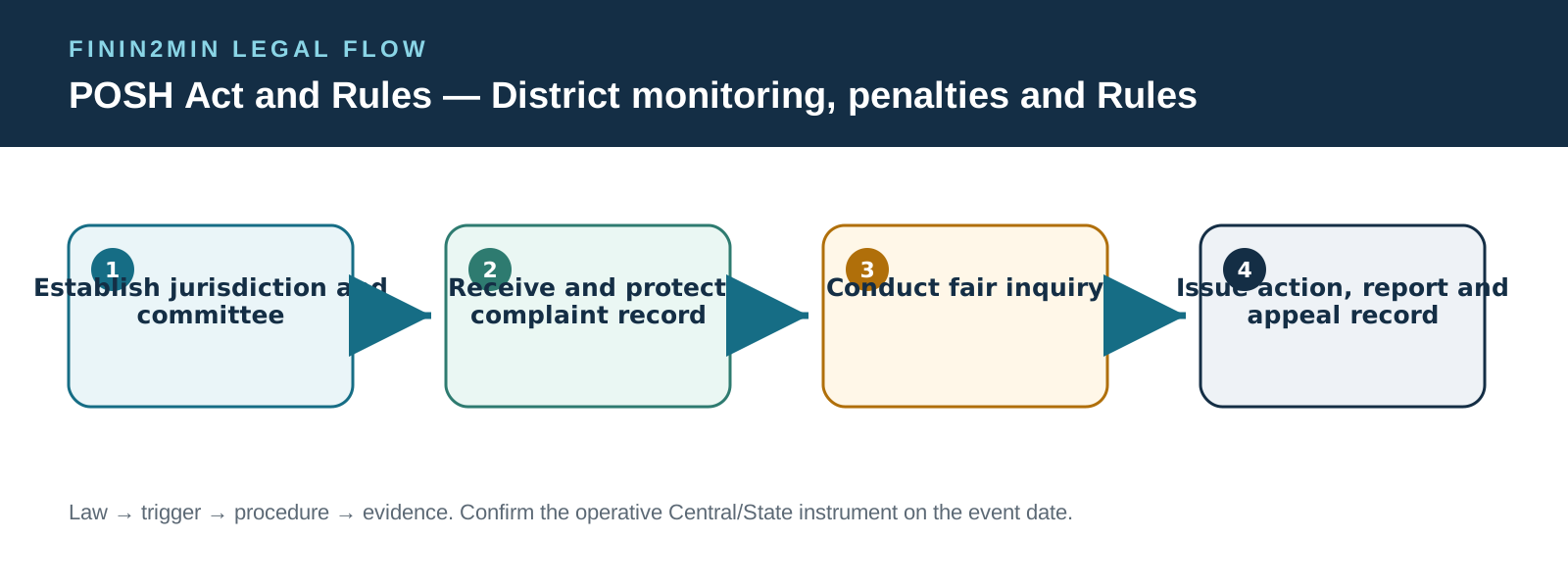
This chapter turns district monitoring, penalties and rules into an operational control file. It covers Section 20 Duties And Powers Of District Officer, Section 21 Committee Annual Report, Section 22 Employer Reporting, Section 23 Government Monitoring And Data; the practical sequence is to classify coverage and event date, apply the provision and mapped Rule, complete the form/register, calculate the entitlement or exposure, and retain evidence for inspection, claim or appeal.
Who is covered
Every workplace, employer, Internal Committee, Local Committee, aggrieved woman, respondent and inquiry participant must follow the applicable complaint and confidentiality framework.
Main obligations and rights
Section 20 Duties And Powers Of District Officer
Section 21 Committee Annual Report
Section 22 Employer Reporting
Section 23 Government Monitoring And Data
Section 24 Government Publicity Measures
Section 25 Information Calls And Inspection Of Records
Key thresholds and timelines
Use only the threshold, rate and limitation period effective on the event date; verify the Central/State instrument before acting.
Forms, registers and evidence
Register
Return
Nomination
Retain classification, calculation, approval, communication, acknowledgement and payment/filing proof.
Employer risk snapshot
Highest practical risks: committee defects, limitation errors, confidentiality breach or non-implementation of recommendations.
Employee/worker remedy snapshot
Core protection: a time-bound complaint process, interim protection, confidentiality and appeal under the statutory framework. Confirm the authority, limitation and appeal route stated in this chapter.
Old law / transition
Apply the instrument effective on the event date and preserve any accrued right, saved notification, pending proceeding or scheme-specific transition.
Five-point professional checklist
Freeze the event date, establishment, location and person/worker classification.
Identify the controlling section/paragraph, mapped Rule, notification and appropriate Government.
Reperform the calculation or decision test and document every exception or approval.
Complete the prescribed form/register/portal step and retain acknowledgement, payment and communication evidence.
Record the remedy, forum, limitation, appeal path and State variation before sign-off.
Finin2min takeaway: for district monitoring, penalties and rules, the defensible answer is not a policy label - it is the event-date law, the mapped procedure, the calculation and a complete evidence trail.
Section 20 - Duties and powers of District Officer | Finin2min
Skip to content
finin
min
Home
POSH hub
Section 20
Chapter VII - District Officer
Section 20: Duties and powers of District Officer
Requires the District Officer to monitor Local Committee reports and engage organisations for awareness and rights education.
Act No. 14 of 2013
Authority: District Officer
Data reviewed on 17 July 2026
In 2 minutes
Requires the District Officer to monitor Local Committee reports and engage organisations for awareness and rights education.
Statutory text
20. Duties and powers of District Officer.—The District Officer shall, —
(a) monitor the timely submission of report furnished by the Local Committee;
(b) take such measures as may be necessary for engaging non-governmental organisations for
creation of awareness on sexual harassment and the rights of the women.
Source transcription: India Code consolidated Act PDF. Check the official source for a live matter.
Rule, authority, record and consequence map
Related Central Rule
No dedicated Central Rule; read the Act, applicable service rules and State material.
Primary authority
District Officer
Core record
LC reports and awareness engagement records
Compliance consequence
Implementation and monitoring deficiencies may attract Government and court scrutiny.
Practical example
The District Officer reviews Local Committee annual reports and commissions district awareness programmes for unorganised workplaces.
Finin2min Q&A
What should an employer or committee do first?
Create the record identified above, check the linked Rule and preserve a dated decision trail. Do not replace the statutory process with an informal HR discussion where the Act applies.
What needs jurisdiction-specific checking?
State rules and notifications, District Officer and Local Committee details, service rules, standing orders, appellate forum and any sector regulator requirements.
← Section 19
POSH hub
Section 21 →
Section map
Top
POSH hub
Timeline
Employer checklist
Primary sources
Source note
Use the official India Code text, the 2013 Rules and the applicable State layer.
Finin2min implementation decode
A multi-location employer prepares a legal classification memo, identifies the appropriate Government, maps the operative provision and Rule, records the decision owner and retains the documents needed to prove compliance during inspection or litigation.
Identify actor, trigger, threshold and territorial authority.
Map form, record, portal, fee and due date.
Separate substantive entitlement from procedure, remedy and penal consequence.
Retain the official instrument and event-date evidence.
Section 21 Committee Annual Report
Section 21 - Committee annual report | Finin2min
Skip to content
finin
min
Home
POSH hub
Section 21
Chapter VIII - Miscellaneous
Section 21: Committee annual report
Requires each Internal or Local Committee to prepare an annual report and send it to the employer and District Officer; the District Officer sends a brief report to the State Government.
Act No. 14 of 2013
Authority: Internal Committee, Local Committee, employer and District Officer
Data reviewed on 17 July 2026
In 2 minutes
Requires each Internal or Local Committee to prepare an annual report and send it to the employer and District Officer; the District Officer sends a brief report to the State Government.
Statutory text
21. Committee to submit annual report.— (1) The Internal Committee or the Local Committee, as
the case may be, shall in each calendar year prepare, in such form and at such time as may be prescribed,
an annual report and submit the same to the employer and the District Officer.
(2) The District Officer shall forward a brief report on the annual reports received under sub-section
(1) to the State Government.
Source transcription: India Code consolidated Act PDF. Check the official source for a live matter.
Rule, authority, record and consequence map
Related Central Rule
Rule 14: Preparation of annual report
Primary authority
Internal Committee, Local Committee, employer and District Officer
Core record
IC/LC annual report and submission proof
Compliance consequence
Missing, inconsistent or inaccurate annual reports undermine section 22, SHe-Box and Government data duties.
Practical example
The committee's year-end report reconciles complaints received, disposed, pending over ninety days, workshops and action taken before submission.
Finin2min Q&A
What should an employer or committee do first?
Create the record identified above, check the linked Rule and preserve a dated decision trail. Do not replace the statutory process with an informal HR discussion where the Act applies.
What needs jurisdiction-specific checking?
State rules and notifications, District Officer and Local Committee details, service rules, standing orders, appellate forum and any sector regulator requirements.
← Section 20
POSH hub
Section 22 →
Section map
Top
POSH hub
Timeline
Employer checklist
Primary sources
Source note
Use the official India Code text, the 2013 Rules and the applicable State layer.
Finin2min implementation decode
A multi-location employer prepares a legal classification memo, identifies the appropriate Government, maps the operative provision and Rule, records the decision owner and retains the documents needed to prove compliance during inspection or litigation.
Identify actor, trigger, threshold and territorial authority.
Map form, record, portal, fee and due date.
Separate substantive entitlement from procedure, remedy and penal consequence.
Retain the official instrument and event-date evidence.
Section 22 Employer Reporting
Section 22 - Employer reporting | Finin2min
Skip to content
finin
min
Home
POSH hub
Section 22
Chapter VIII - Miscellaneous
Section 22: Employer reporting
Requires the employer to include complaint and disposal information in its annual report or report it to the District Officer where no annual report is otherwise prepared.
Act No. 14 of 2013
Authority: Employer / Board and District Officer
Data reviewed on 17 July 2026
In 2 minutes
Requires the employer to include complaint and disposal information in its annual report or report it to the District Officer where no annual report is otherwise prepared.
Company reporting:
from 14 July 2025, the Companies (Accounts) Rules require the Board’s Report to state complaints received, disposed and pending for more than ninety days, alongside the POSH compliance statement.
Statutory text
22. Employer to include information in annual report.—The employer shall include in its report
the number of cases filed, if any, and their disposal under this Act in the annual report of his organisation
or where no such report is required to be prepared, intimate such number of cases, if any, to the District
Officer.
Source transcription: India Code consolidated Act PDF. Check the official source for a live matter.
Rule, authority, record and consequence map
Related Central Rule
Rule 14: Preparation of annual report
Primary authority
Employer / Board and District Officer
Core record
Annual report, Board's Report and District Officer filing proof
Compliance consequence
Non-reporting can trigger POSH exposure; companies also face Companies Act reporting consequences.
Practical example
A company aligns the committee annual report, Board's Report disclosures and District Officer submission so the counts are consistent.
Finin2min Q&A
What should an employer or committee do first?
Create the record identified above, check the linked Rule and preserve a dated decision trail. Do not replace the statutory process with an informal HR discussion where the Act applies.
What needs jurisdiction-specific checking?
State rules and notifications, District Officer and Local Committee details, service rules, standing orders, appellate forum and any sector regulator requirements.
← Section 21
POSH hub
Section 23 →
Section map
Top
POSH hub
Timeline
Employer checklist
Primary sources
Source note
Use the official India Code text, the 2013 Rules and the applicable State layer.
Finin2min implementation decode
A multi-location employer prepares a legal classification memo, identifies the appropriate Government, maps the operative provision and Rule, records the decision owner and retains the documents needed to prove compliance during inspection or litigation.
Identify actor, trigger, threshold and territorial authority.
Map form, record, portal, fee and due date.
Separate substantive entitlement from procedure, remedy and penal consequence.
Retain the official instrument and event-date evidence.
Section 23 Government Monitoring And Data
Section 23 - Government monitoring and data | Finin2min
Skip to content
finin
min
Home
POSH hub
Section 23
Chapter VIII - Miscellaneous
Section 23: Government monitoring and data
Requires Government monitoring and maintenance of complaint and disposal data.
Act No. 14 of 2013
Authority: Appropriate Government
Data reviewed on 17 July 2026
In 2 minutes
Requires Government monitoring and maintenance of complaint and disposal data.
Statutory text
23. Appropriate Government to monitor implementation and maintain data.—The appropriate
Government shall monitor the implementation of this Act and maintain date on the number of cases filed
and disposed of in respect of all cases of sexual harassment at workplace.
Source transcription: India Code consolidated Act PDF. Check the official source for a live matter.
Rule, authority, record and consequence map
Related Central Rule
Rule 14: Preparation of annual report
Primary authority
Appropriate Government
Core record
Aggregate Government data register
Compliance consequence
Failure weakens statutory monitoring and court-directed implementation.
Practical example
The department maintains aggregate received-and-disposed data without exposing protected identities.
Finin2min Q&A
What should an employer or committee do first?
Create the record identified above, check the linked Rule and preserve a dated decision trail. Do not replace the statutory process with an informal HR discussion where the Act applies.
What needs jurisdiction-specific checking?
State rules and notifications, District Officer and Local Committee details, service rules, standing orders, appellate forum and any sector regulator requirements.
← Section 22
POSH hub
Section 24 →
Section map
Top
POSH hub
Timeline
Employer checklist
Primary sources
Source note
Use the official India Code text, the 2013 Rules and the applicable State layer.
Finin2min implementation decode
A multi-location employer prepares a legal classification memo, identifies the appropriate Government, maps the operative provision and Rule, records the decision owner and retains the documents needed to prove compliance during inspection or litigation.
Identify actor, trigger, threshold and territorial authority.
Map form, record, portal, fee and due date.
Separate substantive entitlement from procedure, remedy and penal consequence.
Retain the official instrument and event-date evidence.
Section 24 Government Publicity Measures
Section 24 - Government publicity measures | Finin2min
Skip to content
finin
min
Home
POSH hub
Section 24
Chapter VIII - Miscellaneous
Section 24: Government publicity measures
Requires publicity, awareness and Local Committee training measures by the appropriate Government.
Act No. 14 of 2013
Authority: Appropriate Government
Data reviewed on 17 July 2026
In 2 minutes
Requires publicity, awareness and Local Committee training measures by the appropriate Government.
Statutory text
24. Appropriate Government to take measures to publicise the Act.—The appropriate
Government may, subject to the availability of financial and other resources, —
(a) develop relevant information, education, communication and training materials, and organise
awareness programmes, to advance the understanding of the public of the provisions of this Act
providing for protection against sexual harassment of woman at workplace;
(b) formulate orientation and training programmes for the members of the 1[Local Committee].
Source transcription: India Code consolidated Act PDF. Check the official source for a live matter.
Rule, authority, record and consequence map
Related Central Rule
Rule 13: Manner to organise workshops and awareness
Primary authority
Appropriate Government
Core record
Publicity and training programme records
Compliance consequence
Insufficient publicity or training impairs access and may be examined in implementation proceedings.
Practical example
A State department publishes access routes and trains Local Committee members instead of relying only on a general awareness circular.
Finin2min Q&A
What should an employer or committee do first?
Create the record identified above, check the linked Rule and preserve a dated decision trail. Do not replace the statutory process with an informal HR discussion where the Act applies.
What needs jurisdiction-specific checking?
State rules and notifications, District Officer and Local Committee details, service rules, standing orders, appellate forum and any sector regulator requirements.
← Section 23
POSH hub
Section 25 →
Section map
Top
POSH hub
Timeline
Employer checklist
Primary sources
Source note
Use the official India Code text, the 2013 Rules and the applicable State layer.
Finin2min implementation decode
A multi-location employer prepares a legal classification memo, identifies the appropriate Government, maps the operative provision and Rule, records the decision owner and retains the documents needed to prove compliance during inspection or litigation.
Identify actor, trigger, threshold and territorial authority.
Map form, record, portal, fee and due date.
Separate substantive entitlement from procedure, remedy and penal consequence.
Retain the official instrument and event-date evidence.
Section 25 Information Calls And Inspection Of Records
Section 25 - Information calls and inspection of records | Finin2min
Skip to content
finin
min
Home
POSH hub
Section 25
Chapter VIII - Miscellaneous
Section 25: Information calls and inspection of records
Allows Government to call for workplace information and authorise inspection of records relating to sexual harassment.
Act No. 14 of 2013
Authority: Appropriate Government / authorised officer
Data reviewed on 17 July 2026
In 2 minutes
Allows Government to call for workplace information and authorise inspection of records relating to sexual harassment.
Statutory text
25. Power to call for information and inspection of records.—(1) The appropriate Government, on
being satisfied that it is necessary in the public interest or in the interest of women employees at a
workplace to do so, by order in writing,—
(a) call upon any employer or District Officer to furnish in writing such information relating to
sexual harassment as it may require;
(b) authorise any officer to make inspection of the records and workplace in relation to sexual
harassment, who shall submit a report of such inspection to it within such period as may be specified
in the order.
(2) Every employer and District Officer shall produce on demand before the officer making the
inspection all information, records and other documents in his custody having a bearing on the subject
matter of such inspection.
Source transcription: India Code consolidated Act PDF. Check the official source for a live matter.
Rule, authority, record and consequence map
Related Central Rule
No dedicated Central Rule; read the Act, applicable service rules and State material.
Primary authority
Appropriate Government / authorised officer
Core record
Inspection notice and production index
Compliance consequence
Non-production can lead to inspection findings and support enforcement.
Practical example
During an inspection, the establishment should be able to produce the committee order, policy, training records and annual reports without disclosing material beyond lawful necessity.
Finin2min Q&A
What should an employer or committee do first?
Create the record identified above, check the linked Rule and preserve a dated decision trail. Do not replace the statutory process with an informal HR discussion where the Act applies.
What needs jurisdiction-specific checking?
State rules and notifications, District Officer and Local Committee details, service rules, standing orders, appellate forum and any sector regulator requirements.
← Section 24
POSH hub
Section 26 →
Section map
Top
POSH hub
Timeline
Employer checklist
Primary sources
Source note
Use the official India Code text, the 2013 Rules and the applicable State layer.
Finin2min implementation decode
A multi-location employer prepares a legal classification memo, identifies the appropriate Government, maps the operative provision and Rule, records the decision owner and retains the documents needed to prove compliance during inspection or litigation.
Identify actor, trigger, threshold and territorial authority.
Map form, record, portal, fee and due date.
Separate substantive entitlement from procedure, remedy and penal consequence.
Retain the official instrument and event-date evidence.
Section 26 Penalty For Employer Non Compliance
Section 26 - Penalty for employer non-compliance | Finin2min
Skip to content
finin
min
Home
POSH hub
Section 26
Chapter VIII - Miscellaneous
Section 26: Penalty for employer non-compliance
Imposes a fine up to INR 50,000 for specified employer failures. Repeat conviction can attract double punishment and cancellation, withdrawal or non-renewal of licence or registration.
Act No. 14 of 2013
Authority: Court; licensing or registration authority on repeat conviction
Data reviewed on 17 July 2026
In 2 minutes
Imposes a fine up to INR 50,000 for specified employer failures. Repeat conviction can attract double punishment and cancellation, withdrawal or non-renewal of licence or registration.
Statutory text
26. Penalty for non-compliance with provisions of Act.—(1) Where the employer fails to—
(a) constitute an Internal Committee under sub-section (1) of section 4;
1. Subs. by Act 23 of 2016, s. 3 and the Second Schedule, for “Local Complaints Committee” (w.e.f. 6-5-2016).
(b) take action under sections 13, 14 and 22; and
(c) contravenes or attempts to contravene or abets contravention of other provisions of this Act or
any rules made thereunder,
he shall be punishable with fine which may extend to fifty thousand rupees.
(2) If any employer, after having been previously convicted of an offence punishable under this Act
subsequently commits and is convicted of the same offence, he shall be liable to—
(i) twice the punishment, which might have been imposed on a first conviction, subject to the
punishment being maximum provided for the same offence:
Provided that in case a higher punishment is prescribed under any other law for the time being in
force, for the offence for which the accused is being prosecuted, the court shall take due cognizance
of the same while awarding the punishment;
(ii) cancellation, of his licence or withdrawal, or non-renewal, or approval, or cancellation of the
registration, as the case may be, by the Government or local authority required for carrying on his
business or activity.
Source transcription: India Code consolidated Act PDF. Check the official source for a live matter.
Rule, authority, record and consequence map
Related Central Rule
No dedicated Central Rule; read the Act, applicable service rules and State material.
Primary authority
Court; licensing or registration authority on repeat conviction
Core record
Prosecution and licence/registration correspondence
Compliance consequence
Fine up to INR 50,000; repeat conviction can double punishment and affect licence or registration.
Practical example
Failure to constitute the committee or act on recommendations can result in prosecution and a fine; a repeated conviction exposes the establishment's licence or registration.
Finin2min Q&A
What should an employer or committee do first?
Create the record identified above, check the linked Rule and preserve a dated decision trail. Do not replace the statutory process with an informal HR discussion where the Act applies.
What needs jurisdiction-specific checking?
State rules and notifications, District Officer and Local Committee details, service rules, standing orders, appellate forum and any sector regulator requirements.
← Section 25
POSH hub
Section 27 →
Section map
Top
POSH hub
Timeline
Employer checklist
Primary sources
Source note
Use the official India Code text, the 2013 Rules and the applicable State layer.
Finin2min implementation decode
A multi-location employer prepares a legal classification memo, identifies the appropriate Government, maps the operative provision and Rule, records the decision owner and retains the documents needed to prove compliance during inspection or litigation.
Identify actor, trigger, threshold and territorial authority.
Map form, record, portal, fee and due date.
Separate substantive entitlement from procedure, remedy and penal consequence.
Retain the official instrument and event-date evidence.
Section 27 Cognizance Of Offences
Section 27 - Cognizance of offences | Finin2min
Skip to content
finin
min
Home
POSH hub
Section 27
Chapter VIII - Miscellaneous
Section 27: Cognizance of offences
Restricts court cognizance to complaints by the aggrieved woman or an authorised committee officer and prescribes the competent court level.
Act No. 14 of 2013
Authority: Aggrieved woman or authorised Committee officer; Magistrate/Metropolitan Magistrate
Data reviewed on 17 July 2026
In 2 minutes
Restricts court cognizance to complaints by the aggrieved woman or an authorised committee officer and prescribes the competent court level.
Statutory text
27. Cognizance of offence by courts.—(1) No court shall take cognizance of any offence punishable
under this Act or any rules made thereunder, save on a complaint made by the aggrieved woman or any
person authorised by the Internal Committee or Local Committee in this behalf.
(2) No court inferior to that of a Metropolitan Magistrate or a Judicial Magistrate of the first class
shall try any offence punishable under this Act.
(3) Every offence under this Act shall be non-cognizable.
Source transcription: India Code consolidated Act PDF. Check the official source for a live matter.
Rule, authority, record and consequence map
Related Central Rule
No dedicated Central Rule; read the Act, applicable service rules and State material.
Primary authority
Aggrieved woman or authorised Committee officer; Magistrate/Metropolitan Magistrate
Core record
Authorisation and complaint filing proof
Compliance consequence
A complaint by an unauthorised person may not satisfy the cognizance requirement.
Practical example
A criminal complaint under this Act is initiated through the statutorily authorised complainant or committee officer rather than any unrelated person.
Finin2min Q&A
What should an employer or committee do first?
Create the record identified above, check the linked Rule and preserve a dated decision trail. Do not replace the statutory process with an informal HR discussion where the Act applies.
What needs jurisdiction-specific checking?
State rules and notifications, District Officer and Local Committee details, service rules, standing orders, appellate forum and any sector regulator requirements.
← Section 26
POSH hub
Section 28 →
Section map
Top
POSH hub
Timeline
Employer checklist
Primary sources
Source note
Use the official India Code text, the 2013 Rules and the applicable State layer.
Finin2min implementation decode
A multi-location employer prepares a legal classification memo, identifies the appropriate Government, maps the operative provision and Rule, records the decision owner and retains the documents needed to prove compliance during inspection or litigation.
Identify actor, trigger, threshold and territorial authority.
Map form, record, portal, fee and due date.
Separate substantive entitlement from procedure, remedy and penal consequence.
Retain the official instrument and event-date evidence.
Section 28 Act Additional To Other Laws
Section 28 - Act additional to other laws | Finin2min
Skip to content
finin
min
Home
POSH hub
Section 28
Chapter VIII - Miscellaneous
Section 28: Act additional to other laws
Clarifies that POSH remedies supplement, rather than replace, remedies under other laws.
Act No. 14 of 2013
Authority: All competent forums
Data reviewed on 17 July 2026
In 2 minutes
Clarifies that POSH remedies supplement, rather than replace, remedies under other laws.
Statutory text
28. Act not in derogation of any other law.—The provisions of this Act shall be in addition to and
not in derogation of the provisions of any other law for the time being in force.
Source transcription: India Code consolidated Act PDF. Check the official source for a live matter.
Rule, authority, record and consequence map
Related Central Rule
No dedicated Central Rule; read the Act, applicable service rules and State material.
Primary authority
All competent forums
Core record
Parallel-proceeding tracker
Compliance consequence
Parallel civil, service, labour and criminal consequences may continue.
Practical example
The same facts may require POSH inquiry, disciplinary action and police reporting under applicable criminal law; one track does not automatically extinguish the others.
Finin2min Q&A
What should an employer or committee do first?
Create the record identified above, check the linked Rule and preserve a dated decision trail. Do not replace the statutory process with an informal HR discussion where the Act applies.
What needs jurisdiction-specific checking?
State rules and notifications, District Officer and Local Committee details, service rules, standing orders, appellate forum and any sector regulator requirements.
← Section 27
POSH hub
Section 29 →
Section map
Top
POSH hub
Timeline
Employer checklist
Primary sources
Source note
Use the official India Code text, the 2013 Rules and the applicable State layer.
Finin2min implementation decode
A multi-location employer prepares a legal classification memo, identifies the appropriate Government, maps the operative provision and Rule, records the decision owner and retains the documents needed to prove compliance during inspection or litigation.
Identify actor, trigger, threshold and territorial authority.
Map form, record, portal, fee and due date.
Separate substantive entitlement from procedure, remedy and penal consequence.
Retain the official instrument and event-date evidence.
Section 29 Rule Making Power
Section 29 - Rule-making power | Finin2min
Skip to content
finin
min
Home
POSH hub
Section 29
Chapter VIII - Miscellaneous
Section 29: Rule-making power
Lists matters for Central and State rule-making, including committee allowances, inquiry procedure, action, appeal, confidentiality penalty and annual report details.
Act No. 14 of 2013
Authority: Central and State Governments
Data reviewed on 17 July 2026
In 2 minutes
Lists matters for Central and State rule-making, including committee allowances, inquiry procedure, action, appeal, confidentiality penalty and annual report details.
Statutory text
29. Power of appropriate Government to make rules.—(1) The Central Government may, by
notification in the Official Gazette, make rules for carrying out the provisions of this Act.
(2) In particular and without prejudice to the generality of the foregoing power, such rules may
provide for all or any of the following matters, namely:—
(a) the fees or allowances to be paid to the Members under sub-section (4) of section 4;
(b) nomination of members under clause (c) of sub-section (1) of section 7;
(c) the fees or allowances to be paid to the Chairperson, and Members under sub-section (4) of
section 7;
(d) the person who may make complaint under sub-section (2) of section 9;
(e) the manner of inquiry under sub-section (1) of section 11;
(f) the powers for making an inquiry under clause (c) of sub-section (2) of section 11;
(g) the relief to be recommended under clause (c) of sub-section (1) of section 12;
(h) the manner of action to be taken under clause (i) of sub-section (3) of section 13;
(i) the manner of action to be taken under sub-sections (1) and (2) of section 14;
(j) the manner of action to be taken under section 17;
(k) the manner of appeal under sub-section (1) of section 18;
(l) the manner of organising workshops, awareness programmes for sensitising the employees and
orientation programmes for the members of the Internal Committee under clause (c) of section 19;
and
(m) the form and time for preparation of annual report by Internal Committee and the Local
Committee under sub-section (1) of section 21.
(3) Every rule made by the Central Government under this Act shall be laid as soon as may be after it
is made, before each House of Parliament, while it is in session, for a total period of thirty days which
may be comprised in one session or in two or more successive sessions, and if, before the expiry of the
session immediately following the session or the successive sessions aforesaid, both Houses agree in
making any modification in the rule or both Houses agree that the rule should not be made, the rule shall
thereafter have effect only in such modified form or be of no effect, as the case may be; so, however, that
any such modification or annulment shall be without prejudice to the validity of anything previously done
under that rule.
(4) Any rule made under sub-section (4) of section 8 by the State Government shall be laid, as soon as
may be after it is made, before each House of the State Legislature where it consists of two Houses, or
where such Legislature consists of one House, before that House.
Source transcription: India Code consolidated Act PDF. Check the official source for a live matter.
Rule, authority, record and consequence map
Related Central Rule
Rule 1: Short title and commencement
Rule 2: Definitions
Rule 3: Fees or allowances for external member of Internal Committee
Rule 4: Person familiar with issues relating to sexual harassment
Rule 5: Fees or allowances for Chairperson and members of Local Committee
Rule 6: Complaint of sexual harassment by another person
Rule 7: Manner of inquiry into complaint
Rule 8: Other relief during pendency of inquiry
Rule 9: Manner of taking action for sexual harassment
Rule 10: Action for false or malicious complaint or false evidence
Rule 11: Appeal
Rule 12: Penalty for contravention of confidentiality
Rule 13: Manner to organise workshops and awareness
Rule 14: Preparation of annual report
Primary authority
Central and State Governments
Core record
Rules and jurisdictional legal register
Compliance consequence
Compliance based only on the Act can miss prescribed procedural requirements.
Practical example
A compliance team reads the Act with the 2013 Rules because procedural deadlines and annual-report fields sit in the Rules.
Finin2min Q&A
What should an employer or committee do first?
Create the record identified above, check the linked Rule and preserve a dated decision trail. Do not replace the statutory process with an informal HR discussion where the Act applies.
What needs jurisdiction-specific checking?
State rules and notifications, District Officer and Local Committee details, service rules, standing orders, appellate forum and any sector regulator requirements.
← Section 28
POSH hub
Section 30 →
Section map
Top
POSH hub
Timeline
Employer checklist
Primary sources
Source note
Use the official India Code text, the 2013 Rules and the applicable State layer.
Finin2min implementation decode
A multi-location employer prepares a legal classification memo, identifies the appropriate Government, maps the operative provision and Rule, records the decision owner and retains the documents needed to prove compliance during inspection or litigation.
Identify actor, trigger, threshold and territorial authority.
Map form, record, portal, fee and due date.
Separate substantive entitlement from procedure, remedy and penal consequence.
Retain the official instrument and event-date evidence.
Rule 01 Short Title And Commencement
Rule 1 - Short title and commencement | Finin2min
Skip to content
finin
min
Home
POSH hub
Rule 1
POSH Rules, 2013 · G.S.R. 769(E)
Rule 1: Short title and commencement
The Rules commenced with their Gazette publication on 9 December 2013.
Central Rule
9 December 2013
Data reviewed on 17 July 2026
Rule text
1. Short title and commencement. - (1) These rules may be called the Sexual Harassment of Women at Workplace (Prevention, Prohibition and Redressal) Rules, 2013.
(2) They shall come into force on the date of their publication in the Official Gazette.
Transcribed from the Ministry of Women and Child Development Gazette PDF. For live reliance, open the official PDF in the source register.
Finin2min explanation
The Rules commenced with their Gazette publication on 9 December 2013.
Linked Act sections
Section 1
Section 29
Implementation control
Assign an owner, preserve the evidence required by this Rule, record deadlines and check whether State rules or applicable service rules add a requirement.
Rule navigation
POSH hub
Employer checklist
Section-rule map
Official sources
Finin2min implementation decode
A multi-location employer prepares a legal classification memo, identifies the appropriate Government, maps the operative provision and Rule, records the decision owner and retains the documents needed to prove compliance during inspection or litigation.
Identify actor, trigger, threshold and territorial authority.
Map form, record, portal, fee and due date.
Separate substantive entitlement from procedure, remedy and penal consequence.
Retain the official instrument and event-date evidence.
Rule 02 Definitions
Rule 2 - Definitions | Finin2min
Skip to content
finin
min
Home
POSH hub
Rule 2
POSH Rules, 2013 · G.S.R. 769(E)
Rule 2: Definitions
These definitions support the procedural Rules and import undefined expressions from the Act.
Central Rule
9 December 2013
Data reviewed on 17 July 2026
Rule text
2. Definitions. - In these rules, unless the context otherwise requires,-
(a) “Act” means the Sexual Harassment of Women at Workplace (Prevention, Prohibition and Redressal) Act, 2013 (14 of 2013);
(b) “complaint” means the complaint made under section 9;
(c) “Complaints Committee” means the Internal Committee or the Local Committee, as the case may be;
(d) “incident” means an incident of sexual harassment as defined in clause (n) of section 2;
(e) “section” means a section of the Act;
(f) “special educator” means a person trained in communication with people with special needs in a way that addresses their individual differences and needs;
(g) words and expressions used herein and not defined but defined in the Act shall have the meanings respectively assigned to them in the Act.
Transcribed from the Ministry of Women and Child Development Gazette PDF. For live reliance, open the official PDF in the source register.
Finin2min explanation
These definitions support the procedural Rules and import undefined expressions from the Act.
Linked Act sections
Section 2
Section 29
Implementation control
Assign an owner, preserve the evidence required by this Rule, record deadlines and check whether State rules or applicable service rules add a requirement.
Rule navigation
POSH hub
Employer checklist
Section-rule map
Official sources
Finin2min implementation decode
A multi-location employer prepares a legal classification memo, identifies the appropriate Government, maps the operative provision and Rule, records the decision owner and retains the documents needed to prove compliance during inspection or litigation.
Identify actor, trigger, threshold and territorial authority.
Map form, record, portal, fee and due date.
Separate substantive entitlement from procedure, remedy and penal consequence.
Retain the official instrument and event-date evidence.
Rule 03 Fees Or Allowances For External Member Of Internal Committee
Rule 3 - Fees or allowances for external member of Internal Committee | Finin2min
Skip to content
finin
min
Home
POSH hub
Rule 3
POSH Rules, 2013 · G.S.R. 769(E)
Rule 3: Fees or allowances for external member of Internal Committee
The employer bears the prescribed external-member sitting and travel cost. The amounts are the text of the Central Rules; check any applicable State rule or later notification before payment.
Central Rule
9 December 2013
Data reviewed on 17 July 2026
Rule text
3. Fees or allowances for Member of Internal Committee. - (1) The Member appointed from amongst non-government organisations shall be entitled to an allowance of two hundred rupees per day for holding the proceedings of the Internal Committee and also the reimbursement of travel cost incurred in travelling by train in three tier air condition or air conditioned bus and auto rickshaw or taxi, or the actual amount spent by him on travel, whichever is less.
(2) The employer shall be responsible for the payment of allowances referred to in sub-rule (1).
Transcribed from the Ministry of Women and Child Development Gazette PDF. For live reliance, open the official PDF in the source register.
Finin2min explanation
The employer bears the prescribed external-member sitting and travel cost. The amounts are the text of the Central Rules; check any applicable State rule or later notification before payment.
Linked Act sections
Section 4
Section 29
Implementation control
Assign an owner, preserve the evidence required by this Rule, record deadlines and check whether State rules or applicable service rules add a requirement.
Rule navigation
POSH hub
Employer checklist
Section-rule map
Official sources
Finin2min implementation decode
A multi-location employer prepares a legal classification memo, identifies the appropriate Government, maps the operative provision and Rule, records the decision owner and retains the documents needed to prove compliance during inspection or litigation.
Identify actor, trigger, threshold and territorial authority.
Map form, record, portal, fee and due date.
Separate substantive entitlement from procedure, remedy and penal consequence.
Retain the official instrument and event-date evidence.
Rule 04 Person Familiar With Issues Relating To Sexual Harassment
Rule 4 - Person familiar with issues relating to sexual harassment | Finin2min
Skip to content
finin
min
Home
POSH hub
Rule 4
POSH Rules, 2013 · G.S.R. 769(E)
Rule 4: Person familiar with issues relating to sexual harassment
Expertise can arise through at least five years of relevant social work or familiarity with labour, service, civil or criminal law. The statutory appointment clause and current SHe-Box empanelment process should also be checked.
Central Rule
9 December 2013
Data reviewed on 17 July 2026
Rule text
4. Person familiar with issues relating to sexual harassment. - Person familiar with the issues relating to sexual harassment for the purpose of clause (c) of sub-section (1) of section 7 shall be a person who has expertise on issues relating to sexual harassment and may include any of the following:-
(a) a social worker with at least five years' experience in the field of social work which leads to creation of societal conditions favourable towards empowerment of women and in particular in addressing workplace sexual harassment;
(b) a person who is familiar with labour, service, civil or criminal law.
Transcribed from the Ministry of Women and Child Development Gazette PDF. For live reliance, open the official PDF in the source register.
Finin2min explanation
Expertise can arise through at least five years of relevant social work or familiarity with labour, service, civil or criminal law. The statutory appointment clause and current SHe-Box empanelment process should also be checked.
Linked Act sections
Section 6
Section 7
Section 29
Implementation control
Assign an owner, preserve the evidence required by this Rule, record deadlines and check whether State rules or applicable service rules add a requirement.
Rule navigation
POSH hub
Employer checklist
Section-rule map
Official sources
Finin2min implementation decode
A multi-location employer prepares a legal classification memo, identifies the appropriate Government, maps the operative provision and Rule, records the decision owner and retains the documents needed to prove compliance during inspection or litigation.
Identify actor, trigger, threshold and territorial authority.
Map form, record, portal, fee and due date.
Separate substantive entitlement from procedure, remedy and penal consequence.
Retain the official instrument and event-date evidence.
Rule 05 Fees Or Allowances For Chairperson And Members Of Local Committee
Rule 5 - Fees or allowances for Chairperson and members of Local Committee | Finin2min
Skip to content
finin
min
Home
POSH hub
Rule 5
POSH Rules, 2013 · G.S.R. 769(E)
Rule 5: Fees or allowances for Chairperson and members of Local Committee
The District Officer funds the prescribed Local Committee allowances and travel reimbursement under the Central Rules, subject to applicable jurisdictional provisions.
Central Rule
9 December 2013
Data reviewed on 17 July 2026
Rule text
5. Fees or allowances for Chairperson and Members of Local Committee. - (1) The Chairperson of the Local Committee shall be entitled to an allowance of two hundred and fifty rupees per day for holding the proceedings of the said Committee.
(2) The Members of the Local Committee other than the Members nominated under clauses (b) and (d) of sub-section (1) of section 7 shall be entitled to an allowance of two hundred rupees per day for holding the proceedings of the said Committee and also the reimbursement of travel cost incurred in travelling by train in three tier air condition or air conditioned bus and auto rickshaw or taxi, or the actual amount spent by him on travel, whichever is less.
(3) The District Officer shall be responsible for the payment of allowances referred to in sub-rules (1) and (2).
Transcribed from the Ministry of Women and Child Development Gazette PDF. For live reliance, open the official PDF in the source register.
Finin2min explanation
The District Officer funds the prescribed Local Committee allowances and travel reimbursement under the Central Rules, subject to applicable jurisdictional provisions.
Linked Act sections
Section 6
Section 7
Section 8
Section 29
Implementation control
Assign an owner, preserve the evidence required by this Rule, record deadlines and check whether State rules or applicable service rules add a requirement.
Rule navigation
POSH hub
Employer checklist
Section-rule map
Official sources
Finin2min implementation decode
A multi-location employer prepares a legal classification memo, identifies the appropriate Government, maps the operative provision and Rule, records the decision owner and retains the documents needed to prove compliance during inspection or litigation.
Identify actor, trigger, threshold and territorial authority.
Map form, record, portal, fee and due date.
Separate substantive entitlement from procedure, remedy and penal consequence.
Retain the official instrument and event-date evidence.
Rule 06 Complaint Of Sexual Harassment By Another Person
Rule 6 - Complaint of sexual harassment by another person | Finin2min
Skip to content
finin
min
Home
POSH hub
Rule 6
POSH Rules, 2013 · G.S.R. 769(E)
Rule 6: Complaint of sexual harassment by another person
The rule prevents incapacity, death or inability from blocking access to the complaint mechanism and specifies consent safeguards.
Central Rule
9 December 2013
Data reviewed on 17 July 2026
Rule text
6. Complaint of sexual harassment. - For the purpose of sub-section (2) of section 9,-
(i) where the aggrieved woman is unable to make a complaint on account of her physical incapacity, a complaint may be filed by her relative or friend; her co-worker; an officer of the National Commission for Women or State Women's Commission; or any person who has knowledge of the incident, with her written consent;
(ii) where she is unable to complain on account of mental incapacity, a complaint may be filed by her relative or friend; a special educator; a qualified psychiatrist or psychologist; the guardian or authority under whose care she is receiving treatment or care; or a person with knowledge of the incident jointly with one of those persons;
(iii) where she is unable to complain for any other reason, a person with knowledge of the incident may file with her written consent;
(iv) where she is dead, a person with knowledge of the incident may file with the written consent of her legal heir.
Transcribed from the Ministry of Women and Child Development Gazette PDF. For live reliance, open the official PDF in the source register.
Finin2min explanation
The rule prevents incapacity, death or inability from blocking access to the complaint mechanism and specifies consent safeguards.
Linked Act sections
Section 6
Section 9
Section 29
Implementation control
Assign an owner, preserve the evidence required by this Rule, record deadlines and check whether State rules or applicable service rules add a requirement.
Rule navigation
POSH hub
Employer checklist
Section-rule map
Official sources
Finin2min implementation decode
A multi-location employer prepares a legal classification memo, identifies the appropriate Government, maps the operative provision and Rule, records the decision owner and retains the documents needed to prove compliance during inspection or litigation.
Identify actor, trigger, threshold and territorial authority.
Map form, record, portal, fee and due date.
Separate substantive entitlement from procedure, remedy and penal consequence.
Retain the official instrument and event-date evidence.
Rule 07 Manner Of Inquiry Into Complaint
Rule 7 - Manner of inquiry into complaint | Finin2min
Skip to content
finin
min
Home
POSH hub
Rule 7
POSH Rules, 2013 · G.S.R. 769(E)
Rule 7: Manner of inquiry into complaint
This is the central procedural backbone: copies, service, reply time, natural justice, absence protocol, no legal practitioners and minimum quorum.
Central Rule
9 December 2013
Data reviewed on 17 July 2026
Rule text
7. Manner of inquiry into complaint. - (1) Subject to section 11, the complainant shall submit six copies of the complaint with supporting documents and names and addresses of witnesses.
(2) The Complaints Committee shall send a copy to the respondent within seven working days.
(3) The respondent shall file a reply with documents and witness details within ten working days of receipt.
(4) The inquiry shall follow the principles of natural justice.
(5) The Committee may terminate proceedings or proceed ex parte after three consecutive absences without sufficient cause, but only after fifteen days' advance written notice.
(6) Parties shall not bring a legal practitioner to represent them before the Committee.
(7) At least three Committee members, including the Presiding Officer or Chairperson, must be present.
Transcribed from the Ministry of Women and Child Development Gazette PDF. For live reliance, open the official PDF in the source register.
Finin2min explanation
This is the central procedural backbone: copies, service, reply time, natural justice, absence protocol, no legal practitioners and minimum quorum.
Linked Act sections
Section 9
Section 10
Section 11
Section 29
Implementation control
Assign an owner, preserve the evidence required by this Rule, record deadlines and check whether State rules or applicable service rules add a requirement.
Rule navigation
POSH hub
Employer checklist
Section-rule map
Official sources
Finin2min implementation decode
A multi-location employer prepares a legal classification memo, identifies the appropriate Government, maps the operative provision and Rule, records the decision owner and retains the documents needed to prove compliance during inspection or litigation.
Identify actor, trigger, threshold and territorial authority.
Map form, record, portal, fee and due date.
Separate substantive entitlement from procedure, remedy and penal consequence.
Retain the official instrument and event-date evidence.
Rule 08 Other Relief During Pendency Of Inquiry
Rule 8 - Other relief during pendency of inquiry | Finin2min
Skip to content
finin
min
Home
POSH hub
Rule 8
POSH Rules, 2013 · G.S.R. 769(E)
Rule 8: Other relief during pendency of inquiry
These prescribed measures supplement the transfer and leave relief listed in section 12.
Central Rule
9 December 2013
Data reviewed on 17 July 2026
Rule text
8. Other relief to complainant during pendency of inquiry. - At the written request of the aggrieved woman, the Complaints Committee may recommend that the employer restrain the respondent from reporting on her work performance or writing her confidential report and assign that function to another officer; or, in an educational institution, restrain the respondent from supervising her academic activity.
Transcribed from the Ministry of Women and Child Development Gazette PDF. For live reliance, open the official PDF in the source register.
Finin2min explanation
These prescribed measures supplement the transfer and leave relief listed in section 12.
Linked Act sections
Section 12
Section 29
Implementation control
Assign an owner, preserve the evidence required by this Rule, record deadlines and check whether State rules or applicable service rules add a requirement.
Rule navigation
POSH hub
Employer checklist
Section-rule map
Official sources
Finin2min implementation decode
A multi-location employer prepares a legal classification memo, identifies the appropriate Government, maps the operative provision and Rule, records the decision owner and retains the documents needed to prove compliance during inspection or litigation.
Identify actor, trigger, threshold and territorial authority.
Map form, record, portal, fee and due date.
Separate substantive entitlement from procedure, remedy and penal consequence.
Retain the official instrument and event-date evidence.
Rule 09 Manner Of Taking Action For Sexual Harassment
Rule 9 - Manner of taking action for sexual harassment | Finin2min
Skip to content
finin
min
Home
POSH hub
Rule 9
POSH Rules, 2013 · G.S.R. 769(E)
Rule 9: Manner of taking action for sexual harassment
Where service rules do not prescribe action, the rule supplies a non-exhaustive range of disciplinary recommendations.
Central Rule
9 December 2013
Data reviewed on 17 July 2026
Rule text
9. Manner of taking action for sexual harassment. - Except where service rules exist, when the allegation is proved the Committee may recommend action including written apology, warning, reprimand or censure, withholding promotion, withholding pay rise or increments, termination from service, counselling or community service.
Transcribed from the Ministry of Women and Child Development Gazette PDF. For live reliance, open the official PDF in the source register.
Finin2min explanation
Where service rules do not prescribe action, the rule supplies a non-exhaustive range of disciplinary recommendations.
Linked Act sections
Section 13
Section 29
Implementation control
Assign an owner, preserve the evidence required by this Rule, record deadlines and check whether State rules or applicable service rules add a requirement.
Rule navigation
POSH hub
Employer checklist
Section-rule map
Official sources
Finin2min implementation decode
A multi-location employer prepares a legal classification memo, identifies the appropriate Government, maps the operative provision and Rule, records the decision owner and retains the documents needed to prove compliance during inspection or litigation.
Identify actor, trigger, threshold and territorial authority.
Map form, record, portal, fee and due date.
Separate substantive entitlement from procedure, remedy and penal consequence.
Retain the official instrument and event-date evidence.
Rule 10 Action For False Or Malicious Complaint Or False Evidence
Rule 10 - Action for false or malicious complaint or false evidence | Finin2min
Skip to content
finin
min
Home
POSH hub
Rule 10
POSH Rules, 2013 · G.S.R. 769(E)
Rule 10: Action for false or malicious complaint or false evidence
Action requires a specific finding of malice, knowing falsity or forged/misleading material; mere failure to prove a complaint is insufficient under section 14.
Central Rule
9 December 2013
Data reviewed on 17 July 2026
Rule text
10. Action for false or malicious complaint or false evidence. - Except where service rules exist, where the Committee concludes that the allegation was malicious, the complaint was knowingly false, or a forged or misleading document was produced, it may recommend action in accordance with rule 9.
Transcribed from the Ministry of Women and Child Development Gazette PDF. For live reliance, open the official PDF in the source register.
Finin2min explanation
Action requires a specific finding of malice, knowing falsity or forged/misleading material; mere failure to prove a complaint is insufficient under section 14.
Linked Act sections
Section 14
Section 29
Implementation control
Assign an owner, preserve the evidence required by this Rule, record deadlines and check whether State rules or applicable service rules add a requirement.
Rule navigation
POSH hub
Employer checklist
Section-rule map
Official sources
Finin2min implementation decode
A multi-location employer prepares a legal classification memo, identifies the appropriate Government, maps the operative provision and Rule, records the decision owner and retains the documents needed to prove compliance during inspection or litigation.
Identify actor, trigger, threshold and territorial authority.
Map form, record, portal, fee and due date.
Separate substantive entitlement from procedure, remedy and penal consequence.
Retain the official instrument and event-date evidence.
Rule 11 Appeal
Rule 11 - Appeal | Finin2min
Skip to content
finin
min
Home
POSH hub
Rule 11
POSH Rules, 2013 · G.S.R. 769(E)
Rule 11: Appeal
The prescribed appeal text refers to the 1946 Standing Orders Act. Deployment should cross-link the current Industrial Relations Code transition page and applicable service-rule forum rather than presenting one universal forum.
Central Rule
9 December 2013
Data reviewed on 17 July 2026
Rule text
11. Appeal. - Subject to section 18, an aggrieved person may appeal covered recommendations, confidentiality action or non-implementation to the appellate authority notified under the Industrial Employment (Standing Orders) Act, 1946. The forum must be read with the applicable service rules and the current labour-law transition.
Transcribed from the Ministry of Women and Child Development Gazette PDF. For live reliance, open the official PDF in the source register.
Finin2min explanation
The prescribed appeal text refers to the 1946 Standing Orders Act. Deployment should cross-link the current Industrial Relations Code transition page and applicable service-rule forum rather than presenting one universal forum.
Linked Act sections
Section 18
Section 29
Implementation control
Assign an owner, preserve the evidence required by this Rule, record deadlines and check whether State rules or applicable service rules add a requirement.
Rule navigation
POSH hub
Employer checklist
Section-rule map
Official sources
Finin2min implementation decode
A multi-location employer prepares a legal classification memo, identifies the appropriate Government, maps the operative provision and Rule, records the decision owner and retains the documents needed to prove compliance during inspection or litigation.
Identify actor, trigger, threshold and territorial authority.
Map form, record, portal, fee and due date.
Separate substantive entitlement from procedure, remedy and penal consequence.
Retain the official instrument and event-date evidence.
Rule 12 Penalty For Contravention Of Confidentiality
Rule 12 - Penalty for contravention of confidentiality | Finin2min
Skip to content
finin
min
Home
POSH hub
Rule 12
POSH Rules, 2013 · G.S.R. 769(E)
Rule 12: Penalty for contravention of confidentiality
This prescribed recovery is separate from any service-rule consequence and must be applied with section 17.
Central Rule
9 December 2013
Data reviewed on 17 July 2026
Rule text
12. Penalty for contravention of section 16. - Subject to section 17, if a person contravenes section 16, the employer shall recover five thousand rupees as penalty from that person.
Transcribed from the Ministry of Women and Child Development Gazette PDF. For live reliance, open the official PDF in the source register.
Finin2min explanation
This prescribed recovery is separate from any service-rule consequence and must be applied with section 17.
Linked Act sections
Section 16
Section 17
Section 29
Implementation control
Assign an owner, preserve the evidence required by this Rule, record deadlines and check whether State rules or applicable service rules add a requirement.
Rule navigation
POSH hub
Employer checklist
Section-rule map
Official sources
Finin2min implementation decode
A multi-location employer prepares a legal classification memo, identifies the appropriate Government, maps the operative provision and Rule, records the decision owner and retains the documents needed to prove compliance during inspection or litigation.
Identify actor, trigger, threshold and territorial authority.
Map form, record, portal, fee and due date.
Separate substantive entitlement from procedure, remedy and penal consequence.
Retain the official instrument and event-date evidence.
Rule 13 Manner To Organise Workshops And Awareness
Rule 13 - Manner to organise workshops and awareness | Finin2min
Skip to content
finin
min
Home
POSH hub
Rule 13
POSH Rules, 2013 · G.S.R. 769(E)
Rule 13: Manner to organise workshops and awareness
A policy alone is insufficient. The Rule requires dissemination, employee awareness, Committee training, contact disclosure and recurring capacity building.
Central Rule
9 December 2013
Data reviewed on 17 July 2026
Rule text
13. Manner to organise workshops, etc. - Subject to section 19, every employer shall formulate and widely disseminate an internal policy; orient Internal Committee members; conduct employee awareness and dialogue programmes; conduct capacity and skill building for Committee members; declare Committee member names and contact details; and use State Government modules for workshops and sensitisation.
Transcribed from the Ministry of Women and Child Development Gazette PDF. For live reliance, open the official PDF in the source register.
Finin2min explanation
A policy alone is insufficient. The Rule requires dissemination, employee awareness, Committee training, contact disclosure and recurring capacity building.
Linked Act sections
Section 3
Section 4
Section 19
Section 24
Section 29
Implementation control
Assign an owner, preserve the evidence required by this Rule, record deadlines and check whether State rules or applicable service rules add a requirement.
Rule navigation
POSH hub
Employer checklist
Section-rule map
Official sources
Finin2min implementation decode
A multi-location employer prepares a legal classification memo, identifies the appropriate Government, maps the operative provision and Rule, records the decision owner and retains the documents needed to prove compliance during inspection or litigation.
Identify actor, trigger, threshold and territorial authority.
Map form, record, portal, fee and due date.
Separate substantive entitlement from procedure, remedy and penal consequence.
Retain the official instrument and event-date evidence.
Rule 14 Preparation Of Annual Report
Rule 14 - Preparation of annual report | Finin2min
Skip to content
finin
min
Home
POSH hub
Rule 14
POSH Rules, 2013 · G.S.R. 769(E)
Rule 14: Preparation of annual report
The five fields should reconcile with the employer's annual reporting, District Officer submission, SHe-Box data and, for companies, Board's Report figures.
Central Rule
9 December 2013
Data reviewed on 17 July 2026
Rule text
14. Preparation of annual report. - The annual report under section 21 shall state: (a) complaints received during the year; (b) complaints disposed during the year; (c) cases pending for more than ninety days; (d) workshops or awareness programmes conducted; and (e) nature of action taken by the employer or District Officer.
Transcribed from the Ministry of Women and Child Development Gazette PDF. For live reliance, open the official PDF in the source register.
Finin2min explanation
The five fields should reconcile with the employer's annual reporting, District Officer submission, SHe-Box data and, for companies, Board's Report figures.
Linked Act sections
Section 21
Section 22
Section 23
Section 29
Implementation control
Assign an owner, preserve the evidence required by this Rule, record deadlines and check whether State rules or applicable service rules add a requirement.
Rule navigation
POSH hub
Employer checklist
Section-rule map
Official sources
Finin2min implementation decode
A multi-location employer prepares a legal classification memo, identifies the appropriate Government, maps the operative provision and Rule, records the decision owner and retains the documents needed to prove compliance during inspection or litigation.
Identify actor, trigger, threshold and territorial authority.
Map form, record, portal, fee and due date.
Separate substantive entitlement from procedure, remedy and penal consequence.
Retain the official instrument and event-date evidence.
Forms, records, portal and due-date control
Control
Evidence
Coverage and registration
Entity, location, headcount/category, registration number and portal acknowledgement.
Recurring compliance
Attendance/service, wage/benefit calculation, return/register, payment and employee communication.
Event compliance
Complaint, injury, termination, nomination, claim, inspection or dispute file with limitation diary.
Employer, employee and professional checklists
Employer
Assign responsible officer and backup.
Configure HRIS/payroll/portal controls.
Complete statutory communication and retain proof.
Employee/worker
Retain contract, identity, attendance, payment and correspondence.
Use the prescribed complaint/claim route within limitation.
Professional
Confirm current text, Rules, notification and State variation.
Reconcile calculation, form, authority, remedy and evidence.
Penalties, remedies, appeals and limitation
Create a remedy matrix rather than one combined conclusion: entitlement or arrears; interest/damages; administrative order; civil penalty; prosecution; compounding; company/officer liability; claim forum; appeal; writ/judicial review; and event-date limitation.
Case-law principles
Decision
Current-use principle
Vishaka v. State of Rajasthan
The constitutional prevention framework remains foundational; the 2013 Act now supplies the statutory process.
Aureliano Fernandes v. State of Goa
Constitution of committees, training and implementation require real institutional compliance, not paper appointments.
Medha Kotwal Lele v. Union of India
Workplace mechanisms must be effective, independent and capable of enforcing protections.
State variation alert
Verify the appropriate Government and final State instrument. State forms, authorities, fees, rates and portal routes must be maintained in the location compliance register.
Finin2min Q&A
Which law and version should be applied?
Use the current text of POSH Act and Rules, the commencement notification, the applicable Central or State Rules and any later instrument effective on the event date.
How is the appropriate Government identified?
Classify ownership/control, sector, establishment and contractor relationship before selecting the Central or State authority.
Can a company policy override the statutory protection?
No. A policy may improve a benefit or control, but it cannot contract out of a mandatory statutory floor.
What evidence should be retained?
Retain the classification memo, source instrument, form/portal record, calculation, approval, employee communication, acknowledgement and payment or authority proof.
Do the Central Rules apply to every establishment?
No. They govern the Central sphere. State Rules and State notifications must be checked where the State is the appropriate Government.
How should a historical event be tested?
Apply the law and subordinate instrument effective on the event date, then use the repeal-and-savings provision for pending rights and proceedings.
What happens when portal practice conflicts with the statute?
Record the conflict, follow the higher legal instrument, seek authority clarification where necessary and preserve screenshots and correspondence.
Can criminal and monetary consequences arise together?
They may. Separate wages/benefits, interest, damages, civil penalty, prosecution, compounding and director/officer liability.
Is a contractor arrangement enough to shift liability?
No. Principal-employer and contractor liabilities depend on the specific provision and facts; the contract should allocate evidence and recovery without diluting worker rights.
What is the first professional review step?
Freeze the event date and facts, identify the applicable provision, then map Rules, forms, notification status, authority, limitation and evidence.
What is the operational focus of section 1 - section-20-duties-and-powers-of-district-officer?
The section must be decomposed into actor, trigger, threshold, procedure, exception, consequence and evidence. Read the full official text and the mapped Rules before applying the Finin2min control summary.
What is the operational focus of section 2 - section-21-committee-annual-report?
The section must be decomposed into actor, trigger, threshold, procedure, exception, consequence and evidence. Read the full official text and the mapped Rules before applying the Finin2min control summary.
What is the operational focus of section 3 - section-22-employer-reporting?
The section must be decomposed into actor, trigger, threshold, procedure, exception, consequence and evidence. Read the full official text and the mapped Rules before applying the Finin2min control summary.
What is the operational focus of section 4 - section-23-government-monitoring-and-data?
The section must be decomposed into actor, trigger, threshold, procedure, exception, consequence and evidence. Read the full official text and the mapped Rules before applying the Finin2min control summary.
What is the operational focus of section 5 - section-24-government-publicity-measures?
The section must be decomposed into actor, trigger, threshold, procedure, exception, consequence and evidence. Read the full official text and the mapped Rules before applying the Finin2min control summary.
What is the operational focus of section 6 - section-25-information-calls-and-inspection-of-records?
The section must be decomposed into actor, trigger, threshold, procedure, exception, consequence and evidence. Read the full official text and the mapped Rules before applying the Finin2min control summary.
What is the operational focus of section 7 - section-26-penalty-for-employer-non-compliance?
The section must be decomposed into actor, trigger, threshold, procedure, exception, consequence and evidence. Read the full official text and the mapped Rules before applying the Finin2min control summary.
What is the operational focus of section 8 - section-27-cognizance-of-offences?
The section must be decomposed into actor, trigger, threshold, procedure, exception, consequence and evidence. Read the full official text and the mapped Rules before applying the Finin2min control summary.
Practical examples and calculations
For annual reporting and district monitoring, reconcile complaints received, disposed, pending, time taken, awareness actions and committee constitution. Use anonymised management data and retain the confidential case files separately.
Calculation/control template: Control calculation: verified population or transaction base × applicable notified rate/amount × eligible period, adjusted for statutory inclusions, exclusions, ceilings, interest, compensation and prior payments. Reperform the calculation from retained source data.
Finin2min implementation explanation
Maintain a controlled implementation file for Part 8 - District monitoring, penalties and Rules: coverage and event date, operative Central/State instrument, responsible owner, approval and authority, form/portal step, due date, calculation basis, supporting evidence, exception, escalation and closure proof. Reconcile payroll, HR, finance, contractor and legal records before sign-off.
Practical transaction application
Use the chapter for policy design, Internal Committee constitution, vendor/workplace coverage, complaint intake, conciliation, inquiry, interim measures, disciplinary action, annual reporting and M&A compliance diligence.
Authority, consent and execution controls
Verify the Internal Committee constitution, Presiding Officer, external member, quorum, conflict checks and employer authority to implement recommendations. Management cannot substitute itself for the Committee, and party consent cannot waive confidentiality or mandatory process safeguards.
Stamp duty and registration alerts
Complaints, inquiry records and recommendations generally require confidentiality and controlled retention rather than registration. Settlement or employment instruments may still require State stamp review; confidentiality is not a reason to omit legally required reporting.
Evidence and document-retention checklist
Retain the operative law/rule version, classification note, approvals, signed instruments, statutory forms, portal acknowledgements, registers, calculations, bank proof, correspondence, inspection records, service proof, decision and appeal file. Apply the longer of the statutory retention rule, litigation hold, tax/audit need and contractual requirement; restrict access to personal and sensitive data.
Performance, delivery and payment controls
Maintain a restricted case file with complaint date, service, responses, hearing record, evidence index, interim relief, report, implementation and appeal notice. Separate need-to-know access from payroll or disciplinary execution.
Breach, loss, mitigation and remedy framework
On detecting a breach, stop continuing exposure, preserve evidence, quantify employee and government dues, identify affected persons, make lawful corrective payment/filing, notify the authorised decision-maker, assess self-disclosure or compounding where available, and reserve contractual recovery against responsible vendors without delaying statutory remediation.
Limitation and forum controls
Track the complaint window, extension reasons, inquiry timeline, employer action and appeal period. Use the Internal/Local Committee and statutory appellate route; employment-contract forum clauses cannot displace the statutory mechanism.
Arbitration and mediation interface
Conciliation is available only within the statutory boundaries and must not be based on monetary settlement. External mediation or arbitration cannot replace the Committee inquiry where the complaint proceeds under the Act.
Company, partnership, GST and tax overlays
For a company, align board/delegation and officer-in-default controls; for an LLP or partnership, identify the designated partner/partner and authorised employer representative. Labour dues can affect transaction price, indemnities, director/partner exposure and insolvency claims. Salary/TDS, perquisite, contractor TDS, GST on outsourced services and accounting provisions must be reconciled without treating tax treatment as proof of labour-law classification.