Finin2min SummarySection 6Section 7Section 8Section 9Section 10Section 11Section 12Section 13Section 14Section 15Rules/formsOld lawCase lawState alertsQ&AProvision mapTransaction and cross-law controls
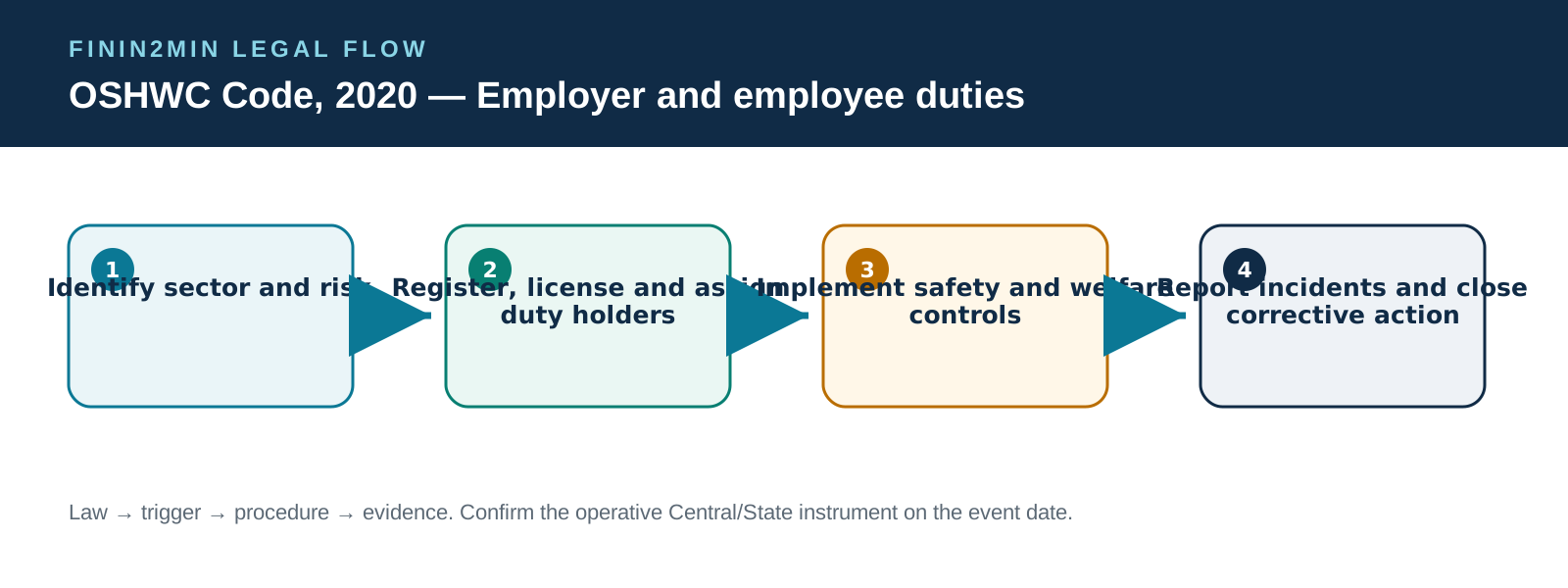
Chapter decision flow
Finin2min Summary - Chapter in 2 Minutes
This chapter turns employer and employee duties into an operational control file. It covers Duties of employer, Duties and responsibilities of owner, agent and manager in relation to mine, Duties of designers, manufacturers, importers or suppliers, Duties of architect, project engineer and designer; the practical sequence is to classify coverage and event date, apply the provision and mapped Rule, complete the form/register, calculate the entitlement or exposure, and retain evidence for inspection, claim or appeal.
Who is covered
Employers, occupiers, contractors, principal employers, workers and sector-specific establishments must identify the establishment type, worker category and appropriate Government.
Main obligations and rights
- Section 6: Duties of employer
- Section 7: Duties and responsibilities of owner, agent and manager in relation to mine
- Section 8: Duties of designers, manufacturers, importers or suppliers
- Section 9: Duties of architect, project engineer and designer
- Section 10: Notice of certain accident
- Section 11: Notice of certain dangerous occurrences
Key thresholds and timelines
- Use only the threshold, rate and limitation period effective on the event date; verify the Central/State instrument before acting.
Forms, registers and evidence
- Notice
- Retain classification, calculation, approval, communication, acknowledgement and payment/filing proof.
Employer risk snapshot
Highest practical risks: misclassification, missed filing/notice, unsupported calculation, incomplete records and use of the wrong Central/State instrument.
Employee/worker remedy snapshot
Core protection: the substantive protection in this chapter, access to the prescribed authority/forum and a documented remedy within limitation. Confirm the authority, limitation and appeal route stated in this chapter.
Old law / transition
Map the event date and savings position against: Factories Act, 1948; Plantations Labour Act, 1951; Mines Act, 1952; Working Journalists laws; Motor Transport Workers Act, 1961.
Five-point professional checklist
- Freeze the event date, establishment, location and person/worker classification.
- Identify the controlling section/paragraph, mapped Rule, notification and appropriate Government.
- Reperform the calculation or decision test and document every exception or approval.
- Complete the prescribed form/register/portal step and retain acknowledgement, payment and communication evidence.
- Record the remedy, forum, limitation, appeal path and State variation before sign-off.
Finin2min takeaway: for employer and employee duties, the defensible answer is not a policy label - it is the event-date law, the mapped procedure, the calculation and a complete evidence trail.
Section-by-section provision map
| Provision | Subject | Implementation focus |
|---|---|---|
| Section 6 | Duties of employer | Trigger, linked Rule/form, evidence, consequence and remedy |
| Section 7 | Duties and responsibilities of owner, agent and manager in relation to mine | Trigger, linked Rule/form, evidence, consequence and remedy |
| Section 8 | Duties of designers, manufacturers, importers or suppliers | Trigger, linked Rule/form, evidence, consequence and remedy |
| Section 9 | Duties of architect, project engineer and designer | Trigger, linked Rule/form, evidence, consequence and remedy |
| Section 10 | Notice of certain accident | Trigger, linked Rule/form, evidence, consequence and remedy |
| Section 11 | Notice of certain dangerous occurrences | Trigger, linked Rule/form, evidence, consequence and remedy |
| Section 12 | Notice of certain diseases | Trigger, linked Rule/form, evidence, consequence and remedy |
| Section 13 | Duties of employee | Trigger, linked Rule/form, evidence, consequence and remedy |
| Section 14 | Rights of employee | Trigger, linked Rule/form, evidence, consequence and remedy |
| Section 15 | Duty not to interfere with or misuse things | Trigger, linked Rule/form, evidence, consequence and remedy |
Section 6: Duties of employer
Current statutory text
6. Duties of employer. — (1) Every employer shall,—

          (a) ensure that workplace is free from hazards which cause or are likely to cause injury or
      occupational disease to the employees;

          (b) comply with the occupational safety and health standards declared under section 18 or the
       rules, regulations, bye-laws or orders made under this Code;

          (c) provide such annual health examination or test free of costs to such employees of such age
      or such class of employees of establishments or such class of establishments, as may be prescribed
     by the appropriate Government;

          (d) provide and maintain, as far as is reasonably practicable, a working environment that is safe
     and without risk to the health of the employees;

          (e) ensure the disposal of hazardous and toxic waste including disposal of e-waste;

             (f) issue a letter of appointment to every employee on his appointment in the establishment,
      with such information and in such form as may be prescribed by the appropriate Government and
     where an employee has not been issued such appointment letter on or before the commencement of
       this Code, he shall, within three months of such commencement, be issued such appointment letter;

           (g) ensure that no charge is levied on any employee, in respect of anything done or provided for
      maintenance of safety and health at workplace including conduct of medical examination and
      investigation for the purpose of detecting occupational diseases;
           (h) relating to factory, mine, dock work, building or other construction work or plantation,
      ensure and be responsible for the safety and health of employees, workers and other persons who
      are on the work premises of the employer, with or without his knowledge, as the case may be.

   (2) Without prejudice to the generality of the provisions of sub-section (1), the duties of an employer
shall particularly in respect of factory, mines, dock, building or other construction work or plantation
include—

          (a) the provision and maintenance of plant and systems of work in the workplace that are safe
     and without risk to health;

          (b) the arrangements in the workplace for ensuring safety and absence of risk to health in
      connection with the use, handling, storage and transport of articles and substances;

          (c) the provision of such information, instruction, training and supervision as are necessary to
      ensure the health and safety of all employees at work;

          (d) the maintenance of all places of work in the workplace in a condition that is safe and without
       risk to health and the provision and maintenance of such means of access to, and egress from, such
      places as are safe and without such risk;

           (e) the provision, maintenance or monitoring of such working environment in the workplace for
      the employees that is safe, without risk to health as regards facilities and arrangements for their
      welfare at work.
Finin2min clause-by-clause decode
- This page does not replace the statutory text. It separates the operative legal transaction into controls so that each subsection, proviso, exception and delegated instrument can be checked against the official India Code source before use.
- Identify the covered establishment, worker category, appropriate Government and event date.
- Identify the covered establishment, worker category, appropriate Government and sector-specific overlay.
- Convert each statutory condition and proviso into an assigned action with a clear deadline.
- Break the provision into trigger, actor, action, timing, evidence and consequence before configuring the process.
- Map the enabling Rule, form, Schedule, authority and any sector-specific notification.
- Read the corresponding Central Rule, prescribed form, Schedule and notified authority together.
- Preserve the decision memo, worker communication, register, portal acknowledgement and payment or inspection evidence.
- Create a named control owner and maker-checker evidence trail.
- Record exceptions, non-compliance consequences, remedy, appeal forum and limitation period.
Applicable Central Rules immediately below the provision
Central Rule 5: Rule 5 — Annual health examination of employees
Rule mapping is retained; read the official 2026 Gazette for the exact sub-rule text and forms.
Central Rule 6: Rule 6 — Letter of appointment to employee
Rule mapping is retained; read the official 2026 Gazette for the exact sub-rule text and forms.
Central Rule 7: Rule 7 — Notice of accidents and dangerous occurrences
Rule mapping is retained; read the official 2026 Gazette for the exact sub-rule text and forms.
Central Rule 8: Rule 8 — Notice of disease
Rule mapping is retained; read the official 2026 Gazette for the exact sub-rule text and forms.
Practical example
A multi-location employer prepares a legal classification memo, identifies the appropriate Government, maps the operative provision and Rule, records the decision owner and retains the documents needed to prove compliance during inspection or litigation.
Controls and evidence
- Employer: assign owner, configure system and retain approval/payment proof.
- Employee/worker: retain contract, attendance, wage/benefit proof and communication.
- Professional: reconcile the Act, Rule, notification, form, limitation and State overlay.
Consequence, remedy and limitation
Identify the substantive default first, then separately map arrears or benefit, interest/damages, administrative penalty, prosecution, compounding, company/officer liability, forum, appeal and limitation. Do not infer a remedy from the heading alone.
Mapped Rules: Rule 5, Rule 6, Rule 7, Rule 8 | Official source: section 6.
Section 7: Duties and responsibilities of owner, agent and manager in relation to mine
Current statutory text
7. Duties and responsibilities of owner, agent and manager in relation to mine.—(1) The owner
and agent of every mine shall jointly and severally be responsible for making financial and other
provisions and for taking such other steps as may be necessary for compliance with the provisions of this
Code and the rules, regulations, bye-laws and orders made thereunder, relating to mine.

   (2) In the event of any contravention by any person whosoever of any of the provisions of this Code or
of the rules, regulations, bye-laws or orders made thereunder, relating to mine, except those which
specifically require any person to do any act or thing or prohibit any person from doing an act or thing,
besides the person who contravenes, then, each of the following persons shall also be deemed to be guilty
of such contravention unless he proves that he had used due diligence to secure compliance with the
provisions and had taken reasonable means to prevent such contravention, namely:—

       (a) the official or officials appointed to perform duties of supervision in respect of the provisions
   contravened;

       (b) the manager of the mine;

       (c) the owner and agent of the mine;

       (d) the person appointed, if any, to carry out the responsibility under section 24.

   (3) It shall not be a defence in any proceedings brought against the owner or agent of a mine under this
section that the manager and other officials have been appointed in accordance with the provisions of this
Code or that a person to carry the responsibility under section 24 has been appointed.
Finin2min clause-by-clause decode
- This page does not replace the statutory text. It separates the operative legal transaction into controls so that each subsection, proviso, exception and delegated instrument can be checked against the official India Code source before use.
- Confirm the sector definition, premises, process and statutory person in ultimate control.
- Establish whether the mine, person and operation fall within the Code and Central rules or a valid exemption.
- Map the sector-specific registration, manager/agent/occupier appointment, technical standard and welfare duty.
- Appoint qualified statutory personnel and maintain current competency, medical and training records.
- Maintain shift, competence, medical, machinery, inspection and contractor records required for the activity.
- Provide rescue station/room coverage, tested breathing apparatus, communication, tracings and emergency teams.
- Integrate emergency, accident-reporting and worker-participation controls into site operations.
- Run initial, refresher, special and post-absence training before assigning hazardous work.
- Test closure, prohibition, improvement direction, appeal and offence exposure against the current Rules and Schedules.
Applicable Central Rules immediately below the provision
No direct Central Rule is mapped. Check general procedural Rules, State Rules and later notifications.
Practical example
Following a workplace event, the incident controller first protects life and the site, then completes statutory reporting, evidence preservation, medical documentation, contractor allocation and root-cause action without waiting for a compensation dispute.
Controls and evidence
- Employer: assign owner, configure system and retain approval/payment proof.
- Employee/worker: retain contract, attendance, wage/benefit proof and communication.
- Professional: reconcile the Act, Rule, notification, form, limitation and State overlay.
Consequence, remedy and limitation
Identify the substantive default first, then separately map arrears or benefit, interest/damages, administrative penalty, prosecution, compounding, company/officer liability, forum, appeal and limitation. Do not infer a remedy from the heading alone.
Mapped Rules: No direct Central Rule mapped in the repository concordance | Official source: section 7.
Section 8: Duties of designers, manufacturers, importers or suppliers
Current statutory text
8. Duties of designers, manufacturers, importers or suppliers.—(1) Every person who designs,
manufactures, imports or supplies any article for use in any establishment shall—

          (a) ensure so far as is reasonably practicable, that the article is so designed and constructed in
      the establishment as to be safe and without risk to the health of the workers when properly used;

          (b) carry out or arrange for the carrying out of such tests and examination in the establishment
      as may be considered necessary for the effective implementation of the provisions of clause (a);

          (c) take steps as may be necessary to ensure that adequate information will be available—

                (i) in connection with the use of the article in any establishment;

                 (ii) about the use for which such article is designed and tested; and

                 (iii) about any conditions necessary to ensure that the article, when put to such use, shall be
          safe, and without risk to the health of the workers:
         Provided that where an article is designed or manufactured outside India, then it shall be
      obligatory on the part of the importer to see—

            (A) that the article conforms to the same standards of such article manufactured in India;
         or

            (B) if the standards adopted in the country outside India for the manufacture of such
           article is above the standards adopted in India, that the article conforms to such standards in
        such country;

            (C) if there is no standard of such article in India, then, the article conforms to the
         standard adopted in the country from where it is imported at its national level.

   (2) The designer, manufacturer, importer or supplier shall also comply with such duties as the
Central Government may, in consultation with the National Occupational Safety and Health Advisory
Board referred to in sub-section (1) of section 16, by regulations specify.

   (3) Every person, who undertakes to design or manufacture any article and substance for use in any
factory, may carry out or arrange for the carrying out of necessary research with a view to the
discovery and, so far as is reasonably, practicable, the elimination or minimisation of any risks to the
health or safety of the workers to which the design or manufacture of article and substance may give
rise to such risk.

   (4) Nothing contained in sub-sections (1) and (2) shall be construed to require a person to repeat the
testing, examination or research which has been carried out otherwise than by him or at his instance in
so far as it is reasonable for him to rely on the results thereof for the purposes of the said sub-sections.

   (5) Any duty imposed on any person by sub-sections (1) and (2) shall extend only to things done in
the course of business carried on by him and to matters within his control.

   (6) Every person,—

       (a) who erects or installs any article for use in a factory, shall ensure, so far as practicable, that
   such article so erected or installed does not make it unsafe or a risk to health when that article is
   used by the persons in such factory;

       (b) who manufactures, imports or supplies any substance for use in any factory shall—

            (i) ensure, so far as practicable, that such substance when used in the factory does not make
         it unsafe or a risk to health of persons working in such factory;

             (ii) carry out or arrange for carrying out of such tests and examination in relation to such
      substance as may be necessary;

             (iii) take such steps as are necessary to secure that the information about the results of tests
       carried out in connection with the use of the substance as referred to in sub-clause (ii) is
      available in a factory along with conditions necessary to ensure its safe use and no risks to
       health;

       (c) who undertakes the manufacture of any substance for use in any factory shall carry out or
   arrange for carrying out of any necessary research with a view to discover and, so far as
   practicable, to ensure the elimination or minimisation of any risks to health or safety to which the
   substance may give rise out of such manufacture or research;

   (7) For the purposes of this section, an article and substance is not to be regarded as properly used,
if they are used without regard to any information or advice relating to their use which has been made
available by the person who has designed, manufactured, imported or supplied the  article and
substance.

   Explanation.—For the purpose of this section—

          (a) “article” shall include plant and machinery;

          (b) “substance” means any natural or artificial substance whether in a solid or liquid form or
       in the form of a gas or vapour; and

              (c) “substance for use in any factory” means such substance, whether or not intended for use
        by persons working in a factory.
Finin2min clause-by-clause decode
- This page does not replace the statutory text. It separates the operative legal transaction into controls so that each subsection, proviso, exception and delegated instrument can be checked against the official India Code source before use.
- Identify the covered establishment, worker category, appropriate Government and event date.
- Identify the covered establishment, worker category, appropriate Government and sector-specific overlay.
- Convert each statutory condition and proviso into an assigned action with a clear deadline.
- Break the provision into trigger, actor, action, timing, evidence and consequence before configuring the process.
- Map the enabling Rule, form, Schedule, authority and any sector-specific notification.
- Read the corresponding Central Rule, prescribed form, Schedule and notified authority together.
- Preserve the decision memo, worker communication, register, portal acknowledgement and payment or inspection evidence.
- Create a named control owner and maker-checker evidence trail.
- Record exceptions, non-compliance consequences, remedy, appeal forum and limitation period.
Applicable Central Rules immediately below the provision
No direct Central Rule is mapped. Check general procedural Rules, State Rules and later notifications.
Practical example
A multi-location employer prepares a legal classification memo, identifies the appropriate Government, maps the operative provision and Rule, records the decision owner and retains the documents needed to prove compliance during inspection or litigation.
Controls and evidence
- Employer: assign owner, configure system and retain approval/payment proof.
- Employee/worker: retain contract, attendance, wage/benefit proof and communication.
- Professional: reconcile the Act, Rule, notification, form, limitation and State overlay.
Consequence, remedy and limitation
Identify the substantive default first, then separately map arrears or benefit, interest/damages, administrative penalty, prosecution, compounding, company/officer liability, forum, appeal and limitation. Do not infer a remedy from the heading alone.
Mapped Rules: No direct Central Rule mapped in the repository concordance | Official source: section 8.
Section 9: Duties of architect, project engineer and designer
Current statutory text
9. Duties of architect, project engineer and designer.—(1) It shall be the duty of the architect,
project engineer or designer responsible for any building or other construction work or the design of any
project or part thereof relating to such building or other construction work to ensure that, at the planning
stage, due consideration is given to the safety and health aspects of the building workers and employees
who are employed in the erection, operation and execution of such projects and structures as the case may
be.

   (2) Adequate care shall be taken by the architect, project engineer and other professionals involved in
the project referred to in sub-section (1), not to include anything in the design which would involve the
use of dangerous structures or other processes or materials, hazardous to health or safety of building
workers and employees during the course of erection, operation and execution as the case may be.

   (3) It shall also be the duty of the professionals, involved in designing the buildings structures or other
construction projects, to take into account the safety aspects associated with the maintenance and upkeep
of the structures and buildings where maintenance and upkeep may involve such hazards as may be
notified by the appropriate Government.
Finin2min clause-by-clause decode
- This page does not replace the statutory text. It separates the operative legal transaction into controls so that each subsection, proviso, exception and delegated instrument can be checked against the official India Code source before use.
- Identify the covered establishment, worker category, appropriate Government and event date.
- Identify the covered establishment, worker category, appropriate Government and sector-specific overlay.
- Convert each statutory condition and proviso into an assigned action with a clear deadline.
- Break the provision into trigger, actor, action, timing, evidence and consequence before configuring the process.
- Map the enabling Rule, form, Schedule, authority and any sector-specific notification.
- Read the corresponding Central Rule, prescribed form, Schedule and notified authority together.
- Preserve the decision memo, worker communication, register, portal acknowledgement and payment or inspection evidence.
- Create a named control owner and maker-checker evidence trail.
- Record exceptions, non-compliance consequences, remedy, appeal forum and limitation period.
Applicable Central Rules immediately below the provision
No direct Central Rule is mapped. Check general procedural Rules, State Rules and later notifications.
Practical example
A multi-location employer prepares a legal classification memo, identifies the appropriate Government, maps the operative provision and Rule, records the decision owner and retains the documents needed to prove compliance during inspection or litigation.
Controls and evidence
- Employer: assign owner, configure system and retain approval/payment proof.
- Employee/worker: retain contract, attendance, wage/benefit proof and communication.
- Professional: reconcile the Act, Rule, notification, form, limitation and State overlay.
Consequence, remedy and limitation
Identify the substantive default first, then separately map arrears or benefit, interest/damages, administrative penalty, prosecution, compounding, company/officer liability, forum, appeal and limitation. Do not infer a remedy from the heading alone.
Mapped Rules: No direct Central Rule mapped in the repository concordance | Official source: section 9.
Section 10: Notice of certain accident
Current statutory text
10. Notice of certain accident.—(1) Where at any place in an establishment, an accident occurs
which causes death, or which causes any bodily injury by reason of which the person injured is prevented
from working for a period of forty-eight hours or more immediately following the accident or which is of
such nature as may be prescribed by the appropriate Government, then,—

       (a) employer or owner or agent or manager referred to in section 67 of such establishment if it is
   mine; or

       (b) employer or manager in relation to such establishment if it is factory or relates to dock work; or

       (c) the employer of a plantation or an establishment relating to building or other construction or any
   other establishment,

shall send notice thereof to such authorities, in such manner and within such time, as may be prescribed
by the appropriate Government.

   (2) Where a notice given under sub-section (1) relates to an accident causing death in a plantation or
an establishment relating to building or other construction work or any other establishment, the authority
to whom the notice is sent shall make an inquiry into the occurrence within two months of the receipt of
the notice or if there is no such authority, the Chief Inspector-cum-Facilitator shall cause the Inspector-
cum-Facilitator to make an inquiry within the said period.
Finin2min clause-by-clause decode
- This page does not replace the statutory text. It separates the operative legal transaction into controls so that each subsection, proviso, exception and delegated instrument can be checked against the official India Code source before use.
- Identify the hazard, exposed worker group, process and statutory duty holder before selecting the control.
- Stabilise the emergency and arrange rescue, first aid and medical treatment before administrative reporting.
- Apply the prescribed engineering, medical, supervision, training, protective-equipment and emergency requirements.
- Classify death, injury, lost-time incapacity, dangerous occurrence or occupational disease against the statutory trigger.
- Map the relevant Rule, Schedule, standard, licence condition and sector-specific authority direction.
- Notify every prescribed authority, police/family where applicable, in the required form and within the specific clock.
- Report notifiable accidents, dangerous occurrences or diseases within the applicable time and preserve the incident file.
- Preserve the first incident record, scene evidence, witness accounts, equipment state and later corrections.
- Close root-cause actions and separately assess compensation, employment protection, inspection and penal consequences.
Applicable Central Rules immediately below the provision
Central Rule 7: Rule 7 — Notice of accidents and dangerous occurrences
Rule mapping is retained; read the official 2026 Gazette for the exact sub-rule text and forms.
Practical example
Following a workplace event, the incident controller first protects life and the site, then completes statutory reporting, evidence preservation, medical documentation, contractor allocation and root-cause action without waiting for a compensation dispute.
Controls and evidence
- Employer: assign owner, configure system and retain approval/payment proof.
- Employee/worker: retain contract, attendance, wage/benefit proof and communication.
- Professional: reconcile the Act, Rule, notification, form, limitation and State overlay.
Consequence, remedy and limitation
Identify the substantive default first, then separately map arrears or benefit, interest/damages, administrative penalty, prosecution, compounding, company/officer liability, forum, appeal and limitation. Do not infer a remedy from the heading alone.
Mapped Rules: Rule 7 | Official source: section 10.
Section 11: Notice of certain dangerous occurrences
Current statutory text
11. Notice of certain dangerous occurrences.—Where in an establishment there is any dangerous
occurrence of such nature, (whether causing any bodily injury or disability, or not) the employer shall
send notice thereof to such authorities, and in such form and within such time, as may be prescribed by
the appropriate Government.
Finin2min clause-by-clause decode
- This page does not replace the statutory text. It separates the operative legal transaction into controls so that each subsection, proviso, exception and delegated instrument can be checked against the official India Code source before use.
- Identify the hazard, exposed worker group, process and statutory duty holder before selecting the control.
- Stabilise the emergency and arrange rescue, first aid and medical treatment before administrative reporting.
- Apply the prescribed engineering, medical, supervision, training, protective-equipment and emergency requirements.
- Classify death, injury, lost-time incapacity, dangerous occurrence or occupational disease against the statutory trigger.
- Map the relevant Rule, Schedule, standard, licence condition and sector-specific authority direction.
- Notify every prescribed authority, police/family where applicable, in the required form and within the specific clock.
- Report notifiable accidents, dangerous occurrences or diseases within the applicable time and preserve the incident file.
- Preserve the first incident record, scene evidence, witness accounts, equipment state and later corrections.
- Close root-cause actions and separately assess compensation, employment protection, inspection and penal consequences.
Applicable Central Rules immediately below the provision
Central Rule 7: Rule 7 — Notice of accidents and dangerous occurrences
Rule mapping is retained; read the official 2026 Gazette for the exact sub-rule text and forms.
Practical example
A multi-location employer prepares a legal classification memo, identifies the appropriate Government, maps the operative provision and Rule, records the decision owner and retains the documents needed to prove compliance during inspection or litigation.
Controls and evidence
- Employer: assign owner, configure system and retain approval/payment proof.
- Employee/worker: retain contract, attendance, wage/benefit proof and communication.
- Professional: reconcile the Act, Rule, notification, form, limitation and State overlay.
Consequence, remedy and limitation
Identify the substantive default first, then separately map arrears or benefit, interest/damages, administrative penalty, prosecution, compounding, company/officer liability, forum, appeal and limitation. Do not infer a remedy from the heading alone.
Mapped Rules: Rule 7 | Official source: section 11.
Section 12: Notice of certain diseases
Current statutory text
12. Notice of certain diseases.—(1) Where any worker in an establishment contracts any disease
specified in the Third Schedule, the employer of the establishment shall send notice thereof to such
authorities, and in such form and within such time, as may be prescribed by the appropriate Government.

   (2) If any qualified medical practitioner attends on a person, who is or has been employed in an
establishment, and who is, or is believed by the qualified medical practitioner, to be suffering from any
disease specified in the Third Schedule, the medical practitioner shall without delay send a report in
writing to the office of the Chief Inspector-cum-Facilitator in such form and manner and within such time
as may be prescribed by the appropriate Government.

   (3) If any qualified medical practitioner fails to comply with the provisions of sub-section (2), he shall
be punishable with penalty which may extend to ten thousand rupees.
Finin2min clause-by-clause decode
- This page does not replace the statutory text. It separates the operative legal transaction into controls so that each subsection, proviso, exception and delegated instrument can be checked against the official India Code source before use.
- Identify the hazard, exposed worker group, process and statutory duty holder before selecting the control.
- Stabilise the emergency and arrange rescue, first aid and medical treatment before administrative reporting.
- Apply the prescribed engineering, medical, supervision, training, protective-equipment and emergency requirements.
- Classify death, injury, lost-time incapacity, dangerous occurrence or occupational disease against the statutory trigger.
- Map the relevant Rule, Schedule, standard, licence condition and sector-specific authority direction.
- Notify every prescribed authority, police/family where applicable, in the required form and within the specific clock.
- Report notifiable accidents, dangerous occurrences or diseases within the applicable time and preserve the incident file.
- Preserve the first incident record, scene evidence, witness accounts, equipment state and later corrections.
- Close root-cause actions and separately assess compensation, employment protection, inspection and penal consequences.
Applicable Central Rules immediately below the provision
Central Rule 8: Rule 8 — Notice of disease
Rule mapping is retained; read the official 2026 Gazette for the exact sub-rule text and forms.
Practical example
A multi-location employer prepares a legal classification memo, identifies the appropriate Government, maps the operative provision and Rule, records the decision owner and retains the documents needed to prove compliance during inspection or litigation.
Controls and evidence
- Employer: assign owner, configure system and retain approval/payment proof.
- Employee/worker: retain contract, attendance, wage/benefit proof and communication.
- Professional: reconcile the Act, Rule, notification, form, limitation and State overlay.
Consequence, remedy and limitation
Identify the substantive default first, then separately map arrears or benefit, interest/damages, administrative penalty, prosecution, compounding, company/officer liability, forum, appeal and limitation. Do not infer a remedy from the heading alone.
Mapped Rules: Rule 8 | Official source: section 12.
Section 13: Duties of employee
Current statutory text
13. Duties of employee. —Every employee at workplace shall,—

       (a) take reasonable care for the health and safety of himself and of other persons who may be
   affected by his acts or omissions at the workplace;

       (b) comply with the safety and health requirements specified in the standards;

       (c) co-operate with the employer in meeting the statutory obligations of the employer under this
   Code;

       (d) if any situation which is unsafe or unhealthy comes to his attention, as soon as practicable,
   report such situation to his employer or to the health and safety representative and in case of mine,
   agent or manager referred to in section 67, safety officers or an official for his workplace or section
   thereof, as the case may be, who shall report it to the employer in the manner as may be prescribed by
   the appropriate Government;

       (e) not wilfully interfere with or misuse or neglect any appliance, convenience or other thing
   provided at workplace for the purpose of securing the health, safety and welfare of workers;

        (f) not do, wilfully and without reasonable cause, anything, likely to endanger himself or others;
   and

       (g) perform such other duties as may be prescribed by the appropriate Government.
Finin2min clause-by-clause decode
- This page does not replace the statutory text. It separates the operative legal transaction into controls so that each subsection, proviso, exception and delegated instrument can be checked against the official India Code source before use.
- Identify the covered establishment, worker category, appropriate Government and event date.
- Identify the covered establishment, worker category, appropriate Government and sector-specific overlay.
- Convert each statutory condition and proviso into an assigned action with a clear deadline.
- Break the provision into trigger, actor, action, timing, evidence and consequence before configuring the process.
- Map the enabling Rule, form, Schedule, authority and any sector-specific notification.
- Read the corresponding Central Rule, prescribed form, Schedule and notified authority together.
- Preserve the decision memo, worker communication, register, portal acknowledgement and payment or inspection evidence.
- Create a named control owner and maker-checker evidence trail.
- Record exceptions, non-compliance consequences, remedy, appeal forum and limitation period.
Applicable Central Rules immediately below the provision
Central Rule 9: Rule 9 — Duties of employee
Rule mapping is retained; read the official 2026 Gazette for the exact sub-rule text and forms.
Practical example
A multi-location employer prepares a legal classification memo, identifies the appropriate Government, maps the operative provision and Rule, records the decision owner and retains the documents needed to prove compliance during inspection or litigation.
Controls and evidence
- Employer: assign owner, configure system and retain approval/payment proof.
- Employee/worker: retain contract, attendance, wage/benefit proof and communication.
- Professional: reconcile the Act, Rule, notification, form, limitation and State overlay.
Consequence, remedy and limitation
Identify the substantive default first, then separately map arrears or benefit, interest/damages, administrative penalty, prosecution, compounding, company/officer liability, forum, appeal and limitation. Do not infer a remedy from the heading alone.
Mapped Rules: Rule 9 | Official source: section 13.
Section 14: Rights of employee
Current statutory text
14. Rights of employee.—(1) Every employee in an establishment shall have the right to obtain from
the employer information relating to employee's health and safety at work and represent to the employer
directly or through a member of the Safety Committee as constituted under section 22, if constituted by
the employer for such purpose, regarding inadequate provision for protection of his safety or health in
connection with the work activity in the workplace, and if not satisfied, to the Inspector-cum-Facilitator.

   (2) Where the employee referred to in sub-section (1) in any workplace has reasonable apprehension
that there is a likelihood of imminent serious personal injury or death or imminent danger to health, he
may bring the same to the notice of his employer directly or through a member of the Safety Committee
referred to in sub-section (1) and simultaneously bring the same to the notice of the Inspector-cum-
Facilitator.

   (3) The employer or any employee referred to in sub-section (1) shall take immediate remedial action
if he is satisfied about the existence of such imminent danger and send a report forthwith of the action
taken  to  the  Inspector-cum-Facilitator  in such manner  as may be prescribed by  the  appropriate
Government.

   (4) If the employer referred to in sub-section (3) is not satisfied about the existence of any imminent
danger as apprehended by his employees, he  shall, nevertheless, refer the matter forthwith to the
Inspector-cum-Facilitator whose decision on the question of the existence of such imminent danger shall
be final.
Finin2min clause-by-clause decode
- This page does not replace the statutory text. It separates the operative legal transaction into controls so that each subsection, proviso, exception and delegated instrument can be checked against the official India Code source before use.
- Identify the covered establishment, worker category, appropriate Government and event date.
- Identify the covered establishment, worker category, appropriate Government and sector-specific overlay.
- Convert each statutory condition and proviso into an assigned action with a clear deadline.
- Break the provision into trigger, actor, action, timing, evidence and consequence before configuring the process.
- Map the enabling Rule, form, Schedule, authority and any sector-specific notification.
- Read the corresponding Central Rule, prescribed form, Schedule and notified authority together.
- Preserve the decision memo, worker communication, register, portal acknowledgement and payment or inspection evidence.
- Create a named control owner and maker-checker evidence trail.
- Record exceptions, non-compliance consequences, remedy, appeal forum and limitation period.
Applicable Central Rules immediately below the provision
Central Rule 10: Rule 10 — Rights of employee
Rule mapping is retained; read the official 2026 Gazette for the exact sub-rule text and forms.
Practical example
A multi-location employer prepares a legal classification memo, identifies the appropriate Government, maps the operative provision and Rule, records the decision owner and retains the documents needed to prove compliance during inspection or litigation.
Controls and evidence
- Employer: assign owner, configure system and retain approval/payment proof.
- Employee/worker: retain contract, attendance, wage/benefit proof and communication.
- Professional: reconcile the Act, Rule, notification, form, limitation and State overlay.
Consequence, remedy and limitation
Identify the substantive default first, then separately map arrears or benefit, interest/damages, administrative penalty, prosecution, compounding, company/officer liability, forum, appeal and limitation. Do not infer a remedy from the heading alone.
Mapped Rules: Rule 10 | Official source: section 14.
Section 15: Duty not to interfere with or misuse things
Current statutory text
15. Duty not to interfere with or misuse things.—No person shall intentionally or recklessly
interfere with, damage or misuse anything which is provided in the interest of health, safety or welfare
under this Code.

                             CHAPTER IV

                          OCCUPATIONAL SAFETY AND HEALTH
Finin2min clause-by-clause decode
- This page does not replace the statutory text. It separates the operative legal transaction into controls so that each subsection, proviso, exception and delegated instrument can be checked against the official India Code source before use.
- Identify the covered establishment, worker category, appropriate Government and event date.
- Identify the covered establishment, worker category, appropriate Government and sector-specific overlay.
- Convert each statutory condition and proviso into an assigned action with a clear deadline.
- Break the provision into trigger, actor, action, timing, evidence and consequence before configuring the process.
- Map the enabling Rule, form, Schedule, authority and any sector-specific notification.
- Read the corresponding Central Rule, prescribed form, Schedule and notified authority together.
- Preserve the decision memo, worker communication, register, portal acknowledgement and payment or inspection evidence.
- Create a named control owner and maker-checker evidence trail.
- Record exceptions, non-compliance consequences, remedy, appeal forum and limitation period.
Applicable Central Rules immediately below the provision
No direct Central Rule is mapped. Check general procedural Rules, State Rules and later notifications.
Practical example
A multi-location employer prepares a legal classification memo, identifies the appropriate Government, maps the operative provision and Rule, records the decision owner and retains the documents needed to prove compliance during inspection or litigation.
Controls and evidence
- Employer: assign owner, configure system and retain approval/payment proof.
- Employee/worker: retain contract, attendance, wage/benefit proof and communication.
- Professional: reconcile the Act, Rule, notification, form, limitation and State overlay.
Consequence, remedy and limitation
Identify the substantive default first, then separately map arrears or benefit, interest/damages, administrative penalty, prosecution, compounding, company/officer liability, forum, appeal and limitation. Do not infer a remedy from the heading alone.
Mapped Rules: No direct Central Rule mapped in the repository concordance | Official source: section 15.
Rules, forms, registers, portals and due dates
| Rule | Subject | Text/control status |
|---|---|---|
| 5 | Rule 5 — Annual health examination of employees | Source-controlled mapping |
| 6 | Rule 6 — Letter of appointment to employee | Source-controlled mapping |
| 7 | Rule 7 — Notice of accidents and dangerous occurrences | Source-controlled mapping |
| 8 | Rule 8 — Notice of disease | Source-controlled mapping |
| 9 | Rule 9 — Duties of employee | Source-controlled mapping |
| 10 | Rule 10 — Rights of employee | Source-controlled mapping |
Forms and registers must be confirmed from the appended 2026 Central Rules and the live portal applicable to the appropriate Government. A form is not treated as current merely because an earlier law used the same number.
Notifications and effective-date history
| Control | Required action |
|---|---|
| Enactment | Record Act number, assent and Gazette publication. |
| Commencement | Use the provision-specific commencement notification; the four Codes became broadly operative from 21 November 2025 subject to earlier partial commencement and corrigenda. |
| Central Rules | Read the applicable 2026 Central Rules from their Gazette date and verify subsequent amendments. |
| State instrument | Check final State Rules, authority notifications, forms and rates where the State is appropriate Government. |
Old-law/new-Code concordance
| Predecessor law | Transition control |
|---|---|
| Factories Act, 1948 | Classify the event date, accrued right, saved Rule/notification and pending proceeding before moving to the Code. |
| Plantations Labour Act, 1951 | Classify the event date, accrued right, saved Rule/notification and pending proceeding before moving to the Code. |
| Mines Act, 1952 | Classify the event date, accrued right, saved Rule/notification and pending proceeding before moving to the Code. |
| Working Journalists laws | Classify the event date, accrued right, saved Rule/notification and pending proceeding before moving to the Code. |
| Motor Transport Workers Act, 1961 | Classify the event date, accrued right, saved Rule/notification and pending proceeding before moving to the Code. |
| Beedi and Cigar Workers Act, 1966 | Classify the event date, accrued right, saved Rule/notification and pending proceeding before moving to the Code. |
| Contract Labour Act, 1970 | Classify the event date, accrued right, saved Rule/notification and pending proceeding before moving to the Code. |
| Inter-State Migrant Workmen Act, 1979 | Classify the event date, accrued right, saved Rule/notification and pending proceeding before moving to the Code. |
| Cine-Workers Act, 1981 | Classify the event date, accrued right, saved Rule/notification and pending proceeding before moving to the Code. |
| Dock Workers Act, 1986 | Classify the event date, accrued right, saved Rule/notification and pending proceeding before moving to the Code. |
| BOCW Act, 1996 | Classify the event date, accrued right, saved Rule/notification and pending proceeding before moving to the Code. |
Practical calculations and control file
Calculation sequence
- Freeze the employee/worker population and event date.
- Apply the statutory wage/benefit base and notified threshold.
- Reconcile attendance, service, payroll and contractor records.
- Calculate principal amount, interest/damages and any statutory compensation separately.
- Obtain legal/payroll approval and retain the versioned worksheet.
Three-owner sign-off
- Employer/HR: facts, classification, communication and workflow.
- Employee/worker: notice, records, nomination/claim and acknowledgement.
- Professional: source, formula, forum, limitation and evidence reconciliation.
Binding and highly relevant case-law principles
| Decision | Principle and present-use caution |
|---|---|
| Consumer Education and Research Centre v. Union of India | Worker health and safety are connected with dignity and life; statutory standards should be treated as minimum controls. |
| J.K. Industries Ltd. v. Chief Inspector of Factories | Responsibility attaches to the statutory person in control; internal delegation does not erase legal accountability. |
| Vellore Citizens Welfare Forum v. Union of India | Preventive and precautionary controls are relevant where industrial risk affects workers and surrounding communities. |
| Gammon India Ltd. v. Union of India | Construction-worker welfare and cess legislation is beneficial and must be applied consistently with the charging and machinery provisions. |
State-law variation alerts
- Confirm whether the Central or State Government is the appropriate Government.
- Central Rules do not automatically displace valid State Rules, rates, registers, authorities or portal procedures.
- Minimum-wage rates, holidays, working-hours permissions, licences and local welfare obligations require State-specific verification.
- Record Gazette number, effective date and supersession status in the location compliance register.
Practical examples and calculations
Classify the worker and establishment, identify the operative provision and notified instrument on the event date, compute the entitlement or exposure from source records, obtain approval, complete the filing/payment/action, and retain evidence. Do not use a portal value or payroll label as a substitute for the statutory test.
Calculation/control template: Control calculation: verified population or transaction base × applicable notified rate/amount × eligible period, adjusted for statutory inclusions, exclusions, ceilings, interest, compensation and prior payments. Reperform the calculation from retained source data.
Finin2min implementation explanation
Maintain a controlled implementation file for Chapter III - Employer and employee duties: coverage and event date, operative Central/State instrument, responsible owner, approval and authority, form/portal step, due date, calculation basis, supporting evidence, exception, escalation and closure proof. Reconcile payroll, HR, finance, contractor and legal records before sign-off.
Practical transaction application
Apply the chapter to site acquisition, factory/establishment registration, contractor mobilisation, licence conditions, migrant-worker deployment, construction, hazardous process, working hours, welfare, accident response and shutdown planning.
Authority, consent and execution controls
Identify the employer, occupier, manager, principal employer, contractor, safety officer, medical officer and authorised signatory. Verify licences, appointments, delegations and government approvals before mobilisation; contract allocation does not extinguish statutory responsibility.
Stamp duty and registration alerts
Licences and statutory registrations are distinct from stamping/registration of leases, construction contracts, contractor agreements, security instruments and land documents. Check State stamp and registration law for the underlying transaction while separately completing labour-law approvals.
Evidence and document-retention checklist
Retain the operative law/rule version, classification note, approvals, signed instruments, statutory forms, portal acknowledgements, registers, calculations, bank proof, correspondence, inspection records, service proof, decision and appeal file. Apply the longer of the statutory retention rule, litigation hold, tax/audit need and contractual requirement; restrict access to personal and sensitive data.
Performance, delivery and payment controls
Use pre-mobilisation gates for registration, licence, competency, medical fitness, training, PPE, welfare and emergency readiness. Link contractor invoices to attendance, wage payment, contribution proof, safety records and incident closure.
Breach, loss, mitigation and remedy framework
On detecting a breach, stop continuing exposure, preserve evidence, quantify employee and government dues, identify affected persons, make lawful corrective payment/filing, notify the authorised decision-maker, assess self-disclosure or compounding where available, and reserve contractual recovery against responsible vendors without delaying statutory remediation.
Limitation and forum controls
Route inspection, licence, prohibition, penalty and appeal matters to the prescribed authority and court. Preserve inspection records, sampling chain, accident evidence, notices and appeal clocks; contractual dispute forums do not displace regulatory action.
Arbitration and mediation interface
Arbitration or mediation may resolve employer-contractor allocation and indemnity disputes, but cannot bind inspectors, waive safety duties, suppress accident reporting or replace statutory prosecution/appeal channels.
Company, partnership, GST and tax overlays
For a company, align board/delegation and officer-in-default controls; for an LLP or partnership, identify the designated partner/partner and authorised employer representative. Labour dues can affect transaction price, indemnities, director/partner exposure and insolvency claims. Salary/TDS, perquisite, contractor TDS, GST on outsourced services and accounting provisions must be reconciled without treating tax treatment as proof of labour-law classification.
Finin2min Q&A
Which law and version should be applied?
Use the current text of OSHWC Code, 2020, the commencement notification, the applicable Central or State Rules and any later instrument effective on the event date.
How is the appropriate Government identified?
Classify ownership/control, sector, establishment and contractor relationship before selecting the Central or State authority.
Can a company policy override the statutory protection?
No. A policy may improve a benefit or control, but it cannot contract out of a mandatory statutory floor.
What evidence should be retained?
Retain the classification memo, source instrument, form/portal record, calculation, approval, employee communication, acknowledgement and payment or authority proof.
Do the Central Rules apply to every establishment?
No. They govern the Central sphere. State Rules and State notifications must be checked where the State is the appropriate Government.
How should a historical event be tested?
Apply the law and subordinate instrument effective on the event date, then use the repeal-and-savings provision for pending rights and proceedings.
What happens when portal practice conflicts with the statute?
Record the conflict, follow the higher legal instrument, seek authority clarification where necessary and preserve screenshots and correspondence.
Can criminal and monetary consequences arise together?
They may. Separate wages/benefits, interest, damages, civil penalty, prosecution, compounding and director/officer liability.
Is a contractor arrangement enough to shift liability?
No. Principal-employer and contractor liabilities depend on the specific provision and facts; the contract should allocate evidence and recovery without diluting worker rights.
What is the first professional review step?
Freeze the event date and facts, identify the applicable provision, then map Rules, forms, notification status, authority, limitation and evidence.
What is the operational focus of section 6 - Duties of employer?
The section must be decomposed into actor, trigger, threshold, procedure, exception, consequence and evidence. Read the full official text and the mapped Rules before applying the Finin2min control summary.
What is the operational focus of section 7 - Duties and responsibilities of owner, agent and manager in relation to mine?
The section must be decomposed into actor, trigger, threshold, procedure, exception, consequence and evidence. Read the full official text and the mapped Rules before applying the Finin2min control summary.
What is the operational focus of section 8 - Duties of designers, manufacturers, importers or suppliers?
The section must be decomposed into actor, trigger, threshold, procedure, exception, consequence and evidence. Read the full official text and the mapped Rules before applying the Finin2min control summary.
What is the operational focus of section 9 - Duties of architect, project engineer and designer?
The section must be decomposed into actor, trigger, threshold, procedure, exception, consequence and evidence. Read the full official text and the mapped Rules before applying the Finin2min control summary.
What is the operational focus of section 10 - Notice of certain accident?
The section must be decomposed into actor, trigger, threshold, procedure, exception, consequence and evidence. Read the full official text and the mapped Rules before applying the Finin2min control summary.
What is the operational focus of section 11 - Notice of certain dangerous occurrences?
The section must be decomposed into actor, trigger, threshold, procedure, exception, consequence and evidence. Read the full official text and the mapped Rules before applying the Finin2min control summary.
What is the operational focus of section 12 - Notice of certain diseases?
The section must be decomposed into actor, trigger, threshold, procedure, exception, consequence and evidence. Read the full official text and the mapped Rules before applying the Finin2min control summary.
What is the operational focus of section 13 - Duties of employee?
The section must be decomposed into actor, trigger, threshold, procedure, exception, consequence and evidence. Read the full official text and the mapped Rules before applying the Finin2min control summary.