Finin2min SummarySection 43Section 44Section 45Section 46Section 47Section 48Section 49Section 50Section 51Section 52Section 53Section 54Section 55Section 56Section 57Section 58Section 59Section 60Section 61Rules/formsOld lawCase lawState alertsQ&AProvision mapTransaction and cross-law controls
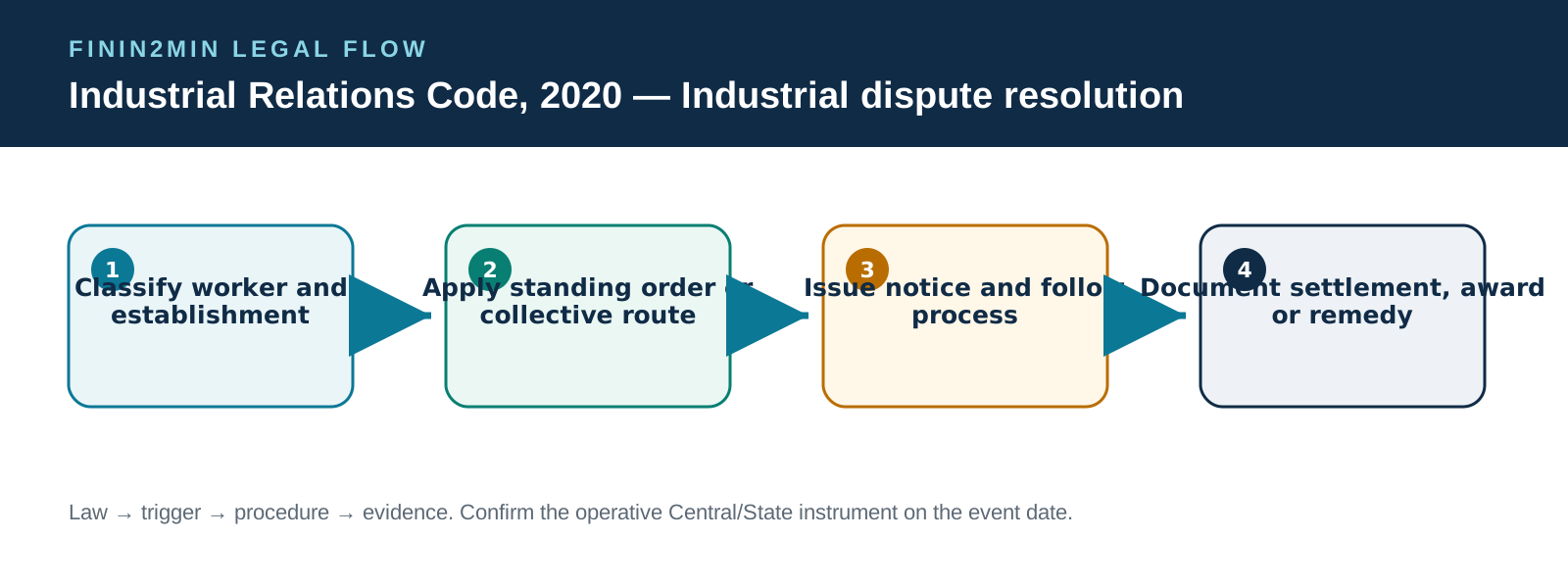
Chapter decision flow
Finin2min Summary - Chapter in 2 Minutes
This chapter turns industrial dispute resolution into an operational control file. It covers Conciliation officers, Industrial Tribunal, Finality of constitution of Tribunal, National Industrial Tribunal; the practical sequence is to classify coverage and event date, apply the provision and mapped Rule, complete the form/register, calculate the entitlement or exposure, and retain evidence for inspection, claim or appeal.
Who is covered
Employers, workers, trade unions, negotiating bodies, standing-order establishments and dispute-resolution authorities should classify the industrial establishment and worker population first.
Main obligations and rights
- Section 43: Conciliation officers
- Section 44: Industrial Tribunal
- Section 45: Finality of constitution of Tribunal
- Section 46: National Industrial Tribunal
- Section 47: Decision of Tribunal or National Industrial Tribunal
- Section 48: Disqualifications for members of Tribunal and National Industrial Tribunal
Key thresholds and timelines
- Use only the threshold, rate and limitation period effective on the event date; verify the Central/State instrument before acting.
Forms, registers and evidence
- Applicable form/register, calculation file, approval and acknowledgement evidence
- Retain classification, calculation, approval, communication, acknowledgement and payment/filing proof.
Employer risk snapshot
Highest practical risks: misclassification, missed filing/notice, unsupported calculation, incomplete records and use of the wrong Central/State instrument.
Employee/worker remedy snapshot
Core protection: the substantive protection in this chapter, access to the prescribed authority/forum and a documented remedy within limitation. Confirm the authority, limitation and appeal route stated in this chapter.
Old law / transition
Map the event date and savings position against: Trade Unions Act, 1926; Industrial Employment (Standing Orders) Act, 1946; Industrial Disputes Act, 1947.
Five-point professional checklist
- Freeze the event date, establishment, location and person/worker classification.
- Identify the controlling section/paragraph, mapped Rule, notification and appropriate Government.
- Reperform the calculation or decision test and document every exception or approval.
- Complete the prescribed form/register/portal step and retain acknowledgement, payment and communication evidence.
- Record the remedy, forum, limitation, appeal path and State variation before sign-off.
Finin2min takeaway: for industrial dispute resolution, the defensible answer is not a policy label - it is the event-date law, the mapped procedure, the calculation and a complete evidence trail.
Section-by-section provision map
| Provision | Subject | Implementation focus |
|---|---|---|
| Section 43 | Conciliation officers | Trigger, linked Rule/form, evidence, consequence and remedy |
| Section 44 | Industrial Tribunal | Trigger, linked Rule/form, evidence, consequence and remedy |
| Section 45 | Finality of constitution of Tribunal | Trigger, linked Rule/form, evidence, consequence and remedy |
| Section 46 | National Industrial Tribunal | Trigger, linked Rule/form, evidence, consequence and remedy |
| Section 47 | Decision of Tribunal or National Industrial Tribunal | Trigger, linked Rule/form, evidence, consequence and remedy |
| Section 48 | Disqualifications for members of Tribunal and National Industrial Tribunal | Trigger, linked Rule/form, evidence, consequence and remedy |
| Section 49 | Procedure and powers of arbitrator, conciliation officer, Tribunal and National Industrial Tribunal | Trigger, linked Rule/form, evidence, consequence and remedy |
| Section 50 | Powers of Tribunal and National Industrial Tribunal to give appropriate relief in case of discharge or dismissal of worker | Trigger, linked Rule/form, evidence, consequence and remedy |
| Section 51 | Transfer of pending cases | Trigger, linked Rule/form, evidence, consequence and remedy |
| Section 52 | Adjustment of services of presiding officers under repealed Act | Trigger, linked Rule/form, evidence, consequence and remedy |
| Section 53 | Conciliation and adjudication of dispute | Trigger, linked Rule/form, evidence, consequence and remedy |
| Section 54 | Reference to and functions of National Industrial Tribunal | Trigger, linked Rule/form, evidence, consequence and remedy |
| Section 55 | Form of award, its communication and commencement | Trigger, linked Rule/form, evidence, consequence and remedy |
| Section 56 | Payment of full wages to worker pending proceedings in higher Courts | Trigger, linked Rule/form, evidence, consequence and remedy |
| Section 57 | Persons on whom settlements and awards are binding | Trigger, linked Rule/form, evidence, consequence and remedy |
| Section 58 | Period of operation of settlements and awards | Trigger, linked Rule/form, evidence, consequence and remedy |
| Section 59 | Recovery of money due from employer | Trigger, linked Rule/form, evidence, consequence and remedy |
| Section 60 | Commencement and conclusion of proceedings | Trigger, linked Rule/form, evidence, consequence and remedy |
| Section 61 | Certain matters to be kept confidential | Trigger, linked Rule/form, evidence, consequence and remedy |
Section 43: Conciliation officers
Current statutory text
43. Conciliation officers.—(1) The appropriate Government may, by notification, appoint such
number of persons, as it thinks fit to be conciliation officers, charged with the duty of mediating in and
promoting the settlement of industrial disputes.

   (2) A conciliation officer may be appointed for a specified area or for specified industries in a
specified area or for one or more specified industries and either permanently or for a limited period.
Finin2min clause-by-clause decode
- Test 1
- The appropriate Government appoints conciliation officers for specified areas or industries; a 2026 notification identifies Central-sphere officers and jurisdiction.
- Implementation control
- Trigger
- Document the fact pattern that activates section 43: conciliation officers.
- Coverage and jurisdiction
- Record worker/employee status, establishment, appropriate Government, threshold and territorial authority.
- Decision owner
- Assign HR/ER, legal, payroll/finance and authorised signatory roles; no action should depend on an undocumented oral decision.
- Evidence pack
Applicable Central Rules immediately below the provision
No direct Central Rule is mapped. Check general procedural Rules, State Rules and later notifications.
Practical example
A multi-location employer prepares a legal classification memo, identifies the appropriate Government, maps the operative provision and Rule, records the decision owner and retains the documents needed to prove compliance during inspection or litigation.
Controls and evidence
- Employer: assign owner, configure system and retain approval/payment proof.
- Employee/worker: retain contract, attendance, wage/benefit proof and communication.
- Professional: reconcile the Act, Rule, notification, form, limitation and State overlay.
Consequence, remedy and limitation
Identify the substantive default first, then separately map arrears or benefit, interest/damages, administrative penalty, prosecution, compounding, company/officer liability, forum, appeal and limitation. Do not infer a remedy from the heading alone.
Mapped Rules: No direct Central Rule mapped in the repository concordance | Official source: section 43.
Section 44: Industrial Tribunal
Current statutory text
44. Industrial Tribunal.—(1) The appropriate Government may, by notification, constitute one or
more Industrial Tribunals for the adjudication of industrial disputes and for performing such other
functions as may be assigned to them under this Code and the Tribunal so constituted by the Central
Government shall also exercise the jurisdiction, powers and authority conferred on the Tribunal, as
defined in clause (m) of section 2 of the Employees' Provident Funds and Miscellaneous Provisions
Act, 1952 (19 of 1952) by or under that Act.

   (2) Every Industrial Tribunal shall consist of two members to be appointed by the appropriate
Government out of whom one shall be a Judicial Member and the other, an Administrative Member.

   (3) A bench of the Tribunal shall consist of a Judicial Member and an Administrative Member or
single Judicial Member or single Administrative Member.

   (4) The qualifications for appointment, method of recruitment, term of  office, salaries and
allowances, resignation, removal and the other terms of conditions of service of the Judicial Member
and the Administrative Member of the Tribunal constituted by the Central Government shall be in
accordance with the rules made under section 184 of the Finance Act, 2017 (7 of 2017):

   Provided that a person who has held a post below the rank of Joint Secretary to the Government of
India or an equivalent rank in the Central Government or a State Government, shall not be eligible to
be appointed as an Administrative Member of the Tribunal.

   (5) The term of office of the Judicial Member and the Administrative Member of a Tribunal
constituted by the State Government under sub-section (1), their salaries and allowances, resignation,
removal and other terms and conditions of service shall be such as may be prescribed by the State
Government.

   (6) The salary and allowances and the terms and conditions of service of the Judicial Member or
Administrative Member referred to in sub-section (2) and appointed by a State Government shall not
be varied to his disadvantage after his appointment.

   (7) The procedure of the Tribunal (including distribution of cases in the benches of the Tribunal)
shall be such as may be prescribed, provided a bench consisting of a Judicial Member and an
Administrative Member shall entertain and decide the cases only relating to—

       (a) the application and interpretation of standing order;

       (b) discharge or dismissal of workmen including reinstatement of, or grant of relief to, workmen
   dismissed;

        (c) illegality or otherwise of a strike or lockout;

       (d) retrenchment of workmen and closure of establishment; and

       (e) Trade Union disputes,

and the remaining cases shall be entertained and decided by the bench of the Tribunal consisting either
a Judicial Member or an Administrative Member of the Tribunal.

   (8) The Judicial Member shall preside over the Tribunal where the bench of the Tribunal consists of
one Judicial Member and one Administrative Member.

    (9) If, for any reason, a vacancy (other than a temporary absence) occurs in a National Industrial
Tribunal or a Tribunal, then, such vacancy shall be filled up in such manner as may be prescribed,
without prejudice to the provisions of sub-section (4) or sub-section (5), as the case may be, and the
proceeding shall be continued before such National Industrial Tribunal or Tribunal, as the case may be,
from the stage at which the vacancy is filled.

   (10) The appropriate Government may provide such number of officers and other staff as it thinks
fit in consultation with the Judicial Member of the Tribunal which may be required for the due discharge
of the functioning of the Tribunal.
Finin2min clause-by-clause decode
- Test 1
- Industrial Tribunals have Judicial and Administrative Members; bench composition depends on the nature of the proceeding.
- Test 2
- Tribunal constitution and bench allocation arise from the Code and appointment notifications; procedural powers are primarily in section 49. Do not confuse the recovery, strike or retrenchment rules with Tribunal constitution.
- Implementation control
- Trigger
- Document the fact pattern that activates section 44: industrial tribunal.
- Coverage and jurisdiction
- Record worker/employee status, establishment, appropriate Government, threshold and territorial authority.
- Decision owner
Applicable Central Rules immediately below the provision
No direct Central Rule is mapped. Check general procedural Rules, State Rules and later notifications.
Practical example
A multi-location employer prepares a legal classification memo, identifies the appropriate Government, maps the operative provision and Rule, records the decision owner and retains the documents needed to prove compliance during inspection or litigation.
Controls and evidence
- Employer: assign owner, configure system and retain approval/payment proof.
- Employee/worker: retain contract, attendance, wage/benefit proof and communication.
- Professional: reconcile the Act, Rule, notification, form, limitation and State overlay.
Consequence, remedy and limitation
Identify the substantive default first, then separately map arrears or benefit, interest/damages, administrative penalty, prosecution, compounding, company/officer liability, forum, appeal and limitation. Do not infer a remedy from the heading alone.
Mapped Rules: No direct Central Rule mapped in the repository concordance | Official source: section 44.
Section 45: Finality of constitution of Tribunal
Current statutory text
45. Finality of constitution of Tribunal.—No  notification of the appropriate Government
appointing any person as a Judicial Member or an Administrative Member of a Tribunal shall be called
in question in any manner; and no act or proceeding before the Tribunal shall be called in question in
any manner on the ground mainly of the existence of any vacancy in, or defect in the constitution of
such Tribunal.
Finin2min clause-by-clause decode
- Test 1
- The provision establishes a procedural or remedial rule for finality of constitution of tribunal.
- Test 2
- Classify the dispute, identify the competent forum, calculate limitation/notice periods and preserve service of every filing.
- Test 3
- Maintain pleadings, evidence, conciliation minutes, settlements, orders, awards and implementation proof.
- Test 4
- Use the appeal, recovery, enforcement or higher-court route specified by the Code; do not substitute an internal grievance process for a statutory remedy.
- Implementation control
- Trigger
Applicable Central Rules immediately below the provision
No direct Central Rule is mapped. Check general procedural Rules, State Rules and later notifications.
Practical example
A multi-location employer prepares a legal classification memo, identifies the appropriate Government, maps the operative provision and Rule, records the decision owner and retains the documents needed to prove compliance during inspection or litigation.
Controls and evidence
- Employer: assign owner, configure system and retain approval/payment proof.
- Employee/worker: retain contract, attendance, wage/benefit proof and communication.
- Professional: reconcile the Act, Rule, notification, form, limitation and State overlay.
Consequence, remedy and limitation
Identify the substantive default first, then separately map arrears or benefit, interest/damages, administrative penalty, prosecution, compounding, company/officer liability, forum, appeal and limitation. Do not infer a remedy from the heading alone.
Mapped Rules: No direct Central Rule mapped in the repository concordance | Official source: section 45.
Section 46: National Industrial Tribunal
Current statutory text
46. National Industrial Tribunal.—(1) The Central Government may, by notification, constitute
one or more National Industrial Tribunals for the adjudication of industrial disputes which, in the
opinion of the Central Government, involve questions of national importance or are of such a nature
that industrial establishments situated in more than one State are likely to be interested in, or affected
by, such disputes.

   (2) A National Industrial Tribunal shall consist of two members to be appointed by the Central
Government out of whom one shall be a Judicial Member and the other, an Administrative Member.

   (3) A person shall not be qualified for appointment as the Judicial Member of a National Industrial
Tribunal unless he is, or has been, a Judge of a High Court.

   (4) A person shall not be qualified for appointment as Administrative Member of a National
Industrial Tribunal unless, he is or has been Secretary to the Government of India or holding an
equivalent rank in the Central Government or State Government, having adequate experience of
handling the labour related matters.

   (5) The Judicial Member shall preside over a National Industrial Tribunal.

   (6) The procedure of selection of Judicial Member and Administrative Member of the National
Industrial Tribunal, their salaries, allowances and other terms and conditions of service shall be such as
may be prescribed.

   (7) The Central Government may provide such number of officers and other staff as it thinks fit in
consultation with the Judicial Member of the National Industrial Tribunal which may be required for
the due discharge of the functioning of the National Industrial Tribunal.
Finin2min clause-by-clause decode
- Test 1
- The Central Government may constitute National Industrial Tribunals for disputes involving national importance or establishments in more than one State.
- Implementation control
- Trigger
- Document the fact pattern that activates section 46: national industrial tribunal.
- Coverage and jurisdiction
- Record worker/employee status, establishment, appropriate Government, threshold and territorial authority.
- Decision owner
- Assign HR/ER, legal, payroll/finance and authorised signatory roles; no action should depend on an undocumented oral decision.
- Evidence pack
Applicable Central Rules immediately below the provision
No direct Central Rule is mapped. Check general procedural Rules, State Rules and later notifications.
Practical example
A multi-location employer prepares a legal classification memo, identifies the appropriate Government, maps the operative provision and Rule, records the decision owner and retains the documents needed to prove compliance during inspection or litigation.
Controls and evidence
- Employer: assign owner, configure system and retain approval/payment proof.
- Employee/worker: retain contract, attendance, wage/benefit proof and communication.
- Professional: reconcile the Act, Rule, notification, form, limitation and State overlay.
Consequence, remedy and limitation
Identify the substantive default first, then separately map arrears or benefit, interest/damages, administrative penalty, prosecution, compounding, company/officer liability, forum, appeal and limitation. Do not infer a remedy from the heading alone.
Mapped Rules: No direct Central Rule mapped in the repository concordance | Official source: section 46.
Section 47: Decision of Tribunal or National Industrial Tribunal
Current statutory text
47. Decision of Tribunal or National Industrial Tribunal.—(1) The decision of a Tribunal or a
National Industrial Tribunal, as the case may be, shall be by consensus of the members.

   (2) If the members of a Tribunal or a National Industrial Tribunal differ in opinion on any point,
they shall state the point or points on which they differ, and make a reference to the appropriate
Government.

   (3) The appropriate Government shall, on receipt of a reference made under sub-section (2), appoint
a Judicial Member of other Tribunal or a National Industrial Tribunal, who shall hear the point or points
himself and such point or points shall be decided according to the majority of the members of a Tribunal
or a National Industrial Tribunal, as the case may be, who have first heard the case, including the
Judicial Member of the other Tribunal who heard the case thereafter.
Finin2min clause-by-clause decode
- Test 1
- The provision establishes a procedural or remedial rule for decision of tribunal or national industrial tribunal.
- Test 2
- Classify the dispute, identify the competent forum, calculate limitation/notice periods and preserve service of every filing.
- Test 3
- Maintain pleadings, evidence, conciliation minutes, settlements, orders, awards and implementation proof.
- Test 4
- Use the appeal, recovery, enforcement or higher-court route specified by the Code; do not substitute an internal grievance process for a statutory remedy.
- Implementation control
- Trigger
Applicable Central Rules immediately below the provision
No direct Central Rule is mapped. Check general procedural Rules, State Rules and later notifications.
Practical example
A multi-location employer prepares a legal classification memo, identifies the appropriate Government, maps the operative provision and Rule, records the decision owner and retains the documents needed to prove compliance during inspection or litigation.
Controls and evidence
- Employer: assign owner, configure system and retain approval/payment proof.
- Employee/worker: retain contract, attendance, wage/benefit proof and communication.
- Professional: reconcile the Act, Rule, notification, form, limitation and State overlay.
Consequence, remedy and limitation
Identify the substantive default first, then separately map arrears or benefit, interest/damages, administrative penalty, prosecution, compounding, company/officer liability, forum, appeal and limitation. Do not infer a remedy from the heading alone.
Mapped Rules: No direct Central Rule mapped in the repository concordance | Official source: section 47.
Section 48: Disqualifications for members of Tribunal and National Industrial Tribunal
Current statutory text
48. Disqualifications for members of Tribunal and National Industrial Tribunal.—No person
shall be appointed to, or continue in, the office of the member of a Tribunal or National Industrial
Tribunal, respectively, if—

          (a) he is not an independent person; or

          (b) he has attained the age of sixty-five years.

   Explanation.—For the purposes of this section "independent person" means a person who is
unconnected with the industrial dispute referred to a Tribunal or National Industrial Tribunal or with
any industry directly affected by such dispute.
Finin2min clause-by-clause decode
- Test 1
- The provision establishes a procedural or remedial rule for disqualifications for members of tribunal and national industrial tribunal.
- Test 2
- Classify the dispute, identify the competent forum, calculate limitation/notice periods and preserve service of every filing.
- Test 3
- Maintain pleadings, evidence, conciliation minutes, settlements, orders, awards and implementation proof.
- Test 4
- Use the appeal, recovery, enforcement or higher-court route specified by the Code; do not substitute an internal grievance process for a statutory remedy.
- Implementation control
- Trigger
Applicable Central Rules immediately below the provision
No direct Central Rule is mapped. Check general procedural Rules, State Rules and later notifications.
Practical example
A multi-location employer prepares a legal classification memo, identifies the appropriate Government, maps the operative provision and Rule, records the decision owner and retains the documents needed to prove compliance during inspection or litigation.
Controls and evidence
- Employer: assign owner, configure system and retain approval/payment proof.
- Employee/worker: retain contract, attendance, wage/benefit proof and communication.
- Professional: reconcile the Act, Rule, notification, form, limitation and State overlay.
Consequence, remedy and limitation
Identify the substantive default first, then separately map arrears or benefit, interest/damages, administrative penalty, prosecution, compounding, company/officer liability, forum, appeal and limitation. Do not infer a remedy from the heading alone.
Mapped Rules: No direct Central Rule mapped in the repository concordance | Official source: section 48.
Section 49: Procedure and powers of arbitrator, conciliation officer, Tribunal and National Industrial Tribunal
Current statutory text
49. Procedure and powers of arbitrator, conciliation officer, Tribunal and National Industrial
Tribunal.—(1) Subject to the provisions of this Code and the rules that may be made in this behalf, an
arbitrator, conciliation officer, Tribunal or National Industrial Tribunal shall follow such procedure as
the arbitrator, conciliation officer, Tribunal or National Industrial Tribunal may deem fit.

    (2) A conciliation officer or an officer authorised in this behalf by the Tribunal or National Industrial
Tribunal may, for the purpose of inquiry into any existing or apprehended industrial dispute, after giving
reasonable notice, enter the premises occupied by any establishment to which the dispute relates.

   (3) The conciliation officer, Tribunal and National Industrial Tribunal shall have the same powers
as are vested in a civil court under the Code of Civil Procedure,1908 (5 of 1908), when trying a suit, in
respect of the following matters, namely: —

        (a) enforcing the attendance of any person and examining him on oath;

        (b) compelling the production of documents and material objects;

         (c) issuing commissions for the examination of witnesses;

        (d) in respect of such other matters as may be prescribed,

and every inquiry or investigation by Tribunal or National Industrial Tribunal, shall be deemed to be a
judicial proceeding within the meaning of sections 193 and 228 of the Indian Penal Code (45 of 1860).

   (4) A conciliation officer may enforce the attendance of any person for the purpose of examination
of such person or call for and inspect any document which he has ground for considering to be relevant
to the industrial dispute or to be necessary for the purpose of verifying the implementation of any award
or carrying out any other duty imposed on him under this Code, and for the aforesaid purposes, the
conciliation officer shall have the same powers as are vested in a civil court under the Code of Civil
Procedure, 1908 (5 of 1908), in respect of enforcing the attendance of any person and examining him
or of compelling the production of documents.

   (5) The appropriate Government may, if it so thinks fit, appoint one or more persons having special
knowledge of the matter under consideration as assessors or experts to advise a Tribunal or National
Industrial Tribunal, as the case may be, in respect of any proceeding before either of the said Tribunals.

   (6) All conciliation officers and the members of a Tribunal or National Industrial Tribunal shall be
deemed to be public servants within the meaning of section 21 of the Indian Penal Code (45 of 1860).

   (7) Subject to any rules made under this Code, the costs of, and incidental to, any proceeding before
a Tribunal or National Industrial Tribunal shall be in the discretion of that Tribunal or National
Industrial Tribunal and the Tribunal or National Industrial Tribunal, as the case may be, shall have full
powers to determine by and to whom and to what extent and subject to what conditions, if any, such
costs are to be paid, and to give all necessary directions for the purposes aforesaid and such costs may,
on application made to the appropriate Government by the person entitled, be recovered by that
Government in the same manner as an arrear of land revenue.

   (8) Every Tribunal or National Industrial Tribunal shall be deemed to be civil court for the purposes
of sections 345, 346, and 348 of the Code of Criminal Procedure, 1973 (2 of 1974).

   (9) Every award made, order issued or settlement arrived at by or before a Tribunal or a National
Industrial Tribunal shall be executed in accordance with the procedure laid down for execution of orders
and decree of a civil court under Order XXI of the Code of Civil Procedure, 1908 (5 of 1908) and for
that purpose such Tribunal or National Industrial Tribunal shall be deemed to be a civil court.
Finin2min clause-by-clause decode
- Test 1
- Arbitrators, conciliation officers and Tribunals exercise statutory procedural powers; procedural fairness, records, evidence and representation are essential.
- Implementation control
- Trigger
- Document the fact pattern that activates section 49: procedure and powers of arbitrator, conciliation officer, tribunal and national industrial tribunal.
- Coverage and jurisdiction
- Record worker/employee status, establishment, appropriate Government, threshold and territorial authority.
- Decision owner
- Assign HR/ER, legal, payroll/finance and authorised signatory roles; no action should depend on an undocumented oral decision.
- Evidence pack
Applicable Central Rules immediately below the provision
Central Rule 45: Rule 45 — Expenses of witness
Practical example
A multi-location employer prepares a legal classification memo, identifies the appropriate Government, maps the operative provision and Rule, records the decision owner and retains the documents needed to prove compliance during inspection or litigation.
Controls and evidence
- Employer: assign owner, configure system and retain approval/payment proof.
- Employee/worker: retain contract, attendance, wage/benefit proof and communication.
- Professional: reconcile the Act, Rule, notification, form, limitation and State overlay.
Consequence, remedy and limitation
Identify the substantive default first, then separately map arrears or benefit, interest/damages, administrative penalty, prosecution, compounding, company/officer liability, forum, appeal and limitation. Do not infer a remedy from the heading alone.
Mapped Rules: Rule 45 | Official source: section 49.
Section 50: Powers of Tribunal and National Industrial Tribunal to give appropriate relief in case of discharge or dismissal of worker
Current statutory text
50. Powers of Tribunal and National Industrial Tribunal to give appropriate relief in case of
discharge or dismissal of worker.—(1) Where the application under sub-section (6) of section 53
relating to an industrial dispute involving discharge or dismissal or otherwise termination of a worker
has been made to a Tribunal or has been referred to a National Industrial Tribunal for adjudication, and,
in the course of adjudication proceedings, the Tribunal or National Industrial Tribunal, as the case may
be, is satisfied that the order of discharge or dismissal or otherwise termination was not justified, it may,
by its award, set aside the order of discharge or dismissal or termination and direct reinstatement of the
worker on such terms and conditions, if any, as it thinks fit, or give such other relief to the worker
including the award of any lesser punishment in lieu of discharge or dismissal or otherwise termination,
as the circumstances of the case may require.

   (2) A Tribunal or National Industrial Tribunal, as the case may be, may, in the interest of justice,
grant such interim relief to the worker referred to in sub-section (1) during the pendency of the industrial
dispute as the circumstances of the case may require: Provided that in any proceeding under this sub-
section the Tribunal or National Industrial Tribunal, as the case may be, shall rely only on the materials
on record and shall not take any fresh evidence in relation to the matter.
Finin2min clause-by-clause decode
- Test 1
- In discharge or dismissal disputes, the Tribunal/National Tribunal can set aside the action, reinstate, modify punishment or grant other relief after testing the record.
- Implementation control
- Trigger
- Document the fact pattern that activates section 50: powers of tribunal and national industrial tribunal to give appropriate relief in case of discharge or dismissal of worker.
- Coverage and jurisdiction
- Record worker/employee status, establishment, appropriate Government, threshold and territorial authority.
- Decision owner
- Assign HR/ER, legal, payroll/finance and authorised signatory roles; no action should depend on an undocumented oral decision.
- Evidence pack
Applicable Central Rules immediately below the provision
No direct Central Rule is mapped. Check general procedural Rules, State Rules and later notifications.
Practical example
Before changing employment status, the employer maps headcount, worker category, service, notice, permission, compensation and re-employment obligations. The decision is held until the legal, HR and finance evidence files reconcile.
Controls and evidence
- Employer: assign owner, configure system and retain approval/payment proof.
- Employee/worker: retain contract, attendance, wage/benefit proof and communication.
- Professional: reconcile the Act, Rule, notification, form, limitation and State overlay.
Consequence, remedy and limitation
Identify the substantive default first, then separately map arrears or benefit, interest/damages, administrative penalty, prosecution, compounding, company/officer liability, forum, appeal and limitation. Do not infer a remedy from the heading alone.
Mapped Rules: No direct Central Rule mapped in the repository concordance | Official source: section 50.
Section 51: Transfer of pending cases
Current statutory text
51. Transfer of pending cases.—(1) On and from the date of commencement of this Code, the cases
pending immediately before such commencement—

       (a) in the Labour Court and the Tribunal constituted under the Industrial Disputes Act, 1947 (14
   of 1947), shall be transferred to the Tribunal having corresponding jurisdiction under this Code;

       (b) in the National Tribunal constituted under the Industrial Disputes Act, 1947 (14 of 1947) shall
   be transferred to the National Industrial Tribunal having corresponding jurisdiction under this Code.

       (2) The cases transferred under sub-section (1) to the Tribunal or the National Industrial Tribunal
   shall be dealt with de novo or from the stage at which they were pending before such transfer, as it
  may deem fit.
Finin2min clause-by-clause decode
- Test 1
- The provision establishes a procedural or remedial rule for transfer of pending cases.
- Test 2
- Classify the dispute, identify the competent forum, calculate limitation/notice periods and preserve service of every filing.
- Test 3
- Maintain pleadings, evidence, conciliation minutes, settlements, orders, awards and implementation proof.
- Test 4
- Use the appeal, recovery, enforcement or higher-court route specified by the Code; do not substitute an internal grievance process for a statutory remedy.
- Implementation control
- Trigger
Applicable Central Rules immediately below the provision
No direct Central Rule is mapped. Check general procedural Rules, State Rules and later notifications.
Practical example
A multi-location employer prepares a legal classification memo, identifies the appropriate Government, maps the operative provision and Rule, records the decision owner and retains the documents needed to prove compliance during inspection or litigation.
Controls and evidence
- Employer: assign owner, configure system and retain approval/payment proof.
- Employee/worker: retain contract, attendance, wage/benefit proof and communication.
- Professional: reconcile the Act, Rule, notification, form, limitation and State overlay.
Consequence, remedy and limitation
Identify the substantive default first, then separately map arrears or benefit, interest/damages, administrative penalty, prosecution, compounding, company/officer liability, forum, appeal and limitation. Do not infer a remedy from the heading alone.
Mapped Rules: No direct Central Rule mapped in the repository concordance | Official source: section 51.
Section 52: Adjustment of services of presiding officers under repealed Act
Current statutory text
52. Adjustment of services of presiding officers under repealed Act.—A presiding officer of a
Labour Court or Tribunal or, as the case may be, National Tribunal, constituted under the Industrial
Disputes Act, 1947 (14 of 1947), holding office as such immediately before the commencement of this
Code and is qualified to be appointed under this Code, shall be the Judicial Member of the Tribunal or,
as the case may be, the Judicial Member of the National Industrial Tribunal, and shall continue as such
for the remaining period of his office.
Finin2min clause-by-clause decode
- Test 1
- The provision establishes a procedural or remedial rule for adjustment of services of presiding officers under repealed act.
- Test 2
- Classify the dispute, identify the competent forum, calculate limitation/notice periods and preserve service of every filing.
- Test 3
- Maintain pleadings, evidence, conciliation minutes, settlements, orders, awards and implementation proof.
- Test 4
- Use the appeal, recovery, enforcement or higher-court route specified by the Code; do not substitute an internal grievance process for a statutory remedy.
- Implementation control
- Trigger
Applicable Central Rules immediately below the provision
No direct Central Rule is mapped. Check general procedural Rules, State Rules and later notifications.
Practical example
A multi-location employer prepares a legal classification memo, identifies the appropriate Government, maps the operative provision and Rule, records the decision owner and retains the documents needed to prove compliance during inspection or litigation.
Controls and evidence
- Employer: assign owner, configure system and retain approval/payment proof.
- Employee/worker: retain contract, attendance, wage/benefit proof and communication.
- Professional: reconcile the Act, Rule, notification, form, limitation and State overlay.
Consequence, remedy and limitation
Identify the substantive default first, then separately map arrears or benefit, interest/damages, administrative penalty, prosecution, compounding, company/officer liability, forum, appeal and limitation. Do not infer a remedy from the heading alone.
Mapped Rules: No direct Central Rule mapped in the repository concordance | Official source: section 52.
Section 53: Conciliation and adjudication of dispute
Current statutory text
53. Conciliation and adjudication of dispute.—(1) Where any industrial dispute exists or is
apprehended or a notice under section 62 has been given, the conciliation officer shall, hold conciliation
proceedings in such manner as may be prescribed:

   Provided that the conciliation officer shall not hold any such proceedings relating to the industrial
dispute after two years from the date on which such industrial dispute arose.
    (2) The conciliation officer shall, for the purpose of bringing about a settlement of the dispute,
without delay, investigate the dispute and all matters affecting the merits and right settlement thereof
and may do all such things as he thinks fit for the purpose of inducing the parties to come to a fair and
amicable settlement of the dispute.

    (3) If a settlement of the dispute or of any of the matters in dispute is arrived at in the course of the
conciliation proceedings, the conciliation officer shall send a report thereof to the appropriate
Government or an officer authorised in this behalf by the appropriate Government together with a
memorandum of the settlement signed by the parties to the dispute.

    (4) If no such settlement is arrived at, the conciliation officer shall, as soon as practicable, after the
close of the investigation, send to the concerned parties and to the appropriate Government a full report,
in the electronic or other form as may be prescribed, setting forth the steps taken by him for ascertaining
the facts and circumstances relating to the dispute and for bringing about a settlement thereof, together
with a full statement of such facts and circumstances, and the reasons on account of which, in his
opinion, a settlement could not be arrived at.

   (5) Notwithstanding anything contained in sub-section (4), the conciliation officer shall send the
report to the concerned parties and the appropriate Government within forty-five days of the
commencement of the conciliation proceedings or within such shorter period as may be fixed by the
appropriate Government:

   Provided that where a conciliation officer receives notice under section 62, he shall send the report
to the concerned parties and to the appropriate Government within fourteen days of the commencement
of the conciliation proceedings:

   Provided further that subject to the approval of the conciliation officer, the time may be extended by
such period as may be agreed upon in writing by the concerned parties to the dispute.

    (6) Any concerned party may make application in the prescribed form to the Tribunal in the matters
not settled by the conciliation officer under this section within ninety days from the date on which the
report under sub-section (4) is received to the concerned party and the Tribunal shall decide such
application in the prescribed manner.
Finin2min clause-by-clause decode
- Test 1
- Conciliation and adjudication timelines and the route for individual termination disputes must be diarised from the date of the dispute and conciliation application.
- Implementation control
- Trigger
- Document the fact pattern that activates section 53: conciliation and adjudication of dispute.
- Coverage and jurisdiction
- Record worker/employee status, establishment, appropriate Government, threshold and territorial authority.
- Decision owner
- Assign HR/ER, legal, payroll/finance and authorised signatory roles; no action should depend on an undocumented oral decision.
- Evidence pack
Applicable Central Rules immediately below the provision
Central Rule 23: Rule 23 — Conciliation proceedings
Practical example
A multi-location employer prepares a legal classification memo, identifies the appropriate Government, maps the operative provision and Rule, records the decision owner and retains the documents needed to prove compliance during inspection or litigation.
Controls and evidence
- Employer: assign owner, configure system and retain approval/payment proof.
- Employee/worker: retain contract, attendance, wage/benefit proof and communication.
- Professional: reconcile the Act, Rule, notification, form, limitation and State overlay.
Consequence, remedy and limitation
Identify the substantive default first, then separately map arrears or benefit, interest/damages, administrative penalty, prosecution, compounding, company/officer liability, forum, appeal and limitation. Do not infer a remedy from the heading alone.
Mapped Rules: Rule 23 | Official source: section 53.
Section 54: Reference to and functions of National Industrial Tribunal
Current statutory text
54. Reference to and functions of National Industrial Tribunal.—(1) The Central Government
may refer an industrial dispute to a National Industrial Tribunal which in the opinion of such
Government involves question  of  national importance  or  is  of such a  nature  that  industrial
establishments situated in more than one State are likely to be interested in, or affected by such industrial
dispute.

   (2) Where an industrial dispute has been referred under sub-section (1) or transferred under section
92 by the Central Government to a National Industrial Tribunal for adjudication,  it shall hold its
proceedings expeditiously and shall, within the period specified in the order referring or transferring
such industrial dispute or further period extended by the Central Government, submit its award to that
Government.
Finin2min clause-by-clause decode
- Test 1
- The provision establishes a procedural or remedial rule for reference to and functions of national industrial tribunal.
- Test 2
- Classify the dispute, identify the competent forum, calculate limitation/notice periods and preserve service of every filing.
- Test 3
- Maintain pleadings, evidence, conciliation minutes, settlements, orders, awards and implementation proof.
- Test 4
- Use the appeal, recovery, enforcement or higher-court route specified by the Code; do not substitute an internal grievance process for a statutory remedy.
- Implementation control
- Trigger
Applicable Central Rules immediately below the provision
No direct Central Rule is mapped. Check general procedural Rules, State Rules and later notifications.
Practical example
A multi-location employer prepares a legal classification memo, identifies the appropriate Government, maps the operative provision and Rule, records the decision owner and retains the documents needed to prove compliance during inspection or litigation.
Controls and evidence
- Employer: assign owner, configure system and retain approval/payment proof.
- Employee/worker: retain contract, attendance, wage/benefit proof and communication.
- Professional: reconcile the Act, Rule, notification, form, limitation and State overlay.
Consequence, remedy and limitation
Identify the substantive default first, then separately map arrears or benefit, interest/damages, administrative penalty, prosecution, compounding, company/officer liability, forum, appeal and limitation. Do not infer a remedy from the heading alone.
Mapped Rules: No direct Central Rule mapped in the repository concordance | Official source: section 54.
Section 55: Form of award, its communication and commencement
Current statutory text
55. Form of award, its communication and commencement.—(1) The award of—

          (i) a Tribunal delivered by a bench consisting of a Judicial Member and an Administrative
  Member or a single Judicial Member or a single Administrative Member; or

          (ii) a National Industrial Tribunal,
shall be in writing and shall be signed electronically or otherwise, as the case may be, by both the
Judicial Member and  the  Administrative Member  or  either by  the  Judicial Member  or  the
Administrative Member by whom the award is delivered.

   (2) Every arbitration award and every award of Tribunal or National Industrial Tribunal shall be
communicated to the parties concerned and the appropriate Government.

   (3) An award made under this Code shall become enforceable on the expiry of thirty days from the
date of its communication under sub-section (2):

   Provided that—

      (a) if the appropriate Government is of the opinion in any case, where the award has been given
   by a Tribunal in relation to an industrial dispute to which it is a party; or

     (b) if the Central Government is of opinion in any case, where the award has been given by a
   National Industrial Tribunal,

that it will be inexpedient on public grounds affecting national economy or social justice to give effect
to the whole or any part of the award, the appropriate Government, or as the case may be, the Central
Government may, by notification, declare that the award shall not become enforceable on the expiry of
the said period of thirty days.

    (4) Where any declaration has been made  in  relation  to an award under the proviso  to
sub-section (3), the appropriate Government or the Central Government, as the case may be, may, within
ninety days from the date of communication of the award under sub-section (2), make an order rejecting
or modifying the award, and shall, on the first available opportunity, lay the award together with a copy
of the order before the Legislature of the State, if the order has been made by a State Government, or
before Parliament, if the order has been made by the Central Government.

   (5) Where any award as rejected or modified by an order made under sub-section (4) is laid before
the Legislature of a State or before Parliament, such award shall become enforceable on the expiry of
fifteen days from the date on which it is so laid; and where no order under sub-section (4) is made in
pursuance of a declaration under the proviso to sub-section (3), the award shall become enforceable on
the expiry of the period of ninety days referred to in sub-section (4).

   (6) Subject to the provisions of sub-section (3) and sub-section (5) regarding the enforceability of
an award, the award shall come into operation with effect from such date as may be specified therein,
but where no date is so specified, it shall come into operation on the date when the award becomes
enforceable under sub-section (3) or sub-section (5), as the case may be.
Finin2min clause-by-clause decode
- Test 1
- Awards must be in writing, signed and communicated; enforceability and commencement follow the Code rather than the date parties first receive an informal copy.
- Implementation control
- Trigger
- Document the fact pattern that activates section 55: form of award, its communication and commencement.
- Coverage and jurisdiction
- Record worker/employee status, establishment, appropriate Government, threshold and territorial authority.
- Decision owner
- Assign HR/ER, legal, payroll/finance and authorised signatory roles; no action should depend on an undocumented oral decision.
- Evidence pack
Applicable Central Rules immediately below the provision
No direct Central Rule is mapped. Check general procedural Rules, State Rules and later notifications.
Practical example
A multi-location employer prepares a legal classification memo, identifies the appropriate Government, maps the operative provision and Rule, records the decision owner and retains the documents needed to prove compliance during inspection or litigation.
Controls and evidence
- Employer: assign owner, configure system and retain approval/payment proof.
- Employee/worker: retain contract, attendance, wage/benefit proof and communication.
- Professional: reconcile the Act, Rule, notification, form, limitation and State overlay.
Consequence, remedy and limitation
Identify the substantive default first, then separately map arrears or benefit, interest/damages, administrative penalty, prosecution, compounding, company/officer liability, forum, appeal and limitation. Do not infer a remedy from the heading alone.
Mapped Rules: No direct Central Rule mapped in the repository concordance | Official source: section 55.
Section 56: Payment of full wages to worker pending proceedings in higher Courts
Current statutory text
56. Payment of full wages to worker pending proceedings in higher Courts.—Where in any case,
a Tribunal or a National Industrial Tribunal by its award directs reinstatement of any worker and the
employer prefers any proceedings against such award in a High Court or the Supreme Court, the
employer shall be liable to pay such worker, during the period of pendency of such proceedings in the
High Court or the Supreme Court, full wages last drawn by him, inclusive of any maintenance allowance
admissible to him under any rule if the worker had not been employed in any establishment during such
period and an affidavit by such worker had been filed to that effect in such Court:

   Provided that where it is proved to the satisfaction of the High Court or the Supreme Court that such
worker had been employed and had been receiving adequate remuneration during any such period or
part thereof, the Court shall order that no wages shall be payable under this section for such period or
part, as the case may be.
Finin2min clause-by-clause decode
- Test 1
- Where reinstatement is challenged in a High Court or Supreme Court, the employer may have to pay full last-drawn wages during pendency if the statutory conditions are met.
- Implementation control
- Trigger
- Document the fact pattern that activates section 56: payment of full wages to worker pending proceedings in higher courts.
- Coverage and jurisdiction
- Record worker/employee status, establishment, appropriate Government, threshold and territorial authority.
- Decision owner
- Assign HR/ER, legal, payroll/finance and authorised signatory roles; no action should depend on an undocumented oral decision.
- Evidence pack
Applicable Central Rules immediately below the provision
No direct Central Rule is mapped. Check general procedural Rules, State Rules and later notifications.
Practical example
A payroll team tests the employee category, wage period, notified rate, permitted exclusions and documentary proof before releasing payroll. It records the calculation, approval, bank output and wage slip so that every disputed limb can be reconstructed.
Controls and evidence
- Employer: assign owner, configure system and retain approval/payment proof.
- Employee/worker: retain contract, attendance, wage/benefit proof and communication.
- Professional: reconcile the Act, Rule, notification, form, limitation and State overlay.
Consequence, remedy and limitation
Identify the substantive default first, then separately map arrears or benefit, interest/damages, administrative penalty, prosecution, compounding, company/officer liability, forum, appeal and limitation. Do not infer a remedy from the heading alone.
Mapped Rules: No direct Central Rule mapped in the repository concordance | Official source: section 56.
Section 57: Persons on whom settlements and awards are binding
Current statutory text
57. Persons on whom settlements and awards are binding.—(1) A settlement arrived at by
agreement between the employer and worker otherwise than in the course of conciliation proceeding
shall be binding on the parties to the agreement.

   (2) Subject to the provisions of sub-section (3), an arbitration award which has become enforceable
shall be binding on the parties to the agreement who referred the dispute to arbitration.

   (3) A settlement arrived at in the course of conciliation proceedings under this Code or an arbitration
or an award of a Tribunal or National Industrial Tribunal which has become enforceable shall be binding
on—

         (a) all parties to the industrial dispute;

         (b) all other parties summoned to appear in the proceedings as parties to the dispute, unless the
    arbitrator, Tribunal or National Industrial Tribunal, as the case may be, records the opinion that they
   were so summoned without proper cause;

         (c) where a party referred to in clause (a) or clause (b) is an employer, his heirs, successors or
   assigns in respect of the establishment to which the dispute relates;

        (d) where a party referred to in clause (a) or clause (b) is composed of workers, all persons who
   were employed in the establishment or part of the establishment, as the case may be, to which the
   dispute relates on the date of the dispute and all persons who subsequently become employed in that
   establishment or part.
Finin2min clause-by-clause decode
- Test 1
- A settlement outside conciliation binds its parties; a conciliation settlement and an enforceable award bind the wider statutory classes stated in the section.
- Implementation control
- Trigger
- Document the fact pattern that activates section 57: persons on whom settlements and awards are binding.
- Coverage and jurisdiction
- Record worker/employee status, establishment, appropriate Government, threshold and territorial authority.
- Decision owner
- Assign HR/ER, legal, payroll/finance and authorised signatory roles; no action should depend on an undocumented oral decision.
- Evidence pack
Applicable Central Rules immediately below the provision
No direct Central Rule is mapped. Check general procedural Rules, State Rules and later notifications.
Practical example
A multi-location employer prepares a legal classification memo, identifies the appropriate Government, maps the operative provision and Rule, records the decision owner and retains the documents needed to prove compliance during inspection or litigation.
Controls and evidence
- Employer: assign owner, configure system and retain approval/payment proof.
- Employee/worker: retain contract, attendance, wage/benefit proof and communication.
- Professional: reconcile the Act, Rule, notification, form, limitation and State overlay.
Consequence, remedy and limitation
Identify the substantive default first, then separately map arrears or benefit, interest/damages, administrative penalty, prosecution, compounding, company/officer liability, forum, appeal and limitation. Do not infer a remedy from the heading alone.
Mapped Rules: No direct Central Rule mapped in the repository concordance | Official source: section 57.
Section 58: Period of operation of settlements and awards
Current statutory text
58. Period of operation of settlements and awards.—(1) A settlement shall come into operation
on such date as is agreed upon by the parties to the dispute, and if no date is agreed upon, on the date
on which the memorandum of the settlement is signed by the parties to the dispute.

    (2) Such settlement shall be binding for such period as is agreed upon by the parties, and if no such
period is agreed upon, for a period of six months from the date on which the memorandum of settlement
is signed by the parties to the dispute, and shall continue to be binding on the parties after the expiry of
the period aforesaid, until the expiry of sixty days from the date on which a notice in writing of an
intention to terminate the settlement is given by one of the parties to the other party or parties to the
settlement.

   (3) An award shall, subject to the provisions of this section, remain in operation for a period of one
year from the date on which the award becomes enforceable under section 55:

   Provided that the appropriate Government may reduce the said period and fix such period as it thinks
fit:

   Provided further that the appropriate Government may, before expiry of the said period, extend the
period of operation by any period not exceeding one year at a time as it thinks fit so, however, that the
total period of operation of any award does not exceed three years from the date on which it came into
operation.

   (4) Where the appropriate Government, whether of its own motion or on the application of any party
bound by the award, considers that since the award was made, there has been a material change in the
circumstances on which it was based, the appropriate Government may refer the award or part of it to
the Tribunal, if the award is made by the Tribunal for decision whether the period of operation should
not, by reason of such change, be shortened and the decision of the Tribunal on such reference shall be
final.
   (5) Nothing contained in sub-section (3) shall apply to any award which by its nature, terms or other
circumstances does not impose, after it has been given effect to, any continuing obligation on the parties
bound by the award.

    (6) Notwithstanding the expiry of the period of operation under sub-section (3), the award shall
continue to be binding on the parties until a period of sixty days has elapsed from the date on which
notice is given by any party bound by the award to the other party or parties intimating its intention to
terminate the award.

   (7) No notice given under sub-section (2) or sub-section (6) shall have effect, unless it is given by a
party representing the majority of persons bound by the settlement or award, as the case may be.
Finin2min clause-by-clause decode
- Test 1
- Settlements and awards operate for their stated/statutory periods and continue until properly terminated as the section provides.
- Implementation control
- Trigger
- Document the fact pattern that activates section 58: period of operation of settlements and awards.
- Coverage and jurisdiction
- Record worker/employee status, establishment, appropriate Government, threshold and territorial authority.
- Decision owner
- Assign HR/ER, legal, payroll/finance and authorised signatory roles; no action should depend on an undocumented oral decision.
- Evidence pack
Applicable Central Rules immediately below the provision
No direct Central Rule is mapped. Check general procedural Rules, State Rules and later notifications.
Practical example
A multi-location employer prepares a legal classification memo, identifies the appropriate Government, maps the operative provision and Rule, records the decision owner and retains the documents needed to prove compliance during inspection or litigation.
Controls and evidence
- Employer: assign owner, configure system and retain approval/payment proof.
- Employee/worker: retain contract, attendance, wage/benefit proof and communication.
- Professional: reconcile the Act, Rule, notification, form, limitation and State overlay.
Consequence, remedy and limitation
Identify the substantive default first, then separately map arrears or benefit, interest/damages, administrative penalty, prosecution, compounding, company/officer liability, forum, appeal and limitation. Do not infer a remedy from the heading alone.
Mapped Rules: No direct Central Rule mapped in the repository concordance | Official source: section 58.
Section 59: Recovery of money due from employer
Current statutory text
59. Recovery of money due from employer.—(1) Where any money is due to a worker from an
employer under a settlement or an award or under the provisions of Chapter IX or Chapter X, the worker
himself or any other person authorised by him in writing in this behalf, or, in the case of the death of
the worker, his assignee or heirs may, without prejudice to any other mode of recovery, make an
application to the appropriate Government for the recovery of the money due to him, and if the
appropriate Government is satisfied that any money is so due, it shall issue a certificate for that amount
to the Collector who shall proceed to recover the same in the same manner as an arrear of land revenue:

   Provided that every such application shall be made within one year from the date on which the
money became due to the worker from the employer:

   Provided further that any such application may be entertained after the expiry of the said period of
one year, if the appropriate Government is satisfied that the applicant had sufficient cause for not
making the application within the said period.

    (2) Where any worker is entitled to receive from the employer any money or any benefit which is
capable of being computed in terms of money and if any question arises as to the amount of money due
or as to the amount at which such benefit should be computed, then the question may, subject to any
rules that may be made under this Code, be decided by such Tribunal as may be specified in this behalf
by the appropriate Government within a period not exceeding three months:

   Provided that where the Tribunal considers it necessary or expedient so to do, it may, for reasons to
be recorded in writing, extend such period by such further period as it may think fit.

   (3) For the purposes of computing the money value of a benefit referred to in sub-section (2), the
Tribunal may, if it so thinks fit, appoint a Commissioner who shall, after taking such evidence as may
be necessary, submit a report to the Tribunal and the Tribunal shall determine the amount after
considering the report of the Commissioner and other circumstances of the case.

   (4) The decision of the Tribunal shall be forwarded by it to the appropriate Government and any
amount found due by the Tribunal may be recovered in the manner provided for in sub-section (1).

   (5) Where workers employed under the same employer are entitled to receive from him any money
or any benefit capable of being computed in terms of money, then, subject to such rules as may be made
in this behalf, a single application for the recovery of the amount due may be made on behalf of or in
respect of any number of such workers.
Finin2min clause-by-clause decode
- Test 1
- Money due under a settlement, award or specified statutory source may be recovered through the appropriate Government and recovery-certificate route.
- Test 2
- A Central notification delegates specified recovery-certificate power to Regional Labour Commissioners.
- Implementation control
- Trigger
- Document the fact pattern that activates section 59: recovery of money due from employer.
- Coverage and jurisdiction
- Record worker/employee status, establishment, appropriate Government, threshold and territorial authority.
- Decision owner
Applicable Central Rules immediately below the provision
Central Rule 24: Rule 24 — Application for recovery of dues
Central Rule 48: Rule 48 — Appointment of Commissioner
Central Rule 49: Rule 49 — Fee for Commissioner, etc
Central Rule 50: Rule 50 — Time for submission of report
Practical example
A multi-location employer prepares a legal classification memo, identifies the appropriate Government, maps the operative provision and Rule, records the decision owner and retains the documents needed to prove compliance during inspection or litigation.
Controls and evidence
- Employer: assign owner, configure system and retain approval/payment proof.
- Employee/worker: retain contract, attendance, wage/benefit proof and communication.
- Professional: reconcile the Act, Rule, notification, form, limitation and State overlay.
Consequence, remedy and limitation
Identify the substantive default first, then separately map arrears or benefit, interest/damages, administrative penalty, prosecution, compounding, company/officer liability, forum, appeal and limitation. Do not infer a remedy from the heading alone.
Mapped Rules: Rule 24, Rule 48, Rule 49, Rule 50 | Official source: section 59.
Section 60: Commencement and conclusion of proceedings
Current statutory text
60. Commencement and conclusion of proceedings.—(1) A conciliation proceeding shall be
deemed to have commenced on the date on which the first meeting is held by the conciliation officer in
an industrial dispute after the receipt of the notice of strike or lock-out by the conciliation officer.

   (2) A conciliation proceeding shall be deemed to have concluded—
       (a) where a settlement is arrived at, when a memorandum of the settlement is signed by the
   parties to the dispute;

       (b) where no settlement is arrived at, and failure of conciliation is recorded by the conciliation
   officer; or (c) when a reference is made to a National Industrial Tribunal, under this Code, during
   the pendency of conciliation proceedings.

    (3) Proceedings before an arbitrator or a Tribunal or a National Industrial Tribunal under this Code
shall be deemed to have commenced on the date of filing application or appeal or on the date of
reference of the dispute for arbitration or adjudication, as the case may be, and such proceedings shall
be deemed to have concluded on the date on which the award becomes enforceable.
Finin2min clause-by-clause decode
- Test 1
- The provision establishes a procedural or remedial rule for commencement and conclusion of proceedings.
- Test 2
- Classify the dispute, identify the competent forum, calculate limitation/notice periods and preserve service of every filing.
- Test 3
- Maintain pleadings, evidence, conciliation minutes, settlements, orders, awards and implementation proof.
- Test 4
- Use the appeal, recovery, enforcement or higher-court route specified by the Code; do not substitute an internal grievance process for a statutory remedy.
- Implementation control
- Trigger
Applicable Central Rules immediately below the provision
No direct Central Rule is mapped. Check general procedural Rules, State Rules and later notifications.
Practical example
A multi-location employer prepares a legal classification memo, identifies the appropriate Government, maps the operative provision and Rule, records the decision owner and retains the documents needed to prove compliance during inspection or litigation.
Controls and evidence
- Employer: assign owner, configure system and retain approval/payment proof.
- Employee/worker: retain contract, attendance, wage/benefit proof and communication.
- Professional: reconcile the Act, Rule, notification, form, limitation and State overlay.
Consequence, remedy and limitation
Identify the substantive default first, then separately map arrears or benefit, interest/damages, administrative penalty, prosecution, compounding, company/officer liability, forum, appeal and limitation. Do not infer a remedy from the heading alone.
Mapped Rules: No direct Central Rule mapped in the repository concordance | Official source: section 60.
Section 61: Certain matters to be kept confidential
Current statutory text
61. Certain matters to be kept confidential.—There shall not be included in any report or award
under this Code, any information obtained by a conciliation officer, arbitrator, Tribunal or National
Industrial Tribunal, in the course of any investigation or inquiry as to a Trade Union or as to any
individual business (whether carried on by a person, firm or company) which is not available otherwise
than through the evidence given before such conciliation officer, arbitrator, Tribunal, or National
Industrial Tribunal, if the Trade Union, person, firm or company, in question has made a request in
writing to the conciliation officer, arbitrator, Tribunal or National Industrial Tribunal, as the case may
be, that such information shall be treated as confidential; nor shall such conciliation officer, or the
arbitrator, or the presiding officer of a Tribunal or a National Industrial Tribunal or any person present
at or concerned in the proceedings disclose any such information without the consent in writing of the
secretary of the Trade Union or the person, firm or company in question, as the case may be:

   Provided that nothing contained in this section shall apply to a disclosure of any such information
for the purposes of a prosecution under section 193 of the Indian Penal Code (45 of 1860).

                        CHAPTER VIII

                                STRIKES AND LOCK-OUTS
Finin2min clause-by-clause decode
- Test 1
- The provision establishes a procedural or remedial rule for certain matters to be kept confidential.
- Test 2
- Classify the dispute, identify the competent forum, calculate limitation/notice periods and preserve service of every filing.
- Test 3
- Maintain pleadings, evidence, conciliation minutes, settlements, orders, awards and implementation proof.
- Test 4
- Use the appeal, recovery, enforcement or higher-court route specified by the Code; do not substitute an internal grievance process for a statutory remedy.
- Implementation control
- Trigger
Applicable Central Rules immediately below the provision
No direct Central Rule is mapped. Check general procedural Rules, State Rules and later notifications.
Practical example
A multi-location employer prepares a legal classification memo, identifies the appropriate Government, maps the operative provision and Rule, records the decision owner and retains the documents needed to prove compliance during inspection or litigation.
Controls and evidence
- Employer: assign owner, configure system and retain approval/payment proof.
- Employee/worker: retain contract, attendance, wage/benefit proof and communication.
- Professional: reconcile the Act, Rule, notification, form, limitation and State overlay.
Consequence, remedy and limitation
Identify the substantive default first, then separately map arrears or benefit, interest/damages, administrative penalty, prosecution, compounding, company/officer liability, forum, appeal and limitation. Do not infer a remedy from the heading alone.
Mapped Rules: No direct Central Rule mapped in the repository concordance | Official source: section 61.
Rules, forms, registers, portals and due dates
| Rule | Subject | Text/control status |
|---|---|---|
| 45 | Rule 45 — Expenses of witness | Exact Gazette extract embedded |
| 23 | Rule 23 — Conciliation proceedings | Exact Gazette extract embedded |
| 24 | Rule 24 — Application for recovery of dues | Exact Gazette extract embedded |
| 48 | Rule 48 — Appointment of Commissioner | Exact Gazette extract embedded |
| 49 | Rule 49 — Fee for Commissioner, etc | Exact Gazette extract embedded |
| 50 | Rule 50 — Time for submission of report | Exact Gazette extract embedded |
Forms and registers must be confirmed from the appended 2026 Central Rules and the live portal applicable to the appropriate Government. A form is not treated as current merely because an earlier law used the same number.
Notifications and effective-date history
| Control | Required action |
|---|---|
| Enactment | Record Act number, assent and Gazette publication. |
| Commencement | Use the provision-specific commencement notification; the four Codes became broadly operative from 21 November 2025 subject to earlier partial commencement and corrigenda. |
| Central Rules | Read the applicable 2026 Central Rules from their Gazette date and verify subsequent amendments. |
| State instrument | Check final State Rules, authority notifications, forms and rates where the State is appropriate Government. |
Old-law/new-Code concordance
| Predecessor law | Transition control |
|---|---|
| Trade Unions Act, 1926 | Classify the event date, accrued right, saved Rule/notification and pending proceeding before moving to the Code. |
| Industrial Employment (Standing Orders) Act, 1946 | Classify the event date, accrued right, saved Rule/notification and pending proceeding before moving to the Code. |
| Industrial Disputes Act, 1947 | Classify the event date, accrued right, saved Rule/notification and pending proceeding before moving to the Code. |
Practical calculations and control file
Calculation sequence
- Freeze the employee/worker population and event date.
- Apply the statutory wage/benefit base and notified threshold.
- Reconcile attendance, service, payroll and contractor records.
- Calculate principal amount, interest/damages and any statutory compensation separately.
- Obtain legal/payroll approval and retain the versioned worksheet.
Three-owner sign-off
- Employer/HR: facts, classification, communication and workflow.
- Employee/worker: notice, records, nomination/claim and acknowledgement.
- Professional: source, formula, forum, limitation and evidence reconciliation.
Binding and highly relevant case-law principles
| Decision | Principle and present-use caution |
|---|---|
| Bangalore Water Supply v. A. Rajappa | The industry test remains an important interpretive starting point, subject to the Code definition and later statutory developments. |
| Workmen of Firestone Tyre v. Management | Domestic enquiry fairness and the adjudicatory power to examine dismissal remain central principles, subject to the Code and certified standing orders. |
| Bharat Bank Ltd. v. Employees | Industrial adjudication is specialised statutory adjudication; forum, reference and award provisions must be followed. |
| Karnal Leather Karamchari Sanghatan v. Liberty Footwear | Settlement and collective-bargaining outcomes require genuine authority, representativeness and statutory compliance. |
State-law variation alerts
- Confirm whether the Central or State Government is the appropriate Government.
- Central Rules do not automatically displace valid State Rules, rates, registers, authorities or portal procedures.
- Minimum-wage rates, holidays, working-hours permissions, licences and local welfare obligations require State-specific verification.
- Record Gazette number, effective date and supersession status in the location compliance register.
Practical examples and calculations
Classify the worker and establishment, identify the operative provision and notified instrument on the event date, compute the entitlement or exposure from source records, obtain approval, complete the filing/payment/action, and retain evidence. Do not use a portal value or payroll label as a substitute for the statutory test.
Calculation/control template: Control calculation: verified population or transaction base × applicable notified rate/amount × eligible period, adjusted for statutory inclusions, exclusions, ceilings, interest, compensation and prior payments. Reperform the calculation from retained source data.
Finin2min implementation explanation
Maintain a controlled implementation file for Chapter VII - Industrial dispute resolution: coverage and event date, operative Central/State instrument, responsible owner, approval and authority, form/portal step, due date, calculation basis, supporting evidence, exception, escalation and closure proof. Reconcile payroll, HR, finance, contractor and legal records before sign-off.
Practical transaction application
Apply the chapter to workforce restructuring, standing orders, union recognition, disciplinary action, settlement drafting, transfer of undertaking, lay-off, retrenchment, closure and industrial-dispute strategy. Build the transaction timeline before notices or board approvals are issued.
Authority, consent and execution controls
Map powers among the board, occupier/employer, HR, disciplinary authority, authorised signatory and legal team. Verify delegation, standing orders, service rules, union/negotiating-council status and government permission or notice requirements; informal consent cannot cure a mandatory statutory step.
Stamp duty and registration alerts
Industrial settlements, service instruments and transfer documents may attract State stamp consequences depending on form and subject matter. Statutory filing, publication or registration under labour law is separate from document registration under the Registration Act and stamping under State law.
Evidence and document-retention checklist
Retain the operative law/rule version, classification note, approvals, signed instruments, statutory forms, portal acknowledgements, registers, calculations, bank proof, correspondence, inspection records, service proof, decision and appeal file. Apply the longer of the statutory retention rule, litigation hold, tax/audit need and contractual requirement; restrict access to personal and sensitive data.
Performance, delivery and payment controls
Create a milestone file for notice, consultation, permission, compensation, re-skilling contribution, service of orders and payment. No restructuring should close until payroll, bank proof, employee-wise computation, statutory filing and possession/access controls reconcile.
Breach, loss, mitigation and remedy framework
On detecting a breach, stop continuing exposure, preserve evidence, quantify employee and government dues, identify affected persons, make lawful corrective payment/filing, notify the authorised decision-maker, assess self-disclosure or compounding where available, and reserve contractual recovery against responsible vendors without delaying statutory remediation.
Limitation and forum controls
Use the conciliation officer, tribunal, national industrial tribunal, appellate channel or other prescribed forum as applicable. Track the dispute date, cause of action, pending proceedings, protected status and service of notices; private jurisdiction clauses cannot override the statutory adjudication scheme.
Arbitration and mediation interface
Voluntary arbitration and settlement mechanisms may be available where the Code permits. Draft the reference, issues, arbitrator appointment, publication/filing and settlement authority carefully; mediation is useful for commercial terms but must preserve non-waivable worker protections.
Company, partnership, GST and tax overlays
For a company, align board/delegation and officer-in-default controls; for an LLP or partnership, identify the designated partner/partner and authorised employer representative. Labour dues can affect transaction price, indemnities, director/partner exposure and insolvency claims. Salary/TDS, perquisite, contractor TDS, GST on outsourced services and accounting provisions must be reconciled without treating tax treatment as proof of labour-law classification.
Finin2min Q&A
Which law and version should be applied?
Use the current text of Industrial Relations Code, 2020, the commencement notification, the applicable Central or State Rules and any later instrument effective on the event date.
How is the appropriate Government identified?
Classify ownership/control, sector, establishment and contractor relationship before selecting the Central or State authority.
Can a company policy override the statutory protection?
No. A policy may improve a benefit or control, but it cannot contract out of a mandatory statutory floor.
What evidence should be retained?
Retain the classification memo, source instrument, form/portal record, calculation, approval, employee communication, acknowledgement and payment or authority proof.
Do the Central Rules apply to every establishment?
No. They govern the Central sphere. State Rules and State notifications must be checked where the State is the appropriate Government.
How should a historical event be tested?
Apply the law and subordinate instrument effective on the event date, then use the repeal-and-savings provision for pending rights and proceedings.
What happens when portal practice conflicts with the statute?
Record the conflict, follow the higher legal instrument, seek authority clarification where necessary and preserve screenshots and correspondence.
Can criminal and monetary consequences arise together?
They may. Separate wages/benefits, interest, damages, civil penalty, prosecution, compounding and director/officer liability.
Is a contractor arrangement enough to shift liability?
No. Principal-employer and contractor liabilities depend on the specific provision and facts; the contract should allocate evidence and recovery without diluting worker rights.
What is the first professional review step?
Freeze the event date and facts, identify the applicable provision, then map Rules, forms, notification status, authority, limitation and evidence.
What is the operational focus of section 43 - Conciliation officers?
The section must be decomposed into actor, trigger, threshold, procedure, exception, consequence and evidence. Read the full official text and the mapped Rules before applying the Finin2min control summary.
What is the operational focus of section 44 - Industrial Tribunal?
The section must be decomposed into actor, trigger, threshold, procedure, exception, consequence and evidence. Read the full official text and the mapped Rules before applying the Finin2min control summary.
What is the operational focus of section 45 - Finality of constitution of Tribunal?
The section must be decomposed into actor, trigger, threshold, procedure, exception, consequence and evidence. Read the full official text and the mapped Rules before applying the Finin2min control summary.
What is the operational focus of section 46 - National Industrial Tribunal?
The section must be decomposed into actor, trigger, threshold, procedure, exception, consequence and evidence. Read the full official text and the mapped Rules before applying the Finin2min control summary.
What is the operational focus of section 47 - Decision of Tribunal or National Industrial Tribunal?
The section must be decomposed into actor, trigger, threshold, procedure, exception, consequence and evidence. Read the full official text and the mapped Rules before applying the Finin2min control summary.
What is the operational focus of section 48 - Disqualifications for members of Tribunal and National Industrial Tribunal?
The section must be decomposed into actor, trigger, threshold, procedure, exception, consequence and evidence. Read the full official text and the mapped Rules before applying the Finin2min control summary.
What is the operational focus of section 49 - Procedure and powers of arbitrator, conciliation officer, Tribunal and National Industrial Tribunal?
The section must be decomposed into actor, trigger, threshold, procedure, exception, consequence and evidence. Read the full official text and the mapped Rules before applying the Finin2min control summary.
What is the operational focus of section 50 - Powers of Tribunal and National Industrial Tribunal to give appropriate relief in case of discharge or dismissal of worker?
The section must be decomposed into actor, trigger, threshold, procedure, exception, consequence and evidence. Read the full official text and the mapped Rules before applying the Finin2min control summary.