Source protocol. Retained provision/rule pages and official documents are consolidated below. The signed Gazette and current authority portal prevail over normalised formatting.
For the exact locally-verified statutory text of every section and rule referenced in this chapter, see the ESIC Repository (regulations, benefits, forms). This chapter is the operational map and Finin2min synthesis layer.
Finin2min Summary - Chapter in 2 Minutes
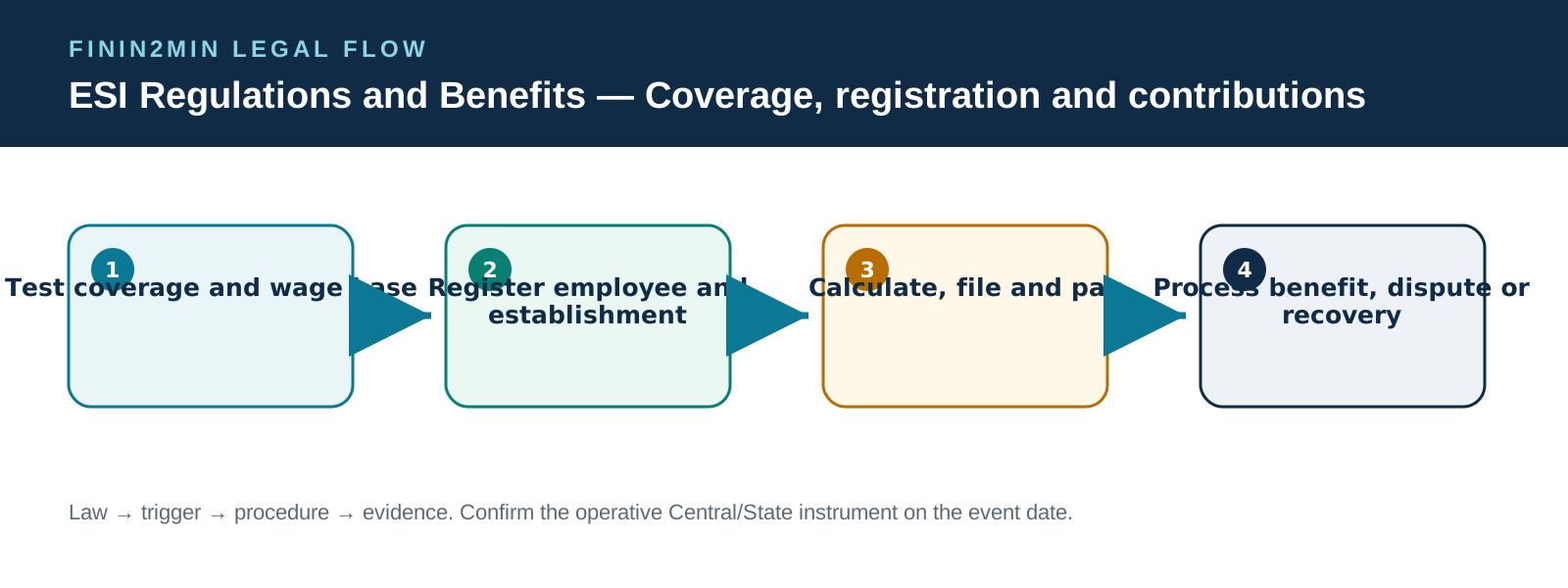
This chapter turns coverage, registration and contributions into an operational control file. It covers Regulation 010, Regulation 010A, Regulation 010B, Regulation 010C; the practical sequence is to classify coverage and event date, apply the provision and mapped Rule, complete the form/register, calculate the entitlement or exposure, and retain evidence for inspection, claim or appeal.
Who is covered
Factories and establishments, insured persons, employers, dependants and ESIC authorities must identify coverage, wage/contribution periods and benefit eligibility.
Main obligations and rights
Regulation 010
Regulation 010A
Regulation 010B
Regulation 010C
Regulation 011
Regulation 012
Key thresholds and timelines
Use only the threshold, rate and limitation period effective on the event date; verify the Central/State instrument before acting.
Forms, registers and evidence
Register
Return
Nomination
Retain classification, calculation, approval, communication, acknowledgement and payment/filing proof.
Employer risk snapshot
Highest practical risks: operating without registration, using stale particulars or missing amendment/closure filings.
Employee/worker remedy snapshot
Core protection: medical and cash benefits, employment-injury protection and access to ESIC/Employees Insurance Court remedies. Confirm the authority, limitation and appeal route stated in this chapter.
Old law / transition
Apply the instrument effective on the event date and preserve any accrued right, saved notification, pending proceeding or scheme-specific transition.
Five-point professional checklist
Freeze the event date, establishment, location and person/worker classification.
Identify the controlling section/paragraph, mapped Rule, notification and appropriate Government.
Reperform the calculation or decision test and document every exception or approval.
Complete the prescribed form/register/portal step and retain acknowledgement, payment and communication evidence.
Record the remedy, forum, limitation, appeal path and State variation before sign-off.
Finin2min takeaway: for coverage, registration and contributions, the defensible answer is not a policy label - it is the event-date law, the mapped procedure, the calculation and a complete evidence trail.
Regulation 10: Regional Boards | ESI General Regulations, 1950 | Finin2min
Labour
ESIC
General Regulations, 1950
› Regulation 10
ESI General Regulations, 1950 · Regulation 10
Regulation 10: Regional Boards
Regulation-wise current-law crosswalk, implementation controls, evidence, remedies and transition treatment.
Instrument
ESI (General) Regulations, 1950
Chapter
I — Preliminary and governance
Current status
One-year saved transitional regulation during the one-year period specified in Code section 164(2)(b), only to the extent not inconsistent with the Code and current instruments.
Source review
2026-07-17
Current legal status and scope
Regulation 10 addresses ESIC governance or delegated decision-making: Regional Boards.
Transition control:
The ESI Act, 1948 has been repealed. Code section 164(2)(b) keeps ESI rules, regulations and schemes in force for one year from commencement, only to the extent not inconsistent with the Code; section 164(2)(a) separately preserves prior actions subject to its conditions. The Corporation approved framing of 2026 General Regulations on 30 June 2026; this page does not treat that approval as a final Gazette replacement.
Consolidated regulation text
Regulation-specific legal and control map
Control 1: Confirm the competent body/officer and valid delegation before relying on a decision.
Confirm the competent body/officer and valid delegation before relying on a decision.
Implementation test:
fix the event date, responsible person, evidence source, current Code/Rule owner and any later ESIC instruction before concluding compliance.
Control 2: Check quorum, voting, agenda, minutes and conflict disclosures where the provision concerns meetings.
Check quorum, voting, agenda, minutes and conflict disclosures where the provision concerns meetings.
Implementation test:
fix the event date, responsible person, evidence source, current Code/Rule owner and any later ESIC instruction before concluding compliance.
Control 3: Preserve the resolution/order and the statutory source of authority.
Preserve the resolution/order and the statutory source of authority.
Implementation test:
fix the event date, responsible person, evidence source, current Code/Rule owner and any later ESIC instruction before concluding compliance.
Control 4: A relaxation or delegated decision must remain within the enabling Code and cannot override a mandatory provision.
A relaxation or delegated decision must remain within the enabling Code and cannot override a mandatory provision.
Implementation test:
fix the event date, responsible person, evidence source, current Code/Rule owner and any later ESIC instruction before concluding compliance.
Responsible parties
Corporation, Standing Committee, Medical Benefit Council, Regional Board/local committee or authorised officer
Trigger
A governance decision, delegation, meeting, relaxation or benefit determination is required.
Current-law crosswalk
Primary Code sections: 5, 9, 12. Central Rules: 8, 11, 12.
Do not duplicate:
the full Code and Central Rule analysis remains under
the L3 Social Security corpus
. This page owns only the saved regulation and its operational transition.
Evidence and audit trail
agenda and notice
attendance/quorum
resolution/minutes
delegation order
reasoned decision
Quality controls
Event date and legal-version lock.
Employee/insured-person identifier reconciliation.
Maker-checker review and exception log.
Current portal acknowledgement or reasoned authority decision.
Privacy-controlled retention of medical and dependant records.
Non-compliance, remedy and escalation
A decision by the wrong authority or without required procedure is vulnerable to challenge.
Employer correction
Correct master data, contribution/return or evidence through the authorised route while retaining the original record and reason.
Insured person or claimant
Use the appropriate claim, grievance, Medical Board, review, ESI Court or High Court route according to the disputed issue.
Authority control
Keep assessment, benefit, interest, damages, recovery and penalty decisions separately reasoned and quantified.
Worked implementation scenario
A transaction arises under
Regulation 10 — Regional Boards
. The compliance owner records the event date and identifies whether the issue concerns coverage, contribution, medical evidence or benefit. The current Code section and 2026 Central Rule are checked first; the saved regulation is then used only for the surviving operational detail. The maker prepares the portal filing, claim or decision pack, while a reviewer verifies identity, wage/contribution or medical evidence, limitation and later ESIC directions. The acknowledgement, calculation and correspondence are preserved together.
Failure pattern:
copying the paper-era process without checking whether the Code, final Central Rules or ESIC digital workflow has displaced it.
Practical Q&A
Is Regulation 10 automatically current because it appears in a consolidated text?
No. It survives only through the Code’s savings framework and only to the extent it is not inconsistent with the Code, final Central Rules or a later valid replacement.
Can portal acceptance cure an incorrect legal classification?
No. Portal processing does not conclusively determine coverage, contribution wage, medical entitlement, dependant status or limitation.
Should the proposed 2026 General Regulations be used now?
Not as final law unless and until a valid Gazette notification brings the replacement instrument into force. Track the official status page.
Related provisions and tools
Code section 5
Current Code provision
Code section 9
Current Code provision
Code section 12
Current Code provision
Central Rule 8
Social Security (Central) Rules, 2026
Central Rule 11
Social Security (Central) Rules, 2026
Central Rule 12
Social Security (Central) Rules, 2026
ESI concordance
Code–Rule–Regulation map
2026 Regulations status
Draft/replacement watch
← Regulation 9
Regulation 10A →
Finin2min implementation decode
The establishment creates a trigger ticket when coverage changes, assigns the authorised signatory, uploads the prescribed attachments, captures the acknowledgement and retains a versioned copy of the form, payment and approval.
Identify actor, trigger, threshold and territorial authority.
Map form, record, portal, fee and due date.
Separate substantive entitlement from procedure, remedy and penal consequence.
Retain the official instrument and event-date evidence.
Regulation 010A
Regulation 10A: Local committees | ESI General Regulations, 1950 | Finin2min
Labour
ESIC
General Regulations, 1950
› Regulation 10A
ESI General Regulations, 1950 · Regulation 10A
Regulation 10A: Local committees
Regulation-wise current-law crosswalk, implementation controls, evidence, remedies and transition treatment.
Instrument
ESI (General) Regulations, 1950
Chapter
I — Preliminary and governance
Current status
One-year saved transitional regulation during the one-year period specified in Code section 164(2)(b), only to the extent not inconsistent with the Code and current instruments.
Source review
2026-07-17
Current legal status and scope
Regulation 10A addresses ESIC governance or delegated decision-making: Local committees.
Transition control:
The ESI Act, 1948 has been repealed. Code section 164(2)(b) keeps ESI rules, regulations and schemes in force for one year from commencement, only to the extent not inconsistent with the Code; section 164(2)(a) separately preserves prior actions subject to its conditions. The Corporation approved framing of 2026 General Regulations on 30 June 2026; this page does not treat that approval as a final Gazette replacement.
Consolidated regulation text
Regulation-specific legal and control map
Control 1: Confirm the competent body/officer and valid delegation before relying on a decision.
Confirm the competent body/officer and valid delegation before relying on a decision.
Implementation test:
fix the event date, responsible person, evidence source, current Code/Rule owner and any later ESIC instruction before concluding compliance.
Control 2: Check quorum, voting, agenda, minutes and conflict disclosures where the provision concerns meetings.
Check quorum, voting, agenda, minutes and conflict disclosures where the provision concerns meetings.
Implementation test:
fix the event date, responsible person, evidence source, current Code/Rule owner and any later ESIC instruction before concluding compliance.
Control 3: Preserve the resolution/order and the statutory source of authority.
Preserve the resolution/order and the statutory source of authority.
Implementation test:
fix the event date, responsible person, evidence source, current Code/Rule owner and any later ESIC instruction before concluding compliance.
Control 4: A relaxation or delegated decision must remain within the enabling Code and cannot override a mandatory provision.
A relaxation or delegated decision must remain within the enabling Code and cannot override a mandatory provision.
Implementation test:
fix the event date, responsible person, evidence source, current Code/Rule owner and any later ESIC instruction before concluding compliance.
Responsible parties
Corporation, Standing Committee, Medical Benefit Council, Regional Board/local committee or authorised officer
Trigger
A governance decision, delegation, meeting, relaxation or benefit determination is required.
Current-law crosswalk
Primary Code sections: 5, 9, 12. Central Rules: 8, 11, 12.
Do not duplicate:
the full Code and Central Rule analysis remains under
the L3 Social Security corpus
. This page owns only the saved regulation and its operational transition.
Evidence and audit trail
agenda and notice
attendance/quorum
resolution/minutes
delegation order
reasoned decision
Quality controls
Event date and legal-version lock.
Employee/insured-person identifier reconciliation.
Maker-checker review and exception log.
Current portal acknowledgement or reasoned authority decision.
Privacy-controlled retention of medical and dependant records.
Non-compliance, remedy and escalation
A decision by the wrong authority or without required procedure is vulnerable to challenge.
Employer correction
Correct master data, contribution/return or evidence through the authorised route while retaining the original record and reason.
Insured person or claimant
Use the appropriate claim, grievance, Medical Board, review, ESI Court or High Court route according to the disputed issue.
Authority control
Keep assessment, benefit, interest, damages, recovery and penalty decisions separately reasoned and quantified.
Worked implementation scenario
A transaction arises under
Regulation 10A — Local committees
. The compliance owner records the event date and identifies whether the issue concerns coverage, contribution, medical evidence or benefit. The current Code section and 2026 Central Rule are checked first; the saved regulation is then used only for the surviving operational detail. The maker prepares the portal filing, claim or decision pack, while a reviewer verifies identity, wage/contribution or medical evidence, limitation and later ESIC directions. The acknowledgement, calculation and correspondence are preserved together.
Failure pattern:
copying the paper-era process without checking whether the Code, final Central Rules or ESIC digital workflow has displaced it.
Practical Q&A
Is Regulation 10A automatically current because it appears in a consolidated text?
No. It survives only through the Code’s savings framework and only to the extent it is not inconsistent with the Code, final Central Rules or a later valid replacement.
Can portal acceptance cure an incorrect legal classification?
No. Portal processing does not conclusively determine coverage, contribution wage, medical entitlement, dependant status or limitation.
Should the proposed 2026 General Regulations be used now?
Not as final law unless and until a valid Gazette notification brings the replacement instrument into force. Track the official status page.
Related provisions and tools
Code section 5
Current Code provision
Code section 9
Current Code provision
Code section 12
Current Code provision
Central Rule 8
Social Security (Central) Rules, 2026
Central Rule 11
Social Security (Central) Rules, 2026
Central Rule 12
Social Security (Central) Rules, 2026
ESI concordance
Code–Rule–Regulation map
2026 Regulations status
Draft/replacement watch
← Regulation 10
Regulation 10B →
Finin2min implementation decode
The establishment creates a trigger ticket when coverage changes, assigns the authorised signatory, uploads the prescribed attachments, captures the acknowledgement and retains a versioned copy of the form, payment and approval.
Identify actor, trigger, threshold and territorial authority.
Map form, record, portal, fee and due date.
Separate substantive entitlement from procedure, remedy and penal consequence.
Retain the official instrument and event-date evidence.
Regulation 010B
Regulation 10B: Registration of factories or establishments | ESI General Regulations, 1950 | Finin2min
Labour
ESIC
General Regulations, 1950
› Regulation 10B
ESI General Regulations, 1950 · Regulation 10B
Regulation 10B: Registration of factories or establishments
Regulation-wise current-law crosswalk, implementation controls, evidence, remedies and transition treatment.
Instrument
ESI (General) Regulations, 1950
Chapter
II — Registration, contributions and employer records
Current status
One-year saved transitional regulation during the one-year period specified in Code section 164(2)(b), only to the extent not inconsistent with the Code and current instruments.
Source review
2026-07-17
Current legal status and scope
Regulation 10B governs an insured-person or establishment master-data step: Registration of factories or establishments.
Transition control:
The ESI Act, 1948 has been repealed. Code section 164(2)(b) keeps ESI rules, regulations and schemes in force for one year from commencement, only to the extent not inconsistent with the Code; section 164(2)(a) separately preserves prior actions subject to its conditions. The Corporation approved framing of 2026 General Regulations on 30 June 2026; this page does not treat that approval as a final Gazette replacement.
Consolidated regulation text
Regulation-specific legal and control map
Control 1: Capture the establishment code, employee identity, date of entry and coverage facts at source.
Capture the establishment code, employee identity, date of entry and coverage facts at source.
Implementation test:
fix the event date, responsible person, evidence source, current Code/Rule owner and any later ESIC instruction before concluding compliance.
Control 2: Complete current portal registration within the applicable statutory/ESIC time and preserve acknowledgement.
Complete current portal registration within the applicable statutory/ESIC time and preserve acknowledgement.
Implementation test:
fix the event date, responsible person, evidence source, current Code/Rule owner and any later ESIC instruction before concluding compliance.
Control 3: Reconcile family and dependent data to supporting documents before benefit use.
Reconcile family and dependent data to supporting documents before benefit use.
Implementation test:
fix the event date, responsible person, evidence source, current Code/Rule owner and any later ESIC instruction before concluding compliance.
Control 4: Treat the 1950 paper form as saved only to the extent consistent with the Code, Rule 18 and current digital instructions.
Treat the 1950 paper form as saved only to the extent consistent with the Code, Rule 18 and current digital instructions.
Implementation test:
fix the event date, responsible person, evidence source, current Code/Rule owner and any later ESIC instruction before concluding compliance.
Control 5: Establishment registration under the Code is now anchored in section 3 and Rule 5; ESI-specific coverage and employee insurance also require section 28 and Rule 18 analysis.
Establishment registration under the Code is now anchored in section 3 and Rule 5; ESI-specific coverage and employee insurance also require section 28 and Rule 18 analysis.
Implementation test:
fix the event date, responsible person, evidence source, current Code/Rule owner and any later ESIC instruction before concluding compliance.
Responsible parties
Principal employer, immediate employer, insured person and appropriate ESIC office
Trigger
Coverage starts, employment changes, family particulars change, or identity evidence is lost/incorrect.
Current-law crosswalk
Primary Code sections: 3, 28, 31. Central Rules: 5, 18.
Do not duplicate:
the full Code and Central Rule analysis remains under
the L3 Social Security corpus
. This page owns only the saved regulation and its operational transition.
Evidence and audit trail
appointment and wage record
employee/dependent identity evidence
portal acknowledgement
change request and approval
employer–contractor reconciliation
Quality controls
Event date and legal-version lock.
Employee/insured-person identifier reconciliation.
Maker-checker review and exception log.
Current portal acknowledgement or reasoned authority decision.
Privacy-controlled retention of medical and dependant records.
Non-compliance, remedy and escalation
Late or incorrect enrolment can expose contributions, interest, damages and delayed or disputed benefit access.
Employer correction
Correct master data, contribution/return or evidence through the authorised route while retaining the original record and reason.
Insured person or claimant
Use the appropriate claim, grievance, Medical Board, review, ESI Court or High Court route according to the disputed issue.
Authority control
Keep assessment, benefit, interest, damages, recovery and penalty decisions separately reasoned and quantified.
Worked implementation scenario
A transaction arises under
Regulation 10B — Registration of factories or establishments
. The compliance owner records the event date and identifies whether the issue concerns coverage, contribution, medical evidence or benefit. The current Code section and 2026 Central Rule are checked first; the saved regulation is then used only for the surviving operational detail. The maker prepares the portal filing, claim or decision pack, while a reviewer verifies identity, wage/contribution or medical evidence, limitation and later ESIC directions. The acknowledgement, calculation and correspondence are preserved together.
Failure pattern:
copying the paper-era process without checking whether the Code, final Central Rules or ESIC digital workflow has displaced it.
Practical Q&A
Is Regulation 10B automatically current because it appears in a consolidated text?
No. It survives only through the Code’s savings framework and only to the extent it is not inconsistent with the Code, final Central Rules or a later valid replacement.
Can portal acceptance cure an incorrect legal classification?
No. Portal processing does not conclusively determine coverage, contribution wage, medical entitlement, dependant status or limitation.
Should the proposed 2026 General Regulations be used now?
Not as final law unless and until a valid Gazette notification brings the replacement instrument into force. Track the official status page.
Related provisions and tools
Code section 3
Current Code provision
Code section 28
Current Code provision
Code section 31
Current Code provision
Central Rule 5
Social Security (Central) Rules, 2026
Central Rule 18
Social Security (Central) Rules, 2026
ESI concordance
Code–Rule–Regulation map
2026 Regulations status
Draft/replacement watch
← Regulation 10A
Regulation 10C →
Finin2min implementation decode
The establishment creates a trigger ticket when coverage changes, assigns the authorised signatory, uploads the prescribed attachments, captures the acknowledgement and retains a versioned copy of the form, payment and approval.
Identify actor, trigger, threshold and territorial authority.
Map form, record, portal, fee and due date.
Separate substantive entitlement from procedure, remedy and penal consequence.
Retain the official instrument and event-date evidence.
Regulation 010C
Regulation 10C: Submission of annual information by factories or establishments | ESI General Regulations, 1950 | Finin2min
Labour
ESIC
General Regulations, 1950
› Regulation 10C
ESI General Regulations, 1950 · Regulation 10C
Regulation 10C: Submission of annual information by factories or establishments
Regulation-wise current-law crosswalk, implementation controls, evidence, remedies and transition treatment.
Instrument
ESI (General) Regulations, 1950
Chapter
II — Registration, contributions and employer records
Current status
One-year saved transitional regulation during the one-year period specified in Code section 164(2)(b), only to the extent not inconsistent with the Code and current instruments.
Source review
2026-07-17
Current legal status and scope
Regulation 10C governs an insured-person or establishment master-data step: Submission of annual information by factories or establishments.
Transition control:
The ESI Act, 1948 has been repealed. Code section 164(2)(b) keeps ESI rules, regulations and schemes in force for one year from commencement, only to the extent not inconsistent with the Code; section 164(2)(a) separately preserves prior actions subject to its conditions. The Corporation approved framing of 2026 General Regulations on 30 June 2026; this page does not treat that approval as a final Gazette replacement.
Consolidated regulation text
Regulation-specific legal and control map
Control 1: Capture the establishment code, employee identity, date of entry and coverage facts at source.
Capture the establishment code, employee identity, date of entry and coverage facts at source.
Implementation test:
fix the event date, responsible person, evidence source, current Code/Rule owner and any later ESIC instruction before concluding compliance.
Control 2: Complete current portal registration within the applicable statutory/ESIC time and preserve acknowledgement.
Complete current portal registration within the applicable statutory/ESIC time and preserve acknowledgement.
Implementation test:
fix the event date, responsible person, evidence source, current Code/Rule owner and any later ESIC instruction before concluding compliance.
Control 3: Reconcile family and dependent data to supporting documents before benefit use.
Reconcile family and dependent data to supporting documents before benefit use.
Implementation test:
fix the event date, responsible person, evidence source, current Code/Rule owner and any later ESIC instruction before concluding compliance.
Control 4: Treat the 1950 paper form as saved only to the extent consistent with the Code, Rule 18 and current digital instructions.
Treat the 1950 paper form as saved only to the extent consistent with the Code, Rule 18 and current digital instructions.
Implementation test:
fix the event date, responsible person, evidence source, current Code/Rule owner and any later ESIC instruction before concluding compliance.
Responsible parties
Principal employer, immediate employer, insured person and appropriate ESIC office
Trigger
Coverage starts, employment changes, family particulars change, or identity evidence is lost/incorrect.
Current-law crosswalk
Primary Code sections: 3, 28, 31. Central Rules: 5, 18.
Do not duplicate:
the full Code and Central Rule analysis remains under
the L3 Social Security corpus
. This page owns only the saved regulation and its operational transition.
Evidence and audit trail
appointment and wage record
employee/dependent identity evidence
portal acknowledgement
change request and approval
employer–contractor reconciliation
Quality controls
Event date and legal-version lock.
Employee/insured-person identifier reconciliation.
Maker-checker review and exception log.
Current portal acknowledgement or reasoned authority decision.
Privacy-controlled retention of medical and dependant records.
Non-compliance, remedy and escalation
Late or incorrect enrolment can expose contributions, interest, damages and delayed or disputed benefit access.
Employer correction
Correct master data, contribution/return or evidence through the authorised route while retaining the original record and reason.
Insured person or claimant
Use the appropriate claim, grievance, Medical Board, review, ESI Court or High Court route according to the disputed issue.
Authority control
Keep assessment, benefit, interest, damages, recovery and penalty decisions separately reasoned and quantified.
Worked implementation scenario
A transaction arises under
Regulation 10C — Submission of annual information by factories or establishments
. The compliance owner records the event date and identifies whether the issue concerns coverage, contribution, medical evidence or benefit. The current Code section and 2026 Central Rule are checked first; the saved regulation is then used only for the surviving operational detail. The maker prepares the portal filing, claim or decision pack, while a reviewer verifies identity, wage/contribution or medical evidence, limitation and later ESIC directions. The acknowledgement, calculation and correspondence are preserved together.
Failure pattern:
copying the paper-era process without checking whether the Code, final Central Rules or ESIC digital workflow has displaced it.
Practical Q&A
Is Regulation 10C automatically current because it appears in a consolidated text?
No. It survives only through the Code’s savings framework and only to the extent it is not inconsistent with the Code, final Central Rules or a later valid replacement.
Can portal acceptance cure an incorrect legal classification?
No. Portal processing does not conclusively determine coverage, contribution wage, medical entitlement, dependant status or limitation.
Should the proposed 2026 General Regulations be used now?
Not as final law unless and until a valid Gazette notification brings the replacement instrument into force. Track the official status page.
Related provisions and tools
Code section 3
Current Code provision
Code section 28
Current Code provision
Code section 31
Current Code provision
Central Rule 5
Social Security (Central) Rules, 2026
Central Rule 18
Social Security (Central) Rules, 2026
ESI concordance
Code–Rule–Regulation map
2026 Regulations status
Draft/replacement watch
← Regulation 10B
Regulation 11 →
Finin2min implementation decode
The establishment creates a trigger ticket when coverage changes, assigns the authorised signatory, uploads the prescribed attachments, captures the acknowledgement and retains a versioned copy of the form, payment and approval.
Identify actor, trigger, threshold and territorial authority.
Map form, record, portal, fee and due date.
Separate substantive entitlement from procedure, remedy and penal consequence.
Retain the official instrument and event-date evidence.
Regulation 011
Regulation 11: Declaration by person in employment on appointed day | ESI General Regulations, 1950 | Finin2min
Labour
ESIC
General Regulations, 1950
› Regulation 11
ESI General Regulations, 1950 · Regulation 11
Regulation 11: Declaration by person in employment on appointed day
Regulation-wise current-law crosswalk, implementation controls, evidence, remedies and transition treatment.
Instrument
ESI (General) Regulations, 1950
Chapter
II — Registration, contributions and employer records
Current status
One-year saved transitional regulation during the one-year period specified in Code section 164(2)(b), only to the extent not inconsistent with the Code and current instruments.
Source review
2026-07-17
Current legal status and scope
Regulation 11 governs an insured-person or establishment master-data step: Declaration by person in employment on appointed day.
Transition control:
The ESI Act, 1948 has been repealed. Code section 164(2)(b) keeps ESI rules, regulations and schemes in force for one year from commencement, only to the extent not inconsistent with the Code; section 164(2)(a) separately preserves prior actions subject to its conditions. The Corporation approved framing of 2026 General Regulations on 30 June 2026; this page does not treat that approval as a final Gazette replacement.
Consolidated regulation text
Regulation-specific legal and control map
Control 1: Capture the establishment code, employee identity, date of entry and coverage facts at source.
Capture the establishment code, employee identity, date of entry and coverage facts at source.
Implementation test:
fix the event date, responsible person, evidence source, current Code/Rule owner and any later ESIC instruction before concluding compliance.
Control 2: Complete current portal registration within the applicable statutory/ESIC time and preserve acknowledgement.
Complete current portal registration within the applicable statutory/ESIC time and preserve acknowledgement.
Implementation test:
fix the event date, responsible person, evidence source, current Code/Rule owner and any later ESIC instruction before concluding compliance.
Control 3: Reconcile family and dependent data to supporting documents before benefit use.
Reconcile family and dependent data to supporting documents before benefit use.
Implementation test:
fix the event date, responsible person, evidence source, current Code/Rule owner and any later ESIC instruction before concluding compliance.
Control 4: Treat the 1950 paper form as saved only to the extent consistent with the Code, Rule 18 and current digital instructions.
Treat the 1950 paper form as saved only to the extent consistent with the Code, Rule 18 and current digital instructions.
Implementation test:
fix the event date, responsible person, evidence source, current Code/Rule owner and any later ESIC instruction before concluding compliance.
Responsible parties
Principal employer, immediate employer, insured person and appropriate ESIC office
Trigger
Coverage starts, employment changes, family particulars change, or identity evidence is lost/incorrect.
Current-law crosswalk
Primary Code sections: 3, 28, 31. Central Rules: 5, 18.
Do not duplicate:
the full Code and Central Rule analysis remains under
the L3 Social Security corpus
. This page owns only the saved regulation and its operational transition.
Evidence and audit trail
appointment and wage record
employee/dependent identity evidence
portal acknowledgement
change request and approval
employer–contractor reconciliation
Quality controls
Event date and legal-version lock.
Employee/insured-person identifier reconciliation.
Maker-checker review and exception log.
Current portal acknowledgement or reasoned authority decision.
Privacy-controlled retention of medical and dependant records.
Non-compliance, remedy and escalation
Late or incorrect enrolment can expose contributions, interest, damages and delayed or disputed benefit access.
Employer correction
Correct master data, contribution/return or evidence through the authorised route while retaining the original record and reason.
Insured person or claimant
Use the appropriate claim, grievance, Medical Board, review, ESI Court or High Court route according to the disputed issue.
Authority control
Keep assessment, benefit, interest, damages, recovery and penalty decisions separately reasoned and quantified.
Worked implementation scenario
A transaction arises under
Regulation 11 — Declaration by person in employment on appointed day
. The compliance owner records the event date and identifies whether the issue concerns coverage, contribution, medical evidence or benefit. The current Code section and 2026 Central Rule are checked first; the saved regulation is then used only for the surviving operational detail. The maker prepares the portal filing, claim or decision pack, while a reviewer verifies identity, wage/contribution or medical evidence, limitation and later ESIC directions. The acknowledgement, calculation and correspondence are preserved together.
Failure pattern:
copying the paper-era process without checking whether the Code, final Central Rules or ESIC digital workflow has displaced it.
Practical Q&A
Is Regulation 11 automatically current because it appears in a consolidated text?
No. It survives only through the Code’s savings framework and only to the extent it is not inconsistent with the Code, final Central Rules or a later valid replacement.
Can portal acceptance cure an incorrect legal classification?
No. Portal processing does not conclusively determine coverage, contribution wage, medical entitlement, dependant status or limitation.
Should the proposed 2026 General Regulations be used now?
Not as final law unless and until a valid Gazette notification brings the replacement instrument into force. Track the official status page.
Related provisions and tools
Code section 3
Current Code provision
Code section 28
Current Code provision
Code section 31
Current Code provision
Central Rule 5
Social Security (Central) Rules, 2026
Central Rule 18
Social Security (Central) Rules, 2026
ESI concordance
Code–Rule–Regulation map
2026 Regulations status
Draft/replacement watch
← Regulation 10C
Regulation 12 →
Finin2min implementation decode
The establishment creates a trigger ticket when coverage changes, assigns the authorised signatory, uploads the prescribed attachments, captures the acknowledgement and retains a versioned copy of the form, payment and approval.
Identify actor, trigger, threshold and territorial authority.
Map form, record, portal, fee and due date.
Separate substantive entitlement from procedure, remedy and penal consequence.
Retain the official instrument and event-date evidence.
Regulation 012
Regulation 12: Declaration by persons engaged after appointed day | ESI General Regulations, 1950 | Finin2min
Labour
ESIC
General Regulations, 1950
› Regulation 12
ESI General Regulations, 1950 · Regulation 12
Regulation 12: Declaration by persons engaged after appointed day
Regulation-wise current-law crosswalk, implementation controls, evidence, remedies and transition treatment.
Instrument
ESI (General) Regulations, 1950
Chapter
II — Registration, contributions and employer records
Current status
One-year saved transitional regulation during the one-year period specified in Code section 164(2)(b), only to the extent not inconsistent with the Code and current instruments.
Source review
2026-07-17
Current legal status and scope
Regulation 12 governs an insured-person or establishment master-data step: Declaration by persons engaged after appointed day.
Transition control:
The ESI Act, 1948 has been repealed. Code section 164(2)(b) keeps ESI rules, regulations and schemes in force for one year from commencement, only to the extent not inconsistent with the Code; section 164(2)(a) separately preserves prior actions subject to its conditions. The Corporation approved framing of 2026 General Regulations on 30 June 2026; this page does not treat that approval as a final Gazette replacement.
Consolidated regulation text
Regulation-specific legal and control map
Control 1: Capture the establishment code, employee identity, date of entry and coverage facts at source.
Capture the establishment code, employee identity, date of entry and coverage facts at source.
Implementation test:
fix the event date, responsible person, evidence source, current Code/Rule owner and any later ESIC instruction before concluding compliance.
Control 2: Complete current portal registration within the applicable statutory/ESIC time and preserve acknowledgement.
Complete current portal registration within the applicable statutory/ESIC time and preserve acknowledgement.
Implementation test:
fix the event date, responsible person, evidence source, current Code/Rule owner and any later ESIC instruction before concluding compliance.
Control 3: Reconcile family and dependent data to supporting documents before benefit use.
Reconcile family and dependent data to supporting documents before benefit use.
Implementation test:
fix the event date, responsible person, evidence source, current Code/Rule owner and any later ESIC instruction before concluding compliance.
Control 4: Treat the 1950 paper form as saved only to the extent consistent with the Code, Rule 18 and current digital instructions.
Treat the 1950 paper form as saved only to the extent consistent with the Code, Rule 18 and current digital instructions.
Implementation test:
fix the event date, responsible person, evidence source, current Code/Rule owner and any later ESIC instruction before concluding compliance.
Responsible parties
Principal employer, immediate employer, insured person and appropriate ESIC office
Trigger
Coverage starts, employment changes, family particulars change, or identity evidence is lost/incorrect.
Current-law crosswalk
Primary Code sections: 3, 28, 31. Central Rules: 5, 18.
Do not duplicate:
the full Code and Central Rule analysis remains under
the L3 Social Security corpus
. This page owns only the saved regulation and its operational transition.
Evidence and audit trail
appointment and wage record
employee/dependent identity evidence
portal acknowledgement
change request and approval
employer–contractor reconciliation
Quality controls
Event date and legal-version lock.
Employee/insured-person identifier reconciliation.
Maker-checker review and exception log.
Current portal acknowledgement or reasoned authority decision.
Privacy-controlled retention of medical and dependant records.
Non-compliance, remedy and escalation
Late or incorrect enrolment can expose contributions, interest, damages and delayed or disputed benefit access.
Employer correction
Correct master data, contribution/return or evidence through the authorised route while retaining the original record and reason.
Insured person or claimant
Use the appropriate claim, grievance, Medical Board, review, ESI Court or High Court route according to the disputed issue.
Authority control
Keep assessment, benefit, interest, damages, recovery and penalty decisions separately reasoned and quantified.
Worked implementation scenario
A transaction arises under
Regulation 12 — Declaration by persons engaged after appointed day
. The compliance owner records the event date and identifies whether the issue concerns coverage, contribution, medical evidence or benefit. The current Code section and 2026 Central Rule are checked first; the saved regulation is then used only for the surviving operational detail. The maker prepares the portal filing, claim or decision pack, while a reviewer verifies identity, wage/contribution or medical evidence, limitation and later ESIC directions. The acknowledgement, calculation and correspondence are preserved together.
Failure pattern:
copying the paper-era process without checking whether the Code, final Central Rules or ESIC digital workflow has displaced it.
Practical Q&A
Is Regulation 12 automatically current because it appears in a consolidated text?
No. It survives only through the Code’s savings framework and only to the extent it is not inconsistent with the Code, final Central Rules or a later valid replacement.
Can portal acceptance cure an incorrect legal classification?
No. Portal processing does not conclusively determine coverage, contribution wage, medical entitlement, dependant status or limitation.
Should the proposed 2026 General Regulations be used now?
Not as final law unless and until a valid Gazette notification brings the replacement instrument into force. Track the official status page.
Related provisions and tools
Code section 3
Current Code provision
Code section 28
Current Code provision
Code section 31
Current Code provision
Central Rule 5
Social Security (Central) Rules, 2026
Central Rule 18
Social Security (Central) Rules, 2026
ESI concordance
Code–Rule–Regulation map
2026 Regulations status
Draft/replacement watch
← Regulation 11
Regulation 13 →
Finin2min implementation decode
The establishment creates a trigger ticket when coverage changes, assigns the authorised signatory, uploads the prescribed attachments, captures the acknowledgement and retains a versioned copy of the form, payment and approval.
Identify actor, trigger, threshold and territorial authority.
Map form, record, portal, fee and due date.
Separate substantive entitlement from procedure, remedy and penal consequence.
Retain the official instrument and event-date evidence.
Regulation 013
Regulation 13: Omitted | ESI General Regulations, 1950 | Finin2min
Labour
ESIC
General Regulations, 1950
› Regulation 13
ESI General Regulations, 1950 · Regulation 13
Regulation 13: Omitted
Regulation-wise current-law crosswalk, implementation controls, evidence, remedies and transition treatment.
Instrument
ESI (General) Regulations, 1950
Chapter
II — Registration, contributions and employer records
Current status
Omitted/deleted — historical concordance only
Source review
2026-07-17
Current legal status and scope
Regulation 13 is shown as omitted/deleted in the consolidated 1950 Regulations. It creates no stand-alone current compliance step under this number.
Transition control:
Regulation 13 is retained only as a historic locator because the consolidated text marks it omitted/deleted.
Consolidated regulation text
Regulation-specific legal and control map
Control 1: Do not build a current payroll, claim or medical workflow solely on this omitted number.
Do not build a current payroll, claim or medical workflow solely on this omitted number.
Implementation test:
fix the event date, responsible person, evidence source, current Code/Rule owner and any later ESIC instruction before concluding compliance.
Control 2: Keep the page as a historical concordance so old orders, forms and cases remain traceable.
Keep the page as a historical concordance so old orders, forms and cases remain traceable.
Implementation test:
fix the event date, responsible person, evidence source, current Code/Rule owner and any later ESIC instruction before concluding compliance.
Control 3: Identify the current Code section, 2026 Central Rule, surviving Regulation or ESIC instruction that now owns the subject.
Identify the current Code section, 2026 Central Rule, surviving Regulation or ESIC instruction that now owns the subject.
Implementation test:
fix the event date, responsible person, evidence source, current Code/Rule owner and any later ESIC instruction before concluding compliance.
Control 4: Do not redirect this precise historic citation to a broad hub where that would destroy research context.
Do not redirect this precise historic citation to a broad hub where that would destroy research context.
Implementation test:
fix the event date, responsible person, evidence source, current Code/Rule owner and any later ESIC instruction before concluding compliance.
Responsible parties
Legal/compliance owner and records custodian
Trigger
An old document, case, assessment or internal policy cites the omitted regulation.
Current-law crosswalk
Primary Code sections: 3, 28, 31. Central Rules: 5, 18.
Do not duplicate:
the full Code and Central Rule analysis remains under
the L3 Social Security corpus
. This page owns only the saved regulation and its operational transition.
Historic placement and research use
This omitted slot sits between “Regulation 12: Declaration by persons engaged after appointed day” and “Regulation 14: Declaration form to be sent to appropriate office” in the consolidated sequence. That placement is preserved so historic documents citing Regulation 13 can be traced without treating the omitted text as a current obligation.
For a live transaction, identify the present Code section, final Central Rule, surviving neighbouring regulation and later ESIC direction that actually governs the subject. A historical citation should retain its event date and source version.
In the consolidated sequence this is the first omitted locator in a consecutive block of 1. The ordinal is recorded only to distinguish historic citations and does not revive any obligation.
Evidence and audit trail
historic instrument or order
event date
replacement-provision analysis
saved-rights note
legal-review sign-off
Quality controls
Event date and legal-version lock.
Employee/insured-person identifier reconciliation.
Maker-checker review and exception log.
Current portal acknowledgement or reasoned authority decision.
Privacy-controlled retention of medical and dependant records.
Non-compliance, remedy and escalation
Using an omitted provision as current law can invalidate a workflow, distort a claim or misstate employer liability.
Employer correction
Correct master data, contribution/return or evidence through the authorised route while retaining the original record and reason.
Insured person or claimant
Use the appropriate claim, grievance, Medical Board, review, ESI Court or High Court route according to the disputed issue.
Authority control
Keep assessment, benefit, interest, damages, recovery and penalty decisions separately reasoned and quantified.
Worked implementation scenario
A transaction arises under
Regulation 13 — Omitted
. The compliance owner records the event date and identifies whether the issue concerns coverage, contribution, medical evidence or benefit. The current Code section and 2026 Central Rule are checked first; the saved regulation is then used only for the surviving operational detail. The maker prepares the portal filing, claim or decision pack, while a reviewer verifies identity, wage/contribution or medical evidence, limitation and later ESIC directions. The acknowledgement, calculation and correspondence are preserved together.
Failure pattern:
copying the paper-era process without checking whether the Code, final Central Rules or ESIC digital workflow has displaced it.
Practical Q&A
Is Regulation 13 automatically current because it appears in a consolidated text?
No. It survives only through the Code’s savings framework and only to the extent it is not inconsistent with the Code, final Central Rules or a later valid replacement.
Can portal acceptance cure an incorrect legal classification?
No. Portal processing does not conclusively determine coverage, contribution wage, medical entitlement, dependant status or limitation.
Should the proposed 2026 General Regulations be used now?
Not as final law unless and until a valid Gazette notification brings the replacement instrument into force. Track the official status page.
Related provisions and tools
Code section 3
Current Code provision
Code section 28
Current Code provision
Code section 31
Current Code provision
Central Rule 5
Social Security (Central) Rules, 2026
Central Rule 18
Social Security (Central) Rules, 2026
ESI concordance
Code–Rule–Regulation map
2026 Regulations status
Draft/replacement watch
← Regulation 12
Regulation 14 →
Finin2min implementation decode
The establishment creates a trigger ticket when coverage changes, assigns the authorised signatory, uploads the prescribed attachments, captures the acknowledgement and retains a versioned copy of the form, payment and approval.
Identify actor, trigger, threshold and territorial authority.
Map form, record, portal, fee and due date.
Separate substantive entitlement from procedure, remedy and penal consequence.
Retain the official instrument and event-date evidence.
Regulation 014
Regulation 14: Declaration form to be sent to appropriate office | ESI General Regulations, 1950 | Finin2min
Labour
ESIC
General Regulations, 1950
› Regulation 14
ESI General Regulations, 1950 · Regulation 14
Regulation 14: Declaration form to be sent to appropriate office
Regulation-wise current-law crosswalk, implementation controls, evidence, remedies and transition treatment.
Instrument
ESI (General) Regulations, 1950
Chapter
II — Registration, contributions and employer records
Current status
One-year saved transitional regulation during the one-year period specified in Code section 164(2)(b), only to the extent not inconsistent with the Code and current instruments.
Source review
2026-07-17
Current legal status and scope
Regulation 14 governs an insured-person or establishment master-data step: Declaration form to be sent to appropriate office.
Transition control:
The ESI Act, 1948 has been repealed. Code section 164(2)(b) keeps ESI rules, regulations and schemes in force for one year from commencement, only to the extent not inconsistent with the Code; section 164(2)(a) separately preserves prior actions subject to its conditions. The Corporation approved framing of 2026 General Regulations on 30 June 2026; this page does not treat that approval as a final Gazette replacement.
Consolidated regulation text
Regulation-specific legal and control map
Control 1: Capture the establishment code, employee identity, date of entry and coverage facts at source.
Capture the establishment code, employee identity, date of entry and coverage facts at source.
Implementation test:
fix the event date, responsible person, evidence source, current Code/Rule owner and any later ESIC instruction before concluding compliance.
Control 2: Complete current portal registration within the applicable statutory/ESIC time and preserve acknowledgement.
Complete current portal registration within the applicable statutory/ESIC time and preserve acknowledgement.
Implementation test:
fix the event date, responsible person, evidence source, current Code/Rule owner and any later ESIC instruction before concluding compliance.
Control 3: Reconcile family and dependent data to supporting documents before benefit use.
Reconcile family and dependent data to supporting documents before benefit use.
Implementation test:
fix the event date, responsible person, evidence source, current Code/Rule owner and any later ESIC instruction before concluding compliance.
Control 4: Treat the 1950 paper form as saved only to the extent consistent with the Code, Rule 18 and current digital instructions.
Treat the 1950 paper form as saved only to the extent consistent with the Code, Rule 18 and current digital instructions.
Implementation test:
fix the event date, responsible person, evidence source, current Code/Rule owner and any later ESIC instruction before concluding compliance.
Responsible parties
Principal employer, immediate employer, insured person and appropriate ESIC office
Trigger
Coverage starts, employment changes, family particulars change, or identity evidence is lost/incorrect.
Current-law crosswalk
Primary Code sections: 3, 28, 31. Central Rules: 5, 18.
Do not duplicate:
the full Code and Central Rule analysis remains under
the L3 Social Security corpus
. This page owns only the saved regulation and its operational transition.
Evidence and audit trail
appointment and wage record
employee/dependent identity evidence
portal acknowledgement
change request and approval
employer–contractor reconciliation
Quality controls
Event date and legal-version lock.
Employee/insured-person identifier reconciliation.
Maker-checker review and exception log.
Current portal acknowledgement or reasoned authority decision.
Privacy-controlled retention of medical and dependant records.
Non-compliance, remedy and escalation
Late or incorrect enrolment can expose contributions, interest, damages and delayed or disputed benefit access.
Employer correction
Correct master data, contribution/return or evidence through the authorised route while retaining the original record and reason.
Insured person or claimant
Use the appropriate claim, grievance, Medical Board, review, ESI Court or High Court route according to the disputed issue.
Authority control
Keep assessment, benefit, interest, damages, recovery and penalty decisions separately reasoned and quantified.
Worked implementation scenario
A transaction arises under
Regulation 14 — Declaration form to be sent to appropriate office
. The compliance owner records the event date and identifies whether the issue concerns coverage, contribution, medical evidence or benefit. The current Code section and 2026 Central Rule are checked first; the saved regulation is then used only for the surviving operational detail. The maker prepares the portal filing, claim or decision pack, while a reviewer verifies identity, wage/contribution or medical evidence, limitation and later ESIC directions. The acknowledgement, calculation and correspondence are preserved together.
Failure pattern:
copying the paper-era process without checking whether the Code, final Central Rules or ESIC digital workflow has displaced it.
Practical Q&A
Is Regulation 14 automatically current because it appears in a consolidated text?
No. It survives only through the Code’s savings framework and only to the extent it is not inconsistent with the Code, final Central Rules or a later valid replacement.
Can portal acceptance cure an incorrect legal classification?
No. Portal processing does not conclusively determine coverage, contribution wage, medical entitlement, dependant status or limitation.
Should the proposed 2026 General Regulations be used now?
Not as final law unless and until a valid Gazette notification brings the replacement instrument into force. Track the official status page.
Related provisions and tools
Code section 3
Current Code provision
Code section 28
Current Code provision
Code section 31
Current Code provision
Central Rule 5
Social Security (Central) Rules, 2026
Central Rule 18
Social Security (Central) Rules, 2026
ESI concordance
Code–Rule–Regulation map
2026 Regulations status
Draft/replacement watch
← Regulation 13
Regulation 15 →
Finin2min implementation decode
The establishment creates a trigger ticket when coverage changes, assigns the authorised signatory, uploads the prescribed attachments, captures the acknowledgement and retains a versioned copy of the form, payment and approval.
Identify actor, trigger, threshold and territorial authority.
Map form, record, portal, fee and due date.
Separate substantive entitlement from procedure, remedy and penal consequence.
Retain the official instrument and event-date evidence.
Regulation 015
Regulation 15: Allotment of insurance number | ESI General Regulations, 1950 | Finin2min
Labour
ESIC
General Regulations, 1950
› Regulation 15
ESI General Regulations, 1950 · Regulation 15
Regulation 15: Allotment of insurance number
Regulation-wise current-law crosswalk, implementation controls, evidence, remedies and transition treatment.
Instrument
ESI (General) Regulations, 1950
Chapter
II — Registration, contributions and employer records
Current status
One-year saved transitional regulation during the one-year period specified in Code section 164(2)(b), only to the extent not inconsistent with the Code and current instruments.
Source review
2026-07-17
Current legal status and scope
Regulation 15 governs an insured-person or establishment master-data step: Allotment of insurance number.
Transition control:
The ESI Act, 1948 has been repealed. Code section 164(2)(b) keeps ESI rules, regulations and schemes in force for one year from commencement, only to the extent not inconsistent with the Code; section 164(2)(a) separately preserves prior actions subject to its conditions. The Corporation approved framing of 2026 General Regulations on 30 June 2026; this page does not treat that approval as a final Gazette replacement.
Consolidated regulation text
Regulation-specific legal and control map
Control 1: Capture the establishment code, employee identity, date of entry and coverage facts at source.
Capture the establishment code, employee identity, date of entry and coverage facts at source.
Implementation test:
fix the event date, responsible person, evidence source, current Code/Rule owner and any later ESIC instruction before concluding compliance.
Control 2: Complete current portal registration within the applicable statutory/ESIC time and preserve acknowledgement.
Complete current portal registration within the applicable statutory/ESIC time and preserve acknowledgement.
Implementation test:
fix the event date, responsible person, evidence source, current Code/Rule owner and any later ESIC instruction before concluding compliance.
Control 3: Reconcile family and dependent data to supporting documents before benefit use.
Reconcile family and dependent data to supporting documents before benefit use.
Implementation test:
fix the event date, responsible person, evidence source, current Code/Rule owner and any later ESIC instruction before concluding compliance.
Control 4: Treat the 1950 paper form as saved only to the extent consistent with the Code, Rule 18 and current digital instructions.
Treat the 1950 paper form as saved only to the extent consistent with the Code, Rule 18 and current digital instructions.
Implementation test:
fix the event date, responsible person, evidence source, current Code/Rule owner and any later ESIC instruction before concluding compliance.
Responsible parties
Principal employer, immediate employer, insured person and appropriate ESIC office
Trigger
Coverage starts, employment changes, family particulars change, or identity evidence is lost/incorrect.
Current-law crosswalk
Primary Code sections: 3, 28, 31. Central Rules: 5, 18.
Do not duplicate:
the full Code and Central Rule analysis remains under
the L3 Social Security corpus
. This page owns only the saved regulation and its operational transition.
Evidence and audit trail
appointment and wage record
employee/dependent identity evidence
portal acknowledgement
change request and approval
employer–contractor reconciliation
Quality controls
Event date and legal-version lock.
Employee/insured-person identifier reconciliation.
Maker-checker review and exception log.
Current portal acknowledgement or reasoned authority decision.
Privacy-controlled retention of medical and dependant records.
Non-compliance, remedy and escalation
Late or incorrect enrolment can expose contributions, interest, damages and delayed or disputed benefit access.
Employer correction
Correct master data, contribution/return or evidence through the authorised route while retaining the original record and reason.
Insured person or claimant
Use the appropriate claim, grievance, Medical Board, review, ESI Court or High Court route according to the disputed issue.
Authority control
Keep assessment, benefit, interest, damages, recovery and penalty decisions separately reasoned and quantified.
Worked implementation scenario
A transaction arises under
Regulation 15 — Allotment of insurance number
. The compliance owner records the event date and identifies whether the issue concerns coverage, contribution, medical evidence or benefit. The current Code section and 2026 Central Rule are checked first; the saved regulation is then used only for the surviving operational detail. The maker prepares the portal filing, claim or decision pack, while a reviewer verifies identity, wage/contribution or medical evidence, limitation and later ESIC directions. The acknowledgement, calculation and correspondence are preserved together.
Failure pattern:
copying the paper-era process without checking whether the Code, final Central Rules or ESIC digital workflow has displaced it.
Practical Q&A
Is Regulation 15 automatically current because it appears in a consolidated text?
No. It survives only through the Code’s savings framework and only to the extent it is not inconsistent with the Code, final Central Rules or a later valid replacement.
Can portal acceptance cure an incorrect legal classification?
No. Portal processing does not conclusively determine coverage, contribution wage, medical entitlement, dependant status or limitation.
Should the proposed 2026 General Regulations be used now?
Not as final law unless and until a valid Gazette notification brings the replacement instrument into force. Track the official status page.
Related provisions and tools
Code section 3
Current Code provision
Code section 28
Current Code provision
Code section 31
Current Code provision
Central Rule 5
Social Security (Central) Rules, 2026
Central Rule 18
Social Security (Central) Rules, 2026
ESI concordance
Code–Rule–Regulation map
2026 Regulations status
Draft/replacement watch
← Regulation 14
Regulation 15A →
Finin2min implementation decode
The establishment creates a trigger ticket when coverage changes, assigns the authorised signatory, uploads the prescribed attachments, captures the acknowledgement and retains a versioned copy of the form, payment and approval.
Identify actor, trigger, threshold and territorial authority.
Map form, record, portal, fee and due date.
Separate substantive entitlement from procedure, remedy and penal consequence.
Retain the official instrument and event-date evidence.
Regulation 015A
Regulation 15A: Registration of families | ESI General Regulations, 1950 | Finin2min
Labour
ESIC
General Regulations, 1950
› Regulation 15A
ESI General Regulations, 1950 · Regulation 15A
Regulation 15A: Registration of families
Regulation-wise current-law crosswalk, implementation controls, evidence, remedies and transition treatment.
Instrument
ESI (General) Regulations, 1950
Chapter
II — Registration, contributions and employer records
Current status
One-year saved transitional regulation during the one-year period specified in Code section 164(2)(b), only to the extent not inconsistent with the Code and current instruments.
Source review
2026-07-17
Current legal status and scope
Regulation 15A governs the operational subject described as “Registration of families” within the saved 1950 Regulations.
Transition control:
The ESI Act, 1948 has been repealed. Code section 164(2)(b) keeps ESI rules, regulations and schemes in force for one year from commencement, only to the extent not inconsistent with the Code; section 164(2)(a) separately preserves prior actions subject to its conditions. The Corporation approved framing of 2026 General Regulations on 30 June 2026; this page does not treat that approval as a final Gazette replacement.
Consolidated regulation text
Regulation-specific legal and control map
Control 1: Identify the legal actor, statutory event and current Code provision before applying the legacy procedure.
Identify the legal actor, statutory event and current Code provision before applying the legacy procedure.
Implementation test:
fix the event date, responsible person, evidence source, current Code/Rule owner and any later ESIC instruction before concluding compliance.
Control 2: Translate paper-era references into the current ESIC portal/office workflow without deleting mandatory evidence.
Translate paper-era references into the current ESIC portal/office workflow without deleting mandatory evidence.
Implementation test:
fix the event date, responsible person, evidence source, current Code/Rule owner and any later ESIC instruction before concluding compliance.
Control 3: Retain the original event record, maker-checker review and acknowledgement or reasoned decision.
Retain the original event record, maker-checker review and acknowledgement or reasoned decision.
Implementation test:
fix the event date, responsible person, evidence source, current Code/Rule owner and any later ESIC instruction before concluding compliance.
Control 4: Check later ESIC directions and the pending 2026 regulation replacement before each material use.
Check later ESIC directions and the pending 2026 regulation replacement before each material use.
Implementation test:
fix the event date, responsible person, evidence source, current Code/Rule owner and any later ESIC instruction before concluding compliance.
Responsible parties
Employer, insured person, ESIC authority or medical authority according to the transaction
Trigger
The facts engage registration of families.
Current-law crosswalk
Primary Code sections: 28, 39. Central Rules: 18, 25.
Do not duplicate:
the full Code and Central Rule analysis remains under
the L3 Social Security corpus
. This page owns only the saved regulation and its operational transition.
Evidence and audit trail
source transaction record
coverage/identity evidence
prescribed communication
approval or decision
audit trail
Quality controls
Event date and legal-version lock.
Employee/insured-person identifier reconciliation.
Maker-checker review and exception log.
Current portal acknowledgement or reasoned authority decision.
Privacy-controlled retention of medical and dependant records.
Non-compliance, remedy and escalation
Incorrect application may affect contribution liability, benefit entitlement, recovery or appeal.
Employer correction
Correct master data, contribution/return or evidence through the authorised route while retaining the original record and reason.
Insured person or claimant
Use the appropriate claim, grievance, Medical Board, review, ESI Court or High Court route according to the disputed issue.
Authority control
Keep assessment, benefit, interest, damages, recovery and penalty decisions separately reasoned and quantified.
Worked implementation scenario
A transaction arises under
Regulation 15A — Registration of families
. The compliance owner records the event date and identifies whether the issue concerns coverage, contribution, medical evidence or benefit. The current Code section and 2026 Central Rule are checked first; the saved regulation is then used only for the surviving operational detail. The maker prepares the portal filing, claim or decision pack, while a reviewer verifies identity, wage/contribution or medical evidence, limitation and later ESIC directions. The acknowledgement, calculation and correspondence are preserved together.
Failure pattern:
copying the paper-era process without checking whether the Code, final Central Rules or ESIC digital workflow has displaced it.
Practical Q&A
Is Regulation 15A automatically current because it appears in a consolidated text?
No. It survives only through the Code’s savings framework and only to the extent it is not inconsistent with the Code, final Central Rules or a later valid replacement.
Can portal acceptance cure an incorrect legal classification?
No. Portal processing does not conclusively determine coverage, contribution wage, medical entitlement, dependant status or limitation.
Should the proposed 2026 General Regulations be used now?
Not as final law unless and until a valid Gazette notification brings the replacement instrument into force. Track the official status page.
Related provisions and tools
Code section 28
Current Code provision
Code section 39
Current Code provision
Central Rule 18
Social Security (Central) Rules, 2026
Central Rule 25
Social Security (Central) Rules, 2026
ESI concordance
Code–Rule–Regulation map
2026 Regulations status
Draft/replacement watch
← Regulation 15
Regulation 15B →
Finin2min implementation decode
The establishment creates a trigger ticket when coverage changes, assigns the authorised signatory, uploads the prescribed attachments, captures the acknowledgement and retains a versioned copy of the form, payment and approval.
Identify actor, trigger, threshold and territorial authority.
Map form, record, portal, fee and due date.
Separate substantive entitlement from procedure, remedy and penal consequence.
Retain the official instrument and event-date evidence.
Regulation 015B
Regulation 15B: Changes in family | ESI General Regulations, 1950 | Finin2min
Labour
ESIC
General Regulations, 1950
› Regulation 15B
ESI General Regulations, 1950 · Regulation 15B
Regulation 15B: Changes in family
Regulation-wise current-law crosswalk, implementation controls, evidence, remedies and transition treatment.
Instrument
ESI (General) Regulations, 1950
Chapter
II — Registration, contributions and employer records
Current status
One-year saved transitional regulation during the one-year period specified in Code section 164(2)(b), only to the extent not inconsistent with the Code and current instruments.
Source review
2026-07-17
Current legal status and scope
Regulation 15B governs an insured-person or establishment master-data step: Changes in family.
Transition control:
The ESI Act, 1948 has been repealed. Code section 164(2)(b) keeps ESI rules, regulations and schemes in force for one year from commencement, only to the extent not inconsistent with the Code; section 164(2)(a) separately preserves prior actions subject to its conditions. The Corporation approved framing of 2026 General Regulations on 30 June 2026; this page does not treat that approval as a final Gazette replacement.
Consolidated regulation text
Regulation-specific legal and control map
Control 1: Capture the establishment code, employee identity, date of entry and coverage facts at source.
Capture the establishment code, employee identity, date of entry and coverage facts at source.
Implementation test:
fix the event date, responsible person, evidence source, current Code/Rule owner and any later ESIC instruction before concluding compliance.
Control 2: Complete current portal registration within the applicable statutory/ESIC time and preserve acknowledgement.
Complete current portal registration within the applicable statutory/ESIC time and preserve acknowledgement.
Implementation test:
fix the event date, responsible person, evidence source, current Code/Rule owner and any later ESIC instruction before concluding compliance.
Control 3: Reconcile family and dependent data to supporting documents before benefit use.
Reconcile family and dependent data to supporting documents before benefit use.
Implementation test:
fix the event date, responsible person, evidence source, current Code/Rule owner and any later ESIC instruction before concluding compliance.
Control 4: Treat the 1950 paper form as saved only to the extent consistent with the Code, Rule 18 and current digital instructions.
Treat the 1950 paper form as saved only to the extent consistent with the Code, Rule 18 and current digital instructions.
Implementation test:
fix the event date, responsible person, evidence source, current Code/Rule owner and any later ESIC instruction before concluding compliance.
Responsible parties
Principal employer, immediate employer, insured person and appropriate ESIC office
Trigger
Coverage starts, employment changes, family particulars change, or identity evidence is lost/incorrect.
Current-law crosswalk
Primary Code sections: 28, 39. Central Rules: 18, 25.
Do not duplicate:
the full Code and Central Rule analysis remains under
the L3 Social Security corpus
. This page owns only the saved regulation and its operational transition.
Evidence and audit trail
appointment and wage record
employee/dependent identity evidence
portal acknowledgement
change request and approval
employer–contractor reconciliation
Quality controls
Event date and legal-version lock.
Employee/insured-person identifier reconciliation.
Maker-checker review and exception log.
Current portal acknowledgement or reasoned authority decision.
Privacy-controlled retention of medical and dependant records.
Non-compliance, remedy and escalation
Late or incorrect enrolment can expose contributions, interest, damages and delayed or disputed benefit access.
Employer correction
Correct master data, contribution/return or evidence through the authorised route while retaining the original record and reason.
Insured person or claimant
Use the appropriate claim, grievance, Medical Board, review, ESI Court or High Court route according to the disputed issue.
Authority control
Keep assessment, benefit, interest, damages, recovery and penalty decisions separately reasoned and quantified.
Worked implementation scenario
A transaction arises under
Regulation 15B — Changes in family
. The compliance owner records the event date and identifies whether the issue concerns coverage, contribution, medical evidence or benefit. The current Code section and 2026 Central Rule are checked first; the saved regulation is then used only for the surviving operational detail. The maker prepares the portal filing, claim or decision pack, while a reviewer verifies identity, wage/contribution or medical evidence, limitation and later ESIC directions. The acknowledgement, calculation and correspondence are preserved together.
Failure pattern:
copying the paper-era process without checking whether the Code, final Central Rules or ESIC digital workflow has displaced it.
Practical Q&A
Is Regulation 15B automatically current because it appears in a consolidated text?
No. It survives only through the Code’s savings framework and only to the extent it is not inconsistent with the Code, final Central Rules or a later valid replacement.
Can portal acceptance cure an incorrect legal classification?
No. Portal processing does not conclusively determine coverage, contribution wage, medical entitlement, dependant status or limitation.
Should the proposed 2026 General Regulations be used now?
Not as final law unless and until a valid Gazette notification brings the replacement instrument into force. Track the official status page.
Related provisions and tools
Code section 28
Current Code provision
Code section 39
Current Code provision
Central Rule 18
Social Security (Central) Rules, 2026
Central Rule 25
Social Security (Central) Rules, 2026
ESI concordance
Code–Rule–Regulation map
2026 Regulations status
Draft/replacement watch
← Regulation 15A
Regulation 16 →
Finin2min implementation decode
The establishment creates a trigger ticket when coverage changes, assigns the authorised signatory, uploads the prescribed attachments, captures the acknowledgement and retains a versioned copy of the form, payment and approval.
Identify actor, trigger, threshold and territorial authority.
Map form, record, portal, fee and due date.
Separate substantive entitlement from procedure, remedy and penal consequence.
Retain the official instrument and event-date evidence.
Regulation 016
Regulation 16: Corporation to receive assistance from employers | ESI General Regulations, 1950 | Finin2min
Labour
ESIC
General Regulations, 1950
› Regulation 16
ESI General Regulations, 1950 · Regulation 16
Regulation 16: Corporation to receive assistance from employers
Regulation-wise current-law crosswalk, implementation controls, evidence, remedies and transition treatment.
Instrument
ESI (General) Regulations, 1950
Chapter
II — Registration, contributions and employer records
Current status
One-year saved transitional regulation during the one-year period specified in Code section 164(2)(b), only to the extent not inconsistent with the Code and current instruments.
Source review
2026-07-17
Current legal status and scope
Regulation 16 addresses ESIC governance or delegated decision-making: Corporation to receive assistance from employers.
Transition control:
The ESI Act, 1948 has been repealed. Code section 164(2)(b) keeps ESI rules, regulations and schemes in force for one year from commencement, only to the extent not inconsistent with the Code; section 164(2)(a) separately preserves prior actions subject to its conditions. The Corporation approved framing of 2026 General Regulations on 30 June 2026; this page does not treat that approval as a final Gazette replacement.
Consolidated regulation text
Regulation-specific legal and control map
Control 1: Confirm the competent body/officer and valid delegation before relying on a decision.
Confirm the competent body/officer and valid delegation before relying on a decision.
Implementation test:
fix the event date, responsible person, evidence source, current Code/Rule owner and any later ESIC instruction before concluding compliance.
Control 2: Check quorum, voting, agenda, minutes and conflict disclosures where the provision concerns meetings.
Check quorum, voting, agenda, minutes and conflict disclosures where the provision concerns meetings.
Implementation test:
fix the event date, responsible person, evidence source, current Code/Rule owner and any later ESIC instruction before concluding compliance.
Control 3: Preserve the resolution/order and the statutory source of authority.
Preserve the resolution/order and the statutory source of authority.
Implementation test:
fix the event date, responsible person, evidence source, current Code/Rule owner and any later ESIC instruction before concluding compliance.
Control 4: A relaxation or delegated decision must remain within the enabling Code and cannot override a mandatory provision.
A relaxation or delegated decision must remain within the enabling Code and cannot override a mandatory provision.
Implementation test:
fix the event date, responsible person, evidence source, current Code/Rule owner and any later ESIC instruction before concluding compliance.
Responsible parties
Corporation, Standing Committee, Medical Benefit Council, Regional Board/local committee or authorised officer
Trigger
A governance decision, delegation, meeting, relaxation or benefit determination is required.
Current-law crosswalk
Primary Code sections: 3, 28, 31. Central Rules: 5, 18.
Do not duplicate:
the full Code and Central Rule analysis remains under
the L3 Social Security corpus
. This page owns only the saved regulation and its operational transition.
Evidence and audit trail
agenda and notice
attendance/quorum
resolution/minutes
delegation order
reasoned decision
Quality controls
Event date and legal-version lock.
Employee/insured-person identifier reconciliation.
Maker-checker review and exception log.
Current portal acknowledgement or reasoned authority decision.
Privacy-controlled retention of medical and dependant records.
Non-compliance, remedy and escalation
A decision by the wrong authority or without required procedure is vulnerable to challenge.
Employer correction
Correct master data, contribution/return or evidence through the authorised route while retaining the original record and reason.
Insured person or claimant
Use the appropriate claim, grievance, Medical Board, review, ESI Court or High Court route according to the disputed issue.
Authority control
Keep assessment, benefit, interest, damages, recovery and penalty decisions separately reasoned and quantified.
Worked implementation scenario
A transaction arises under
Regulation 16 — Corporation to receive assistance from employers
. The compliance owner records the event date and identifies whether the issue concerns coverage, contribution, medical evidence or benefit. The current Code section and 2026 Central Rule are checked first; the saved regulation is then used only for the surviving operational detail. The maker prepares the portal filing, claim or decision pack, while a reviewer verifies identity, wage/contribution or medical evidence, limitation and later ESIC directions. The acknowledgement, calculation and correspondence are preserved together.
Failure pattern:
copying the paper-era process without checking whether the Code, final Central Rules or ESIC digital workflow has displaced it.
Practical Q&A
Is Regulation 16 automatically current because it appears in a consolidated text?
No. It survives only through the Code’s savings framework and only to the extent it is not inconsistent with the Code, final Central Rules or a later valid replacement.
Can portal acceptance cure an incorrect legal classification?
No. Portal processing does not conclusively determine coverage, contribution wage, medical entitlement, dependant status or limitation.
Should the proposed 2026 General Regulations be used now?
Not as final law unless and until a valid Gazette notification brings the replacement instrument into force. Track the official status page.
Related provisions and tools
Code section 3
Current Code provision
Code section 28
Current Code provision
Code section 31
Current Code provision
Central Rule 5
Social Security (Central) Rules, 2026
Central Rule 18
Social Security (Central) Rules, 2026
ESI concordance
Code–Rule–Regulation map
2026 Regulations status
Draft/replacement watch
← Regulation 15B
Regulation 17 →
Finin2min implementation decode
The establishment creates a trigger ticket when coverage changes, assigns the authorised signatory, uploads the prescribed attachments, captures the acknowledgement and retains a versioned copy of the form, payment and approval.
Identify actor, trigger, threshold and territorial authority.
Map form, record, portal, fee and due date.
Separate substantive entitlement from procedure, remedy and penal consequence.
Retain the official instrument and event-date evidence.
Regulation 017
Regulation 17: Identity cards | ESI General Regulations, 1950 | Finin2min
Labour
ESIC
General Regulations, 1950
› Regulation 17
ESI General Regulations, 1950 · Regulation 17
Regulation 17: Identity cards
Regulation-wise current-law crosswalk, implementation controls, evidence, remedies and transition treatment.
Instrument
ESI (General) Regulations, 1950
Chapter
II — Registration, contributions and employer records
Current status
One-year saved transitional regulation during the one-year period specified in Code section 164(2)(b), only to the extent not inconsistent with the Code and current instruments.
Source review
2026-07-17
Current legal status and scope
Regulation 17 governs an insured-person or establishment master-data step: Identity cards.
Transition control:
The ESI Act, 1948 has been repealed. Code section 164(2)(b) keeps ESI rules, regulations and schemes in force for one year from commencement, only to the extent not inconsistent with the Code; section 164(2)(a) separately preserves prior actions subject to its conditions. The Corporation approved framing of 2026 General Regulations on 30 June 2026; this page does not treat that approval as a final Gazette replacement.
Consolidated regulation text
Regulation-specific legal and control map
Control 1: Capture the establishment code, employee identity, date of entry and coverage facts at source.
Capture the establishment code, employee identity, date of entry and coverage facts at source.
Implementation test:
fix the event date, responsible person, evidence source, current Code/Rule owner and any later ESIC instruction before concluding compliance.
Control 2: Complete current portal registration within the applicable statutory/ESIC time and preserve acknowledgement.
Complete current portal registration within the applicable statutory/ESIC time and preserve acknowledgement.
Implementation test:
fix the event date, responsible person, evidence source, current Code/Rule owner and any later ESIC instruction before concluding compliance.
Control 3: Reconcile family and dependent data to supporting documents before benefit use.
Reconcile family and dependent data to supporting documents before benefit use.
Implementation test:
fix the event date, responsible person, evidence source, current Code/Rule owner and any later ESIC instruction before concluding compliance.
Control 4: Treat the 1950 paper form as saved only to the extent consistent with the Code, Rule 18 and current digital instructions.
Treat the 1950 paper form as saved only to the extent consistent with the Code, Rule 18 and current digital instructions.
Implementation test:
fix the event date, responsible person, evidence source, current Code/Rule owner and any later ESIC instruction before concluding compliance.
Responsible parties
Principal employer, immediate employer, insured person and appropriate ESIC office
Trigger
Coverage starts, employment changes, family particulars change, or identity evidence is lost/incorrect.
Current-law crosswalk
Primary Code sections: 28, 39. Central Rules: 18, 25.
Do not duplicate:
the full Code and Central Rule analysis remains under
the L3 Social Security corpus
. This page owns only the saved regulation and its operational transition.
Evidence and audit trail
appointment and wage record
employee/dependent identity evidence
portal acknowledgement
change request and approval
employer–contractor reconciliation
Quality controls
Event date and legal-version lock.
Employee/insured-person identifier reconciliation.
Maker-checker review and exception log.
Current portal acknowledgement or reasoned authority decision.
Privacy-controlled retention of medical and dependant records.
Non-compliance, remedy and escalation
Late or incorrect enrolment can expose contributions, interest, damages and delayed or disputed benefit access.
Employer correction
Correct master data, contribution/return or evidence through the authorised route while retaining the original record and reason.
Insured person or claimant
Use the appropriate claim, grievance, Medical Board, review, ESI Court or High Court route according to the disputed issue.
Authority control
Keep assessment, benefit, interest, damages, recovery and penalty decisions separately reasoned and quantified.
Worked implementation scenario
A transaction arises under
Regulation 17 — Identity cards
. The compliance owner records the event date and identifies whether the issue concerns coverage, contribution, medical evidence or benefit. The current Code section and 2026 Central Rule are checked first; the saved regulation is then used only for the surviving operational detail. The maker prepares the portal filing, claim or decision pack, while a reviewer verifies identity, wage/contribution or medical evidence, limitation and later ESIC directions. The acknowledgement, calculation and correspondence are preserved together.
Failure pattern:
copying the paper-era process without checking whether the Code, final Central Rules or ESIC digital workflow has displaced it.
Practical Q&A
Is Regulation 17 automatically current because it appears in a consolidated text?
No. It survives only through the Code’s savings framework and only to the extent it is not inconsistent with the Code, final Central Rules or a later valid replacement.
Can portal acceptance cure an incorrect legal classification?
No. Portal processing does not conclusively determine coverage, contribution wage, medical entitlement, dependant status or limitation.
Should the proposed 2026 General Regulations be used now?
Not as final law unless and until a valid Gazette notification brings the replacement instrument into force. Track the official status page.
Related provisions and tools
Code section 28
Current Code provision
Code section 39
Current Code provision
Central Rule 18
Social Security (Central) Rules, 2026
Central Rule 25
Social Security (Central) Rules, 2026
Legacy Form 4
Identity Card
ESI concordance
Code–Rule–Regulation map
2026 Regulations status
Draft/replacement watch
← Regulation 16
Regulation 17A →
Finin2min implementation decode
The establishment creates a trigger ticket when coverage changes, assigns the authorised signatory, uploads the prescribed attachments, captures the acknowledgement and retains a versioned copy of the form, payment and approval.
Identify actor, trigger, threshold and territorial authority.
Map form, record, portal, fee and due date.
Separate substantive entitlement from procedure, remedy and penal consequence.
Retain the official instrument and event-date evidence.
Regulation 017A
Regulation 17A: Issue of certificate of employment | ESI General Regulations, 1950 | Finin2min
Labour
ESIC
General Regulations, 1950
› Regulation 17A
ESI General Regulations, 1950 · Regulation 17A
Regulation 17A: Issue of certificate of employment
Regulation-wise current-law crosswalk, implementation controls, evidence, remedies and transition treatment.
Instrument
ESI (General) Regulations, 1950
Chapter
II — Registration, contributions and employer records
Current status
One-year saved transitional regulation during the one-year period specified in Code section 164(2)(b), only to the extent not inconsistent with the Code and current instruments.
Source review
2026-07-17
Current legal status and scope
Regulation 17A governs an insured-person or establishment master-data step: Issue of certificate of employment.
Transition control:
The ESI Act, 1948 has been repealed. Code section 164(2)(b) keeps ESI rules, regulations and schemes in force for one year from commencement, only to the extent not inconsistent with the Code; section 164(2)(a) separately preserves prior actions subject to its conditions. The Corporation approved framing of 2026 General Regulations on 30 June 2026; this page does not treat that approval as a final Gazette replacement.
Consolidated regulation text
Regulation-specific legal and control map
Control 1: Capture the establishment code, employee identity, date of entry and coverage facts at source.
Capture the establishment code, employee identity, date of entry and coverage facts at source.
Implementation test:
fix the event date, responsible person, evidence source, current Code/Rule owner and any later ESIC instruction before concluding compliance.
Control 2: Complete current portal registration within the applicable statutory/ESIC time and preserve acknowledgement.
Complete current portal registration within the applicable statutory/ESIC time and preserve acknowledgement.
Implementation test:
fix the event date, responsible person, evidence source, current Code/Rule owner and any later ESIC instruction before concluding compliance.
Control 3: Reconcile family and dependent data to supporting documents before benefit use.
Reconcile family and dependent data to supporting documents before benefit use.
Implementation test:
fix the event date, responsible person, evidence source, current Code/Rule owner and any later ESIC instruction before concluding compliance.
Control 4: Treat the 1950 paper form as saved only to the extent consistent with the Code, Rule 18 and current digital instructions.
Treat the 1950 paper form as saved only to the extent consistent with the Code, Rule 18 and current digital instructions.
Implementation test:
fix the event date, responsible person, evidence source, current Code/Rule owner and any later ESIC instruction before concluding compliance.
Responsible parties
Principal employer, immediate employer, insured person and appropriate ESIC office
Trigger
Coverage starts, employment changes, family particulars change, or identity evidence is lost/incorrect.
Current-law crosswalk
Primary Code sections: 28, 39. Central Rules: 18, 25.
Do not duplicate:
the full Code and Central Rule analysis remains under
the L3 Social Security corpus
. This page owns only the saved regulation and its operational transition.
Evidence and audit trail
appointment and wage record
employee/dependent identity evidence
portal acknowledgement
change request and approval
employer–contractor reconciliation
Quality controls
Event date and legal-version lock.
Employee/insured-person identifier reconciliation.
Maker-checker review and exception log.
Current portal acknowledgement or reasoned authority decision.
Privacy-controlled retention of medical and dependant records.
Non-compliance, remedy and escalation
Late or incorrect enrolment can expose contributions, interest, damages and delayed or disputed benefit access.
Employer correction
Correct master data, contribution/return or evidence through the authorised route while retaining the original record and reason.
Insured person or claimant
Use the appropriate claim, grievance, Medical Board, review, ESI Court or High Court route according to the disputed issue.
Authority control
Keep assessment, benefit, interest, damages, recovery and penalty decisions separately reasoned and quantified.
Worked implementation scenario
A transaction arises under
Regulation 17A — Issue of certificate of employment
. The compliance owner records the event date and identifies whether the issue concerns coverage, contribution, medical evidence or benefit. The current Code section and 2026 Central Rule are checked first; the saved regulation is then used only for the surviving operational detail. The maker prepares the portal filing, claim or decision pack, while a reviewer verifies identity, wage/contribution or medical evidence, limitation and later ESIC directions. The acknowledgement, calculation and correspondence are preserved together.
Failure pattern:
copying the paper-era process without checking whether the Code, final Central Rules or ESIC digital workflow has displaced it.
Practical Q&A
Is Regulation 17A automatically current because it appears in a consolidated text?
No. It survives only through the Code’s savings framework and only to the extent it is not inconsistent with the Code, final Central Rules or a later valid replacement.
Can portal acceptance cure an incorrect legal classification?
No. Portal processing does not conclusively determine coverage, contribution wage, medical entitlement, dependant status or limitation.
Should the proposed 2026 General Regulations be used now?
Not as final law unless and until a valid Gazette notification brings the replacement instrument into force. Track the official status page.
Related provisions and tools
Code section 28
Current Code provision
Code section 39
Current Code provision
Central Rule 18
Social Security (Central) Rules, 2026
Central Rule 25
Social Security (Central) Rules, 2026
ESI concordance
Code–Rule–Regulation map
2026 Regulations status
Draft/replacement watch
← Regulation 17
Regulation 17B →
Finin2min implementation decode
The establishment creates a trigger ticket when coverage changes, assigns the authorised signatory, uploads the prescribed attachments, captures the acknowledgement and retains a versioned copy of the form, payment and approval.
Identify actor, trigger, threshold and territorial authority.
Map form, record, portal, fee and due date.
Separate substantive entitlement from procedure, remedy and penal consequence.
Retain the official instrument and event-date evidence.
Regulation 017B
Regulation 17B: Issue of permanent acceptance card | ESI General Regulations, 1950 | Finin2min
Labour
ESIC
General Regulations, 1950
› Regulation 17B
ESI General Regulations, 1950 · Regulation 17B
Regulation 17B: Issue of permanent acceptance card
Regulation-wise current-law crosswalk, implementation controls, evidence, remedies and transition treatment.
Instrument
ESI (General) Regulations, 1950
Chapter
II — Registration, contributions and employer records
Current status
One-year saved transitional regulation during the one-year period specified in Code section 164(2)(b), only to the extent not inconsistent with the Code and current instruments.
Source review
2026-07-17
Current legal status and scope
Regulation 17B governs an insured-person or establishment master-data step: Issue of permanent acceptance card.
Transition control:
The ESI Act, 1948 has been repealed. Code section 164(2)(b) keeps ESI rules, regulations and schemes in force for one year from commencement, only to the extent not inconsistent with the Code; section 164(2)(a) separately preserves prior actions subject to its conditions. The Corporation approved framing of 2026 General Regulations on 30 June 2026; this page does not treat that approval as a final Gazette replacement.
Consolidated regulation text
Regulation-specific legal and control map
Control 1: Capture the establishment code, employee identity, date of entry and coverage facts at source.
Capture the establishment code, employee identity, date of entry and coverage facts at source.
Implementation test:
fix the event date, responsible person, evidence source, current Code/Rule owner and any later ESIC instruction before concluding compliance.
Control 2: Complete current portal registration within the applicable statutory/ESIC time and preserve acknowledgement.
Complete current portal registration within the applicable statutory/ESIC time and preserve acknowledgement.
Implementation test:
fix the event date, responsible person, evidence source, current Code/Rule owner and any later ESIC instruction before concluding compliance.
Control 3: Reconcile family and dependent data to supporting documents before benefit use.
Reconcile family and dependent data to supporting documents before benefit use.
Implementation test:
fix the event date, responsible person, evidence source, current Code/Rule owner and any later ESIC instruction before concluding compliance.
Control 4: Treat the 1950 paper form as saved only to the extent consistent with the Code, Rule 18 and current digital instructions.
Treat the 1950 paper form as saved only to the extent consistent with the Code, Rule 18 and current digital instructions.
Implementation test:
fix the event date, responsible person, evidence source, current Code/Rule owner and any later ESIC instruction before concluding compliance.
Responsible parties
Principal employer, immediate employer, insured person and appropriate ESIC office
Trigger
Coverage starts, employment changes, family particulars change, or identity evidence is lost/incorrect.
Current-law crosswalk
Primary Code sections: 28, 39. Central Rules: 18, 25.
Do not duplicate:
the full Code and Central Rule analysis remains under
the L3 Social Security corpus
. This page owns only the saved regulation and its operational transition.
Evidence and audit trail
appointment and wage record
employee/dependent identity evidence
portal acknowledgement
change request and approval
employer–contractor reconciliation
Quality controls
Event date and legal-version lock.
Employee/insured-person identifier reconciliation.
Maker-checker review and exception log.
Current portal acknowledgement or reasoned authority decision.
Privacy-controlled retention of medical and dependant records.
Non-compliance, remedy and escalation
Late or incorrect enrolment can expose contributions, interest, damages and delayed or disputed benefit access.
Employer correction
Correct master data, contribution/return or evidence through the authorised route while retaining the original record and reason.
Insured person or claimant
Use the appropriate claim, grievance, Medical Board, review, ESI Court or High Court route according to the disputed issue.
Authority control
Keep assessment, benefit, interest, damages, recovery and penalty decisions separately reasoned and quantified.
Worked implementation scenario
A transaction arises under
Regulation 17B — Issue of permanent acceptance card
. The compliance owner records the event date and identifies whether the issue concerns coverage, contribution, medical evidence or benefit. The current Code section and 2026 Central Rule are checked first; the saved regulation is then used only for the surviving operational detail. The maker prepares the portal filing, claim or decision pack, while a reviewer verifies identity, wage/contribution or medical evidence, limitation and later ESIC directions. The acknowledgement, calculation and correspondence are preserved together.
Failure pattern:
copying the paper-era process without checking whether the Code, final Central Rules or ESIC digital workflow has displaced it.
Practical Q&A
Is Regulation 17B automatically current because it appears in a consolidated text?
No. It survives only through the Code’s savings framework and only to the extent it is not inconsistent with the Code, final Central Rules or a later valid replacement.
Can portal acceptance cure an incorrect legal classification?
No. Portal processing does not conclusively determine coverage, contribution wage, medical entitlement, dependant status or limitation.
Should the proposed 2026 General Regulations be used now?
Not as final law unless and until a valid Gazette notification brings the replacement instrument into force. Track the official status page.
Related provisions and tools
Code section 28
Current Code provision
Code section 39
Current Code provision
Central Rule 18
Social Security (Central) Rules, 2026
Central Rule 25
Social Security (Central) Rules, 2026
ESI concordance
Code–Rule–Regulation map
2026 Regulations status
Draft/replacement watch
← Regulation 17A
Regulation 18 →
Finin2min implementation decode
The establishment creates a trigger ticket when coverage changes, assigns the authorised signatory, uploads the prescribed attachments, captures the acknowledgement and retains a versioned copy of the form, payment and approval.
Identify actor, trigger, threshold and territorial authority.
Map form, record, portal, fee and due date.
Separate substantive entitlement from procedure, remedy and penal consequence.
Retain the official instrument and event-date evidence.
Contributions Compliance
Contributions, contractor reconciliation and recovery — ESIC Detailed Guide | Finin2min
Labour
ESIC
› Contributions, contractor reconciliation and recovery
ESIC implementation journey
Contributions, contractor reconciliation and recovery
Current Code, 2026 Central Rules, saved regulation controls, evidence and remedies.
Code sections
29, 31, 42, 47, 127, 128, 129
Central Rules
19, 53
Saved regulations
Review
2026-07-17
Decision path
Step 1
Wage And Coverage Calculation
Identify the controlling facts, current Code/Rule requirement, saved operational detail, evidence and responsible owner.
Step 2
Principal/Immediate-Employer Reconciliation
Identify the controlling facts, current Code/Rule requirement, saved operational detail, evidence and responsible owner.
Step 3
Due-Date And Payment
Identify the controlling facts, current Code/Rule requirement, saved operational detail, evidence and responsible owner.
Step 4
Interest, Damages And Recovery
Identify the controlling facts, current Code/Rule requirement, saved operational detail, evidence and responsible owner.
Implementation controls
Lock the insured-person, employer and event identifiers before computation or claim.
Separate current Code/Rule law from saved 1950 procedure and later ESIC directions.
Reconcile payroll/contractor, medical, family and contribution data according to the benefit.
Preserve submission, deficiency, decision, payment, review and appeal timestamps.
Restrict medical/dependant data access and retain a reasoned exception trail.
Current Code and Rules
Code section 29
Current provision
Code section 31
Current provision
Code section 42
Current provision
Code section 47
Current provision
Code section 127
Current provision
Code section 128
Current provision
Code section 129
Current provision
Central Rule 19
2026 Rule
Central Rule 53
2026 Rule
Saved operational regulations
Regulation 26
Return of contributions to appropriate office
Regulation 29
Payment of contribution
Regulation 31
Time for payment of contribution
Regulation 31A
Interest on contribution due but not paid in time
Regulation 31B
Recovery of interest
Regulation 31C
Damages for contribution or other amount not paid in time
Regulation 32
Register of employees engaged by immediate employer
Regulation 36
Employment for part of a wage period
Regulation 38
Scheme by joint employers
Regulation 39
Reckoning wages where employee works for two or more employers in same wage period
Regulation 40
Refund of contribution erroneously paid
Finin2min implementation decode
The establishment creates a trigger ticket when coverage changes, assigns the authorised signatory, uploads the prescribed attachments, captures the acknowledgement and retains a versioned copy of the form, payment and approval.
Identify actor, trigger, threshold and territorial authority.
Map form, record, portal, fee and due date.
Separate substantive entitlement from procedure, remedy and penal consequence.
Retain the official instrument and event-date evidence.
Insurance Registration
Insurance, registration and identity — ESIC Detailed Guide | Finin2min
Labour
ESIC
› Insurance, registration and identity
ESIC implementation journey
Insurance, registration and identity
Current Code, 2026 Central Rules, saved regulation controls, evidence and remedies.
Code sections
3, 28, 31
Central Rules
5, 18
Saved regulations
Review
2026-07-17
Decision path
Step 1
Coverage Decision
Identify the controlling facts, current Code/Rule requirement, saved operational detail, evidence and responsible owner.
Step 2
Establishment Registration
Identify the controlling facts, current Code/Rule requirement, saved operational detail, evidence and responsible owner.
Step 3
Insured-Person Enrolment
Identify the controlling facts, current Code/Rule requirement, saved operational detail, evidence and responsible owner.
Step 4
Family/Identity Maintenance
Identify the controlling facts, current Code/Rule requirement, saved operational detail, evidence and responsible owner.
Implementation controls
Lock the insured-person, employer and event identifiers before computation or claim.
Separate current Code/Rule law from saved 1950 procedure and later ESIC directions.
Reconcile payroll/contractor, medical, family and contribution data according to the benefit.
Preserve submission, deficiency, decision, payment, review and appeal timestamps.
Restrict medical/dependant data access and retain a reasoned exception trail.
Current Code and Rules
Code section 3
Current provision
Code section 28
Current provision
Code section 31
Current provision
Central Rule 5
2026 Rule
Central Rule 18
2026 Rule
Saved operational regulations
Regulation 10B
Registration of factories or establishments
Regulation 10C
Submission of annual information by factories or establishments
Regulation 11
Declaration by person in employment on appointed day
Regulation 12
Declaration by persons engaged after appointed day
Regulation 14
Declaration form to be sent to appropriate office
Regulation 15
Allotment of insurance number
Regulation 15A
Registration of families
Regulation 15B
Changes in family
Regulation 16
Corporation to receive assistance from employers
Regulation 17
Identity cards
Regulation 17A
Issue of certificate of employment
Regulation 17B
Issue of permanent acceptance card
Regulation 18
Loss of identity card
Finin2min implementation decode
The establishment creates a trigger ticket when coverage changes, assigns the authorised signatory, uploads the prescribed attachments, captures the acknowledgement and retains a versioned copy of the form, payment and approval.
Identify actor, trigger, threshold and territorial authority.
Map form, record, portal, fee and due date.
Separate substantive entitlement from procedure, remedy and penal consequence.
Retain the official instrument and event-date evidence.
Forms, records, portal and due-date control
Control
Evidence
Coverage and registration
Entity, location, headcount/category, registration number and portal acknowledgement.
Recurring compliance
Attendance/service, wage/benefit calculation, return/register, payment and employee communication.
Event compliance
Complaint, injury, termination, nomination, claim, inspection or dispute file with limitation diary.
Employer, employee and professional checklists
Employer
Assign responsible officer and backup.
Configure HRIS/payroll/portal controls.
Complete statutory communication and retain proof.
Employee/worker
Retain contract, identity, attendance, payment and correspondence.
Use the prescribed complaint/claim route within limitation.
Professional
Confirm current text, Rules, notification and State variation.
Reconcile calculation, form, authority, remedy and evidence.
Penalties, remedies, appeals and limitation
Create a remedy matrix rather than one combined conclusion: entitlement or arrears; interest/damages; administrative order; civil penalty; prosecution; compounding; company/officer liability; claim forum; appeal; writ/judicial review; and event-date limitation.
Case-law principles
Decision
Current-use principle
ESIC v. Ramanuja Match Industries
Coverage provisions receive a beneficial construction, but statutory thresholds and factual control remain essential.
Royal Talkies v. ESIC
Employees connected with establishment operations may be covered despite contractual arrangements, depending on the statutory control test.
State variation alert
Verify the appropriate Government and final State instrument. State forms, authorities, fees, rates and portal routes must be maintained in the location compliance register.
Finin2min Q&A
Which law and version should be applied?
Use the current text of ESI Regulations and Benefits, the commencement notification, the applicable Central or State Rules and any later instrument effective on the event date.
How is the appropriate Government identified?
Classify ownership/control, sector, establishment and contractor relationship before selecting the Central or State authority.
Can a company policy override the statutory protection?
No. A policy may improve a benefit or control, but it cannot contract out of a mandatory statutory floor.
What evidence should be retained?
Retain the classification memo, source instrument, form/portal record, calculation, approval, employee communication, acknowledgement and payment or authority proof.
Do the Central Rules apply to every establishment?
No. They govern the Central sphere. State Rules and State notifications must be checked where the State is the appropriate Government.
How should a historical event be tested?
Apply the law and subordinate instrument effective on the event date, then use the repeal-and-savings provision for pending rights and proceedings.
What happens when portal practice conflicts with the statute?
Record the conflict, follow the higher legal instrument, seek authority clarification where necessary and preserve screenshots and correspondence.
Can criminal and monetary consequences arise together?
They may. Separate wages/benefits, interest, damages, civil penalty, prosecution, compounding and director/officer liability.
Is a contractor arrangement enough to shift liability?
No. Principal-employer and contractor liabilities depend on the specific provision and facts; the contract should allocate evidence and recovery without diluting worker rights.
What is the first professional review step?
Freeze the event date and facts, identify the applicable provision, then map Rules, forms, notification status, authority, limitation and evidence.
What is the operational focus of section 1 - regulation-010?
The section must be decomposed into actor, trigger, threshold, procedure, exception, consequence and evidence. Read the full official text and the mapped Rules before applying the Finin2min control summary.
What is the operational focus of section 2 - regulation-010a?
The section must be decomposed into actor, trigger, threshold, procedure, exception, consequence and evidence. Read the full official text and the mapped Rules before applying the Finin2min control summary.
What is the operational focus of section 3 - regulation-010b?
The section must be decomposed into actor, trigger, threshold, procedure, exception, consequence and evidence. Read the full official text and the mapped Rules before applying the Finin2min control summary.
What is the operational focus of section 4 - regulation-010c?
The section must be decomposed into actor, trigger, threshold, procedure, exception, consequence and evidence. Read the full official text and the mapped Rules before applying the Finin2min control summary.
What is the operational focus of section 5 - regulation-011?
The section must be decomposed into actor, trigger, threshold, procedure, exception, consequence and evidence. Read the full official text and the mapped Rules before applying the Finin2min control summary.
What is the operational focus of section 6 - regulation-012?
The section must be decomposed into actor, trigger, threshold, procedure, exception, consequence and evidence. Read the full official text and the mapped Rules before applying the Finin2min control summary.
What is the operational focus of section 7 - regulation-013?
The section must be decomposed into actor, trigger, threshold, procedure, exception, consequence and evidence. Read the full official text and the mapped Rules before applying the Finin2min control summary.
What is the operational focus of section 8 - regulation-014?
The section must be decomposed into actor, trigger, threshold, procedure, exception, consequence and evidence. Read the full official text and the mapped Rules before applying the Finin2min control summary.
Practical examples and calculations
An establishment crosses the applicable coverage threshold during a wage period. Record the event date, employee population, notified area/category and registration action; identify employees from the correct coverage date rather than the portal approval date.
Calculation/control template: Control calculation: verified population or transaction base × applicable notified rate/amount × eligible period, adjusted for statutory inclusions, exclusions, ceilings, interest, compensation and prior payments. Reperform the calculation from retained source data.
Finin2min implementation explanation
Maintain a controlled implementation file for Part 1 - Coverage, registration and contributions: coverage and event date, operative Central/State instrument, responsible owner, approval and authority, form/portal step, due date, calculation basis, supporting evidence, exception, escalation and closure proof. Reconcile payroll, HR, finance, contractor and legal records before sign-off.
Practical transaction application
Use the chapter for coverage, registration, contribution periods, wage classification, accident reporting, sickness/maternity/disablement/dependants benefits, contractor compliance and claims management.
Authority, consent and execution controls
Map employer, principal employer, immediate employer, authorised branch officer and medical/benefit authority. Contract terms do not remove principal-employer exposure where the statute places responsibility on it.
Stamp duty and registration alerts
ESI registrations and returns are regulatory records, not substitutes for stamping of service, contractor, lease or settlement instruments under State law.
Evidence and document-retention checklist
Retain the operative law/rule version, classification note, approvals, signed instruments, statutory forms, portal acknowledgements, registers, calculations, bank proof, correspondence, inspection records, service proof, decision and appeal file. Apply the longer of the statutory retention rule, litigation hold, tax/audit need and contractual requirement; restrict access to personal and sensitive data.
Performance, delivery and payment controls
Reconcile insured-person records, contribution file, challan, bank debit, attendance, accident report, medical certificate and benefit claim. Escalate identity, wage and contribution mismatches before the benefit window closes.
Breach, loss, mitigation and remedy framework
On detecting a breach, stop continuing exposure, preserve evidence, quantify employee and government dues, identify affected persons, make lawful corrective payment/filing, notify the authorised decision-maker, assess self-disclosure or compounding where available, and reserve contractual recovery against responsible vendors without delaying statutory remediation.
Limitation and forum controls
Use the Employees’ Insurance Court and statutory appeal/recovery framework where applicable. Track contribution, accident, benefit rejection and order-service dates separately.
Arbitration and mediation interface
Employer-contractor allocation may be mediated or arbitrated, but statutory contributions, employee benefits and Corporation powers remain outside private waiver.
Company, partnership, GST and tax overlays
For a company, align board/delegation and officer-in-default controls; for an LLP or partnership, identify the designated partner/partner and authorised employer representative. Labour dues can affect transaction price, indemnities, director/partner exposure and insolvency claims. Salary/TDS, perquisite, contractor TDS, GST on outsourced services and accounting provisions must be reconciled without treating tax treatment as proof of labour-law classification.