Finin2min SummarySection 26Section 27Section 28Section 29Section 30Section 31Section 32Section 33Section 34Section 35Section 36Section 37Section 38Section 39Section 40Section 41Rules/formsOld lawCase lawState alertsQ&AProvision mapTransaction and cross-law controls
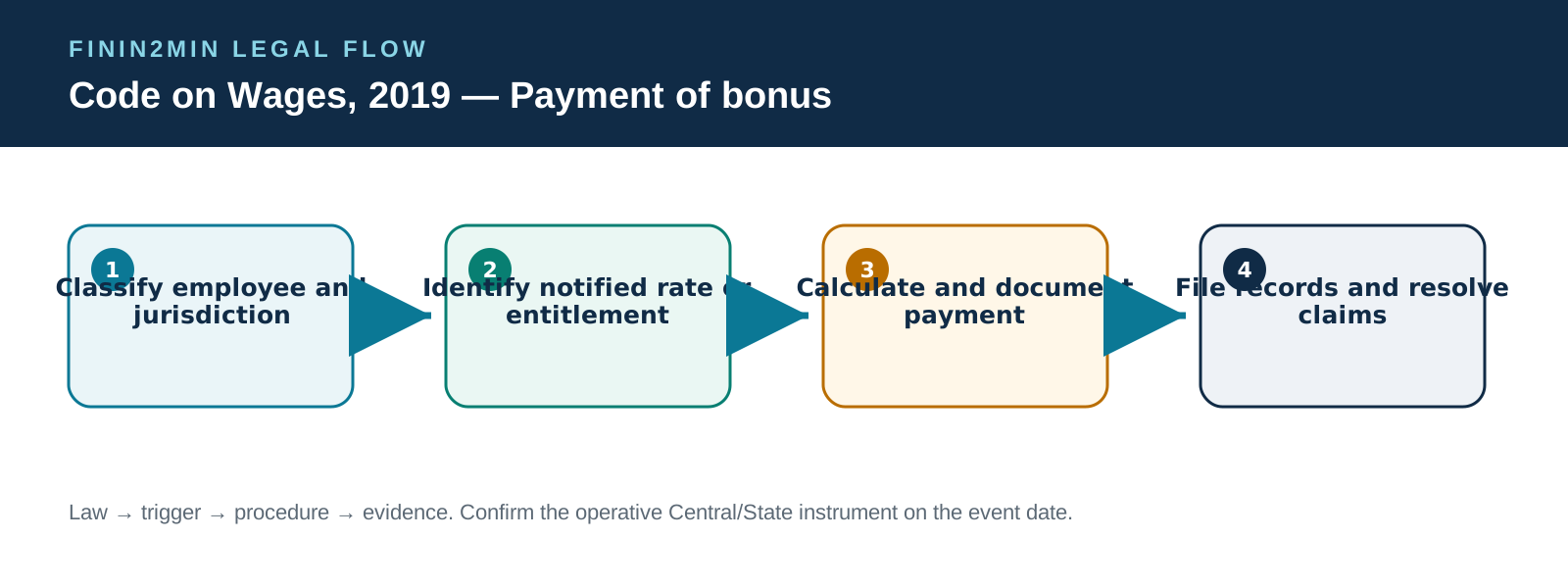
Chapter decision flow
Finin2min Summary - Chapter in 2 Minutes
This chapter turns payment of bonus into an operational control file. It covers Eligibility for bonus, etc, Proportionate reduction in bonus in certain cases, Computation of number of working days, Disqualification for bonus; the practical sequence is to classify coverage and event date, apply the provision and mapped Rule, complete the form/register, calculate the entitlement or exposure, and retain evidence for inspection, claim or appeal.
Who is covered
Employers, employees, workers, contractors and payroll teams must first identify the appropriate Government, employment category and event date.
Main obligations and rights
- Section 26: Eligibility for bonus, etc
- Section 27: Proportionate reduction in bonus in certain cases
- Section 28: Computation of number of working days
- Section 29: Disqualification for bonus
- Section 30: Establishments to include departments, undertakings and branches
- Section 31: Payment of bonus out of allocable surplus
Key thresholds and timelines
- Use only the threshold, rate and limitation period effective on the event date; verify the Central/State instrument before acting.
Forms, registers and evidence
- Applicable form/register, calculation file, approval and acknowledgement evidence
- Retain classification, calculation, approval, communication, acknowledgement and payment/filing proof.
Employer risk snapshot
Highest practical risks: wrong wage base, late payment, unauthorised deduction or incomplete payroll evidence.
Employee/worker remedy snapshot
Core protection: timely and lawful wage payment, a transparent wage slip and a claims route for short-payment or unlawful deduction. Confirm the authority, limitation and appeal route stated in this chapter.
Old law / transition
Map the event date and savings position against: Payment of Wages Act, 1936; Minimum Wages Act, 1948; Payment of Bonus Act, 1965; Equal Remuneration Act, 1976.
Five-point professional checklist
- Freeze the event date, establishment, location and person/worker classification.
- Identify the controlling section/paragraph, mapped Rule, notification and appropriate Government.
- Reperform the calculation or decision test and document every exception or approval.
- Complete the prescribed form/register/portal step and retain acknowledgement, payment and communication evidence.
- Record the remedy, forum, limitation, appeal path and State variation before sign-off.
Finin2min takeaway: for payment of bonus, the defensible answer is not a policy label - it is the event-date law, the mapped procedure, the calculation and a complete evidence trail.
Section-by-section provision map
| Provision | Subject | Implementation focus |
|---|---|---|
| Section 26 | Eligibility for bonus, etc | Trigger, linked Rule/form, evidence, consequence and remedy |
| Section 27 | Proportionate reduction in bonus in certain cases | Trigger, linked Rule/form, evidence, consequence and remedy |
| Section 28 | Computation of number of working days | Trigger, linked Rule/form, evidence, consequence and remedy |
| Section 29 | Disqualification for bonus | Trigger, linked Rule/form, evidence, consequence and remedy |
| Section 30 | Establishments to include departments, undertakings and branches | Trigger, linked Rule/form, evidence, consequence and remedy |
| Section 31 | Payment of bonus out of allocable surplus | Trigger, linked Rule/form, evidence, consequence and remedy |
| Section 32 | Computation of gross profits | Trigger, linked Rule/form, evidence, consequence and remedy |
| Section 33 | Computation of available surplus | Trigger, linked Rule/form, evidence, consequence and remedy |
| Section 34 | Sums deductible from gross profits | Trigger, linked Rule/form, evidence, consequence and remedy |
| Section 35 | Calculation of direct tax payable by employer | Trigger, linked Rule/form, evidence, consequence and remedy |
| Section 36 | Set on and set off of allocable surplus | Trigger, linked Rule/form, evidence, consequence and remedy |
| Section 37 | Adjustment of customary or interim bonus against bonus payable under this Code | Trigger, linked Rule/form, evidence, consequence and remedy |
| Section 38 | Deduction of certain amounts from bonus payable | Trigger, linked Rule/form, evidence, consequence and remedy |
| Section 39 | Time limit for payment of bonus | Trigger, linked Rule/form, evidence, consequence and remedy |
| Section 40 | Application of this Chapter to establishments in public sector in certain cases | Trigger, linked Rule/form, evidence, consequence and remedy |
| Section 41 | Non-applicability of this Chapter | Trigger, linked Rule/form, evidence, consequence and remedy |
Section 26: Eligibility for bonus, etc
Current statutory text
26. Eligibility for bonus, etc.—(1) There shall be paid to every employee, drawing wages not
exceeding such amount per mensem, as determined by notification, by the appropriate Government, by
his employer, who has put in at least thirty days work in an accounting year, an annual minimum bonus
calculated at the rate of eight and one-third per cent. of the wages earned by the employee or one hundred
rupees, whichever is higher whether or not the employer has any allocable surplus during the previous
accounting year.

    (2) For the purpose of calculation of the bonus where the wages of the employee exceeds such
amount per mensem, as determined by notification by the appropriate Government, the bonus payable to
such employee under sub-sections (1) and (3) shall be calculated as if his wage were such amount, so
determined by the appropriate Government or the minimum wage fixed by the appropriate Government,
whichever is higher.

    (3) Where in respect of any accounting year referred to in sub-section (1), the allocable surplus
exceeds the amount of minimum bonus payable to the employees under that sub-section, the employer
shall, in lieu of such minimum bonus, be bound to pay to every employee in respect of that accounting
year, bonus which shall be an amount in proportion to the wages earned by the employee during the
accounting year, subject to a maximum of twenty per cent. of such wages.

    (4) In computing the allocable surplus under this section, the amount set on or the amount set off
under the provisions of section 36 shall be taken into account in accordance with the provisions of that
section.

    (5) Any demand for bonus in excess of the bonus referred to in sub-section (1), either on the basis of
production or productivity in an accounting year for which the bonus is payable shall be determined by an
agreement or settlement between the employer and the employees, subject to the condition that the total
bonus including the annual minimum bonus referred to in sub-section (1) shall not exceed twenty per
cent. of the wages earned by the employee in the accounting year.

    (6) In the first five accounting years following the accounting year in which the employer sells the
goods produced or manufactured by him or renders services, as the case may be, from such establishment,
bonus shall be payable only in respect of the accounting year in which the employer derives profit from
such establishment and such bonus shall be calculated in accordance with the provisions of this Code in
relation to that year, but without applying the provisions of section 36.

    (7) For the sixth and seventh accounting years following the accounting year in which the employer
sells the goods produced or manufactured by him or renders services, as the case may be, from such
establishment, the provisions of section 36 shall apply subject to the following modifications, namely:--

          (i) for the sixth accounting year set on or set off, as the case may be, shall be made, in the manner
    as may be prescribed by the Central Government, taking into account the excess or deficiency, if any,
    as the case may be, of the allocable surplus set on or set off in respect of the fifth and sixth accounting
    years;

           (ii) for the seventh accounting year set on or set off, as the case may be, shall be made, in the
   manner as may be prescribed by the Central Government, taking into account the excess or

    deficiency, if any, as the case may be, of the allocable surplus set on or set off in respect of the fifth,
    sixth and seventh accounting years.

    (8) From the eighth accounting year following the accounting year in which the employer sells the
goods produced or manufactured by him or renders services, as the case may be, from such establishment,
the provisions of section 36 shall apply in relation to such establishment as they apply in relation to any
other establishment.

    Explanation 1.—For the purpose of sub-section (6), an employer shall not be deemed to have derived
profit in any accounting year, unless—

        (a) he has made provision for depreciation of that year to which he is entitled under the Income-
    tax Act or, as the case may be, under the agricultural income tax law; and

        (b) the arrears of such depreciation and losses incurred by him in respect of the establishment for
    the previous accounting years have been fully set off against his profits.

       Explanation 2.—For the purposes of sub-sections (6), (7) and (8), sale of the goods produced or
    manufactured during the course of the trial running of any factory or of the prospecting stage of any
   mine or an oil-field shall not be taken into consideration and where any question arises with regard to
    such production or manufacture, the appropriate Government may,  after giving the  parties a
    reasonable opportunity of representing the case, decide upon the issue.

    (9) The provisions of sub-sections (6), (7) and (8) shall, so far as may be, apply to new departments or
undertakings or branches set up by existing establishments.
Finin2min clause-by-clause decode
- Identify the person or establishment to whom section 26 applies.
- Convert every condition in “Eligibility for bonus, etc” into a dated checklist.
- Map the applicable authority, State/Central jurisdiction and documentary evidence.
- Test exceptions, provisos, deeming language and consequences separately.
Applicable Central Rules immediately below the provision
Central Rule 21: Rule 21: Payment of bonus to contractual employee
Central Rule 22: Rule 22: Calculation for sixth accounting year
Central Rule 23: Rule 23: Calculation for seventh accounting year
Central Rule 27: Rule 27: Manner of carrying forward when allocable surplus exceeds maximum bonus payable
Central Rule 28: Rule 28: Manner of carrying forward when there is no allocable surplus for payment of minimum
Practical example
A payroll team tests the employee category, wage period, notified rate, permitted exclusions and documentary proof before releasing payroll. It records the calculation, approval, bank output and wage slip so that every disputed limb can be reconstructed.
Controls and evidence
- Employer: assign owner, configure system and retain approval/payment proof.
- Employee/worker: retain contract, attendance, wage/benefit proof and communication.
- Professional: reconcile the Act, Rule, notification, form, limitation and State overlay.
Consequence, remedy and limitation
Identify the substantive default first, then separately map arrears or benefit, interest/damages, administrative penalty, prosecution, compounding, company/officer liability, forum, appeal and limitation. Do not infer a remedy from the heading alone.
Mapped Rules: Rule 21, Rule 22, Rule 23, Rule 27, Rule 28 | Official source: section 26.
Section 27: Proportionate reduction in bonus in certain cases
Current statutory text
27. Proportionate reduction in bonus in certain cases.—Where an employee has not worked for all
the working days in an accounting year, the minimum bonus under sub-section (1) of section 26, if such
bonus is higher than eight and one third per cent. of the salary or wage of the days such employee has
worked in that accounting year, shall be proportionately reduced.
Finin2min clause-by-clause decode
- Identify the person or establishment to whom section 27 applies.
- Convert every condition in “Proportionate reduction in bonus in certain cases” into a dated checklist.
- Map the applicable authority, State/Central jurisdiction and documentary evidence.
- Test exceptions, provisos, deeming language and consequences separately.
Applicable Central Rules immediately below the provision
No direct Central Rule is mapped. Check general procedural Rules, State Rules and later notifications.
Practical example
A payroll team tests the employee category, wage period, notified rate, permitted exclusions and documentary proof before releasing payroll. It records the calculation, approval, bank output and wage slip so that every disputed limb can be reconstructed.
Controls and evidence
- Employer: assign owner, configure system and retain approval/payment proof.
- Employee/worker: retain contract, attendance, wage/benefit proof and communication.
- Professional: reconcile the Act, Rule, notification, form, limitation and State overlay.
Consequence, remedy and limitation
Identify the substantive default first, then separately map arrears or benefit, interest/damages, administrative penalty, prosecution, compounding, company/officer liability, forum, appeal and limitation. Do not infer a remedy from the heading alone.
Mapped Rules: No direct Central Rule mapped in the repository concordance | Official source: section 27.
Section 28: Computation of number of working days
Current statutory text
28. Computation of number of working days.—For the purposes of section 27, an employee shall
be deemed to have worked in an establishment in any accounting year also on the days on which,—

        (a) he has been laid off under an agreement or as permitted by standing orders under the
    Industrial Employment (Standing Orders) Act, 1946 (20 of 1946), or under the Industrial Disputes
    Act, 1947 (14 of 1947), or under any other law applicable to the establishment;

        (b) he has been on leave with salary or wages;

         (c) he has been absent due to temporary disablement caused by accident arising out of and in the
    course of his employment; and

        (d) the employee has been on maternity leave with salary or wages, during the accounting year.
Finin2min clause-by-clause decode
- Identify the person or establishment to whom section 28 applies.
- Convert every condition in “Computation of number of working days” into a dated checklist.
- Map the applicable authority, State/Central jurisdiction and documentary evidence.
- Test exceptions, provisos, deeming language and consequences separately.
Applicable Central Rules immediately below the provision
No direct Central Rule is mapped. Check general procedural Rules, State Rules and later notifications.
Practical example
A multi-location employer prepares a legal classification memo, identifies the appropriate Government, maps the operative provision and Rule, records the decision owner and retains the documents needed to prove compliance during inspection or litigation.
Controls and evidence
- Employer: assign owner, configure system and retain approval/payment proof.
- Employee/worker: retain contract, attendance, wage/benefit proof and communication.
- Professional: reconcile the Act, Rule, notification, form, limitation and State overlay.
Consequence, remedy and limitation
Identify the substantive default first, then separately map arrears or benefit, interest/damages, administrative penalty, prosecution, compounding, company/officer liability, forum, appeal and limitation. Do not infer a remedy from the heading alone.
Mapped Rules: No direct Central Rule mapped in the repository concordance | Official source: section 28.
Section 29: Disqualification for bonus
Current statutory text
29. Disqualification for bonus.—Notwithstanding anything contained in this Code, an employee
shall be disqualified from receiving bonus under this Code, if he is dismissed from service for—

        (a) fraud; or

        (b) riotous or violent behaviour while on the premises of the establishment; or

         (c) theft, misappropriation or sabotage of any property of the establishment; or

        (d) conviction for sexual harassment.
Finin2min clause-by-clause decode
- Identify the person or establishment to whom section 29 applies.
- Convert every condition in “Disqualification for bonus” into a dated checklist.
- Map the applicable authority, State/Central jurisdiction and documentary evidence.
- Test exceptions, provisos, deeming language and consequences separately.
Applicable Central Rules immediately below the provision
No direct Central Rule is mapped. Check general procedural Rules, State Rules and later notifications.
Practical example
A payroll team tests the employee category, wage period, notified rate, permitted exclusions and documentary proof before releasing payroll. It records the calculation, approval, bank output and wage slip so that every disputed limb can be reconstructed.
Controls and evidence
- Employer: assign owner, configure system and retain approval/payment proof.
- Employee/worker: retain contract, attendance, wage/benefit proof and communication.
- Professional: reconcile the Act, Rule, notification, form, limitation and State overlay.
Consequence, remedy and limitation
Identify the substantive default first, then separately map arrears or benefit, interest/damages, administrative penalty, prosecution, compounding, company/officer liability, forum, appeal and limitation. Do not infer a remedy from the heading alone.
Mapped Rules: No direct Central Rule mapped in the repository concordance | Official source: section 29.
Section 30: Establishments to include departments, undertakings and branches
Current statutory text
30.  Establishments  to  include  departments,  undertakings  and  branches.—Where  an
establishment consists of different departments or undertakings or has branches, whether situated in the
same place or in different places, all such departments or undertakings or branches shall be treated as
parts of the same establishment for the purpose of computation of bonus under this Code:

    Provided that where for any accounting year a separate balance sheet and profit and loss account are
prepared and maintained in respect of any such department or undertaking or branch, then, such
department or undertaking or branch shall be treated as a separate establishment for the purpose of
computation of bonus, under this Code for that year, unless such department or undertaking or branch


was, immediately before the commencement of that accounting year treated as part of the establishment
for the purpose of computation of bonus.
Finin2min clause-by-clause decode
- Identify the person or establishment to whom section 30 applies.
- Convert every condition in “Establishments to include departments, undertakings and branches” into a dated checklist.
- Map the applicable authority, State/Central jurisdiction and documentary evidence.
- Test exceptions, provisos, deeming language and consequences separately.
Applicable Central Rules immediately below the provision
No direct Central Rule is mapped. Check general procedural Rules, State Rules and later notifications.
Practical example
A multi-location employer prepares a legal classification memo, identifies the appropriate Government, maps the operative provision and Rule, records the decision owner and retains the documents needed to prove compliance during inspection or litigation.
Controls and evidence
- Employer: assign owner, configure system and retain approval/payment proof.
- Employee/worker: retain contract, attendance, wage/benefit proof and communication.
- Professional: reconcile the Act, Rule, notification, form, limitation and State overlay.
Consequence, remedy and limitation
Identify the substantive default first, then separately map arrears or benefit, interest/damages, administrative penalty, prosecution, compounding, company/officer liability, forum, appeal and limitation. Do not infer a remedy from the heading alone.
Mapped Rules: No direct Central Rule mapped in the repository concordance | Official source: section 30.
Section 31: Payment of bonus out of allocable surplus
Current statutory text
31. Payment of bonus out of allocable surplus.—(1) The bonus shall be paid out of the allocable
surplus which shall be an amount equal to sixty per cent. in case of a banking company and sixty-seven
per cent. in case of other establishment, of the available surplus and the available surplus shall be the
amount calculated in accordance with section 33.

    (2) Audited accounts of companies shall not normally be questioned.

    (3) Where there  is any dispute regarding the quantum of bonus, the authority notified by the
appropriate Government having jurisdiction may call upon the employer to produce the balance sheet
before it, but the authority shall not disclose any information contained in the balance sheet unless agreed
to by the employer.
Finin2min clause-by-clause decode
- Identify the person or establishment to whom section 31 applies.
- Convert every condition in “Payment of bonus out of allocable surplus” into a dated checklist.
- Map the applicable authority, State/Central jurisdiction and documentary evidence.
- Test exceptions, provisos, deeming language and consequences separately.
Applicable Central Rules immediately below the provision
No direct Central Rule is mapped. Check general procedural Rules, State Rules and later notifications.
Practical example
A payroll team tests the employee category, wage period, notified rate, permitted exclusions and documentary proof before releasing payroll. It records the calculation, approval, bank output and wage slip so that every disputed limb can be reconstructed.
Controls and evidence
- Employer: assign owner, configure system and retain approval/payment proof.
- Employee/worker: retain contract, attendance, wage/benefit proof and communication.
- Professional: reconcile the Act, Rule, notification, form, limitation and State overlay.
Consequence, remedy and limitation
Identify the substantive default first, then separately map arrears or benefit, interest/damages, administrative penalty, prosecution, compounding, company/officer liability, forum, appeal and limitation. Do not infer a remedy from the heading alone.
Mapped Rules: No direct Central Rule mapped in the repository concordance | Official source: section 31.
Section 32: Computation of gross profits
Current statutory text
32. Computation of gross profits.—The gross profits derived by an employer from an establishment
in respect of the accounting year shall,—

        (a) in the case of a banking company, be calculated in the manner as may be prescribed by the
    Central Government;

        (b) in any other case, be calculated in the manner as may be prescribed by the Central
   Government.
Finin2min clause-by-clause decode
- Identify the person or establishment to whom section 32 applies.
- Convert every condition in “Computation of gross profits” into a dated checklist.
- Map the applicable authority, State/Central jurisdiction and documentary evidence.
- Test exceptions, provisos, deeming language and consequences separately.
Applicable Central Rules immediately below the provision
Central Rule 24: Rule 24: Computation of gross profits for banking company
Central Rule 25: Rule 25: Computation of gross profits for other than banking company
Practical example
A multi-location employer prepares a legal classification memo, identifies the appropriate Government, maps the operative provision and Rule, records the decision owner and retains the documents needed to prove compliance during inspection or litigation.
Controls and evidence
- Employer: assign owner, configure system and retain approval/payment proof.
- Employee/worker: retain contract, attendance, wage/benefit proof and communication.
- Professional: reconcile the Act, Rule, notification, form, limitation and State overlay.
Consequence, remedy and limitation
Identify the substantive default first, then separately map arrears or benefit, interest/damages, administrative penalty, prosecution, compounding, company/officer liability, forum, appeal and limitation. Do not infer a remedy from the heading alone.
Mapped Rules: Rule 24, Rule 25 | Official source: section 32.
Section 33: Computation of available surplus
Current statutory text
33. Computation of available surplus.—The available surplus in respect of any accounting year
shall be the gross profits for that year after deducting there from the sums referred to in section 34:

    Provided that the available surplus in respect of the accounting year commencing on any day in a year
after the commencement of this Code and in respect of every subsequent accounting year shall be the
aggregate of—

        (a) the gross profits for that accounting year after deducting there from the sums referred to in
    section 34; and

        (b) an amount equal to the difference between—

               (i) the direct tax, calculated in accordance with the provisions of section 35, in respect of an
       amount equal to the gross profits of the employer for the immediately preceding accounting year;
       and

                (ii) the direct tax, calculated in accordance with provisions of section 35, in respect of an
       amount equal to the gross profits of the employer for such preceding accounting year after
       deducting there from the amount of bonus which the employer has paid or is liable to pay to his
       employees in accordance with the provisions of this Code for that year.
Finin2min clause-by-clause decode
- Identify the person or establishment to whom section 33 applies.
- Convert every condition in “Computation of available surplus” into a dated checklist.
- Map the applicable authority, State/Central jurisdiction and documentary evidence.
- Test exceptions, provisos, deeming language and consequences separately.
Applicable Central Rules immediately below the provision
No direct Central Rule is mapped. Check general procedural Rules, State Rules and later notifications.
Practical example
A multi-location employer prepares a legal classification memo, identifies the appropriate Government, maps the operative provision and Rule, records the decision owner and retains the documents needed to prove compliance during inspection or litigation.
Controls and evidence
- Employer: assign owner, configure system and retain approval/payment proof.
- Employee/worker: retain contract, attendance, wage/benefit proof and communication.
- Professional: reconcile the Act, Rule, notification, form, limitation and State overlay.
Consequence, remedy and limitation
Identify the substantive default first, then separately map arrears or benefit, interest/damages, administrative penalty, prosecution, compounding, company/officer liability, forum, appeal and limitation. Do not infer a remedy from the heading alone.
Mapped Rules: No direct Central Rule mapped in the repository concordance | Official source: section 33.
Section 34: Sums deductible from gross profits
Current statutory text
34. Sums deductible from gross profits.—The following sums shall be deducted from the gross
profits as prior charges, namely:—

        (a) any amount by way of depreciation admissible in accordance with the provisions of sub-
    section (1) of section 32 of the Income-tax Act or in accordance with the provisions of the agricultural
    income-tax law, for the time being in force, as the case may be;

        (b) subject to the provisions of section 35, any direct tax which the employer is liable to pay for
the accounting year in respect of his income, profits and gains during that year;

         (c) such further sums in respect of the employer as may be prescribed by the Central Government.
Finin2min clause-by-clause decode
- Identify the person or establishment to whom section 34 applies.
- Convert every condition in “Sums deductible from gross profits” into a dated checklist.
- Map the applicable authority, State/Central jurisdiction and documentary evidence.
- Test exceptions, provisos, deeming language and consequences separately.
Applicable Central Rules immediately below the provision
Central Rule 26: Rule 26: Deduction of further sums from gross profit
Practical example
A multi-location employer prepares a legal classification memo, identifies the appropriate Government, maps the operative provision and Rule, records the decision owner and retains the documents needed to prove compliance during inspection or litigation.
Controls and evidence
- Employer: assign owner, configure system and retain approval/payment proof.
- Employee/worker: retain contract, attendance, wage/benefit proof and communication.
- Professional: reconcile the Act, Rule, notification, form, limitation and State overlay.
Consequence, remedy and limitation
Identify the substantive default first, then separately map arrears or benefit, interest/damages, administrative penalty, prosecution, compounding, company/officer liability, forum, appeal and limitation. Do not infer a remedy from the heading alone.
Mapped Rules: Rule 26 | Official source: section 34.
Section 35: Calculation of direct tax payable by employer
Current statutory text
35. Calculation of direct tax payable by employer.—For the purposes of this Code, any direct tax
payable by the employer for any accounting year shall, subject to the following provisions, be calculated
at the rates applicable to the income of the employer for that year, namely:—

    (a) in calculating such tax no account shall be taken of,—

               (i) any loss incurred by the employer in respect of any previous accounting year and carried
       forward under any law for the time being in force relating to direct taxes;


                (ii) any arrears of depreciation which the employer is entitled to add to the amount of the
       allowance for depreciation for any succeeding accounting year or years under sub-section (2)
        of section 32 of the Income-tax Act;

        (b) where the employer is a religious or a charitable institution to which the provisions of section
   41 do not apply and the whole or any part of its income is exempt from the tax under the Income-tax
    Act, then, with respect to the income so exempted, such institution shall be treated as if it were a
   company in which the public are substantially interested within the meaning of that Act;

         (c) where the employer is an individual or a Hindu undivided family, the tax payable by such
   employer under the Income-tax Act shall be calculated on the basis that the income derived by him
   from the establishment is his only income;

             (d) where the income of any employer includes any profits and gains derived from the export
        of any goods or merchandise out of India and any rebate on such income is allowed under any
       law for the time being in force relating to direct taxes, then, no account shall be taken of such
        rebate;

         (e) no account shall be taken of any rebate other than development rebate or investment
    allowance or development allowance or credit or relief or deduction (not hereinbefore mentioned in
     this section) in the payment of any direct tax allowed under any law for the time being in force
    relating to direct taxes or under the relevant annual Finance Act, for the development of any industry.
Finin2min clause-by-clause decode
- Identify the person or establishment to whom section 35 applies.
- Convert every condition in “Calculation of direct tax payable by employer” into a dated checklist.
- Map the applicable authority, State/Central jurisdiction and documentary evidence.
- Test exceptions, provisos, deeming language and consequences separately.
Applicable Central Rules immediately below the provision
No direct Central Rule is mapped. Check general procedural Rules, State Rules and later notifications.
Practical example
A multi-location employer prepares a legal classification memo, identifies the appropriate Government, maps the operative provision and Rule, records the decision owner and retains the documents needed to prove compliance during inspection or litigation.
Controls and evidence
- Employer: assign owner, configure system and retain approval/payment proof.
- Employee/worker: retain contract, attendance, wage/benefit proof and communication.
- Professional: reconcile the Act, Rule, notification, form, limitation and State overlay.
Consequence, remedy and limitation
Identify the substantive default first, then separately map arrears or benefit, interest/damages, administrative penalty, prosecution, compounding, company/officer liability, forum, appeal and limitation. Do not infer a remedy from the heading alone.
Mapped Rules: No direct Central Rule mapped in the repository concordance | Official source: section 35.
Section 36: Set on and set off of allocable surplus
Current statutory text
36. Set on and set off of allocable surplus.—(1) Where for any accounting year, the allocable
surplus exceeds the amount of maximum bonus payable to the employees in the establishment under
section 26, then, the excess shall, subject to a limit of twenty per cent. of the total salary or wage of the
employees employed in the establishment in that accounting year, be carried forward for being set on in
the succeeding accounting year and so on up to and inclusive of the fourth accounting year to be utilised
for the purpose of payment of bonus in such manner as may be prescribed by the Central Government.

    (2) Where for any accounting year, there is no available surplus or the allocable surplus in respect of
that year falls short of the amount of minimum bonus payable to the employees in the establishment under
section 26, and there is no amount or sufficient amount carried forward and set on under sub-section (1)
which could be utilised for the purpose of payment of the minimum bonus, then, such minimum amount
or the deficiency, as the case may be, shall be carried forward for being set off in the succeeding
accounting year and so on up to and inclusive of the fourth accounting year in such manner as may be
prescribed by the Central Government.

    (3) The principle of set on and set off as may be provided in rules by the Central Government under
this Code shall apply to all other cases not covered by sub-section (1) or sub-section (2) for the purpose of
payment of bonus under this Code.

    (4) Where in any accounting year any amount has been carried forward and set on or set off under this
section, then, in calculating bonus for the succeeding accounting year, the amount of set on or set off
carried forward from the earliest accounting year shall first be taken into account.
Finin2min clause-by-clause decode
- Identify the person or establishment to whom section 36 applies.
- Convert every condition in “Set on and set off of allocable surplus” into a dated checklist.
- Map the applicable authority, State/Central jurisdiction and documentary evidence.
- Test exceptions, provisos, deeming language and consequences separately.
Applicable Central Rules immediately below the provision
Central Rule 27: Rule 27: Manner of carrying forward when allocable surplus exceeds maximum bonus payable
Central Rule 28: Rule 28: Manner of carrying forward when there is no allocable surplus for payment of minimum
Practical example
A multi-location employer prepares a legal classification memo, identifies the appropriate Government, maps the operative provision and Rule, records the decision owner and retains the documents needed to prove compliance during inspection or litigation.
Controls and evidence
- Employer: assign owner, configure system and retain approval/payment proof.
- Employee/worker: retain contract, attendance, wage/benefit proof and communication.
- Professional: reconcile the Act, Rule, notification, form, limitation and State overlay.
Consequence, remedy and limitation
Identify the substantive default first, then separately map arrears or benefit, interest/damages, administrative penalty, prosecution, compounding, company/officer liability, forum, appeal and limitation. Do not infer a remedy from the heading alone.
Mapped Rules: Rule 27, Rule 28 | Official source: section 36.
Section 37: Adjustment of customary or interim bonus against bonus payable under this Code
Current statutory text
37. Adjustment of customary or interim bonus against bonus payable under this Code.—Where
in any accounting year,—

        (a) an employer has paid any puja bonus or other customary bonus to employee; or

        (b) an employer has paid a part of the bonus payable under this Code to an employee before the
    date on which such bonus becomes payable,

then, the employer shall be entitled to deduct the amount of bonus so paid from the amount of bonus
payable by him to the employee under this Code in respect of that accounting year and the employee shall
be entitled to receive only the balance.
Finin2min clause-by-clause decode
- Identify the person or establishment to whom section 37 applies.
- Convert every condition in “Adjustment of customary or interim bonus against bonus payable under this Code” into a dated checklist.
- Map the applicable authority, State/Central jurisdiction and documentary evidence.
- Test exceptions, provisos, deeming language and consequences separately.
Applicable Central Rules immediately below the provision
No direct Central Rule is mapped. Check general procedural Rules, State Rules and later notifications.
Practical example
A payroll team tests the employee category, wage period, notified rate, permitted exclusions and documentary proof before releasing payroll. It records the calculation, approval, bank output and wage slip so that every disputed limb can be reconstructed.
Controls and evidence
- Employer: assign owner, configure system and retain approval/payment proof.
- Employee/worker: retain contract, attendance, wage/benefit proof and communication.
- Professional: reconcile the Act, Rule, notification, form, limitation and State overlay.
Consequence, remedy and limitation
Identify the substantive default first, then separately map arrears or benefit, interest/damages, administrative penalty, prosecution, compounding, company/officer liability, forum, appeal and limitation. Do not infer a remedy from the heading alone.
Mapped Rules: No direct Central Rule mapped in the repository concordance | Official source: section 37.
Section 38: Deduction of certain amounts from bonus payable
Current statutory text
38. Deduction of certain amounts from bonus payable.—Where in any accounting year, an
employee is found guilty of misconduct causing financial loss to the employer, then, it shall be lawful for
the employer to deduct the amount of loss from the amount of bonus payable by him to the employee
under this Code in respect of that accounting year only and the employee shall be entitled to receive the
balance, if any.
Finin2min clause-by-clause decode
- Identify the person or establishment to whom section 38 applies.
- Convert every condition in “Deduction of certain amounts from bonus payable” into a dated checklist.
- Map the applicable authority, State/Central jurisdiction and documentary evidence.
- Test exceptions, provisos, deeming language and consequences separately.
Applicable Central Rules immediately below the provision
No direct Central Rule is mapped. Check general procedural Rules, State Rules and later notifications.
Practical example
A payroll team tests the employee category, wage period, notified rate, permitted exclusions and documentary proof before releasing payroll. It records the calculation, approval, bank output and wage slip so that every disputed limb can be reconstructed.
Controls and evidence
- Employer: assign owner, configure system and retain approval/payment proof.
- Employee/worker: retain contract, attendance, wage/benefit proof and communication.
- Professional: reconcile the Act, Rule, notification, form, limitation and State overlay.
Consequence, remedy and limitation
Identify the substantive default first, then separately map arrears or benefit, interest/damages, administrative penalty, prosecution, compounding, company/officer liability, forum, appeal and limitation. Do not infer a remedy from the heading alone.
Mapped Rules: No direct Central Rule mapped in the repository concordance | Official source: section 38.
Section 39: Time limit for payment of bonus
Current statutory text
39 .Time limit for payment of bonus.—(1) All amounts payable to an employee by way of bonus
under this Code shall be paid by crediting it in the bank account of the employee by his employer within a
period of eight months from the close of the accounting year:

    Provided that the appropriate Government or such authority as the appropriate Government may
specify in this behalf may, upon an application made to it by the employer and for sufficient reasons, by
order, extend the said period of eight months to such further period or periods as it thinks fit; so, however,
that the total period so extended shall not in any case exceed two years.

    (2) Notwithstanding anything contained in sub-section  (1), where there  is a dispute regarding
payment of bonus pending before any authority, such bonus shall be paid, within a period of one month
from the date on which the award becomes enforceable or the settlement comes into operation, in respect
of such dispute:

    Provided that if, there is a dispute for payment at the higher rate, the employer shall pay eight and
one-third per cent. of the wages earned by the employee as per the provisions of this Code within a period
of eight months from the close of the accounting year.
Finin2min clause-by-clause decode
- Identify the person or establishment to whom section 39 applies.
- Convert every condition in “Time limit for payment of bonus” into a dated checklist.
- Map the applicable authority, State/Central jurisdiction and documentary evidence.
- Test exceptions, provisos, deeming language and consequences separately.
Applicable Central Rules immediately below the provision
No direct Central Rule is mapped. Check general procedural Rules, State Rules and later notifications.
Practical example
A payroll team tests the employee category, wage period, notified rate, permitted exclusions and documentary proof before releasing payroll. It records the calculation, approval, bank output and wage slip so that every disputed limb can be reconstructed.
Controls and evidence
- Employer: assign owner, configure system and retain approval/payment proof.
- Employee/worker: retain contract, attendance, wage/benefit proof and communication.
- Professional: reconcile the Act, Rule, notification, form, limitation and State overlay.
Consequence, remedy and limitation
Identify the substantive default first, then separately map arrears or benefit, interest/damages, administrative penalty, prosecution, compounding, company/officer liability, forum, appeal and limitation. Do not infer a remedy from the heading alone.
Mapped Rules: No direct Central Rule mapped in the repository concordance | Official source: section 39.
Section 40: Application of this Chapter to establishments in public sector in certain cases
Current statutory text
40. Application of this Chapter to establishments in public sector in certain cases.—(1) If in any
accounting year an establishment in public sector sells any goods produced or manufactured by it or
renders any services, in competition with an establishment in private sector, and the income from such
sale or services or both, is not less than twenty per cent. of the gross income of the establishment in public
sector for that year, then, the provisions of this Chapter shall apply in relation to such establishment in
public sector as they apply in relation to a like establishment in private sector.

    (2) Save as otherwise provided in sub-section  (1), nothing in  this Chapter shall apply to the
employees employed by any establishment in public sector.
Finin2min clause-by-clause decode
- Identify the person or establishment to whom section 40 applies.
- Convert every condition in “Application of this Chapter to establishments in public sector in certain cases” into a dated checklist.
- Map the applicable authority, State/Central jurisdiction and documentary evidence.
- Test exceptions, provisos, deeming language and consequences separately.
Applicable Central Rules immediately below the provision
No direct Central Rule is mapped. Check general procedural Rules, State Rules and later notifications.
Practical example
A multi-location employer prepares a legal classification memo, identifies the appropriate Government, maps the operative provision and Rule, records the decision owner and retains the documents needed to prove compliance during inspection or litigation.
Controls and evidence
- Employer: assign owner, configure system and retain approval/payment proof.
- Employee/worker: retain contract, attendance, wage/benefit proof and communication.
- Professional: reconcile the Act, Rule, notification, form, limitation and State overlay.
Consequence, remedy and limitation
Identify the substantive default first, then separately map arrears or benefit, interest/damages, administrative penalty, prosecution, compounding, company/officer liability, forum, appeal and limitation. Do not infer a remedy from the heading alone.
Mapped Rules: No direct Central Rule mapped in the repository concordance | Official source: section 40.
Section 41: Non-applicability of this Chapter
Current statutory text
41. Non-applicability of this Chapter.—(1) Nothing in this Chapter shall apply to—

        (a) employees employed by the Life Insurance Corporation of India;

        (b) seamen as defined in clause (42) of section 3 of the Merchant Shipping Act, 1958 (44 of
    1958);

         (c) employees registered or listed under any scheme made under the Dock Workers (Regulation
    of Employment) Act, 1948 (9 of 1948), and employed by registered or listed employers;

        (d) employees employed by an establishment under the authority of any department of the Central
   Government or a State Government or a local authority;

         (e) employees employed by—

               (i) the Indian Red Cross Society or any other institution of a like nature including  its
        branches;

                (ii) universities and other educational institutions;

                (iii) institutions including hospitals, chamber of commerce and social welfare institutions
        established not for purposes of profit;

          (f) employees employed by the Reserve Bank of India;

        (g) employees employed by public sector financial institution other than a banking company,
   which the Central Government may, by notification, specify, having regard to—

               (i) its capital structure;

                (ii) its objectives and the nature of its activities;

                (iii) the nature and extent of financial assistance or any concession given to  it by the
       Government; and

              (iv) any other relevant factor;

        (h) employees employed by inland water transport establishments operating on routes passing
    through any other country; and


          (i) employees of any other establishment which the appropriate Government may, by notification,
   exempt having regard to the overall benefits under any other scheme of profit sharing available in
    such establishments to the employees.

    (2) Subject to the provisions of sub-section (1) and notwithstanding anything contained in any other
provisions of this Chapter, the provisions of this Chapter shall apply to such establishment in which
twenty or more persons are employed or were employed on any day during an accounting year.

                            CHAPTER V
                                ADVISORY BOARD
Finin2min clause-by-clause decode
- Identify the person or establishment to whom section 41 applies.
- Convert every condition in “Non-applicability of this Chapter” into a dated checklist.
- Map the applicable authority, State/Central jurisdiction and documentary evidence.
- Test exceptions, provisos, deeming language and consequences separately.
Applicable Central Rules immediately below the provision
No direct Central Rule is mapped. Check general procedural Rules, State Rules and later notifications.
Practical example
A multi-location employer prepares a legal classification memo, identifies the appropriate Government, maps the operative provision and Rule, records the decision owner and retains the documents needed to prove compliance during inspection or litigation.
Controls and evidence
- Employer: assign owner, configure system and retain approval/payment proof.
- Employee/worker: retain contract, attendance, wage/benefit proof and communication.
- Professional: reconcile the Act, Rule, notification, form, limitation and State overlay.
Consequence, remedy and limitation
Identify the substantive default first, then separately map arrears or benefit, interest/damages, administrative penalty, prosecution, compounding, company/officer liability, forum, appeal and limitation. Do not infer a remedy from the heading alone.
Mapped Rules: No direct Central Rule mapped in the repository concordance | Official source: section 41.
Rules, forms, registers, portals and due dates
| Rule | Subject | Text/control status |
|---|---|---|
| 21 | Rule 21: Payment of bonus to contractual employee | Exact Gazette extract embedded |
| 22 | Rule 22: Calculation for sixth accounting year | Exact Gazette extract embedded |
| 23 | Rule 23: Calculation for seventh accounting year | Exact Gazette extract embedded |
| 27 | Rule 27: Manner of carrying forward when allocable surplus exceeds maximum bonus payable | Exact Gazette extract embedded |
| 28 | Rule 28: Manner of carrying forward when there is no allocable surplus for payment of minimum | Exact Gazette extract embedded |
| 24 | Rule 24: Computation of gross profits for banking company | Exact Gazette extract embedded |
| 25 | Rule 25: Computation of gross profits for other than banking company | Exact Gazette extract embedded |
| 26 | Rule 26: Deduction of further sums from gross profit | Exact Gazette extract embedded |
Forms and registers must be confirmed from the appended 2026 Central Rules and the live portal applicable to the appropriate Government. A form is not treated as current merely because an earlier law used the same number.
Notifications and effective-date history
| Control | Required action |
|---|---|
| Enactment | Record Act number, assent and Gazette publication. |
| Commencement | Use the provision-specific commencement notification; the four Codes became broadly operative from 21 November 2025 subject to earlier partial commencement and corrigenda. |
| Central Rules | Read the applicable 2026 Central Rules from their Gazette date and verify subsequent amendments. |
| State instrument | Check final State Rules, authority notifications, forms and rates where the State is appropriate Government. |
Old-law/new-Code concordance
| Predecessor law | Transition control |
|---|---|
| Payment of Wages Act, 1936 | Classify the event date, accrued right, saved Rule/notification and pending proceeding before moving to the Code. |
| Minimum Wages Act, 1948 | Classify the event date, accrued right, saved Rule/notification and pending proceeding before moving to the Code. |
| Payment of Bonus Act, 1965 | Classify the event date, accrued right, saved Rule/notification and pending proceeding before moving to the Code. |
| Equal Remuneration Act, 1976 | Classify the event date, accrued right, saved Rule/notification and pending proceeding before moving to the Code. |
Practical calculations and control file
Calculation sequence
- Freeze the employee/worker population and event date.
- Apply the statutory wage/benefit base and notified threshold.
- Reconcile attendance, service, payroll and contractor records.
- Calculate principal amount, interest/damages and any statutory compensation separately.
- Obtain legal/payroll approval and retain the versioned worksheet.
Three-owner sign-off
- Employer/HR: facts, classification, communication and workflow.
- Employee/worker: notice, records, nomination/claim and acknowledgement.
- Professional: source, formula, forum, limitation and evidence reconciliation.
Binding and highly relevant case-law principles
| Decision | Principle and present-use caution |
|---|---|
| People’s Union for Democratic Rights v. Union of India | Non-payment of the applicable minimum wage may engage constitutional and statutory consequences; use the principle only after aligning it with the universal Code coverage and current notification. |
| Airfreight Ltd. v. State of Karnataka | Minimum-wage components and neutralisation must be read from the governing notification and statutory scheme, not from payroll labels alone. |
| Manganese Ore (India) Ltd. v. Chandi Lal Saha | The legal character of an allowance or benefit depends on the governing provision and facts; nomenclature is not decisive. |
| Workmen v. Reptakos Brett & Co. | Needs-based wage principles remain relevant to wage fixation, but the current statutory floor and notified rates control compliance. |
State-law variation alerts
- Confirm whether the Central or State Government is the appropriate Government.
- Central Rules do not automatically displace valid State Rules, rates, registers, authorities or portal procedures.
- Minimum-wage rates, holidays, working-hours permissions, licences and local welfare obligations require State-specific verification.
- Record Gazette number, effective date and supersession status in the location compliance register.
Practical examples and calculations
Classify the worker and establishment, identify the operative provision and notified instrument on the event date, compute the entitlement or exposure from source records, obtain approval, complete the filing/payment/action, and retain evidence. Do not use a portal value or payroll label as a substitute for the statutory test.
Calculation/control template: Control calculation: verified population or transaction base × applicable notified rate/amount × eligible period, adjusted for statutory inclusions, exclusions, ceilings, interest, compensation and prior payments. Reperform the calculation from retained source data.
Finin2min implementation explanation
Maintain a controlled implementation file for Chapter IV - Payment of bonus: coverage and event date, operative Central/State instrument, responsible owner, approval and authority, form/portal step, due date, calculation basis, supporting evidence, exception, escalation and closure proof. Reconcile payroll, HR, finance, contractor and legal records before sign-off.
Practical transaction application
Use the chapter when drafting offer letters, wage structures, contractor work orders, payroll calendars, bonus workings, separation settlements and due-diligence requests. Classify the establishment, employee, wage components and relevant event date before applying the provision and linked Rule.
Authority, consent and execution controls
HR may prepare the computation, but the employer or duly authorised signatory should approve wage-period, deduction, bonus and claim responses. Contractor clauses must identify the principal employer, payment evidence owner and escalation authority; consent cannot validate a deduction prohibited by law.
Stamp duty and registration alerts
Ordinary payroll records do not attract registration. Employment, settlement, indemnity or service instruments should nevertheless be checked under the applicable State stamp law; an unstamped or insufficiently stamped instrument may face evidentiary or enforcement objections. Portal filing or statutory notice is not a substitute for stamping where independently applicable.
Evidence and document-retention checklist
Retain the operative law/rule version, classification note, approvals, signed instruments, statutory forms, portal acknowledgements, registers, calculations, bank proof, correspondence, inspection records, service proof, decision and appeal file. Apply the longer of the statutory retention rule, litigation hold, tax/audit need and contractual requirement; restrict access to personal and sensitive data.
Performance, delivery and payment controls
Link attendance, output and variable-pay conditions to objective records. Pay wages, overtime, bonus and final dues through traceable banking channels within the applicable statutory window; reconcile payroll, bank advice, ledger, return and employee acknowledgement.
Breach, loss, mitigation and remedy framework
On detecting a breach, stop continuing exposure, preserve evidence, quantify employee and government dues, identify affected persons, make lawful corrective payment/filing, notify the authorised decision-maker, assess self-disclosure or compounding where available, and reserve contractual recovery against responsible vendors without delaying statutory remediation.
Limitation and forum controls
Route statutory wage claims and appeals to the authority/appellate authority under the Code and Rules. Preserve the event date, service date and proof of payment because limitation and condonation are fact-sensitive. Contractual forum clauses cannot oust a mandatory statutory forum.
Arbitration and mediation interface
Mediation can resolve computation or factual disputes where lawful, but cannot contract out of minimum wages, prohibited deductions, statutory bonus or penal consequences. Record any settlement precisely and complete mandatory filing/approval steps.
Company, partnership, GST and tax overlays
For a company, align board/delegation and officer-in-default controls; for an LLP or partnership, identify the designated partner/partner and authorised employer representative. Labour dues can affect transaction price, indemnities, director/partner exposure and insolvency claims. Salary/TDS, perquisite, contractor TDS, GST on outsourced services and accounting provisions must be reconciled without treating tax treatment as proof of labour-law classification.
Finin2min Q&A
Which law and version should be applied?
Use the current text of Code on Wages, 2019, the commencement notification, the applicable Central or State Rules and any later instrument effective on the event date.
How is the appropriate Government identified?
Classify ownership/control, sector, establishment and contractor relationship before selecting the Central or State authority.
Can a company policy override the statutory protection?
No. A policy may improve a benefit or control, but it cannot contract out of a mandatory statutory floor.
What evidence should be retained?
Retain the classification memo, source instrument, form/portal record, calculation, approval, employee communication, acknowledgement and payment or authority proof.
Do the Central Rules apply to every establishment?
No. They govern the Central sphere. State Rules and State notifications must be checked where the State is the appropriate Government.
How should a historical event be tested?
Apply the law and subordinate instrument effective on the event date, then use the repeal-and-savings provision for pending rights and proceedings.
What happens when portal practice conflicts with the statute?
Record the conflict, follow the higher legal instrument, seek authority clarification where necessary and preserve screenshots and correspondence.
Can criminal and monetary consequences arise together?
They may. Separate wages/benefits, interest, damages, civil penalty, prosecution, compounding and director/officer liability.
Is a contractor arrangement enough to shift liability?
No. Principal-employer and contractor liabilities depend on the specific provision and facts; the contract should allocate evidence and recovery without diluting worker rights.
What is the first professional review step?
Freeze the event date and facts, identify the applicable provision, then map Rules, forms, notification status, authority, limitation and evidence.
What is the operational focus of section 26 - Eligibility for bonus, etc?
The section must be decomposed into actor, trigger, threshold, procedure, exception, consequence and evidence. Read the full official text and the mapped Rules before applying the Finin2min control summary.
What is the operational focus of section 27 - Proportionate reduction in bonus in certain cases?
The section must be decomposed into actor, trigger, threshold, procedure, exception, consequence and evidence. Read the full official text and the mapped Rules before applying the Finin2min control summary.
What is the operational focus of section 28 - Computation of number of working days?
The section must be decomposed into actor, trigger, threshold, procedure, exception, consequence and evidence. Read the full official text and the mapped Rules before applying the Finin2min control summary.
What is the operational focus of section 29 - Disqualification for bonus?
The section must be decomposed into actor, trigger, threshold, procedure, exception, consequence and evidence. Read the full official text and the mapped Rules before applying the Finin2min control summary.
What is the operational focus of section 30 - Establishments to include departments, undertakings and branches?
The section must be decomposed into actor, trigger, threshold, procedure, exception, consequence and evidence. Read the full official text and the mapped Rules before applying the Finin2min control summary.
What is the operational focus of section 31 - Payment of bonus out of allocable surplus?
The section must be decomposed into actor, trigger, threshold, procedure, exception, consequence and evidence. Read the full official text and the mapped Rules before applying the Finin2min control summary.
What is the operational focus of section 32 - Computation of gross profits?
The section must be decomposed into actor, trigger, threshold, procedure, exception, consequence and evidence. Read the full official text and the mapped Rules before applying the Finin2min control summary.
What is the operational focus of section 33 - Computation of available surplus?
The section must be decomposed into actor, trigger, threshold, procedure, exception, consequence and evidence. Read the full official text and the mapped Rules before applying the Finin2min control summary.