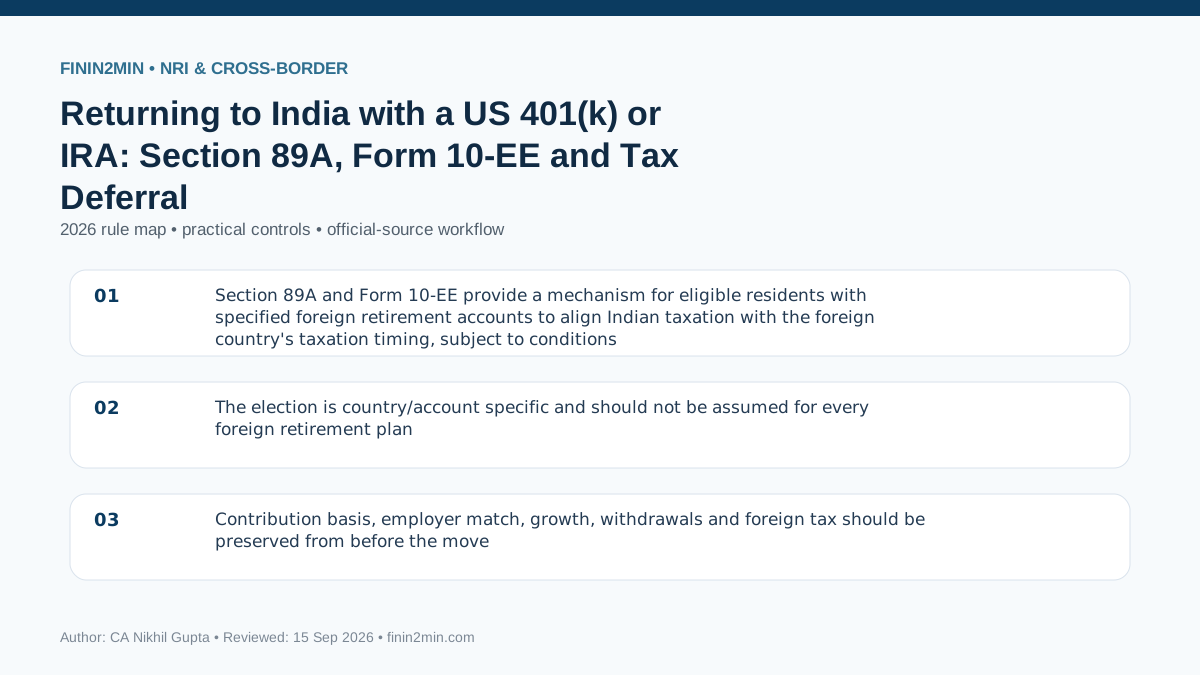
A US 401(k) or IRA can create a timing mismatch: India may otherwise tax account income on accrual while the US may tax only at distribution. The former Income-tax Act, 1961 addressed this through section 89A and Form 10-EE.
Current rule and what decides the result
For returnees with specified foreign retirement accounts, the governing Indian provision changed from 1 April 2026. Under the Income-tax Act, 1961, section 89A with Rule 21AAA/Form 10-EE addressed timing mismatch. Under the Income-tax Act, 2025, the corresponding relief is section 158, and the Income-tax Rules, 2026 prescribe Rule 74/Form 40. The relief aligns Indian taxation timing of eligible specified retirement-account income with taxation in the notified country, subject to the option and conditions. It does not erase foreign-asset, foreign-income or foreign-tax-credit reporting.
Key rules to apply
- From 1 April 2026, the Income-tax Act, 2025 carries the retirement-benefit-account relief into section 158, and the notified Income-tax Rules, 2026 prescribe Form 40 under Rule 74.
- Returnees should therefore distinguish historical elections from the form/rule applicable to the current tax year instead of blindly filing old Form 10-EE.
- The provision aims to align Indian taxation timing for income in specified foreign retirement accounts with taxation in the notified foreign country, subject to statutory conditions.
- For years governed by the 1961 Act, section 89A and Rule 21AAA/Form 10-EE were the operative framework for eligible specified accounts.
- Under the Income-tax Act, 2025, section 158 and Rule 74/Form 40 govern the corresponding option from the new-law commencement.
- Form 40 expressly includes the US among notified-country choices and asks for account number, retirement fund, balance, opening date, local tax basis and withdrawal eligibility.
Returnee with existing 401(k)
An Indian professional returns from the US in June 2026 with a 401(k) worth USD 300,000. The account generates USD 12,000 of investment income during the Indian tax year, but US tax is deferred until distribution under the account rules. For a tax year governed by the 2025 Act, the taxpayer should examine section 158 and the Form 40 election/Rule 74 requirements rather than filing the old Form 10-EE by habit. Schedule FA/foreign-income disclosure remains a separate compliance question.
Distribution after timing election
Assume an eligible taxpayer has properly opted for the specified-account timing relief and later withdraws USD 40,000 that becomes taxable in the US. The Indian computation must follow section 158/Rule 74 mechanics and coordinate any available foreign tax credit. The taxpayer should preserve annual account statements and US tax documents so the amount previously deferred in India can be matched to the distribution year instead of being taxed twice or omitted.
How to apply it step by step
- Identify each foreign retirement account and whether the country/account is within the notified relief framework.
- Determine which Indian Act governs the tax year—1961 Act historically or 2025 Act from 1 April 2026.
- For 2026–27 onward, review section 158, Rule 74 and Form 40 rather than defaulting to Form 10-EE.
- Capture account opening date, balance, local tax basis and withdrawal eligibility required by the form.
- Maintain annual income/gain statements even when Indian timing is deferred.
- Complete Schedule FA/FSI and other foreign-asset/income disclosures independently as applicable.
- When distributions occur, reconcile foreign tax paid and Form 67/FTC requirements.
- Keep the original election and all retirement-account statements for the entire deferral period.
Common mistakes and edge cases
- Filing old Form 10-EE for a 2026–27 tax year without checking the new law.
- Assuming timing relief means the account need not be disclosed.
- Applying relief to an account/country not within the notified framework.
- Losing basis and annual statements before future distributions.
- Claiming foreign tax credit without matching the income and tax year.
FAQs
What replaced section 89A from 1 April 2026?
The corresponding Income-tax Act, 2025 provision is section 158.
What form applies from tax year 2026–27?
The Income-tax Rules, 2026 prescribe Form 40 under Rule 74 for the corresponding option.
Is Form 10-EE still the current form?
It belongs to the earlier section 89A/1961 Act framework.
Does the election make 401(k) income tax-free in India?
No. It is a timing-relief mechanism, not an exemption.
Do I still disclose the foreign account?
Foreign-asset/income disclosure requirements remain separate and should be tested independently.
What records are essential?
Election form, account statements, contribution/basis history, distributions and foreign tax documents.
Related Finin2min guides
- Form 10E & Section 89 Relief: How to Avoid Extra Tax on Salary Arrears or Advance Salary
- Section 89A Relief: 401(k) & IRA Tax for Returning NRIs
- Form 10B Filed Late: Condonation and Section 11 Exemption Evidence for Charitable Trusts
- Form 141: One TDS Statement for Property, Rent and Crypto
- TDS on Salary & Form 16 Explained Line by Line
- Section 87A Tax Rebate Explained: How to Pay Zero Tax Up to ₹12 Lakh Income
- Section 80C Investments: Full List, Limits & Best Options FY 2025-26
- Section 80C in FY 2026-27: Now Section 123