Act: Indian Partnership Act, 1932; Act 9 of 1932; commencement 1 October 1932; section 69 from 1 October 1933.
Source protocol: Complete central provision text is reproduced locally. Local public-domain central Act transcription reconciled to India Code structure. Official India Code and Gazette instruments prevail if any discrepancy is identified.
Full statutory text and Finin2min decode
Section 1 - Short title, extent and commencement
Local statutory-text source control: Local public-domain central Act transcription reconciled to India Code structure. Official India Code source prevails.
Current statutory text
(1) This Act may be called the Indian Partnership Act, 1932.
(2) It extends to the whole of India.
(3) It shall come into force on the 1st day of October, 1932, except section 69, which shall come into force on the 1st day of October, 1933.
Finin2min clause-by-clause decode
Clause
Statutory requirement
Finin2min meaning
Evidence/control
(1)
This Act may be called the Indian Partnership Act, 1932.
Test this (1) within the scope and classification framework. Operational focus: this act may be called the indian partnership act, 1932.
Contract/deed, authority, chronology, notices, performance and payment records tied to this limb.
(2)
It extends to the whole of India.
Test this (2) within the scope and classification framework. Operational focus: it extends to the whole of india.
Contract/deed, authority, chronology, notices, performance and payment records tied to this limb.
(3)
It shall come into force on the 1st day of October, 1932, except section 69, which shall come into force on the 1st day of October, 1933.
Test this (3) within the scope and classification framework. Operational focus: it shall come into force on the 1st day of october, 1932, except section 69, which shall come.
Contract/deed, authority, chronology, notices, performance and payment records tied to this limb.
Finin2min implementation explanation
Section 1 is a scope and classification provision dealing with short title, extent and commencement. Identify the actor, trigger, cumulative or alternative conditions, provisos, exceptions and legal consequence before reaching a conclusion.
Implementation control: Freeze the event date and statutory definitions before applying the remaining provisions. Record why each party, asset, instrument and transaction falls inside or outside the defined class.
Section-level practical application
Transaction test
Apply this provision to the event-date facts and record every satisfied, disputed or inapplicable limb.
Consequence and remedy
Identify how it changes validity, title, authority, liability, payment, rejection, recovery, registration, evidence or relief.
Section 2 - Definitions
Local statutory-text source control: Local public-domain central Act transcription reconciled to India Code structure. Official India Code source prevails.
Current statutory text
In this Act, unless there is anything repugnant in the subject or context,-
(a) an "act of a firm" means any act or omission by all the partners, or by any partner or agent of the firm which gives rise to a right enforceable by or against the firm;
(b) "business" includes every trade, occupation and profession;
(c) "prescribed" means prescribed by rules made under this Act;
(d) "third party" used in relation to a firm or to a partner therein means any person who is not a partner in the firm; and
(e) expressions used but not defined in this Act and defined in the Indian Contract Act, 1872, shall have the meanings assigned to them in that Act.
Finin2min clause-by-clause decode
Clause
Statutory requirement
Finin2min meaning
Evidence/control
Main rule
In this Act, unless there is anything repugnant in the subject or context,-
Test this main limb within the scope and classification framework. Operational focus: in this act, unless there is anything repugnant in the subject or context,-.
Contract/deed, authority, chronology, notices, performance and payment records tied to this limb.
(a)
an "act of a firm" means any act or omission by all the partners, or by any partner or agent of the firm which gives rise to a right enforceable by or against the firm
Test this (a) within the scope and classification framework. Operational focus: an "act of a firm" means any act or omission by all the partners, or by any partner.
Contract/deed, authority, chronology, notices, performance and payment records tied to this limb.
(b)
"business" includes every trade, occupation and profession
Test this (b) within the scope and classification framework. Operational focus: "business" includes every trade, occupation and profession.
Contract/deed, authority, chronology, notices, performance and payment records tied to this limb.
(c)
"prescribed" means prescribed by rules made under this Act
Test this (c) within the scope and classification framework. Operational focus: "prescribed" means prescribed by rules made under this act.
Contract/deed, authority, chronology, notices, performance and payment records tied to this limb.
(d)
"third party" used in relation to a firm or to a partner therein means any person who is not a partner in the firm; and
Test this (d) within the scope and classification framework. Operational focus: "third party" used in relation to a firm or to a partner therein means any person who is.
Contract/deed, authority, chronology, notices, performance and payment records tied to this limb.
(e)
expressions used but not defined in this Act and defined in the Indian Contract Act, 1872, shall have the meanings assigned to them in that Act.
Test this (e) within the scope and classification framework. Operational focus: expressions used but not defined in this act and defined in the indian contract act, 1872, shall have.
Contract/deed, authority, chronology, notices, performance and payment records tied to this limb.
Finin2min implementation explanation
Section 2 is a scope and classification provision dealing with definitions. Identify the actor, trigger, cumulative or alternative conditions, provisos, exceptions and legal consequence before reaching a conclusion.
Implementation control: Freeze the event date and statutory definitions before applying the remaining provisions. Record why each party, asset, instrument and transaction falls inside or outside the defined class.
Section-level practical application
Transaction test
Apply this provision to the event-date facts and record every satisfied, disputed or inapplicable limb.
Consequence and remedy
Identify how it changes validity, title, authority, liability, payment, rejection, recovery, registration, evidence or relief.
Section 3 - Application of provisions of Act 9 of 1872
Local statutory-text source control: Local public-domain central Act transcription reconciled to India Code structure. Official India Code source prevails.
Current statutory text
The unrepealed provisions of the Indian Contract Act, 1872, save in so far as they are inconsistent with the express provisions of this Act, shall continue to apply to firms.
Finin2min clause-by-clause decode
Clause
Statutory requirement
Finin2min meaning
Evidence/control
Main rule
The unrepealed provisions of the Indian Contract Act, 1872, save in so far as they are inconsistent with the express provisions of this Act, shall continue to apply to firms.
Test this main limb within the scope and classification framework. Operational focus: the unrepealed provisions of the indian contract act, 1872, save in so far as they are inconsistent with.
Contract/deed, authority, chronology, notices, performance and payment records tied to this limb.
Finin2min implementation explanation
Section 3 is a scope and classification provision dealing with application of provisions of act 9 of 1872. Identify the actor, trigger, cumulative or alternative conditions, provisos, exceptions and legal consequence before reaching a conclusion.
Implementation control: Freeze the event date and statutory definitions before applying the remaining provisions. Record why each party, asset, instrument and transaction falls inside or outside the defined class.
Section-level practical application
Transaction test
Apply this provision to the event-date facts and record every satisfied, disputed or inapplicable limb.
Consequence and remedy
Identify how it changes validity, title, authority, liability, payment, rejection, recovery, registration, evidence or relief.
Practical examples and calculations
Chapter scenario
A live transaction raises issues concerning preliminary and contract act interface. Freeze the event date, map each statutory condition, preserve authority and performance evidence, quantify exposure and choose remedy only after limitation and forum review.
Calculation
Method
Evidence
Price / consideration
Reconcile base amount, GST/tax, credits, retention, deductions and payment terms.
Contract, invoice, ledger, tax documents and bank proof.
Loss / compensation
Separate direct loss, consequential loss, avoided cost, mitigation, restitution, interest and stipulated sum.
Loss model, market evidence and mitigation log.
Partner settlement
Reconcile capital, current accounts, loans, drawings, profit share, assets, liabilities and goodwill.
Deed, ledgers, bank records and valuation.
Limitation
Record accrual, breach/refusal, notice, acknowledgment, exclusion and filing date.
Chronology and limitation memorandum.
Practical transaction application
Identify the transaction, relationship, parties and event date.
Map every provision to the contract/deed and actual conduct.
Record conditions satisfied, disputed, waived, excused or prevented.
Reconcile authority, delivery/performance, acceptance, payment and notices.
Quantify exposure and choose cure, termination, recovery, settlement or litigation strategy.
Authority, consent and execution controls
Authority
Correct legal entities and counterparties.
Board, partner, power-of-attorney or delegated authority.
Ordinary-course and implied-authority limits.
Third-party knowledge of restrictions.
Consent
Offer, acceptance and agreed version.
Capacity, free consent and disclosures.
Conditions precedent and approvals.
No unauthorised post-execution alteration.
Execution
Complete schedules and annexures.
Witnessing, attestation and e-sign audit trail.
Counterparts, date and place.
Original and certified-copy custody.
Stamp duty and registration alerts
Stamp duty is State/UT-specific. Classify the true instrument, place of execution or receipt, consideration and property. Registration is a separate enquiry. Insufficient stamping may require impounding; non-registration may affect property and third-party enforceability.
Instrument
Alert
Commercial agreement
Do not default to a generic article if the substance is indemnity, guarantee, security, transfer, lease or another specifically charged instrument.
Partnership deed/reconstitution
Check capital contribution, immovable property, retirement/dissolution and Registrar filing separately.
Sale of movable goods
Coordinate contract, invoice, GST/e-invoice, transport and sectoral records.
Property-related relief
Check compulsory registration, title, court fee and decree-registration effects.
Evidence and document-retention checklist
Core file
Executed deed and amendments
Partner identity and authority records
Capital, current account and drawings ledger
Profit-sharing and remuneration approvals
Firm property and goodwill register
Bank mandate and signing matrix
Admission, retirement or expulsion documents
Registrar filings and public notice evidence
Electronic evidence
Native email/message and metadata.
Version history and e-sign certificate.
System logs and acknowledgements.
Legal hold and defensible export.
Retention
Executed originals and amendments.
Authority and entity records.
Tax, payment and accounting records.
Claims and litigation records through final disposal.
Forms, registers and operational records
Record/form
Control
State registration statement
Form and fee are prescribed by the relevant State/UT rules under section 71.
Change intimation
State forms commonly apply to firm name, principal place, branches, partner changes and dissolution.
Public notice evidence
Registrar notice plus Official Gazette and vernacular-newspaper publication where section 72 requires it.
Performance, delivery and payment controls
Stage
Control
Proof
Obligation matrix
List each reciprocal obligation, owner, due date, dependency and consequence.
Signed matrix tied to contract sections.
Delivery/performance
Record dispatch, carrier, title/risk point, milestones, inspection and acceptance/rejection.
Delivery documents, certificates and correspondence.
Payment
Reconcile invoice, tax, credit, retention, set-off, due date and bank receipt.
Invoice, e-invoice, ledger and bank proof.
Change/cure
Use authorised variation and cure procedures; avoid informal waiver.
Change order, approval and cure closure.
Breach, loss, mitigation and remedy framework
Identify the exact obligation and legally material breach.
Confirm causation, remoteness, foreseeability and proof of loss.
Record mitigation, avoided cost and substitute performance.
Test damages, price, restitution, lien, stoppage, accounts, dissolution, specific performance, injunction, rescission, rectification, cancellation or declaration.
Check remedy election, double recovery, caps/exclusions and public policy.
Limitation and forum controls
Control
Analysis
Accrual
Classify cause of action and record breach, refusal, knowledge, demand and continuing-obligation dates.
Limitation
Apply the correct article; test acknowledgment, part-payment, exclusion and disability.
Jurisdiction
Check territorial/pecuniary rules, Commercial Courts threshold, exclusive forum and special court.
Interim relief
Assess preservation, injunction, receiver, security and evidence protection.
Appeal/enforcement
Map decree/award challenge, execution, interest and cross-border enforcement.
Arbitration and mediation interface
Validate agreement, signatories, scope, seat, rules and appointment mechanism.
Separate substantive rights from forum selection and identify non-arbitrable issues.
Check interim measures, consolidation, joinder and multi-contract issues.
Preserve limitation during negotiation or mediation.
Record settlement authority, confidentiality, tax, stamp and enforceability.
Company, partnership, GST and tax overlays
Overlay
Questions
Companies Act
Authority, objects, approvals, related-party, loan/guarantee/security and disclosure requirements.
Partnership/LLP
Deed/LLP authority, current constitution and public records.
Withholding, partner remuneration/interest, capital/revenue, bad debt, settlement and transfer consequences.
IBC/FEMA/consumer
Moratorium and avoidance, cross-border payment/governing law, consumer and e-commerce protection.
Binding and foundational judicial principles
Authority
Principle
Verification
Cox v. Hickman
Profit sharing is relevant but mutual agency is the decisive partnership test.
Verify official judgment and later treatment.
Dulichand Laxminarayan v. CIT
A firm is not a separate legal person in the same sense as a company; statutory context controls treatment.
Verify official judgment and later treatment.
Addanki Narayanappa v. Bhaskara Krishnappa
A partner has a right to a share in partnership assets and profits, not ownership of a specific item of firm property during subsistence.
Verify official judgment and later treatment.
Jagdish Chandra Gupta v. Kajaria Traders
Section 69 disabilities are construed with the statutory nature of the claim and firm registration status.
Verify official judgment and later treatment.
Central and State/UT variation alerts
Partnership Rules, forms, fees, Registrar portals, stamp duty and public-notice practice are State/UT-specific.
Use the State/UT variation register in the data folder for the live source checklist.
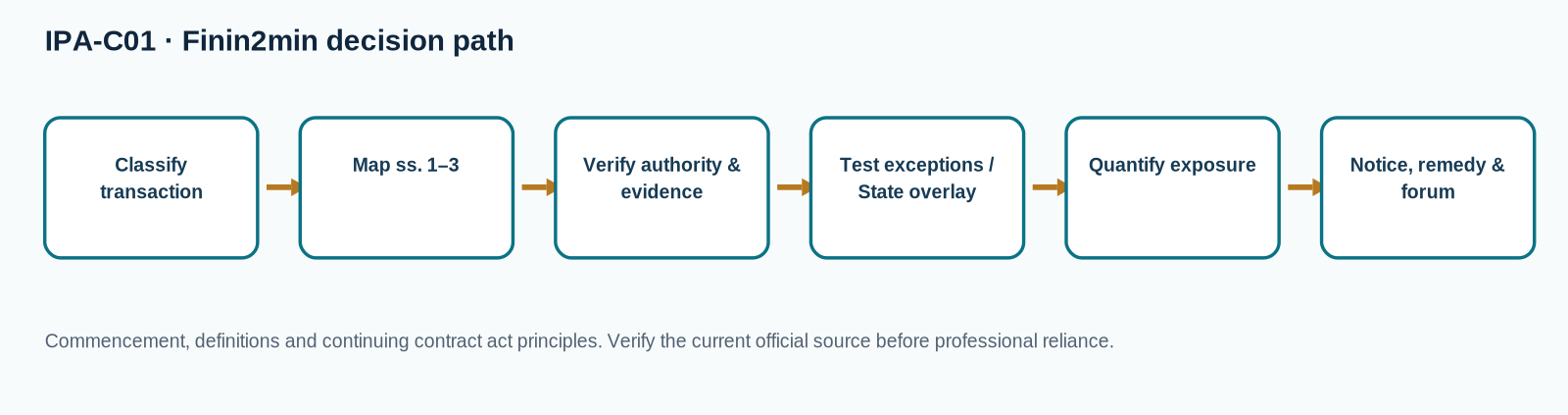
Chapter-specific decision flowchart
Finin2min Q&A
What decision does IPA-C01 help a business make?
It determines how preliminary and contract act interface should be classified, documented, performed and enforced under sections 1-3 of the Indian Partnership Act, 1932.
Which provision should be read first in IPA-C01?
Begin with section 1 (Short title, extent and commencement) and then read the connected definitions, exceptions and remedy provisions in sequence.
What is the principal implementation risk in IPA-C01?
Applying a commercial label without proving the statutory conditions for preliminary and contract act interface, or acting without authority, notice, performance and payment evidence.
Which execution checks are specific to IPA-C01?
Confirm the correct entities, signatory authority, consent, complete annexures, stamp and registration treatment, digital audit trail and approvals relevant to preliminary and contract act interface.
How should evidence be indexed for IPA-C01?
Link every section in the chapter with the contract or deed, authority, chronology, notices, performance, delivery, payment, loss and remedy evidence supporting it.
What calculation should be retained for IPA-C01?
Retain the relevant price, tax, interest, partner-account, loss, mitigation, restitution or relief working with sources and assumptions, not only the final number.
How does limitation affect IPA-C01?
Classify the precise cause of action associated with preliminary and contract act interface, record accrual, refusal, notice, acknowledgment and exclusion dates, and apply the correct Limitation Act article.
Can arbitration resolve every dispute arising under IPA-C01?
Arbitration may govern the forum, but it does not validate illegality, remove mandatory rules or make a non-arbitrable subject arbitrable. Check scope, seat and interim relief.
Which tax and entity overlays should be checked for IPA-C01?
Check Companies Act authority and related-party controls, partnership constitution, GST supply and invoice consequences, withholding, accounting and insolvency effects.
What is the final professional sign-off for IPA-C01?
Confirm the current statutory source, section conclusions, State variation, authority, calculation, limitation, remedy, forum and complete evidence trail.
Why is section 3 important to IPA-C01?
Section 3 (Application of provisions of Act 9 of 1872) completes the chapter control and must be tested independently.
Official Gazette and applicable State/UT Gazette, Registrar and court portals.
Review date: 2026-07-18.
Source and review trail
Use the current official instrument, portal or regulator publication before acting. This panel separates the category authority from page-specific references.