ICA-C05 - 31 provisions

Performance, Reciprocal Promises, Time and Discharge

Indian Contract Act, 1872

Full local statutory textFinin2min implementation editionCA Nikhil Gupta and Kajri Singh

Download chapter PDFDownload one-page cheat sheet

Finin2min Summary - Chapter in 2 Minutes

Purpose

This unit converts performance, reciprocal promises, time and discharge into statutory, transaction, evidence and remedy decisions.

Who is covered

Businesses, contracting parties, partners, buyers, sellers, principals, agents and litigants affected by this chapter.

Main obligations

Read the transaction documents and actual conduct against every statutory limb, exception and connected law.

Key timelines

Record event, breach, refusal, notice, acknowledgment and filing dates; apply the correct Limitation Act article.

Forms and evidence

Use the chapter evidence checklist and State/UT forms where registration or public notice applies.

Top risk

Wrong classification, missing authority, weak evidence, ineffective notice, unverified State process or wrong remedy.

Remedy

Preserve rights, mitigate loss, quantify exposure and confirm forum, arbitration, limitation and interim relief.

Finin2min takeaway

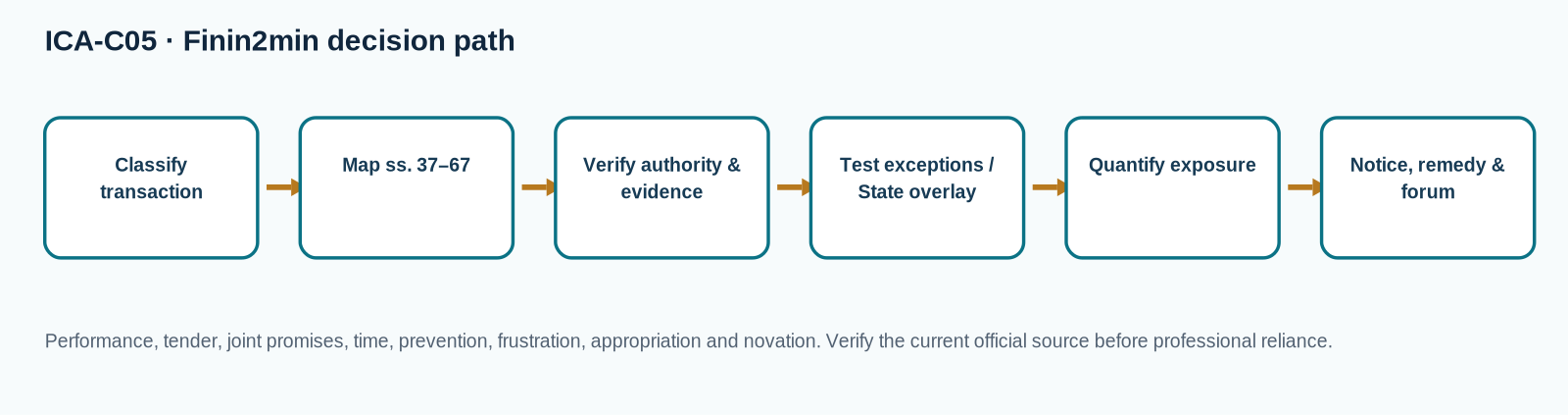
Classify - map law - verify authority - prove performance - quantify consequence - select remedy and forum.

Section-by-section provision map

ProvisionTitleStatusDecision theme
s.37Obligation of parties to contractsoperativecommercial rights and obligations
s.38Effect of refusal to accept offer of performanceoperativeformation and communication
s.39Effect of refusal of party to perform promise whollyoperativecommercial rights and obligations
s.40Person by whom promise is to be performedoperativecommercial rights and obligations
s.41Effect of accepting performance from third personoperativecommercial rights and obligations
s.42Devolution of joint liabilitiesoperativecommercial rights and obligations
s.43Any one of joint promisors may be compelled to perform. Each promisor may compel contribution. Sharing of loss by default in contributionoperativecommercial rights and obligations
s.44Effect of release of one joint promisoroperativecommercial rights and obligations
s.45Devolution of joint rightsoperativecommercial rights and obligations
s.46Time for performance of promise, when no application is to be made and no time is specifiedoperativecommercial rights and obligations
s.47Time and place for performance of promise, where time is specified and no application to be madeoperativecommercial rights and obligations
s.48Application for performance on certain day to be at proper time and placeoperativecommercial rights and obligations
s.49Place for performance of promise, where no application to be made and no place fixed foroperativecommercial rights and obligations
s.50Performance in manner or at time prescribed or sanctioned by promiseeoperativecommercial rights and obligations
s.51Promisor not bound to perform, unless reciprocal promisee ready and willing to performoperativecommercial rights and obligations
s.52Order of performance of reciprocal promisesoperativecommercial rights and obligations
s.53Liability of party preventing event on which the contract is to take effectoperativepartnership authority and liability
s.54Effect of default as to that promise which should be first performed, in contract consisting of reciprocal promisesoperativecommercial rights and obligations
s.55Effect of failure to perform at fixed time, in contract in which time is essential. Effect of such failure when time is not essential. Effect of acceptance of performance at time other than that agreed uponoperativeformation and communication
s.56Agreement to do impossible act. Contract to do an act afterwards becoming impossible or unlawful. Compensation for loss through non-performance of act known to be impossible or unlawfuloperativebreach and remedies
s.57Reciprocal promise to do things legal, and also other things illegaloperativecommercial rights and obligations
s.58Alternative promise, one branch being illegaloperativecommercial rights and obligations
s.59Application of payment where debt to be discharged is indicatedoperativeprice, payment and financial consequence
s.60Application of payment where debt to be discharged is not indicatedoperativeprice, payment and financial consequence
s.61Application of payment where neither party appropriatesoperativeprice, payment and financial consequence
s.62Effect of novation, rescission, and alteration of contractoperativecorrective and declaratory relief
s.63Promisee may dispense with or remit performance of promiseoperativecommercial rights and obligations
s.64Consequences of rescission of voidable contractoperativevalidity and consent
s.65Obligation of person who has received advantage under void agreement, or contract that becomes voidoperativevalidity and consent
s.66Mode of communicating or revoking rescission of voidable contractoperativevalidity and consent
s.67Effect of neglect of promisee to afford promisor reasonable facilities for performanceoperativecommercial rights and obligations

Legal status, amendments and source protocol

Act: Indian Contract Act, 1872; Act 9 of 1872; commencement 1 September 1872.

Source protocol: Complete central provision text is reproduced locally. Retained official India Code PDF extract. Official India Code and Gazette instruments prevail if any discrepancy is identified.

Full statutory text and Finin2min decode

Section 37 - Obligation of parties to contracts
Local statutory-text source control: Retained official India Code PDF extract. Official India Code source prevails.

Current statutory text

37. Obligation of parties to contracts.—The parties to a contract must either perform, or offer to perform, their respective promises, unless such performance is dispensed with or excused under the provisions of this Act, or of any other law. Promises bind the representatives of the promisors in case of the death of such promisors before performance, unless a contrary intention appears from the contract. Illustrations (a) A promises to deliver goods to B on a certain day on payment of Rs. 1,000. A dies before that day. A’s representatives are bound to deliver the goods to B, and B is bound to pay the Rs. 1,000 to A’s representatives. (b) A promises to paint a picture for B by a certain day, at a certain price. A dies before the day. The contract cannot be enforced either by A’s representatives or by B.

Finin2min clause-by-clause decode

ClauseStatutory requirementFinin2min meaningEvidence/control
Main rule37. Obligation of parties to contracts.—The parties to a contract must either perform, or offer to perform, their respective promises, unless such performance is dispensed with or excused under the provisions of this Act, or of any other law. Promises bind the representatives of the promisors in case of the death of such promisors before performance, unless a contrary intention appears from the contract. IllustrationsTest this main limb within the commercial rights and obligations framework. Operational focus: 37. obligation of parties to contracts.—the parties to a contract must either perform, or offer to perform, their.Contract/deed, authority, chronology, notices, performance and payment records tied to this limb.
(a)A promises to deliver goods to B on a certain day on payment of Rs. 1,000. A dies before that day. A’s representatives are bound to deliver the goods to B, and B is bound to pay the Rs. 1,000 to A’s representatives.Test this (a) within the commercial rights and obligations framework. Operational focus: a promises to deliver goods to b on a certain day on payment of rs. 1,000. a dies.Contract/deed, authority, chronology, notices, performance and payment records tied to this limb.
(b)A promises to paint a picture for B by a certain day, at a certain price. A dies before the day. The contract cannot be enforced either by A’s representatives or by B.Test this (b) within the commercial rights and obligations framework. Operational focus: a promises to paint a picture for b by a certain day, at a certain price. a dies.Contract/deed, authority, chronology, notices, performance and payment records tied to this limb.

Finin2min implementation explanation

Section 37 is a commercial rights and obligations provision dealing with obligation of parties to contracts. Identify the actor, trigger, cumulative or alternative conditions, provisos, exceptions and legal consequence before reaching a conclusion.

Implementation control: Translate the provision into an owner, trigger, approval, evidence, deadline, exception and remedy control, then test connected law and State variation.

Section-level practical application

Transaction test

Apply this provision to the event-date facts and record every satisfied, disputed or inapplicable limb.

Consequence and remedy

Identify how it changes validity, title, authority, liability, payment, rejection, recovery, registration, evidence or relief.
Section 38 - Effect of refusal to accept offer of performance
Local statutory-text source control: Retained official India Code PDF extract. Official India Code source prevails.

Current statutory text

38. Effect of refusal to accept offer of performance.—Where a promisor has made an offer of performance to the promisee, and the offer has not been accepted, the promisor is not responsible for non-performance, nor does he thereby lose his rights under the contract. Every such offer must fulfil the following conditions:— (1) it must be unconditional; (2) it must be made at a proper time and place, and under such circumstances that the person to whom it is made may have a reasonable opportunity of ascertaining that the person by whom it is made is able and willing there and then to do the whole of what he is bound by his promise to do; (3) if the offer is an offer to deliver anything to the promisee, the promisee must have a reasonable opportunity of seeing that the thing offered is the thing which the promisor is bound by his promise to deliver. An offer to one of several joint promisees has the same legal consequences as an offer to all of them. Illustration A contracts to deliver to B at his warehouse, on the 1st March, 1873, 100 bales of cotton of a particular quality. In order to make an offer of a performance with the effect stated in this section, A must bring the cotton to B’s warehouse, on the appointed day, under such circumstances that B may have areasonable opportunity of satisfying himself that the thing offered is cotton of the quality contracted for, and that there are 100 bales.

Finin2min clause-by-clause decode

ClauseStatutory requirementFinin2min meaningEvidence/control
Main rule38. Effect of refusal to accept offer of performance.—Where a promisor has made an offer of performance to the promisee, and the offer has not been accepted, the promisor is not responsible for non-performance, nor does he thereby lose his rights under the contract. Every such offer must fulfil the following conditions:—Test this main limb within the formation and communication framework. Operational focus: 38. effect of refusal to accept offer of performance.—where a promisor has made an offer of performance to.Contract/deed, authority, chronology, notices, performance and payment records tied to this limb.
(1)it must be unconditionalTest this (1) within the formation and communication framework. Operational focus: it must be unconditional.Contract/deed, authority, chronology, notices, performance and payment records tied to this limb.
(2)it must be made at a proper time and place, and under such circumstances that the person to whom it is made may have a reasonable opportunity of ascertaining that the person by whom it is made is able and willing there and then to do the whole of what he is bound by his promise to doTest this (2) within the formation and communication framework. Operational focus: it must be made at a proper time and place, and under such circumstances that the person to.Contract/deed, authority, chronology, notices, performance and payment records tied to this limb.
(3)if the offer is an offer to deliver anything to the promisee, the promisee must have a reasonable opportunity of seeing that the thing offered is the thing which the promisor is bound by his promise to deliver. An offer to one of several joint promisees has the same legal consequences as an offer to all of them. Illustration A contracts to deliver to B at his warehouse, on the 1st March, 1873, 100 bales of cotton of a particular quality. In order to make an offer of a performance with the effect stated in this section, A must bring the cotton to B’s warehouse, on the appointed day, under such circumstances that B may have...Test this (3) within the formation and communication framework. Operational focus: if the offer is an offer to deliver anything to the promisee, the promisee must have a reasonable.Contract/deed, authority, chronology, notices, performance and payment records tied to this limb.

Finin2min implementation explanation

Section 38 is a formation and communication provision dealing with effect of refusal to accept offer of performance. Identify the actor, trigger, cumulative or alternative conditions, provisos, exceptions and legal consequence before reaching a conclusion.

Implementation control: Build a dated offer-acceptance matrix, identify authorised senders and recipients, preserve dispatch and receipt evidence, and isolate counter-offers, conditions and revocations.

Section-level practical application

Transaction test

Apply this provision to the event-date facts and record every satisfied, disputed or inapplicable limb.

Consequence and remedy

Identify how it changes validity, title, authority, liability, payment, rejection, recovery, registration, evidence or relief.

Section 39 - Effect of refusal of party to perform promise wholly
Local statutory-text source control: Retained official India Code PDF extract. Official India Code source prevails.

Current statutory text

39. Effect of refusal of party to perform promise wholly.—When a party to a contract has refused to perform, or disabled himself from performing, his promise in its entirety, the promisee may put an end to the contract, unless he has signified, by words or conduct, his acquiescence in its continuance. Illustrations (a) A, a singer, enters into a contract with B, the manager of a theatre, to sing at his theatre two nights in every week during the next two months, and B engages to pay her 100 rupees for each night’s performance. On the sixth night A wilfully absents herself from the theatre. B is at liberty to put an end to the contract. (b) A, a singer, enters into a contract with B, the manager of a theatre, to sing at his theatre two night’s in every week during the next two months, and B engages to pay her at the rate of 100 rupees for each night. On the sixth night, A wilfully absents herself. With the assent of B, A sings on the seventh night. B has signified his acquiescence in the continuance of the contract, and cannot now put an end to it, but is entitled to compensation for the damage sustained by him through A’s failure to sing on the sixth night. By whom contracts must be performed

Finin2min clause-by-clause decode

ClauseStatutory requirementFinin2min meaningEvidence/control
Main rule39. Effect of refusal of party to perform promise wholly.—When a party to a contract has refused to perform, or disabled himself from performing, his promise in its entirety, the promisee may put an end to the contract, unless he has signified, by words or conduct, his acquiescence in its continuance. IllustrationsTest this main limb within the commercial rights and obligations framework. Operational focus: 39. effect of refusal of party to perform promise wholly.—when a party to a contract has refused to.Contract/deed, authority, chronology, notices, performance and payment records tied to this limb.
(a)A, a singer, enters into a contract with B, the manager of a theatre, to sing at his theatre two nights in every week during the next two months, and B engages to pay her 100 rupees for each night’s performance. On the sixth night A wilfully absents herself from the theatre. B is at liberty to put an end to the contract.Test this (a) within the commercial rights and obligations framework. Operational focus: a, a singer, enters into a contract with b, the manager of a theatre, to sing at his.Contract/deed, authority, chronology, notices, performance and payment records tied to this limb.
(b)A, a singer, enters into a contract with B, the manager of a theatre, to sing at his theatre two night’s in every week during the next two months, and B engages to pay her at the rate of 100 rupees for each night. On the sixth night, A wilfully absents herself. With the assent of B, A sings on the seventh night. B has signified his acquiescence in the continuance of the contract, and cannot now put an end to it, but is entitled to compensation for the damage sustained by him through A’s failure to sing on the sixth night. By whom contracts must be performedTest this (b) within the commercial rights and obligations framework. Operational focus: a, a singer, enters into a contract with b, the manager of a theatre, to sing at his.Contract/deed, authority, chronology, notices, performance and payment records tied to this limb.

Finin2min implementation explanation

Section 39 is a commercial rights and obligations provision dealing with effect of refusal of party to perform promise wholly. Identify the actor, trigger, cumulative or alternative conditions, provisos, exceptions and legal consequence before reaching a conclusion.

Implementation control: Translate the provision into an owner, trigger, approval, evidence, deadline, exception and remedy control, then test connected law and State variation.

Section-level practical application

Transaction test

Apply this provision to the event-date facts and record every satisfied, disputed or inapplicable limb.

Consequence and remedy

Identify how it changes validity, title, authority, liability, payment, rejection, recovery, registration, evidence or relief.

Section 40 - Person by whom promise is to be performed
Local statutory-text source control: Retained official India Code PDF extract. Official India Code source prevails.

Current statutory text

40.Person by whom promise is to be performed.—If it appears from the nature of the case that it was the intention of the parties to any contract that any promise contained in it should be performed by the promisor himself, such promise must be performed by the promisor. In other cases, the promisor or his representatives may employ a competent person to perform it. Illustrations (a) A promises to pay B a sum of money. A may perform this promise, either by personally paying the money to B or by causing it to be paid to B by another ; and, if A dies before the time appointed for payment, his representatives must perform the promise, or employ some proper person to do so. (b) A promises to paint a picture for B. A must perform this promise personally.

Finin2min clause-by-clause decode

ClauseStatutory requirementFinin2min meaningEvidence/control
Main rule40.Person by whom promise is to be performed.—If it appears from the nature of the case that it was the intention of the parties to any contract that any promise contained in it should be performed by the promisor himself, such promise must be performed by the promisor. In other cases, the promisor or his representatives may employ a competent person to perform it. IllustrationsTest this main limb within the commercial rights and obligations framework. Operational focus: 40.person by whom promise is to be performed.—if it appears from the nature of the case that it.Contract/deed, authority, chronology, notices, performance and payment records tied to this limb.
(a)A promises to pay B a sum of money. A may perform this promise, either by personally paying the money to B or by causing it to be paid to B by another ; and, if A dies before the time appointed for payment, his representatives must perform the promise, or employ some proper person to do so.Test this (a) within the commercial rights and obligations framework. Operational focus: a promises to pay b a sum of money. a may perform this promise, either by personally paying.Contract/deed, authority, chronology, notices, performance and payment records tied to this limb.
(b)A promises to paint a picture for B. A must perform this promise personally.Test this (b) within the commercial rights and obligations framework. Operational focus: a promises to paint a picture for b. a must perform this promise personally.Contract/deed, authority, chronology, notices, performance and payment records tied to this limb.

Finin2min implementation explanation

Section 40 is a commercial rights and obligations provision dealing with person by whom promise is to be performed. Identify the actor, trigger, cumulative or alternative conditions, provisos, exceptions and legal consequence before reaching a conclusion.

Implementation control: Translate the provision into an owner, trigger, approval, evidence, deadline, exception and remedy control, then test connected law and State variation.

Section-level practical application

Transaction test

Apply this provision to the event-date facts and record every satisfied, disputed or inapplicable limb.

Consequence and remedy

Identify how it changes validity, title, authority, liability, payment, rejection, recovery, registration, evidence or relief.

Section 41 - Effect of accepting performance from third person
Local statutory-text source control: Retained official India Code PDF extract. Official India Code source prevails.

Current statutory text

41. Effect of accepting performance from third person.—When a promisee accepts performance of the promise from a third person, he cannot afterwards enforce it against the promisor.

Finin2min clause-by-clause decode

ClauseStatutory requirementFinin2min meaningEvidence/control
Main rule41. Effect of accepting performance from third person.—When a promisee accepts performance of the promise from a third person, he cannot afterwards enforce it against the promisor.Test this main limb within the commercial rights and obligations framework. Operational focus: 41. effect of accepting performance from third person.—when a promisee accepts performance of the promise from a third.Contract/deed, authority, chronology, notices, performance and payment records tied to this limb.

Finin2min implementation explanation

Section 41 is a commercial rights and obligations provision dealing with effect of accepting performance from third person. Identify the actor, trigger, cumulative or alternative conditions, provisos, exceptions and legal consequence before reaching a conclusion.

Implementation control: Translate the provision into an owner, trigger, approval, evidence, deadline, exception and remedy control, then test connected law and State variation.

Section-level practical application

Transaction test

Apply this provision to the event-date facts and record every satisfied, disputed or inapplicable limb.

Consequence and remedy

Identify how it changes validity, title, authority, liability, payment, rejection, recovery, registration, evidence or relief.

Section 42 - Devolution of joint liabilities
Local statutory-text source control: Retained official India Code PDF extract. Official India Code source prevails.

Current statutory text

42. Devolution of joint liabilities.—When two or more persons have made a joint promise, then, unless a contrary intention appears by the contract, all such persons, during their joint lives, and, after the death of any of them, his representative jointly with the survivor or survivors, and, after the death of the last survivor, the representatives of all jointly, must fulfil the promise.

Finin2min clause-by-clause decode

ClauseStatutory requirementFinin2min meaningEvidence/control
Main rule42. Devolution of joint liabilities.—When two or more persons have made a joint promise, then, unless a contrary intention appears by the contract, all such persons, during their joint lives, and, after the death of any of them, his representative jointly with the survivor or survivors, and, after the death of the last survivor, the representatives of all jointly, must fulfil the promise.Test this main limb within the commercial rights and obligations framework. Operational focus: 42. devolution of joint liabilities.—when two or more persons have made a joint promise, then, unless a contrary.Contract/deed, authority, chronology, notices, performance and payment records tied to this limb.

Finin2min implementation explanation

Section 42 is a commercial rights and obligations provision dealing with devolution of joint liabilities. Identify the actor, trigger, cumulative or alternative conditions, provisos, exceptions and legal consequence before reaching a conclusion.

Implementation control: Translate the provision into an owner, trigger, approval, evidence, deadline, exception and remedy control, then test connected law and State variation.

Section-level practical application

Transaction test

Apply this provision to the event-date facts and record every satisfied, disputed or inapplicable limb.

Consequence and remedy

Identify how it changes validity, title, authority, liability, payment, rejection, recovery, registration, evidence or relief.

Section 43 - Any one of joint promisors may be compelled to perform. Each promisor may compel contribution. Sharing of loss by default in contribution
Local statutory-text source control: Retained official India Code PDF extract. Official India Code source prevails.

Current statutory text

43.Any one of joint promisors may be compelled to perform.—When two or more persons make a joint promise, the promisee may, in the absence of express agreement to the contrary, compel any 1[one or more] of such joint promisors to perform the whole of the promise. Each promisor may compel contribution.—Each of two or more joint promisors may compel every other joint promisor to contribute equally with himself to the performance of the promise, unless a contrary intention appears from the contract. Sharing of loss by default in contribution.—If any one of two or more joint promisors makes default in such contribution, the remaining joint promisors must bear the loss arising from such default in equal shares. 1. Subs. by Act 12 of 1891, s. 2 and the Second Schedule, Pt. I, for “one”. Explanation.—Nothing in this section shall prevent a surety from recovering from his principal, payments made by the surety on behalf of the principal, or entitle the principal to recover anything from the surety on account of payments made by the principal. Illustrations (a) A, B and C jointly promise to pay D 3,000 rupees. D may compel either A or B or C to pay him 3,000 rupees. (b) A, B and C jointly promise to pay D the sum of 3,000 rupees. C is compelled to pay the whole. A is insolvent, but his assets are sufficient to pay one-half of his debts. C is entitled to receive 500 rupees from A’s estate, and 1,250 rupees from B. (c) A, B and C are under a joint promise to pay D 3,000 rupees. C is unable to pay anything, and A is compelled to pay the whole. A is entitled to receive 1,500 rupees from B. (d) A, B and C are under a joint promise to pay D 3,000 rupees, A and B being only sureties for C. C fails to pay. A and B are compelled to pay the whole sum. They are entitled to recover it from C.

Finin2min clause-by-clause decode

ClauseStatutory requirementFinin2min meaningEvidence/control
Main rule43.Any one of joint promisors may be compelled to perform.—When two or more persons make a joint promise, the promisee may, in the absence of express agreement to the contrary, compel any 1[one or more] of such joint promisors to perform the whole of the promise. Each promisor may compel contribution.—Each of two or more joint promisors may compel every other joint promisor to contribute equally with himself to the performance of the promise, unless a contrary intention appears from the contract. Sharing of loss by default in contribution.—If any one of two or more joint promisors makes default in such contribution, the...Test this main limb within the commercial rights and obligations framework. Operational focus: 43.any one of joint promisors may be compelled to perform.—when two or more persons make a joint promise.Contract/deed, authority, chronology, notices, performance and payment records tied to this limb.
(a)A, B and C jointly promise to pay D 3,000 rupees. D may compel either A or B or C to pay him 3,000 rupees.Test this (a) within the commercial rights and obligations framework. Operational focus: a, b and c jointly promise to pay d 3,000 rupees. d may compel either a or b.Contract/deed, authority, chronology, notices, performance and payment records tied to this limb.
(b)A, B and C jointly promise to pay D the sum of 3,000 rupees. C is compelled to pay the whole. A is insolvent, but his assets are sufficient to pay one-half of his debts. C is entitled to receive 500 rupees from A’s estate, and 1,250 rupees from B.Test this (b) within the commercial rights and obligations framework. Operational focus: a, b and c jointly promise to pay d the sum of 3,000 rupees. c is compelled to.Contract/deed, authority, chronology, notices, performance and payment records tied to this limb.
(c)A, B and C are under a joint promise to pay D 3,000 rupees. C is unable to pay anything, and A is compelled to pay the whole. A is entitled to receive 1,500 rupees from B.Test this (c) within the commercial rights and obligations framework. Operational focus: a, b and c are under a joint promise to pay d 3,000 rupees. c is unable to.Contract/deed, authority, chronology, notices, performance and payment records tied to this limb.
(d)A, B and C are under a joint promise to pay D 3,000 rupees, A and B being only sureties for C. C fails to pay. A and B are compelled to pay the whole sum. They are entitled to recover it from C.Test this (d) within the commercial rights and obligations framework. Operational focus: a, b and c are under a joint promise to pay d 3,000 rupees, a and b being.Contract/deed, authority, chronology, notices, performance and payment records tied to this limb.

Finin2min implementation explanation

Section 43 is a commercial rights and obligations provision dealing with any one of joint promisors may be compelled to perform. each promisor may compel contribution. sharing of loss by default in contribution. Identify the actor, trigger, cumulative or alternative conditions, provisos, exceptions and legal consequence before reaching a conclusion.

Implementation control: Translate the provision into an owner, trigger, approval, evidence, deadline, exception and remedy control, then test connected law and State variation.

Section-level practical application

Transaction test

Apply this provision to the event-date facts and record every satisfied, disputed or inapplicable limb.

Consequence and remedy

Identify how it changes validity, title, authority, liability, payment, rejection, recovery, registration, evidence or relief.

Section 44 - Effect of release of one joint promisor
Local statutory-text source control: Retained official India Code PDF extract. Official India Code source prevails.

Current statutory text

44.Effect of release of one joint promisor.—Where two or more persons have made a joint promise, a release of one of such joint promisors by the promisee does not discharge the other joint promisor or joint promisors; neither does it free the joint promisors so released from responsibility to the other joint promisor or joint promisors.1

Finin2min clause-by-clause decode

ClauseStatutory requirementFinin2min meaningEvidence/control
Main rule44.Effect of release of one joint promisor.—Where two or more persons have made a joint promise, a release of one of such joint promisors by the promisee does not discharge the other joint promisor or joint promisors; neither does it free the joint promisors so released from responsibility to the other joint promisor or joint promisors.1Test this main limb within the commercial rights and obligations framework. Operational focus: 44.effect of release of one joint promisor.—where two or more persons have made a joint promise, a release.Contract/deed, authority, chronology, notices, performance and payment records tied to this limb.

Finin2min implementation explanation

Section 44 is a commercial rights and obligations provision dealing with effect of release of one joint promisor. Identify the actor, trigger, cumulative or alternative conditions, provisos, exceptions and legal consequence before reaching a conclusion.

Implementation control: Translate the provision into an owner, trigger, approval, evidence, deadline, exception and remedy control, then test connected law and State variation.

Section-level practical application

Transaction test

Apply this provision to the event-date facts and record every satisfied, disputed or inapplicable limb.

Consequence and remedy

Identify how it changes validity, title, authority, liability, payment, rejection, recovery, registration, evidence or relief.

Section 45 - Devolution of joint rights
Local statutory-text source control: Retained official India Code PDF extract. Official India Code source prevails.

Current statutory text

45. Devolution of joint rights.—When a person has made a promise to two or more persons jointly, then, unless a contrary intention appears from the contract, the right to claim performance rests, as between him and them, with them during their joint lives, and, after the death of any of them, with the representative of such deceased person jointly with the survivor or survivors, and, after the death of the last survivor, with the representatives of all jointly.2 Illustration A, in consideration of 5,000 rupees, lent to him by B and C, promises B and C jointly to repay them that sum with interest on a day specified. B dies. The right to claim performance rests with B’s representative jointly with C during C’s life, and after the death of C with the representatives of B and C jointly. Time and place for performance

Finin2min clause-by-clause decode

ClauseStatutory requirementFinin2min meaningEvidence/control
Main rule45. Devolution of joint rights.—When a person has made a promise to two or more persons jointly, then, unless a contrary intention appears from the contract, the right to claim performance rests, as between him and them, with them during their joint lives, and, after the death of any of them, with the representative of such deceased person jointly with the survivor or survivors, and, after the death of the last survivor, with the representatives of all jointly.2 Illustration A, in consideration of 5,000 rupees, lent to him by B and C, promises B and C jointly to repay them that sum with interest on a day specified. B dies. The...Test this main limb within the commercial rights and obligations framework. Operational focus: 45. devolution of joint rights.—when a person has made a promise to two or more persons jointly, then.Contract/deed, authority, chronology, notices, performance and payment records tied to this limb.

Finin2min implementation explanation

Section 45 is a commercial rights and obligations provision dealing with devolution of joint rights. Identify the actor, trigger, cumulative or alternative conditions, provisos, exceptions and legal consequence before reaching a conclusion.

Implementation control: Translate the provision into an owner, trigger, approval, evidence, deadline, exception and remedy control, then test connected law and State variation.

Section-level practical application

Transaction test

Apply this provision to the event-date facts and record every satisfied, disputed or inapplicable limb.

Consequence and remedy

Identify how it changes validity, title, authority, liability, payment, rejection, recovery, registration, evidence or relief.

Section 46 - Time for performance of promise, when no application is to be made and no time is specified
Local statutory-text source control: Retained official India Code PDF extract. Official India Code source prevails.

Current statutory text

46. Time for performance of promise, when no application is to be made and no time is specified.—Where, by the contract, a promisor is to perform his promise without application by the promisee, and no time for performance is specified, the engagement must be performed within a reasonable time. Explanation.—The question “what is a reasonable time” is, in each particular case, a question of fact.

Finin2min clause-by-clause decode

ClauseStatutory requirementFinin2min meaningEvidence/control
Main rule46. Time for performance of promise, when no application is to be made and no time is specified.—Where, by the contract, a promisor is to perform his promise without application by the promisee, and no time for performance is specified, the engagement must be performed within a reasonable time. Explanation.—The question “what is a reasonable time” is, in each particular case, a question of fact.Test this main limb within the commercial rights and obligations framework. Operational focus: 46. time for performance of promise, when no application is to be made and no time is specified.—where.Contract/deed, authority, chronology, notices, performance and payment records tied to this limb.

Finin2min implementation explanation

Section 46 is a commercial rights and obligations provision dealing with time for performance of promise, when no application is to be made and no time is specified. Identify the actor, trigger, cumulative or alternative conditions, provisos, exceptions and legal consequence before reaching a conclusion.

Implementation control: Translate the provision into an owner, trigger, approval, evidence, deadline, exception and remedy control, then test connected law and State variation.

Section-level practical application

Transaction test

Apply this provision to the event-date facts and record every satisfied, disputed or inapplicable limb.

Consequence and remedy

Identify how it changes validity, title, authority, liability, payment, rejection, recovery, registration, evidence or relief.

Section 47 - Time and place for performance of promise, where time is specified and no application to be made
Local statutory-text source control: Retained official India Code PDF extract. Official India Code source prevails.

Current statutory text

47.Time and place for performance of promise, where time is specified and no application to be made.—When a promise is to be performed on a certain day, and the promisor has undertaken to perform it without application by the promisee, the promisor may perform it at any time during the usual hours of business on such day and at the place at which the promise ought to be performed. Illustration A promises to deliver goods at B’s warehouse on the first January. On that day A brings the goods to B’s warehouse, but after the usual hour for closing it, and they are not received. A has not performed his promise.

Finin2min clause-by-clause decode

ClauseStatutory requirementFinin2min meaningEvidence/control
Main rule47.Time and place for performance of promise, where time is specified and no application to be made.—When a promise is to be performed on a certain day, and the promisor has undertaken to perform it without application by the promisee, the promisor may perform it at any time during the usual hours of business on such day and at the place at which the promise ought to be performed. Illustration A promises to deliver goods at B’s warehouse on the first January. On that day A brings the goods to B’s warehouse, but after the usual hour for closing it, and they are not received. A has not performed his promise.Test this main limb within the commercial rights and obligations framework. Operational focus: 47.time and place for performance of promise, where time is specified and no application to be made.—when a.Contract/deed, authority, chronology, notices, performance and payment records tied to this limb.

Finin2min implementation explanation

Section 47 is a commercial rights and obligations provision dealing with time and place for performance of promise, where time is specified and no application to be made. Identify the actor, trigger, cumulative or alternative conditions, provisos, exceptions and legal consequence before reaching a conclusion.

Implementation control: Translate the provision into an owner, trigger, approval, evidence, deadline, exception and remedy control, then test connected law and State variation.

Section-level practical application

Transaction test

Apply this provision to the event-date facts and record every satisfied, disputed or inapplicable limb.

Consequence and remedy

Identify how it changes validity, title, authority, liability, payment, rejection, recovery, registration, evidence or relief.

Section 48 - Application for performance on certain day to be at proper time and place
Local statutory-text source control: Retained official India Code PDF extract. Official India Code source prevails.

Current statutory text

48. Application for performance on certain day to be at proper time and place.—When a promise is to be performed on a certain day, and the promisor has not undertaken to perform it without application by the promisee, it is the duty of the promisee to apply for performance at a proper place and within the usual hours of business. 1. See s. 138, infra. 2. For an Exception to s. 45 in case of Government securities, see the Public Debt Act, 1944 (18 of 1944), s. 8. Explanation.—The question “what is a proper time and place” is, in each particular case, a question of fact.

Finin2min clause-by-clause decode

ClauseStatutory requirementFinin2min meaningEvidence/control
Main rule48. Application for performance on certain day to be at proper time and place.—When a promise is to be performed on a certain day, and the promisor has not undertaken to perform it without application by the promisee, it is the duty of the promisee to apply for performance at a proper place and within the usual hours of business. 1. See s. 138, infra. 2. For an Exception to s. 45 in case of Government securities, see the Public Debt Act, 1944 (18 of 1944), s. 8. Explanation.—The question “what is a proper time and place” is, in each particular case, a question of fact.Test this main limb within the commercial rights and obligations framework. Operational focus: 48. application for performance on certain day to be at proper time and place.—when a promise is to.Contract/deed, authority, chronology, notices, performance and payment records tied to this limb.

Finin2min implementation explanation

Section 48 is a commercial rights and obligations provision dealing with application for performance on certain day to be at proper time and place. Identify the actor, trigger, cumulative or alternative conditions, provisos, exceptions and legal consequence before reaching a conclusion.

Implementation control: Translate the provision into an owner, trigger, approval, evidence, deadline, exception and remedy control, then test connected law and State variation.

Section-level practical application

Transaction test

Apply this provision to the event-date facts and record every satisfied, disputed or inapplicable limb.

Consequence and remedy

Identify how it changes validity, title, authority, liability, payment, rejection, recovery, registration, evidence or relief.

Section 49 - Place for performance of promise, where no application to be made and no place fixed for
Local statutory-text source control: Retained official India Code PDF extract. Official India Code source prevails.

Current statutory text

49. Place for performance of promise, where no application to be made and no place fixed for performance.—When a promise is to be performed without application by the promisee, and no place is fixed for the performance of it, it is the duty of the promisor to apply to the promisee to appoint a reasonable place for the performance of the promise, and to perform it at such place. Illustration A undertakes to deliver a thousand maunds of jute to B on a fixed day. A must apply to B to appoint a reasonable place for the purpose of receiving it, and must deliver it to him at such place.

Finin2min clause-by-clause decode

ClauseStatutory requirementFinin2min meaningEvidence/control
Main rule49. Place for performance of promise, where no application to be made and no place fixed for performance.—When a promise is to be performed without application by the promisee, and no place is fixed for the performance of it, it is the duty of the promisor to apply to the promisee to appoint a reasonable place for the performance of the promise, and to perform it at such place. Illustration A undertakes to deliver a thousand maunds of jute to B on a fixed day. A must apply to B to appoint a reasonable place for the purpose of receiving it, and must deliver it to him at such place.Test this main limb within the commercial rights and obligations framework. Operational focus: 49. place for performance of promise, where no application to be made and no place fixed for performance.—when.Contract/deed, authority, chronology, notices, performance and payment records tied to this limb.

Finin2min implementation explanation

Section 49 is a commercial rights and obligations provision dealing with place for performance of promise, where no application to be made and no place fixed for. Identify the actor, trigger, cumulative or alternative conditions, provisos, exceptions and legal consequence before reaching a conclusion.

Implementation control: Translate the provision into an owner, trigger, approval, evidence, deadline, exception and remedy control, then test connected law and State variation.

Section-level practical application

Transaction test

Apply this provision to the event-date facts and record every satisfied, disputed or inapplicable limb.

Consequence and remedy

Identify how it changes validity, title, authority, liability, payment, rejection, recovery, registration, evidence or relief.

Section 50 - Performance in manner or at time prescribed or sanctioned by promisee
Local statutory-text source control: Retained official India Code PDF extract. Official India Code source prevails.

Current statutory text

50. Performance in manner or at time prescribed or sanctioned by promisee.—The performance of any promise may be made in any manner, or at any time which the promisee prescribes or sanctions. Illustrations (a) B owes A 2,000 rupees. A desires B to pay the amount to A’s account with C, a banker. B, who also banks with C, orders the amount to be transferred from his account to A’s credit, and this is done by C. Afterwards, and before A knows of the transfer, C fails. There has been a good payment by B. (b) A and B are mutually indebted. A and B settle an account by setting off one item against another, and B pays A the balance found to be due from him upon such settlement. This amounts to a payment by A and B, respectively, of the sums which they owed to each other. (c) A owes B 2,000 rupees. B accepts some of A’s goods in reduction of the debt. The delivery of goods operates as a part payment. (d) A desires B, who owes him Rs. 100, to send him a note for Rs. 100 by post. The debt is discharged as soon as B puts into the post a letter containing the note duly addressed to A. Performance of reciprocal promises

Finin2min clause-by-clause decode

ClauseStatutory requirementFinin2min meaningEvidence/control
Main rule50. Performance in manner or at time prescribed or sanctioned by promisee.—The performance of any promise may be made in any manner, or at any time which the promisee prescribes or sanctions. IllustrationsTest this main limb within the commercial rights and obligations framework. Operational focus: 50. performance in manner or at time prescribed or sanctioned by promisee.—the performance of any promise may be.Contract/deed, authority, chronology, notices, performance and payment records tied to this limb.
(a)B owes A 2,000 rupees. A desires B to pay the amount to A’s account with C, a banker. B, who also banks with C, orders the amount to be transferred from his account to A’s credit, and this is done by C. Afterwards, and before A knows of the transfer, C fails. There has been a good payment by B.Test this (a) within the commercial rights and obligations framework. Operational focus: b owes a 2,000 rupees. a desires b to pay the amount to a’s account with c, a.Contract/deed, authority, chronology, notices, performance and payment records tied to this limb.
(b)A and B are mutually indebted. A and B settle an account by setting off one item against another, and B pays A the balance found to be due from him upon such settlement. This amounts to a payment by A and B, respectively, of the sums which they owed to each other.Test this (b) within the commercial rights and obligations framework. Operational focus: a and b are mutually indebted. a and b settle an account by setting off one item against.Contract/deed, authority, chronology, notices, performance and payment records tied to this limb.
(c)A owes B 2,000 rupees. B accepts some of A’s goods in reduction of the debt. The delivery of goods operates as a part payment.Test this (c) within the commercial rights and obligations framework. Operational focus: a owes b 2,000 rupees. b accepts some of a’s goods in reduction of the debt. the delivery.Contract/deed, authority, chronology, notices, performance and payment records tied to this limb.
(d)A desires B, who owes him Rs. 100, to send him a note for Rs. 100 by post. The debt is discharged as soon as B puts into the post a letter containing the note duly addressed to A. Performance of reciprocal promisesTest this (d) within the commercial rights and obligations framework. Operational focus: a desires b, who owes him rs. 100, to send him a note for rs. 100 by post.Contract/deed, authority, chronology, notices, performance and payment records tied to this limb.

Finin2min implementation explanation

Section 50 is a commercial rights and obligations provision dealing with performance in manner or at time prescribed or sanctioned by promisee. Identify the actor, trigger, cumulative or alternative conditions, provisos, exceptions and legal consequence before reaching a conclusion.

Implementation control: Translate the provision into an owner, trigger, approval, evidence, deadline, exception and remedy control, then test connected law and State variation.

Section-level practical application

Transaction test

Apply this provision to the event-date facts and record every satisfied, disputed or inapplicable limb.

Consequence and remedy

Identify how it changes validity, title, authority, liability, payment, rejection, recovery, registration, evidence or relief.

Section 51 - Promisor not bound to perform, unless reciprocal promisee ready and willing to perform
Local statutory-text source control: Retained official India Code PDF extract. Official India Code source prevails.

Current statutory text

51.Promisor not bound to perform, unless reciprocal promisee ready and willing to perform.—When a contract consists of reciprocal promises to be simultaneously performed, no promisor need perform his promise unless the promisee is ready and willing to perform his reciprocal promise. Illustrations (a) A and B contract that A shall deliver goods to B to be paid for by B on delivery. A need not deliver the goods, unless B is ready and willing to pay for the goods on delivery. B need not pay for the goods, unless A is ready and willing to deliver them on payment. (b) A and B contract that A shall deliver goods to B at a price to be paid by instalments, the first instalment to be paid on delivery. A need not deliver, unless B is ready and willing to pay the first instalment on delivery. B need not pay the first instalment, unless A is ready and willing to deliver the goods on payment of the first instalment.

Finin2min clause-by-clause decode

ClauseStatutory requirementFinin2min meaningEvidence/control
Main rule51.Promisor not bound to perform, unless reciprocal promisee ready and willing to perform.—When a contract consists of reciprocal promises to be simultaneously performed, no promisor need perform his promise unless the promisee is ready and willing to perform his reciprocal promise. IllustrationsTest this main limb within the commercial rights and obligations framework. Operational focus: 51.promisor not bound to perform, unless reciprocal promisee ready and willing to perform.—when a contract consists of reciprocal.Contract/deed, authority, chronology, notices, performance and payment records tied to this limb.
(a)A and B contract that A shall deliver goods to B to be paid for by B on delivery. A need not deliver the goods, unless B is ready and willing to pay for the goods on delivery. B need not pay for the goods, unless A is ready and willing to deliver them on payment.Test this (a) within the commercial rights and obligations framework. Operational focus: a and b contract that a shall deliver goods to b to be paid for by b on.Contract/deed, authority, chronology, notices, performance and payment records tied to this limb.
(b)A and B contract that A shall deliver goods to B at a price to be paid by instalments, the first instalment to be paid on delivery. A need not deliver, unless B is ready and willing to pay the first instalment on delivery. B need not pay the first instalment, unless A is ready and willing to deliver the goods on payment of the first instalment.Test this (b) within the commercial rights and obligations framework. Operational focus: a and b contract that a shall deliver goods to b at a price to be paid by.Contract/deed, authority, chronology, notices, performance and payment records tied to this limb.

Finin2min implementation explanation

Section 51 is a commercial rights and obligations provision dealing with promisor not bound to perform, unless reciprocal promisee ready and willing to perform. Identify the actor, trigger, cumulative or alternative conditions, provisos, exceptions and legal consequence before reaching a conclusion.

Implementation control: Translate the provision into an owner, trigger, approval, evidence, deadline, exception and remedy control, then test connected law and State variation.

Section-level practical application

Transaction test

Apply this provision to the event-date facts and record every satisfied, disputed or inapplicable limb.

Consequence and remedy

Identify how it changes validity, title, authority, liability, payment, rejection, recovery, registration, evidence or relief.

Section 52 - Order of performance of reciprocal promises
Local statutory-text source control: Retained official India Code PDF extract. Official India Code source prevails.

Current statutory text

52.Order of performance of reciprocal promises.—Where the order in which reciprocal promises are to be performed is expressly fixed by the contract, they shall be performed in that order; and where the order is not expressly fixed by the contract, they shall be performed in that order which the nature of the transaction requires. Illustrations (a) A and B contract that A shall build a house for B at a fixed price. A’s promise to build the house must be performed before B’s promise to pay for it. (b) A and B contract that A shall make over his stock-in-trade to B at a fixed price, and B promises to give security for the payment of the money. A’s promise need not be performed until the security is given, for the nature of the transaction requires that A should have security before he delivers up his stock.

Finin2min clause-by-clause decode

ClauseStatutory requirementFinin2min meaningEvidence/control
Main rule52.Order of performance of reciprocal promises.—Where the order in which reciprocal promises are to be performed is expressly fixed by the contract, they shall be performed in that order; and where the order is not expressly fixed by the contract, they shall be performed in that order which the nature of the transaction requires. IllustrationsTest this main limb within the commercial rights and obligations framework. Operational focus: 52.order of performance of reciprocal promises.—where the order in which reciprocal promises are to be performed is expressly.Contract/deed, authority, chronology, notices, performance and payment records tied to this limb.
(a)A and B contract that A shall build a house for B at a fixed price. A’s promise to build the house must be performed before B’s promise to pay for it.Test this (a) within the commercial rights and obligations framework. Operational focus: a and b contract that a shall build a house for b at a fixed price. a’s promise.Contract/deed, authority, chronology, notices, performance and payment records tied to this limb.
(b)A and B contract that A shall make over his stock-in-trade to B at a fixed price, and B promises to give security for the payment of the money. A’s promise need not be performed until the security is given, for the nature of the transaction requires that A should have security before he delivers up his stock.Test this (b) within the commercial rights and obligations framework. Operational focus: a and b contract that a shall make over his stock-in-trade to b at a fixed price, and.Contract/deed, authority, chronology, notices, performance and payment records tied to this limb.

Finin2min implementation explanation

Section 52 is a commercial rights and obligations provision dealing with order of performance of reciprocal promises. Identify the actor, trigger, cumulative or alternative conditions, provisos, exceptions and legal consequence before reaching a conclusion.

Implementation control: Translate the provision into an owner, trigger, approval, evidence, deadline, exception and remedy control, then test connected law and State variation.

Section-level practical application

Transaction test

Apply this provision to the event-date facts and record every satisfied, disputed or inapplicable limb.

Consequence and remedy

Identify how it changes validity, title, authority, liability, payment, rejection, recovery, registration, evidence or relief.

Section 53 - Liability of party preventing event on which the contract is to take effect
Local statutory-text source control: Retained official India Code PDF extract. Official India Code source prevails.

Current statutory text

53. Liability of party preventing event on which the contract is to take effect.—When a contract contains reciprocal promises, and one party to the contract prevents the other from performing his promise, the contract becomes voidable at the option of the party so prevented; and he is entitled to compensation 1from the other party for any loss which he may sustain in consequence of the non- performance of the contract. Illustration A and B contract that B shall execute certain work for A for a thousand rupees. B is ready and willing to execute the work accordingly, but A prevents him from doing so. The contract is voidable at the option of B; and, if he elects to rescind it, he is entitled to recover from A compensation for any loss which he has incurred by its non-performance.

Finin2min clause-by-clause decode

ClauseStatutory requirementFinin2min meaningEvidence/control
Main rule53. Liability of party preventing event on which the contract is to take effect.—When a contract contains reciprocal promises, and one party to the contract prevents the other from performing his promise, the contract becomes voidable at the option of the party so prevented; and he is entitled to compensation 1from the other party for any loss which he may sustain in consequence of the non- performance of the contract. Illustration A and B contract that B shall execute certain work for A for a thousand rupees. B is ready and willing to execute the work accordingly, but A prevents him from doing so. The contract is voidable at...Test this main limb within the partnership authority and liability framework. Operational focus: 53. liability of party preventing event on which the contract is to take effect.—when a contract contains reciprocal.Contract/deed, authority, chronology, notices, performance and payment records tied to this limb.

Finin2min implementation explanation

Section 53 is a partnership authority and liability provision dealing with liability of party preventing event on which the contract is to take effect. Identify the actor, trigger, cumulative or alternative conditions, provisos, exceptions and legal consequence before reaching a conclusion.

Implementation control: Reconcile the deed, ordinary course, internal limits, third-party knowledge, firm-name execution, admissions and holding out. Internal restrictions may not defeat external liability.

Section-level practical application

Transaction test

Apply this provision to the event-date facts and record every satisfied, disputed or inapplicable limb.

Consequence and remedy

Identify how it changes validity, title, authority, liability, payment, rejection, recovery, registration, evidence or relief.

Section 54 - Effect of default as to that promise which should be first performed, in contract consisting of reciprocal promises
Local statutory-text source control: Retained official India Code PDF extract. Official India Code source prevails.

Current statutory text

54. Effect of default as to that promise which should be first performed, in contract consisting of reciprocal promises.—When a contract consists of reciprocal promises, such that one of them cannot be performed, or that its performance cannot be claimed till the other has been performed, and the promisor of the promise last mentioned fails to perform it, such promisor cannot claim the performance of the reciprocal promise, and must make compensation to the other party to the contract for any loss which such other party may sustain by the non-performance of the contract. Illustrations (a) A hires B’s ship to take in and convey, from Calcutta to the Mauritius, a cargo to be provided by A, B receiving a certain freight for its conveyance. A does not provide any cargo for the ship. A cannot claim the performance of B’s promise, and must make compensation to B for the loss which B sustains by the non-performance of the contract. (b) A contracts with B to execute certain builder’s work for a fixed price, B supplying the scaffolding and timber necessary for the work. B refuses to furnish any scaffolding or timber, and the work cannot be executed. A need not execute the work, and B is bound to make compensation to A for any loss caused to him by the non-performance of the contract. (c) A contracts with B to deliver to him, at a specified price, certain merchandise on board a ship which cannot arrive for a month, and B engages to pay for the merchandise within a week from the date of the contract. B does not pay within the week. A’s promise to deliver need not be performed, and B must make compensation. (d) A promises B to sell him one hundred bales of merchandise, to be delivered next day, and B promises A to pay for them within a month. A does not deliver according to his promise. B’s promise to pay need not be performed, and A must make compensation.

Finin2min clause-by-clause decode

ClauseStatutory requirementFinin2min meaningEvidence/control
Main rule54. Effect of default as to that promise which should be first performed, in contract consisting of reciprocal promises.—When a contract consists of reciprocal promises, such that one of them cannot be performed, or that its performance cannot be claimed till the other has been performed, and the promisor of the promise last mentioned fails to perform it, such promisor cannot claim the performance of the reciprocal promise, and must make compensation to the other party to the contract for any loss which such other party may sustain by the non-performance of the contract. IllustrationsTest this main limb within the commercial rights and obligations framework. Operational focus: 54. effect of default as to that promise which should be first performed, in contract consisting of reciprocal.Contract/deed, authority, chronology, notices, performance and payment records tied to this limb.
(a)A hires B’s ship to take in and convey, from Calcutta to the Mauritius, a cargo to be provided by A, B receiving a certain freight for its conveyance. A does not provide any cargo for the ship. A cannot claim the performance of B’s promise, and must make compensation to B for the loss which B sustains by the non-performance of the contract.Test this (a) within the commercial rights and obligations framework. Operational focus: a hires b’s ship to take in and convey, from calcutta to the mauritius, a cargo to be.Contract/deed, authority, chronology, notices, performance and payment records tied to this limb.
(b)A contracts with B to execute certain builder’s work for a fixed price, B supplying the scaffolding and timber necessary for the work. B refuses to furnish any scaffolding or timber, and the work cannot be executed. A need not execute the work, and B is bound to make compensation to A for any loss caused to him by the non-performance of the contract.Test this (b) within the commercial rights and obligations framework. Operational focus: a contracts with b to execute certain builder’s work for a fixed price, b supplying the scaffolding and.Contract/deed, authority, chronology, notices, performance and payment records tied to this limb.
(c)A contracts with B to deliver to him, at a specified price, certain merchandise on board a ship which cannot arrive for a month, and B engages to pay for the merchandise within a week from the date of the contract. B does not pay within the week. A’s promise to deliver need not be performed, and B must make compensation.Test this (c) within the commercial rights and obligations framework. Operational focus: a contracts with b to deliver to him, at a specified price, certain merchandise on board a ship.Contract/deed, authority, chronology, notices, performance and payment records tied to this limb.
(d)A promises B to sell him one hundred bales of merchandise, to be delivered next day, and B promises A to pay for them within a month. A does not deliver according to his promise. B’s promise to pay need not be performed, and A must make compensation.Test this (d) within the commercial rights and obligations framework. Operational focus: a promises b to sell him one hundred bales of merchandise, to be delivered next day, and b.Contract/deed, authority, chronology, notices, performance and payment records tied to this limb.

Finin2min implementation explanation

Section 54 is a commercial rights and obligations provision dealing with effect of default as to that promise which should be first performed, in contract consisting of reciprocal promises. Identify the actor, trigger, cumulative or alternative conditions, provisos, exceptions and legal consequence before reaching a conclusion.

Implementation control: Translate the provision into an owner, trigger, approval, evidence, deadline, exception and remedy control, then test connected law and State variation.

Section-level practical application

Transaction test

Apply this provision to the event-date facts and record every satisfied, disputed or inapplicable limb.

Consequence and remedy

Identify how it changes validity, title, authority, liability, payment, rejection, recovery, registration, evidence or relief.

Section 55 - Effect of failure to perform at fixed time, in contract in which time is essential. Effect of such failure when time is not essential. Effect of acceptance of performance at time other than that agreed upon
Local statutory-text source control: Retained official India Code PDF extract. Official India Code source prevails.

Current statutory text

55. Effect of failure to perform at fixed time, in contract in which time is essential.—When a party to a contract promises to do a certain thing at or before a specified time, or certain things at or before specified times, and fails to do any such thing at or before the specified time, the contract, or so much of it as has not been performed, becomes voidable at the option of the promisee, if the intention of the parties was that time should be of the essence of the contract. Effect of such failure when time is not essential.—If it was not the intention of the parties that time should be of the essence of the contract, the contract does not become voidable by the failure to do such thing at or before the specified time; but the promisee is entitled to compensation from the promisor for any loss occasioned to him by such failure. Effect of acceptance of performance at time other than that agreed upon.—If, in case of a contract voidable on account of the promisor’s failure to perform his promise at the time agreed, the promisee accepts performance of such promise at any time other than that agreed, the promisee cannot claim compensation for any loss occasioned by the non-performance of the promise at the time agreed, unless, at the time of such acceptance, he gives notice to the promisor of his intention to do so.2 STATE AMENDMENT Uttar Pradesh Amendment of section 55.—In section 55 of the Principal Act, in the third paragraph, for the words “unless at the time of such acceptance he gives notice to the promiser of his intention to do so”, the words “where at the time of such acceptance he has waived his right to do so” shall be substituted.” [Vide Uttar Pradesh 57 of 1976, s. 26] 1. See s. 73, infra. 2. C.f. ss. 62 and 63, infra.

Finin2min clause-by-clause decode

ClauseStatutory requirementFinin2min meaningEvidence/control
Main rule55. Effect of failure to perform at fixed time, in contract in which time is essential.—When a party to a contract promises to do a certain thing at or before a specified time, or certain things at or before specified times, and fails to do any such thing at or before the specified time, the contract, or so much of it as has not been performed, becomes voidable at the option of the promisee, if the intention of the parties was that time should be of the essence of the contract. Effect of such failure when time is not essential.—If it was not the intention of the parties that time should be of the essence of the contract, the...Test this main limb within the formation and communication framework. Operational focus: 55. effect of failure to perform at fixed time, in contract in which time is essential.—when a party.Contract/deed, authority, chronology, notices, performance and payment records tied to this limb.

Finin2min implementation explanation

Section 55 is a formation and communication provision dealing with effect of failure to perform at fixed time, in contract in which time is essential. effect of such failure when time is not essential. effect of acceptance of performance at time other than that agreed upon. Identify the actor, trigger, cumulative or alternative conditions, provisos, exceptions and legal consequence before reaching a conclusion.

Implementation control: Build a dated offer-acceptance matrix, identify authorised senders and recipients, preserve dispatch and receipt evidence, and isolate counter-offers, conditions and revocations.

Section-level practical application

Transaction test

Apply this provision to the event-date facts and record every satisfied, disputed or inapplicable limb.

Consequence and remedy

Identify how it changes validity, title, authority, liability, payment, rejection, recovery, registration, evidence or relief.

Section 56 - Agreement to do impossible act. Contract to do an act afterwards becoming impossible or unlawful. Compensation for loss through non-performance of act known to be impossible or unlawful
Local statutory-text source control: Retained official India Code PDF extract. Official India Code source prevails.

Current statutory text

56. Agreement to do impossible act.—An agreement to do an act impossible in itself is void. Contract to do an act afterwards becoming impossible or unlawful.—A contract to do an act which, after the contract is made, becomes impossible, or, by reason of some event which the promisor could not prevent, unlawful, becomes void when the act becomes impossible or unlawful.1 Compensation for loss through non-performance of act known to be impossible or unlawful.— Where one person has promised to do something which he knew, or, with reasonable diligence, might have known, and which the promisee did not know, to be impossible or unlawful, such promisor must make compensation to such promisee for any loss which such promisee sustains through the non- performance of the promise. Illustrations (a) A agrees with B to discover treasure by magic. The agreement is void. (b) A and B contract to marry each other. Before the time fixed for the marriage, A goes mad. The contract becomes void. (c) A contracts to marry B, being already married to C, and being forbidden by the law to which he is subject to practise polygamy, A must make compensation to B for the loss caused to her by the non-performance of his promise. (d) A contracts to take in cargo for B at a foreign port. A’s Government afterwards declares war against the country in which the port is situated. The contract becomes void when war is declared. (e) A contracts to act at a theatre for six months in consideration of a sum paid in advance by B. On several occasions A is too ill to act. The contract to act on those occasions becomes void.

Finin2min clause-by-clause decode

ClauseStatutory requirementFinin2min meaningEvidence/control
Main rule56. Agreement to do impossible act.—An agreement to do an act impossible in itself is void. Contract to do an act afterwards becoming impossible or unlawful.—A contract to do an act which, after the contract is made, becomes impossible, or, by reason of some event which the promisor could not prevent, unlawful, becomes void when the act becomes impossible or unlawful.1 Compensation for loss through non-performance of act known to be impossible or unlawful.— Where one person has promised to do something which he knew, or, with reasonable diligence, might have known, and which the promisee did not know, to be impossible or...Test this main limb within the breach and remedies framework. Operational focus: 56. agreement to do impossible act.—an agreement to do an act impossible in itself is void. contract to.Contract/deed, authority, chronology, notices, performance and payment records tied to this limb.
(a)A agrees with B to discover treasure by magic. The agreement is void.Test this (a) within the breach and remedies framework. Operational focus: a agrees with b to discover treasure by magic. the agreement is void.Contract/deed, authority, chronology, notices, performance and payment records tied to this limb.
(b)A and B contract to marry each other. Before the time fixed for the marriage, A goes mad. The contract becomes void.Test this (b) within the breach and remedies framework. Operational focus: a and b contract to marry each other. before the time fixed for the marriage, a goes mad.Contract/deed, authority, chronology, notices, performance and payment records tied to this limb.
(c)A contracts to marry B, being already married to C, and being forbidden by the law to which he is subject to practise polygamy, A must make compensation to B for the loss caused to her by the non-performance of his promise.Test this (c) within the breach and remedies framework. Operational focus: a contracts to marry b, being already married to c, and being forbidden by the law to which.Contract/deed, authority, chronology, notices, performance and payment records tied to this limb.
(d)A contracts to take in cargo for B at a foreign port. A’s Government afterwards declares war against the country in which the port is situated. The contract becomes void when war is declared.Test this (d) within the breach and remedies framework. Operational focus: a contracts to take in cargo for b at a foreign port. a’s government afterwards declares war against.Contract/deed, authority, chronology, notices, performance and payment records tied to this limb.
(e)A contracts to act at a theatre for six months in consideration of a sum paid in advance by B. On several occasions A is too ill to act. The contract to act on those occasions becomes void.Test this (e) within the breach and remedies framework. Operational focus: a contracts to act at a theatre for six months in consideration of a sum paid in advance.Contract/deed, authority, chronology, notices, performance and payment records tied to this limb.

Finin2min implementation explanation

Section 56 is a breach and remedies provision dealing with agreement to do impossible act. contract to do an act afterwards becoming impossible or unlawful. compensation for loss through non-performance of act known to be impossible or unlawful. Identify the actor, trigger, cumulative or alternative conditions, provisos, exceptions and legal consequence before reaching a conclusion.

Implementation control: Identify breach, causation, remoteness, mitigation, stipulated sums, restitution, interest and remedy election. Preserve a reproducible claim and defence working.

Section-level practical application

Transaction test

Apply this provision to the event-date facts and record every satisfied, disputed or inapplicable limb.

Consequence and remedy

Identify how it changes validity, title, authority, liability, payment, rejection, recovery, registration, evidence or relief.

Section 57 - Reciprocal promise to do things legal, and also other things illegal
Local statutory-text source control: Retained official India Code PDF extract. Official India Code source prevails.

Current statutory text

57.Reciprocal promise to do things legal, and also other things illegal.—Where persons reciprocally promise, firstly, to do certain things which are legal, and, secondly, under specified circumstances, to do certain other things which are illegal, the first set of promises is a contract, but the second is a void agreement. Illustration A and B agree that A shall sell B a house for 10,000 rupees, but that, if B uses it as a gambling house, he shall pay A 50,000 rupees for it. The first set of reciprocal promises, namely, to sell the house and to pay 10,000 rupees for it, is a contract. The second set is for an unlawful object, namely, that B may use the house as a gambling house, and is a void agreement.

Finin2min clause-by-clause decode

ClauseStatutory requirementFinin2min meaningEvidence/control
Main rule57.Reciprocal promise to do things legal, and also other things illegal.—Where persons reciprocally promise, firstly, to do certain things which are legal, and, secondly, under specified circumstances, to do certain other things which are illegal, the first set of promises is a contract, but the second is a void agreement. Illustration A and B agree that A shall sell B a house for 10,000 rupees, but that, if B uses it as a gambling house, he shall pay A 50,000 rupees for it. The first set of reciprocal promises, namely, to sell the house and to pay 10,000 rupees for it, is a contract. The second set is for an unlawful object,...Test this main limb within the commercial rights and obligations framework. Operational focus: 57.reciprocal promise to do things legal, and also other things illegal.—where persons reciprocally promise, firstly, to do certain.Contract/deed, authority, chronology, notices, performance and payment records tied to this limb.

Finin2min implementation explanation

Section 57 is a commercial rights and obligations provision dealing with reciprocal promise to do things legal, and also other things illegal. Identify the actor, trigger, cumulative or alternative conditions, provisos, exceptions and legal consequence before reaching a conclusion.

Implementation control: Translate the provision into an owner, trigger, approval, evidence, deadline, exception and remedy control, then test connected law and State variation.

Section-level practical application

Transaction test

Apply this provision to the event-date facts and record every satisfied, disputed or inapplicable limb.

Consequence and remedy

Identify how it changes validity, title, authority, liability, payment, rejection, recovery, registration, evidence or relief.

Section 58 - Alternative promise, one branch being illegal
Local statutory-text source control: Retained official India Code PDF extract. Official India Code source prevails.

Current statutory text

58. Alternative promise, one branch being illegal.—In the case of an alternative promise, one branch of which is legal and the other illegal, the legal branch alone can be enforced. Illustration A and B agree that A shall pay B 1,000 rupees, for which B shall afterwards deliver to A either rice or smuggled opium. This is a valid contract to deliver rice, and a void agreement as to the opium. Appropriation of payments

Finin2min clause-by-clause decode

ClauseStatutory requirementFinin2min meaningEvidence/control
Main rule58. Alternative promise, one branch being illegal.—In the case of an alternative promise, one branch of which is legal and the other illegal, the legal branch alone can be enforced. Illustration A and B agree that A shall pay B 1,000 rupees, for which B shall afterwards deliver to A either rice or smuggled opium. This is a valid contract to deliver rice, and a void agreement as to the opium. Appropriation of paymentsTest this main limb within the commercial rights and obligations framework. Operational focus: 58. alternative promise, one branch being illegal.—in the case of an alternative promise, one branch of which is.Contract/deed, authority, chronology, notices, performance and payment records tied to this limb.

Finin2min implementation explanation

Section 58 is a commercial rights and obligations provision dealing with alternative promise, one branch being illegal. Identify the actor, trigger, cumulative or alternative conditions, provisos, exceptions and legal consequence before reaching a conclusion.

Implementation control: Translate the provision into an owner, trigger, approval, evidence, deadline, exception and remedy control, then test connected law and State variation.

Section-level practical application

Transaction test

Apply this provision to the event-date facts and record every satisfied, disputed or inapplicable limb.

Consequence and remedy

Identify how it changes validity, title, authority, liability, payment, rejection, recovery, registration, evidence or relief.

Section 59 - Application of payment where debt to be discharged is indicated
Local statutory-text source control: Retained official India Code PDF extract. Official India Code source prevails.

Current statutory text

59.Application of payment where debt to be discharged is indicated.—Where a debtor, owing several distinct debts to one person, makes a payment to him, either with express intimation, or under circumstances implying, that the payment is to be applied to the discharge of some particular debt, the payment, if accepted, must be applied accordingly. 1. See s. 65, infra. Illustrations (a) A owes B, among other debts, 1,000 rupees upon a promissory note which falls due on the first June. He owes B no other debt of that amount. On the first June, A pays to B 1,000 rupees. The payment is to be applied to the discharge of the promissory note. (b) A owes to B, among other debts, the sum of 567 rupees. B writes to A and demands payment of this sum. A sends to B 567 rupees. This payment is to be applied to the discharge of the debt of which B had demanded payment.

Finin2min clause-by-clause decode

ClauseStatutory requirementFinin2min meaningEvidence/control
Main rule59.Application of payment where debt to be discharged is indicated.—Where a debtor, owing several distinct debts to one person, makes a payment to him, either with express intimation, or under circumstances implying, that the payment is to be applied to the discharge of some particular debt, the payment, if accepted, must be applied accordingly. 1. See s. 65, infra. IllustrationsTest this main limb within the price, payment and financial consequence framework. Operational focus: 59.application of payment where debt to be discharged is indicated.—where a debtor, owing several distinct debts to one.Contract/deed, authority, chronology, notices, performance and payment records tied to this limb.
(a)A owes B, among other debts, 1,000 rupees upon a promissory note which falls due on the first June. He owes B no other debt of that amount. On the first June, A pays to B 1,000 rupees. The payment is to be applied to the discharge of the promissory note.Test this (a) within the price, payment and financial consequence framework. Operational focus: a owes b, among other debts, 1,000 rupees upon a promissory note which falls due on the first.Contract/deed, authority, chronology, notices, performance and payment records tied to this limb.
(b)A owes to B, among other debts, the sum of 567 rupees. B writes to A and demands payment of this sum. A sends to B 567 rupees. This payment is to be applied to the discharge of the debt of which B had demanded payment.Test this (b) within the price, payment and financial consequence framework. Operational focus: a owes to b, among other debts, the sum of 567 rupees. b writes to a and demands.Contract/deed, authority, chronology, notices, performance and payment records tied to this limb.

Finin2min implementation explanation

Section 59 is a price, payment and financial consequence provision dealing with application of payment where debt to be discharged is indicated. Identify the actor, trigger, cumulative or alternative conditions, provisos, exceptions and legal consequence before reaching a conclusion.

Implementation control: Reconcile base price, taxes, credits, deductions, interest, due dates and payment proof. Link every adjustment to the contract and statute.

Section-level practical application

Transaction test

Apply this provision to the event-date facts and record every satisfied, disputed or inapplicable limb.

Consequence and remedy

Identify how it changes validity, title, authority, liability, payment, rejection, recovery, registration, evidence or relief.

Section 60 - Application of payment where debt to be discharged is not indicated
Local statutory-text source control: Retained official India Code PDF extract. Official India Code source prevails.

Current statutory text

60. Application of payment where debt to be discharged is not indicated.—Where the debtor has omitted to intimate and there are no other circumstances indicating to which debt the payment is to be applied, the creditor may apply it at his discretion to any lawful debt actually due and payable to him from the debtor, whether its recovery is or is not barred by the law in force for the time being as to the limitation of suits.

Finin2min clause-by-clause decode

ClauseStatutory requirementFinin2min meaningEvidence/control
Main rule60. Application of payment where debt to be discharged is not indicated.—Where the debtor has omitted to intimate and there are no other circumstances indicating to which debt the payment is to be applied, the creditor may apply it at his discretion to any lawful debt actually due and payable to him from the debtor, whether its recovery is or is not barred by the law in force for the time being as to the limitation of suits.Test this main limb within the price, payment and financial consequence framework. Operational focus: 60. application of payment where debt to be discharged is not indicated.—where the debtor has omitted to intimate.Contract/deed, authority, chronology, notices, performance and payment records tied to this limb.

Finin2min implementation explanation

Section 60 is a price, payment and financial consequence provision dealing with application of payment where debt to be discharged is not indicated. Identify the actor, trigger, cumulative or alternative conditions, provisos, exceptions and legal consequence before reaching a conclusion.

Implementation control: Reconcile base price, taxes, credits, deductions, interest, due dates and payment proof. Link every adjustment to the contract and statute.

Section-level practical application

Transaction test

Apply this provision to the event-date facts and record every satisfied, disputed or inapplicable limb.

Consequence and remedy

Identify how it changes validity, title, authority, liability, payment, rejection, recovery, registration, evidence or relief.

Section 61 - Application of payment where neither party appropriates
Local statutory-text source control: Retained official India Code PDF extract. Official India Code source prevails.

Current statutory text

61. Application of payment where neither party appropriates.—Where neither party makes any appropriation, the payment shall be applied in discharge of the debts in order of time, whether they are or are not barred by the law in force for the time being as to the limitation of suits. If the debts are of equal standing, the payment shall be applied in discharge of each proportionably. Contracts which need not be performed

Finin2min clause-by-clause decode

ClauseStatutory requirementFinin2min meaningEvidence/control
Main rule61. Application of payment where neither party appropriates.—Where neither party makes any appropriation, the payment shall be applied in discharge of the debts in order of time, whether they are or are not barred by the law in force for the time being as to the limitation of suits. If the debts are of equal standing, the payment shall be applied in discharge of each proportionably. Contracts which need not be performedTest this main limb within the price, payment and financial consequence framework. Operational focus: 61. application of payment where neither party appropriates.—where neither party makes any appropriation, the payment shall be applied.Contract/deed, authority, chronology, notices, performance and payment records tied to this limb.

Finin2min implementation explanation

Section 61 is a price, payment and financial consequence provision dealing with application of payment where neither party appropriates. Identify the actor, trigger, cumulative or alternative conditions, provisos, exceptions and legal consequence before reaching a conclusion.

Implementation control: Reconcile base price, taxes, credits, deductions, interest, due dates and payment proof. Link every adjustment to the contract and statute.

Section-level practical application

Transaction test

Apply this provision to the event-date facts and record every satisfied, disputed or inapplicable limb.

Consequence and remedy

Identify how it changes validity, title, authority, liability, payment, rejection, recovery, registration, evidence or relief.

Section 62 - Effect of novation, rescission, and alteration of contract
Local statutory-text source control: Retained official India Code PDF extract. Official India Code source prevails.

Current statutory text

62. Effect of novation, rescission, and alteration of contract.—If the parties to a contract agree to substitute a new contract for it, or to rescind or alter it, the original contract, need not be performed. Illustrations (a) A owes money to B under a contract. It is agreed between A, B and C that B shall thenceforth accept C as his debtor, instead of A. The old debt of A to B is at an end, and a new debt from C to B has been contracted. (b) A owes B 10,000 rupees. A enters into an arrangement with B and gives B a mortgage of his (A’s) estate for 5,000 rupees in place of the debt of 10,000 rupees. This is a new contract and extinguishes the old. (c) A owes B 1,000 rupees under a contract. B owes C 1,000 rupees B orders A to credit C with 1,000 rupees in his books, but C does not assent to the arrangement. B still owes C 1,000 rupees, and no new contract has been entered into.

Finin2min clause-by-clause decode

ClauseStatutory requirementFinin2min meaningEvidence/control
Main rule62. Effect of novation, rescission, and alteration of contract.—If the parties to a contract agree to substitute a new contract for it, or to rescind or alter it, the original contract, need not be performed. IllustrationsTest this main limb within the corrective and declaratory relief framework. Operational focus: 62. effect of novation, rescission, and alteration of contract.—if the parties to a contract agree to substitute a.Contract/deed, authority, chronology, notices, performance and payment records tied to this limb.
(a)A owes money to B under a contract. It is agreed between A, B and C that B shall thenceforth accept C as his debtor, instead of A. The old debt of A to B is at an end, and a new debt from C to B has been contracted.Test this (a) within the corrective and declaratory relief framework. Operational focus: a owes money to b under a contract. it is agreed between a, b and c that b.Contract/deed, authority, chronology, notices, performance and payment records tied to this limb.
(b)A owes B 10,000 rupees. A enters into an arrangement with B and gives B a mortgage of his (A’s) estate for 5,000 rupees in place of the debt of 10,000 rupees. This is a new contract and extinguishes the old.Test this (b) within the corrective and declaratory relief framework. Operational focus: a owes b 10,000 rupees. a enters into an arrangement with b and gives b a mortgage of.Contract/deed, authority, chronology, notices, performance and payment records tied to this limb.
(c)A owes B 1,000 rupees under a contract. B owes C 1,000 rupees B orders A to credit C with 1,000 rupees in his books, but C does not assent to the arrangement. B still owes C 1,000 rupees, and no new contract has been entered into.Test this (c) within the corrective and declaratory relief framework. Operational focus: a owes b 1,000 rupees under a contract. b owes c 1,000 rupees b orders a to credit.Contract/deed, authority, chronology, notices, performance and payment records tied to this limb.

Finin2min implementation explanation

Section 62 is a corrective and declaratory relief provision dealing with effect of novation, rescission, and alteration of contract. Identify the actor, trigger, cumulative or alternative conditions, provisos, exceptions and legal consequence before reaching a conclusion.

Implementation control: Identify the instrument or right requiring correction, statutory prerequisites, third-party interests, readiness, equitable conduct, limitation and exact order requested.

Section-level practical application

Transaction test

Apply this provision to the event-date facts and record every satisfied, disputed or inapplicable limb.

Consequence and remedy

Identify how it changes validity, title, authority, liability, payment, rejection, recovery, registration, evidence or relief.

Section 63 - Promisee may dispense with or remit performance of promise
Local statutory-text source control: Retained official India Code PDF extract. Official India Code source prevails.

Current statutory text

63. Promisee may dispense with or remit performance of promisee.—Every promisee may dispense with or remit, wholly or in part, the performance of the promisee made to him, or may extend the time for such performance1,or may accept instead of it any satisfaction which he thinks fit. Illustrations (a) A promises to paint a picture for B. B afterwards forbids him to do so. A is no longer bound to perform the promise. (b) A owes B 5,000 rupees. A pays to B, and B accepts, in satisfaction of the whole debt, 2,000 rupees paid at the time and place at which the 5,000 rupees were payable. The whole debt is discharged. (c) A owes B 5,000 rupees. C pays to B 1,000 rupees, and B accepts them, in satisfaction of his claim on A. This payment is a discharge of the whole claim2. (d) A owes B, under. a contract, a sum of money, the amount of which has not been ascertained. A, without ascertaining the amount, gives to B, and B, in satisfaction thereof, accepts, the sum of 2,000 rupees. This is a discharge of the whole debt, whatever may be its amount. (e) A owes B 2,000 rupees, and is also indebted to other creditors. A makes an arrangement with his creditors, including B, to pay them a 3[composition] of eight annas in the rupee upon their respective demands. Payment to B of 1,000 rupees is a discharge of B’s demand.

Finin2min clause-by-clause decode

ClauseStatutory requirementFinin2min meaningEvidence/control
Main rule63. Promisee may dispense with or remit performance of promisee.—Every promisee may dispense with or remit, wholly or in part, the performance of the promisee made to him, or may extend the time for such performance1,or may accept instead of it any satisfaction which he thinks fit. IllustrationsTest this main limb within the commercial rights and obligations framework. Operational focus: 63. promisee may dispense with or remit performance of promisee.—every promisee may dispense with or remit, wholly or.Contract/deed, authority, chronology, notices, performance and payment records tied to this limb.
(a)A promises to paint a picture for B. B afterwards forbids him to do so. A is no longer bound to perform the promise.Test this (a) within the commercial rights and obligations framework. Operational focus: a promises to paint a picture for b. b afterwards forbids him to do so. a is no.Contract/deed, authority, chronology, notices, performance and payment records tied to this limb.
(b)A owes B 5,000 rupees. A pays to B, and B accepts, in satisfaction of the whole debt, 2,000 rupees paid at the time and place at which the 5,000 rupees were payable. The whole debt is discharged.Test this (b) within the commercial rights and obligations framework. Operational focus: a owes b 5,000 rupees. a pays to b, and b accepts, in satisfaction of the whole debt.Contract/deed, authority, chronology, notices, performance and payment records tied to this limb.
(c)A owes B 5,000 rupees. C pays to B 1,000 rupees, and B accepts them, in satisfaction of his claim on A. This payment is a discharge of the whole claim2.Test this (c) within the commercial rights and obligations framework. Operational focus: a owes b 5,000 rupees. c pays to b 1,000 rupees, and b accepts them, in satisfaction of.Contract/deed, authority, chronology, notices, performance and payment records tied to this limb.
(d)A owes B, under. a contract, a sum of money, the amount of which has not been ascertained. A, without ascertaining the amount, gives to B, and B, in satisfaction thereof, accepts, the sum of 2,000 rupees. This is a discharge of the whole debt, whatever may be its amount.Test this (d) within the commercial rights and obligations framework. Operational focus: a owes b, under. a contract, a sum of money, the amount of which has not been ascertained.Contract/deed, authority, chronology, notices, performance and payment records tied to this limb.
(e)A owes B 2,000 rupees, and is also indebted to other creditors. A makes an arrangement with his creditors, including B, to pay them a 3[composition] of eight annas in the rupee upon their respective demands. Payment to B of 1,000 rupees is a discharge of B’s demand.Test this (e) within the commercial rights and obligations framework. Operational focus: a owes b 2,000 rupees, and is also indebted to other creditors. a makes an arrangement with his.Contract/deed, authority, chronology, notices, performance and payment records tied to this limb.

Finin2min implementation explanation

Section 63 is a commercial rights and obligations provision dealing with promisee may dispense with or remit performance of promise. Identify the actor, trigger, cumulative or alternative conditions, provisos, exceptions and legal consequence before reaching a conclusion.

Implementation control: Translate the provision into an owner, trigger, approval, evidence, deadline, exception and remedy control, then test connected law and State variation.

Section-level practical application

Transaction test

Apply this provision to the event-date facts and record every satisfied, disputed or inapplicable limb.

Consequence and remedy

Identify how it changes validity, title, authority, liability, payment, rejection, recovery, registration, evidence or relief.

Section 64 - Consequences of rescission of voidable contract
Local statutory-text source control: Retained official India Code PDF extract. Official India Code source prevails.

Current statutory text

64. Consequences of rescission of voidable contract.—When a person at whose option a contract is voidable rescinds it, the other party thereto need not perform any promise therein contained in which he is promisor. The party rescinding a voidable contract shall, if he have received any benefit thereunder from another party to such contract, restore such benefit, so far as may be, to the person from whom it was received.4 1. But see s. 135, infra. 2. See s. 41, supra. 3. Subs. by Act 12 of 1891, s. 2 and the Second Schedule, Pt. I, for “compensation”. 4. See s. 75, infra.

Finin2min clause-by-clause decode

ClauseStatutory requirementFinin2min meaningEvidence/control
Main rule64. Consequences of rescission of voidable contract.—When a person at whose option a contract is voidable rescinds it, the other party thereto need not perform any promise therein contained in which he is promisor. The party rescinding a voidable contract shall, if he have received any benefit thereunder from another party to such contract, restore such benefit, so far as may be, to the person from whom it was received.4 1. But see s. 135, infra. 2. See s. 41, supra. 3. Subs. by Act 12 of 1891, s. 2 and the Second Schedule, Pt. I, for “compensation”. 4. See s. 75, infra.Test this main limb within the validity and consent framework. Operational focus: 64. consequences of rescission of voidable contract.—when a person at whose option a contract is voidable rescinds it.Contract/deed, authority, chronology, notices, performance and payment records tied to this limb.

Finin2min implementation explanation

Section 64 is a validity and consent provision dealing with consequences of rescission of voidable contract. Identify the actor, trigger, cumulative or alternative conditions, provisos, exceptions and legal consequence before reaching a conclusion.

Implementation control: Preserve negotiations, disclosures and approvals. Test capacity, free consent, lawful object, severability, restitution and ratification as separate questions.

Section-level practical application

Transaction test

Apply this provision to the event-date facts and record every satisfied, disputed or inapplicable limb.

Consequence and remedy

Identify how it changes validity, title, authority, liability, payment, rejection, recovery, registration, evidence or relief.

Section 65 - Obligation of person who has received advantage under void agreement, or contract that becomes void
Local statutory-text source control: Retained official India Code PDF extract. Official India Code source prevails.

Current statutory text

65. Obligation of person who has received advantage under void agreement, or contract that becomes void.—When an agreement is discovered to be void, or when a contract becomes void, any person who has received any advantage under such agreement or contract is bound to restore it, or to make compensation for it to the person from whom he received it. Illustrations (a) A pays B 1,000 rupees in consideration of B’s promising to marry C, A’s daughter. C is dead at the time of the promise. The agreement is void, but B must repay A the 1,000 rupees. (b) A contracts with B to deliver to him 250 maunds of rice before the first of May. A delivers 130 maunds only before that day, and none after. B retains the 130 maunds after the first of May. He is bound to pay A for them. (c) A, a singer, contracts with B, the manager of a theatre, to sing at his theatre for two nights in every week during the next two months, and B engages to pay her a hundred rupees for each night’s performance. On the sixth night, A wilfully absents herself from the theatre, and B, in consequence, rescinds the contract. B must pay A for the five nights on which she had sung. (d) A contracts to sing for B at a concert for 1,000 rupees, which are paid in advance. A is too ill to sing. A is not bound to make compensation to B for the loss of the profits which B would have made if A had been able to sing, but must refund to B the 1,000 rupees paid in advance.

Finin2min clause-by-clause decode

ClauseStatutory requirementFinin2min meaningEvidence/control
Main rule65. Obligation of person who has received advantage under void agreement, or contract that becomes void.—When an agreement is discovered to be void, or when a contract becomes void, any person who has received any advantage under such agreement or contract is bound to restore it, or to make compensation for it to the person from whom he received it. IllustrationsTest this main limb within the validity and consent framework. Operational focus: 65. obligation of person who has received advantage under void agreement, or contract that becomes void.—when an agreement.Contract/deed, authority, chronology, notices, performance and payment records tied to this limb.
(a)A pays B 1,000 rupees in consideration of B’s promising to marry C, A’s daughter. C is dead at the time of the promise. The agreement is void, but B must repay A the 1,000 rupees.Test this (a) within the validity and consent framework. Operational focus: a pays b 1,000 rupees in consideration of b’s promising to marry c, a’s daughter. c is dead.Contract/deed, authority, chronology, notices, performance and payment records tied to this limb.
(b)A contracts with B to deliver to him 250 maunds of rice before the first of May. A delivers 130 maunds only before that day, and none after. B retains the 130 maunds after the first of May. He is bound to pay A for them.Test this (b) within the validity and consent framework. Operational focus: a contracts with b to deliver to him 250 maunds of rice before the first of may. a.Contract/deed, authority, chronology, notices, performance and payment records tied to this limb.
(c)A, a singer, contracts with B, the manager of a theatre, to sing at his theatre for two nights in every week during the next two months, and B engages to pay her a hundred rupees for each night’s performance. On the sixth night, A wilfully absents herself from the theatre, and B, in consequence, rescinds the contract. B must pay A for the five nights on which she had sung.Test this (c) within the validity and consent framework. Operational focus: a, a singer, contracts with b, the manager of a theatre, to sing at his theatre for two.Contract/deed, authority, chronology, notices, performance and payment records tied to this limb.
(d)A contracts to sing for B at a concert for 1,000 rupees, which are paid in advance. A is too ill to sing. A is not bound to make compensation to B for the loss of the profits which B would have made if A had been able to sing, but must refund to B the 1,000 rupees paid in advance.Test this (d) within the validity and consent framework. Operational focus: a contracts to sing for b at a concert for 1,000 rupees, which are paid in advance. a.Contract/deed, authority, chronology, notices, performance and payment records tied to this limb.

Finin2min implementation explanation

Section 65 is a validity and consent provision dealing with obligation of person who has received advantage under void agreement, or contract that becomes void. Identify the actor, trigger, cumulative or alternative conditions, provisos, exceptions and legal consequence before reaching a conclusion.

Implementation control: Preserve negotiations, disclosures and approvals. Test capacity, free consent, lawful object, severability, restitution and ratification as separate questions.

Section-level practical application

Transaction test

Apply this provision to the event-date facts and record every satisfied, disputed or inapplicable limb.

Consequence and remedy

Identify how it changes validity, title, authority, liability, payment, rejection, recovery, registration, evidence or relief.

Section 66 - Mode of communicating or revoking rescission of voidable contract
Local statutory-text source control: Retained official India Code PDF extract. Official India Code source prevails.

Current statutory text

66. Mode of communicating or revoking rescission of voidable contract.—The rescission of a voidable contract may be communicated or revoked in the same manner, and subject to the same rules, as apply to the communication or revocation of a proposal1.

Finin2min clause-by-clause decode

ClauseStatutory requirementFinin2min meaningEvidence/control
Main rule66. Mode of communicating or revoking rescission of voidable contract.—The rescission of a voidable contract may be communicated or revoked in the same manner, and subject to the same rules, as apply to the communication or revocation of a proposal1.Test this main limb within the validity and consent framework. Operational focus: 66. mode of communicating or revoking rescission of voidable contract.—the rescission of a voidable contract may be communicated.Contract/deed, authority, chronology, notices, performance and payment records tied to this limb.

Finin2min implementation explanation

Section 66 is a validity and consent provision dealing with mode of communicating or revoking rescission of voidable contract. Identify the actor, trigger, cumulative or alternative conditions, provisos, exceptions and legal consequence before reaching a conclusion.

Implementation control: Preserve negotiations, disclosures and approvals. Test capacity, free consent, lawful object, severability, restitution and ratification as separate questions.

Section-level practical application

Transaction test

Apply this provision to the event-date facts and record every satisfied, disputed or inapplicable limb.

Consequence and remedy

Identify how it changes validity, title, authority, liability, payment, rejection, recovery, registration, evidence or relief.

Section 67 - Effect of neglect of promisee to afford promisor reasonable facilities for performance
Local statutory-text source control: Retained official India Code PDF extract. Official India Code source prevails.

Current statutory text

67. Effect of neglect of promisee to afford promisor reasonable facilities for performance.—If any promisee neglects or refuses to afford the promisor reasonable facilities for the performance of his promise, the promisor is excused by such neglect or refusal as to any non-performance caused thereby. Illustration A contracts with B to repair B’s house. B neglects or refuses to point out to A the places in which his house requires repair. A is excused for the non-performance of the contract if it is caused by such neglector refusal. CHAPTER V OF CERTAIN RELATIONS RESEMBLING THOSE CREATED BY CONTRACT

Finin2min clause-by-clause decode

ClauseStatutory requirementFinin2min meaningEvidence/control
Main rule67. Effect of neglect of promisee to afford promisor reasonable facilities for performance.—If any promisee neglects or refuses to afford the promisor reasonable facilities for the performance of his promise, the promisor is excused by such neglect or refusal as to any non-performance caused thereby. Illustration A contracts with B to repair B’s house. B neglects or refuses to point out to A the places in which his house requires repair. A is excused for the non-performance of the contract if it is caused by such neglector refusal. CHAPTER V OF CERTAIN RELATIONS RESEMBLING THOSE CREATED BY CONTRACTTest this main limb within the commercial rights and obligations framework. Operational focus: 67. effect of neglect of promisee to afford promisor reasonable facilities for performance.—if any promisee neglects or refuses.Contract/deed, authority, chronology, notices, performance and payment records tied to this limb.

Finin2min implementation explanation

Section 67 is a commercial rights and obligations provision dealing with effect of neglect of promisee to afford promisor reasonable facilities for performance. Identify the actor, trigger, cumulative or alternative conditions, provisos, exceptions and legal consequence before reaching a conclusion.

Implementation control: Translate the provision into an owner, trigger, approval, evidence, deadline, exception and remedy control, then test connected law and State variation.

Section-level practical application

Transaction test

Apply this provision to the event-date facts and record every satisfied, disputed or inapplicable limb.

Consequence and remedy

Identify how it changes validity, title, authority, liability, payment, rejection, recovery, registration, evidence or relief.

Practical examples and calculations

Chapter scenario

A live transaction raises issues concerning performance, reciprocal promises, time and discharge. Freeze the event date, map each statutory condition, preserve authority and performance evidence, quantify exposure and choose remedy only after limitation and forum review.

CalculationMethodEvidence
Price / considerationReconcile base amount, GST/tax, credits, retention, deductions and payment terms.Contract, invoice, ledger, tax documents and bank proof.
Loss / compensationSeparate direct loss, consequential loss, avoided cost, mitigation, restitution, interest and stipulated sum.Loss model, market evidence and mitigation log.
Partner settlementReconcile capital, current accounts, loans, drawings, profit share, assets, liabilities and goodwill.Deed, ledgers, bank records and valuation.
LimitationRecord accrual, breach/refusal, notice, acknowledgment, exclusion and filing date.Chronology and limitation memorandum.

Practical transaction application

  1. Identify the transaction, relationship, parties and event date.
  2. Map every provision to the contract/deed and actual conduct.
  3. Record conditions satisfied, disputed, waived, excused or prevented.
  4. Reconcile authority, delivery/performance, acceptance, payment and notices.
  5. Quantify exposure and choose cure, termination, recovery, settlement or litigation strategy.

Authority, consent and execution controls

Authority

  • Correct legal entities and counterparties.
  • Board, partner, power-of-attorney or delegated authority.
  • Ordinary-course and implied-authority limits.
  • Third-party knowledge of restrictions.

Consent

  • Offer, acceptance and agreed version.
  • Capacity, free consent and disclosures.
  • Conditions precedent and approvals.
  • No unauthorised post-execution alteration.

Execution

  • Complete schedules and annexures.
  • Witnessing, attestation and e-sign audit trail.
  • Counterparts, date and place.
  • Original and certified-copy custody.

Stamp duty and registration alerts

Stamp duty is State/UT-specific. Classify the true instrument, place of execution or receipt, consideration and property. Registration is a separate enquiry. Insufficient stamping may require impounding; non-registration may affect property and third-party enforceability.
InstrumentAlert
Commercial agreementDo not default to a generic article if the substance is indemnity, guarantee, security, transfer, lease or another specifically charged instrument.
Partnership deed/reconstitutionCheck capital contribution, immovable property, retirement/dissolution and Registrar filing separately.
Sale of movable goodsCoordinate contract, invoice, GST/e-invoice, transport and sectoral records.
Property-related reliefCheck compulsory registration, title, court fee and decree-registration effects.

Evidence and document-retention checklist

Core file

  • Executed agreement and every amendment
  • Authority and approval trail
  • Negotiation and version history
  • Notices and receipt proof
  • Performance and acceptance evidence
  • Invoices, ledger and bank proof
  • Loss and mitigation working
  • Limitation and forum note

Electronic evidence

  • Native email/message and metadata.
  • Version history and e-sign certificate.
  • System logs and acknowledgements.
  • Legal hold and defensible export.

Retention

  • Executed originals and amendments.
  • Authority and entity records.
  • Tax, payment and accounting records.
  • Claims and litigation records through final disposal.

Forms, registers and operational records

Record/formControl
No universal statutory formThe Act generally works through agreements, notices and evidence rather than prescribed Central forms.
Contract registerMaintain owner, counterparty, value, term, renewal, governing law and dispute route.
Breach/claim filePreserve notice, causation, loss, mitigation and remedy decision.

Performance, delivery and payment controls

StageControlProof
Obligation matrixList each reciprocal obligation, owner, due date, dependency and consequence.Signed matrix tied to contract sections.
Delivery/performanceRecord dispatch, carrier, title/risk point, milestones, inspection and acceptance/rejection.Delivery documents, certificates and correspondence.
PaymentReconcile invoice, tax, credit, retention, set-off, due date and bank receipt.Invoice, e-invoice, ledger and bank proof.
Change/cureUse authorised variation and cure procedures; avoid informal waiver.Change order, approval and cure closure.

Breach, loss, mitigation and remedy framework

  1. Identify the exact obligation and legally material breach.
  2. Confirm causation, remoteness, foreseeability and proof of loss.
  3. Record mitigation, avoided cost and substitute performance.
  4. Test damages, price, restitution, lien, stoppage, accounts, dissolution, specific performance, injunction, rescission, rectification, cancellation or declaration.
  5. Check remedy election, double recovery, caps/exclusions and public policy.

Limitation and forum controls

ControlAnalysis
AccrualClassify cause of action and record breach, refusal, knowledge, demand and continuing-obligation dates.
LimitationApply the correct article; test acknowledgment, part-payment, exclusion and disability.
JurisdictionCheck territorial/pecuniary rules, Commercial Courts threshold, exclusive forum and special court.
Interim reliefAssess preservation, injunction, receiver, security and evidence protection.
Appeal/enforcementMap decree/award challenge, execution, interest and cross-border enforcement.

Arbitration and mediation interface

  • Validate agreement, signatories, scope, seat, rules and appointment mechanism.
  • Separate substantive rights from forum selection and identify non-arbitrable issues.
  • Check interim measures, consolidation, joinder and multi-contract issues.
  • Preserve limitation during negotiation or mediation.
  • Record settlement authority, confidentiality, tax, stamp and enforceability.

Company, partnership, GST and tax overlays

OverlayQuestions
Companies ActAuthority, objects, approvals, related-party, loan/guarantee/security and disclosure requirements.
Partnership/LLPDeed/LLP authority, current constitution and public records.
GSTSupply, time/place/value, invoice/e-invoice, ITC, credit note, advance, damages and settlement treatment.
Income tax/TDSWithholding, partner remuneration/interest, capital/revenue, bad debt, settlement and transfer consequences.
IBC/FEMA/consumerMoratorium and avoidance, cross-border payment/governing law, consumer and e-commerce protection.

Binding and foundational judicial principles

AuthorityPrincipleVerification
Mohori Bibee v. Dharmodas GhoseCapacity: a minor cannot be made contractually liable through an agreement treated as enforceable against the minor.Verify official judgment and later treatment.
Bhagwandas Goverdhandas Kedia v. Girdharilal ParshottamdasCommunication rules determine where and when acceptance creates a concluded contract.Verify official judgment and later treatment.
Central Inland Water Transport Corp. v. Brojo Nath GangulyUnconscionable terms and unequal bargaining power may engage public-policy and undue-influence analysis.Verify official judgment and later treatment.
Satyabrata Ghose v. Mugneeram Bangur & Co.Section 56 covers practical impossibility and frustration, not merely literal physical impossibility.Verify official judgment and later treatment.
Fateh Chand v. Balkishan DasA stipulated sum does not automatically become recoverable; reasonable compensation remains the statutory measure.Verify official judgment and later treatment.
Kailash Nath Associates v. DDASection 74 compensation requires legal injury and cannot operate as an automatic windfall.Verify official judgment and later treatment.

Central and State/UT variation alerts

Stamp duty, registration, court fee, civil procedure and State amendments must be checked for the instrument and forum.

Use the State/UT variation register in the data folder for the live source checklist.

Chapter-specific decision flowchart

Decision flow for Performance, Reciprocal Promises, Time and Discharge

Finin2min Q&A

What decision does ICA-C05 help a business make?

It determines how performance, reciprocal promises, time and discharge should be classified, documented, performed and enforced under sections 37-67 of the Indian Contract Act, 1872.

Which provision should be read first in ICA-C05?

Begin with section 37 (Obligation of parties to contracts) and then read the connected definitions, exceptions and remedy provisions in sequence.

What is the principal implementation risk in ICA-C05?

Applying a commercial label without proving the statutory conditions for performance, reciprocal promises, time and discharge, or acting without authority, notice, performance and payment evidence.

Which execution checks are specific to ICA-C05?

Confirm the correct entities, signatory authority, consent, complete annexures, stamp and registration treatment, digital audit trail and approvals relevant to performance, reciprocal promises, time and discharge.

How should evidence be indexed for ICA-C05?

Link every section in the chapter with the contract or deed, authority, chronology, notices, performance, delivery, payment, loss and remedy evidence supporting it.

What calculation should be retained for ICA-C05?

Retain the relevant price, tax, interest, partner-account, loss, mitigation, restitution or relief working with sources and assumptions, not only the final number.

How does limitation affect ICA-C05?

Classify the precise cause of action associated with performance, reciprocal promises, time and discharge, record accrual, refusal, notice, acknowledgment and exclusion dates, and apply the correct Limitation Act article.

Can arbitration resolve every dispute arising under ICA-C05?

Arbitration may govern the forum, but it does not validate illegality, remove mandatory rules or make a non-arbitrable subject arbitrable. Check scope, seat and interim relief.

Which tax and entity overlays should be checked for ICA-C05?

Check Companies Act authority and related-party controls, partnership constitution, GST supply and invoice consequences, withholding, accounting and insolvency effects.

What is the final professional sign-off for ICA-C05?

Confirm the current statutory source, section conclusions, State variation, authority, calculation, limitation, remedy, forum and complete evidence trail.

Why is section 67 important to ICA-C05?

Section 67 (Effect of neglect of promisee to afford promisor reasonable facilities for performance) completes the chapter control and must be tested independently.

Official sources and verification status

Source and review trail

Use the current official instrument, portal or regulator publication before acting. This panel separates the category authority from page-specific references.

Primary category
Commercial Contracts & Remedies
Official starting point
www.indiacode.nic.in
Editorial review date
2026-07-19
Content status
Finin2min explanation; official source controls where facts, law, rates, forms or procedures can change.

Page source links