Current statutory text
2. Interpretation-clause.—In this Act the following words and expressions are used in the following
senses, unless a contrary intention appears from the context:—
(a) When one person signifies to another his willingness to do or to abstain from doing anything,
with a view to obtaining the assent of that other to such act or abstinence, he is said to make a
proposal;
1. For the Statement of Objects and Reasons for the Bill which was based on a a report of Her Majesty’s Commissioners
appointed to prepare a body of substantive law for India, dated 6th July, 1866, see Gazette of India, 1867 Extraordinary, p. 34; for
the Report of the Select Committee, see ibid., Extraordinary, dated 28th March, 1872; for discussions in Council, see ibid., 1867,
Supplement, p. 1064; ibid., 1871, p. 313, and ibid., 1872, p. 527. It has been amended in C.P. by C.P. Act 1 of 1915 and in C.P.
and Berar by C.P. and Berar Act 15 of 1938.
The Chapters and sections of the Transfer of Property Act, 1882 (4 of 1882), which relate to contracts are, in places in which
that Act is in force, to be taken as part of this Act—see Act 4 of 1882, s. 4.
This Act has been extended to Berar by the Berar Laws Act, 1941 (4 of 1941) to Dadra and Nagar Haveli by Reg. 6 of 1963,
s. 2 and Sch. I to Goa, Daman and Diu by Reg. 11 of 1963, s. 3 and Sch., (w.e.f. 1-10-1965) to Laccadive, Minicoy and
Amindivi
Islands
by
Reg. 8 of 1965, s. 3 and Sch., to Pondicherry by Act 26 of 1968, s. 3 and Sch. and has been declared to be in force in—
the Sonthal Parganas—see Sonthal Parganas Settlement Regulation, 1872 (3 of 1872), s. 3, as amended by the Sonthal
Parganas Justice and Laws Regulation, 1899 (3 of 1899), s. 3.
Panth Piploda—see the Panth Piploda Law Regulation, 1929 (1 of 1929), s. 2.
It has been declared, by notification under s. 3(a) of the Scheduled Districts Act, 1874 (14 of 1874), to be in force in—
The Tarai of the Province of Agra—see Gazette of India, 1876, Pt. I, p. 505;
the Districts of Hazari bagh, Lohardaga and Manbhum, and Pargana Dhalbhum and the Kolhan in the District of Singhbhum—
see Gazette of India, 1881, pt. I, p. 504.—The District of Lohardaga included at this time the present District of Palamau which
was separated in 1894. The District of Lohardaga is now called the Ranchi District—see Calcutta Gazette, 1899, pt. I, p. 44.
2. Subs. by Act 3 of 1951, s. 3 and Sch., for “except Part B States.”
3. The words “except the State of Jammu and Kashmir” omitted by Act 34 of 2019, s. 95 and the Fifth Schedule
(w.e.f. 31-10- 2019).
4. The words “The enactments mentioned in the Schedule hereto are repealed to the extent specified in the third column thereof,
but” rep. by Act 10 of 1914, s. 3 and the Second Schedule.
(b) When the person to whom the proposal is made signifies his assent thereto, the proposal is
said to be accepted. A proposal, when accepted, becomes a promise;
(c) The person making the proposal is called the “promisor”, and the person accepting the
proposal is called the “promisee”;
(d) When, at the desire of the promisor, the promisee or any other person has done or abstained
from doing, or does or abstains from doing, or promises to do or to abstain from doing, something,
such act or abstinence or promise is called a consideration for the promise;
(e) Every promise and every set of promises, forming the consideration for each other, is an
agreement;
(f) Promises which form the consideration or part of the consideration for each other are called
reciprocal promises;
(g) An agreement not enforceable by law is said to be void;
(h) An agreement enforceable by law is a contract;
(i) An agreement which is enforceable by law at the option of one or more of the parties thereto,
but not at the option of the other or others, is a voidable contract;
(j) A contract which ceases to be enforceable by law becomes void when it ceases to be
enforceable.
CHAPTER I
OF THE COMMUNICATION, ACCEPTANCE AND REVOCATION OF PROPOSALS
Finin2min clause-by-clause decode
| Clause | Statutory requirement | Finin2min meaning | Evidence/control |
|---|
| Main rule | 2. Interpretation-clause.—In this Act the following words and expressions are used in the following senses, unless a contrary intention appears from the context:— | Test this main limb within the commercial rights and obligations framework. Operational focus: 2. interpretation-clause.—in this act the following words and expressions are used in the following senses, unless a contrary. | Contract/deed, authority, chronology, notices, performance and payment records tied to this limb. |
| (a) | When one person signifies to another his willingness to do or to abstain from doing anything, with a view to obtaining the assent of that other to such act or abstinence, he is said to make a proposal; 1. For the Statement of Objects and Reasons for the Bill which was based on a a report of Her Majesty’s Commissioners appointed to prepare a body of substantive law for India, dated 6th July, 1866, see Gazette of India, 1867 Extraordinary, p. 34; for the Report of the Select Committee, see ibid., Extraordinary, dated 28th March, 1872; for discussions in Council, see ibid., 1867, Supplement, p. 1064; ibid., 1871, p. 313, and ibid.,... | Test this (a) within the commercial rights and obligations framework. Operational focus: when one person signifies to another his willingness to do or to abstain from doing anything, with a. | Contract/deed, authority, chronology, notices, performance and payment records tied to this limb. |
| (a) | of the Scheduled Districts Act, 1874 (14 of 1874), to be in force in— The Tarai of the Province of Agra—see Gazette of India, 1876, Pt. I, p. 505; the Districts of Hazari bagh, Lohardaga and Manbhum, and Pargana Dhalbhum and the Kolhan in the District of Singhbhum— see Gazette of India, 1881, pt. I, p. 504.—The District of Lohardaga included at this time the present District of Palamau which was separated in 1894. The District of Lohardaga is now called the Ranchi District—see Calcutta Gazette, 1899, pt. I, p. 44. 2. Subs. by Act 3 of 1951, s. 3 and Sch., for “except Part B States.” 3. The words “except the State of Jammu and... | Test this (a) within the commercial rights and obligations framework. Operational focus: of the scheduled districts act, 1874 (14 of 1874), to be in force in— the tarai of the. | Contract/deed, authority, chronology, notices, performance and payment records tied to this limb. |
| (b) | When the person to whom the proposal is made signifies his assent thereto, the proposal is said to be accepted. A proposal, when accepted, becomes a promise | Test this (b) within the commercial rights and obligations framework. Operational focus: when the person to whom the proposal is made signifies his assent thereto, the proposal is said to. | Contract/deed, authority, chronology, notices, performance and payment records tied to this limb. |
| (c) | The person making the proposal is called the “promisor”, and the person accepting the proposal is called the “promisee” | Test this (c) within the commercial rights and obligations framework. Operational focus: the person making the proposal is called the “promisor”, and the person accepting the proposal is called the. | Contract/deed, authority, chronology, notices, performance and payment records tied to this limb. |
| (d) | When, at the desire of the promisor, the promisee or any other person has done or abstained from doing, or does or abstains from doing, or promises to do or to abstain from doing, something, such act or abstinence or promise is called a consideration for the promise | Test this (d) within the commercial rights and obligations framework. Operational focus: when, at the desire of the promisor, the promisee or any other person has done or abstained from. | Contract/deed, authority, chronology, notices, performance and payment records tied to this limb. |
| (e) | Every promise and every set of promises, forming the consideration for each other, is an agreement | Test this (e) within the commercial rights and obligations framework. Operational focus: every promise and every set of promises, forming the consideration for each other, is an agreement. | Contract/deed, authority, chronology, notices, performance and payment records tied to this limb. |
| (f) | Promises which form the consideration or part of the consideration for each other are called reciprocal promises | Test this (f) within the commercial rights and obligations framework. Operational focus: promises which form the consideration or part of the consideration for each other are called reciprocal promises. | Contract/deed, authority, chronology, notices, performance and payment records tied to this limb. |
| (g) | An agreement not enforceable by law is said to be void | Test this (g) within the commercial rights and obligations framework. Operational focus: an agreement not enforceable by law is said to be void. | Contract/deed, authority, chronology, notices, performance and payment records tied to this limb. |
| (h) | An agreement enforceable by law is a contract | Test this (h) within the commercial rights and obligations framework. Operational focus: an agreement enforceable by law is a contract. | Contract/deed, authority, chronology, notices, performance and payment records tied to this limb. |
| (i) | An agreement which is enforceable by law at the option of one or more of the parties thereto, but not at the option of the other or others, is a voidable contract | Test this (i) within the commercial rights and obligations framework. Operational focus: an agreement which is enforceable by law at the option of one or more of the parties thereto. | Contract/deed, authority, chronology, notices, performance and payment records tied to this limb. |
| (j) | A contract which ceases to be enforceable by law becomes void when it ceases to be enforceable. CHAPTER I OF THE COMMUNICATION, ACCEPTANCE AND REVOCATION OF PROPOSALS | Test this (j) within the commercial rights and obligations framework. Operational focus: a contract which ceases to be enforceable by law becomes void when it ceases to be enforceable. chapter. | Contract/deed, authority, chronology, notices, performance and payment records tied to this limb. |
Finin2min implementation explanation
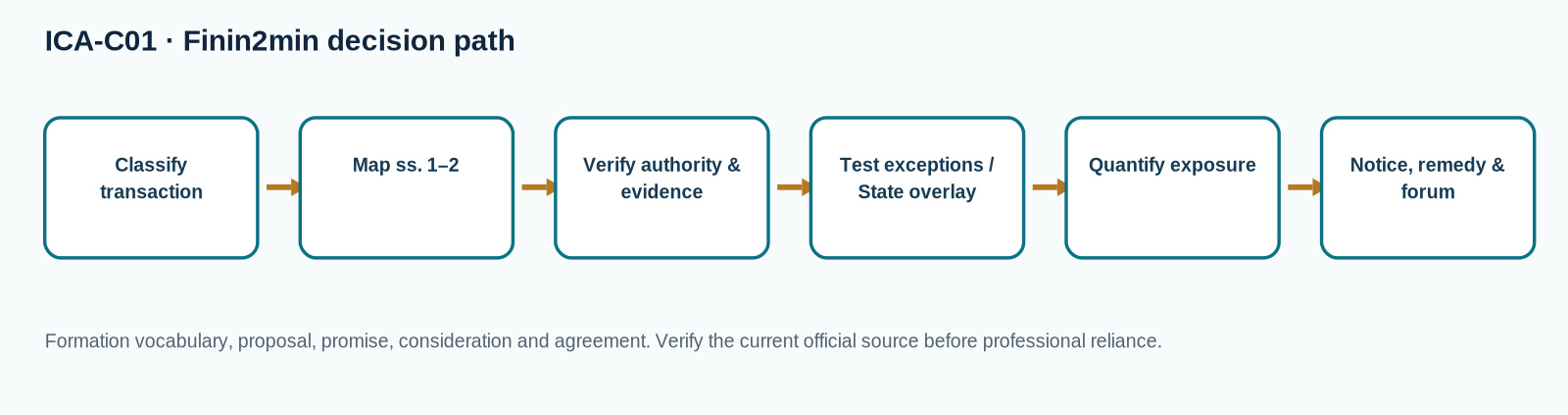
Section 2 is a commercial rights and obligations provision dealing with interpretation-clause. Identify the actor, trigger, cumulative or alternative conditions, provisos, exceptions and legal consequence before reaching a conclusion.
Implementation control: Translate the provision into an owner, trigger, approval, evidence, deadline, exception and remedy control, then test connected law and State variation.
Section-level practical application
Transaction test
Apply this provision to the event-date facts and record every satisfied, disputed or inapplicable limb.
Consequence and remedy
Identify how it changes validity, title, authority, liability, payment, rejection, recovery, registration, evidence or relief.