Investment Taxation
Mutual Fund Tax in 2026: Equity, Debt and Hybrid Funds Under the New Act
By Finin2min Editorial Desk · Reviewed by CA Divyanshu Sengar · Published 19 September 2026 · about 6 minute read
📄 Download the PDF edition (free sign-in)
Finin2min 2-minute summary
The word “hybrid”, “debt”, “balanced” or “ETF” does not by itself determine capital-gains treatment. From tax year 2026–27 the Income-tax Act, 2025 is the current starting point, with section 76 governing specified mutual-fund units and market-linked debentures in defined cases. Reconcile actual asset classification, acquisition date and holding period before choosing a rate.
Start with the legal classification, not the fund’s marketing name
An equity-oriented mutual fund meeting the statutory exposure and securities transaction tax conditions can have a different capital-gains result from a predominantly debt and money-market scheme. A balanced advantage fund’s commercial promise to balance risk is not an automatic tax classification. Compare its relevant statutory qualifying portfolio, scheme documents and prescribed measurement basis to the definition under tax law. Older lots and new purchases need not follow identical transitional provisions.
For debt-heavy specified mutual funds acquired after the legislated date, section 76 of the Income-tax Act, 2025 can deem gains short-term regardless of the holding period. That is why a five-year redemption does not invariably qualify for the 12.5% general long-term rate merely because five calendar years elapsed.
Understand the new section number for 2026 transactions
The 2025 Act restructures the familiar legacy Income-tax Act, 1961 references. Section 76 in the new Act addresses specified mutual-fund units and other named assets, including market-linked debentures. The specified-fund definition has portfolio composition tests, including a more-than-65% debt and money-market category and qualifying holdings through such funds. Obtain a scheme factsheet for the applicable measurement period and calculate the statutory composition using the required approach.
Citing section 50AA of the 1961 Act without checking the current law can produce the wrong return annotation and sometimes the wrong classification. Historical references may still be useful for explaining old purchases; they should be labelled as historical rather than quoted as the operative section for new tax years.
Equity funds: aggregate the annual exemption correctly
For eligible equity-oriented units and transfers satisfying the statutory conditions, the post-July-2024 special long-term capital-gains rate has been 12.5% above the aggregate annual ₹1.25 lakh threshold; specified short-term transfers attract the applicable 20% special rate. These are income-tax rates before surcharge and cess, and the annual threshold is not a fresh deduction for each mutual-fund folio or brokerage account.
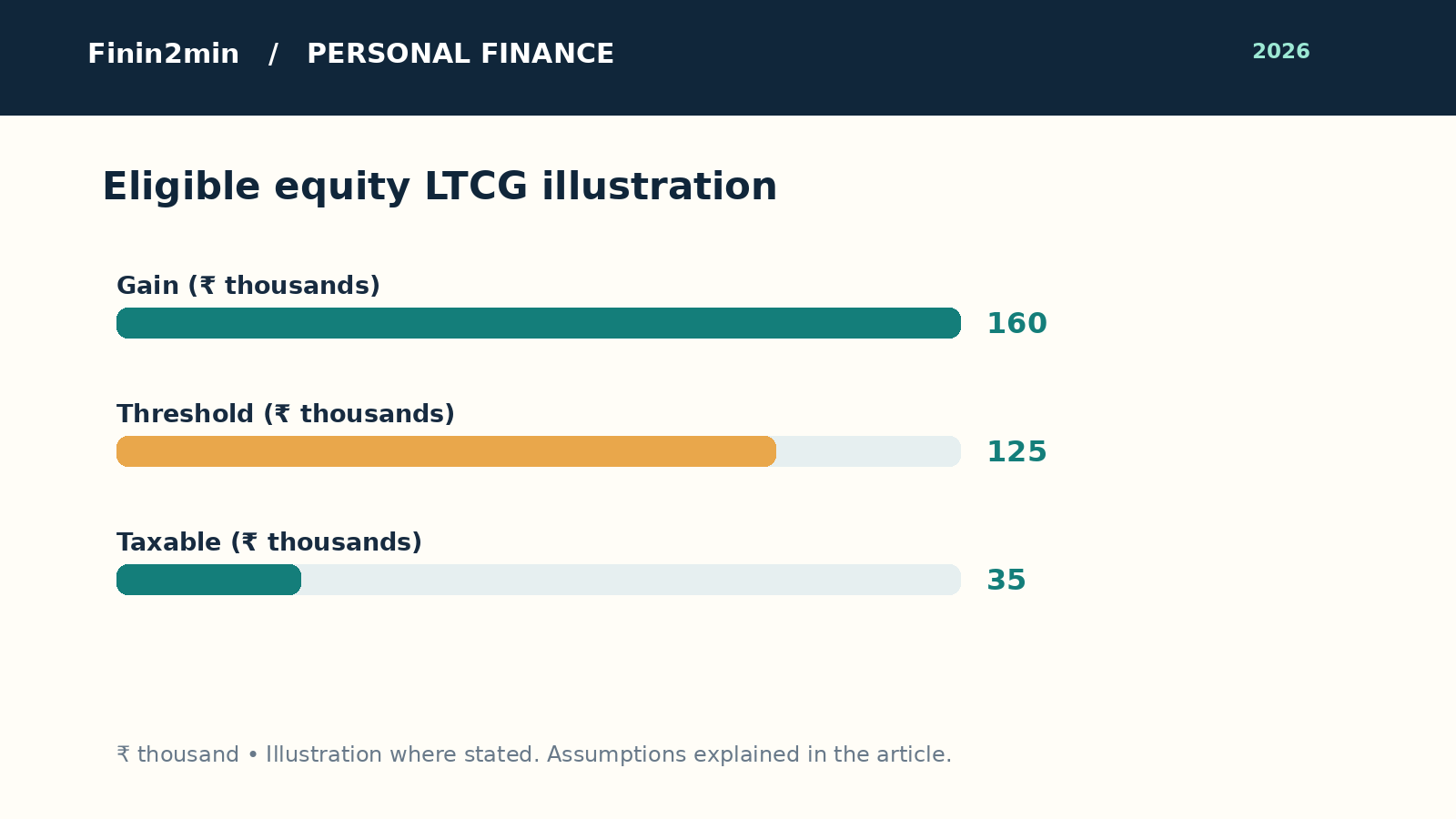
Suppose an investor realises eligible long-term gains of ₹1.60 lakh from one equity fund and no other gains using the same threshold. The excess over ₹1.25 lakh is ₹35,000. At 12.5%, illustrative basic LTCG tax is ₹4,375 before applicable cess and other adjustments. A second fund’s eligible gains would share that same annual threshold rather than create a second allowance.
Debt-heavy funds require acquisition-date reconciliation
Debt and cash-like investments often look stable because their daily price movement is smaller than equities. But tax can significantly alter their attractiveness when gains are taxed at slab rates, particularly for a high-income investor. Use the legal classification of the exact units, acquisition date and transfer date. Units within the specified-fund provision may be deemed short-term even when the economic investment horizon is long.
For a household parking funds for near-term obligations, safety, liquidity, credit quality and settlement time may matter more than a small estimated after-tax yield difference. An emergency fund should never be invested on an assumed tax rule if the actual scheme portfolio has not been checked.
Real-life tax lots are rarely one purchase and one sale
Systematic investment plans create multiple lots, each with its own acquisition date and cost. Switches between schemes can themselves be disposals for tax, even though funds move within the same AMC. Distributions, redemptions and systematic withdrawals are not equivalent transactions. Reconcile the consolidated account statement, capital-gain statement, bank credit and AIS information without assuming all data sources are perfectly synchronised.
For an inherited or reorganised portfolio, acquisition cost and holding period can require special statutory treatment; do not overwrite all entries with the date on which a new account holder first saw the units. An inaccurate imported cost can look like a profitable redemption and inflate reported tax.
Fund-category tax stress test before redeeming
A taxable transaction requires more information than the name displayed by an investment app. Start with the fund's legal classification for the relevant period, equity exposure where required, acquisition date, sale date, scheme documents, gains or losses and any grandfathering or transitional provision. An equity-oriented hybrid fund, a fund of funds and a specified mutual fund can have meaningfully different treatment even where a platform places them on the same product shelf. Special rules for specified mutual funds need to be read alongside the Income-tax Act, 2025 definitions and timing provisions, not approximated from a fund's advertising label.
Illustrate two redemptions with identical profit but different holding-period and classification facts. An equity-oriented unit meeting long-term conditions may have a different rate and threshold treatment from an ineligible or specified fund. Investment apps often show “profit” without an income-tax-ready classification of capital gains or the effect of capital loss set-off. Collect the capital gains statement, transaction ledger, units purchased under any SIP instalment, and corporate action disclosures. Each SIP instalment generally has its own acquisition date for holding-period analysis.
Where a family wants to rebalance between debt and equity, compare after-tax realisable proceeds and portfolio risk rather than assuming one type of fund should always be sold first. Also evaluate exit load, STT where applicable, surcharge, cess and other income that may exhaust thresholds. Tax treatment can change around a new Act's commencement, so the exact tax-year transition and original statutory text matter.
Portfolio choice after tax and exit load
A useful investment comparison evaluates expected gross return, scheme expenses, exit load, tax class, holding period, liquidity and portfolio risk on the same cash-flow timeline. An arbitrage fund may have a different qualifying equity orientation from an ultra-short debt scheme, but both carry non-identical risks. A tax-efficient wrapper does not turn market or counterparty exposure into a fixed deposit guarantee.
Keep tax records for each sale or switch and use official legislative text for filing. If funds change asset mix during a year, do not confidently assert the tax result from one marketing snapshot. When in doubt obtain the relevant statutory asset-mix evidence or seek a specific tax opinion.
Worked India-specific illustration
Example: qualifying equity-oriented LTCG of ₹1.60 lakh with no other eligible gains sharing the same annual threshold produces excess ₹35,000 over ₹1.25 lakh; basic tax at 12.5% would be ₹4,375 before cess/surcharge. A specified debt-fund gain does not automatically receive this treatment.
Practical action checklist
- Classify the exact scheme using legally required portfolio figures.
- Split SIP redemptions by tax lot and acquisition date.
- Apply the Income-tax Act, 2025 for the relevant 2026-27 tax year.
- Check if section 76 deems the asset short-term.
- Aggregate special-rate equity LTCG across all eligible holdings.
- Preserve CAS, gain statement, factsheets and tax workings.
Questions readers ask
Does a hybrid fund automatically qualify for equity LTCG?
No. The statutory equity-oriented definition and conditions must be met.
Does holding a specified debt mutual fund for three years guarantee LTCG?
No. The special deemed short-term rule may apply.
Is the ₹1.25 lakh threshold available for every fund?
No. It is linked to the specified eligible long-term equity regime.
Should 1961 Act section numbers be used for tax year 2026–27?
Use the operative Income-tax Act, 2025 sections and label legacy references accurately.
Official sources
- Income Tax Department: Income-tax Act, 2025 section 76 specified mutual funds (2025-08-01)
- Income Tax Department: Official long-term capital-gains tax guidance (2026-01-01)
For general financial and legal education only, not individual investment, insurance, credit or legal advice. Examples assume stated rates and terms and are not guaranteed results. Confirm current regulations, provider documents and individual circumstances before acting.