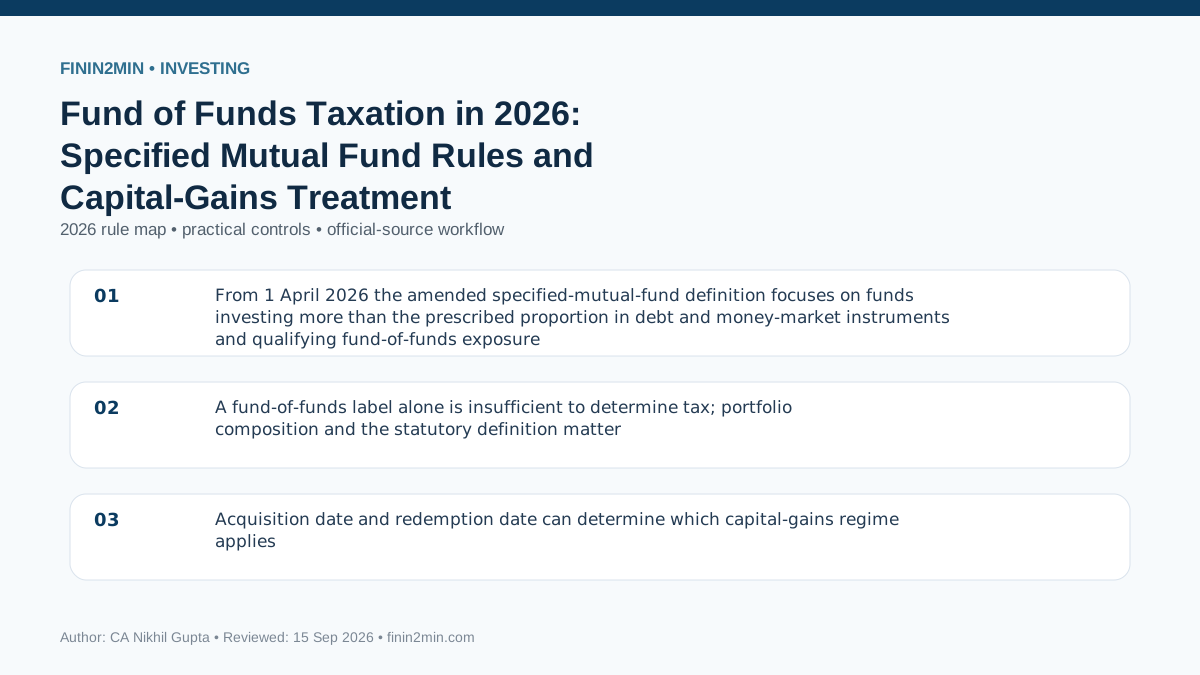
From 1 April 2026, section 50AA treats a fund as a specified mutual fund when it invests more than 65% in debt and money-market instruments, or when it invests at least 65% in units of such a debt-heavy fund. Other FoFs—such as gold or overseas/equity structures—must be classified under the remaining capital-gains provisions.
Current rule and what decides the result
From 1 April 2026 the specified-mutual-fund rule is narrower: it targets a mutual fund investing more than 65% of proceeds in debt and money-market instruments, and a fund investing at least 65% in units of such debt-heavy funds. A debt FoF meeting that definition can have its covered gains deemed short term. Gold, international and other FoFs are not automatically caught merely because they do not qualify as domestic-equity funds; their actual portfolio and the general unit holding-period rules must be tested. A switch is ordinarily a taxable redemption/transfer even if cash is immediately reinvested.
Key rules to apply
- A FoF investing 65% or more of its proceeds in units of a fund that itself invests more than 65% in debt/money-market instruments is within the post-1 April 2026 specified-fund definition.
- For covered units acquired on/after the statutory date, gains on transfer/redemption/maturity are deemed short-term; long holding alone does not create LTCG.
- Do not assume an FoF holding equity funds automatically qualifies as an equity-oriented fund for section 112A; test the statutory definition and direct domestic-equity exposure conditions.
- A gold FoF that invests in a Gold ETF is not automatically a debt-heavy section 50AA fund after the 2026 narrowing; classify the actual scheme under general rules.
- International FoFs can have different equity-oriented eligibility because the Indian definition focuses on domestic equity; verify before applying section 112A.
- A switch between schemes is generally a taxable transfer/redemption even when money never reaches the bank account.
Debt FoF inside specified-fund rule
Neha invests ₹8 lakh on 15 April 2026 in a FoF whose mandate keeps at least 65% in units of a debt fund that itself invests more than 65% in debt and money-market instruments. She redeems after 30 months for ₹9.40 lakh. The ₹1.40 lakh gain is still tested under the specified-mutual-fund deeming rule; the 30-month holding does not by itself convert it into long-term capital gain.
Gold FoF outside automatic debt test
Arjun buys ₹5 lakh of a gold FoF in May 2026 and redeems for ₹6.10 lakh after 27 months. The fund primarily holds units of a Gold ETF, not a debt fund meeting the specified-mutual-fund test. He should therefore classify the units under the general capital-asset rules that apply to that FoF rather than blindly applying the debt-fund deeming rule. The resulting ₹1.10 lakh gain then takes the rate and holding-period treatment applicable to that classification.
How to apply it step by step
- Identify what the FoF actually holds; do not stop at “fund of funds”.
- Test the >65% debt/money-market condition at the underlying fund level.
- If the FoF invests in another fund, test the separate 65% units-of-debt-fund limb.
- For non-specified FoFs, determine whether the unit is listed and apply the applicable general holding-period rule.
- Do not assume an equity FoF is an equity-oriented fund unless the statutory domestic-equity definition is satisfied.
- Treat scheme switches as disposals and compute gain on the redeemed scheme.
- Track SIP lots separately for purchase date and cost.
- Keep scheme factsheets/SID and redemption statements as evidence of classification.
Common mistakes and edge cases
- Treating every FoF as a debt fund.
- Treating every international/equity FoF as an equity-oriented fund.
- Assuming a long holding overrides the specified-mutual-fund deeming rule.
- Ignoring the tax event on a scheme switch.
- Using an old pre-2026 section 50AA explanation without checking the narrowed definition.
FAQs
Are all FoFs specified mutual funds after 1 April 2026?
No. The rule focuses on debt/money-market exposure and qualifying FoFs of such debt-heavy funds.
Can a gold FoF get general long-term treatment?
Potentially, depending on its actual classification and the general rules; it is not automatically a specified debt fund.
Does an equity FoF automatically qualify for section 112A?
No. The statutory equity-oriented-fund definition must be satisfied.
Is a switch between two funds taxable?
Generally yes because one scheme is redeemed and another is acquired.
Does holding a specified debt FoF for three years create LTCG?
What evidence supports classification?
Retain SID/factsheets, portfolio data and statements relevant to the investment and redemption period.
Related Finin2min guides
- Switching Between Mutual Funds? Why It Is a Taxable Event, Even Without Withdrawing Cash
- Mutual Fund Capital Gains Tax Planning 2026
- NRI Capital Gains on Indian Shares and Mutual Funds
- NRI Capital Gains on Investments
- Capital Gains on Shares and Mutual Funds: Rates, Records and Checklist
- NRI Capital Gains on Investments
- Shares and Funds: Capital Gains Checklist
- Specified Mutual Funds under Section 76: 65% Debt Test, Short-Term Capital Gains and Investor Checklist