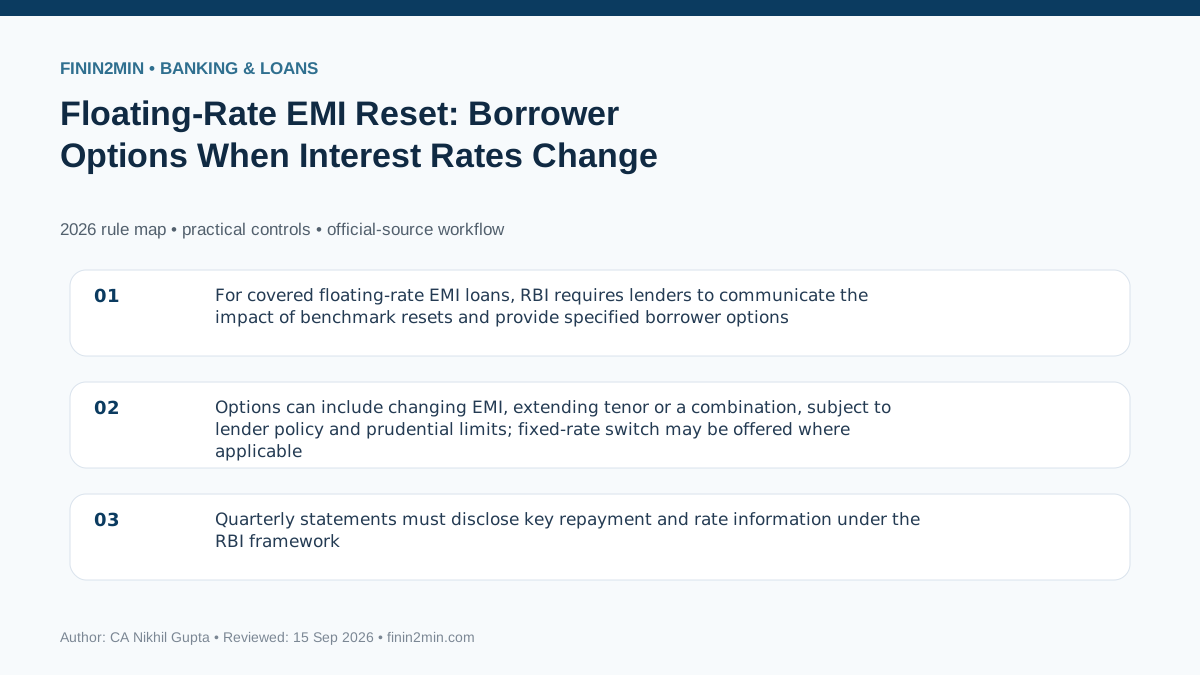
A floating-rate reset should not silently push a borrower into endless tenor extension. RBI’s August 2023 framework for EMI-based personal loans requires regulated entities to communicate the impact of rate resets and offer specified borrower choices.
Current rule and what decides the result
RBI's reset framework for EMI-based floating-rate personal loans requires the regulated entity to communicate the impact of benchmark changes and offer choices at reset. The borrower should be able to choose higher EMI, longer tenor or a combination; lenders must also provide a fixed-rate switch option where their Board-approved policy offers it, and allow part/full prepayment subject to applicable charges. The lender should not silently create negative amortisation where the EMI fails to cover interest. The correct response to a reset is to compare total remaining interest, not just the next EMI.
Key rules to apply
- The January 2025 FAQ confirms the framework applies to existing borrowers and to housing loans that fall within the defined personal-loan category.
- At a rate reset, the borrower must be given options to increase EMI, extend the number of EMIs, use a combination, switch to fixed rate under policy and prepay partly or fully.
- RBI’s FAQ states the framework applies to existing as well as new covered borrowers.
- Lenders must communicate the impact of rate reset on EMI/tenor and provide periodic statements containing specified loan information.
- If the lender does not currently offer fixed-rate product in the covered category, RBI’s FAQ says it must introduce the option for compliance with the framework.
- The reset design should not produce a structure where the instalment fails to cover required interest and principal does not reduce as envisaged.
8% to 9% reset on ₹50 lakh
A borrower has ₹50 lakh outstanding with 15 years left. At 8%, the EMI is about ₹47,783. At 9%, keeping the 15-year term would require about ₹50,713—roughly ₹2,931 more each month. If the EMI stays near ₹47,783 instead, the tenure stretches to roughly 206 months, about 26 extra months. The bank should show the borrower these consequences so the borrower can choose the preferred mix.
Part-prepayment instead of tenure extension
Suppose a ₹30 lakh balance has 10 years left after a rate increase. Rather than accept a long tenure extension, the borrower prepays ₹3 lakh and asks the lender to recalculate the schedule. The ₹3 lakh immediately reduces principal on which future floating interest is computed; the exact EMI/tenure benefit depends on the revised rate. The borrower should compare the prepayment’s opportunity cost with interest saved before choosing the amount.
How to apply it step by step
- Read the reset communication and identify benchmark, spread, old rate and new rate.
- Ask for the revised amortisation schedule under the bank’s default option.
- Request alternatives: higher EMI, longer tenor and a combination.
- Ask whether a fixed-rate switch is offered under the lender’s policy and what conversion charge applies.
- Model part-prepayment using the outstanding principal and remaining tenure.
- Check that the proposed EMI covers interest and does not create negative amortisation.
- Record the chosen option in writing and confirm the next EMI/tenor in the account statement.
- Reassess whenever the benchmark resets materially rather than letting tenure drift unnoticed.
Common mistakes and edge cases
- Looking only at the rate percentage and not the revised amortisation schedule.
- Allowing tenure to extend repeatedly without measuring lifetime interest.
- Assuming a fixed-rate switch is free.
- Making a prepayment without asking whether EMI or tenure will be reduced.
- Ignoring negative-amortisation risk if EMI is too low.
FAQs
What choices should a borrower get at reset?
Covered borrowers should be informed of EMI/tenor impact and offered specified choices around EMI, tenor, fixed switch where policy permits, and prepayment.
Can the bank only extend tenure?
The framework is intended to give the borrower choices rather than silently using only one adjustment.
Is a fixed-rate option mandatory for every lender?
A switch is to be offered where the regulated entity provides it under its Board-approved policy; charges should be disclosed.
Can I part-prepay a floating loan?
Yes subject to the applicable product/regulatory rules; check charges and how the schedule will be recast.
What is negative amortisation?
It occurs when the payment is insufficient to cover interest, causing unpaid interest/principal mechanics to worsen rather than reduce the debt.
Which comparison matters most?
Compare remaining lifetime interest, cash-flow affordability and fees under each reset option.
Related Finin2min guides
- Floating-Rate Home Loan Reset
- Floating Rate Reset: EMI Increase vs Tenure Extension
- Floating Rate Reset: EMI Increase vs Tenure Extension
- Floating Rate Loan Reset: Why EMI Changes Without Warning
- Floating Rate Loan Reset: Why EMI Changes Without Warning
- Bank Loan Interest Rate Not Reduced After Benchmark Reset: Borrower Recalculation and Complaint File
- PPF Interest Rate 2026: How to Verify 7.1% and Calculate Interest
- EPF Interest Rate FY 2025-26: What the 8.25% Recommendation Means