Chapter II-A - Transfer, Capacity and Operation
Reviewed by CA Nikhil Gupta and Kajri Singh · Last reviewed 30 August 2026
Classify the property, transferor capacity, form and effect before testing conditions or third-party rights.
Dedicated Finin2min Summary - Chapter in 2 Minutes
- Section 5: Transfer of property defined - convert every condition, exception and consequence into evidence-backed controls.
- Section 6: What may be transferred - convert every condition, exception and consequence into evidence-backed controls.
- Section 7: Persons competent to transfer - convert every condition, exception and consequence into evidence-backed controls.
- Classify the property, transferor capacity, form and effect before testing conditions or third-party rights.
- Apply current State stamp, registration, land, tenancy, RERA and procedural law before execution or litigation.
Current statutory text / controlled source map
Section-by-section provision map
| Provision | Subject | Status | Finin2min clause-by-clause decode | Implementation | Evidence/control |
|---|---|---|---|---|---|
| Section 5 | Transfer of property defined | Operative subject to current official/State law | Section 5 governs transfer of property defined. Identify actor, property/right, transfer event, statutory conditions, exceptions, notice and legal consequence within the validity, capacity, transfer form and operation framework. | Record title and authority, transaction dates, consideration, possession, instrument form, stamp/registration status, notice, approvals and third-party claims. Obtain State-specific review before execution or enforcement. | Official source snapshot; title chain; encumbrance/litigation search; authority; executed instrument; valuation; payment and tax proof; possession/delivery record; notices; registration receipt. |
| Section 6 | What may be transferred | Operative subject to current official/State law | Section 6 governs what may be transferred. Identify actor, property/right, transfer event, statutory conditions, exceptions, notice and legal consequence within the validity, capacity, transfer form and operation framework. | Record title and authority, transaction dates, consideration, possession, instrument form, stamp/registration status, notice, approvals and third-party claims. Obtain State-specific review before execution or enforcement. | Official source snapshot; title chain; encumbrance/litigation search; authority; executed instrument; valuation; payment and tax proof; possession/delivery record; notices; registration receipt. |
| Section 7 | Persons competent to transfer | Operative subject to current official/State law | Section 7 governs persons competent to transfer. Identify actor, property/right, transfer event, statutory conditions, exceptions, notice and legal consequence within the validity, capacity, transfer form and operation framework. | Record title and authority, transaction dates, consideration, possession, instrument form, stamp/registration status, notice, approvals and third-party claims. Obtain State-specific review before execution or enforcement. | Official source snapshot; title chain; encumbrance/litigation search; authority; executed instrument; valuation; payment and tax proof; possession/delivery record; notices; registration receipt. |
| Section 8 | Operation of transfer | Operative subject to current official/State law | Section 8 governs operation of transfer. Identify actor, property/right, transfer event, statutory conditions, exceptions, notice and legal consequence within the validity, capacity, transfer form and operation framework. | Record title and authority, transaction dates, consideration, possession, instrument form, stamp/registration status, notice, approvals and third-party claims. Obtain State-specific review before execution or enforcement. | Official source snapshot; title chain; encumbrance/litigation search; authority; executed instrument; valuation; payment and tax proof; possession/delivery record; notices; registration receipt. |
| Section 9 | Oral transfer | Operative subject to current official/State law | Section 9 governs oral transfer. Identify actor, property/right, transfer event, statutory conditions, exceptions, notice and legal consequence within the validity, capacity, transfer form and operation framework. | Record title and authority, transaction dates, consideration, possession, instrument form, stamp/registration status, notice, approvals and third-party claims. Obtain State-specific review before execution or enforcement. | Official source snapshot; title chain; encumbrance/litigation search; authority; executed instrument; valuation; payment and tax proof; possession/delivery record; notices; registration receipt. |
| Section 10 | Condition restraining alienation | Operative subject to current official/State law | Section 10 governs condition restraining alienation. Identify actor, property/right, transfer event, statutory conditions, exceptions, notice and legal consequence within the validity, capacity, transfer form and operation framework. | Record title and authority, transaction dates, consideration, possession, instrument form, stamp/registration status, notice, approvals and third-party claims. Obtain State-specific review before execution or enforcement. | Official source snapshot; title chain; encumbrance/litigation search; authority; executed instrument; valuation; payment and tax proof; possession/delivery record; notices; registration receipt. |
| Section 11 | Restriction repugnant to interest created | Operative subject to current official/State law | Section 11 governs restriction repugnant to interest created. Identify actor, property/right, transfer event, statutory conditions, exceptions, notice and legal consequence within the validity, capacity, transfer form and operation framework. | Record title and authority, transaction dates, consideration, possession, instrument form, stamp/registration status, notice, approvals and third-party claims. Obtain State-specific review before execution or enforcement. | Official source snapshot; title chain; encumbrance/litigation search; authority; executed instrument; valuation; payment and tax proof; possession/delivery record; notices; registration receipt. |
| Section 12 | Interest determinable on insolvency or attempted alienation | Operative subject to current official/State law | Section 12 governs interest determinable on insolvency or attempted alienation. Identify actor, property/right, transfer event, statutory conditions, exceptions, notice and legal consequence within the validity, capacity, transfer form and operation framework. | Record title and authority, transaction dates, consideration, possession, instrument form, stamp/registration status, notice, approvals and third-party claims. Obtain State-specific review before execution or enforcement. | Official source snapshot; title chain; encumbrance/litigation search; authority; executed instrument; valuation; payment and tax proof; possession/delivery record; notices; registration receipt. |
Finin2min implementation explanation
Classification
Identify the property, interest, parties, consideration, possession and intended legal result. Separate agreement, conveyance, security, licence, lease and statutory transfer.
Title and authority
Verify chain of title, encumbrances, litigation, acquisition/land restrictions, co-owner rights, entity authority and power-of-attorney scope.
Form and perfection
Select instrument, attestation, stamp duty, registration, filing, notice, possession and security-perfection steps under current Central and State law.
Closing and change control
Block payment/possession until conditions are met. Preserve closing set, registration receipt and superseded drafts. Recheck law and searches on closing date.
Practical examples and calculations
A property transaction is approved commercially before legal classification is complete. The professional file must identify the statutory transaction, authority, title, form, consideration, possession, registration, third-party rights and remedies before execution.
| Calculation/control | Method | Evidence |
|---|---|---|
| Consideration/value | Reconcile stated price, market value, taxes, retention, debt and non-cash consideration. | Agreement, valuation and ledger |
| Stamp and fees | Apply State instrument classification, market value, duty, surcharge and registration fee. | Current State schedule and adjudication |
| Exposure | Quantify encumbrances, arrears, interest, possession loss, cure cost and remedy value. | Searches, statements and legal model |
Practical transaction application
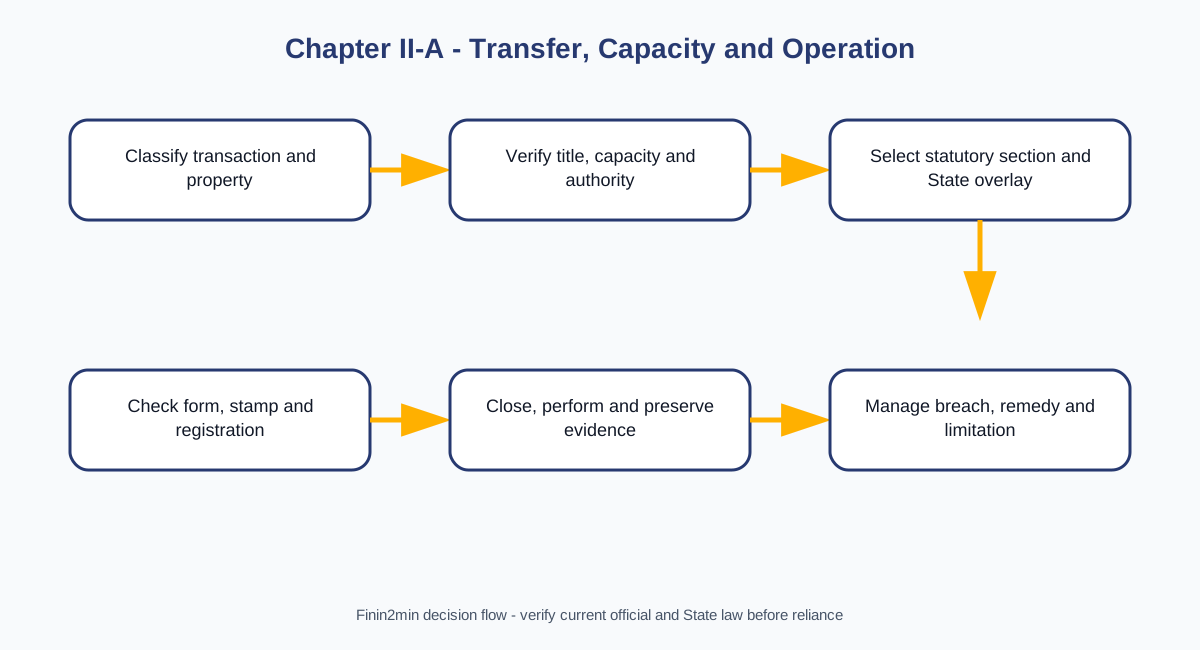
- Classify the transaction and every interest being created, transferred, reserved, charged or extinguished.
- Complete title, authority, encumbrance, litigation, land-use and possession diligence.
- Map each statutory provision to the instrument and identify State stamp, registration, RERA, tenancy and local-law overlays.
- Reconcile consideration, taxes, debt, possession, completion deliverables, representations, indemnities and notices.
- Approve closing, post-registration filings, evidence retention and enforcement/limitation strategy.
Authority, consent and execution controls
- Correct legal identity, title and capacity of transferor and transferee.
- Board, partner, trustee, guardian, co-owner, lender and regulatory consents.
- Power-of-attorney validity, scope, stamp and registration.
- Execution, witnessing, attestation, e-sign and document-custody protocol.
- Conflict, related-party and fiduciary approvals.
Stamp duty and registration alerts
- Instrument classification and market value are State-specific; obtain current rate and adjudication where ambiguity exists.
- Sections 54, 59, 107 and 123 must be read with the Registration Act and State amendments.
- Section 53A protection requires compliance with the post-2001 registration framework.
- Registration does not by itself cure defective title, authority, prohibited transfer or insufficient stamping.
Evidence and document-retention checklist
- Mother deed/title chain, revenue/municipal records and survey/property description.
- Encumbrance, ROC/CERSAI, litigation, acquisition, RERA and insolvency searches.
- Authority, consents, valuation, tax and KYC/beneficial-ownership records.
- Executed and stamped instrument, witness/attestation evidence and registration receipt.
- Consideration, TDS/GST, possession, originals handover and closing checklist.
- Notices, acknowledgments, defaults, cure, settlement and limitation chronology.
Performance, delivery and payment controls
- Define conditions precedent and long-stop date.
- Use escrow/retention for title releases and post-closing deliverables.
- Record possession condition and risk transfer separately from title.
- Reconcile taxes, charges, utilities, rent, deposits and apportionments.
- Do not release originals or consideration without authorised closing evidence.
Breach, loss, mitigation and remedy framework
- Separate invalidity, rescission, specific performance, injunction, possession, redemption, foreclosure/sale, damages, restitution and indemnity.
- Prove causation, remoteness, mitigation, market value and avoided cost.
- Identify third-party and bona-fide-purchaser protections.
- Protect title and possession through timely notices, registration, caveats and interim relief.
Limitation and forum controls
- Identify relief-specific limitation under the Limitation Act and special statutes.
- Confirm civil court, Commercial Court, RERA, DRT/DRAT, NCLT, consumer, revenue or arbitral forum.
- Compute notice, cure, redemption, termination, appeal and enforcement clocks independently.
- Check jurisdiction, valuation, court fee, territorial situs and exclusive-forum clauses.
Arbitration and mediation interface
Property disputes may be arbitrable where they concern subordinate contractual rights, but rights in rem, statutory forums, registration/title rectification and third-party interests require separate analysis. Preserve interim-relief, lis pendens, possession and limitation strategy even during mediation.
Company, partnership, GST and tax overlays
- Companies Act, LLP and partnership authority, charges and related-party controls.
- RERA registration, promoter/allottee rights and project disclosures.
- GST classification, works/development rights, lease and assignment treatment.
- Income-tax TDS, capital gains, section 50C/43CA/56 valuation and depreciation.
- FEMA, benami, PMLA/KYC, insolvency moratorium and secured-creditor priority.
Finin2min Q&A
What is the first professional step?
Classify the transaction and property interest before applying Chapter II-A - Transfer, Capacity and Operation.
What is the most common failure?
Executing or paying before title, authority, State stamp/registration and third-party rights are independently verified.
Does a contract always transfer ownership?
No. The Act distinguishes contracts, completed transfers, security interests and possession-based protections; the required instrument and registration must be tested.
What should the matter file contain?
Official source, title chain, searches, authority, valuation, instrument, payment, possession, notices, tax records, registration proof and remedy/limitation analysis.
Chapter-specific decision flowchart