Part I - Preliminary
Reviewed by CA Nikhil Gupta and Kajri Singh · Last reviewed 30 August 2026
Establish extent, commencement, defined terms and the State-specific operating environment before classifying any document.
Dedicated Finin2min Summary - Chapter in 2 Minutes
- Section 1: Short title, extent and commencement - translate the statutory rule into a document, evidence, deadline and State-source control.
- Section 2: Definitions - translate the statutory rule into a document, evidence, deadline and State-source control.
- Establish extent, commencement, defined terms and the State-specific operating environment before classifying any document.
- Registration is a State-operated statutory process: verify current amendments, Rules, fee table, office jurisdiction and portal instructions.
Current statutory text / controlled source map
Section-by-section provision map
| Provision | Subject | Status | Finin2min clause-by-clause decode | Implementation | Evidence/control |
|---|---|---|---|---|---|
| Section 1 | Short title, extent and commencement | Operative subject to current Central and State law | Section 1 governs short title, extent and commencement. Identify actor, trigger, document, property, time, office, authority, evidence, State rule and legal consequence before acting. | Create a transaction-date checklist linking the Central section, current State amendment/rule, office notification, portal workflow, form, fee, stamp, identity evidence and remedy clock. Preserve the exact source version used. | Official Act and State source; executed instrument; title/property description; stamp/fee proof; identity/authority; appointment/presentation receipt; endorsements/certificate; certified copies; notices and remedy chronology. |
| Section 2 | Definitions | Operative subject to current Central and State law | Section 2 governs definitions. Identify actor, trigger, document, property, time, office, authority, evidence, State rule and legal consequence before acting. | Create a transaction-date checklist linking the Central section, current State amendment/rule, office notification, portal workflow, form, fee, stamp, identity evidence and remedy clock. Preserve the exact source version used. | Official Act and State source; executed instrument; title/property description; stamp/fee proof; identity/authority; appointment/presentation receipt; endorsements/certificate; certified copies; notices and remedy chronology. |
Finin2min Q&A
What is the first step?
Classify the document and operative rights before applying Part I - Preliminary.
Is registration alone proof of valid title?
No. Registration creates a public statutory record and legal consequences, but does not cure defective title, capacity, authority, illegality, fraud or insufficient stamp.
Why is the State overlay essential?
Section 69 Rules, State amendments, fee tables, office jurisdiction, online workflow, valuation and refusal controls differ materially.
What evidence should be retained?
The exact source pack, final executed instrument, stamp and fee proof, identity and authority, portal/office receipts, endorsements, certificate, registered copy, search record and remedy chronology.
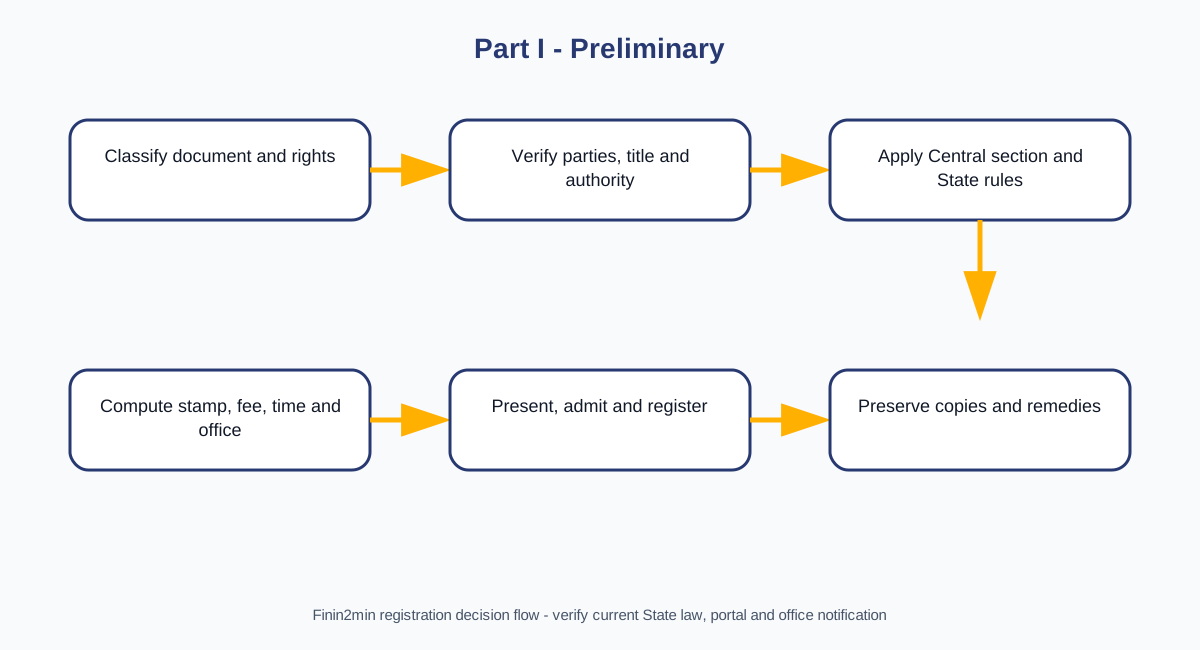
Chapter-specific decision flowchart