Second Schedule - Enactments preserved from overriding effect
Lists enactments whose special mediation/conciliation mechanisms are preserved from section 55 override, including labour, family, legal services, senior citizens, POSH and specified tribunal laws.
Dedicated Finin2min Summary - Chapter in 2 Minutes
- Lists enactments whose special mediation/conciliation mechanisms are preserved from section 55 override, including labour, family, legal services, senior citizens, POSH and specified tribunal laws.
- Section 55 is not commenced under the reviewed commencement notification.
- Use the India Code Act and the Department of Legal Affairs Gazette files as controlling sources.
- Separate the Mediation Act from existing Commercial Courts, consumer, company, court-annexed and special-statute mediation rules.
- Document consent, authority, limitation, confidentiality, settlement drafting, tax, stamp and enforcement before closing the file.
Section-by-section provision map
| Provision / gate | Topic | Commencement / status | Finin2min decode | Implementation | Evidence / control |
|---|---|---|---|---|---|
| Schedule status | Enabling section | Section 55 is not commenced under the reviewed commencement notification. | Lists enactments whose special mediation/conciliation mechanisms are preserved from section 55 override, including labour, family, legal services, senior citizens, POSH and specified tribunal laws. | Reconcile exact Schedule text, target Act and commencement before use. | Official Act PDF, commencement notification and target-statute consolidation. |
| Transaction control | Cross-law amendment | Do not assume effective | Lists enactments whose special mediation/conciliation mechanisms are preserved from section 55 override, including labour, family, legal services, senior citizens, POSH and specified tribunal laws. | Update contracts/forms only after legal effective-date memo. | Change-control approval and versioned templates. |
| Litigation control | Forum and transition | Event-date law applies | Pending and transitional matters require separate analysis. | Case chronology, pleadings and applicable law snapshot. |
Finin2min clause-by-clause decode
Status: Section 55 is not commenced under the reviewed commencement notification.
Lists enactments whose special mediation/conciliation mechanisms are preserved from section 55 override, including labour, family, legal services, senior citizens, POSH and specified tribunal laws.
Implementation: Reconcile exact Schedule text, target Act and commencement before use.
Evidence: Official Act PDF, commencement notification and target-statute consolidation.
Status: Do not assume effective
Lists enactments whose special mediation/conciliation mechanisms are preserved from section 55 override, including labour, family, legal services, senior citizens, POSH and specified tribunal laws.
Implementation: Update contracts/forms only after legal effective-date memo.
Evidence: Change-control approval and versioned templates.
Status: Event-date law applies
Pending and transitional matters require separate analysis.
Implementation: Case chronology, pleadings and applicable law snapshot.
Evidence:
Finin2min implementation explanation
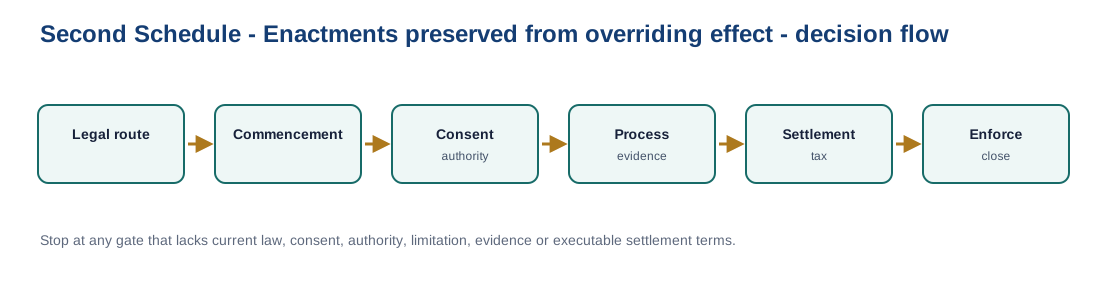
Create a matter control sheet that identifies the operative legal route, provision-level commencement, parties, subject matter, special law, mediator/provider, process rules, limitation, authority, evidence, settlement form and enforcement path. No team should rely on a page without the current source and event-date status.
Practical examples and calculations
- Lists enactments whose special mediation/conciliation mechanisms are preserved from section 55 override, including labour, family, legal services, senior citizens, POSH and specified tribunal laws.
- Create a dispute-specific chronology, authority matrix, settlement term sheet, tax/stamp note and source register before use.
Timeline model: where an operative route adopts the Act model, separately calculate invitation/service, first appearance, 120-day process period, agreed extension up to 60 days, optional registration clock of 180 days, and challenge clock of 90 days plus a possible further 90 days. Do not apply these figures to an uncommenced provision.
Settlement value model: principal + agreed interest + tax adjustments + costs + security value - payments/credits/set-off, with milestone and default sensitivity.
Practical transaction application
Classify the dispute and contract, issue a source-controlled invitation, secure settlement authority before substantive bargaining, reconcile commercial and legal terms, and close only after signatures, tax/stamp treatment, payment/security, filings and retention are complete.
Authority, consent and execution controls
Verify legal entity names, capacity, board/partner/POA authority, monetary and non-monetary settlement limits, government approval hierarchy, lender/insurer/third-party consents and authority to sign, register, pay, release and withdraw proceedings.
Stamp duty and registration alerts
Evidence and document-retention checklist
Maintain two controlled indexes: protected mediation material and independently existing evidence. Preserve contract, authority, notices, service, process agreement, mediator disclosures, attendance, cost, settlement signatures, tax/stamp review, registration, payment, withdrawal and enforcement records.
- Contract and mediation clause
- Special-law and commencement memo
- Invitation, notice and service proof
- Party identity and legal capacity
- Board/partner/POA authority
- Mediator appointment and disclosure
- Process agreement and rules version
- Protected-material index
- Independent-evidence index
- Attendance and cost ledger
- Settlement term sheet and approvals
- Signed/authenticated agreement
- Stamp and registration note
- GST/TDS/accounting working
- Payment/security/withdrawal proof
- Challenge/enforcement/retention file
Performance, delivery and payment controls
Translate each settlement promise into owner, amount, currency, tax, date, milestone, acceptance test, invoice/credit note, security, escrow, default interest, cure, set-off, release trigger and proof of completion.
Breach, loss, mitigation and remedy framework
Quantify principal, interest, admitted/disputed amounts, counterclaims, direct loss, avoided cost, mitigation, costs, tax and security. Select cure, variation, acceleration, termination, enforcement, fresh proceedings or insolvency strategy without double recovery.
Limitation and forum controls
Maintain a dated chronology for cause of action, invitation, statutory notice, first appearance, sessions, termination, settlement, challenge, acknowledgment and filing. Identify court/tribunal jurisdiction, commercial-court PIMS, special-statute forum and any exclusion or condonation rule.
Arbitration and mediation interface
Draft the interface between negotiation, mediation, expert determination, adjudication and arbitration. Preserve urgent interim relief and limitation. Avoid deadlock clauses with no transition, indefinite negotiation or contradictory seat/forum wording.
Company, partnership, GST and tax overlays
Check Companies Act/LLP/partnership authority, related-party and disclosure issues; GST price/credit-note and place-of-supply consequences; TDS, income recognition and deductibility; stamp/registration; FEMA for cross-border payments; IBC moratorium/claims; competition and sector approvals.
Chapter-specific decision flowchart
Finin2min Q&A
Is the entire Mediation Act operational because India Code shows an enforcement date of 9 October 2023?
No. The section 1 footnote identifies a limited list of commenced provisions. Apply a provision-level commencement matrix.
Can parties still mediate where a Mediation Act provision is uncommenced?
Often yes under contract, court-annexed rules, special statutes, institutional rules or general settlement law, but do not attribute uncommenced statutory consequences to the Act.
Is pre-institution mediation optional in every commercial dispute?
No. Commercial Courts Act section 12A and the PIMS Rules require separate current-law analysis, including the urgent interim-relief exception.
Does a signed settlement automatically have decree status under section 27?
Only when the relevant Mediation Act enforcement provisions are legally operative and conditions are met. Otherwise analyse contract, consent decree, arbitral consent award or special-statute routes.
Can the mediator decide who is right?
No. A mediator facilitates voluntary resolution and should not adjudicate or impose a settlement.
May mediation sessions be recorded?
The Act contemplates confidentiality and no audio/video recording, but confirm the operative legal and institutional rule set for the matter.
What authority is needed to settle for a company or LLP?
Use specific board, committee, partner, power-of-attorney or delegated authority covering amount, non-monetary terms, releases, security and tax consequences.
Does mediation stop limitation automatically?
Do not assume so. Calculate limitation under current operative law, special statutes, acknowledgements, exclusions and any standstill arrangement.
Is an online settlement valid with an electronic signature?
Potentially, subject to the IT Act, contract law, authority, platform integrity, electronic-signature method, stamp/registration and the operative mediation framework.
Are all rules and regulations under the Act now final?
The reviewed sources identify three final 2024 Council governance/accounts rules. The package separately flags regulations, schemes, guidelines and process rules that require current Gazette confirmation.