Mediation Clause Drafting and Multi-tier Dispute Resolution Master
Reviewed by CA Nikhil Gupta and Kajri Singh · Last reviewed 30 August 2026
Draft scope, trigger, notices, institution/provider, mediator selection, venue/online mode, confidentiality, time-box, authority, interim relief and arbitration/litigation fall-back.
Dedicated Finin2min Summary - Chapter in 2 Minutes
- Draft scope, trigger, notices, institution/provider, mediator selection, venue/online mode, confidentiality, time-box, authority, interim relief and arbitration/litigation fall-back.
- Provision-level commencement is the first legal gate: only 21 sections were commenced by S.O. 4384(E) on 9 October 2023 in the reviewed official record.
- Use the India Code Act and the Department of Legal Affairs Gazette files as controlling sources.
- Separate the Mediation Act from existing Commercial Courts, consumer, company, court-annexed and special-statute mediation rules.
- Document consent, authority, limitation, confidentiality, settlement drafting, tax, stamp and enforcement before closing the file.
Section-by-section provision map
| Provision / gate | Topic | Commencement / status | Finin2min decode | Implementation | Evidence / control |
|---|---|---|---|---|---|
| Gate 1 | Scope and disputes | Operational control | Convert scope and disputes into a matter-specific decision and evidence test. | Assign owner, due date, reviewer and escalation. | Scope and disputes checklist, approval and source record. |
| Gate 2 | Trigger and notices | Operational control | Convert trigger and notices into a matter-specific decision and evidence test. | Assign owner, due date, reviewer and escalation. | Trigger and notices checklist, approval and source record. |
| Gate 3 | Provider/mediator | Operational control | Convert provider/mediator into a matter-specific decision and evidence test. | Assign owner, due date, reviewer and escalation. | Provider/mediator checklist, approval and source record. |
| Gate 4 | Process and time-box | Operational control | Convert process and time-box into a matter-specific decision and evidence test. | Assign owner, due date, reviewer and escalation. | Process and time-box checklist, approval and source record. |
| Gate 5 | Settlement authority | Operational control | Convert settlement authority into a matter-specific decision and evidence test. | Assign owner, due date, reviewer and escalation. | Settlement authority checklist, approval and source record. |
| Gate 6 | Fallback and interim relief | Operational control | Convert fallback and interim relief into a matter-specific decision and evidence test. | Assign owner, due date, reviewer and escalation. | Fallback and interim relief checklist, approval and source record. |
Finin2min clause-by-clause decode
Status: Operational control
Convert scope and disputes into a matter-specific decision and evidence test.
Implementation: Assign owner, due date, reviewer and escalation.
Evidence: Scope and disputes checklist, approval and source record.
Status: Operational control
Convert trigger and notices into a matter-specific decision and evidence test.
Implementation: Assign owner, due date, reviewer and escalation.
Evidence: Trigger and notices checklist, approval and source record.
Status: Operational control
Convert provider/mediator into a matter-specific decision and evidence test.
Implementation: Assign owner, due date, reviewer and escalation.
Evidence: Provider/mediator checklist, approval and source record.
Status: Operational control
Convert process and time-box into a matter-specific decision and evidence test.
Implementation: Assign owner, due date, reviewer and escalation.
Evidence: Process and time-box checklist, approval and source record.
Status: Operational control
Convert settlement authority into a matter-specific decision and evidence test.
Implementation: Assign owner, due date, reviewer and escalation.
Evidence: Settlement authority checklist, approval and source record.
Status: Operational control
Convert fallback and interim relief into a matter-specific decision and evidence test.
Implementation: Assign owner, due date, reviewer and escalation.
Evidence: Fallback and interim relief checklist, approval and source record.
Practical examples and calculations
- Draft scope, trigger, notices, institution/provider, mediator selection, venue/online mode, confidentiality, time-box, authority, interim relief and arbitration/litigation fall-back.
- Create a dispute-specific chronology, authority matrix, settlement term sheet, tax/stamp note and source register before use.
Timeline model: where an operative route adopts the Act model, separately calculate invitation/service, first appearance, 120-day process period, agreed extension up to 60 days, optional registration clock of 180 days, and challenge clock of 90 days plus a possible further 90 days. Do not apply these figures to an uncommenced provision.
Settlement value model: principal + agreed interest + tax adjustments + costs + security value - payments/credits/set-off, with milestone and default sensitivity.
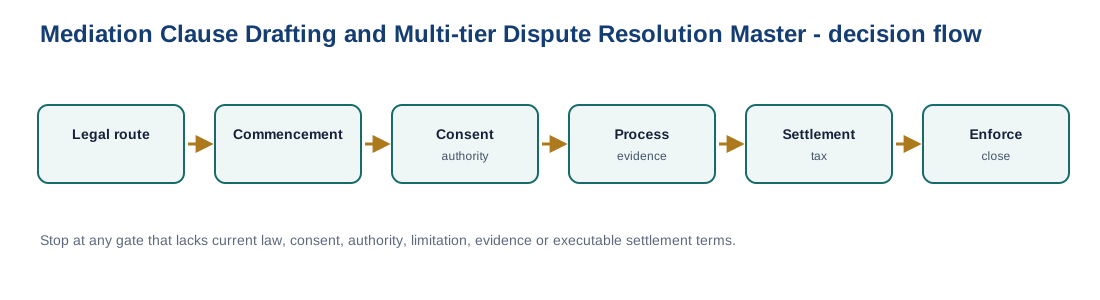
Chapter-specific decision flowchart