Chapter XIV — Miscellaneous, Enforcement and Adjudication
Reviewed by CA Nikhil Gupta and Kajri Singh · Last reviewed 30 August 2026
Integrate filing, additional fee, adjudication, court/Tribunal forum, strike-off, officer liability and rule-making controls.
Finin2min Summary — Chapter in 2 Minutes
- Integrate filing, additional fee, adjudication, court/Tribunal forum, strike-off, officer liability and rule-making controls.
- Separate civil penalty, criminal offence, additional fee, compounding, Tribunal and Special Court processes.
- Read every section with the amended Rules, current MCA form and the LLP agreement.
- Authority, source evidence, State stamp/registration and cross-law effects are separate closing gates.
- A portal acknowledgement is evidence of filing—not a substitute for legal accuracy or complete transaction documentation.
Section-by-section provision map
| Provision | Subject | Legal effect / rule | Implementation | Evidence |
|---|---|---|---|---|
| 66 | Partner transactions with LLP | This provision regulates a partner, partnership interest or contribution through partner transactions with llp. | Reconcile agreement, consent, authority, valuation, payment/vesting, capital account, tax and statutory filing. | Keep signed agreement/deed, consent, valuation, payment/title evidence, ledger and filing acknowledgement. |
| 67 | Application of Companies Act provisions | This section establishes the statutory rule concerning application of companies act provisions. | Apply the chapter gate: Separate civil penalty, criminal offence, additional fee, compounding, Tribunal and Special Court processes. | Retain the source instrument, approvals, signed documents, communications, financial trail and filing/order evidence relevant to the section. |
| 67A | Special Courts | This section establishes the statutory rule concerning special courts. | Apply the chapter gate: Separate civil penalty, criminal offence, additional fee, compounding, Tribunal and Special Court processes. | Retain the source instrument, approvals, signed documents, communications, financial trail and filing/order evidence relevant to the section. |
| 67B | Procedure and powers of Special Court | This section establishes the statutory rule concerning procedure and powers of special court. | Apply the chapter gate: Separate civil penalty, criminal offence, additional fee, compounding, Tribunal and Special Court processes. | Retain the source instrument, approvals, signed documents, communications, financial trail and filing/order evidence relevant to the section. |
| 67C | Appeal and revision | This section establishes the statutory rule concerning appeal and revision. | Apply the chapter gate: Separate civil penalty, criminal offence, additional fee, compounding, Tribunal and Special Court processes. | Retain the source instrument, approvals, signed documents, communications, financial trail and filing/order evidence relevant to the section. |
| 68 | Electronic filing | Statutory documents are filed electronically in the prescribed manner and authentication. | Maintain DSC custody, role-based access, prefill review, attachment naming, fee payment and acknowledgement controls. | Archive final filed form, attachments, hash/PDF, SRN, challan and master-data update. |
| 68A | Registration offices | This provision controls the LLP’s public identity or service address through registration offices. | Align legal name/address across MCA, agreement, invoices, contracts, banks, GST, tax, licences and digital channels. | Retain search/approval, occupancy/NOC, change approval, filing receipt and updated public documents. |
| 69 | Additional fee | Delayed filing can trigger additional fees; fee payment does not necessarily cure substantive default or penalty. | Run due-date register, escalation before deadline and separate assessment of adjudication/compounding exposure. | Keep calendar, reasons, approvals, fee calculation and corrective filing trail. |
| 70 | Enhanced punishment | This provision controls the consequence, prosecution or adjudication path for enhanced punishment. | Identify the responsible LLP/person, default period, continuing-default exposure, authority, forum, correction and appeal before calculating risk. | Preserve statutory notice, filing history, role/knowledge evidence, remediation, order, payment and appeal limitation. |
| 71 | Other laws not barred | This section establishes the statutory rule concerning other laws not barred. | Apply the chapter gate: Separate civil penalty, criminal offence, additional fee, compounding, Tribunal and Special Court processes. | Retain the source instrument, approvals, signed documents, communications, financial trail and filing/order evidence relevant to the section. |
| 72 | Tribunal and Appellate Tribunal jurisdiction | This section establishes the statutory rule concerning tribunal and appellate tribunal jurisdiction. | Apply the chapter gate: Separate civil penalty, criminal offence, additional fee, compounding, Tribunal and Special Court processes. | Retain the source instrument, approvals, signed documents, communications, financial trail and filing/order evidence relevant to the section. |
| 73 | Omitted | The provision is omitted in the current consolidation. | Do not rely on historic text without checking the amending Act and savings/transition consequences. | Keep an amendment-history note and redirect users to the current operative provision. |
| 74 | General penalties | This section establishes the statutory rule concerning general penalties. | Apply the chapter gate: Separate civil penalty, criminal offence, additional fee, compounding, Tribunal and Special Court processes. | Retain the source instrument, approvals, signed documents, communications, financial trail and filing/order evidence relevant to the section. |
| 75 | Strike-off of defunct LLP | Registrar may strike a defunct LLP off the register under prescribed process. | Clear assets, liabilities, bank/tax/GST/litigation, obtain partner consent, prepare accounts/indemnity and manage notices. | Retain closure file permanently, including creditor settlement and final order. |
| 76 | Offences by LLPs | This provision controls the consequence, prosecution or adjudication path for offences by llps. | Identify the responsible LLP/person, default period, continuing-default exposure, authority, forum, correction and appeal before calculating risk. | Preserve statutory notice, filing history, role/knowledge evidence, remediation, order, payment and appeal limitation. |
| 76A | Adjudication of penalties | In-house adjudication machinery applies to specified civil penalties, subject to appeal. | Track show-cause service, facts, statutory cap, mitigating documents, hearing and appeal limitation. | Preserve notice, response, proof of correction, order, payment and appeal file. |
| 77 | Jurisdiction of Courts | This section establishes the statutory rule concerning jurisdiction of courts. | Apply the chapter gate: Separate civil penalty, criminal offence, additional fee, compounding, Tribunal and Special Court processes. | Retain the source instrument, approvals, signed documents, communications, financial trail and filing/order evidence relevant to the section. |
| 77A | Cognizance of offences | This provision controls the consequence, prosecution or adjudication path for cognizance of offences. | Identify the responsible LLP/person, default period, continuing-default exposure, authority, forum, correction and appeal before calculating risk. | Preserve statutory notice, filing history, role/knowledge evidence, remediation, order, payment and appeal limitation. |
| 78 | Power to alter Schedules | This section establishes the statutory rule concerning power to alter schedules. | Apply the chapter gate: Separate civil penalty, criminal offence, additional fee, compounding, Tribunal and Special Court processes. | Retain the source instrument, approvals, signed documents, communications, financial trail and filing/order evidence relevant to the section. |
| 79 | Power to make rules | This section establishes the statutory rule concerning power to make rules. | Apply the chapter gate: Separate civil penalty, criminal offence, additional fee, compounding, Tribunal and Special Court processes. | Retain the source instrument, approvals, signed documents, communications, financial trail and filing/order evidence relevant to the section. |
| 80 | Power to remove difficulties | This section establishes the statutory rule concerning power to remove difficulties. | Apply the chapter gate: Separate civil penalty, criminal offence, additional fee, compounding, Tribunal and Special Court processes. | Retain the source instrument, approvals, signed documents, communications, financial trail and filing/order evidence relevant to the section. |
| 81 | Omitted | The provision is omitted in the current consolidation. | Do not rely on historic text without checking the amending Act and savings/transition consequences. | Keep an amendment-history note and redirect users to the current operative provision. |
Finin2min clause-by-clause decode
Section 66 — Partner transactions with LLP
Legal effect: This provision regulates a partner, partnership interest or contribution through partner transactions with llp.
Finin2min implementation: Reconcile agreement, consent, authority, valuation, payment/vesting, capital account, tax and statutory filing.
Evidence/control: Keep signed agreement/deed, consent, valuation, payment/title evidence, ledger and filing acknowledgement.
Section 67 — Application of Companies Act provisions
Legal effect: This section establishes the statutory rule concerning application of companies act provisions.
Finin2min implementation: Apply the chapter gate: Separate civil penalty, criminal offence, additional fee, compounding, Tribunal and Special Court processes.
Evidence/control: Retain the source instrument, approvals, signed documents, communications, financial trail and filing/order evidence relevant to the section.
Section 67A — Special Courts
Legal effect: This section establishes the statutory rule concerning special courts.
Finin2min implementation: Apply the chapter gate: Separate civil penalty, criminal offence, additional fee, compounding, Tribunal and Special Court processes.
Evidence/control: Retain the source instrument, approvals, signed documents, communications, financial trail and filing/order evidence relevant to the section.
Section 67B — Procedure and powers of Special Court
Legal effect: This section establishes the statutory rule concerning procedure and powers of special court.
Finin2min implementation: Apply the chapter gate: Separate civil penalty, criminal offence, additional fee, compounding, Tribunal and Special Court processes.
Evidence/control: Retain the source instrument, approvals, signed documents, communications, financial trail and filing/order evidence relevant to the section.
Section 67C — Appeal and revision
Legal effect: This section establishes the statutory rule concerning appeal and revision.
Finin2min implementation: Apply the chapter gate: Separate civil penalty, criminal offence, additional fee, compounding, Tribunal and Special Court processes.
Evidence/control: Retain the source instrument, approvals, signed documents, communications, financial trail and filing/order evidence relevant to the section.
Section 68 — Electronic filing
Legal effect: Statutory documents are filed electronically in the prescribed manner and authentication.
Finin2min implementation: Maintain DSC custody, role-based access, prefill review, attachment naming, fee payment and acknowledgement controls.
Evidence/control: Archive final filed form, attachments, hash/PDF, SRN, challan and master-data update.
Section 68A — Registration offices
Legal effect: This provision controls the LLP’s public identity or service address through registration offices.
Finin2min implementation: Align legal name/address across MCA, agreement, invoices, contracts, banks, GST, tax, licences and digital channels.
Evidence/control: Retain search/approval, occupancy/NOC, change approval, filing receipt and updated public documents.
Section 69 — Additional fee
Legal effect: Delayed filing can trigger additional fees; fee payment does not necessarily cure substantive default or penalty.
Finin2min implementation: Run due-date register, escalation before deadline and separate assessment of adjudication/compounding exposure.
Evidence/control: Keep calendar, reasons, approvals, fee calculation and corrective filing trail.
Section 70 — Enhanced punishment
Legal effect: This provision controls the consequence, prosecution or adjudication path for enhanced punishment.
Finin2min implementation: Identify the responsible LLP/person, default period, continuing-default exposure, authority, forum, correction and appeal before calculating risk.
Evidence/control: Preserve statutory notice, filing history, role/knowledge evidence, remediation, order, payment and appeal limitation.
Section 71 — Other laws not barred
Legal effect: This section establishes the statutory rule concerning other laws not barred.
Finin2min implementation: Apply the chapter gate: Separate civil penalty, criminal offence, additional fee, compounding, Tribunal and Special Court processes.
Evidence/control: Retain the source instrument, approvals, signed documents, communications, financial trail and filing/order evidence relevant to the section.
Section 72 — Tribunal and Appellate Tribunal jurisdiction
Legal effect: This section establishes the statutory rule concerning tribunal and appellate tribunal jurisdiction.
Finin2min implementation: Apply the chapter gate: Separate civil penalty, criminal offence, additional fee, compounding, Tribunal and Special Court processes.
Evidence/control: Retain the source instrument, approvals, signed documents, communications, financial trail and filing/order evidence relevant to the section.
Section 73 — Omitted
Legal effect: The provision is omitted in the current consolidation.
Finin2min implementation: Do not rely on historic text without checking the amending Act and savings/transition consequences.
Evidence/control: Keep an amendment-history note and redirect users to the current operative provision.
Section 74 — General penalties
Legal effect: This section establishes the statutory rule concerning general penalties.
Finin2min implementation: Apply the chapter gate: Separate civil penalty, criminal offence, additional fee, compounding, Tribunal and Special Court processes.
Evidence/control: Retain the source instrument, approvals, signed documents, communications, financial trail and filing/order evidence relevant to the section.
Section 75 — Strike-off of defunct LLP
Legal effect: Registrar may strike a defunct LLP off the register under prescribed process.
Finin2min implementation: Clear assets, liabilities, bank/tax/GST/litigation, obtain partner consent, prepare accounts/indemnity and manage notices.
Evidence/control: Retain closure file permanently, including creditor settlement and final order.
Section 76 — Offences by LLPs
Legal effect: This provision controls the consequence, prosecution or adjudication path for offences by llps.
Finin2min implementation: Identify the responsible LLP/person, default period, continuing-default exposure, authority, forum, correction and appeal before calculating risk.
Evidence/control: Preserve statutory notice, filing history, role/knowledge evidence, remediation, order, payment and appeal limitation.
Section 76A — Adjudication of penalties
Legal effect: In-house adjudication machinery applies to specified civil penalties, subject to appeal.
Finin2min implementation: Track show-cause service, facts, statutory cap, mitigating documents, hearing and appeal limitation.
Evidence/control: Preserve notice, response, proof of correction, order, payment and appeal file.
Section 77 — Jurisdiction of Courts
Legal effect: This section establishes the statutory rule concerning jurisdiction of courts.
Finin2min implementation: Apply the chapter gate: Separate civil penalty, criminal offence, additional fee, compounding, Tribunal and Special Court processes.
Evidence/control: Retain the source instrument, approvals, signed documents, communications, financial trail and filing/order evidence relevant to the section.
Section 77A — Cognizance of offences
Legal effect: This provision controls the consequence, prosecution or adjudication path for cognizance of offences.
Finin2min implementation: Identify the responsible LLP/person, default period, continuing-default exposure, authority, forum, correction and appeal before calculating risk.
Evidence/control: Preserve statutory notice, filing history, role/knowledge evidence, remediation, order, payment and appeal limitation.
Section 78 — Power to alter Schedules
Legal effect: This section establishes the statutory rule concerning power to alter schedules.
Finin2min implementation: Apply the chapter gate: Separate civil penalty, criminal offence, additional fee, compounding, Tribunal and Special Court processes.
Evidence/control: Retain the source instrument, approvals, signed documents, communications, financial trail and filing/order evidence relevant to the section.
Section 79 — Power to make rules
Legal effect: This section establishes the statutory rule concerning power to make rules.
Finin2min implementation: Apply the chapter gate: Separate civil penalty, criminal offence, additional fee, compounding, Tribunal and Special Court processes.
Evidence/control: Retain the source instrument, approvals, signed documents, communications, financial trail and filing/order evidence relevant to the section.
Section 80 — Power to remove difficulties
Legal effect: This section establishes the statutory rule concerning power to remove difficulties.
Finin2min implementation: Apply the chapter gate: Separate civil penalty, criminal offence, additional fee, compounding, Tribunal and Special Court processes.
Evidence/control: Retain the source instrument, approvals, signed documents, communications, financial trail and filing/order evidence relevant to the section.
Section 81 — Omitted
Legal effect: The provision is omitted in the current consolidation.
Finin2min implementation: Do not rely on historic text without checking the amending Act and savings/transition consequences.
Evidence/control: Keep an amendment-history note and redirect users to the current operative provision.
Finin2min implementation explanation
Forum, filing and penalty gate. Separate civil penalty, criminal offence, additional fee, compounding, Tribunal and Special Court processes. Convert the chapter into an owner, trigger, due date, approval, filing, evidence and exception workflow; the LLP agreement and portal records must be reconciled at each event.
Practical examples and calculations
Example 66: Partner transactions with LLP
An LLP takes action under section 66 (Partner transactions with LLP) using an unsigned email approval and updates neither its agreement nor statutory records. The control response is to identify the competent authority, document the effective date, complete the prescribed filing and retain evidence before treating the action as closed.
Calculation/control: Exposure and timing must be computed from the actual statutory trigger, days of delay, prescribed caps, consideration/contribution, tax base and State duty schedule; retain the calculation sheet and source date.
Example 67: Application of Companies Act provisions
An LLP takes action under section 67 (Application of Companies Act provisions) using an unsigned email approval and updates neither its agreement nor statutory records. The control response is to identify the competent authority, document the effective date, complete the prescribed filing and retain evidence before treating the action as closed.
Calculation/control: Exposure and timing must be computed from the actual statutory trigger, days of delay, prescribed caps, consideration/contribution, tax base and State duty schedule; retain the calculation sheet and source date.
Example 67A: Special Courts
An LLP takes action under section 67A (Special Courts) using an unsigned email approval and updates neither its agreement nor statutory records. The control response is to identify the competent authority, document the effective date, complete the prescribed filing and retain evidence before treating the action as closed.
Calculation/control: Exposure and timing must be computed from the actual statutory trigger, days of delay, prescribed caps, consideration/contribution, tax base and State duty schedule; retain the calculation sheet and source date.
Example 67B: Procedure and powers of Special Court
An LLP takes action under section 67B (Procedure and powers of Special Court) using an unsigned email approval and updates neither its agreement nor statutory records. The control response is to identify the competent authority, document the effective date, complete the prescribed filing and retain evidence before treating the action as closed.
Calculation/control: Exposure and timing must be computed from the actual statutory trigger, days of delay, prescribed caps, consideration/contribution, tax base and State duty schedule; retain the calculation sheet and source date.
Example 67C: Appeal and revision
An LLP takes action under section 67C (Appeal and revision) using an unsigned email approval and updates neither its agreement nor statutory records. The control response is to identify the competent authority, document the effective date, complete the prescribed filing and retain evidence before treating the action as closed.
Calculation/control: Exposure and timing must be computed from the actual statutory trigger, days of delay, prescribed caps, consideration/contribution, tax base and State duty schedule; retain the calculation sheet and source date.
Example 68: Electronic filing
An LLP takes action under section 68 (Electronic filing) using an unsigned email approval and updates neither its agreement nor statutory records. The control response is to identify the competent authority, document the effective date, complete the prescribed filing and retain evidence before treating the action as closed.
Calculation/control: Exposure and timing must be computed from the actual statutory trigger, days of delay, prescribed caps, consideration/contribution, tax base and State duty schedule; retain the calculation sheet and source date.
Practical transaction application
At transaction opening, identify the section trigger, governing agreement clause, signatory authority, prescribed form/rule, State instrument requirement, tax/GST consequence, counterparty condition precedent and post-closing filing. Do not release consideration until documentary conditions are satisfied.
Stamp duty and registration alerts
The LLP Act is central, but LLP agreements and many transaction instruments are stamped under State law. Property, security, assignment, conversion, lease and power-of-attorney instruments may also require registration. Obtain State-specific advice before execution and before filing Form 3 or completing a conversion.
Evidence and document-retention checklist
- Current statutory source and amendment log
- Stamped LLP agreement and every amendment
- Partner/designated-partner consent and KYC
- Authority/reserved-matters matrix
- Signed forms and attachments
- SRN, challan and acknowledgement
- Books, bank and tax/GST reconciliation
- Contracts, invoices, delivery and acceptance
- Notices and proof of service
- Valuation/title/security documents
- Legal opinions, orders and appeal records
- Exception, correction and mitigation log
Preserve the current stamped LLP agreement and amendments; partner/designated-partner KYC and consent; resolutions; authority matrix; filed forms and attachments; SRNs/challans; books and bank/tax reconciliations; contracts; notices; delivery/acceptance evidence; legal opinions; orders; and a source/version register.
Performance, delivery and payment controls
Use milestones, acceptance criteria, invoices, tax documents, payment approvals, set-off/withholding limits, change orders, service levels, audit rights and termination handover. Align commercial performance records with the LLP’s authority and accounting records.
Breach, loss, mitigation and remedy framework
Issue a fact-specific notice, stop continuing loss, preserve evidence, suspend unauthorised access, quantify direct and consequential exposure, consider insurance/indemnity, cure regulatory filings, avoid admissions and document mitigation. Fraud, false statements and continuing defaults require immediate escalation.
Limitation and forum controls
Classify the claim—agreement, contribution, debt, indemnity, fraud, statutory penalty, oppression/arrangement, property or tax—then identify accrual, acknowledgement, exclusion/condonation and competent forum. Do not copy a generic three-year period into every dispute.
Arbitration and mediation interface
Draft arbitration/mediation clauses for inter se contractual disputes, seat, institution, appointment, interim relief, confidentiality and emergency relief. Statutory filings, adjudication, criminal offences, Special Court, Registrar or Tribunal powers cannot be contracted away.
Company, partnership, GST and tax overlays
Read this chapter with the LLP Rules and current forms, the stamped LLP agreement, Indian Contract Act, Specific Relief, Limitation, Arbitration/Mediation, Companies Act cross-application, Income-tax, GST, FEMA, IBC, DPDP, employment and sector licences.
Finin2min Q&A
What is the central risk in Miscellaneous, Enforcement and Adjudication?
Integrate filing, additional fee, adjudication, court/Tribunal forum, strike-off, officer liability and rule-making controls.
What is the first control before acting?
Identify the exact current Act section, amended Rule/form, LLP agreement clause, authority and State-law instrument requirement.
Can additional fee cure the entire default?
No. It may permit delayed filing, but substantive contravention, false statement, civil penalty, criminal exposure or transaction defects require separate analysis.
Does MCA acceptance prove legal validity?
No. Acceptance is important evidence, but it does not automatically cure authority, stamping, registration, tax, fraud or inaccurate disclosure.
Can the LLP agreement override the Act?
It can structure inter se rights where the Act permits, but cannot override mandatory statutory duties, public filings or regulatory powers.
What should be retained?
Keep signed source documents, approvals, filings and receipts, accounting/tax trail, notices, delivery evidence and the legal source/version relied on.
Can every dispute be arbitrated?
No. Contractual partner/LLP disputes may be arbitrable, while Registrar, adjudication, criminal, Special Court and Tribunal powers remain statutory.
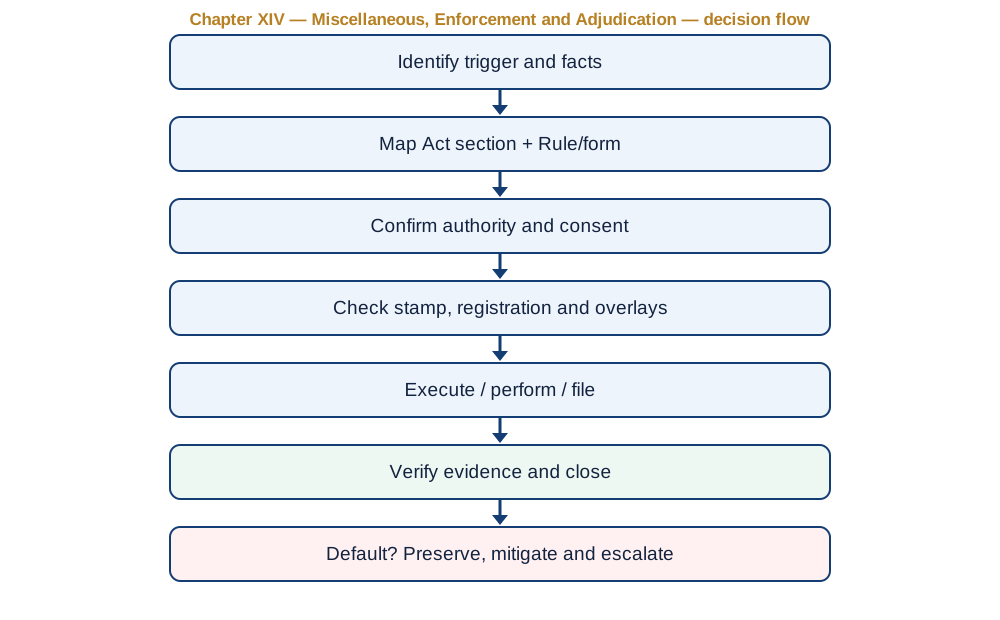
Chapter-specific decision flowchart
Source and review trail
Use the current official instrument, portal or regulator publication before acting. This panel separates the category authority from page-specific references.
- Official starting point
- www.indiacode.gov.in