Part III - Computation of period of limitation
Reviewed by CA Nikhil Gupta and Kajri Singh · Last reviewed 30 August 2026
Build a date-by-date chronology and test each exclusion, postponement, fresh-start and continuing-wrong rule independently.
Dedicated Finin2min Summary - Chapter in 2 Minutes
- Section 12 governs exclusion of time in legal proceedings; isolate its actor, trigger, conditions, exceptions and legal consequence before computing time.
- Section 13 governs indigent-person application exclusion; isolate its actor, trigger, conditions, exceptions and legal consequence before computing time.
- Wrong-forum time is excluded only after proving diligence, good faith, same matter/relief and a jurisdiction-like defect.
- Section 15 governs other statutory exclusions; isolate its actor, trigger, conditions, exceptions and legal consequence before computing time.
- Section 16 governs effect of death before accrual; isolate its actor, trigger, conditions, exceptions and legal consequence before computing time.
- Build a date-by-date chronology and test each exclusion, postponement, fresh-start and continuing-wrong rule independently.
Current statutory text / controlled source extract
Section-by-section / article-by-article provision map
| Provision | Subject | Status / period | Finin2min clause-by-clause decode | Implementation | Evidence/control |
|---|---|---|---|---|---|
| Section 12 | Exclusion of time in legal proceedings | Operative | Section 12 governs exclusion of time in legal proceedings; isolate its actor, trigger, conditions, exceptions and legal consequence before computing time. | Maintain a day-level chronology with certified-copy, stay, notice, sanction and prior-proceeding documents. | Orders, filing receipts, certified-copy applications, readiness notices, stay orders, statutory notices, sanction requests and prior pleadings. |
| Section 13 | Indigent-person application exclusion | Operative | Section 13 governs indigent-person application exclusion; isolate its actor, trigger, conditions, exceptions and legal consequence before computing time. | Maintain a day-level chronology with certified-copy, stay, notice, sanction and prior-proceeding documents. | Source text, chronology, contract/order, communications, proof of service, computation sheet, approvals and filing acknowledgment. |
| Section 14 | Proceeding in wrong forum | Operative | Wrong-forum time is excluded only after proving diligence, good faith, same matter/relief and a jurisdiction-like defect. | Maintain a day-level chronology with certified-copy, stay, notice, sanction and prior-proceeding documents. | Orders, filing receipts, certified-copy applications, readiness notices, stay orders, statutory notices, sanction requests and prior pleadings. |
| Section 15 | Other statutory exclusions | Operative | Section 15 governs other statutory exclusions; isolate its actor, trigger, conditions, exceptions and legal consequence before computing time. | Maintain a day-level chronology with certified-copy, stay, notice, sanction and prior-proceeding documents. | Orders, filing receipts, certified-copy applications, readiness notices, stay orders, statutory notices, sanction requests and prior pleadings. |
| Section 16 | Effect of death before accrual | Operative | Section 16 governs effect of death before accrual; isolate its actor, trigger, conditions, exceptions and legal consequence before computing time. | Assign a legal owner, record the trigger and source, compute independently, and retain approval and filing proof. | Source text, chronology, contract/order, communications, proof of service, computation sheet, approvals and filing acknowledgment. |
| Section 17 | Fraud or mistake | Operative | Fraud or mistake postpones time to discovery subject to diligence and protected third-party interests. | Preserve original documents, signatures, authority, discovery evidence, ledgers and payment trail; do not rely on oral reconstruction. | Source text, chronology, contract/order, communications, proof of service, computation sheet, approvals and filing acknowledgment. |
| Section 18 | Acknowledgment in writing | Operative | A pre-expiry signed acknowledgment restarts limitation even if qualified, but authority and content must be proved. | Preserve original documents, signatures, authority, discovery evidence, ledgers and payment trail; do not rely on oral reconstruction. | Original acknowledgment/payment record, electronic metadata, authority, ledger, bank proof and delivery/receipt evidence. |
| Section 19 | Part-payment or interest | Operative | Section 19 governs part-payment or interest; isolate its actor, trigger, conditions, exceptions and legal consequence before computing time. | Preserve original documents, signatures, authority, discovery evidence, ledgers and payment trail; do not rely on oral reconstruction. | Original acknowledgment/payment record, electronic metadata, authority, ledger, bank proof and delivery/receipt evidence. |
| Section 20 | Acknowledgment/payment by another | Operative | Section 20 governs acknowledgment/payment by another; isolate its actor, trigger, conditions, exceptions and legal consequence before computing time. | Preserve original documents, signatures, authority, discovery evidence, ledgers and payment trail; do not rely on oral reconstruction. | Original acknowledgment/payment record, electronic metadata, authority, ledger, bank proof and delivery/receipt evidence. |
| Section 21 | Adding or substituting parties | Operative | Adding a party ordinarily starts limitation against that party on addition unless good-faith relation-back is ordered. | Assign a legal owner, record the trigger and source, compute independently, and retain approval and filing proof. | Source text, chronology, contract/order, communications, proof of service, computation sheet, approvals and filing acknowledgment. |
| Section 22 | Continuing breaches and torts | Operative | A fresh period runs while a wrong truly continues; repeated consequences of a completed wrong are not enough. | Assign a legal owner, record the trigger and source, compute independently, and retain approval and filing proof. | Source text, chronology, contract/order, communications, proof of service, computation sheet, approvals and filing acknowledgment. |
| Section 23 | Special damage | Operative | Section 23 governs special damage; isolate its actor, trigger, conditions, exceptions and legal consequence before computing time. | Assign a legal owner, record the trigger and source, compute independently, and retain approval and filing proof. | Source text, chronology, contract/order, communications, proof of service, computation sheet, approvals and filing acknowledgment. |
| Section 24 | Gregorian calendar | Operative | Section 24 governs gregorian calendar; isolate its actor, trigger, conditions, exceptions and legal consequence before computing time. | Assign a legal owner, record the trigger and source, compute independently, and retain approval and filing proof. | Source text, chronology, contract/order, communications, proof of service, computation sheet, approvals and filing acknowledgment. |
Finin2min implementation explanation
Classification
Determine whether the matter is a suit, appeal, application, execution, arbitration claim or special-statute proceeding. Record relief, forum and event date.
Computation
Select the exact article or special-law period. Record the third-column trigger, first-day exclusion, calendar period and each legally available adjustment.
Control owner
Legal owns statutory classification; business/finance owns transaction dates; secretarial/HR/property teams supply authority and evidence; counsel confirms forum filing.
Change control
Recalculate after any amendment, acknowledgment, payment, order, stay, certified-copy event or forum change. Preserve the superseded computation.
Practical examples and calculations
A claim appears late by 47 days. The team excludes the first day, certified-copy time and a documented stay, but rejects an unsigned balance confirmation as an acknowledgment. The final filing date changes only for legally supported adjustments.
| Calculation step | Method | Evidence |
|---|---|---|
| Base trigger | Record the exact statutory third-column or special-law event date. | Contract/order/notice/service/knowledge evidence |
| First day | Exclude the day from which the period is reckoned under section 12(1). | Calendar worksheet |
| Period | Add the prescribed days, months or years using the Gregorian calendar. | Date calculation and assumptions |
| Adjustments | Apply only proven exclusions, disability, fraud, acknowledgment/payment or court-closure rules. | Orders, copy records, signed documents, bank proof |
| Final cut-off | State last filing day, forum hours/e-filing rule and any condonation range. | Court calendar, portal receipt and legal sign-off |
Practical transaction application
- Open the chronology when the first default, refusal, knowledge event, dispossession, order or enforceability event occurs.
- Classify every proposed relief separately and select the governing special statute and Schedule article.
- Record authority, service, contractual cure periods, statutory notice, copy time, stay and prior proceedings.
- Test acknowledgment, part-payment, fraud, disability and continuing-wrong claims against their exact statutory conditions.
- Approve the last filing date, fallback forum, condonation position and evidence pack before action.
Authority, consent and execution controls
- Confirm claimant/applicant legal capacity and representative authority.
- Obtain board, partner, trustee, government or power-of-attorney approvals.
- Authorise acknowledgments, settlements and admissions carefully because they affect limitation.
- Check counsel authority and affidavit/verification requirements.
Stamp duty and registration alerts
- Limitation does not cure an unstamped or unregistered instrument.
- Assess State stamp duty and registration separately for the underlying contract, deed, mortgage, lease, release or settlement.
- Preserve original instrument and adjudication/impounding record.
- Do not assume an electronic record avoids stamp or registration law.
Evidence and document-retention checklist
- Executed instrument and amendments.
- Trigger-date correspondence and service proof.
- Invoices, delivery, acceptance, account and bank records.
- Court/tribunal orders and certified-copy records.
- Acknowledgment and authority evidence.
- Chronology and independent calculation.
- Special-law text and amendment snapshot.
- Filing receipt, diary number and portal timestamp.
Performance, delivery and payment controls
- Map each obligation, milestone, due date and cure period.
- Separate invoice date, payment due date, acceptance, breach and termination.
- Track recurring instalments and successive breaches individually.
- Record mitigation and substitute performance without assuming a new limitation period.
Breach, loss, mitigation and remedy framework
- Identify suit, appeal, application, arbitration, execution or public-law remedy.
- Quantify principal, interest, damages, restitution and costs separately.
- Do not allow negotiations or a legal notice to revive a barred right unless statute permits.
- Evaluate settlement, acknowledgment and standstill language for unintended consequences.
Limitation and forum controls
- Confirm territorial, pecuniary and subject-matter jurisdiction.
- Apply special-law period and express exclusion before the general Schedule.
- Record appeal/review/revision and condonation limits separately.
- For arbitration, separate claim limitation from court-application limitation.
Arbitration and mediation interface
Arbitration does not create a new substantive limitation period for a barred claim. Separately compute the underlying claim, arbitration commencement, section 11 application, interim relief, award challenge and enforcement. For mediation and PIMS, identify the statutory exclusion period and preserve application, service, closure and settlement records.
Company, partnership, GST and tax overlays
- Companies Act and LLP authority/records.
- Partnership agency and joint liability.
- GST invoice, credit-note and tax evidence.
- Income-tax write-off, recovery and settlement treatment.
- IBC default and acknowledgment interface.
- Arbitration, Commercial Courts, MSME, consumer and RERA special periods.
Finin2min Q&A
What is the first professional step?
Identify the governing special law and proceeding before selecting a Schedule article.
What is the most common failure?
Using a generic three-year assumption without proving the statutory trigger and available exclusions.
What should the matter file contain?
A reproducible chronology, source-controlled law, computation, evidence, approvals and filing proof.
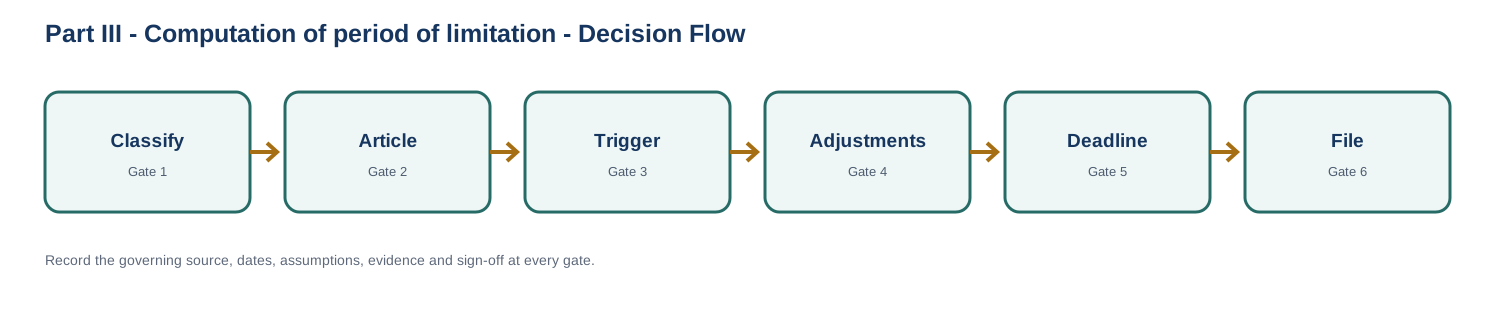
Chapter-specific decision flowchart