Source, commencement and implementation control
Department of Consumer Affairs / Central Consumer Protection Authority
Most operative provisions commenced on 20 July 2020; subordinate instruments have separate dates.
Act, Commission Rules, CCPA instruments, e-commerce, direct-selling, misleading-advertisement and dark-pattern controls require instrument-date verification.
Provision architecture and professional interpretation are local. Exact statutory wording and event-date instruments remain controlled by the official source.
Official source: Open the current India Code record.
Provision-specific operating checklist
- Establish consumer status and territorial/forum jurisdiction.
- Classify defect, deficiency, unfair trade practice and unfair contract.
- Capture invoice, advertisement, platform and service evidence.
- Separate trader, manufacturer, service-provider and marketplace roles.
- Calculate limitation, pecuniary jurisdiction and remedy route.
- Test product-liability, mediation and ccpa exposure independently.
Topic under review: Territorial and Pecuniary Jurisdiction. Before advice, filing, enforcement or publication, preserve the operative Act, commencement notification, applicable Rules/regulations, amendments, portal instructions and current judicial treatment in the matter file.
Finin2min implementation record for this unit
Decision question. Identify the exact statutory or regulatory trigger covered by Territorial and Pecuniary Jurisdiction, the person on whom the duty falls, the event date and the evidence that proves compliance or breach.
Applicability test. Record the entity, transaction, product, data set, project, market or proceeding in scope; test statutory exclusions and exemptions; then freeze the version of the law applying on the event date.
Execution workflow. Allocate the matter to responsible legal, compliance, finance, operations and evidence owners; prepare a dated issue note; obtain approvals; complete filing, disclosure, notice, payment or remediation; and retain acknowledgement plus supporting evidence.
Consequence and remedy. Distinguish administrative correction, civil relief, compensation, monetary penalty, prosecution, appeal, settlement, mediation, arbitration and constitutional or judicial review. Limitation and pre-deposit requirements must be computed independently.
Cross-law review. Test the Contract Act, Companies Act, GST, income tax, accounting, evidence, limitation, arbitration, consumer, competition, insolvency, data-protection and sector-regulatory overlays only where factually relevant.
Dedicated Finin2min Summary - Chapter in 2 Minutes
- Identify the legal trigger, responsible actor and evidence relevant to territorial and pecuniary jurisdiction.
- Read the Act with all effective Rules, regulations, notifications, directions, guidelines and forum procedure as at the event date.
- Separate substantive obligation, operational workflow, filing or reporting, enforcement consequence, remedy, appeal and limitation.
- Maintain a reproducible source pack, decision memo, approval trail and transaction-level evidence.
- Apply connected company, contract, tax, accounting, data, competition, consumer, insolvency and sector-law overlays independently.
Section-by-section / instrument map
| Provision | Subject | Control domain | Source rule |
|---|---|---|---|
| Operational module | Territorial and Pecuniary Jurisdiction | territorial and pecuniary jurisdiction | Instrument-specific source and implementation controls apply. |
Finin2min clause-by-clause decode
Actor and trigger
Identify who acts, who is protected, the transaction or processing event, territorial nexus, threshold, exception and effective date.
Conditions and consequence
Convert each cumulative or alternative limb, proviso and exemption into an evidence-backed checklist. Record the consequence of satisfaction or failure.
Finin2min implementation explanation
Professional control master for territorial and pecuniary jurisdiction Build the workflow around named owners, system gates, approval limits, due dates, filing evidence, exception escalation and independent review.
Practical example and calculation approach
| Working | Method | Evidence |
|---|---|---|
| Threshold/value | Apply the event-date statutory base and document assumptions, inclusions, exclusions and connected persons. | Financials, transaction documents, system data and valuation. |
| Time/limitation | Record trigger, service, exclusion, acknowledgment, statutory extension, filing and appeal dates. | Chronology, delivery proof, portal receipt and order. |
| Exposure | Separate principal, compensation, penalty, interest, refund, remediation cost and litigation cost. | Reproducible calculation and approval. |
Practical transaction application
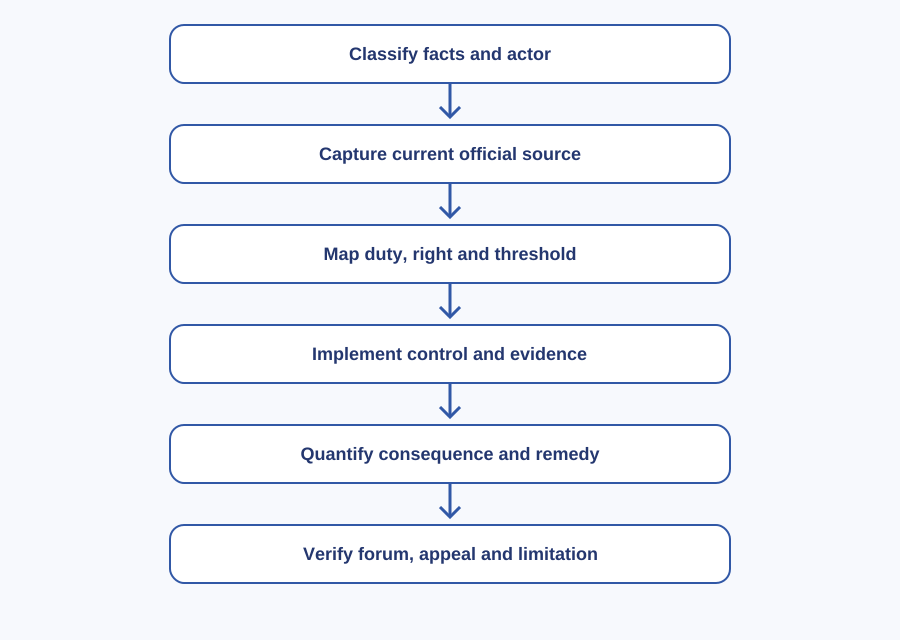
- Classify transaction, parties, role, product/service/data/project and jurisdiction.
- Capture operative Act, Rules, regulations, notifications, directions and forum procedure.
- Map approvals, disclosures, consents, contracts, filings, system controls and evidence.
- Calculate thresholds, due dates, exposure and remedial options.
- Obtain independent review before irreversible execution, public statement, filing or enforcement response.
Authority, consent and execution controls
- Correct legal entities, role allocation and beneficial ownership.
- Board, partner, officer, DPO, compliance, regulator-facing and delegated authority.
- Final approved contract, policy, notice, disclosure, filing or public communication.
- Consent, acceptance, service, electronic signature and version evidence.
- Conflict, privilege, confidentiality and segregation controls.
Evidence and document-retention checklist
- Official source snapshot and amendment/commencement memo.
- Actor, threshold and jurisdiction classification.
- Contract, notice, consent, disclosure and communication versions.
- System logs, approvals, calculations, payments and delivery evidence.
- Complaint, investigation, remediation, filing, order and appeal chronology.
Breach, remedy, limitation and forum
Separate cure, withdrawal, refund, compensation, interest, penalty, director/officer exposure, prosecution, regulator direction, settlement, appeal and judicial review. Do not use one statute's limitation or remedy to assume the result under another statute.
Cross-law and tax overlays
Check contract, Companies Act/LLP, GST, income tax/TDS, accounting, DPDP/IT, consumer, competition, RERA, MSMED, FEMA, IBC, sector regulator and evidence law independently.
Finin2min Q&A
What is the first control for territorial and pecuniary jurisdiction?
Classify the facts and event date, then capture the current official Act and delegated instruments before applying an operational rule.
Can a contract override the statute?
Only where the statute permits contractual allocation. Mandatory duties, regulator powers, public-law consequences and non-waivable rights continue to apply.
What evidence should be retained?
The operative contract or policy, authority, notices, system records, calculations, approvals, filings, delivery proof and the official-source version used.
Which forum applies?
Determine the statutory authority, tribunal or court, territorial and subject-matter jurisdiction, appeal route, preconditions and limitation separately.
Is the page a substitute for legal advice?
No. It is a professional implementation framework and must be reconciled with the signed Gazette and matter-specific advice.
Decision flowchart