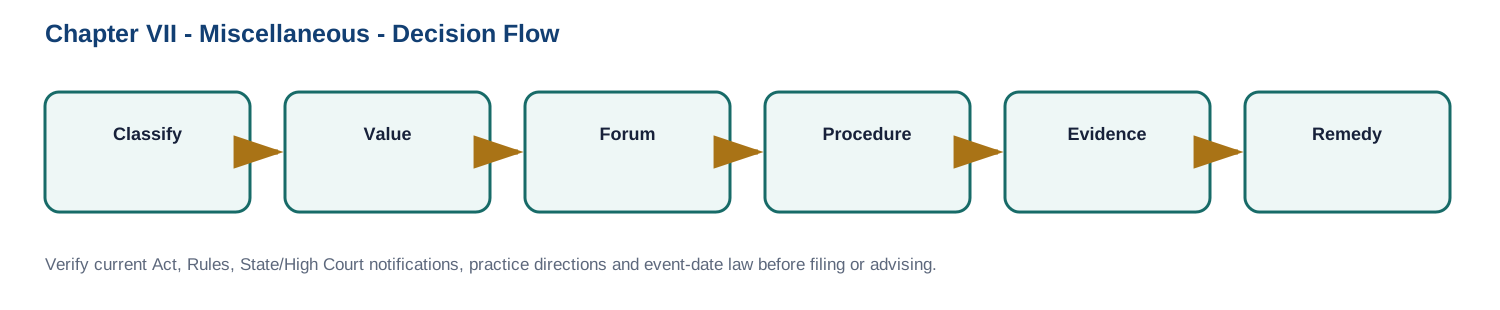
Opening control
Freeze the transaction, relief, cause of action, limitation, specified value, territorial facts, current notified court, urgent-relief position and arbitration/special-statute interface.
Maintain the delegated-legislation, High Court practice-direction, notification, data and transition layer alongside the Act.
| Provision / gate | Subject | Status | Finin2min decode | Implementation | Evidence |
|---|---|---|---|---|---|
| Section 17 | Collection and disclosure of statistical data. | Current / mapped | Each commercial forum maintains monthly data on filings, pendency, status and disposal and publishes it on the relevant High Court website. | Assign High Court/State/court administration ownership, source current directions, publish data and retain training/infrastructure evidence. | Official Act, Gazette instrument, High Court practice direction, administrative order, monthly data and review sign-off. |
| Section 18 | Power of High Court to issue directions. | Current / mapped | High Courts may issue practice directions supplementing Chapter II and the commercial CPC procedure. | Assign High Court/State/court administration ownership, source current directions, publish data and retain training/infrastructure evidence. | Official Act, Gazette instrument, High Court practice direction, administrative order, monthly data and review sign-off. |
| Section 19 | Infrastructure facilities. | Current / mapped | State Government must provide necessary infrastructure. | Assign High Court/State/court administration ownership, source current directions, publish data and retain training/infrastructure evidence. | Official Act, Gazette instrument, High Court practice direction, administrative order, monthly data and review sign-off. |
| Section 20 | Training and continuous education. | Current / mapped | State Government may establish judicial training facilities in consultation with the High Court. | Assign High Court/State/court administration ownership, source current directions, publish data and retain training/infrastructure evidence. | Official Act, Gazette instrument, High Court practice direction, administrative order, monthly data and review sign-off. |
| Section 21 | Overriding effect. | Current / mapped | The Act prevails over inconsistent law or instruments except where the Act itself provides otherwise. | Maintain a source-controlled Act/Rule/notification register and record any conflict, override, transition or historical-only status. | Official Act, Gazette instrument, High Court practice direction, administrative order, monthly data and review sign-off. |
| Section 21A | Central Government rule-making power. | Current / mapped | Central Government may make Rules, particularly for PIMS, subject to parliamentary laying. | Maintain a source-controlled Act/Rule/notification register and record any conflict, override, transition or historical-only status. | Official Act, Gazette instrument, High Court practice direction, administrative order, monthly data and review sign-off. |
| Section 22 | Power to remove difficulties. | Current / mapped | The time-limited difficulty-removal power is historical; verify whether any valid order was made within the statutory window. | Maintain a source-controlled Act/Rule/notification register and record any conflict, override, transition or historical-only status. | Official Act, Gazette instrument, High Court practice direction, administrative order, monthly data and review sign-off. |
| Section 23 | Repeal and savings. | Current / mapped | The 2015 Ordinance is repealed with savings for action already taken. | Maintain a source-controlled Act/Rule/notification register and record any conflict, override, transition or historical-only status. | Official Act, Gazette instrument, High Court practice direction, administrative order, monthly data and review sign-off. |
Freeze the transaction, relief, cause of action, limitation, specified value, territorial facts, current notified court, urgent-relief position and arbitration/special-statute interface.
Assign legal, finance, records, business and authorised-signatory owners. Use one dated matter file and a court-calendar owner with exception escalation.
A supplier seeks principal, contractual interest and damages. The team classifies the supply agreement as a commercial dispute, computes interest only to filing for specified value, completes PIMS unless genuine urgent relief exists, and opens a 120-day written-statement and disclosure calendar.
| Calculation | Method | Evidence |
|---|---|---|
| Specified value | Principal or market/intangible value plus interest computed only up to filing; arbitration uses claim plus counterclaim. | Invoices, contract, interest schedule, valuation and arbitration pleadings. |
| Interest | State legal/contract basis, rate, from/to dates, total to filing and daily accrual afterwards. | Contract clause, MSMED/statute analysis, ledger and bank records. |
| Litigation economics | Claim, defence/set-off, court fees, PIMS cost, legal/expert cost, interest, recovery probability and time value. | Approved claim model and settlement authority. |
Map milestones, specifications, variation approvals, delivery, inspection, acceptance, defects, cure, termination and mitigation to contemporaneous records.
Reconcile principal, GST, TDS, retention, credits, debit notes, interest basis, payment appropriation and MSMED exposure before pleading.
Record accrual, invoice/due date, breach/refusal, acknowledgement, part payment, PIMS exclusion, arbitration commencement, certified-copy time and filing date.
Verify commercial category, specified value, territory, original side, court level, State notification, statutory bar, arbitration allocation and appealability.
Section 10 allocates qualifying Arbitration Act applications and appeals to the commercial forum. Section 12A PIMS applies to qualifying suits not contemplating urgent interim relief. Contractual mediation, MSMED conciliation, consumer mediation, arbitration and court-annexed settlement must be classified separately rather than blended into one procedure.
Check company/LLP/partnership authority, related-party restrictions, insolvency moratorium, assignment, guarantees, insurance and officer admissions.
Reconcile GST supply/credit notes, TDS, interest accounting, provision/contingent liability, bad-debt/recovery treatment, stamp duty and settlement allocation.
Classify the dispute, relief, specified value, urgent-relief requirement and currently notified forum.
Late written statement, incomplete disclosure, defective Statement of Truth, missed PIMS, wrong forum and non-appealable interlocutory challenges.
A single source-controlled matter file containing current law, notifications, valuation, authority, pleadings, evidence, dates and court outputs.