Part I, Chapter X - Miscellaneous
Manage deposits, jurisdictional anchoring, confidentiality, insolvency and separate limitation clocks.
Dedicated Finin2min Summary - Chapter in 2 Minutes
- Manage deposits, jurisdictional anchoring, confidentiality, insolvency and separate limitation clocks.
- Use the current India Code consolidation as on 1 June 2026 together with amendment footnotes and event-date law.
- Convert every section into an owner, deadline, evidence and remedy control.
- Separate seat, venue, governing law, court and institutional rules.
- Do not treat arbitration as a substitute for proof of contract, performance, authority, loss or limitation.
Section-by-section provision map
| Provision / gate | Statutory focus | Finin2min decode | Implementation | Evidence / control |
|---|---|---|---|---|
| Section 38 | Deposits. | Section 38 governs award, money or cost consequences: Deposits. | Separate claim, counterclaim, principal, interest, cost, tax, payment and enforceability. | Quantum model, invoices, award/order and payment/security records. |
| Section 39 | Lien on arbitral award and deposits as to costs. | Section 39 governs award, money or cost consequences: Lien on arbitral award and deposits as to costs. | Separate claim, counterclaim, principal, interest, cost, tax, payment and enforceability. | Quantum model, invoices, award/order and payment/security records. |
| Section 40 | Arbitration agreement not discharged by death. | Section 40 addresses arbitration agreement not discharged by death. | Identify actor, trigger, conditions, provisos, exceptions, consequence and linked provisions before acting. | Current source, contract, authority, notices, procedural record and outcome evidence. |
| Section 41 | Provisions in case of insolvency. | Section 41 addresses provisions in case of insolvency. | Identify actor, trigger, conditions, provisos, exceptions, consequence and linked provisions before acting. | Current source, contract, authority, notices, procedural record and outcome evidence. |
| Section 42 | Jurisdiction. | Once a competent court receives a Part I application, that court ordinarily anchors subsequent Part I applications. | Check the first application, court competence, seat, subject matter and transferred/returned proceedings. | All court filing history and jurisdiction memorandum. |
| Section 42A | Confidentiality of information. | Section 42A controls confidentiality/disclosure: Confidentiality of information. | Classify information, recipients, permitted disclosure, legal hold and enforcement exception. | Confidentiality protocol, access log and disclosure record. |
| Section 42B | Protection of action taken in good faith. | Section 42B addresses protection of action taken in good faith. | Identify actor, trigger, conditions, provisos, exceptions, consequence and linked provisions before acting. | Current source, contract, authority, notices, procedural record and outcome evidence. |
| Section 43 | Limitations. | Limitation Act applies to arbitrations with statutory adaptations including commencement and failed-arbitration exclusions. | Maintain cause-of-action, acknowledgement, section 21, exclusion, insolvency and court/arbitration clocks separately. | Chronology, notices, acknowledgements and limitation computation. |
Finin2min clause-by-clause decode
Section 38 governs award, money or cost consequences: Deposits.
Implementation: Separate claim, counterclaim, principal, interest, cost, tax, payment and enforceability.
Evidence: Quantum model, invoices, award/order and payment/security records.
Section 39 governs award, money or cost consequences: Lien on arbitral award and deposits as to costs.
Implementation: Separate claim, counterclaim, principal, interest, cost, tax, payment and enforceability.
Evidence: Quantum model, invoices, award/order and payment/security records.
Section 40 addresses arbitration agreement not discharged by death.
Implementation: Identify actor, trigger, conditions, provisos, exceptions, consequence and linked provisions before acting.
Evidence: Current source, contract, authority, notices, procedural record and outcome evidence.
Section 41 addresses provisions in case of insolvency.
Implementation: Identify actor, trigger, conditions, provisos, exceptions, consequence and linked provisions before acting.
Evidence: Current source, contract, authority, notices, procedural record and outcome evidence.
Once a competent court receives a Part I application, that court ordinarily anchors subsequent Part I applications.
Implementation: Check the first application, court competence, seat, subject matter and transferred/returned proceedings.
Evidence: All court filing history and jurisdiction memorandum.
Section 42A controls confidentiality/disclosure: Confidentiality of information.
Implementation: Classify information, recipients, permitted disclosure, legal hold and enforcement exception.
Evidence: Confidentiality protocol, access log and disclosure record.
Section 42B addresses protection of action taken in good faith.
Implementation: Identify actor, trigger, conditions, provisos, exceptions, consequence and linked provisions before acting.
Evidence: Current source, contract, authority, notices, procedural record and outcome evidence.
Limitation Act applies to arbitrations with statutory adaptations including commencement and failed-arbitration exclusions.
Implementation: Maintain cause-of-action, acknowledgement, section 21, exclusion, insolvency and court/arbitration clocks separately.
Evidence: Chronology, notices, acknowledgements and limitation computation.
Finin2min implementation explanation
Create one matter control sheet containing clause, seat, governing law, institution/rules, tribunal, court, claims, counterclaims, limitation, procedural calendar, budget, evidence, settlement authority and source version. Assign business, legal, finance and document owners.
Practical examples and calculations
- Section 38: Example control: for section 38, prepare a fact-to-provision matrix for deposits, identify evidence for every condition and separately calculate time, principal, interest, fee, cost or security from source records.
- Section 39: Example control: for section 39, prepare a fact-to-provision matrix for lien on arbitral award and deposits as to costs, identify evidence for every condition and separately calculate time, principal, interest, fee, cost or security from source records.
- Section 40: Example control: for section 40, prepare a fact-to-provision matrix for arbitration agreement not discharged by death, identify evidence for every condition and separately calculate time, principal, interest, fee, cost or security from source records.
- Section 41: Example control: for section 41, prepare a fact-to-provision matrix for provisions in case of insolvency, identify evidence for every condition and separately calculate time, principal, interest, fee, cost or security from source records.
- Section 42: Example control: for section 42, prepare a fact-to-provision matrix for jurisdiction, identify evidence for every condition and separately calculate time, principal, interest, fee, cost or security from source records.
Quantum framework: separate principal, admitted amount, disputed amount, set-off/counterclaim, contractual/statutory interest, tax, costs, security, payments and mitigation. Preserve a reproducible spreadsheet and source documents.
Practical transaction application
At contract stage, define scope, seat/venue, governing law, institution/rules, tribunal number/appointment, language, notices, interim relief, confidentiality, consolidation/joinder, emergency relief, costs and survival. Link performance, acceptance, price, tax and change-control records to the dispute clause.
Authority, consent and execution controls
Verify legal entity, board/partner/delegated authority, power of attorney, notice authority, arbitrator appointment authority, pleading affidavit, settlement limits and payment/security approval. Preserve changes in directors/partners and insolvency status.
Stamp duty and registration alerts
Evidence and document-retention checklist
Maintain legal hold, originals register, immutable exports, metadata, contract versions, notices/service, procedural orders, pleadings, document production, witness/expert files, transcripts, award, court records, security/payment and source-version hashes. Retention continues through challenge, enforcement and limitation.
- Executed contract and amendments
- Clause/rules version
- Authority and power of attorney
- Notices and service evidence
- Chronology and limitation sheet
- Invoices, delivery and GST records
- Pleadings and procedural orders
- Document production index
- Witness and expert files
- Hearing transcript/record
- Award/settlement and delivery
- Court, security and payment records
Performance, delivery and payment controls
Tie obligations to deliverables, acceptance criteria, change orders, certification, invoices, tax documents, payment milestones, retention, liquidated damages and cure notices. Quantify admitted, disputed, set-off and counterclaim amounts separately.
Breach, loss, mitigation and remedy framework
Stop avoidable loss, preserve evidence, serve contract/statutory notices, offer cure where required, mitigate, secure assets/evidence, quantify causation/remoteness, choose interim relief and maintain consistent civil/arbitration/insolvency strategy.
Limitation and forum controls
Use separate clocks for cause of action, contractual notice/cure, section 21 commencement, section 11 petition, pleadings, award, section 33, section 34, section 37, enforcement, foreign-award objections and insolvency. Confirm exclusion, acknowledgement and court holidays from current law.
Arbitration and mediation interface
Arbitration, conciliation and mediation are distinct. Define when negotiation/mediation pauses or does not pause limitation, how settlements are authenticated, and how court/tribunal proceedings are stayed, withdrawn or converted into an award/settlement order.
Company, partnership, GST and tax overlays
Companies/LLP/partnership law controls authority and liability; GST/income tax affects invoice evidence, damages, interest, withholding and settlements; FEMA governs cross-border payment/award remittance; IBC may impose moratorium and claim filing; accounting standards govern provisions, contingent liabilities and award recognition.
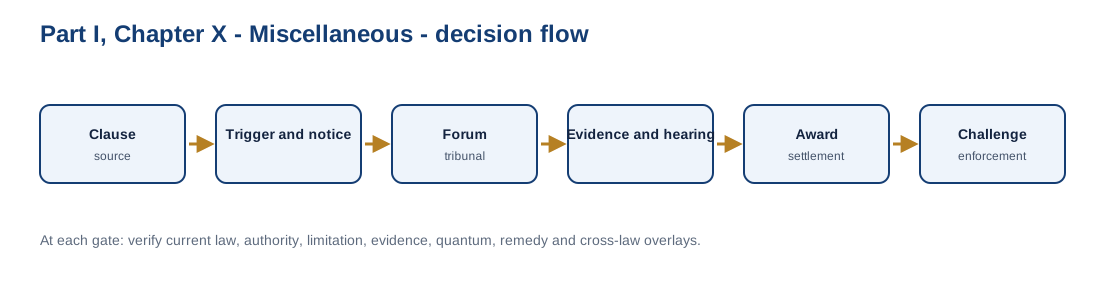
Chapter-specific decision flowchart
Finin2min Q&A
Is venue always the legal seat?
No. The clause, institutional rules and surrounding language must be analysed; the legal seat determines curial law and supervisory court.
Does filing a section 34 petition automatically stay enforcement?
No. A separate stay application/order is required under section 36, subject to the current statutory provisos.
Can an interested party unilaterally appoint the sole arbitrator?
Current Supreme Court neutrality jurisprudence makes such mechanisms high risk or invalid; use a neutral appointment process.
Does an unstamped contract make the arbitration clause non-existent?
Current Supreme Court law treats stamping as a curable issue and preserves separability; State stamp procedure and admissibility still require compliance.
Can a section 34 court re-hear the merits?
No. The court applies statutory grounds and current Supreme Court law; it is not a regular appeal.
Does negotiation automatically stop limitation?
No. Use a written standstill where lawful and calculate limitation under the Act, Limitation Act, acknowledgements and exclusions.
Can foreign awards be refused because the court disagrees with the facts?
Ordinarily no. Part II provides limited refusal grounds and excludes a merits review.
Should settlement authority be assumed from litigation authority?
No. Obtain specific board/partner/delegated authority and document tax, payment, release and default consequences.