RBI Cuts Key Export and Import Settlement Window to 9 Months From October 1
An RBI FEMA amendment published in the Gazette shortens the specified 15-month export/import period in Regulation 5 to nine months and the related 18-month proviso to 12 months, effective 1 October 2026. It also inserts a transition rule for caution-listed exporters and gives Authorised Dealers power to handle specified legacy transactions that earlier required RBI approval.
What changed
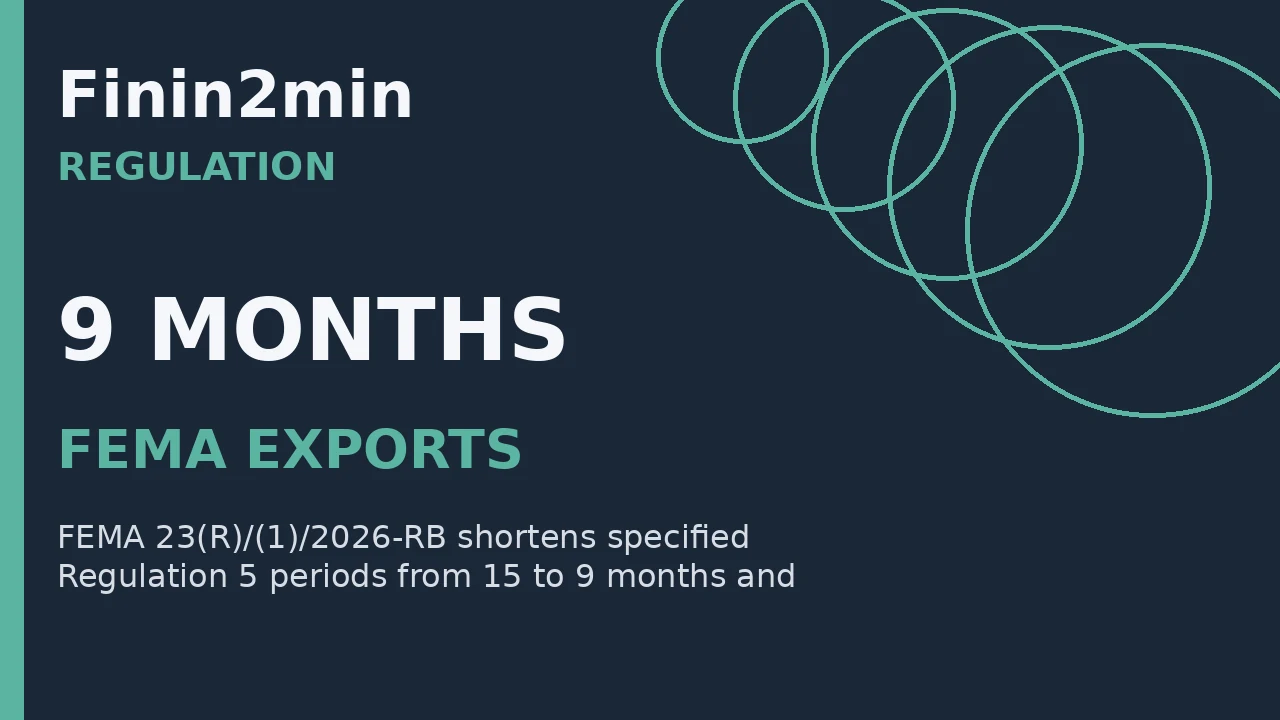
FEMA 23(R)/(1)/2026-RB shortens specified Regulation 5 periods from 15 to 9 months and 18 to 12 months, adds a Caution List transition and inserts delegated AD powers for specified legacy cases.
Why it matters
The 1 October commencement compresses compliance timelines and changes the handling path for some pre-commencement transactions.
Who is affected
Exporters, importers, merchant traders, authorised dealer banks, CFOs, treasury teams, auditors and FEMA compliance professionals.
Action required
Map open cross-border items to the amended clauses before 1 October; flag aged cases and obtain AD-bank confirmation for legacy transactions under new Regulation 20.
# RBI Cuts Key Export and Import Settlement Window to 9 Months From October 1
Finin2min 2-minute summary
An RBI FEMA amendment published in the Gazette shortens the specified 15-month export/import period in Regulation 5 to nine months and the related 18-month proviso to 12 months, effective 1 October 2026. It also inserts a transition rule for caution-listed exporters and gives Authorised Dealers power to handle specified legacy transactions that earlier required RBI approval.
**Research cutoff:** 2026-09-26 22:17 IST
**Workflow status:** NEW / LATE_BACKFILL
Key verified facts
- Notification No. FEMA 23(R)/(1)/2026-RB was issued on 22 September 2026 and published on 24 September 2026.
- The amendment comes into force on 1 October 2026.
- In Regulation 5(1)(a) and (b), 'fifteen months' is substituted with 'nine months'.
- In the first proviso to Regulation 5(1), 'eighteen months' is substituted with 'twelve months'.
- Exporters on the Caution List as at 30 September 2026 continue under applicable earlier orders until removed.
- New Regulation 20 empowers Authorised Dealers to handle specified pre-1 October legacy export/import/merchanting transactions that previously required RBI approval.
Why this late backfill is material
The amendment predates the immediate 25 September 23:42 IST FinNews baseline but was absent from that package. It is therefore labelled LATE_BACKFILL instead of being presented as a fresh 26 September event. Because the operative date is 1 October, the practical implementation window is short: exporters, importers and banks have only days to align process notes and pending cases.
The source hierarchy is also important. This is not commentary on a proposal; the Gazette carries an RBI amendment notification with a defined commencement date. FinNews therefore treats the statutory text—not a news report—as the controlling source.
What the shorter timeline changes
Reducing the specified period from 15 months to nine months compresses the time available for the relevant export/import settlement obligations captured by Regulation 5. A shorter statutory clock raises the cost of weak receivables follow-up because a transaction that looked comfortably within the old window can approach the new limit much sooner.
The related proviso also moves from 18 months to 12 months. Finance and export teams should map each outstanding transaction to the precise clause and transaction date rather than applying one generic 'nine-month rule' to every cross-border receipt or payment.
Authorised Dealer transition power
New Regulation 20 is operationally significant because it allows Authorised Dealers to handle specified transactions undertaken before 1 October 2026 relating to exports, imports and merchanting trade that would previously have required RBI approval under the earlier regulations or master directions. This can move work from a central-bank approval path to the bank handling the transaction, subject to the exact conditions.
For companies, that does not mean every legacy exception is automatically approved. The AD bank still needs documents, rationale and compliance evidence, and the transaction must fall within the authority delegated by the new regulation.
Caution List continuity
The amendment protects continuity for exporters already in the Caution List on 30 September 2026. Orders issued under the earlier 2015 framework continue until the exporter is removed from the list. That avoids a regulatory gap on commencement day and means affected exporters cannot assume the new regime wipes out an existing caution status.
Teams dealing with such exporters should preserve the old order, correspondence and removal conditions alongside the new regulation. Transition provisions are often where operational errors occur because users read the new main rule without the savings clause.
Cash-flow and treasury impact
A shorter realisation or settlement window can change working-capital discipline. Export receivables that remain unpaid for months may require earlier escalation, stronger collection triggers and more frequent exception reporting. Import teams may similarly need to reconcile advances, delayed shipments and supporting documents more quickly.
For treasury, the key is not just compliance but forecasting. Faster closure of cross-border items can improve visibility over expected foreign-currency receipts and payments, while unresolved cases may require earlier engagement with the AD bank.
Accounting and audit trail
The FEMA amendment does not itself determine revenue recognition, expected-credit-loss provisioning or foreign-currency accounting under applicable accounting standards. Those are separate accounting judgments. But a shortened regulatory timeline can be a relevant compliance indicator for ageing dashboards, control testing and audit evidence.
Auditors and controllers should be able to trace each open item from invoice and shipping/import documentation through bank realisation/payment evidence, extensions or delegated AD decisions. The transition date should be explicitly captured in the control matrix.
What not to infer
Do not state that all cross-border transactions now have a universal nine-month deadline; the exact application depends on the amended provision and transaction type. Do not assume legacy RBI approvals are void, or that every pre-October case is automatically regularised by the AD bank. And do not treat the Caution List savings clause as a fresh caution-listing power—it preserves existing orders.
The amendment also does not replace all FEMA master directions. Operational teams must read the amended regulations together with current RBI directions and bank procedures.
What to do before 1 October
Create an ageing list of open export, import and merchanting items; identify cases that cross nine or 12 months under the new text; segregate exporters covered by the 30 September Caution List transition; and obtain written bank guidance for legacy cases to be handled under Regulation 20. Update SOPs, maker-checker controls and escalation points only after mapping the exact regulation.
Finin2min bottom line
The amendment is a real deadline compression, not merely a drafting tidy-up. The best response is transaction-level mapping and early AD-bank engagement, especially for aged items and legacy approvals.
Source record
Gazette of India / Reserve Bank of India — FEMA 23(R)/(1)/2026-RB. Source reference: Gazette ID CG-MH-E-24092026-276477 — FEMA 23(R)/(1)/2026-RB. Source URL: https://egazette.gov.in/WriteReadData/2026/276477.pdf
Reader note
For information and education only. Verify the latest controlling source before any investment, tax, legal, compliance or treasury decision.
View official source →
FinNews is educational and professional reference material, not financial, tax or legal advice. Confirm the current official position from the primary source before acting on any figure, rate, provision or deadline mentioned here.