MSCI India Rebalance Takes Effect After 31 August Close: 4 Additions, 3 Deletions
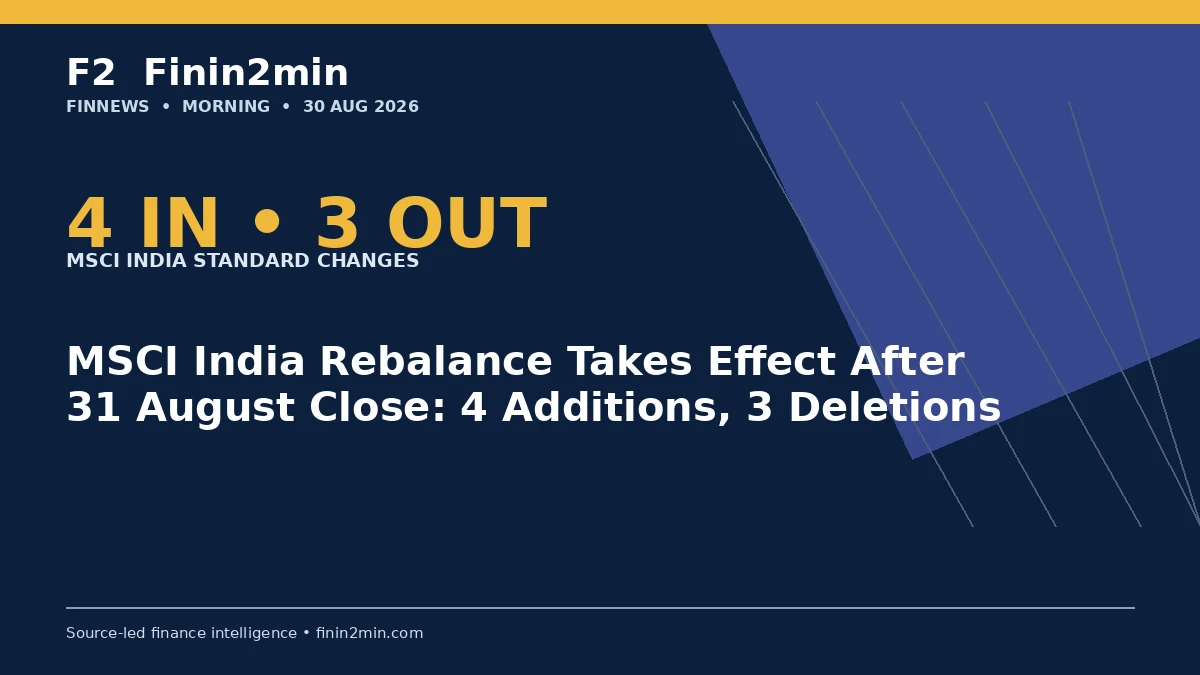
MSCI’s August Global Standard review adds Adani Energy Solutions, Billionbrains Garage Ventures, Laurus Labs and Lenskart Solutions to the MSCI India Index while deleting Astral, Balkrishna Industries and SBI Cards.
What changed
MSCI’s Global Standard Index review shows four additions and three deletions for India, with all changes taking effect as of the close of 31 August 2026.
Why it matters
Index changes can create mechanical trading demand or supply for funds benchmarked to MSCI indexes and can concentrate turnover near the effective close. MSCI’s public list establishes constituents and timing, but it does not provide a guaranteed stock-price move or a universal passive-flow amount.
Who is affected
Investors in Adani Energy Solutions, Billionbrains Garage Ventures, Laurus Labs, Lenskart Solutions, Astral, Balkrishna Industries and SBI Cards; index funds, ETFs, institutional desks and traders managing closing-auction liquidity.
Action required
Use the official MSCI constituent list and treat any broker flow estimates as estimates. Avoid assuming inclusion guarantees a rise or deletion guarantees a fall; actual execution depends on benchmarked assets, free float, tracking choices, market liquidity and prior positioning.
Finin2min 2-minute summary
MSCI’s August 2026 Global Standard Index review takes effect as of the close of 31 August. For India, the official list shows four additions—Adani Energy Solutions, Billionbrains Garage Ventures, Laurus Labs and Lenskart Solutions—and three deletions—Astral, Balkrishna Industries and SBI Cards and Payment Services. The effective-close timing matters because index-tracking portfolios typically need to align holdings around the rebalance, which can increase turnover and closing-auction activity.
What MSCI actually announced
The public MSCI Global Standard list dated 12 August records India with four securities added and three deleted. The same document states that the changes take place as of the close of 31 August 2026. This is the controlling fact set. Finin2min does not use unverified social-media lists or broker screenshots as the authority for constituent changes.
Why index changes can move stocks
Passive funds and benchmark-aware active funds may need to buy additions and sell deletions to keep portfolios aligned with their reference index. That can concentrate liquidity near the implementation close. But the direction and size of a stock’s move are not predetermined. Some traders position before the effective date, some funds use implementation techniques that reduce market impact, and active managers are not required to copy the index mechanically.
Finance and execution lens
A rebalance changes index membership; it does not change a company’s revenue, profit, cash flow or intrinsic value on the effective date. The immediate effect is on the potential ownership and trading-flow mix. For a finance-focused investor, the correct separation is fundamentals versus flow. A company can receive passive buying while its earnings outlook deteriorates, or face deletion-related selling while its business economics improve. Those two forces can dominate at different horizons.
Why fixed flow estimates need caution
Brokerages often publish estimated inflows and outflows, but those figures depend on assumptions about assets tracking specific MSCI benchmarks, free-float adjustments, implementation prices, FX rates and how closely individual portfolios replicate the index. MSCI’s public constituent list does not itself guarantee a rupee or dollar flow amount. Any such number should therefore be timestamped, sourced and labelled as an estimate rather than reported as an official MSCI figure.
Closing-auction and liquidity risk
Because implementation is tied to the closing level, trading interest can cluster late in the session. That can widen temporary price dislocations and amplify volume, especially where anticipated passive demand is large relative to ordinary liquidity. Investors using market orders near the close should understand that execution can be affected by the auction mechanism and by other month-end flows. A rebalance is therefore both an index event and a market-microstructure event.
What to watch on 31 August
Watch closing-auction volume, deviations between regular-session prices and the auction outcome, and whether the affected stocks had already priced in expected flows before implementation. After the rebalance, the more durable question returns to fundamentals. Inclusion can broaden institutional ownership, but it is not a substitute for earnings quality, balance-sheet strength or valuation discipline.
Source control
MSCI Inc. — MSCI Global Standard Indexes, August 2026 Index Review, dated 12 August 2026.
For information and education only. This is not investment, tax, legal or accounting advice.
View official source →
FinNews is educational and professional reference material, not financial, tax or legal advice. Confirm the current official position from the primary source before acting on any figure, rate, provision or deadline mentioned here.