India 10-Year Bond Yield Ends at 6.9625% as Oil and Global Debt Selloff Drive Third Straight Weekly Loss
Indian government bonds weakened for a third consecutive week as expensive oil and a global sovereign-bond selloff outweighed record domestic liquidity.
What changed
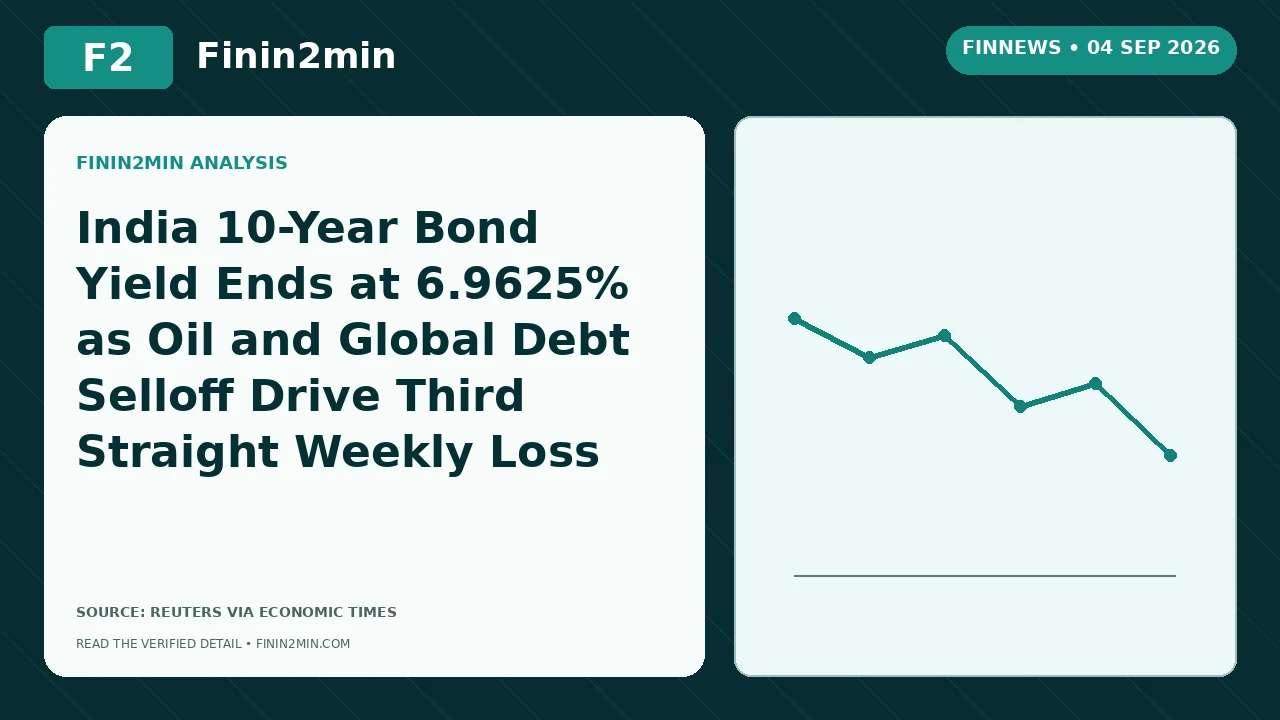
The benchmark 6.94% 2036 bond yield ended near 6.9625%, around five basis points higher for the week and roughly 20 basis points higher over three weeks.
Why it matters
Higher sovereign yields can transmit into corporate borrowing costs, valuation discount rates and bank treasury books even when banking-system cash is abundant.
Who is affected
Banks, insurers, debt mutual funds, corporate borrowers, primary dealers and fixed-income investors.
Action required
Stress-test funding plans for higher benchmark yields and track whether RBI liquidity absorption changes the short end before the long end stabilises.
Finin2min 2-minute summary
Indian government bonds weakened for a third consecutive week as expensive oil and a global sovereign-bond selloff outweighed record domestic liquidity.
**What changed:** The benchmark 6.94% 2036 bond yield ended near 6.9625%, around five basis points higher for the week and roughly 20 basis points higher over three weeks.
**Why it matters:** Higher sovereign yields can transmit into corporate borrowing costs, valuation discount rates and bank treasury books even when banking-system cash is abundant.
**Who is affected:** Banks, insurers, debt mutual funds, corporate borrowers, primary dealers and fixed-income investors.
**Action required:** Stress-test funding plans for higher benchmark yields and track whether RBI liquidity absorption changes the short end before the long end stabilises.
What happened
Indian government bonds weakened for a third consecutive week as expensive oil and a global sovereign-bond selloff outweighed record domestic liquidity. The material facts below are tied to the cited controlling source available by the research cut-off.
The key discipline is to separate **what has happened**, **what is legally or operationally final**, and **what changes the decision for an investor, CFO, tax team or compliance function**. Finin2min does not treat a headline, consultation, source-based report, intraday quote or court-news summary as equivalent to an operative statute, final regulatory instrument or completed market close.
Key verified facts
- Benchmark 6.94% 2036 yield ended around 6.9625%.
- The yield rose roughly five basis points during the week.
- It has risen about 20 basis points over the last three weeks.
- Oil and global bond-market weakness outweighed the support from excess domestic liquidity.
Finin2min analysis
- Liquidity can suppress money-market rates without guaranteeing a rally in long-duration government securities.
- Persistent oil risk raises both inflation and fiscal sensitivity for duration investors.
- Corporate treasury desks should not assume deposit liquidity automatically translates into cheap long-term debt.
For market participants, translate the headline into price, liquidity and funding channels. Index or yield moves are observations, not recommendations. Valuation, liquidity and positioning can reverse quickly when oil, rates and FX move together.
The immediate signal should also be tested against the wider system. A market move can be offset by liquidity. A liquidity operation can be outweighed by inflation. A compliance simplification can increase data-matching risk. A large financing can improve growth capacity while concentrating leverage. This second-order analysis is what turns a news item into a decision-useful finance brief.
Transmission channels to consider
1. **Cash flow and funding:** Does the development change borrowing cost, liquidity, working capital, tax cash outflow or access to capital?
2. **Valuation and market risk:** Does it alter discount rates, FX, commodity inputs, equity risk premium or balance-sheet fair values?
3. **Compliance and legal status:** Is the item final and effective, or is it still a consultation, reported proposal, source-based development or decision awaiting implementation?
4. **Operational controls:** Is a portal, form, reporting field, customer workflow, hedge process or board approval affected?
5. **Second-order exposure:** Which suppliers, customers, lenders, counterparties or foreign markets transmit the effect indirectly?
India and stakeholder lens
Banks, insurers, debt mutual funds, corporate borrowers, primary dealers and fixed-income investors. For an India-focused reader, the practical effect should be tested against domestic liquidity, the rupee, oil and imported inflation, local regulatory implementation and the company’s own balance-sheet structure. The same headline can be positive for one stakeholder and negative for another.
Where a development is global, India’s transmission usually comes through some combination of the dollar, U.S. yields, commodity prices, foreign portfolio flows, trade demand and technology/supply-chain exposure. Where it is domestic, the relevant transmission may be through compliance cost, funding availability, customer behaviour, taxation or market structure.
Accounting, finance and risk lens
Finance teams should document the controlling source, observation date, whether the item is final or developing, and the specific financial variable that would trigger a change in action. This prevents news-flow from becoming an uncontrolled assumption in forecasts or board papers.
For accounting purposes, consider whether the development can affect fair values, impairment assumptions, provisions, tax positions, liquidity forecasts, covenant headroom or going-concern sensitivities. For treasury, quantify exposure before changing a hedge. For compliance, preserve evidence of the rule, circular, order or portal acknowledgement relied upon.
What could change the view
- A later primary-source clarification, final order, circular or filing could narrow or alter the reported development.
- A sharp reversal in oil, rates, currency or risk appetite could change the financial transmission even if the underlying event remains unchanged.
- Implementation timing and transition rules can matter as much as the headline decision.
- Company-specific balance sheets, hedges, contracts and tax facts can produce a different outcome from the market average.
What to watch next
- Global sovereign yields
- India inflation expectations
- Crude oil and fiscal sensitivity
- Government borrowing mix
Finin2min Q&A
### What is the main takeaway?
Higher sovereign yields can transmit into corporate borrowing costs, valuation discount rates and bank treasury books even when banking-system cash is abundant.
### What should an investor, CFO, tax professional or compliance team do now?
Stress-test funding plans for higher benchmark yields and track whether RBI liquidity absorption changes the short end before the long end stabilises.
### What source should be checked first?
The controlling source used for this article is **Reuters via Economic Times**: https://economictimes.indiatimes.com/markets/bonds/india-bonds-slip-for-third-week-tracking-oil-global-debt-rout/articleshow/133762455.cms. Where the source itself relies on market participants or unnamed sources, that limitation is preserved rather than silently converted into an official fact.
Source and methodology
**Primary/controlling source used:** Reuters via Economic Times — https://economictimes.indiatimes.com/markets/bonds/india-bonds-slip-for-third-week-tracking-oil-global-debt-rout/articleshow/133762455.cms
**Source reference:** Reuters-syndicated India bond market close, 4 Sep 2026
**Research cut-off:** 2026-09-04 23:35 IST
Finin2min uses a primary-source-first hierarchy for law, tax and regulation; high-quality wires for live markets and proprietary reported developments; and secondary legal/business sources only where the underlying official document was not fully accessible by cut-off. Unofficial IPO GMP is excluded. Foreign cash-market values observed before the relevant market close are labelled mid-session rather than as a final close.
Disclaimer
This material is for general information and education. It is not investment, tax, legal or accounting advice. Readers should verify operative law, exchange filings, regulatory directions, certified court/tribunal orders and their own facts before acting.
Read wire report →
FinNews is educational and professional reference material, not financial, tax or legal advice. Confirm the current official position from the primary source before acting on any figure, rate, provision or deadline mentioned here.