Finin2min Weekly Brief — September 25, 2026
Weekly Finance Intelligence: markets, economy, tax, regulation and compliance | 25 Sep 2026 India finished a volatile week with a Friday rebound, but the larger financial story was the combination of expensive crude, higher sovereign yields and a dense regulatory calendar.

Weekly Finance Intelligence: markets, economy, tax, regulation and compliance | 25 Sep 2026
1. The week in 2 minutes
India finished a volatile week with a Friday rebound, but the larger financial story was the combination of expensive crude, higher sovereign yields and a dense regulatory calendar. The Nifty ended at 23,140.50, about 0.9% lower for the week, while Brent settled at $104.32 and the US 10-year Treasury yield remained above 5%.
Domestic activity data improved: the flash Composite PMI rose to 56.5, manufacturing reached 55.7 and services 55.8. At the same time, CBDT issued Notifications 120/2026 and 121/2026, SEBI's board approved a broad market-regulation package, IRDAI opened a major distribution-commission consultation, EPFO's Rs 25,000 statutory wage ceiling took effect, IFSCA updated fund and bullion frameworks, and the Government published its H2 borrowing calendar.
For the week ahead, the immediate operational focus is 30 September tax-audit reporting, the proposed 28-30 September public-sector bank strike, payroll implementation of the EPFO ceiling, the next formal instruments following SEBI's board decisions, and fresh pricing in oil, yields and GIFT Nifty after weekend geopolitical developments.
2. India markets - seventh losing week despite Friday rebound
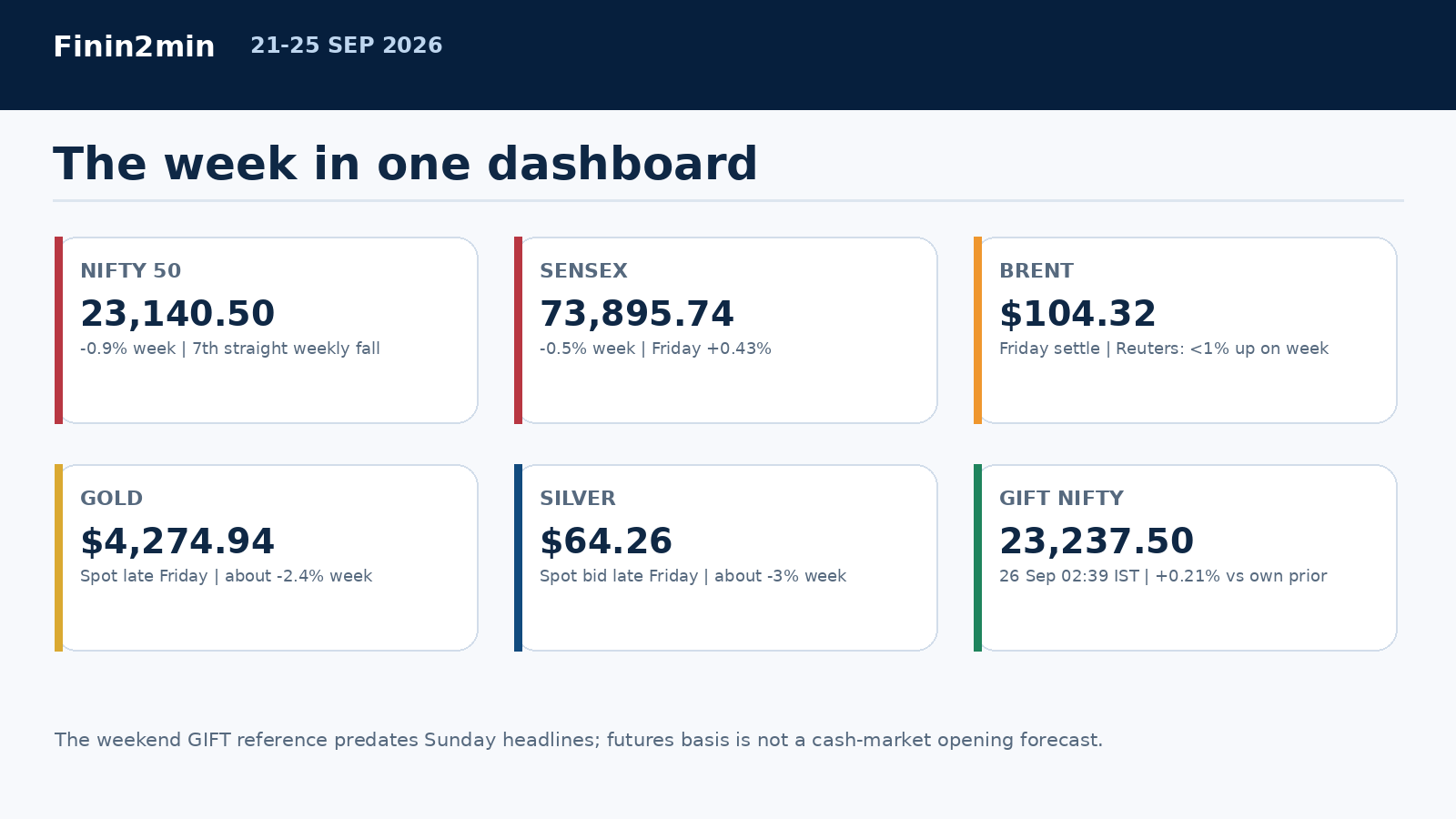
The Nifty 50 finished Friday at 23,140.50, up 0.34% on the day but down about 0.9% for the week. The Sensex closed at 73,895.74, up 0.43% Friday and down about 0.5% for the week. Reuters described this as the seventh consecutive weekly decline for both benchmarks, the longest such run in six years.
Thursday was the decisive session: Nifty fell 1.64% to 23,063.10 as oil, global yields and domestic insurance-sector concerns converged. Friday's value buying recovered only part of the decline.
Provisional cash-market arithmetic for 21-25 September shows foreign investors as net sellers of about Rs 11,490 crore and domestic institutions as net buyers of about Rs 16,398 crore. Treat these as provisional exchange data, not final custodial flow statistics or derivatives positions.

| Session | Nifty close | Daily move | Dominant driver |
|---|---|---|---|
| Mon 21 | 23,414.30 | +0.29% | Oil relief + bargain buying |
| Tue 22 | 23,329.00 | -0.36% | IT drag; crude below $100 |
| Wed 23 | 23,446.80 | +0.50% | Financials-led rebound |
| Thu 24 | 23,063.10 | -1.64% | Oil/yield shock + insurance sell-off |
| Fri 25 | 23,140.50 | +0.34% | Partial rebound |
3. Crude oil and shipping - India's largest external swing factor
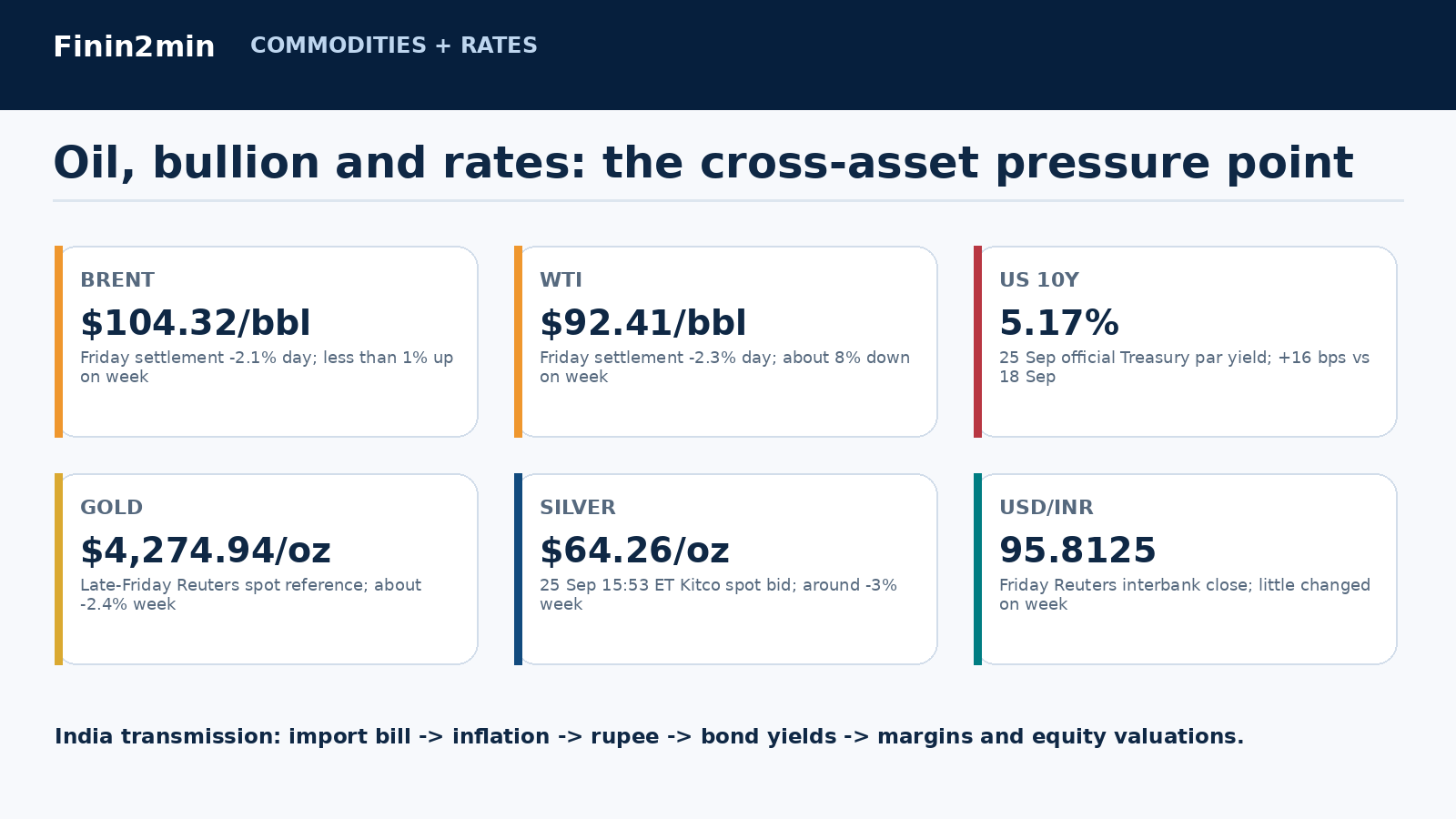
Brent settled Friday at $104.32 a barrel and WTI at $92.41, both down a little over 2% on the day. Reuters calculated Brent up less than 1% for the week while WTI fell about 8%. The weekly path was volatile: Brent traded below $100 on Tuesday, surged above $106 as supply risk returned, then eased on Friday as negotiators explored a phased US-Iran path out of war.
For India, the transmission is broader than fuel prices: crude changes the import bill, importer dollar demand, the current account, inflation expectations, sovereign yields and operating margins across aviation, paint, chemicals, tyres, logistics and other energy-intensive industries.
Weekend Reuters reporting indicated that US-Iran positions remained apart over the conditions for reopening the Strait of Hormuz. Those Sunday developments occurred after futures closed and therefore are not embedded in Friday's settlement or the last completed GIFT Nifty print.
4. Gold, silver, FX and rates - haven demand met a 5%+ yield hurdle
Spot gold was $4,274.94/oz at 11:45 a.m. ET on Friday, with Reuters putting the weekly loss at about 2.4% at that time. Silver was $64.26/oz at 15:53 ET on Kitco's spot display and ended the week lower by roughly 3%. The main headwind was the rise in US yields: the official Treasury 10-year par yield reached 5.17% on 25 September, up about 16 basis points from 18 September.
The rupee closed at 95.8125 per US dollar on Friday and was little changed on the week. Reuters attributed support to easing Friday oil prices and central-bank-linked intervention, while importer dollar demand and elevated global yields remained constraints.
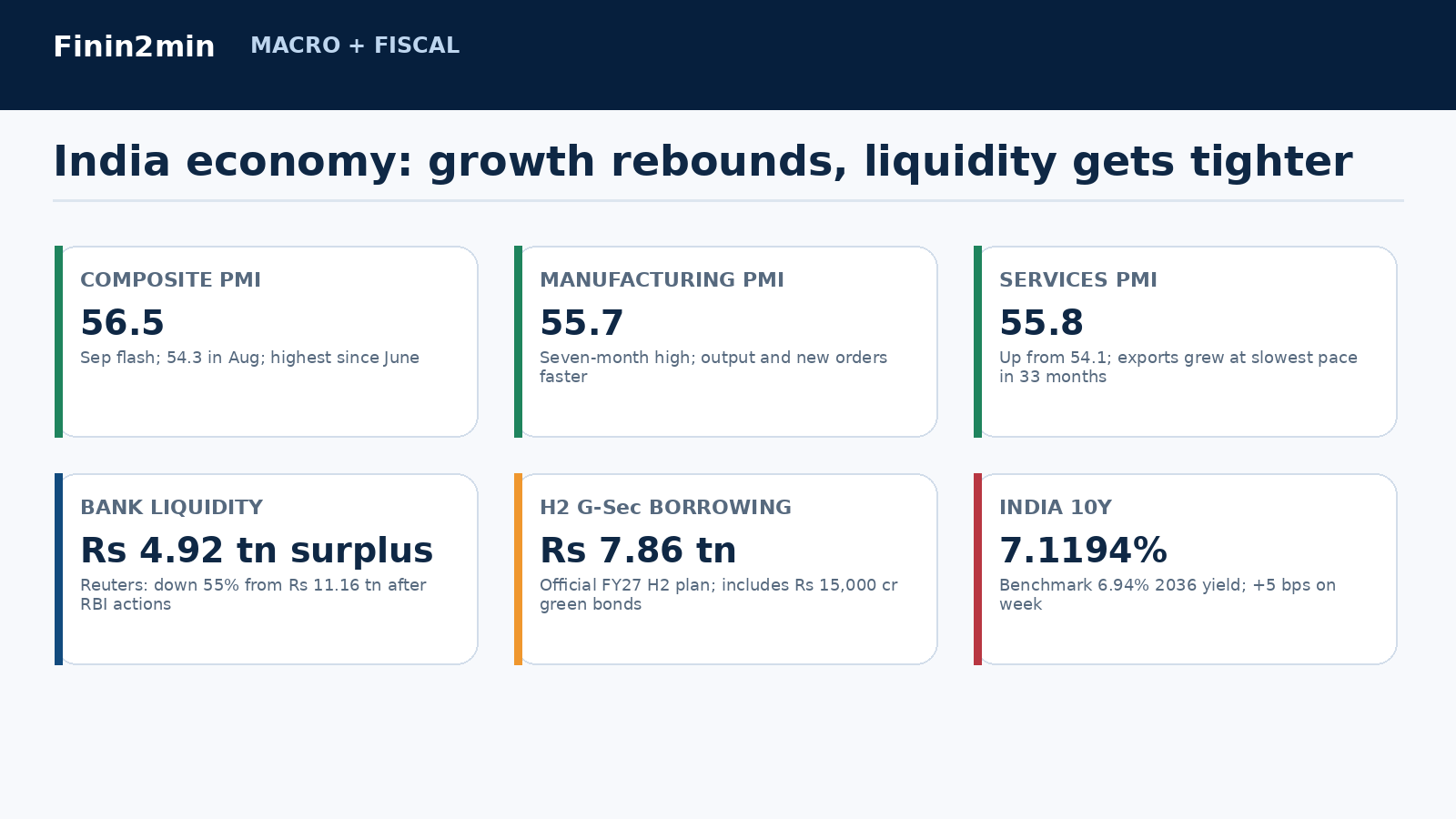
India's benchmark 6.94% 2036 government bond yield ended at 7.1194%, up 5 bps for the week. The bond market logged a sixth consecutive weekly loss, illustrating how oil and global rates can tighten domestic financial conditions even when local growth indicators improve.
5. India economy - activity rebounds while external demand stays softer
HSBC's flash India Composite PMI rose to 56.5 in September from 54.3 in August, the highest since June. Manufacturing PMI climbed to 55.7 from 52.8 and services PMI rose to 55.8 from 54.1. Readings above 50 indicate expansion.
The composition matters: output and new orders improved, input-cost inflation eased to its lowest since January and business confidence reached a four-month high. New export orders, however, grew at the slowest pace in 33 months, and the quarter's average composite reading remained below April-June.
Separately, India's infrastructure output rose 4.8% year-on-year in August. Cement and electricity were strong, while coal, crude oil, natural gas and fertiliser output contracted. That mix reinforces the need to distinguish headline growth from sector-level cost and supply pressures.
6. RBI liquidity and fiscal borrowing - the rates desk matters to every CFO
Reuters reported that banking-system surplus liquidity had fallen to Rs 4.92 trillion, down 55% from a record Rs 11.16 trillion about two weeks earlier, after RBI bond sales, FX swaps and other drains. The RBI had sold Rs 750 billion of bonds over the preceding week and banks had parked Rs 3.4 trillion through reverse repos.
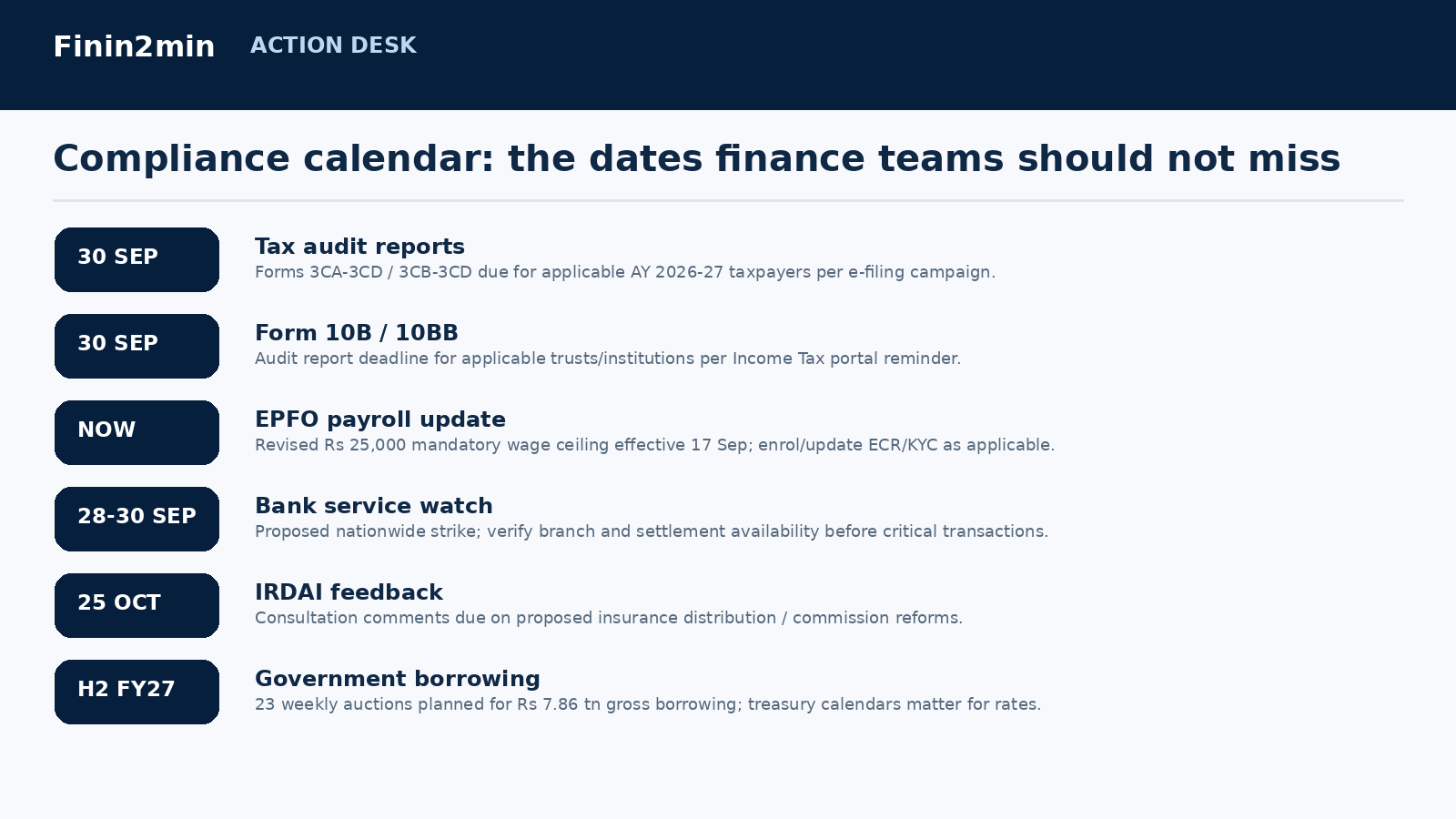
On 25 September, the Government of India announced its H2 FY2026-27 borrowing plan: Rs 7.86 trillion of gross dated-security borrowing through 23 weekly auctions, including Rs 15,000 crore of Sovereign Green Bonds. Full-year dated market borrowing is expected at Rs 15.99506 trillion versus the Budget Estimate of Rs 17.20 trillion.
The H2 maturity mix spans 3-year through 50-year securities. The government also set Q3 Treasury-bill issuance at Rs 23,000 crore per week and the H2 Ways and Means Advances limit at Rs 50,000 crore. These schedules influence the supply side of the yield curve and therefore corporate borrowing benchmarks.
7. Income tax - three changes and one urgent deadline cluster
CBDT Notification 121/2026 (24 September): the Income Tax Department says the notification extends TDS reporting requirements for non-resident property transactions and updates Forms 132 and 141. Tax teams handling cross-border immovable-property transactions should review the final notification text and transaction-specific applicability before filing.
CBDT Notification 120/2026 (24 September): the registration deadline for Registered Valuers and Authorised Income-tax Practitioners was extended to 31 March 2027, with revised Forms 169 and 171 introduced.
Notification No. 3 of 2026 (21 September) sets out the procedure for registration of reporting persons/entities and submission of Form 98 under rule 160 of the Income-tax Rules, 2026.
The e-filing portal also ran targeted reminders on 22 September that applicable Tax Audit Reports in Forms 3CA-3CD / 3CB-3CD and audit reports in Forms 10B / 10BB are due by 30 September 2026. Applicability remains taxpayer-specific; the portal reminder should not be read as making every form applicable to every assessee.
8. SEBI - a broad board-level overhaul across market regulation
At its 24 September board meeting (PR No. 59/2026), SEBI approved a package of measures spanning portfolio managers, settlement proceedings, research analysts, advertising, commodity derivatives, vault managers, REITs/InvITs, debt securities, alternative investment funds and accredited investors.
The headline items include a proposed SEBI (Portfolio Managers) Regulations, 2026 framework to supersede the 2020 regulations; a new settlement framework to replace the 2018 settlement rules; a Common Advertisement Code; wider access for FPIs in specified commodity derivatives; broader Vault Manager rules; Depository Receipts on REIT/InvIT units; changes to unitholder voting/exit mechanisms; easing around existing unlisted NCDs; and AIF/accredited-investor changes.
Status matters: a board approval or press release is not automatically the same as a legally effective regulation. Finance and compliance teams should track the subsequent Gazette notifications, regulations and circulars for commencement dates, transition rules and exact drafting before changing controls.

9. IRDAI - insurance distribution economics put under consultation
IRDAI's 23 September consultation paper proposes a major recalibration of insurance distribution. Reuters reported product- and channel-specific commission caps, lower commission levels for open-architecture channels, restrictions on compulsory bundling with loans, and a multi-year reduction in Expenses of Management limits.
Illustrative proposals reported by Reuters include 2%-5% caps for banks/lenders selling insurance with loans depending on product, health-insurance first-time distribution commissions around 15%-20% with lower renewal/porting caps, and life first-year commissions varying by policy tenor. These are consultation proposals, not final rules.
IRDAI has sought stakeholder feedback until 25 October 2026. Banks, NBFCs, insurers, brokers, web aggregators and large corporate-agent networks should model economics but avoid treating draft caps as final legal requirements until the regulator issues the final framework.
10. Labour and payroll - EPFO wage ceiling rises to Rs 25,000
The statutory wage ceiling for mandatory EPFO coverage increased from Rs 15,000 to Rs 25,000 per month with effect from 17 September 2026. PIB/EPFO says the change can bring more than 51 lakh additional employees into the mandatory social-security framework, subject to applicable scheme provisions.
Regional EPFO guidance during the week told employers to update payroll and compliance systems, enroll eligible workers in the Rs 15,000-Rs 25,000 band who were previously outside mandatory coverage, file Electronic Challan-cum-Returns on time, and complete Aadhaar/KYC processes where required.
The operational takeaway is immediate: HR, payroll, finance and compliance teams should reconcile employee populations and employer contributions from the effective date rather than waiting for year-end payroll clean-up.
11. GIFT-IFSC and bullion regulation - two updates worth tracking
IFSCA published a Regulatory Framework for differential distribution on 25 September for Venture Capital Schemes and Restricted Schemes, designed to facilitate blended-finance and other fund structures in the IFSC.
On 22 September, IFSCA also updated its consolidated circular governing import of gold or silver through the India International Bullion Exchange (IIBX). Entities involved in bullion imports should use the updated official consolidated circular for eligibility and operating conditions rather than relying on older versions.
These changes make GIFT-IFSC increasingly relevant to fund structuring and precious-metals market infrastructure, not only to derivatives trading.
12. Banking operations - proposed 28-30 September strike raises execution risk
The Finance Ministry said a three-day nationwide strike has been proposed by bank unions for 28-30 September 2026. To reduce the risk of a prolonged interruption around the preceding weekend, all Public Sector Banks and Regional Rural Banks were directed to operate normally on Sunday, 27 September, with RBI approval for branches, offices, ATM-link branches and currency chests to remain operational.
The strike remained described by the Government as proposed in the latest official communication used for this brief. Businesses with payroll, tax, treasury, vendor-payment or cash-management dependencies should verify branch and digital-service status directly with their banks before relying on time-sensitive settlement windows.
13. GST, MCA and IBC - regulatory watch
GST: no major central GST Council rate announcement was identified in the official GST Council release/newsletter archive for the 21-25 September review window. This does not remove routine return, invoice, e-way bill, e-invoice or sector-specific compliance obligations.
MCA: no material new central MCA circular was identified in the official MCA update scan for 21-25 September. Company-specific filing deadlines and previously issued rules still apply, so finance teams should not interpret the absence of a major circular as a compliance holiday.
IBC: the official IBBI circular listing available in the review continued to show the 9 September circular on due diligence by Insolvency Professionals regarding misuse of the IBC framework as the latest major circular. The practical message is heightened process due diligence, particularly around potentially fraudulent or malicious initiation.
14. Corporate governance / legal watch - Tata dispute tests board-shareholder boundaries
Reuters reported a governance dispute between Tata Sons and majority shareholder Tata Trusts involving board matters, the potential listing of Tata Sons and the exit path of the Shapoorji Pallonji Group. The facts are significant because they illustrate how shareholder rights, board duties, regulatory classification and capital-market access can collide in a large private holding company.
Different participants and governance commentators dispute the legal and governance implications. The episode is best monitored through verified filings, regulatory decisions and any court process; the competing legal and governance positions should not be treated as settled facts.
15. Global finance - US equities rose even as yields climbed
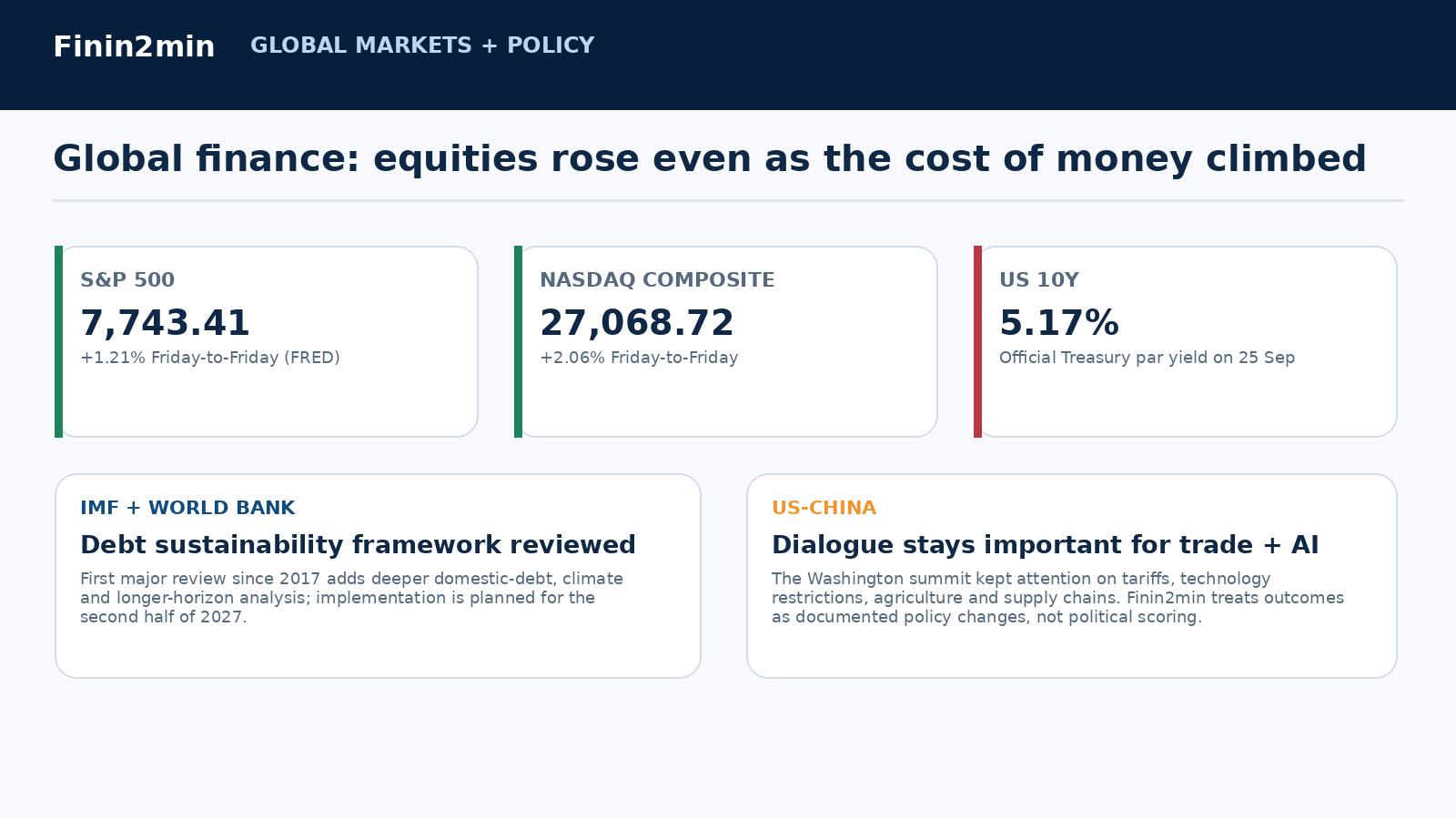
The S&P 500 ended 25 September at 7,743.41 versus 7,650.50 on 18 September, a 1.21% gain. The Nasdaq Composite ended at 27,068.72, about 2.06% above the prior Friday. Technology and AI enthusiasm therefore coexisted with a much higher discount-rate backdrop.
The US Treasury 10-year par yield rose to 5.17% on 25 September from 5.01% a week earlier. For global portfolios and corporate finance, that move matters because it influences dollar funding, emerging-market flows, equity discount rates and the relative attraction of non-yielding assets such as bullion.
The IMF and World Bank also reviewed their joint Debt Sustainability Framework for Low-Income Countries, the first major review since 2017. The revised framework is intended to incorporate deeper domestic-debt analysis, long-term challenges such as climate change, improved forecasting and better transparency, with implementation planned for the second half of 2027.
16. US-China and Middle East - policy events remain financial variables
US-China discussions during President Xi Jinping's 23-25 September US visit kept trade, AI, agricultural purchases, technology restrictions and broader strategic stability in focus. Verified policy announcements should be separated from political commentary or claims about who 'won' a summit.
In the Middle East, shipping through the Strait of Hormuz remained a key financial variable. Reuters reported materially lower vessel traffic than pre-war norms during the week. Any confirmed change in access, insurance premiums, freight rates or export routing can quickly transmit to oil, inflation and emerging-market risk pricing.
17. GIFT Nifty and the Monday setup - latest completed reference only
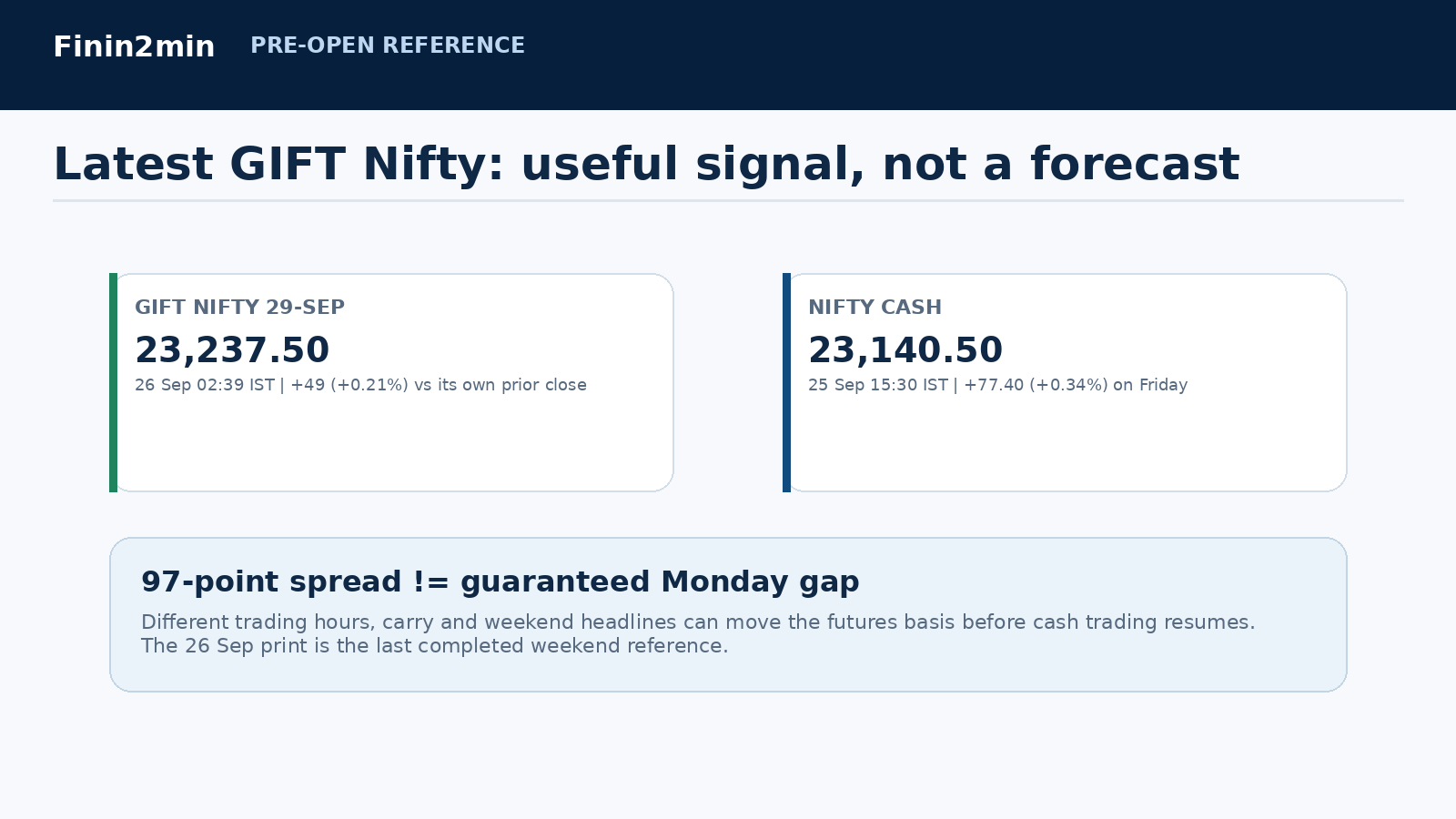
NSE's own website showed GIFT Nifty 29-Sep futures at 23,237.50, up 49 points (+0.21%) at 26 September 02:39 IST. That was the last completed weekend reference as of 26 September 02:39 IST and stood about 97 points above Friday's Nifty cash close.
The 97-point difference is a futures basis comparison, not a guaranteed Monday cash opening. GIFT trades different hours and the next session can reprice new weekend information before the NSE cash market opens.
NSE IX also reported record GIFT Nifty activity on 25 September, including $23.67 billion of single-day turnover and 512,023 contracts, highlighting the contract's growing role in global price discovery for Indian equities.
18. Finance and compliance action checklist
- Tax: confirm whether the 30 September audit-report deadlines apply; complete portal validation and DSC/EVC readiness early.
- Cross-border property/TDS: review Notification 121/2026 and revised Forms 132/141 before processing affected non-resident property transactions.
- Valuation/tax practice: map Notification 120/2026 to registration renewal/workflow changes and the 31 March 2027 deadline.
- Securities: inventory policies potentially affected by SEBI's 24 September board decisions, but wait for final legal instruments before treating approvals as effective rules.
- Insurance: quantify exposure to draft distribution caps and EoM changes; prepare IRDAI consultation feedback by 25 October if relevant.
- Payroll: identify newly covered employees under the Rs 25,000 EPFO wage ceiling, reconcile contributions from the effective date and validate ECR/KYC processes.
- Treasury: stress-test oil above $100, USD/INR around current levels and higher sovereign yields in working-capital and funding plans.
- Banking operations: verify service availability for 28-30 September and bring forward critical tax, payroll, treasury or vendor settlements where operationally sensible.
- GIFT/IFSC: review 25 September differential-distribution framework and 22 September bullion circular if operating in IFSC funds or precious metals.
- Controls: preserve timestamp discipline - close, settlement, overnight futures and weekend headlines should never be mixed in the same 'live' number.
19. Risk transmission map - what to watch next
Four conditions can change the next week's finance picture. They are monitoring triggers, not forecasts or probability assignments.
20. Source discipline and status labels
Core publication sources are Reuters and primary/official institutions: Income Tax Department, SEBI, PIB/EPFO, IFSCA, Government of India/PIB, NSE/NSE IX, US Treasury, Federal Reserve Bank of St. Louis (FRED), Nasdaq, IMF/World Bank, IBBI and GST Council.
Every item is labelled by status where it matters: final market close vs intraday quote; provisional institutional flows; consultation proposal vs final rule; SEBI board approval vs Gazette commencement; Friday settlement vs Sunday geopolitical development; and futures basis vs cash-market prediction.
Disclaimer: This newsletter is educational and informational only. It is not investment, legal, tax or accounting advice. Readers should verify applicability of laws, forms and deadlines to their specific facts and use the latest official notification/circular before acting.
FinNews is educational and professional reference material, not financial, tax or legal advice. Confirm the current official position from the primary source before acting on any figure, rate, provision or deadline mentioned here.