Finin2min Daily Brief | 30 September 2026
Quarter-end pressure: India equities slide, oil stays elevated, rupee steadies and compliance dates move to centre stage
30 September 2026
Quarter-end pressure: India equities slide, oil stays elevated, rupee steadies and compliance dates move to centre stage
Data cut: 1 October 2026, 01:20 IST2-Minute Summary
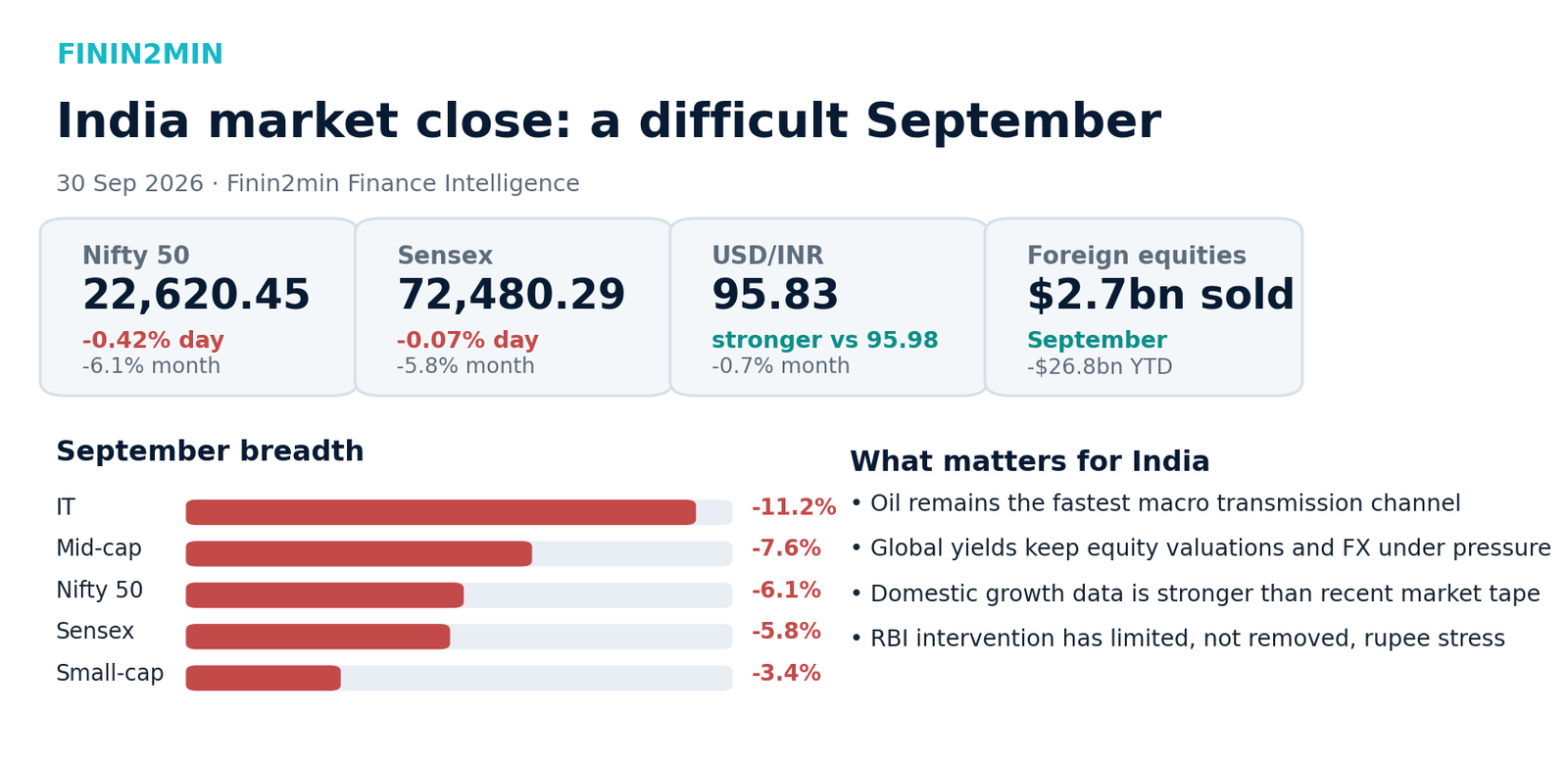
- Nifty 50 closed at 22,620.45 (-0.42%) and Sensex at 72,480.29 (-0.07%). September was much weaker: Nifty -6.1%, Sensex -5.8%, with IT down 11.2% and foreign investors selling about US$2.7 billion of Indian shares during the month.
- The rupee closed at 95.83/$, firmer than 95.98 in the prior session, but still lost 0.7% in September and 1.2% in Q3 as high oil and global yields weighed on India.
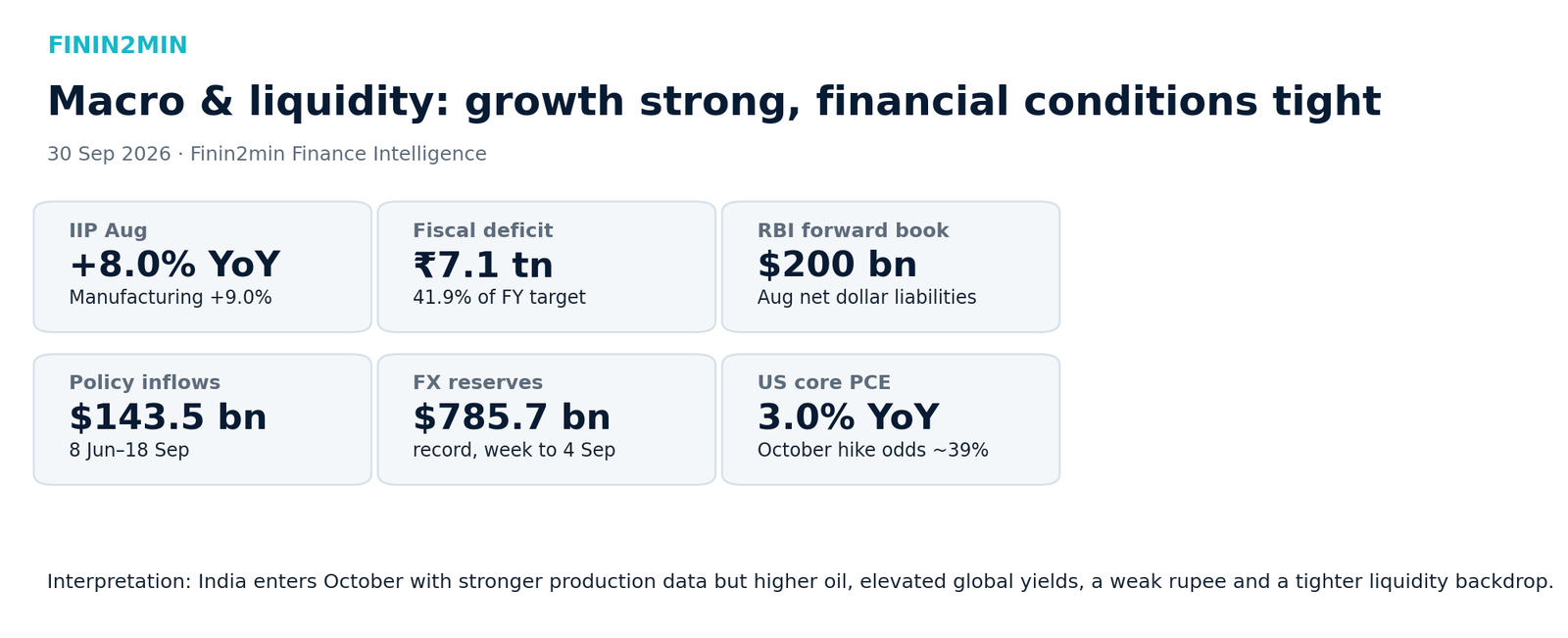
- Oil stayed elevated: expiring November Brent settled at US$103.50/bbl, more-active December Brent was US$98.03, and WTI settled at US$90.42. Brent gained roughly 14% in September.
- Spot gold was US$4,152.86/oz (-0.7%) and spot silver US$60.18/oz (-2.1%) in Reuters’ late-US update. Gold fell 6.6% in September as higher yields and the dollar offset safe-haven demand.
- GIFT Nifty October futures were 22,635.50 at 01:01:18 IST on 1 October in the referenced global feed. That is a timestamped futures signal, not a guaranteed cash-opening level.
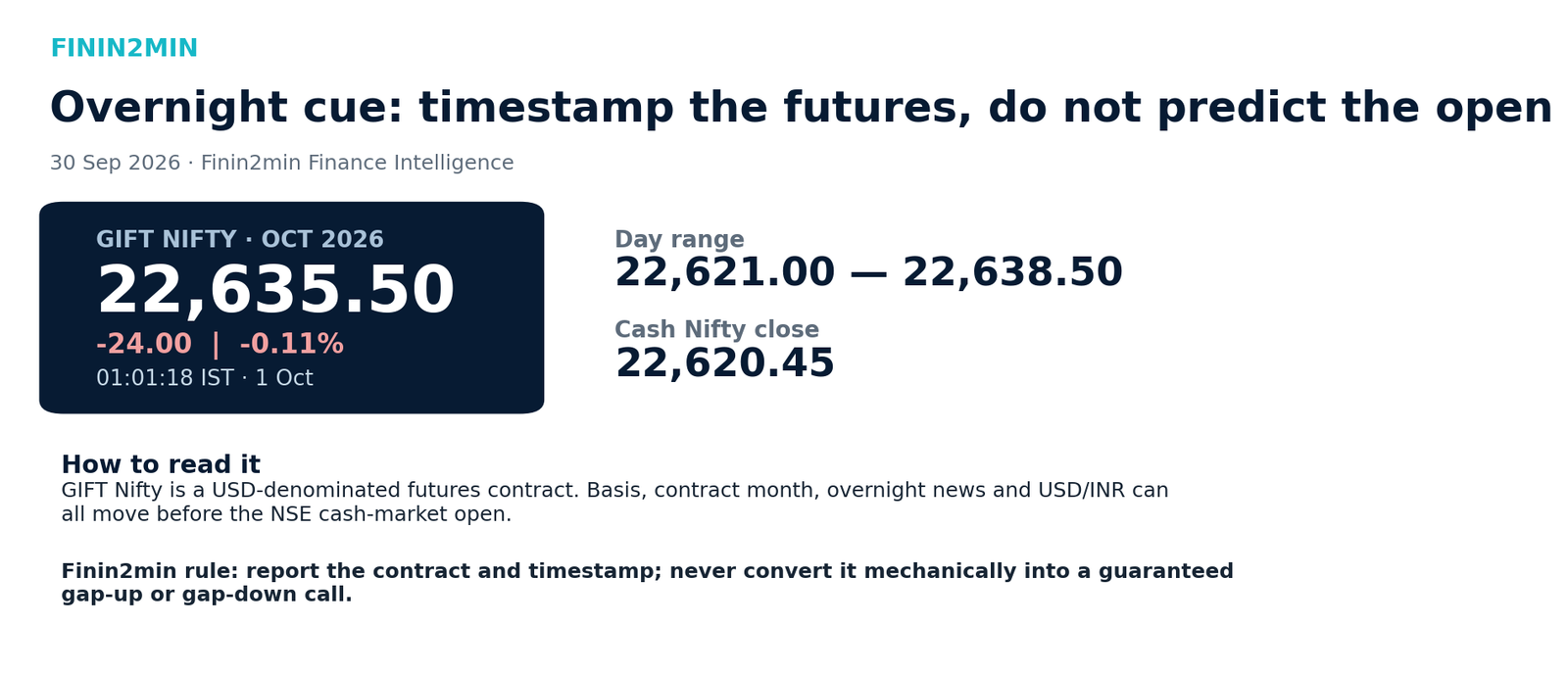
- August IIP grew 8.0% YoY, while the April-August fiscal deficit reached ₹7.1 trillion, or 41.9% of the full-year target. Real-economy data is stronger than the recent equity tape, but the energy/rates shock remains a headwind.
- RBI net forward dollar liabilities reached a record US$200 billion in August. The same balance-of-payments measures that lifted FX reserves also created a larger forward book and tighter rupee liquidity.
- For the covered AY 2026-27 audit category, the tax-audit report date is 21 October 2026 and the related return due date is 21 November 2026. IFSCA also posted a 30 September circular extending its CMI certification-course timeline.
Market Dashboard
| Indicator | Level | Move | Timestamp / status |
|---|---|---|---|
| Nifty 50 | 22,620.45 | -0.42% | 30 Sep cash close |
| Sensex | 72,480.29 | -0.07% | 30 Sep cash close |
| USD/INR | 95.83 | rupee +0.16% vs prior close | 30 Sep close |
| GIFT Nifty Oct-26 | 22,635.50 | -0.11% | 1 Oct 01:01:18 IST |
| Brent Nov-26 | US$103.50/bbl | +0.9% | 30 Sep settlement; expiring contract |
| Brent Dec-26 | US$98.03/bbl | +1.9% | 30 Sep active-contract update |
| WTI | US$90.42/bbl | +1.2% | 30 Sep settlement |
| Spot gold | US$4,152.86/oz | -0.7% | 30 Sep 17:40 GMT / 23:10 IST |
| US gold futures | US$4,186.70/oz | +0.2% | 30 Sep settlement |
| Spot silver | US$60.18/oz | -2.1% | 30 Sep late US update |
India closes the month under pressure
What changed
Nifty 50 ended at 22,620.45, down 95.75 points or 0.42%, while Sensex closed at 72,480.29, down 48.78 points or 0.07%. The day looks mild; the month does not. Nifty fell 6.1% in September and Sensex 5.8%, their steepest monthly decline since March.
Breadth and leadership
All 16 major sectors tracked by Reuters were lower for September. IT was the largest sectoral drag at about -11.2%; mid-caps fell 7.6% and small-caps 3.4%. Foreign investors sold roughly US$2.7 billion of Indian equities in September, taking 2026 outflows to about US$26.8 billion.
Why it matters
The market is pricing an uncomfortable combination: imported energy inflation, higher global discount rates, a weak currency and persistent foreign selling. Strong domestic production data helps the earnings backdrop, but does not neutralise these cross-asset pressures.
Rupee, bonds and RBI liquidity
Rupee
USD/INR closed at 95.83, firmer than 95.98 in the previous session. Even after the day’s recovery, the rupee lost 0.7% in September and 1.2% in Q3. RBI dollar sales and broader policy tools have helped prevent a retest of the prior 96.96 record low.
RBI forward book
RBI’s net forward dollar liabilities rose to a record US$200 billion in August, up about US$63 billion month-on-month. Temporary balance-of-payments measures drew US$143.5 billion between 8 June and 18 September, with almost US$133 billion via foreign-currency deposits. FX reserves reached a record US$785.7 billion in the week ended 4 September.
Treasury implication
The forward book is not the same as an immediate reserve loss, but it changes the maturity and liquidity profile of RBI’s FX operations. Reuters reported sell/buy swaps are being used to bring forward maturities and drain surplus rupee liquidity; treasury teams should watch forward premia, liquidity and RBI operations together.
Crude oil: the contract detail matters
Latest
The November Brent contract, which expired on 30 September, settled at US$103.50/bbl (+0.9%). The more-active December Brent contract was US$98.03 (+1.9%). WTI settled at US$90.42 (+1.2%). Brent rose about 14% in September; WTI about 5%.
Drivers
Stalled US-Iran talks and tight US fuel inventories supported prices. Gasoline and distillate stocks fell even as crude inventories rose, while OPEC+ sources told Reuters the group was likely to keep November production targets steady.
India lens
For India, sustained oil above recent averages affects the trade deficit, rupee, inflation expectations, aviation/paint/chemical/transport margins and the policy-rate debate. Use the more-active Brent contract for forward monitoring after expiry rather than carrying the expiring US$103.50 quote into October.
Gold, silver and US inflation
Bullion
Spot gold was US$4,152.86/oz (-0.7%) at 17:40 GMT / 23:10 IST; US gold futures settled at US$4,186.70 (+0.2%). Spot silver fell 2.1% to US$60.18. Gold was down 6.6% for September.
Macro driver
August US headline PCE inflation rose 3.4% YoY, below the 3.7% Reuters poll estimate; core PCE was 3.0% YoY in the data cited by Reuters. Market pricing for an October Fed hike fell to roughly 39%, but long-dated yields remained elevated and oil kept inflation risk alive.
How to read metals
Gold is receiving geopolitical and inflation-hedge demand, but high nominal/real yields and a firm dollar raise the opportunity cost of holding non-yielding assets. Silver adds industrial-demand sensitivity, so it can diverge sharply from gold during risk repricing.
GIFT Nifty: latest overnight reference
Timestamped futures cue
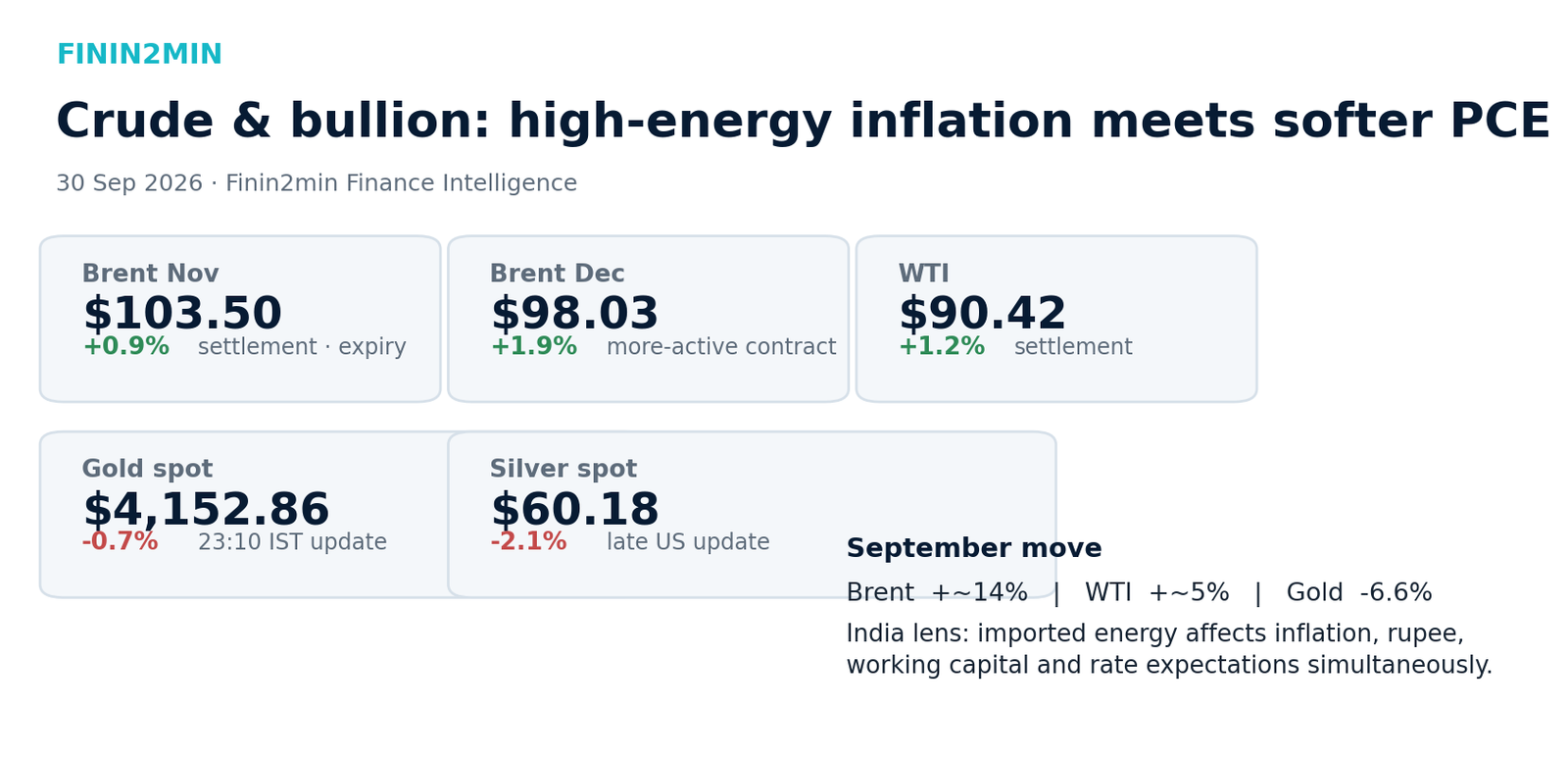
GIFT Nifty October 2026 futures were 22,635.50 at 01:01:18 IST on 1 October, down 24 points or 0.11%, with a displayed range of 22,621.00–22,638.50.
What it does not mean
It does not guarantee a 15-point positive cash-market gap versus the Nifty close. Futures basis, the USD-denominated contract, overnight headlines, Asian trading and the NSE pre-open can all change the relationship.
Practical use
Use GIFT Nifty as one input alongside Brent, US yields, USD/INR, Asian equities and domestic news. The signal is most useful when the contract month and timestamp are stated explicitly.
India economy: production strong, fiscal use rises
IIP
India’s August IIP rose 8.0% YoY. Manufacturing grew 9.0% and electricity & gas supply 12.3%, while mining declined 5.6%. The manufacturing momentum shows the real-economy picture is not as weak as the equity correction alone might suggest.
Fiscal deficit
The Union government’s April-August fiscal deficit was ₹7.1 trillion, equal to 41.9% of the FY2026-27 target, compared with ₹6.0 trillion in the year-earlier period. Finance teams should track the spending/revenue mix, borrowing calendar and bond-yield response rather than reading the percentage in isolation.
Rates link
Higher global yields and expensive oil can still lift India’s funding costs even with strong industrial activity. The upcoming RBI policy decision therefore matters across FX, bonds, bank funding and corporate borrowing.
Corporate finance pulse
Reliance bond sale
Reliance Industries completed a ₹130 billion (about US$1.35 billion) 10-year rupee bond issue at a 7.90% coupon. Reuters reported SBI bought nearly ₹50 billion, roughly 40% of the issue. The bonds were rated AAA by Crisil and CareEdge.
What it signals
Large high-grade issuers are using the domestic bond market to lock funding ahead of possible tighter monetary conditions. Banks, insurers and pension investors continue to value scarce long-duration, high-quality paper.
CFO lens
For borrowers, compare all-in bond cost with bank/MCLR-linked funding, hedge costs on foreign borrowing and refinancing concentration. A headline coupon is not the same as the issuer’s full economic funding cost.
Tax, legal and compliance desk
Direct tax — high priority
CBDT extended the specified date for furnishing the audit report for the covered AY 2026-27 category from 30 September to 21 October 2026. The related return-of-income due date moves from 31 October to 21 November 2026. The Income Tax portal lists Circular No. 07/2026 dated 28 September 2026 for the extension.
GST calendar
For ordinary monthly filers, the GST portal states GSTR-1 is generally due on the 11th of the succeeding month and GSTR-3B on the 20th. October due dates should still be checked for taxpayer category, QRMP status and any specific extension.
SEBI
SEBI’s general legal listing shows the 28 September Master Circular for Debenture Trustees as the latest broad circular at the data cut. Its 30 September docket contains multiple enforcement orders, including a final order in the matter of Eqwires Research Analyst. Compliance teams should distinguish case-specific orders from generally applicable circulars.
IFSCA
IFSCA posted a circular on 30 September extending the timeline for completion of the prescribed certification course by KMPs and other employees of Capital Market Intermediaries under the CMI Regulations, 2025. Affected IFSC entities should use the operative circular rather than the earlier 30 September deadline.
Banking operations
The proposed 28–30 September bank strike was deferred after IBA-UFBU minutes were signed. A high-level committee is to examine the remaining-Saturdays / five-day-banking issue. Five-day banking should not be treated as implemented merely because the strike was deferred.
What finance users should watch on 1 October
Markets
Active December Brent, US Treasury yields, the dollar, Asian risk sentiment, GIFT Nifty into the morning session and USD/INR. Watch whether India breadth stabilises after the September drawdown.
Macro / policy
Any fresh RBI communication ahead of policy, liquidity operations around quarter-end, the government borrowing calendar and follow-through from the US inflation data.
Compliance
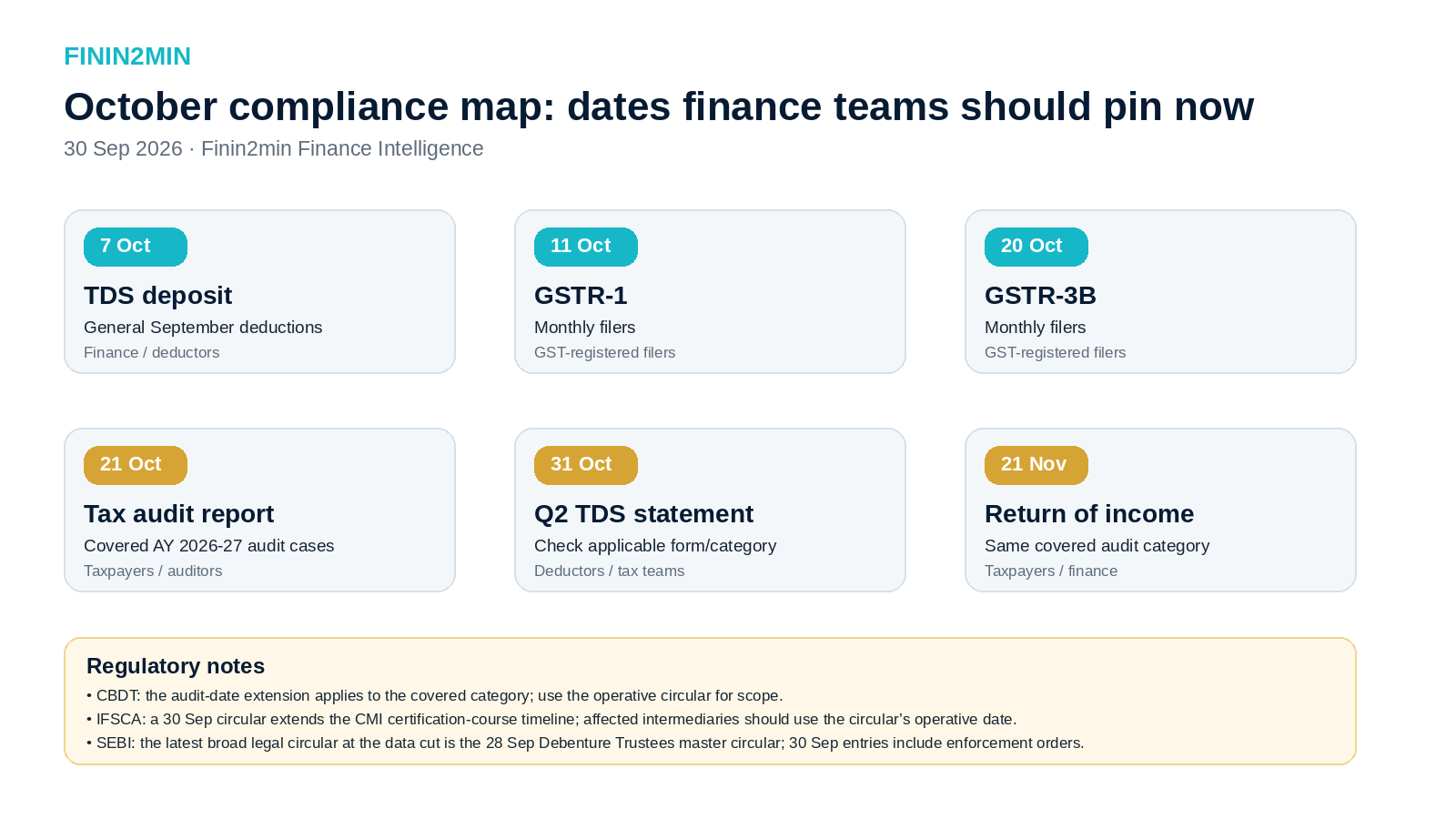
Tax-audit workplans should now target 21 October with a buffer, not the legal deadline itself. GST/TDS calendars should be reconciled immediately at the start of October; IFSC CMIs should read the 30 September IFSCA extension circular before closing their certification-compliance tracker.
Compliance Calendar
| Date | Obligation / event | Who should care | Status / note |
|---|---|---|---|
| 07 Oct 2026 | TDS deposit for September deductions (general non-government monthly rule; challan-statement cases differ) | Deductors / finance teams | Standard rule; verify entity-specific exceptions |
| 11 Oct 2026 | GSTR-1 for September for monthly filers | GST-registered monthly filers | Standard due date unless specifically extended |
| 15 Oct 2026 | Internal month-end payroll / statutory reconciliation checkpoint | Payroll / finance | Use entity/state-specific statutory calendar |
| 20 Oct 2026 | GSTR-3B for September for monthly filers | GST-registered monthly filers | Standard due date unless specifically extended |
| 21 Oct 2026 | Tax-audit report for covered AY 2026-27 audit cases | Taxpayers / auditors | Extended from 30 Sep 2026 |
| 31 Oct 2026 | Q2 TDS statement — check applicable form/category | Deductors / tax teams | Confirm form-specific applicability before filing |
| 21 Nov 2026 | Return of income for same covered audit category | Taxpayers / finance teams | Extended from 31 Oct 2026 |
Primary and market sources
- Reuters — India benchmark shares log worst month since March as oil, global rate hikes spark outflows
- Reuters — Rupee lingers around bottom of Asia FX pile as global headwinds deepen
- Reuters — Oil prices rise by about $1/bbl on stalled US-Iran talks and tight fuel markets
- Reuters — Gold falls despite cooler inflation data, monthly loss in sight
- Reuters — S&P 500, Nasdaq climb as soft inflation dampens Fed rate hike expectations
- Reuters — India RBI's FX forward book tipped to shrink after touching $200 billion
- Reuters — State Bank of India buys nearly 40% of Reliance's $1.35 billion debt sale
- Reuters / Government data — India's April-August fiscal deficit at 42% of 2026/27 target
- PIB / MoSPI — Quick Estimates of IIP for August 2026
- PIB / CBDT — CBDT extends due date for AY 2026-27 audit cases
- Income Tax Department — Portal latest news / Circular 07/2026
- SEBI — SEBI legal and enforcement listings
- IFSCA — Extension of timeline for CMI certification course
- GST Portal — GSTR-1 user guide
- GST Portal — Welcome kit for taxpayers
- Income Tax Department — Tax Payments help
- Investing.com global market feed — GIFT Nifty 50 Futures - Oct 26
- UFBU/BEFI circular reproduced publicly — UFBU Circular 58/2026 / minutes with IBA
Disclaimer: General information and education only; not investment, trading, tax, legal or accounting advice. Prices can change rapidly. Verify applicable law and primary-source text before action.
FinNews is educational and professional reference material, not financial, tax or legal advice. Confirm the current official position from the primary source before acting on any figure, rate, provision or deadline mentioned here.